http://www.scirp.org/journal/jmf ISSN Online: 2162-2442
ISSN Print: 2162-2434
A Comparison Study of ADI and LOD Methods
on Option Pricing Models
Neda Bagheri
1, Hassan Karnameh Haghighi
21Faculty of Mathematical and Finance, Sheikhbahaee University, Isfahan, Iran 2Faculty of Management, Sheikhbahaee University, Isfahan, Iran
Abstract
This paper will focus on pricing options in marketing with two basic assets with risk and one basic asset without risk. In so doing, the Black-Scholes model and the European options which is applicable at the due date were used. By investigating the European option to find the proper price, it is ne-cessary to solve an equation with partial derivatives which has two spatial va-riables. The finite differences will be used for such equations. Finite differenc-es for one dimensional equations commonly ends in a three diagonal set which will be solved by calculation costs O(n) in which n is the number of discrete points. But here, since the problems are two dimensional, the Alter-nating Direction Implicit (ADI) and Locally One-Dimensional (LOD) are used to reduce the calculation costs. The open cost is at the level of discrete points and this is the advantage of these methods. Moreover, these methods enjoy acceptable stability. Though ADI and LOD are equal and easy in calcu-lations, evaluating these methods in pricing the option indicates that the ADI method is sensitive to discontinuity or non-derivation which is the common property of income function; therefore, this thesis proposes the LOD method.
Keywords
Black-Scholes Equation, ADI, LOD, Option Pricing, Finite Difference Method
1. Introduction
Imagine than an option contract for two underlying assets with the present pric-es of x and y and the future prices of X1 and X1 at the maturity time of T has
been signed. If the volatility of the first and second assets are shown by σ σ1, 2 and the ρ is the correlation coefficient between the prices of the two underly-ing assets and r is interest rate, then u x y T
(
, ,)
is the this contract price in the following equation which is called the two dimensional Black-Scholes equation. How to cite this paper: Bagheri, N. andHaghighi, H.K. (2017) A Comparison Stu- dy of ADI and LOD Methods on Option Pricing Models. Journal of Mathematical Finance, 7, 275-290.
https://doi.org/10.4236/jmf.2017.72014
Received: January 18, 2017 Accepted: May 9, 2017 Published: May 15, 2017
Copyright © 2017 by authors and Scientific Research Publishing Inc. This work is licensed under the Creative Commons Attribution International License (CC BY 4.0).
http://creativecommons.org/licenses/by/4.0/
2 2 2 2
2 2 2
1 2 1 2 1 2
1 1 1
2 2 2
.
u u u u
xy y
x
t x y x y
u u
rx ry ru
x y
ρ
σ σ σ σ
∂ = ∂ + ∂ + ∂
∂ ∂ ∂ ∂ ∂
∂ ∂
+ + −
∂ ∂
(1)
where
(
x y t, ,)
∈ Ω ×(
0,T]
and u=u x y t(
, ,)
is the three-variate u function. One of the variables is t and the other two variables are the spatial variables. By the two dimensional Black-Scholes equation we mean that there are two special variables in this equation. Although pricing options problems are defined in an infinite set such as:(
0,T]
{
(
x y t, ,) (
| x y,)
,t(
0,T]
}
Ω × = ∈ Ω ∈
To use numerical methods, a limited range will be considered. Therefore, Eq-uation (1) will be considered on a finite range where M and L are selected so large that the error in the u price become negligible [1]. Boundary conditions are necessary to solve the above equation. Various forms of boundary conditions can be artificially added to the problem. This conditions are:
(1) linear boundary conditions
(
)
2
2 0, , 0, 0 , 0,
u
y t y M t
x
∂ = ≤ ≤ ≥
∂
(
)
2
2 , , 0, 0 , 0,
u
L y t y M t
x
∂ = ≤ ≤ ≥
∂
(
)
2
2 , 0, 0, 0 , 0,
u
x t x L t
y
∂ = ≤ ≤ ≥
∂
(
)
2
2 , , 0, 0 , 0.
u
x M t x L t
y
∂
= ≤ ≤ ≥
∂
(2) Dirichlet boundary conditions
(
, 0,)
( )
, 0 , 0 , 0,u x t = Λ x ≤ ≤x L t≥
(
, ,)
(
,)
, 0 , 0,u x M t = Λ x M ≤ ≤x L t≥
(
0, ,)
( )
0, , 0 , 0,u y t = Λ y ≤ ≤y M t≥
(
, ,)
(
,)
, 0 , 0.u L y t = Λ L y ≤ ≤y M t≥
The third condition is Neumann boundary condition which is not used in the present thesis. A combination of the first and the second condition might also be used [2].
2. Weight Methods for the Two Dimensional Black-Scholes
Equation
( )
( )
(
)
( )
( )(
)
( )
(
)
2 2
2 1, , 1, 2 , 1 , , 1
1 2
2 2
1, 1 , 1 1, , 1 2
1, 1, , 1 , 1
, 2 2 , 2 2 . 2 2
n n n n n n
i j i j i j i j i j i j
n ij
n n n n
i j i j i j i j
n n n n
i j i j i j i j n
i j
u u u u u u
Lu i x j y
x y
u u u u
i x j y
x y
u u u u
r i x r j y ru
x y σ σ ρσ σ + − + − + + + + + − + − − + − + = ∆ + ∆ ∆ ∆ − + + + ∆ ∆ ∆ ∆ − − + ∆ + ∆ − ∆ ∆ (2)
The explicit method is as follows 1
, n n ij ij n
ij u u Lu t + − =
∆ (3) And the implicit method is as follows
1
, , 1
, . n n
i j i j n i j u u Lu t + + − = ∆
In general form, CrankNicolson method is as follows
(
)
1
, , 1
, ,
1 n n
i j i j n n i j i j
u u
Lu Lu
t
θ
θ
+
+ −
= − +
∆
There is no need to solve the set in the explicit method since
1 ,
n n n
ij ij ij
u+ =u + ∆tLu
However, the explicit method has conditional stability and its stability domain is much smaller than the one dimensional mode. In fact, as the number of di-mensions increase, the stability domain of the explicit method become smaller. The implicit method is stable and need to solve the linear equation set.
1
, , 1
, . n n
i j i j n i j u u Lu t + + − = ∆
The dimensions of this set equals the numbers of points in the net. Since in the two dimensional mode the number of points is twice the number of points in the one dimensional mode; therefore, we have a large set of Nx,Ny dimensions
which is too expensive to solve. The same can be found in Crank Nicolson me-thod for 0≤ ≤θ 1 Therefore these methods are not recommended. ADI and
LOD methods will be proposed in the next section. These methods are both un-conditionally stable and have low computational costs. In these methods, by de-composing the L operator to two x and y operators at each step, a number of three diagonal sets with Nx or Ny dimension will be solved to be able to go
to the next step [4].
3. ADI Method for the Two-Dimensional Black-Scholes
Model
To obtain the Alternating Direction Implicit (ADI), the time derivation will be estimated as,
1 1 1 1
1 1
1 2 2 2 2
, , , , , , , , , ,
.
n n n n
n n n n
n n
i j i j ui j ui j ui j ui j ui j ui j ui j ui j
u u u
t t t t t
+ + + +
+ +
+ − − + − − −
∂ ≅ = = +
In fact, we added and subtracted one intermediate step 1 2 n
t
+ and divided the time derivation into two parts. Now, by the using the LOD of L, we try to find the following equation to solve the equation.
1 1
1 2 2 1
, , , , 2 1.
n n
n n
n
i j i j i j i j n x i y i
u u u u
L u L u
t t + + + + + − − + = +
∆ ∆ (5)
We will explain the way of obtaining the above mentioned equation in the following. To get from −n to − +
(
n 1)
in ADI method, we first solve1
1 2
, , 2
, n n
n i j i j
x i j
u u L u t + + − =
∆ (6) For j=1,,Ny, and every one of them is a three diagonal set from the Nx
dimension. By this action, the values of u will be obtained in 1
2
n+ stage. Then,
to obtain u in
(
n+1)
phase, we solve 11 2
, , 1
, n
n
i j i j n y i j
u u L u t + + + − =
∆ (7) For i=1,,Nx every one of them is a set from the Ny dimension.
Refer-ring to the above explanations and consideRefer-ring the fact that solving three di-agonal sets has O N
( )
cost, we conclude that getting from −n to − +(
n 1)
step equals the rank of the number of network points.( )
( ) (
)
y x x y x y
N O N +N O N =O N N
This is the least possible calculation cost. Now, we explain how we can obtain x
L and Ly and equation sets. First, the time step of t tn, n+1 is divided into the two steps of 1
2 , n n t t +
and 12 1 , n n
t+ t+
. in the first time step, the derivations should be implicitly estimated in relation to x and the derivations will be expli-citly estimated in relation to y variable. In other words, we write
(
∆ = ∆ =x y h)
1 1 1 1
2 2
2 2 2 2
, , 1 2 1, , 1, 2 2 , 1 , , 1
2 2
1, 1 1, 1 1, 1 1, 1
1 2 2
1 1
1
2 2
1, , , 1 , 2
,
2 2
1 2 2
2
1
2 4
.
n n n n
n n n n
i j i j i j i j i j i j i j i j
i j
n n n n
i j i j i j i j
i j
n n
n n
n
i j i j i j i j
i j i j
u u u u u u u u
x y
h h
t
u u u u
x y
h
u u u u
rx ry ru
h h σ σ ρσ σ + + + + + − + − + + − − + − − + + + + + + − − + − + = + ∆ + − − + − − + + − (8)
In the second time step, i.e. in 1 1 2
, n n
t+ t+
1 1 1 1
1 2 2 2 2 2 2 1 1 1
, , 1 2 1, , 1, 2 2 , 1 , , 1
2 2
1 1 1 1
2 2 2 2
1, 1 1, 1 1, 1 1, 1
1 2 2
1 1
2 2
1, , , 1
2 2
1 2 2
2
1
2 4
n n n n
n n n n
i j i j i j i j i j i j i j i j
i j
n n n n
i j i j i j i j i j
n n
n i j i j i j
i j
u u u u u u u u
x y
h h
t
u u u u
x y
h
u u u
rx ry h σ σ ρσ σ + + + + + + + + + − + − + + + + + + − − + − − + + + + + − − + − + = + ∆ + − − + −
+ + , 1
, 1
. n
i j n i j u ru h + − + − (9)
In the above equations, the derivation of 2u
x y
∂
∂ ∂ is explicitly written and y in the last sentence is implicitly written. Now, if we multiply the two sides of the Equation (8) by 1
2 and defne the left side with
1 2 , n x i j
L u + , also if we multiply the
two sides of the Equation (9) by 1
2 define the left side with
1 ,
n y i j
L u + , we get the
(8) and (9) equations. Now, if j is constant in (8)) equation and transfer the value in 1
2
n+ step to the left, the unknown values are.
1 1 1
2 2 2
, , 1, , 1, n n n i j i j i j
u+ u−+ u++
In the present equations, the coefficient 1 2 1, n i j
u−+ is
2 2 1 2 4 i i t x h
σ
α
= − ∆
And cofficient 12 , n i j
u + is
2 2 1 2 1 1 1
2 2 2
i i i
t t
x rx r
h h
σ
β
= + ∆ − ∆ + Coefficient 1 2 1, n i j
u++ is
2 2 1
2
4 2
i i i
t r t
x x
h h
σ
γ
= − ∆ + ∆
if we transfer the values in the −n step to the right side and define
(
)
2 , 1 , , 1 , 1 ,, 2 2
1, 1 1, 1 1, 1 1, 1
1 2 2
2 :
4 2
.
2 4
n n n n n
i j i j i j i j i j n
ij i j j j
n n n n
i j i j i j i j i j
u u u u u
t t
f u y ry
h h
u u u u
t x y h σ ρσ σ + − + + + − − − + + − − + − ∆ ∆ = + + + − − ∆ +
then, we get to the below equation
1 1 1
2 2 2
1, , 1, , .
n n n
i iu j i i ju i iu j fi j
α −+ +β + +γ ++ =
1 1
2 2 2
1 1 1
0 0 0
0 0
0 0
0 0 0 0 0 0
x x x x x
x
N N N
N N
A
β γ
α β γ
α β γ
α β − − − =
The sentence 12 1 0,
n j
u
α + in the first line and the sentence 12 1,
x x
n
NuN j
γ ++ in the last line will be transferred to right and will be subtracted from fNx,j,f1,j respec-tively. These sentences will be substituted from the boundary condition and the left side of the rectangular area of Ω =
[ ] [
0,L × 0,M]
. the new values will bepresented by fˆi j, values will be obtained in
1 2
n+ step [1]. The algorithm of
this half-step is for j=1:Ny for i=1:Nx
set α β γi, i, i and fij. end
solve 12
1: x, ˆ1: x,
n
x N j N j
A u+ = f by using Thomas algorithm.
end
Considering the (9), we follow the same procedure for the second half-step. First, we define
2 2 2 2 4 j j t y h
σ
α
= − ∆ ana 2 2 2 2 1 1 1
2 2 2
j j j
t t
y ry r
h h
σ
β
= + ∆ − ∆ + and 2 2 2 2 4 2
j j j
t r t
y y
h h
σ
γ
= − ∆ + ∆
1 1
2 2 2
1 1 1
0 0 0
0 0
0 0
0 0 0
0 0 0
y y y y y
y
N N N
N N
A
β γ
α β γ
α β γ
α β − − − =
which is a three diagonal set. The sentence 1 1 ,0
n i
u
α + In first line and the sentence
1 , 1
y y
n N ui N
γ +
,
ˆi j
g the set Nx will be solved for i=1, 2,,Nx and the u value will be ob-tained at n+1 step.
(
)
1 1 1 1 1
1 2 2 2 2 2
2 1, , 1, 1, ,
2
, 1 2
1 1 1 1
2 2 2 2
1, 1 1, 1 1, 1 1, 1
1 2 2
2 :
4 2
.
2 4
n n n n n
n i j i j i j i j i j
ij i j i i
n n n n
i j i j i j i j
i j
u u u u u
t t
g u x rx
h h
u u u u
t x y h σ ρσ σ + + + + + + + − + + + + + + + − − − + + − − + − ∆ ∆ = + + + − − ∆ +
therefore, the following equation will be obtained.
1 1 1
, 1 , , 1 , .
n n n
iui j iui j iui j gi j
α + β + γ +
− + + + = (10)
The second phase algorithm is as follows. for i=1:Nx
for j=1:Ny
set α β γj, j, j and gij.
end
solve
( ) ( )
1 ,1: y ,1: yT T
n
y i N i N
A u + = g by using Thomas algorithm.
end
As it can be seen, in the first half-step of Ny, the three diagonal set will be solved from the dimension of Nx and in the second half-step of Nx, the three diagonal set will be solved from the dimension of Therefore, the calculation cost of the method to get from the n step to the n+1 step is from the rank of Ny
x
N , that is, the rank of the number of the network points.
4. LOD Method
The LOD method, similar to ADI method is divided into two steps in each time step. The first stage estimations are implicit and in relation to x and the second step is explicit and in relation to y. the Black-Scholes model is rewritten as [5],
( )
(
)
2 2 2
1
1 2 2
2 2 2
2
1 2 2
1 1 1
2 2 2 2 2
1
.
2 2 2
x
u u u u u r
rx xy u
t t x x x y
y u u u r
ry xy u
y x y
y
σ σ σ ρ
σ σ σ ρ
∂ + ∂ = ∂ + ∂ + ∂ − ∂ ∂ ∂ ∂ ∂ ∂ ∂ ∂ ∂ + + + − ∂ ∂ ∂ ∂ (11)
in which the derivations for x and y are written separatel y. The derivation 2
u x y
∂
∂ ∂ and the u are divided between the two groups. Now, the time step of
[
t tn, n+1]
will be divided into two steps of 1 2 , n n t t + and we will solve the first half-step, that is, 1
2 , n n t t +
of the equation
( )
2 2 21
1 2 2
1 1
.
2 2 2 2
x
u u u u r
rx xy u
t x x x y
σ σ σ ρ
∂ = ∂ + ∂ + ∂ −
We will solve the half-step 1 1 2
, n n
t + t+
of the equation.
(
)
2 2 22
1 2 2
1 1
.
2 2 2 2
y
u u u u r
ry xy u
t y y x y
σ σ σ ρ
∂ = ∂ + ∂ + ∂ −
∂ ∂ ∂ ∂ ∂ (13)
Both equation will be fragmented implicitly. In this way, the operators L Lox, oy
defined as follows.
(
)
2 1 1 1 1 11 2 2 2 2 2 1
1, , 1, 1, ,
1
2 2
, 2
1, 1 1, 1 1, 1 1, 1
1 2 2
2
: ,
2 2
1
2 4
n n n n n
n i j i j i j i j i j n i
o
x ij i i j
n n n n
i j i j i j i j i j
u u u u u
x r
L u rx u
h h
u u u u
x y
h
σ
σ σ ρ
+ + + + + + − + + + + + − − − + + − − + − = + − + − + + (14) and
(
)
21 1 1 1 1
2 , 1 , , 1 , 1 ,
1 1
, 2
1 1 1 1
2 2 2 2
1, 1 1, 1 1, 1 1, 1
1 2 2
2
2 2
1
.
2 4
n n n n n
j i j i j i j i j i j
o n n
y ij j i j
n n n n
i j i j i j i j i j
y u u u u u r
L u ry u
h h
u u u u
x y
h
σ
σ σ ρ
+ + + + + − + + + + + + + + + + − − − + + − − + − = + − + − + + (15)
Now the two following sets are made. 1
1 2
, , 2
, , n n
n i j i j o
x i j
u u L u t + + − =
∆ (16) and
1
1 2
, , 1
, , n
n
i j i j o n y i j
u u L u t + + + − =
∆ (17) which are called the first phase and the second phase sets respectively. Therefore, the algorithm of LOD method has two phases. In the first phase, the Equation (12) will be fragmented and summarized.
1 1 1
2 2 2
1, , 1, ,
n n n
i iu j i i ju i iu j fi j
α −+ +β + +γ ++ =
The coefficients of αi, βi, and γi are defined as
2 2 2 2 2 2
1 1 1
2 , 1 2 , 2 .
2
2 2
i i i
i i i i i
x t x t t r x t t
rx rx
h h
h h h
σ
σ
σ
α
= − ∆β
= − ∆ − ∆ +γ
= − ∆ − ∆
Also, the right side of fi j, is
1, 1 1, 1 1, 1 1, 1
1 2 2 .
2 4
n n n n
i j i j i j i j
ij i j
u u u u
t
f x y
h
ρσ σ + + + − − − − + − + −
∆ =
The only difference between ADI and LOD is in the right hand side value of
,
i j
f . on the LOD, the discrete values of
2
2
u y
∂
∂ and
u y
∂
1 1 1
, 1 , , 1 ,
n n n
jui j jui j jui j gi j
α + β + γ +
− + + + =
The coefficients of αj, βj, and γj are defined as
2 2 2
2
2 2 2
2
2 2 2
2
, 2
1 ,
2 . 2
j j
j
j j
j
j j
y t h
y t t r
ry h h
y t t
ry h h
σ α
σ β
σ γ
∆ = −
∆ ∆
= − − +
∆ ∆
= − −
And the right side values are defined as
1 1 1 1
2 2 2 2
1, 1 1, 1 1, 1 1, 1
1 2 2 .
2 4
n n n n
i j i j i j i j i j
u u u u
t
x y
h
ρσ σ
+ + + +
+ + + − − − − + − + − ∆
This phase is similar to the second phase of the ADI method. The only differ- ence is that the right side does not include the fragmented values of 22
u x
∂
∂ and
u x
∂ ∂ .
5. Meassuring the Numerical Method Error
If x is the exact value of a numerical quantity and xˆ is an approximate quantity.
Absolute error is defined as
ˆ
x x x
∆ = − (18) But if the purpose is estimating a function such as u x y T
(
, ,)
, instead of one number of the function value u x y T(
, ,)
in the points(
x yi, j)
which1≤ ≤i Nx, 1≤ ≤j Ny should be investigated. Therefore, the definition of (18)
is corrected. If the exact response value for t=T with the function.
(
, ,)
,[ ]
0, ,[
0,]
e
u x y T x∈ L y∈ M
And the approximate values in the points
(
x yi, j)
with u x y Tˆ(
i, j,)
. In thisway, the error is
1 1
ˆ max max
x y
e
ij ij
i N j N
e∞ u u
≤ ≤ ≤ ≤
= −
Defined as the “extreme norm error” or “the maximum error”. The “norm error of two” or “mean square error” is defined as
(
)
(
)
22
1 1 1
ˆ
, , .
y xN
N e
i j ij i j
x y
e u x y T u
N N = =
=
∑∑
− (19)(
)
{
, | 0.9 1 1.1 1, 0.9 2 1.1 2}
G= x y X ≤ ≤x X X ≤ ≤x X
The neighborhood gure is as follows.
In which every
(
x yi, j)
is in G. Therefore, the following will be done.1 1
1 1
0.9X xi 1.1X 0.9X i 1.1X ,
x x
≤ ≤ ⇒ ≤ ≤ − −
∆ ∆
similarly, we have
2 2
0.9X j 1.1X .
y y
≤ ≤ − −
∆ ∆
The number of
( )
i j, which are in this neighborhood are defined as1 1 2 2
1.1X 0.9 X 1 1.1X 0.9X 1 .
N
X X y y
= − − ∆ − ∆ + − − ∆ − ∆ + (20)
We also use the root mean square error (RMSE) on a specific region. The RMSE is defined as
(
)
2, 2,
, 1
ˆ N
e
i j ij G i j
RMSE u u e
N
=
∑
− =where N is the number of points on the gray region show in Figure 1.
6. All Cash or None
[image:10.595.231.518.452.720.2]First, the option of two cash assets or none will be considered. We assume that by having two assets x, y the income of option is as follows [3].
(
)
cash 1, 2 ,0 unless
x X y X
x y ≥ ≥
Λ =
(21)
where X1, X2 are the prices of x, y.
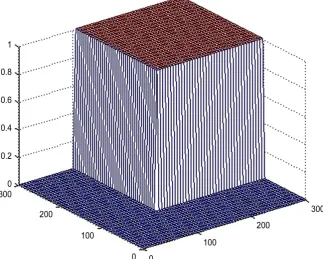
The function figure is as follows.
The following values will be used for the numerical simulation of the parame-ters.
1 2 0.3, r 0.03, 0.5, cash 1,X1 X2 100,
σ =σ = = ρ= = = =
We consider the calculation domain as Ω =
[
0, 300] [
× 0, 300]
for this exam-ple, in Figure 2 with the mentioned parameters, the exact answer is(
,)
cash exp( )
(
1(
,) (
, 2 ,)
)
V x y = −rt Ψρ Y x y Y x y
( )
121
1 1
1
, log ,
2
x
Y x y r T
X T
σ
σ
= + −
( )
222
2 2
1
, log .
2
y
Y x y r T
X T
σ
σ
= + −
Note that Ψρ is a bivariate normal cumulative distribution function, i.e.,
( )
2 22 2
1
, : exp d d . 2π 2 1 2 1
a b x y xy
a b x y
ρ ρ
ρ ρ
−∞ −∞
+
Ψ = − +
− −
∫ ∫
[image:11.595.212.536.451.710.2]For this example, the errors of both ADI and LOD methods with different time and location step length are presented in Table 1 and Table 2.
7. Result
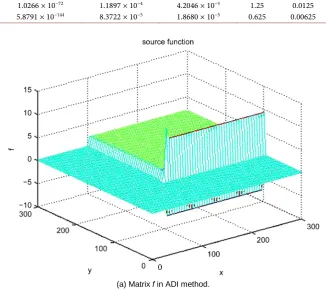
As shown in Table 1, the ADI shows better convergence than the LOD method with relatively large space step sizes. However, with smaller space step size (equivalently large temporal step size), convergence the method ADI shows the results which have big error while the method LOD make convergent results. To investigate what made blowup solutions for the ADI scheme, we compare solu- tions, u12 ana u1, and source terms, f and g, generated from the ADI and LOD methods. We used time step size, ∆ =t 0.5, and space step size h=5. In
[image:12.595.206.539.310.374.2]Fig-ure 3, the first and the second columns show the numerical results at each step of the ADI and LOD for a two-asset cash or nothing option, respectively. As we can see from the figure, the numerical result of the ADI with a relatively large time step shows oscillatory solution along the lines x=X1 and y=X2, source terms in the first steps are shown.
Table 1. The results of ADI program.
RMSE e2 e∞ h Δt
2.6819 × 10⁻²⁰ 3.5622 × 10⁻⁴ 4.4095 × 10⁻⁵ 5.0 0.05
1.184 × 10⁻⁴ 5.5920 × 10⁻⁵ 2.3593 × 10⁻⁶ 2.5 0.025
1.8877 × 10−69 2.4637 × 10⁻¹¹ 1.3877 × 10⁻⁷ 1.25 0.0125
[image:12.595.209.536.444.734.2]N.A N.A N.A 0.625 0.00625
Table 2. The results of LOD program.
RMSE e2 e∞ h Δt
1.6230 × 10⁻²⁰ 5.639 × 10⁻⁴ 2.2564 × 10⁻⁴ 5.0 0.05
2.9567 × 10−42 2.2343 × 10⁻⁴ 9.9937 × 10⁻⁵ 2.5 0.025 1.0266 × 10−72 1.1897 × 10⁻⁴ 4.2046 × 10⁻⁵ 1.25 0.0125 5.8791 × 10−144 8.3722 × 10⁻⁵ 1.8680 × 10⁻⁵ 0.625 0.00625
(b) Matrix f in LOD method.
(c)Matrix
1 2
(d) Matrix
1 2
u in LOD method.
(f) Matrix g in LOD method.
(g)Matrix 1
(h) Matrix u1 in LOD method.
Figure 3. Numerical results of cash or nothing using the ADI and LOD. (a) source term f at step1, (b) solution u12 at step 1, (c) source term g at step 2, and (d) solution u1 at step
2.
The source term in the ADI method exhibits oscillation around y= X2 which is from the y-derivatives in the source term. On the other hand, for the LOD method, we don’t have the y-derivatives in the source term and solution
1 2
u is monotone around y= X2. Therefore, for the ADI we have an LOD solution at the first step. After one complete time step, the result with the ADI shows nonsmooth numerical solution. However, the LOD method results in a smooth numerical solution [1].
References
[1] Jeong, D. and Kim, J. (2013) A Comparison Study of ADI and Operator Splitting Methods on Option Pricing Models. Journal of Computational and Applied Ma-thematics, 247, 162-171.
[2] Shreve, S.E. (2004) Stochastic Calculus for Finance I, II. IEEE International Joint Conference on Computational Sciences and Optimization.
[3] Black, F. and Scholes, M. (1973) The Pricing of Options and Corporate Liabilities. The Journal of Political Economy, 81, 637-654. https://doi.org/10.1086/260062
[4] Eckner, A. and Comput, J. (2004) Operator Splitting Methods for American Option Pricing.Applied Mathematics Letters, 17, Article ID: 814809.
[5] Carol, A. and Venkatramanan, A. (2012) Analytic Approximations for Multi Asset Option Pricing. Mathematical Finance, 22, 667-689.
Submit or recommend next manuscript to SCIRP and we will provide best service for you:
Accepting pre-submission inquiries through Email, Facebook, LinkedIn, Twitter, etc. A wide selection of journals (inclusive of 9 subjects, more than 200 journals)
Providing 24-hour high-quality service User-friendly online submission system Fair and swift peer-review system
Efficient typesetting and proofreading procedure
Display of the result of downloads and visits, as well as the number of cited articles Maximum dissemination of your research work
Submit your manuscript at: http://papersubmission.scirp.org/