© 2019, IRJET | Impact Factor value: 7.211 | ISO 9001:2008 Certified Journal
| Page 5135
SOIL STABILIZATION USING WHEAT HUSK AND LIME
Ashwani Bhardwaj
1, Dushyant Parashar
2, Akshay Dutta
3, Ajay Kumar Saini
4, Prince Batra
5,
Avinash Tiwari
61,2
Assistant Professor, Department of Civil Engineering, ADGITM, New Delhi, India
3,4,5,6Students, Department of Civil Engineering, ADGITM, New Delhi, India
---***---Abstract –
Soil is a heterogeneous substance that exhibitvariety of nature. Its properties differ from place to place and also changes as depth increases. In construction when excavation is done, the soil is very unstable and may collapse while construction. Soil stabilization is a technique of holding up of soil without collapsing and hence enhancing its properties. This study presented a review of literature on soil stabilization using wheat husk and lime. In this we have used wheat husk at different percentages like for 3%, 4.5%, 6% with and without lime. Lime percentages are taken as 3% with 3% Wheat Husk and 6% with 6% Wheat Husk. We have tested all these combination on light proctor compaction test to determine maximum dry density. Maximum dry Density will help us determine shrink-swell properties of a soil, thus improving the load bearing capacity of a sub-grade to support pavements and foundations.
Key Words: Soil Stabilization, Lime, Wheat Husk, Dry Density, Strength, etc.
1.
INTRODUCTION
Foundation is a very important part of a structure. It transfers all the load to the bottom strata of the soil. Hence soil needs to be of sufficient bearing capacity. When the excavation is done for the foundation work, the soil on the sides is very unstable and hence it may collapse while construction, due to any type of vibration in the soil. So in order to prevent the soil from collapsing the soil stabilization is done. Soil Stabilization is a process of enhancing properties of soil with the addition of different type of material like wheat husk, lime, coir, Plastic fiber etc. In this research we have used Wheat Husk and Lime as additive for the stabilization of soil. We have tested soil with only wheat husk and with the combination of wheat husk and lime.
1.1 Wheat Husk
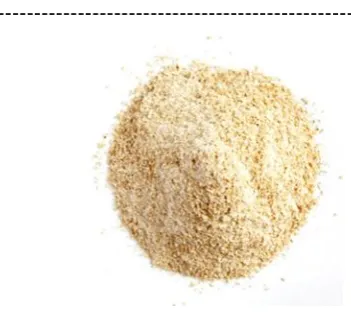
Wheat is the most common and important type of food grain and ranks second in total production. Wheat husk is the outer covering of the grain that is separated from the grain as it is of no use. Wheat Husk is considered a waste product and is extracted out while washing the grain..
Fig -1: Wheat Husk
1.2 Lime
Lime is a calcium-containing inorganic mineral. It is obtained from limestone that are primarily composed of calcium oxides. Lime is widely used in construction materials like in cement. It contributes a great part in cement production. Lime is easily available material in the market and at very cheap prices. Using lime in soil stabilization will lead to an economical concept.
2. PROBLEM RELATED TO SOIL
Problems that occur with the soil are only related to its geotechnical properties. These problems can contribute a faulty construction. The geotechnical properties of soil such as size, moisture content, specific gravity, maximum dry density broadly affect any structure to be constructed, whether it be a residential building or airport or highway or a dam. Some remedial measures can be taken to prevent damages. These are Moisturizing the soil or addition of some additives that fill up the voids between the soil particles.
3. REMEDIAL MEASURES
[image:1.595.328.504.198.359.2]© 2019, IRJET | Impact Factor value: 7.211 | ISO 9001:2008 Certified Journal
| Page 5136
4. METHODOLOGY
The following experiments are conducted based on IS codes:
A. Determination of soil specific gravity B. Particle size distribution by sieve analysis
C. Determination of soil index properties (Atterberg Limits)
D. Liquid limit by Casagrande’s apparatus E. Plastic limit
F. Determination of maximum dry density (MDD) and the corresponding Optimum Moisture Content (OMC) of the soil by standard proctor compaction test
G. Determination of shear strength by California Bearing Ratio Test.
5. EXPERIMENTAL INVESTIGATION
Soil with Wheat Husk
Liquid Limit Test
Moisture Content (%) = w = (Ww/Wd)*100
Table -1: Liquid Limit for Soil with only Wheat Husk
Wheat Husk Percentage 3% 4.5% 6%
No. of Blows 25 25 25
Wt. of empty container in
gm,W1 10 16 16
Wt. of container + wet soil in gm, W2
30 27 27
Wt. of container + dried soil
in gm, W3 25 24 24
Wt. of oven dried soil in gm,
Wd=W3-W1 15 08 08
Wt. of water in gm,
Ww=W2-W3
05 03 03
Moisture content of Soil (%) 33.33 37.5 37.5
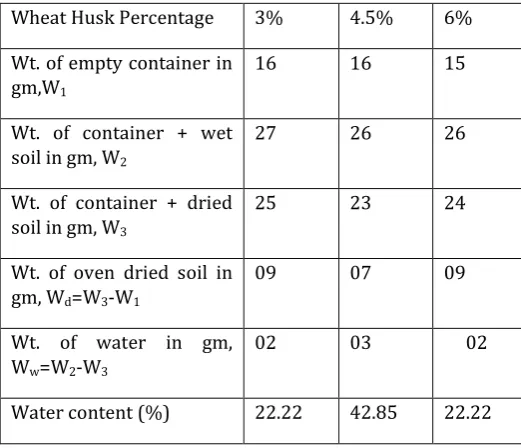
Plastic Limit Test
[image:2.595.303.564.160.384.2]Moisture Content (%) = w = (Ww/Wd)*100
Table -2: Plastic Limit for Soil with only Wheat Husk
Wheat Husk Percentage 3% 4.5% 6%
Wt. of empty container in
gm,W1 16 16 15
Wt. of container + wet soil in gm, W2
27 26 26
Wt. of container + dried
soil in gm, W3 25 23 24
Wt. of oven dried soil in gm, Wd=W3-W1
09 07 09
Wt. of water in gm,
Ww=W2-W3 02 03 02
Water content (%) 22.22 42.85 22.22
Soil with Wheat Husk and Lime
Liquid Limit Test
[image:2.595.29.564.413.759.2]Moisture Content (%) = w = (Ww/Wd)*100
Table -3: Liquid Limit for Soil with Wheat Husk and Lime
Percentages 3% WH
+ 3% Lime
6% WH
+
6% Lime
No. of Blows 25 25
Wt. of empty container in gm,W1 16 07
Wt. of container + wet soil in gm, W2 30 18
Wt. of container + dried soil in gm,
W3 25 14
Wt. of oven dried soil in gm, Wd=W3-W1
09 07
Wt. of water in gm, Ww=W2-W3 05 04
Moisture content of Soil (%) 55.55 57.14
© 2019, IRJET | Impact Factor value: 7.211 | ISO 9001:2008 Certified Journal
| Page 5137
Plastic Limit Test [image:3.595.42.287.443.581.2]Moisture Content (%) = w = (Ww/Wd)*100
Table -4: Plastic Limit for Soil with Wheat Husk and Lime
Percentages 3% WH
+
3% Lime
6% WH
+
6% Lime
Wt. of empty container in gm,W1 8 11
Wt. of container + wet soil in gm,
W2 25 32
Wt. of container + dried soil in gm,
W3 21 27
Wt. of oven dried soil in gm,
Wd=W3-W1 13 16
Wt. of water in gm, Ww=W2-W3 4 5
Water content (%) 30.76 31.25
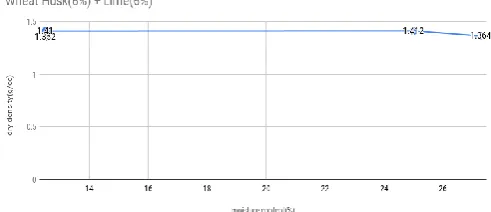
Procter compaction test
Graph -1: Dry Density VS Moisture content curve
Graph -2: Dry Density VS Moisture content curve
Table -5: CBR Values of Soil
% Wheat Husk
& Lime CBR @2.5mm Value Penetration (%)
CBR Value
@5mm Penetration (%)
3% Wheat Husk 3.428 3.324
4.5% Wheat
Husk 4.56 4.22
6% Wheat Husk 10.62 10.16
3% WH & 3% Lime
8.66 8.43
6% WH & 6%
Lime 6.24 6.12
6. CONCLUSIONS
Since wheat husk is generally a waste but when mixed with lime shows engineering properties which is a very good indication of its utilization.
Also use of lime and wheat husk together can solve many engineering problems related to soil. It is also economical and can save a lot of project amount to utilize for solving other problems involved in the project.
The values of OMC and CBR are widely used by engineers for designing and construction of structures. Since the values have increased by using a mixture of wheat husk and lime so they can be easily used for the construction purposes.
The two materials used are readily available and their transportation is also easy and they won't even deteriorate so can be travelled for large distances for the use.
The use of wheat husk and lime can be used for repair work of structures also.
These two materials can also be used for the construction of pavements.
Wheat husk and lime can be used not only with soil but with cement too.
[image:3.595.39.285.630.736.2]© 2019, IRJET | Impact Factor value: 7.211 | ISO 9001:2008 Certified Journal
| Page 5138
ACKNOWLEDGEMENT
With respectable regards and immense pleasure we take it as a privilege to express our profound sense of gratitude and indebtedness to our respected supervisors Prof. Ashwani & Prof. Dushyant, Department of Civil Engineering, ADGITM Delhi, for their encouragement, guidance and great support during the project work. They always motivated us and shared their expertise during the whole course of project work.
We would like to express our gratitude towards Ms. Preeti and Mr. Vivek, the lab assistants of the concerned labs and all the faculty members, Department of Civil Engineering (ADGITM) for their kind co-operation and encouragement which help us in completion of this project.
Our thanks and appreciations to our batch mates in developing the project and willingly helping us out with their abilities.
REFERENCES
[1] Mr. Santosh and Prof. Vishwanath C.S.
“Stabilization of Expansive Soil by using Wheat Husk Ash and Granulated Blast Furnace Slag” IJSRD - International Journal for Scientific Research & Development| Vol. 3, Issue 04, 2015 | ISSN (online): 2321-0613
[2] Robert M. Brooks (2009) entitled “soil
stabilization with fly ash and rice husk ash” (ISSN: 2076-734X, EISSN: 2076-7366 VOLUME 1.
[3] D.Koteswar Rao et.al(2011), stabilization of
expansive soil with rice husk ash, lime and gypsum –an experimental study ,IJEST,Vol.3,No.11, November 2011.
[4] N K Bhasin ,N K Goswami , P Oli, N Krishan and N
B Lal (1988),” A Laboratory study on utilization of waste material for the construction of roads in black cotton soil areas”, high way research bulle-tin, No.36, pp. 1-11.
[5] S.Chandra, S Kumar and R K Anand (2005), “soil
stabilization with rice husk ash and lime sludge:, Indian Highways, Vol.33, No.5, Pp. 87-98.
[6] Sabyasachibiswas and Arghadeep Biswas (2012)
entiteled “utilization of Rice Husk with Lime on Sub grade Soil for a Rural Road” ( International conference in emerging Frontiers in Technology for Rural Area (EFITRA) 2012 Proceedings published in international journal of computer Application.
[7] LaxmikantYadu et.al (2011) entitled “comparison
of Fly Ash and Rice Husk Ash Stabilized Black Cotton Soil “ (ISSN 0974-5904, Volume 04)
[8] O.Okafor and Ugochukwu N. Okonkwo , Effect of
rice husk ash on some Geotechnical properties of soil field. Leanardo electronic journal of practices and technologies, issue 15, July-December (2009), pp 67-74.
[9] B.Suneel Kumar &T.V.Preeti, “Behavior of clayey
Soil Stabilized with Rice Husk Ash & Lime” , International journal of Engineering Trends and Technology (IJETT), Volume-11 No.1 ,May 2014.
[10] DilipShrivastva, A K Singhal and R K Yadav, “Effect
of lime and rice husk ash on engineering properties of black cotton soil”, International journal of Engg. Research & Science & Technology, 2014.
[11] A.Kezdi, “Stabilized Earth Roads”. Amsterdam:
Elsevier Scientific Publishing Company, 1979.
[12] Andrzej K Bledzki, Dr. Abdullah Al-Mamun, Jürgen
Volk “Physical, chemical and surface properties of wheat husk, rye husk and soft wood and their polypropylene composites” Composites Part A Applied Science and Manufacturing, 2010, 41(4):480-488.
[13] O.O Amu, S. A Oguniyi and O.O Oladeji,
Geotechnica properties of Lateritic Soil Stabilized with sugar cane straw ash, America Journal of Scientific and Industrial Research, 2011, 2(2), pp. 323- 339.
[14] M. Chittaranjan, M. Vijay and D. Keerthi
“Agricultural wastes as soil stabilizers” International Journal of Earth Sciences and Engineering, 2011,Vol-04, Issue No 06 SPL, pp. 50-51.
[15] S. Manimaran, Gayathiri .K, Sinduja .R,
Vengadesh.S” Role of Additives in Expansive Soil to Improve Stabilization Performance Using Biomass Silica” International Journal for Scientific Research & Development,2015,Vol. 3, Issue 04 ,ISSN 2321-0613.
[16] IS 2720-3-1 1980 Methods of test for soils, Part 3:
Determination of specific gravity, Section 1: Fine grained soils
[17] IS 2720-3-2 1980 Methods of test for soils, Part 3:
Determination of specific gravity, Section 2: Fine, medium and coarse grained soils
[18] IS 2720-4 1985 Methods of test for soils, Part 4:
Grain size analysis
[19] IS 2720-5 1985 Methods of test for soils, Part 5:
Determination of liquid and plastic limit
[20] IS 2720-6 1972 Methods of test for soils, Part 6:
© 2019, IRJET | Impact Factor value: 7.211 | ISO 9001:2008 Certified Journal
| Page 5139
[21] IS 2720-7 1980 Methods of test for soils, Part 7:
Determination of water content-dry density relation using light compaction
[22] IS 2720-10 1991 Methods of test for soils, Part 10:
Determination of unconfined compressive strength
BIOGRAPHIES
Akshay Dutta
4th year, B.tech, Civil
Engineering, ADGITM, New Delhi
Ajay Kumar Saini
4th year, B.tech, Civil
Engineering, ADGITM, New Delhi
Avinash Tiwari
4th year, B.tech, Civil
Engineering, ADGITM, New Delhi
Prince Batra
4th year, B.tech, Civil
Engineering, ADGITM, New Delhi