warwick.ac.uk/lib-publications
Original citation:
Chen, Chao, Woo Lee, Sang, Watson, Tim, Maple, Carsten and Lu, Yi (2018) CAESAR : A
criticality-aware ECDSA signature verification scheme with Markov Model. In: 2017 IEEE
Vehicular Networking Conference (VNC), Torino, Italy, 27-29 Nov 2017. Published in: 2017
IEEE Vehicular Networking Conference (VNC) ISSN 2157-9865.
doi:
10.1109/VNC.2017.8275638
Permanent WRAP URL:
http://wrap.warwick.ac.uk
/
94340
Copyright and reuse:
The Warwick Research Archive Portal (WRAP) makes this work by researchers of the
University of Warwick available open access under the following conditions. Copyright ©
and all moral rights to the version of the paper presented here belong to the individual
author(s) and/or other copyright owners. To the extent reasonable and practicable the
material made available in WRAP has been checked for eligibility before being made
available.
Copies of full items can be used for personal research or study, educational, or not-for profit
purposes without prior permission or charge. Provided that the authors, title and full
bibliographic details are credited, a hyperlink and/or URL is given for the original metadata
page and the content is not changed in any way.
Publisher’s statement:
“© 2018 IEEE. Personal use of this material is permitted. Permission from IEEE must be
obtained for all other uses, in any current or future media, including reprinting
/republishing this material for advertising or promotional purposes, creating new collective
works, for resale or redistribution to servers or lists, or reuse of any copyrighted component
of this work in other works.”
A note on versions:
The version presented here may differ from the published version or, version of record, if
you wish to cite this item you are advised to consult the publisher’s version. Please see the
‘permanent WRAP URL’ above for details on accessing the published version and note that
access may require a subscription.
CAESAR: A Criticality-Aware ECDSA Signature
Verification Scheme with Markov Model
Chao Chen
1, Sang Woo Lee
2, Tim Watson
1, Carsten Maple
1, and Yi Lu
11
Cyber Security Centre, University of Warwick, United Kingdom
2ETRI, Electronics and Telecommunications Research Institute, South Korea
1
{c.chen.27, tw, cm, y.lu.16}@warwick.ac.uk,
2[email protected]
Abstract—Intelligent transport systems (ITS) facilitate road traffic by periodically exchanging messages with neighbouring vehicles, road side units (RSUs) and ITS stations. For security reasons these messages will be encapsulated with security cre-dentials to form secured messages (SMs) and will be inoperative until the authentication completes. This creates a challenge in a dynamic and dense road network where many SMs are awaiting authentication. To address this problem, we propose CAESAR, a criticality-aware Elliptic Curve Digital Signature Algorithm (ECDSA) signature verification scheme that utilizes multi-level priority queues (MLPQs) and Markov model to dis-patch and schedule SMs. Simulation results verify the accuracy of CAESAR and the enhancements in terms of several safety awareness metrics compared with the existing schemes.
Index Terms—ITS, Authentication, Security;
I. INTRODUCTION
Intelligent transport systems (ITS) is a core component of the future traffic system. Equipped on-board units (OBUs) and wireless data exchanging are essential requirements for cooperative awareness, emergency warning notification, ef-ficient route guidance and entertainments. ITS applications broadcast their information to surrounding vehicles, RSUs and ITS stations. These broadcast messages are known as basic safety messages (BSMs) in the WAVE standard [1], cooperative awareness messages (CAMs) and decentralized environmental notification messages (DENMs) in ETSI stan-dard [2]. Exchanged messages facilitate vehicles and stations to extend their control beyond the non-line-of-sight (NLOS) and develop a local dynamic map (LDM) containing a guid-ance of road traffic [3], such as intersection collision warning, wrong way driving warning, approaching emergency vehicle warning application, etc. Because of the importance of LDM, exchanging messages are an easy target for malicious users. Hence, authentication is a key procedure in the transmission of messages. Once a message is generated at the application layer, a digital signature is added and it is encapsulated as a secured message (SM) before transmission [4]. At the receiver side, the received SM is placed into a message queue where it will be verified before passing it to the relevant application. The content of message cannot be aware by the ITS application before it has successfully been verified.
For the road safety, vehicles are required to respond to arrival SMs as soon as possible. However, this authentication incurs additional communication and processing overheads that decrease the quality of service (QoS) of ITS [5] [6]. Both ESTI and WAVE recommended the usage of ECDSA instead
RSU
A: 40Mp/h
B: 30Mp/h C: 100Mp/h
Visual obstructions E: 70Mp/h
[image:2.612.350.520.214.387.2]Visual obstructions
Fig. 1: The exemplar of critical scenarios
of RSA algorithm for signing and verifying SMs to improve the QoS. In addition, [7] [8] adopt the approach to verify SMs nearby firstly, to achieve the road safety. But it could delay the processing of critical SMs (CSMs) and hazard the safety at the following three scenarios in Fig. 1.
• Vehicle A (40Mp/h) and vehicle B (30Mp/h): despite vehicle A and B are geographically close compared to all others, they cannot meet each other or cause any dangerous issue, because they are in different directions of the crossroad. However, if vehicle A verifies SMs from vehicle B or vice versa, it could delay the CSMs from other areas where cause dangerous.
• Truck C (100Mp/h) and vehicle B: since vehicle B is far away in distance from truck C, vehicle B might process the verification from truck C lately. But truck C is in a high speed moving towards vehicle B, and trees amongst in the middle of the road as a visual obstruction that becomes a NLOS condition. This will cause a severe accident if its CSMs cannot be verified in time.
• Vehicle E (70Mp/h) and others: Vehicle E as an emer-gency vehicle is approaching in this area from a long distance. Considering this is a busy area where vehicles verified and processed SMs nearby firstly, before vehicle E is closing, none of these vehicles could have enough time to adjust their positions.
verification of CSMs, rather than simply verifying the geo-graphically close area. CAESAR classifies the received signal strengths of SMs into several ranges and dispatches them into MLPQs. This enables SMs from different areas to be placed in different priority queues and hence verified rapidly. We analyse the performance of CAESAR and compare it with existing schemes using simulations. Results show that the criticality-aware authentication framework can significantly improve various performance metrics of safety applications.
II. RELATED WORK
A number of schemes have been proposed to reduce verification processing overhead [4], [7]–[9]. These can be regarded as two main aspects: the random, and the distant-based signature verification.
The random based verification schemes [4] [9] choose a few of random SMs for verification to reduce the congestion at the security queue. The drawback of these random verifications cannot guarantee the nearby situations or important SMs will be verified and processed in time. [8] prioritizes the security queue based on the distance between transmitter and receiver. [7] also adopts the distance-based method with the K-means clustering to classify the received SMs, which requires the off-line training and a larger time complexity compared to ours. In addition, as we mentioned in Section I, critical cases are inevitably happening various areas in the real traffic. Authentication solely relying on the distance could delay the verification and processing of CSMs and it causes unnecessary accidents.
A Markov chain (MC) is a sequence of random values,Xt,
whose value at a time interval,t. The value of a MC variable at the present time is called itsstate. For anyt∈time intervals, the probability distribution of the state at timet+ 1depends on the state at timet, and does not depend on the previous states leading to states at timet [10].
pi,j ≡ P~ is the probability that state j at time t to the
system is in state i. If the system has a finite number of states (1, 2,· · ·,S), then the MC model can be defined by the transition probability matrix as Eq. 1, wherePsj=1pi,j= 1.
~ P =
p1,1 p1,2, · · · p1,s
p2,1 p2,2, · · · p2,s
..
. . .. ...
ps,1 ps,2, · · · ps,s
(1)
Therefore, we can define the transition matrix afterm+n
steps using Eq. 2 [10].
Pi,jn+m=X
k∈S
Pi,kn Pk,jm (2) III. CAESAR: CRITICALITY-AWAREECDSA SIGNATURE
VERIFICATIONFRAMEWORK
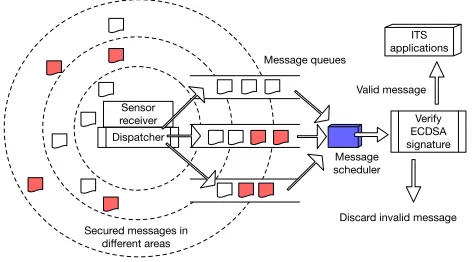
In this section, we unfold CAESAR in details. The key idea is to prioritize the verification of receiving SMs based on its distribution of CSMs on different message queues as shown in Fig. 2. Equipped sensors in the vehicle can receive SMs from other surrounding vehicles or ITS-stations. Some of SMs
Dispatcher
Verify ECDSA signature
ITS applications
Valid message Sensor
receiver
Message scheduler Message queues
Secured messages in different areas
[image:3.612.319.555.60.191.2]Discard invalid message
Fig. 2: CAESAR system overview
are extremely critical in the road situation that we marked them as the red colour, their criticality is unknown for ITS applications before the verification. After the receiver gathers its surrounding SMs, it then dispatches SMs into MLPQs based on their signal strengths for being scheduled, verified and processed. Experimental studies [11], [12] demonstrate sensors can partition these received messages by its signal strengths. Each one of message queues represents its geo-graphical region by one interval of signal strength. The MLPQ allows the vehicles to schedule the verification of SMs based on the assigned priority. Using MLPQ and MC, CAESAR schedules SMs from each message queue to verify based on the distribution of CSMs amongst MLPQs. As a consequence, CSMs are verified with improved outcomes compared to others.
A. Dispatching SMs based on the physical distance into multilevel queues
The first feature of CAESAR consists of dispatching SMs to their corresponding message queue. Each one of message queues has an interval of signal strength that indicates a SM will be allocated to which message queue. For example, there arek message queues, and each interval of signal strength is
[(ki−1)·θ, ki·θ), where ki is the index of message queue,
and θ is the interval of signal strength that we can obtain from Eq. 3, where ~µis the vector of signal strengths for all received SMs.
θ=max(~µ)−min(~µ)
k (3)
Using the received signal strengths and the number of message queues, we can determine and dispatch SMs into relative message queues, respectively. It is worth noting the time complexity of this classification is O(n) compared to
O(ndk+1·logn)in [7] by k-means clustering, which is more practicable in the real case.
B. Criticality distribution by modelling Markov Chain
and dispatches them in message queues. Each one of MLPQs contains a portion of CSMs. A transition between two states represents the probability/portion of CSMs in MLPQs be-tween two sequential time slots. For example, a three message queue has one state[0.3,0.1,0.5]means 30%of CSMs from all received CSMs are in the first message queue, q1, 10%
CSMs in q2 and 50% CSMs in q3. Given the observations
of received CSMs, X0, X1,· · ·, Xt, we can obtainpi,j, the
probability of transition from stateito state j by Eq. 4.
pi,j=P r[Xj|Xi] =P r[qj←qi|t] =
Cj
C ←
Ci
C (4)
whereCis the total number of received CSMs within MLPQs at time slot t, the number of received CSMs at message queues,qi andqj, are represented asCiandCj, respectively.
Based on ITS safety applications, we can use a series of observations regarding to the distribution of CSMs over message queues to calculate the transition probability matrix. Therefore, based on the current distribution of received CSMs as the state and the transition probability matrix, we can use Eq. 2 to calculate the distribution of CSMs of next state.
C. SM Queue Scheduler and ECDSA Signature Verification
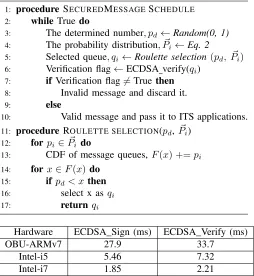
The third feature of our proposed framework contains the SM multi-level queue scheduling algorithm which aims at extracting SMs from different queues based on the distribution of CSMs to verify their signatures (using ECDSA), as listed in Algorithm 1. During the first initial step (line 2 in Algorithm 1), all received SMs have been dispatched into relevant MLPQ based on its signal strengths and ready to be scheduled. For each one of scheduling, a random number between 0 and 1 is generated,pd, for determining the selected queue (line 3).
Eq. 2 is then applied to calculate the next distribution of CSMs for MLPQs (line 4).
Then, roulette selection is adopted to select a queue, qi,
based on the calculated distribution of CSMs over MLPQs and the determined number,pd (line 5). For the roulette selection
procedure (line 14), it will firstly iterate all probabilities to generate the ratio of CSMs over MLPQs as Cumulative Distribution Function (CDF). Then, to iterate each one of CDF and compare it with pd. If pd is bigger than one of
probabilities, this queue is selected to be returned.
Once the selected queue,qi, is determined, message
sched-uler extracts the SM from the chosen queue to apply ECDSA algorithm (line 6). If this SM is verified successfully, it will pass to ITS applications to further process, such as build up LDM. Otherwise, if it cannot be verified (due to malicious data injection attacks), this message will be regarded as invalid and discarded it, or a reputation module [13] can be implemented to isolate the malicious nodes in the network, which is outside the scope of this paper.
IV. PERFORMANCE EVALUATION
A. Simulation Setup
We develop a simulation model to analyse the performance of CAESAR. This simulation is used for SMs transmission exchange between vehicles and RSUs. The packet size of a SM including the security overhead is taken as 300 bytes.
Algorithm 1 Scheduling SMs to ECDSA signature verifica-tion
1: procedure SECUREDMESSAGESCHEDULE 2: whileTruedo
3: The determined number, pd←Random(0, 1)
4: The probability distribution, ~Pi←Eq. 2
5: Selected queue, qi←Roulette selection (pd, ~Pi)
6: Verification flag←ECDSA verify(qi)
7: if Verification flag6=Truethen
8: Invalid message and discard it.
9: else
10: Valid message and pass it to ITS applications.
11: procedure ROULETTE SELECTION(pd,P~i)
12: forpi∈P~i do
13: CDF of message queues, F(x) +=pi
14: forx∈F(x)do
15: if pd< x then
16: select x asqi
17: returnqi
Hardware ECDSA_Sign (ms) ECDSA_Verify (ms) OBU-ARMv7 27.9 33.7
[image:4.612.313.567.74.350.2]Intel-i5 5.46 7.32 Intel-i7 1.85 2.21 TABLE I: The comparisons of ECDSA on different hardwares
Each vehicle generates10 SMs per second with6Mpps data rate. We adopt ECDSA-256-SHA-256 algorithm from the ETSI to sign and verify SMs. We evaluated the signature and verification at three hardware platforms (OBU ARM v7, Intel i5 and Intel i7), the results display in Table I. Due to the road safety, specialized hardware security module or trusted platform module will be utilized to accelerate the cryptographic operations by using the higher CPU instead of directly using OBU [6]. For simplicity, we choose 5ms and
7ms for signing and verifying, respectively. SMs that could not get verified within100ms time interval are dropped from the security queue and this loss is termed as the cryptographic loss.
To generate mobility traces, we choose the scenarios as shown in Fig. 1. The critical cases are emerged from different areas that based on three major distributions (Exponential, Gaussian and Uniform) through five MLPQs within the sim-ulation. A road network of2km ×2km is used. The vehicle density is set to150 vehicles/km2 to create a dense network.
B. Simulation Results
Q-1 Q-2 Q-3 Q-4 Q-5 0.00
0.15 0.30 0.45
The PDF of CSMs
(a)-Exponential
Traffic CAESAR
Q-1 Q-2 Q-3 Q-4 Q-5
0.0 0.1 0.2
CSMs PDF
(b)-Gaussian
Q-1 Q-2 Q-3 Q-4 Q-5
0.005 0.010 0.015
CSMs PDF
[image:5.612.77.275.58.208.2](c)-Uniform
Fig. 3: The comparisons of CAESAR and road traffic in PDF
SQ-F MQ-F MQ-R CAESAR
0.0 0.1 0.2 0.3 0.4 0.5
CSMs Loss (%)
(a)
SQ-F MQ-F MQ-R CAESAR
0 10 20 30 40
CSMs Latency (ms)
[image:5.612.87.267.242.370.2](b)
Fig. 4: The performance comparisons of CAESAR with others and the third technique is MLPQ random signature verifi-cation (MQ-R) that randomly picks SMs from its MLPQs. In the end, we compare the end-to-end latency for CSMs and all received SMs with three techniques.
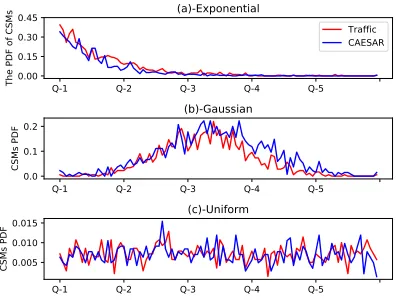
1) Accuracy of CAESAR: The experimental results for the accuracy of CAESAR on the prediction of CSMs as in probability density function (PDF) are shown in Fig. 3, which breaks down the accuracy by five message queues (Q-1, Q-2, Q-3, Q-4 and Q-5). It can be seen from this figure that CAESAR is fairly accurate. A further observation shows that as the traffic distribution from the exponential to the uniform, the average ratio of difference are float around0.45. Although a few of ups and downs at Q-4 in the Gaussian distribution have some differences, CAESAR captures most sharp changes through5message queues amongst these three major distributions.
2) The performance comparisons of CAESAR with others:
The experiments in this subsection investigate the loss of CSMs within a dense network. Results are presented in Fig. 4(a). CAESAR significantly reduces the loss of CSMs compared with other three approaches by around30%, 26%
and14%.
Moreover, we compare CAESAR in the end-to-end latency for CSMs in Fig. 4(b). CAESAR improves the latency by
25ms,14ms and 6.6ms, respectively. In addition, the latency of all received SMs are primarily identical for MQ-F, MQ-R and CAESAR, which proves the efficiency of CAESAR at critical situations whilst it can guarantee the latency of total
received SMs.
V. CONCLUSION
We have described a priority based queuing approach to reduce the signature verification time for CSMs in the ITS. CAESAR adopts the message classification by the signal strengths to dispatch into MLPQ. With the help of Markov model, CAESAR assigns the relevant priority to MLPQ that ensures CSMs have a rapid verification. Then, we have compared our approach with the existing schemes and shown its accuracy and a significant improvement in terms of cryp-tographic packet loss and end-to-end delay.
ACKNOWLEDGEMENT
This work is conducted under international technology R&D collaboration program which is supported by the Min-istry of Trade, Industry & Energy (MOTIE) and Korea Insti-tute for Advancement of Technology (KIAT) (N0001710).
REFERENCES
[1] D. Jiang and L. Delgrossi, “Ieee 802.11 p: Towards an international standard for wireless access in vehicular environments,” inIEEE VTC, 2008.
[2] A. Festag, “Cooperative intelligent transport systems standards in europe,”IEEE communications magazine, vol. 52, no. 12, 2014. [3] ETSI. (2011) Intelligent transport system (its); basic set of applications;
local dynamic map (ldm). [Online]. Available: https://goo.gl/U4gYU2 [4] M. Raya, P. Papadimitratos, and J.-P. Hubaux, “Securing vehicular
communications,”IEEE Wireless Communications, vol. 13, no. 5, 2006. [5] E. B. Hamida, H. Noura, and W. Znaidi, “Security of cooperative intel-ligent transport systems: Standards, threats analysis and cryptographic countermeasures,”Electronics, vol. 4, no. 3, 2015.
[6] M. A. Javed, E. Ben Hamida, and W. Znaidi, “Security in intelligent transport systems for smart cities: From theory to practice,”Sensors, vol. 16, no. 6, 2016.
[7] E. B. Hamida and M. A. Javed, “Channel-aware ecdsa signature verification of basic safety messages with k-means clustering in vanets,” inAINA. IEEE, 2016.
[8] Z. Li and C. Chigan, “On resource-aware message verification in vanets,” inCommunications (ICC). IEEE, 2010.
[9] S. Biswas and J. Miši´c, “Location-based anonymous authentication for vehicular communications,” inPersonal Indoor and Mobile Radio
Communications (PIMRC). IEEE, 2011.
[10] S. Karlin,A first course in stochastic processes. Academic press, 2014. [11] R. Meireles, M. Boban, P. Steenkiste, O. Tonguz, and J. Barros, “Experimental study on the impact of vehicular obstructions in vanets,”
inVehicular Networking Conference (VNC). IEEE, 2010.
[12] E. B. Hamida and G. Chelius, “Investigating the impact of human activity on the performance of wireless networks—an experimental approach,” inIEEE WoWMoM, 2010.
[13] S. K. Dhurandher, M. S. Obaidat, A. Jaiswal, A. Tiwari, and A. Tyagi, “Vehicular security through reputation and plausibility checks,”IEEE