Refactoring the Genia Event Extraction Shared Task
Toward a General Framework for IE-Driven KB Development
Jin-Dong Kim
∗,1, Yue Wang
1, Nicola Colic
2, Seung Han Baek
3, Yong Hwan Kim
3, Min Song
3 1Database Center for Life Science (DBCLS)
2
University of Z¨urich
3Yonsei University
Abstract
For its fourth organization, the Genia event extraction (GE) shared task is refactored toward a general platform for shared infor-mation extraction (IE) tasks, and for an IE-driven knowledge base (KB) system. On the newly implemented shared task plat-form, the GE task is run as an experimental task. The task and the platform has been tested by two teams who cooperated with the organizers. The paper presents the new shared task system and discusses on the experimental submissions.
1 Introduction
Since its first introduction in 2009 as the task of the first BioNLP Shared Task (BioNLP-ST) orga-nization, the Genia event extraction (GE) task has been one of the most investigated IE tasks (Kim et al., 2009; Kim et al., 2011; Kim et al., 2013). The biggest contribution of BioNLP-ST might be that it introduced fine-grained and highly structured information extraction (IE) tasks to the commu-nity of biomedical information extraction (BioIE), when the research in the community was weighted toward extracting binary relations (Krallinger et al., 2007; Lu et al., 2004; Chun et al., 2006). Since then the tasks of BioNLP-ST have motivated and nourished the community to develop a number of biomedical event extraction systems (Bj¨orne and Salakoski, 2013; Miwa et al., 2010),
Originally designed as tasks based on intrin-sic evaluation, however, the tasks of BioNLP-ST could not be free from criticism on unclarity about their impact on real world application (Caporaso et al., 2008). Also, there was a growing need for generalized resources for shared task organiza-tion with which the cost of organizing shared tasks
∗
Corresponding author,[email protected]
could be substantially reduced. With this motiva-tion, for its 4th organization in 2016, the GE task is completely re-designed and re-implemented as an experimental task with two goals.
Firstly, we aim at establishing a seamless con-nection from the IE task to knowledge base (KB) construction. It means we assume KB construc-tion as the target applicaconstruc-tion of the GE task. Par-ticularly, we aim at developing a KB about NFκB proteins, which is the subject domain the GE task has focused on. In the end, we hope to be able to deliver an end-user service of the KB, so that peo-ple who are interested in NFκB proteins can easily access knowledge about them. Toward this end, we automate the process of populating a KB from the output of the task, and solicit working systems to perform the task.
Secondly, we aim at generalizing the resources of shared task organization. Previous iterations of organization showed that shared task is an effec-tive format to promote development of IE solu-tions. Shared task organization however requires a lot of effort and expertise. If the resources for shared task organization become generalized and readily available, more shared tasks can be eas-ily organized. To this end, we designed and re-implemented the shared task resources which have been developed so far for the GE task.
2 Design
2.1 Platform
To achieve the first goal of generalizing the shared task system, PubAnnotation (Kim and Wang, 2012) was chosen as the platform. There were several reasons for the choice. Firstly, as a pub-lic repository of literature annotation, PubAnnota-tion provides various ways of submitting and ac-cessing annotation data sets, which are fundamen-tal for shared task organization. Secondly, it fea-tures an automatic text alignment function, which provides a reliable solution for aligning annota-tions collected from different groups. Thirdly, it is a near mature system, which has a growing user base with more than hundred of data sets.
While PubAnnotation provides many useful functions, a shared task organization still requires more functions. Most importantly, automatic eval-uation needs to be enabled for efficient develop-ment of IE systems. Also, to prevent over-fitting the benchmark data set, often the annotations in the benchmark data set are required to be hid-den. Accordingly, the two key features are imple-mented into PubAnnotation, which are described in following sections.
2.1.1 Comparison of annotations
A shared task organization often features an au-tomatic evaluation of predicted annotations. For generalization, we cast it as general comparison of two different annotation sets. On PubAnnotation, an annotation data set is maintained as aproject, and each project is maintained by itsmaintainer.
A new featureannotation comparisonis imple-mented into PubAnnotation. Using the feature, the maintainer of a project can compare the project against any other project. We call the former a subject project, and the latter areference project. A comparison is performed by looking at how many annotations in the reference project can be recovered in the subject project. The comparison is calculated in terms of recall, precision, and f-score, in their standard meaning.
As PubAnnotation represents annotations in three types,denotations, relations, and modifica-tions1, comparison is also performed for each of
the three types. In case the subject and reference projects have different sets of documents, compar-ison is performed only for the documents found in
1http://www.pubannotation.org/docs/
annotation-format/
both projects.
With this feature, any corpus with manual anno-tation can potentially serve as a shared task: any one can attempt to automatically reproduce the manual annotation, and evaluate the accuracy.
2.1.2 Blind annotations
A new feature blind annotations is implemented into PubAnnotation, to enable hiding annotations in a certain project. By blinding annotations of a project, individual annotations become inacces-sible. However, the project can still be used for comparison. In this way, the project can still func-tion as a benchmark data set.
2.2 Data sets
Data sets prepared for the GE4 task is grouped into benchmark data setsandsupporting data sets.
2.2.1 Benchmark data sets
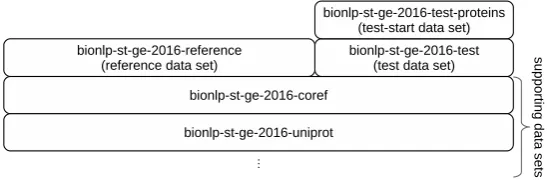
For the benchmark data set of the GE4 task, the same set of documents used for the GE3 task are cleaned and used again. However, the separation of the data set into training, development and test sets is slightly changed: the training and develop-ment data sets are merged into one set which we call areference data set. Thus the GE4 benchmark data set consists of two sets: the reference data set with 20 full papers and the test data set with 14 full papers. The change in dataset separation and naming is made in order to remove the impression that it is a machine learning task and to encourage development of various approaches.
Figure 1: Data sets for the GE4 task
2.2.2 Supporting data sets
Besides the benchmark data sets, other data sets are prepared to support participants to use rich information. Firstly, the coreference annotations from the GE3 data set are separated into an in-dividual annotation set, bionlp-st-ge-2016-coref. Secondly, UniProt IDs are annotated to the bench-mark data sets, to provide “normalization” or “grounding” of protein annotations. Note that the GE4 task organization aims at constructing an IE-driven KB which requires information pieces to be grounded to database entries. The UniProt ID an-notation thus plays an important role in the GE4 task. For the UniProt ID annotation, a simple dic-tionary matching approach is used, but the dictio-nary is tailored to the benchmark data sets to raise the accuracy of UniProt ID annotation particularly for the benchmark data sets.
For other supporting data sets, we attempted to collect automatic annotation tools, rather than just collecting static annotation data sets2.
PubAnno-tation has a feature to communicate with web ser-vices to obtain annotations, and the feature is used to produce the supporting resources via the auto-matic annotation tools. It ensures that the same an-notations can be produced for new documents. Be-sides the two sets of annotations described above, two syntactic parsers, and several named entity recognizers are prepared as RESTful web service:
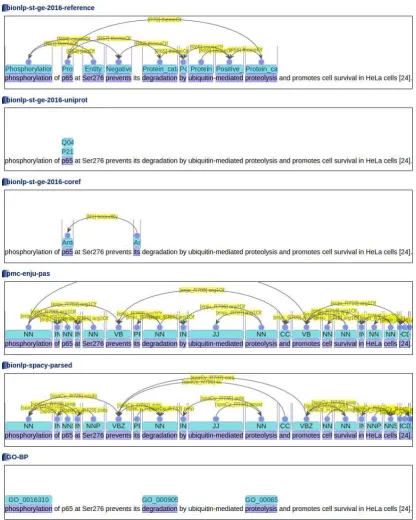
• bionlp-st-ge-2016-uniprot: UniProt ID annotation • bionlp-st-ge-2016-coref: coreference annotation • pmc-enju-pas: deep dependency parsing by Enju
(Miyao and Tsujii, 2008)
• bionlp-spacy-parsed: dependency parsing spacy (Hon-nibal et al., 2013)
• UBERON-AE: anatomical entities in UBERON (Mungall et al., 2012)
• ICD10: disease names as defined in ICD10
2Except for the coreference annotation, which is
origi-nally produced manually.
• GO-BP: biological processes as defined in GO • GO-CC: cellular components as defined in GO
Note that collection of supporting annotations usu-ally requires a non-trivial effort of organizers, to ensure all the annotations provided by different groups to be precisely aligned to the texts in the benchmark datasets. Otherwise, there is a high chance that the texts may be changed during pre-processing by different groups, which may cause an issue of aligning different versions of texts when they are collected. However, thanks to the automatic alignment algorithm implemented in PubAnnotation (See section 2.1), it is not an issue any more as long as they are collected on PubAn-notation. It is a clear benefit of using PubAnnota-tion as a platform of shared task organizaPubAnnota-tion.
Figure 9 shows excerpts of data sets pre-pared for the GE4 task. The annotation data sets can be retrieved individually or altogether through the RESTful API. For example, by accessing the following URL, the annotations shown in Figure 9 can be obtained in JSON at once: http://pubannotation.org/docs/ sourcedb/PMC/sourceid/3245220/divs/ 11/spans/4375-4513/annotations.json? projects=bionlp-st-ge-2016-reference, bionlp-st-ge-2016-uniprot,
bionlp-st-ge-2016-coref,pmc-enju-pas, bionlp-spacy-parsed,GO-BP
2.3 KB
By the KB, we mean a SPARQL endpoint pop-ulated with RDF statements which are results of conversion from the GE task results. To achieve the goal of establishing a seamless connection from the IE to KB, an automatic process is de-signed and implemented into PubAnnotation for:
Also, a SPARQL-driven user interface to search the KB is designed and implemented.
[image:4.595.327.495.343.546.2]Figure 2: The core model of TAO
Figure 3: Annotation example using TAO
Considering its characteristics, the KB is de-signed to provide an easy access to the textual contexts of each knowledge piece. After survey-ing existsurvey-ing vocabularies for RDF statements (Ci-ccarese et al., 2011; Livingston et al., 2013), we chose to use a minimal vocabulary optimized for search, which we call text annotation ontology (TAO)(Kim et al., 2015). Figure 2 shows the core model of TAO, and Figure 3 shows an example of annotation representation using TAO. The exam-ple describes that
• the spanp65“denotes”T1. • T1is auniprot:Q04206.
• the spanphosphorylation“denotes”E1. • E1is age:Phosphorylation.
• T1is a theme ofE1.
Note that the role of TAO is to make connections between the two text spans, p65and phosphory-lation, and the corresponding context entities,T1 andE1, respectively3. Other parts of the
annota-tions are described using other vocabularies: look at the two namespaces,rdf andge.
A converter to produce RDF statements from annotations and a loader to feed the statements to a SPARQL endpoint is implemented to create an automatic flow from IE results to KB. TAO makes
3The prefixes,TandE, are used here just for readability.
They do not hold any special meaning in the system.
SPARQL queries to search the KB simple. For example, following query instructs the system to search for spans (?s) that denote an object (?o) which is auniprot:q04206.
PREFIX tao:<http://pubannotation.org/ontology/tao.owl#> PREFIX prj:<http://pubannotation.org/projects/> PREFIX uniprot:<http://www.uniprot.org/uniprot/>
SELECT ?s
FROM prj:bionlp-st-ge-2016-uniprot WHERE {
?s tao:denotes ?o . ?o a uniprot:Q04206 . }
The results are URIs of the spans:
doc:sourcedb/PMC/sourceid/2664230/divs/2/spans/818-821 doc:sourcedb/PMC/sourceid/2664230/divs/5/spans/1128-1131 doc:sourcedb/PMC/sourceid/2674207/divs/18/spans/2512-2515 ...
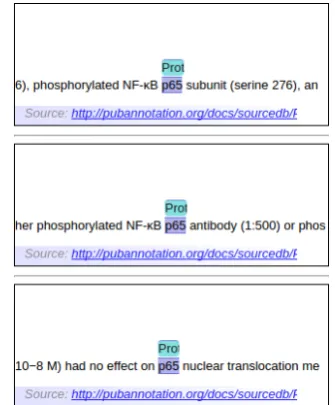
Note, however, that the span URIs are deref-erenceable URIs which PubAnnotation provides. This means that the user can directly access the span following the URI. Figure 4 shows the spans of URIs from the above example rendered in Tex-tAE4, the default visualizer of PubAnnotation.
Figure 4: Example of spans rendered in TextAE
2.4 Participation procedure
Participants to the GE4 task are supposed to go through following procedure:
1. To create a new project in PubAnnotation.
2. To import documents from the project, bionlp-st-2016-test-proteinsto the new project. The 14 documents in the test set will be copied into the new project. 3. To import also annotations from the project,
bionlp-st-2016-test-proteinsto the project. All the protein anno-tations in the test set will be copied into the project.
4. At this point, the participant may want to compare the project against the test project. It will show that pro-tein annotations are 100% correct, but the other anno-tations, e.g., events, are of 0%.
5. To produce event annotations, using a participating sys-tem, upon the protein annotations.
6. To upload the annotations to the project. 7. To compare the project against to the test project.
Every step of the procedure can be performed using the graphical interface of PubAnnotation. Some steps also can be performed using a pro-grammable RESTful API of PubAnnotation. We believe the procedure is quite generic and can be applied to other shared tasks with similar setting.
3 Results and analyses
The results of GE4 organization are as follows:
• The general shared task framework implemented in PubAnnotation.
• The GE4 task re-engineered using the new framework • The pipeline to populate a KB (SPARQL endpoint)
from IE results
• The user interface to the KB • The user experience of participants
As the first three are explained in previous sec-tions, this section discusses the last two: KB user interface and user experience. Also, the bench-mark data sets are analyzed to simulate the process of knowledge access using the KB.
3.1 User interface to IE-driven KB
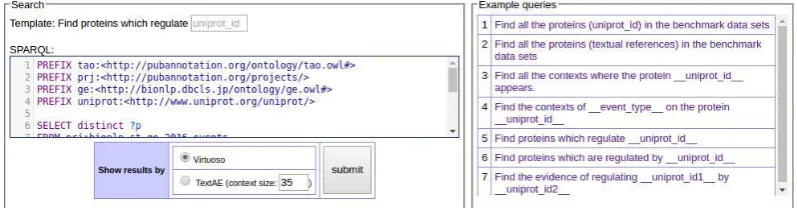
A prototype interface to the IE-driven KB is im-plemented, of which a snapshot is shown in Fig-ure 5. Since the KB is implemented as RDF data sets stored in a SPARQL endpoint, the interface is also SPARQL-oriented: see the input box for a SPARQL query in the center of the interface.
For those who are not familiar with SPARQL, a template system is implemented. A SPARQL template is a SPARQL query with placeholders, of which the value is easily changeable by user’s input. For example, look at the template shown in Figure 6. It has one placeholder, uniprot id . A placeholder is indicated by double underscore characters (‘ ’) at its both sides. The title of the template is supposed to have the same placehold-ers. When displayed, the placeholders in the ti-tle become text input boxes to accept user’s input,
as shown at the top in the left pane of the screen-shot. Upon change of the value in the input boxes, the placeholders in the SPARQL template are also updated, accordingly. Using the templates, users who are not familiar with SPARQL can still ac-cess the KB. Even for expert SPARQL users, it re-duces time to author frequently necessary queries from scratch. In the left pane of the snapshot, 7 predefined templates are shown.
The next section presents results of analyzing benchmark data sets utilizing the templates.
3.2 Data analysis from KB perspective
In this section, the benchmark data sets are ana-lyzed from a perspective of KB, and observations are discussed.
Table 1 shows statistics of UniProt ID anno-tations, which form the basis of the knowledge pieces of the KB we develop. For accuracy, only the UniProt ID annotations that are overlapping with (manual) protein annotations are counted. Note that, UniProt ID annotations that are not an-notated as proteins in the benchmark data set are not involved in any further annotations, e.g. rela-tions, so, anyway, they cannot be involved in any knowledge piece to be extracted from the data sets.
Reference Test Sum
No. of instances 8,292 3,148 11,440 No. of types 221 110 242
Table 1: Statistics of UniProt ID annotation Template 1,Find all the proteins in the benchmark data sets, with slight modifications, e.g. addition ofGROUP BY modifier to count types, is used to obtain the statistics. Among the 110 UniProt IDs that appear in the test data set, 21 do not appear in the reference data set, simulating unseen protein names. They may represent an extra challenge for protein name recognition, and an extra chance for novel knowledge piece, at the same time.
Table 2 shows statistics of NFκB proteins, for which Template 3,Find all the contexts where the protein uniprot id appears, is used with the UniProt IDs of the 5 NFκB proteins set to the placeholder. It shows that p65 is the most fre-quently referenced protein in both reference and test data sets.
Figure 5: SPARQL interface to the IE-induced KB
PREFIX tao:<http://pubannotation.org/ontology/tao.owl#> PREFIX prj:<http://pubannotation.org/projects/> PREFIX ge:<http://bionlp.dbcls.jp/ontology/ge.owl#> PREFIX uniprot:<http://www.uniprot.org/uniprot/>
SELECT DISTINCT ?p
FROM prj:bionlp-st-ge-2016-events FROM prj:bionlp-st-ge-2016-uniprot WHERE {
graph prj:bionlp-st-ge-2016-uniprot { ?o1 tao:denoted_by ?s1 .
?o1 a uniprot:__uniprot_id__ . ?o2 tao:denoted_by ?s2 . ?o2 a ?p .
}
?o1_1 tao:denoted_by ?s1 . ?o2_1 tao:denoted_by ?s2 .
?o1_1 ˆge:partOf? / ge:themeOf+ ?e . ?o2_1 ˆge:partOf? / ge:causeOf+ ?e .
FILTER (?p != tao:Context_entity) }
Figure 6: A SPARQL template of titleFind proteins which regulate uniprot id
uniprot id , can be used. With Q04206 (p65) set to the placeholder, we find the following:
• In the ref. data, 21 proteins are found to regulate p65 • In the test data, 2 are found to regulate p65
• Among the 2 proteins found in the test data, one (P01375; TNFα) also in the reference data, whereas the other (P01584; IL1β) only in the test data.
Assuming that the reference data represents a KB at a point, and that the test data represents new feed to the KB, the piece of information that IL1B regulates p65 may represent a new piece of knowl-edge. On the other hand, the piece of information that TNFαregulates p65 itself may not represent a new knowledge. However, it may supply addi-tional contexts to the known piece of knowledge, from which more detailed information, e.g. exper-imental condition, may be accessed.
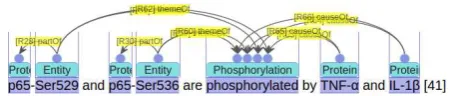
Using Template 7, Find the evidence for uniprot id1 to regulate uniprot id2 , with P01375 set to the first placeholder, and Q04206 to the second, we can access individual contexts of TNFαto regulate p65. Figure 7 shows one exam-ple, which suggests that more detailed knowledge about the regulation may be extracted by further
digging the context, e.g., TNFα regulates phos-phorylation of p65, and the specific sites of the phosphorylation are Ser529 and Ser536,
The series of analyses demonstrates that how IE results may contribute to populate the KB, and how the IE-driven KB can be explored using the template system.
3.3 Analyses on submissions
Class Uniprot ID Name (Gene) Reference Test
I P19838 Nuclear factor NF-kappa-B p105 subunit (NFKB1) 24 37 Q00653 Nuclear factor NF-kappa-B p100 subunit (NFKB2) 8 12 II Q04206 Transcription factor p65 (RELA) 295 98
Q04864 Proto-oncogene c-Rel (REL) 16 6
[image:7.595.98.505.71.153.2]Q01201 Transcription factor RelB (RELB) 6 3
Table 2: Statistics of NFκb proteins in benchmark data sets
Figure 7: An annotation excerpt from PMC:3312845
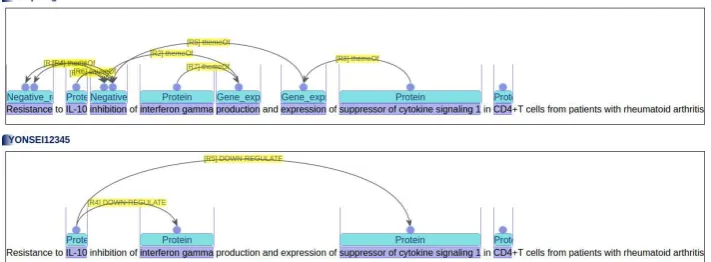
One submission was made using the PKDE4J system (Song et al., 2015). An observation on the output revealed that a major discrepancy be-tween the representation of GE4 and the sys-tem comes from the fact that while GE4 is an event extraction task PKDE4J is a relation ex-traction system. In other words, while GE4 re-quires events to be materialized in the representa-tion, PKDE4J represents them as relations. An ex-ample shown in Figure 8 explains the difference. Note that the GE task materializes the events Neg-ative regulationandGene expressioncaptured by the trigger words inhibition and production, re-spectively. While PKDE4J does not material-ize them, however, it correctly extracts the rela-tion thatIL-10down-regulatesinterferon gamma. It also correctly extracts the relation that IL-10 down-regulates suppressor of cytokine signaling I. Although PKDE4J does not recognize the Neg-ative regulationcaptured byResistance, it seems right considering that PKDE4J is a relation extrac-tion system which requires two arguments for each relation. The observation suggests that character-istics of individual systems need to be carefully considered to better understand and utilize them.
Furthermore, an attempt was made to use TEES, an open source event extraction system, which won previous iterations of the GE task (Bj¨orne and Salakoski, 2013). The goal was to observe TEES’ out-of-the-box performance in the GE4 task. With TEES, a different way of entering the task, namely submission of the URL of a RESTful web service, was tested. PubAnnotation offers a function to communicate with a web service to obtain anno-tations from it. Thus, by submitting the URL of an annotation system which implements a
REST-ful API, annotations can be pulled into PubAn-notation. In order to make use of this feature, a small script was written that runs TEES as a RESTful web service, and annotations obtained directly through PubAnnotation. Conversion from the Interaction XML, TEES’ native format, to the PubAnnotation JSON format was only minimally implemented, to test the submission. To make use of the performance of TEES, the conversion needs to be implemented more thoroughly, which is left as a future work.
4 Conclusions
The GE4 task is organized as an experimental task, toward generalization of the shared task resources and seamless connection of IE task results to KB population. As the result, a new shared task sys-tem is implemented using PubAnnotation as the platform. Note that PubAnnotation itself is an open source project. By being embraced by the open platform, the shared task system is expected to become more sustainable, and accessible. As the newly implemented system is fairly generic, organizing a new shared task is easy, which we hope to promote organization of more shared tasks by interested parties, particularly by domain ex-perts. The GE4 shared task will be running contin-uously inviting open participation from the com-munity.
Acknowledgments
[image:7.595.185.411.188.236.2]Figure 8: Example of the output of PKDE4J system
References
Jari Bj¨orne and Tapio Salakoski. 2013. Tees 2.1: Au-tomated annotation scheme learning in the bionlp 2013 shared task. In Proceedings of the BioNLP Shared Task 2013 Workshop, pages 16–25, Sofia, Bulgaria, August.
J Gregory Caporaso, J Lynn Fink, Philip E Bourne, K Bretonnel Cohen, and Lawrence Hunter. 2008. Intrinsic evaluation of text mining tools may not pre-dict performance on realistic tasks. Pacific Sympo-sium on Biocomputing, pages 640–6513.
Hong-Woo Chun, Yoshimasa Tsuruoka, Jin-Dong Kim, Rie Shiba, Naoki Nagata, Teruyoshi Hishiki, and Jun’ichi Tsujii. 2006. Extraction of gene-disease relations from medline using domain dictio-naries and machine learning. InProceedings of the Pacific Symposium on Biocomputing (PSB), pages 4–15, Maui, Hawaii, USA, January.
Paolo Ciccarese, Marco Ocana, Leyla Garcia Castro, Sudeshna Das, and Tim Clark. 2011. An open an-notation ontology for science on web 3.0. Journal of Biomedical Semantics, 2(Suppl 2):S4.
Matthew Honnibal, Yoav Goldberg, and Mark Johnson. 2013. A non-monotonic arc-eager transition system for dependency parsing. InCoNLL, pages 163–172. Jin-Dong Kim and Yue Wang. 2012. Pubannotation: A persistent and sharable corpus and annotation repos-itory. In Proceedings of the 2012 Workshop on Biomedical Natural Language Processing, BioNLP ’12, pages 202–205, Stroudsburg, PA, USA. Jin-Dong Kim, Tomoko Ohta, Sampo Pyysalo,
Yoshi-nobu Kano, and Jun’ichi Tsujii. 2009. Overview of BioNLP’09 Shared Task on Event Extraction. InProceedings of Natural Language Processing in Biomedicine (BioNLP) Workshop, pages 1–9. Jin-Dong Kim, Yue Wang, Toshihisa Takagi, and
Aki-nori Yonezawa. 2011. Overview of the Genia Event task in BioNLP Shared Task 2011. InProceedings of the BioNLP 2011 Workshop Companion Volume for Shared Task, Portland, Oregon, June.
Jin-Dong Kim, Yue Wang, and Yamamoto Yasunori. 2013. The Genia Event Extraction Shared Task, 2013 Edition - Overview. In Proceedings of the BioNLP Shared Task 2013 Workshop, pages 8–15, Sofia, Bulgaria, August.
Jin-Dong Kim, Jung-jae Kim, Xu Han, and Dietrich Rebholz-Schuhmann. 2015. Extending the evalua-tion of genia event task toward knowledge base con-struction and comparison to gene regulation ontol-ogy task. BMC Bioinformatics, 16(Suppl 10):S3. Martin Krallinger, Florian Leitner, and Alfonso
Valen-cia. 2007. Assessment of the Second BioCreative PPI task: Automatic Extraction of Protein-Protein Interactions. In L. Hirschman, M. Krallinger, and A. Valencia, editors,Proceedings of Second BioCre-ative Challenge Evaluation Workshop, pages 29–39. Kevin Livingston, Michael Bada, Lawrence Hunter, and Karin Verspoor. 2013. Representing annota-tion composiannota-tionality and provenance for the seman-tic web.Journal of Biomedical Semantics, 4(1):38. Z. Lu, D. Szafron, R. Greiner, P. Lu, D.S. Wishart,
B. Poulin, J. Anvik, C. Macdonell, and R. Eisner. 2004. Predicting subcellular localization of proteins using machine-learned classifiers. Bioinformatics, 20(4):547–556.
Makoto Miwa, Rune Sætre, Jin-Dong Kim, and Jun’ichi Tsujii. 2010. Event extraction with com-plex event classification using rich features. Jour-nal of Bioinformatics and ComputatioJour-nal Biology (JBCB), 8(1):131–146, February.
Yusuke Miyao and Jun’ichi Tsujii. 2008. Feature for-est models for probabilistic hpsg parsing. Comput. Linguist., 34(1):35–80, March.
Christopher J Mungall, Carlo Torniai, Georgios V Gk-outos, Suzanna E Lewis, and Melissa A Haendel. 2012. Uberon, an integrative multi-species anatomy ontology.Genome Biology, 13(1):R5.