The Genia Event Extraction Shared Task, 2013 Edition - Overview
Jin-Dong Kim and Yue Wang and Yamamoto Yasunori Database Center for Life Science (DBCLS)
Research Organization of Information and Systems (ROIS) {jdkim|wang|yy}@dbcls.rois.ac.jp
Abstract
The Genia Event Extraction task is orga-nized for the third time, in BioNLP Shared Task 2013. Toward knowledge based con-struction, the task is modified in a num-ber of points. As the final results, it re-ceived 12 submissions, among which 2 were withdrawn from the final report. This paper presents the task setting, data sets, and the final results with discussion for possible future directions.
1 Introduction
Among various resources of life science, litera-ture is regarded as one of the most important types of knowledge base. Nevertheless, lack of explicit structure in natural language texts prevents com-puter systems from accessing fine-grained infor-mation written in literature. BioNLP Shared Task (ST) series (Kim et al., 2009; Kim et al., 2011a) is one of the community-wide efforts to address the problem. Since its initial organization in 2009, BioNLP-ST series has published a number of fine-grained information extraction (IE) tasks moti-vated for bioinformatics projects. Having solicited wide participation from the community of natural language processing, machine learning, and bioin-formatics, it has contributed to the production of rich resources for fine-grained BioIE, e.g., TEES1 (Bj¨orne and Salakoski, 2011), SBEP2(McClosky et al., 2011) and EVEX3 (Van Landeghem et al., 2011).
The Genia Event Extraction (GE) task is a sem-inal task of BioNLP-ST. It was first organized as the sole task of the initial 2009 edition of BioNLP-ST. The task was originally designed and imple-mented based on the Genia event corpus (Kim et
1
https://github.com/jbjorne/TEES/wiki
2
http://nlp.stanford.edu/software/eventparser.shtml
3http://www.evexdb.org/
al., 2008b) which represented domain knowledge around NFκB proteins. There were also some
ef-forts to explore the possibility of literature mining for pathway construction (Kim et al., 2008a; Oda et al., 2008). The GE task was designed to make such an effort a community-driven one by sharing available resources, e.g., benchmark data sets, and evaluation tools, with the community.
In its second edition (Kim et al., 2011b) orga-nized in BioNLP-ST 2011 (Kim et al., 2011a), the data sets were extended to include full text articles. The data sets consisted of two collections. The ab-stract collection, that had come from the first edi-tion, was used again to measure the progress of the community between 2009 and 2011 editions, and the full text collection, that was newly created, was used to measure the generalization of the technol-ogy to full text papers.
In its third edition this year, while succeeding the fundamental characteristics from its previous editions, the GE task tries to evolve with the goal to make it a more “real” task toward knowledge base construction. The first design choice to ad-dress the goal is to construct the data sets fully with recent full papers, so that the extracted pieces of information can represent up-to-date knowl-edge of the domain. The abstract collection, that had been already used twice (in 2009 and 2011), is removed from official evaluation this time4. Sec-ond, GE task subsumes the coreference task which has long been considered critical for improvement of event extraction performance. It is implemented by providing coreference annotation in integration with event annotation in the data sets.
The paper explains the task setting and data sets, presents the final results of participating systems, and discusses notable observations with conclu-sions.
4
However, if necessary, the online evaluation for the pre-vious editions of GE task may be used, which is available at http://bionlp-st.dbcls.jp/GE/.
Event Type Primary Argument Secondary Argument
Gene expression Theme(Protein) Transcription Theme(Protein)
Localization Theme(Protein) Loc(Entity)?
Protein catabolism Theme(Protein)
Binding Theme(Protein)+ Site(Entity)*
Protein modification Theme(Protein), Cause(Protein/Event)? Site(Entity)? Phosphorylation Theme(Protein), Cause(Protein/Event)? Site(Entity)? Ubiquitination Theme(Protein), Cause(Protein/Event)? Site(Entity)? Acetylation Theme(Protein), Cause(Protein/Event)? Site(Entity)? Deacetylation Theme(Protein), Cause(Protein/Event)? Site(Entity)?
[image:2.595.106.498.60.208.2]Regulation Theme(Protein/Event), Cause(Protein/Event)? Site(Entity)?, CSite(Entity)? Positive regulation Theme(Protein/Event), Cause(Protein/Event)? Site(Entity)?, CSite(Entity)? Negative regulation Theme(Protein/Event), Cause(Protein/Event)? Site(Entity)?, CSite(Entity)?
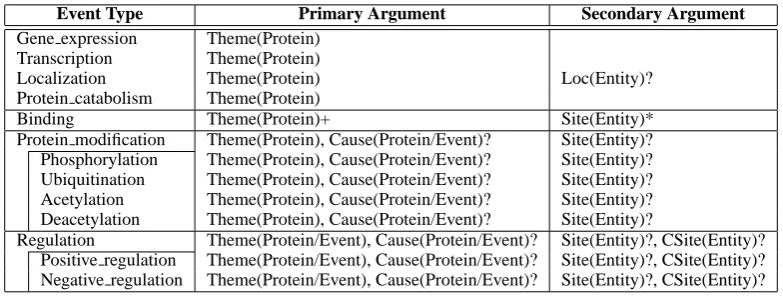
Table 1: Event types and their arguments for Genia Event Extraction task. The type of each filler entity is specified in parenthesis. Arguments that may be filled more than once per event are marked with “+”, and optional arguments are with “?”.
2 Task setting
This section explains the task setting of the 2013 edition of the GE task with a focus on changes to previous editions. For comprehensive explanation, readers are referred to Kim et al. (2009).
The changes made to the task setting are three-folds, among which two are about event types to be extracted. Table 1 shows the event types and their arguments targeted in the 2013 edition. First, four new event types are added to the target of extraction; the Protein modification
type and its three sub-types,Ubiquitination,
Acetylation, Deacetylation. Second, TheProtein modificationtypes are modi-fied to be directly linked to causal entities, which was only possible through Regulation events in previous editions.
The modifications were made based on analy-sis on preliminary annotation during preparation of the data sets: in recent papers on NFκB,
dis-cussions on protein modification were observed with non-trivial frequency. However, in the end, it turned out that the influence of the above modi-fications was trivial in terms of the number of an-notated instances in the final data sets, as shown in section 3, after filtering out events on non-individual proteins, e.g., protein families, protein complexes.
Third change made to the task setting is addition of coreference and part-of annotations to the data sets. It is to address the observation from 2009 edition that coreference structures and entity rela-tions often hide the syntactic paths between event triggers and their arguments, restricting the perfor-mance of event extraction. In 2011, the Protein
coreference task and Entity Relation were orga-nized as sub-tasks, to explicitly address the prob-lem, but this time, coreference and part-of anno-tations are integrated in the GE task, to encour-age an integrative use of them for event extrac-tion. Figure 1 shows an example of annotation with coreference and part-of annotations5. Note that the event representation in the figure is re-lation centric6, which is different from the event centric representation of the default BioNLP-ST format. The two representations are interchange-able, and the GE task provides data sets in both formats, together with an automatic converter be-tween them. Below is the corresponding annota-tion in the BioNLP-ST format:
T8 Protein 933 938 TRAF1 T9 Protein 940 945 TRAF2 T10 Protein 947 952 TRAF3 T11 Protein 958 963 TRAF6 T12 Protein 1038 1042 CD40
T41 Anaphora 1058 1072 These proteins T48 Binding 1112 1119 binding
T49 Entity 1127 1143 cytoplasmic tail T13 Protein 1147 1151 CD40
R1 Coreference Subject:T41 Object:T8 R2 Coreference Subject:T41 Object:T9 R3 Coreference Subject:T41 Object:T10 R4 Coreference Subject:T41 Object:T11
E4 Binding:T48 Theme:T8 Theme2:T13 Site2:T49 E5 Binding:T48 Theme:T9 Theme2:T13 Site2:T49 E6 Binding:T48 Theme:T10 Theme2:T13 Site2:T49 E7 Binding:T48 Theme:T11 Theme2:T13 Site2:T49
In the example, the event trigger, binding, de-notes four binding events, in which the four pro-teins, TRAF1, TRAF2, TRAF3, and TRAF6, bind to the protein, CD40, respectively, through the site, cytoplasmic tail. The links between the four
5
The example is taken from the file, PMC-3148254-01-Introduction.
Figure 1: Annotation example with coreferences and part-of relationship
proteins and the event trigger are however very hard to find, without being bridged by the demon-strative noun phrase (NP), These proteins. In the case, if the link between the demonstrative NP, These proteins and its four antecedents, TRAF1, TRAF2, TRAF3, and TRAF6, can be somehow de-tected, the remaining link, between the demonstra-tive NP and the trigger, may be detected by their syntactic connection. A key point here is the dif-ferent characteristics of the two step links: de-tecting the former is rather semantic or discour-sal while the latter may be a more syntactic prob-lem. Then, solving them using different processes would make a sense. To encourage an exploration into the hypothesis, the coreference annotation is provided in the training and development data sets. Based on the definition of event types, the en-tire task is divided into three sub-tasks addressing event extraction at different levels of specificity:
Task 1. Core event extraction addresses the
ex-traction of typed events together with their primary arguments.
Task 2. Event enrichment addresses the
extrac-tion of secondary arguments that further specify the events extracted in Task 1.
Task 3. Negation/Speculation detection
addresses the detection of negations and speculations over the extracted events.
For more detail of the subtasks, readers are re-ferred to Kim et al. (2011b).
Item Training Devel Test
Articles 10 10 14
Words 54938 57907 75144
Proteins 3571 4138 4359
Entities 121 314 327
Events 2817 3199 3348
Gene expression 729 591 619
Transcription 122 98 101
Localization 44 197 99
Protein catabolism 23 30 14
Binding 195 376 342
Protein modification 8 1 1
Phosphorylation 117 197 161
Ubiquitination 4 2 30
Acetylation 0 3 0
Deacetylation 0 5 0
Regulation 299 284 299
Positive regulation 780 883 1144
Negative regulation 496 532 538
Coreferences 178 160 197
to Protein 152 123 169
to Entity 5 6 6
to Event 18 27 13
to Anaphora 3 4 9
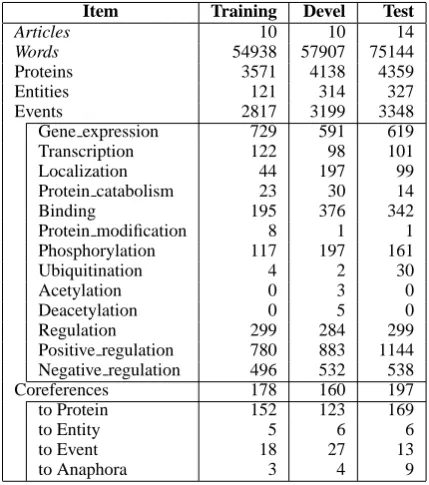
Table 2: Statistics of annotations in training, de-velopment, and test sets
3 Data Preparation
As discussed in section 1, for the 2013 edition, the data sets are constructed fully with full text pa-pers. Table 2 shows statistics of three data sets for training, development and test. The data sets con-sist of 34 full text papers from the Open Access subset of PubMed Central. The papers were re-trieved using lexical variants of the term, “NFκB”
[image:3.595.312.527.301.544.2]Item TIAB Intro. R/D/C Methods Caption all
Words 10483 25543 125172 59612 29085 263133
Proteins 816 1507 9060 1797 2169 16427
(Density: P / W) (7.78%) (5.90%) (7.24%) (3.01%) (7.46%) (6.24%)
Prot. Coreferences 18 89 267 5 33 445
(Density: C / P) (2.21%) (5.91%) (2.95%) (0.28%) (1.52%) (2.71%)
Events 510 902 6391 311 892 9364
(Density: E / W) (4.87%) (3.53%) (5.11%) (0.52%) (3.07%) (3.56%) (Density: E / P) (62.50%) (59.85%) (70.54%) (17.31%) (41.12%) (57.00%)
Gene expression 101 152 1265 125 220 1939
Transcription 10 18 209 36 47 321
Localization 19 47 191 8 41 340
Protein catabolism 0 3 49 0 8 67
Binding 29 158 572 15 92 913
Protein modification 1 1 7 0 0 10
Phosphorylation 27 38 347 19 35 475
Ubiquitination 0 2 8 0 10 36
Acetylation 0 3 0 0 0 3
Deacetylation 0 5 0 0 0 5
Regulation 67 76 625 7 66 882
Positive regulation 167 286 2045 19 203 2807
[image:4.595.113.491.59.284.2]Negative regulation 89 113 1073 69 170 1566
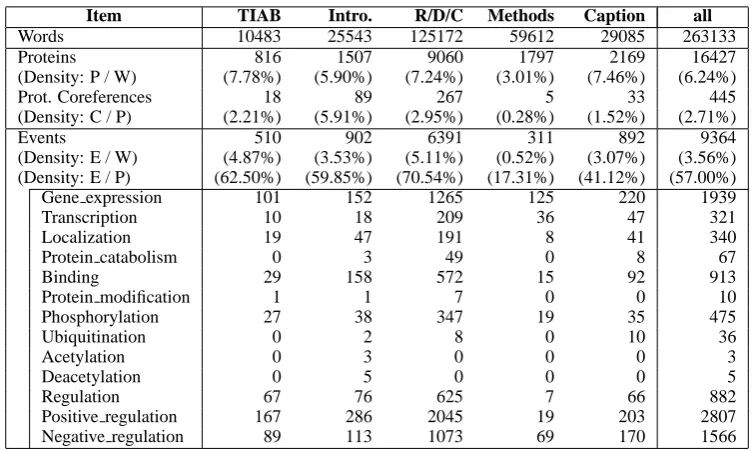
Table 3: Statistics of annotations in different sections of text: the Abstract column is of the abstraction collection (1210 titles and abstracts), and the following columns are of full paper collection (14 full papers). TIAB = title and abstract, Intro. = introduction and background, R/D/C = results, discussions, and conclusions, Methods = methods, materials, and experimental procedures. Some minor sections, supporting information, supplementary material, and synopsis, are ignored. Density = relative density of annotation (P/W = Protein/Word, E/W = Event/Word, and E/P = Event/Protein).
Figure 2: Event distribution in different sections
to newer ones. Note that among 34 papers, 14 were from the full text collection of 2011 edition data sets, and 20 were newly collected this time. The annotation to the all 34 papers were produced by the same annotators who also produced anno-tations for the previous editions of GE task.
The annotated papers are divided into the train-ing, development, and test data sets; 10, 10, and 14, respectively. Note that the size of the training data set is much smaller than previous editions, in terms of number of words and events, while the size of the development and test data sets are
comparable to previous editions. It is the conse-quence of a design choice of the organizers with the notion that (1) relevant resources are substan-tially accumulated through last two editions, and that (2) therefore the importance of training data set may be reduced while the importance of devel-opment and test data sets needs to be kept. Instead, participants may utilize, for example, the abstract collection of the 2011 edition, of which the anno-tation was produced by the same annotators with almost same principles. As another example, the data sets of the EPI task (Ohta et al., 2011) also may be utilized for the newly added protein modi-fication events.
Table 3 shows the statistics of annotated event types in different sections of the full papers in the data sets. For the analysis, the sections are classi-fied to five groups as follows:
• The TIAB group includes the titles and abstracts. In the GE-2011 data sets, the corresponding files match the pattern,
PMC-*TIAB*.txt.
• The Intro group includes sections for introduction, and background. The corresponding files match the pattern,
[image:4.595.77.279.397.544.2]Team ’09 ’11 Task Expertise
EVEX UTurku 123 2C+2BI+1B
TEES-2.1 UTurku 123 2BI
BioSEM TM-SCS 1-- 1C+1BI
NCBI CCP-BTMG 1-- 3BI
DlutNLP 1-- 3C
HDS4NLP 1-- 3C
NICTANLM CCP-BTMG 1-3 6C
USheff 1-- 2C
UZH UZurich 1-- 6C
HCMUS HCMUS 1-- 4C
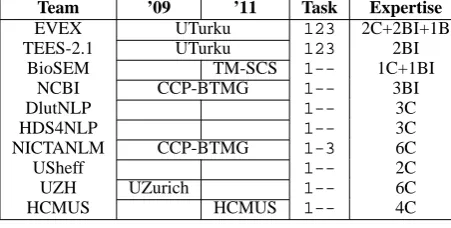
Table 4: Team profiles: The ’09 and ’11 columns show the predecessors in 2009 and 2011 editions. In Expertise column, C=Computer Scientist, BI=Bioinformatician, B=Biologist, L=Linguist
• The R/D/C group includes sections on results, discussions, and conclu-sions. The files match the pattern,
PMC-*@(-|._)@(R|D|Conc)*.txt
• The Methods group includes sections on methods, materials, and experimental pro-cedures. The files match the pattern, PMC-*@(-|._)@(Met|Mat|MAT|E)*.txt
• TheCaptiongroup includes the captions of tables and figures. The corresponding files math the pattern,PMC-*aption*.txt.
Figure 2 illustrates the different distribution of annotated event types in the five section groups. It shows that the Methods group has signifi-cantly different distribution of annotated events, confirming a similar observation reported in Kim et al. (2011b).
4 Participation
The GE task received final submissions from 12 teams, among which 2 were withdrawn from final report. Table 4 summarizes the teams. Unfortu-nately, the subtasks 2 and 3 did not met a large participation.
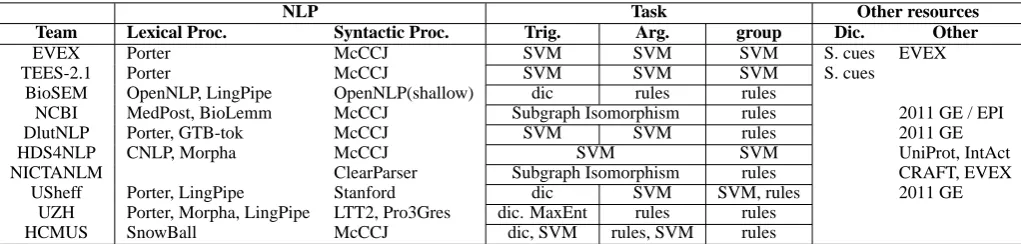
Table 5 profiles the participating systems. The systems are roughly grouped into SVM-based pipeline (EVEX, TEES-2.1, and DlutNLP), rule-based pipeline (BioSEM and UZH), mixed pipeline (USheff and HCMUS), joint pattern matching (NCBIandNICTANLM), and joint SVM (HDS4NLP) systems. In terms of use of ex-ternal resources, 5 teams (EVEX, TEES-2.1,
NCBI,DlutNLP, andUSheff) utilized data sets from 2011 edition, and two teams (HDS4NLPand
NICTANLM) utilized independent resources, e.g.,
UniProt (Bairoch et al., 2005), IntAct (Kerrien et al., 2012), and CRAFT (Verspoor et al., 2012).
[image:5.595.75.301.64.178.2]5 Results and Discussions
Table 6 shows the final results of subtask 1. Over-all EVEX, TEES-2.1, and BioSEM show the best performance only with marginal difference between them. In detail, the performance of
BioSEMis significantly different fromEVEXand
TEES-2.1: (1) whileBioSEMshow the best per-formance with Binding and Protein modification events, EVEXandTEES-2.1show the best per-formance with Regulation events which takes the largest portion of annotation in data sets; and (2) while the performance of EVEX andTEES-2.1
is balanced over recall and precision, BioSEMis biased for precision, which is a typical feature of rule-based systems. It is also notable thatBioSEM
has achieved a near best performance using only shallow parsing. Although it is not shown in the table, NCBI is the only system which produced
Ubiquitination events, which is interpreted as a result of utilizing 2011-EPI data sets (Ohta et al., 2011) for the system development.
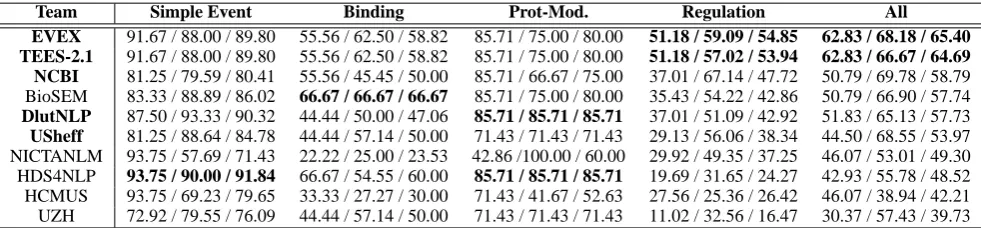
Table 7 shows subtask 1 final results only within TIAB sections. It shows that the systems de-veloped utilizing previous resources, e.g., 2011 data sets, and EVEX, perform better for titles and abstracts, which makes sense because those re-sources are title and abstract-centric.
Tables 8 and 9 show evaluation results within Methods and Captions section groups, respec-tively. All the systems show their worst per-formance in the two section groups. Especially the drop of performance with regulation events is huge. Note the two section groups also show sig-nificantly different event distribution compared to other section groups (see section 3). It suggests that language expression in the two section groups may be quite different from other sections, and an extensive examination is required to get a reason-able performance in the sections.
Table 10 and 11 show final results of Task 2 (Event enrichment) and 3 (Negation/Speculation detection), respectively, which unfortunately did not meet a large participation.
6 Conclusions
NLP Task Other resources Team Lexical Proc. Syntactic Proc. Trig. Arg. group Dic. Other
EVEX Porter McCCJ SVM SVM SVM S. cues EVEX
TEES-2.1 Porter McCCJ SVM SVM SVM S. cues
BioSEM OpenNLP, LingPipe OpenNLP(shallow) dic rules rules
NCBI MedPost, BioLemm McCCJ Subgraph Isomorphism rules 2011 GE / EPI
DlutNLP Porter, GTB-tok McCCJ SVM SVM rules 2011 GE
HDS4NLP CNLP, Morpha McCCJ SVM SVM UniProt, IntAct
NICTANLM ClearParser Subgraph Isomorphism rules CRAFT, EVEX
USheff Porter, LingPipe Stanford dic SVM SVM, rules 2011 GE
UZH Porter, Morpha, LingPipe LTT2, Pro3Gres dic. MaxEnt rules rules
HCMUS SnowBall McCCJ dic, SVM rules, SVM rules
Table 5: System profiles: SnowBall=SnowBall Stemmer, CNLP=Stanford CoreNLP (tokenization), McCCJ=McClosky-Charniak-Johnson Parser, Stanford=Stanford Parser, S.=Speculation, N.=Negation
Team Simple Event Binding Prot-Mod. Regulation All
EVEX 73.83 / 79.56 / 76.59 41.14 / 44.77 / 42.88 61.78 / 69.41 / 65.37 32.41 / 47.16 / 38.41 45.44 / 58.03 / 50.97
TEES-2.1 74.19 / 79.64 / 76.82 42.34 / 44.34 / 43.32 63.87 / 69.32 / 66.49 33.08 / 44.78 / 38.05 46.17 / 56.32 / 50.74
BioSEM 67.71 / 86.90 / 76.11 47.45 / 52.32 / 49.76 69.11 / 80.49 / 74.37 28.19 / 49.06 / 35.80 42.47 / 62.83 / 50.68
[image:6.595.76.587.62.184.2]NCBI 72.99 / 72.12 / 72.55 37.54 / 41.81 / 39.56 64.92 / 77.02 / 70.45 24.74 / 55.61 / 34.25 40.53 / 61.72 / 48.93 DlutNLP 69.15 / 80.56 / 74.42 40.84 / 44.16 / 42.43 62.83 / 77.42 / 69.36 26.49 / 43.46 / 32.92 40.81 / 57.00 / 47.56 HDS4NLP 75.27 / 83.27 / 79.07 41.74 / 33.74 / 37.32 70.68 / 75.84 / 73.17 16.67 / 30.86 / 21.64 37.11 / 51.19 / 43.03 NICTANLM 73.59 / 57.67 / 64.66 32.13 / 31.10 / 31.61 42.41 / 72.97 / 53.64 21.60 / 47.14 / 29.63 36.99 / 50.68 / 42.77 USheff 54.50 / 80.07 / 64.86 31.53 / 46.88 / 37.70 39.79 / 92.68 / 55.68 21.14 / 52.69 / 30.18 31.69 / 63.28 / 42.23 UZH 60.26 / 77.47 / 67.79 22.22 / 28.03 / 24.79 62.30 / 70.83 / 66.30 11.06 / 31.02 / 16.31 27.57 / 51.33 / 35.87 HCMUS 67.47 / 60.24 / 63.65 38.74 / 26.99 / 31.81 64.92 / 57.67 / 61.08 19.60 / 19.93 / 19.76 36.23 / 33.80 / 34.98
Table 6: Evaluation results (recall / precision / f-score) of Task 1. Some notable figures are emphasized in bold.
is kept maintained. Unfortunately, the corefer-ence annotation, which has been integrated in the event annotation in the data sets, was not exploited by the participants, during the official shared task period. An analysis shows that the performance of systems significantly drops in the Methods and Captions sections, suggesting for an extensive ex-amination in the sections.
As usual, after the official shared task period, the GE task is maintaining an online evaluation that can be freely accessed by anyone but with a time limitation; once in 24 hours per a per-son. With a few new features that are introduced in 2013 editions but are not fully exploited by the participants, the organizers solicit participants to continuously explore the task using the online evaluation. The organizers are also planning to provide more resources to the participants, based on the understanding that interactive communica-tion between organizers and participants is impor-tant for progress of the participating systems and also the task itself.
References
Amos Bairoch, Rolf Apweiler, Cathy H. Wu, Winona C. Barker, Brigitte Boeckmann, Serenella Ferro, Elisabeth Gasteiger, Hongzhan Huang, Ro-drigo Lopez, Michele Magrane, Maria J. Mar-tin, Darren A. Natale, Claire O’Donovan, Nicole Redaschi, and Lai-Su L. Yeh. 2005. The universal protein resource (uniprot). Nucleic Acids Research, 33(suppl 1):D154–D159.
Jari Bj¨orne and Tapio Salakoski. 2011. Generaliz-ing biomedical event extraction. In ProceedGeneraliz-ings of
BioNLP Shared Task 2011 Workshop, pages 183–
191, Portland, Oregon, USA, June. Association for Computational Linguistics.
Samuel Kerrien, Bruno Aranda, Lionel Breuza, Alan Bridge, Fiona Broackes-Carter, Carol Chen, Mar-garet Duesbury, Marine Dumousseau, Marc Feuer-mann, Ursula Hinz, Christine Jandrasits, Rafael C. Jimenez, Jyoti Khadake, Usha Mahadevan, Patrick Masson, Ivo Pedruzzi, Eric Pfeiffenberger, Pablo Porras, Arathi Raghunath, Bernd Roechert, Sandra Orchard, and Henning Hermjakob. 2012. The in-tact molecular interaction database in 2012. Nucleic
Acids Research, 40(D1):D841–D846.
Jin-Dong Kim, Tomoko Ohta, Kanae Oda, and Jun’ichi Tsujii. 2008a. From text to pathway: corpus annota-tion for knowledge acquisiannota-tion from biomedical lit-erature. In Proceedings of the 6th Asia Pacific
Bioin-formatics and Computational Biology, pages 165–
176. Imperial College Press.
Jin-Dong Kim, Tomoko Ohta, and Jun’ichi Tsujii. 2008b. Corpus annotation for mining biomedical events from lterature. BMC Bioinformatics, 9(1):10.
Jin-Dong Kim, Tomoko Ohta, Sampo Pyysalo, Yoshi-nobu Kano, and Jun’ichi Tsujii. 2009. Overview of BioNLP’09 Shared Task on Event Extraction. In Proceedings of Natural Language Processing
in Biomedicine (BioNLP) NAACL 2009 Workshop,
pages 1–9.
Jin-Dong Kim, Sampo Pyysalo, Tomoko Ohta, Robert Bossy, and Jun’ichi Tsujii. 2011a. Overview of BioNLP Shared Task 2011. In Proceedings of
the BioNLP 2011 Workshop Companion Volume for Shared Task, Portland, Oregon, June. Association
for Computational Linguistics.
Jin-Dong Kim, Yue Wang, Toshihisa Takagi, and Aki-nori Yonezawa. 2011b. Overview of the Genia Event task in BioNLP Shared Task 2011. In
Pro-ceedings of the BioNLP 2011 Workshop Companion Volume for Shared Task, Portland, Oregon, June.
As-sociation for Computational Linguistics.
David McClosky, Mihai Surdeanu, and Christopher Manning. 2011. Event extraction as dependency parsing. In Proceedings of the 49th Annual
Meet-ing of the Association for Computational LMeet-inguis- Linguis-tics: Human Language Technologies, pages 1626–
1635, Portland, Oregon, USA, June. Association for Computational Linguistics.
Kanae Oda, Jin-Dong Kim, Tomoko Ohta, Daisuke Okanohara, Takuya Matsuzaki, Yuka Tateisi, and Jun’ichi Tsujii. 2008. New challenges for text min-ing: Mapping between text and manually curated pathways.
Tomoko Ohta, Sampo Pyysalo, and Jun’ichi Tsu-jii. 2011. Overview of the Epigenetics and Post-translational Modifications (EPI) task of BioNLP Shared Task 2011. In Proceedings of the BioNLP
2011 Workshop Companion Volume for Shared Task,
Portland, Oregon, June. Association for Computa-tional Linguistics.
Sofie Van Landeghem, Filip Ginter, Yves Van de Peer, and Tapio Salakoski. 2011. Evex: A pubmed-scale resource for homology-based generalization of text mining predictions. In Proceedings of BioNLP 2011
Workshop, pages 28–37, Portland, Oregon, USA,
June. Association for Computational Linguistics.
Team Simple Event Binding Prot-Mod. Regulation All EVEX 91.67 / 88.00 / 89.80 55.56 / 62.50 / 58.82 85.71 / 75.00 / 80.00 51.18 / 59.09 / 54.85 62.83 / 68.18 / 65.40 TEES-2.1 91.67 / 88.00 / 89.80 55.56 / 62.50 / 58.82 85.71 / 75.00 / 80.00 51.18 / 57.02 / 53.94 62.83 / 66.67 / 64.69 NCBI 81.25 / 79.59 / 80.41 55.56 / 45.45 / 50.00 85.71 / 66.67 / 75.00 37.01 / 67.14 / 47.72 50.79 / 69.78 / 58.79 BioSEM 83.33 / 88.89 / 86.02 66.67 / 66.67 / 66.67 85.71 / 75.00 / 80.00 35.43 / 54.22 / 42.86 50.79 / 66.90 / 57.74
DlutNLP 87.50 / 93.33 / 90.32 44.44 / 50.00 / 47.06 85.71 / 85.71 / 85.71 37.01 / 51.09 / 42.92 51.83 / 65.13 / 57.73
[image:8.595.76.567.70.184.2]USheff 81.25 / 88.64 / 84.78 44.44 / 57.14 / 50.00 71.43 / 71.43 / 71.43 29.13 / 56.06 / 38.34 44.50 / 68.55 / 53.97 NICTANLM 93.75 / 57.69 / 71.43 22.22 / 25.00 / 23.53 42.86 /100.00 / 60.00 29.92 / 49.35 / 37.25 46.07 / 53.01 / 49.30 HDS4NLP 93.75 / 90.00 / 91.84 66.67 / 54.55 / 60.00 85.71 / 85.71 / 85.71 19.69 / 31.65 / 24.27 42.93 / 55.78 / 48.52 HCMUS 93.75 / 69.23 / 79.65 33.33 / 27.27 / 30.00 71.43 / 41.67 / 52.63 27.56 / 25.36 / 26.42 46.07 / 38.94 / 42.21 UZH 72.92 / 79.55 / 76.09 44.44 / 57.14 / 50.00 71.43 / 71.43 / 71.43 11.02 / 32.56 / 16.47 30.37 / 57.43 / 39.73
Table 7: Evaluation results (recall / precision / f-score) of Task 1 in titles and abstracts. Some notable figures are emphasized in bold.
Team Simple Event Binding Prot-Mod. Regulation All
BioSEM 70.83 / 90.44 / 79.44 48.24 / 53.93 / 50.93 74.17 / 82.41 / 78.07 28.74 / 51.25 / 36.83 42.97 / 64.90 / 51.70
[image:8.595.74.564.424.542.2]EVEX 73.51 / 83.26 / 78.08 43.72 / 47.80 / 45.67 66.67 / 66.12 / 66.39 32.79 / 46.79 / 38.56 45.29 / 58.05 / 50.88 TEES-2.1 74.09 / 83.37 / 78.46 43.72 / 47.80 / 45.67 66.67 / 65.04 / 65.84 33.24 / 44.48 / 38.04 45.70 / 56.34 / 50.46 NCBI 74.28 / 75.59 / 74.93 38.19 / 45.24 / 41.42 67.50 / 81.82 / 73.97 24.69 / 55.46 / 34.17 40.01 / 63.56 / 49.11 DlutNLP 70.06 / 84.49 / 76.60 39.20 / 44.32 / 41.60 67.50 / 74.31 / 70.74 27.78 / 43.23 / 33.83 41.01 / 56.70 / 47.60 NICTANLM 75.24 / 57.14 / 64.95 35.68 / 41.76 / 38.48 52.50 / 76.83 / 62.38 22.33 / 46.83 / 30.24 37.73 / 52.30 / 43.84 USheff 56.81 / 80.43 / 66.59 32.66 / 48.15 / 38.92 45.00 / 94.74 / 61.02 21.67 / 53.55 / 30.85 32.27 / 63.93 / 42.89 HDS4NLP 76.20 / 84.65 / 80.20 41.21 / 38.14 / 39.61 75.83 / 75.21 / 75.52 16.58 / 30.16 / 21.40 36.19 / 51.26 / 42.42 UZH 63.53 / 78.25 / 70.13 23.12 / 28.75 / 25.63 66.67 / 74.07 / 70.18 10.61 / 29.39 / 15.59 27.36 / 50.89 / 35.58 HCMUS 67.18 / 62.84 / 64.94 38.19 / 28.15 / 32.41 67.50 / 61.83 / 64.54 19.45 / 20.11 / 19.78 35.09 / 33.95 / 34.51
Table 8: Evaluation results (recall / precision / f-score) of Task 1 in Methods section group. Some notable figures are emphasized in bold.
Team Simple Event Binding Prot-Mod. Regulation All
TEES-2.1 76.67 / 67.65 / 71.88 53.19 / 46.30 / 49.50 60.61 / 76.92 / 67.80 22.68 / 39.29 / 28.76 43.41/53.74 / 48.02
BioSEM 60.00 / 78.26 / 67.92 68.09 / 58.18 / 62.75 69.70 / 82.14 / 75.41 23.20 / 34.35 / 27.69 42.31/54.42 / 47.60 EVEX 76.67 / 67.65 / 71.88 53.19 / 46.30 / 49.50 48.48 / 72.73 / 58.18 21.13 / 39.81 / 27.61 41.48/53.74 / 46.82 DlutNLP 70.00 / 67.02 / 68.48 55.32 / 48.15 / 51.49 57.58 / 79.17 / 66.67 18.04 / 46.67 / 26.02 39.29/57.89 / 46.81 NCBI 80.00 / 58.54 / 67.61 40.43 / 41.30 / 40.86 66.67 / 70.97 / 68.75 14.95 / 44.62 / 22.39 39.01/53.58 / 45.15 HDS4NLP 78.89 / 78.02 / 78.45 48.94 / 29.49 / 36.80 66.67 / 68.75 / 67.69 06.19 / 14.63 / 08.70 35.16/45.23 / 39.57 UZH 57.78 / 68.42 / 62.65 23.40 / 26.19 / 24.72 69.70 / 74.19 / 71.88 12.89 / 43.10 / 19.84 30.49/53.62 / 38.88 USheff 47.78 / 74.14 / 58.11 36.17 / 45.95 / 40.48 30.30 /100.00 / 46.51 13.40 / 45.61 / 20.72 26.37/59.26 / 36.50 NICTANLM 75.56 / 53.12 / 62.39 40.43 / 27.94 / 33.04 18.18 / 54.55 / 27.27 11.34 / 36.67 / 17.32 31.59/43.07 / 36.45 HCMUS 73.33 / 52.80 / 61.40 53.19 / 25.51 / 34.48 63.64 / 53.85 / 58.33 15.46 / 17.96 / 16.62 39.01/33.10 / 35.81
Table 9: Evaluation results (recall / precision / f-score) of Task 1 in Captions section group. Some notable figures are emphasized in bold.
Team Site-Binding Site-Phosphorylation Loc-Localization Total
TEES-2.1 31.37 / 56.14 / 40.25 37.21 / 82.05 / 51.20 36.67 / 78.57 / 50.00 22.03 / 61.90 / 32.50 EVEX 31.37 / 56.14 / 40.25 32.56 / 80.00 / 46.28 36.67 / 78.57 / 50.00 20.90 / 61.67 / 31.22
Table 10: Evaluation results (recall / precision / f-score) of Task 2
Team Negation Speculation Total
TEES-2.1 21.68 / 36.84 / 27.30 18.46 / 33.96 / 23.92 19.53 / 35.59 / 25.22 EVEX 20.98 / 38.03 / 27.04 18.46 / 32.73 / 23.61 19.82 / 34.41 / 25.15 NICTANLM 15.38 / 32.76 / 20.94 14.36 / 34.15 / 20.22 14.79 / 33.57 / 20.54