Learning Distributed Word Representations For
Bidirectional LSTM Recurrent Neural Network
∗Peilu Wang1,2†, Yao Qian3, Hai Zhao1‡, Frank K. Soong2, Lei He2, Ke Wu1 1Shanghai Jiao Tong University, Shanghai, China
2Microsoft Research Asia, Beijing, China 3Educational Testing Service Research, CA, USA
[email protected], [email protected], [email protected]
{frankkps, helei}@microsoft.com,[email protected]
Abstract
Bidirectional long short-term memory (BLSTM) recurrent neural network (RNN) has been successfully applied in many tagging tasks. BLSTM-RNN relies on the distributed representation of words, which implies that the former can be futhermore improved through learning the latter better. In this work, we propose a novel approach to learn distributed word representations by training BLSTM-RNN on a specially designed task which only relies on unlabeled data. Our experimental results show that the proposed approach learns useful distributed word representations, as the trained representations significantly elevate the performance of BLSTM-RNN on three tagging tasks: part-of-speech tagging, chunking and named entity recognition, surpassing word representations trained by other published methods.
1 Introduction
Distributed word representations represent word with a real valued vector, which is also referred to
∗
The work was partially supported by the National Natural Science Foundation of China (Grant No. 61170114, and Grant No. 61272248), the National Basic Research Program of China (Grant No. 2013CB329401), the Science and Technology Com-mission of Shanghai Municipality (Grant No. 13511500200), the European Union Seventh Framework Program (Grant No. 247619), the Cai Yuanpei Program (CSC fund 201304490199, 201304490171), and the art and science interdisciplinary funds of Shanghai Jiao Tong University, No. 14X190040031, and the Key Project of National Society Science Foundation of China, No. 15-ZDA041.
†
*Work performed as an intern in speech group, Microsoft Research Asia
‡
Corresponding author
as word embedding. Well learned distributed word representations have been shown capable of captur-ing semantic and syntactic regularities (Penncaptur-ington et al., 2014a; Mikolov et al., 2013c) and enhanc-ing neural network model by beenhanc-ing used as features (Collobert and Weston, 2008; Bengio and Heigold, 2014; Wang et al., 2015).
Sequence tagging is a basic structure learning task for natural language processing. Many primary pro-cessing tasks over sentence such as word segmen-tation, named entity recognition and part-of-speech tagging can be formalized as a tagging task (Zhao et al., 2006; Huang and Zhao, 2007; Zhao and Kit, 2008b; Zhao and Kit, 2008a; Zhao et al., 2010; Zhao and Kit, 2011). Recently, many state-of-the-art sys-tems of tagging related tasks are implemented with bidirectional long short-term memory (BLSTM) re-current neural network (RNN), for example, slot filling (Mesnil et al., 2013), part-of-speech tagging (Huang et al., 2015), and dependency parsing (Dyer et al., 2015) etc. All of these systems use distributed representation of words to involve word level infor-mation. Better trained word representations would further improve the state-of-the-art performance of these tasks which makes it worthy to research the training methods of word representations.
The existing training methods of word represen-tation can generally be divided into two classes: 1) Matrix factorization methods. These methods uti-lize low-rank approximation to decompose a large matrix that contains corpus statistics. One typical work is the latent semantic analysis (LSA) (Deer-wester et al., 1990) in which the matrix records “term-document” information, i.e., the rows
respond to words, and the columns correspond to different documents in the corpus. Another work is hyperspace analogue to language (HAL) (Lund and Burgess, 1996) which decomposes the matrix recording “term-term” information, i.e., the rows correspond to words and columns correspond to the number of times that a word occurs in the given context. 2) Window-based methods. This type of methods learn representations by training a neural network model to make prediction within local con-text windows. For example, (Bengio et al., 2003) learns word representation through a feedforward neural network language model which predicts a word given its previous several words. (Collobert et al., 2011) trains a neural network to judge the va-lidity of a given context. (Mikolov et al., 2013a) proposes skip-gram and continuous bag-of-words (CBOW) models based on a single-layer network ar-chitecture. The objective of skip-gram model is to predict the context given the word itself, while the objective of CBOW is to predict a word given its context. Aside from these two sets of methods, dis-tributed representation can also be obtained by train-ing recurrent neural network (RNN) language model proposed by (Mikolov et al., 2010) or GloVe model proposed by (Pennington et al., 2014a) which trains a log-bilinear model on word-word co-occurrence counts.
All of these methods suffer from shortcomings that might limit the quality of trained word distri-butions. The matrix factorization family only uses the statistics of co-occurrence counts, disregarding of the position of word in sentence and word or-der. The window-based methods only consider local context, which is incapable of involving information outside the context window. While RNN language model theoretically considers all information of the previous sequence, but fails to involve the informa-tion of the posterior sequence. The word-word co-occurence counts that GloVe model relies on also only include information within a limited sized con-text window.
In this paper, we propose a novel method to ob-tain word representation by training BLSTM-RNN model on a specifically designed tagging task. Since BLSTM-RNN theoretically involves all information of input sentence, our approach avoids those short-ages suffered by most current methods.
We firstly introduce the structure of BLSTM-RNN used to learn word representations in section 2. Then the tagging task for training BLSTM-RNN is described in section 3. Experiments are presented in section 4, followed by conclusion.
2 Model Structure
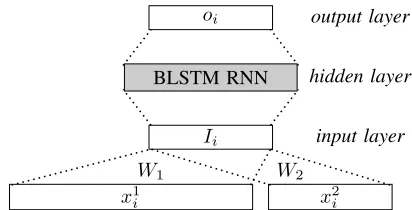
The structure of BLSTM-RNN to train word rep-resentation is illustrated in Figure 1. Each input is composed of a word identityx1
i and additional
real-valued featuresx2
i. x1i is represented with one-hot
representation which is a binary vector with dimen-sion|V|whereV is the vocabulary. The input vector Iiof the network is computed as:
Ii =W1x1i +W2x2i
whereW1 and W2 are weight matrixes connecting
two layers and are updated with the neural network during training. W1x1i is also known as the
dis-tributed representation of word or word embedding which is a real-valued vector usually with a much smaller dimension than x1
i. Distributed
represen-tation trained in other tasks can be easily incorpo-rated by initializing W1 with these external
repre-sentations.
3 Learning Representation
According to the structure shown in Figure 1, W1
is a matrix of weights that is updated during train-ing, thus the distributed representations contained in W1 are learned simultaneously with the
train-ing of BLSTM-RNN on any supervised learntrain-ing tasks. However, all such tasks for BLSTM-RNN, to the best of our knowledge, require labeled data which is usually too small in size and hard to ob-tain. In this section, we propose a tagging task spe-cially for BLSTM-RNN to train distributed repre-sentations with unlabeled data.
x1
i x2i
Ii input layer
BLSTM RNN hidden layer
oi output layer
[image:3.612.192.398.58.163.2]W1 W2
Figure 1:BLSTM-RNN for training word representation.
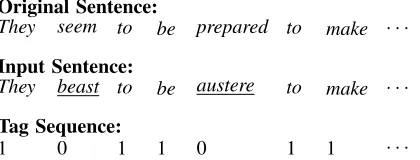
threshold. For those replaced words, their tags are 0 (incorrect) and for those that are not replaced, their tags are 1 (correct). A simple sample of constructed corpus is shown in Figure 2. Although it is possible that some replaced words are also reasonable in the sentence, they are still considered “incorrect”. Then BLSTM-RNN is trained to judge which words have been replaced by minimizing the binary classifica-tion error on the training corpus. When the network is trained, W1 contains all trained word
representa-tions. In our experiments, to reduce the vocabulary V, each letter of input word is transferred to its low-ercase. The upper case information is kept in an additional features x2
i which in practice is a
three-dimensional binary vector to indicate if x1 i is full
lowercase, full uppercase or leading with a capital letter.
Our approach is similar to (Collobert and We-ston, 2008) and (Gutmann and Hyv¨arinen, 2012; Mnih and Teh, 2012; Vaswani et al., 2013). All of these works introduce randomly sampled words and train a neural network on a binary classification task, while (Collobert and Weston, 2008) learns represen-tations for a feedforward network and (Gutmann and Hyv¨arinen, 2012; Mnih and Teh, 2012; Vaswani et al., 2013) learns normalization parameters instead of representations.
4 Experiments
4.1 Experimental setup
To construct corpus for training word representa-tions, we use North American news (Graff, 2008) which contains about 536 million words as un-labeled data. The North American news data is first tokenized with the Penn Treebank tokenizer
script1. Consecutive digits occurring within a word
are replaced with the symbol “#” . For example, both words “tel92” and “tel6” are converted into “tel#”. The vocabulary is limited to the most fre-quent 100,000 words in North American news cor-pus (Graff, 2008), plus one single “UNK” sym-bol for replacing all out of vocabulary words. The threshold to determine whether a word is replaced is 0.2, which means about 20% tokens in corpus are re-placed with tokens randomly selected from vocabu-lary. BLSTM-RNN is implemented based on CUR-RENNT (Weninger et al., 2014), an open source GPU-based toolkit of BLSTM-RNN. The dimension of word representation as well as input layer size of BLSTM-RNN is 100 and hidden layer size is 128.
Three published methods for training word repre-sentations are compared:Skip-gram(Mikolov et al., 2013a), CBOW (Mikolov et al., 2013a) and GloVe
(Pennington et al., 2014a). They are reported su-perior in capturing meaningful latent structures than other previous works in (Mikolov et al., 2013a; Pen-nington et al., 2014a), thus are regarded as the state-of-the-art approach of training word representations. We train theSkip-gramandCBOWmodel using the word2vec tool (Mikolov et al., 2013b) with a con-text window size of 10 and 10 negative samples. For trainingGloVe, we use the GloVe tool (Pennington et al., 2014b) with a context window size 10. These configurations are set by following (Pennington et al., 2014a). Training corpus, vocabulary and dimen-sion of word representations are set the same as that in experiment for training word representations with BLSTM-RNN2.
1https://www.cis.upenn.edu/˜treebank/
tokenization.html
2Our experimental setup are released at: https://
Original Sentence:
They seem to be prepared to make . . .
Input Sentence:
They beast to be austere to make . . .
Tag Sequence:
[image:4.612.194.404.61.141.2]1 0 1 1 0 1 1 . . .
Figure 2:Sample of constructed corpus for training word representations. Two words “seem” and “prepared” are replaced with words randomly chosen from vocabulary.
Sys POS(Acc.) CHUNK(F1) NER(F1)
BLSTM 96.60 91.71 82.52
BLSTM+CBOW 96.73 92.14 84.37
BLSTM+Skip 96.85 92.45 85.80
BLSTM+GloVe 97.02 93.01 87.33
BLSTM+BLSTMWE 97.26 94.44 88.38
Table 1:Performance of BLSTM-RNN with different representations on three tagging tasks
4.2 Evaluation
The quality of trained distributed representation is evaluated by the performance of BLSTM-RNN which uses the trained representations on practical tasks. The representations which lead to better per-formance are considered containing more useful la-tent information and are judged better. The struc-ture of BLSTM-RNN to test word representations is the same as that in Figure1. To use trained repre-sentation, we initialize the weight matrix W1 with
these external representations. For words without corresponding external representations, their repre-sentations are initialized with uniformly distributed random values, ranging from -0.1 to 0.1. Three typ-ical tagging tasks are used for the evaluation: part-of-speech tagging (POS), chunking (CHUNK) and named entity recognition (NER).
• The POS tagging experiment is conducted on the Wall Street Journal data from Penn Tree-bank III (Marcus et al., 1993). Training, devel-opment and test sets are split according to in (Collins, 2002). Performance is evaluated by the accuracy of predicted tags on test set.
• CHUNK experiment is conducted on the data of CoNLL-2000 shared task (Sang and Buch-holz, 2000). Performance is assessed by the F1 score computed by the evaluation script
re-leased by the CoNLL-2000 shared task3.
• NER experiment is conducted on the CoNLL-2003 shared task (Tjong Kim Sang and De Meulder, 2003). Performance is measured by the F1 score calculated by the evaluation script of the CoNLL-2003 shared task4.
To focus on the effect of word representation, for all tasks, we use the network with the same hid-den structure and input features. The size of input layer is 100, size of BLSTM hidden layer is 128 and output layer size is set as the number of tag types according to the specific tagging task. Input features are composed of word identity and three-dimensional binary vector to indicate if the word is full lowercase, full uppercase or leading with a cap-ital letter.
Table 1 presents the performance of BLSTM-RNN with different distributed representations on these three tasks. BLSTM is the baseline sys-tem that does not involve external word representa-tions. Among all representations,BLSTMWEwhich is trained by our approach gets the best performance on all three tasks. It shows our approach is more helpful for BLSTM-RNN. Besides, all of the three published word representations also significantly
en-3http://www.cnts.ua.ac.be/conll2000/
chunking
Sys POS(Acc.) CHUNK(F1) NER(F1)
BLSTMWE(10M) 96.61 91.91 84.66
BLSTMWE(100M) 97.10 93.86 86.47
[image:5.612.161.448.59.118.2]BLSTMWE(536M) 97.26 94.44 88.38 Table 2:Performance of BLSTMWE trained on corpora with different size
Skip-gram CBOW GloVe BLSTM RNN
Time (min.) 344 117 127 1393
Table 3:Running time of different training methods
hance BLSTM RNN. It confirms the commonly ac-cepted notion that word representation is a useful feature.
4.3 Analysis
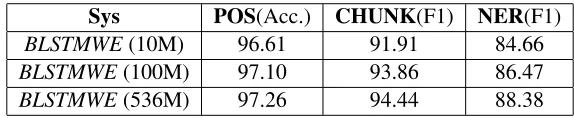
Table 2 shows the performance of word rep-resentations trained on corpora with different size. BLSTMWE (10M), BLSTMWE (100M) and
BLSTMWE(536M) are word representations respec-tively trained by BLSTM-RNN on the first 10 lion words, first 100 million words and all 536 mil-lion words of the North American news corpus. As expected, there is a monotonic increase in perfor-mance as the corpus size increases. This observation suggests that the result might be further improved by using even bigger unlabeled data.
Table 3 presents running time with different meth-ods to train word representations on 536 million words corpus. BLSTM-RNN is trained on one NVIDIA Tesla M2090 GPU. The other three meth-ods are trained on a 12 core, 2.53GHz Intel Xeon E5649 machine, using 12 threads. Though with the help of GPU, BLSTM-RNN is still slower than the other methods. However, it should be noted that the speed of our approach is acceptable compared with previous neural network language model based methods, including (Bengio et al., 2003; Mikolov et al., 2010; Mnih and Hinton, 2007), as our model uses a much simpler output layer which only has two nodes, avoiding the time consuming computation of the big softmax output layer in language model.
5 CONCLUSION
In this paper, we propose a novel approach to learn distributed word representations with
BLSTM-RNN. Word representations are implemented as the layer weights and are obtained as a byproduct of training BLSTM-RNN on a specially designed task, thus theoretically involve information of the whole sentence. The quality of word representations are evaluated by the performance of BLSTM-RNN which uses these representations on three tagging tasks: part-of-speech tagging, chunking and named entity recognition. In experiments, word representa-tions trained by our approach outperform the word representations trained by other published methods. Our work demonstrates an alternative way to im-prove BLSTM-RNN’s performance by learning use-ful word representations.
References
Samy Bengio and Georg Heigold. 2014. Word em-beddings for speech recognition. InINTERSPEECH, pages 1053–1057.
Yoshua Bengio, Rejean Ducharme, Pascal Vincent, and Christian Jauvin. 2003. A neural probabilistic lan-guage model. In Journal of Machine Learning
Re-search (JMLR), volume 3, pages 1137–1155.
Michael Collins. 2002. Discriminative training meth-ods for Hidden Markov Models: Theory and experi-ments with perceptron algorithms. InProceedings of Empirical Methods in Natural Language Processing
(EMNLP), pages 1–8.
Ronan Collobert and Jason Weston. 2008. A unified ar-chitecture for natural language processing: Deep neu-ral networks with multitask learning. In Proceed-ings of International Conference on Machine Learning
(ICML), pages 160–167.
Journal of Machine Learning Research (JMLR), 12:2493–2537.
Scott Deerwester, Susan Dumais, Thomas Landauer, George Furnas, and Richard Harshman. 1990. Index-ing by latent semantic analysis. JASIS, 41(6):391–407. Chris Dyer, Miguel Ballesteros, Wang Ling, Austin Matthews, and Noah A. Smith. 2015. Transition-based dependency parsing with stack long short-term memory. InProceedings of Association for Computa-tional Linguistics (ACL), pages 334–343.
David Graff. 2008. North American News Text, Com-plete LDC2008T15. https://catalog.ldc.
upenn.edu/LDC2008T15.
Michael Gutmann and Aapo Hyv¨arinen. 2012. Noise-contrastive estimation of unnormalized statistical models, with applications to natural image statis-tics. Journal of Machine Learning Research (JMLR), 13:307–361.
Changning Huang and Hai Zhao. 2007. Chinese word segmentation: A decade review. Journal of Chinese Information Processing, 21(3):8–20.
Zhiheng Huang, Wei Xu, and Kai Yu. 2015. Bidi-rectional LSTM-CRF models for sequence tagging.
arXiv:1508.01991.
Kevin Lund and Curt Burgess. 1996. Producing high-dimensional semantic spaces from lexical co-occurrence. Behavior Research Methods, Instruments, & Computers, 28(2):203–208.
Mitchell Marcus, Mary Ann Marcinkiewicz, and Beatrice Santorini. 1993. Building a large annotated corpus of English: The Penn Treebank. Computational linguis-tics (CL), 19(2):313–330.
Gr´egoire Mesnil, Xiaodong He, Li Deng, and Yoshua Bengio. 2013. Investigation of recurrent-neural-network architectures and learning methods for spoken language understanding. In INTERSPEECH, pages 3771–3775.
Tomas Mikolov, Martin Karafi´at, Lukas Burget, Jan Cer-nock`y, and Sanjeev Khudanpur. 2010. Recurrent neural network based language model. In
INTER-SPEECH, pages 1045–1048.
Tomas Mikolov, Kai Chen, Greg Corrado, and Jeffrey Dean. 2013a. Efficient estimation of word representa-tions in vector space. arXiv preprint arXiv:1301.3781. Tomas Mikolov, Kai Chen, Greg Corrado, and Jef-frey Dean. 2013b. word2vec. https://code.
google.com/p/word2vec/.
Tomas Mikolov, Ilya Sutskever, Kai Chen, Greg Corrado, and Jeff Dean. 2013c. Distributed representations of words and phrases and their compositionality. In ceedings of Conference on Neural Information
Pro-cessing Systems (NIPS), pages 3111–3119.
Andriy Mnih and Geoffrey Hinton. 2007. Three new graphical models for statistical language modelling. In
Proceedings of International Conference on Machine
Learning (ICML), pages 641–648.
Andriy Mnih and Yee Whye Teh. 2012. A fast and sim-ple algorithm for training neural probabilistic language models. InProceedings of International Conference
on Machine Learning (ICML), pages 1751–1758.
Jeffrey Pennington, Richard Socher, and Christopher Manning. 2014a. Glove: Global vectors for word rep-resentation. InProceedings of Empirical Methods in
Natural Language Processing (EMNLP), pages 1532–
1543.
Jeffrey Pennington, Richard Socher, and Christopher D. Manning. 2014b. GloVe. http://nlp.
stanford.edu/projects/glove/.
Erik Tjong Kim Sang and Sabine Buchholz. 2000. Intro-duction to the CoNLL-2000 shared task: Chunking.
In Proceedings of Conference on Natural Language
Learning (CoNLL), pages 127–132.
Erik Tjong Kim Sang and Fien De Meulder. 2003. Intro-duction to the CoNLL-2003 shared task: Language-independent named entity recognition. In Proceed-ings of Conference on Natural Language Learning
(CoNLL), pages 142–147.
Ashish Vaswani, Yinggong Zhao, Victoria Fossum, and David Chiang. 2013. Decoding with large-scale neu-ral language models improves translation. In Proceed-ings of Empirical Methods in Natural Language
Pro-cessing (EMNLP), pages 1387–1392.
Peilu Wang, Yao Qian, Frank Soong, Lei He, and Hai Zhao. 2015. Word embedding for recurrent neural network based tts synthesis. InProceedings of Inter-national Conference on Acoustics, Speech, and Signal
Processing (ICASSP), pages 4879–4883.
Felix Weninger, Johannes Bergmann, and Bj¨orn Schuller. 2014. Introducing CURRENNT–the Munich open-source CUDA recurrent Neural Network Toolkit.
Journal of Machine Learning Research (JMLR),
16(1):547–551.
Hai Zhao and Chunyu Kit. 2008a. An empirical compar-ison of goodness measures for unsupervised chinese word segmentation with a unified framework. In Pro-ceedings of International Joint Conference on Natural
Language Processing (IJCNLP), volume 1, pages 9–
16.
Hai Zhao and Chunyu Kit. 2008b. Unsupervised seg-mentation helps supervised learning of character tag-ging for word segmentation and named entity recog-nition. InSIGHAN Workshop on Chinese Language Processing, pages 106–111.
role of goodness measures. Information Sciences, 181(1):163–183.
Hai Zhao, Chang-Ning Huang, and Mu Li. 2006. An im-proved chinese word segmentation system with condi-tional random field. InSIGHAN Workshop on Chinese
Language Processing, pages 162–165.