Annotating Entailment Relations for Shortanswer Questions
Simon Ostermann, Andrea Horbach, Manfred Pinkal
Department of Computational Linguistics, Saarland University, Saarbr¨ucken, Germany
(simono|andrea|pinkal)@coli.uni-saarland.de
Abstract
This paper presents an annotation project that explores the relationship between tex-tual entailment and short answer scoring (SAS). We annotate entailment relations between learner and target answers in the Corpus of Reading Comprehension Ex-ercises for German (CREG) with a fine-grained label inventory and compare them in various ways to correctness scores as-signed by teachers. Our main finding is that although both tasks are clearly related, not all of our entailment tags can be di-rectly mapped to SAS scores and that es-pecially the area of partial entailment cov-ers instances that are problematic for auto-matic scoring and need further investiga-tion.
1 Introduction
Reading comprehension exercises are a standard task in foreign language education: Students read a text in the language they are learning and answer questions about it. With the advent of computer-based language learning courses, the automatic scoring of such shortanswer questions has become an important research topic (for an overview see Burrows et al. (2015); Ziai et al. (2012)), not only for reading and listening comprehension in the context of foreign language learning, but also e.g. in science questions for native speaker students.
It has been often noted that the SAS task is related to the task of recognizing textual entail-ment (RTE, e.g. Mohler et al. (2011), Sukkarieh and Blackmore (2009), Dzikovska et al. (2013b)). RTE is the task to decide whether there is an in-ference relation between two texts; in the case of SAS, these texts are the learner answer (LA), given by a student, and a teacher-specified target answer (TA, i.e. a sample solution). An entailment
relation between two textsAandBis given if peo-ple readingAandBwould infer that wheneverA
is true,Bis most likely true as well (Dagan et al., 2013).
Consider the following example:1
(1) Q:Why did Julchen come to the kitchen?
TA: She came to the kitchen because of the noise her parents made.
LA:She came to the kitchen because Mr. and Mrs. Muschler became out of breath from laughing.
In this example, the LA textually (but not log-ically) entails the TA. In a strictly logical sense of entailment, laughing until you are out of breath does not entail making noise. However, it seems plausible to many people that laughing in that way makes a lot of noise. Such a learner answer that is more specific than the target answer – and thus entails the target answer – is likely to be scored as correct by a teacher.
In some aspects, SAS for reading comprehen-sion in a language learning scenario differs from a standard textual entailment scenario: Whereas in standard RTE, two texts are compared, in the SAS scenario the additional context of the question has to be accounted for in terms of information struc-ture and resolution of anaphora and ellipses. Ad-ditionally, when processing learner language one often has to deal with ungrammatical sentences and orthographical variance that are challenging for many NLP tools, up to the extent that it is sometimes difficult to understand what the learner wanted to express with an answer (the so-called
target hypothesis).
In this study, we want to explicitly assess the re-lation between RTE labels and correctness scores assigned by teachers. We assume that they are re-lated, but we expect that the relation is not a direct
1All examples are taken from the CREG corpus and
trans-lated by the authors preserving linguistic errors whenever possible.
mapping. We expect, for example, that, if a LA entails a TA and vice versa at the same time, i.e. if they are paraphrases, then the LA will probably be scored as correct by a teacher. On the other hand, the fact that there is only some partial conceptual overlap between a LA and a TA does not constitute entailment, but is in some instances enough for an answer to be scored as correct by a teacher.
We present in this paper the first part of an an-notation project that aims at investigating the re-lationship between SAS and RTE and that com-pares existing binary correctness scores annotated by teachers to RTE annotations that have been conducted without the correctness or quality of the learner answer in mind. (In future work, we will also look at the relation between reading texts and learner answers.)
Understanding these relations better will poten-tially help us to leverage techniques from RTE for the task of SAS in a more efficient way and to shed light on the the way teachers score shortanswer questions.
This paper makes the following contributions:
• We provide a fine-grained annotation of the Corpus of Reading Comprehension Exercises in German (CREG) (Ott et al., 2012) with 7 textual entailment labels that specify the entailment relations between learner answers and target answers.
• We provide an evaluation of our annotations that compares how our label distribution cor-responds to the distribution of binary teacher scores in CREG.
• State of the art binary scoring approaches la-bel only about 86% of the corpus correctly (Hahn and Meurers, 2012). In order to un-derstand the challenges of automatic scoring better, we evaluate which instances in terms of our entailment annotation labels are most problematic for automatic scoring with a bi-nary label.
• We will further explore the relation between textual entailment and SAS by comparing, how well features from shortanswer scoring tasks can be used to learn our classification.
2 Related Work
Recognizing textual entailment and automatic shortanswer scoring are two related tasks in which
text pairs are labeled with the relation between them:
The RTE task in its original formulation (Da-gan and Glickman, 2004) is a binary classification task deciding whether atext tentails ahypothesis h. The two-way task has been extended to a 3-way task involving the labels Entailed, Contradicted
and Unknown (Giampiccolo et al., 2007). An-nual RTE shared tasks led to a growing community with a large number of approaches, cf. (Dagan et al., 2013). MacCartney and Manning (2009a) pro-posed an extension of the classification schema to a much more fine-grained inventory of 7 semantic relations that expresses additional concepts such asequivalenceandreverse entailmentand also in-spired our label set.
In SAS, the task is to assign a student answer a score that specifies the correctness of the answer. Many approaches to SAS compare learner answers given by a student to target answers specified by a teacher and rely on some measure of surface or semantic overlap between them (e.g. Bailey and Meurers (2008); Meurers et al. (2011); Mohler et al. (2011)) or measure whether teacher-specified aspects of a correct answer (so-called facets) are addressed in the learner answer (Nielsen et al., 2008).
In SAS corpora, the label for an answer is a bi-nary score, stating whether the LA is correct or incorrect. Some data sets also provide annotations with points from an integer scale (e.g. Mohler and Mihalcea (2009) or the kaggle SAS competition
2). Other data use more meaningful diagnostic
la-bels such as Ott et al. (2012) and Bailey and Meur-ers (2008) that provide feedback to the learner.
In our study, we primarily rely on binary cor-rectness scores for our comparisons. For the RTE task, we see LA and TA as text and hypothesis and expect that entailment will correlate with correct-ness: While a LA paraphrasing the TA should def-initely count as correct, making the LA more spe-cific should not make it incorrect either. However, omitting crucial information from the TA will po-tentially make the LA incorrect.
SemEval-2013 task 7 (Dzikovska et al., 2013b) took a first step in bringing together the RTE and the SAS community in a task to label student an-swers to explanation and definition questions with 5 RTE-labels. The data set used there (Dzikovska et al., 2012) focuses on science questions (Nielsen
et al., 2008) and physics questions from tutorial di-alogues (Dzikovska et al., 2010), i.e. in contrast to our scenario they deal with native speakers – thus avoiding problems in processing learner language – and the questions do not refer to a specific read-ing text. Most importantly, our perspective on the relation between SAS and RTE also differs from the SemEval definition: The SemEval task uses RTE labels that are constructed from labels as-signed by teachers as meaningful feedback to stu-dents. They assume that there is a direct mapping from RTE labels to binary teacher scores and con-struct their binary data set from collapsing those labels. Their approach is backed up by a small feasibility study that shows the correspondence of the RTE and SAS label sets in their setting. In our study, we consider RTE and SAS as different tasks and want to explore their relation. We there-fore compare labeling from a RTE perspective and scoring from a teacher’s point of view.
Both within the context of the SemEval task and already before, RTE approaches have been used for SAS. Levy et al. (2013) try to recognizepartial entailmentbased on the facet approach by Nielsen et al. (2008) and aim at exploring its possible im-pact on recognizing full entailment relations on learner data as part of the SemEval-2013 task 7. Consequently, they also see the tasks of RTE and SAS as equivalent. In contrast to this, Mohler et al. (2011) present a SAS approach that uses techniques from RTE (e.g. a dependency graph matching approach, cf. Haghighi et al. (2005)), but clearly point out that although their system uses those methods, it cannot be seen as RTE system.
3 Annotations
3.1 Data Set
We use the Corpus of Reading Comprehension Exercises in German (CREG) (Ott et al., 2012), a prominent resource for shortanswer scoring data for German as a Foreign Language, as basis for our annotations. It contains 1032 learner answers (half of which have been scored as correct, the other half as incorrect by teachers), answering 177 dif-ferent questions about a total of 32 texts together with teacher-specified target answers. Sometimes the corpus contains more than one target answer for a question. In such cases the corpus provides annotations that link every learner answer to ex-actly one best-fitting target answer. We use these annotations in creating LA-TA pairs for our
anno-tations.
3.2 LA-TA Annotation Scheme
The aim of this first part of our annotation project is to investigate the textual entailment relations be-tween TAs and LAs.
We use an extended and slightly modified ver-sion of the entailment classes proposed by Mac-Cartney and Manning (2009b) that we adapted to our scenario of answer pairs, instead of self-contained text pairs (or even sentence pairs as in the early RTE tasks). Our labels are as follows:
paraphrase: TA and LA are paraphrases, i.e. ex-press the same semantic content.
entailment: The LA textually entails the TA, i.e. it is more specific than the TA.
reverse entailment: The TA textually entails the LA.
partial entailment: There is a semantic overlap between TA and LA but there is no clear entail-ment relation in any direction3.
contradiction: LA and TA are mutually exclu-sive, i.e. they cannot both be true at the same point in time.
topical non-entailment: The LA is in principle a valid answer to the question (it ison-topic) but there is no semantic overlap to the TA that would qualify it for one of the other entailment cate-gories.
off-topic: While answers with any of the previ-ous labels addressed the right question, i.e. were
on-topic, for this label, the LA is off-topic4 , i.e.
it either answers a different question or is a non-answer and therefore cannot be compared to the TA.
Table 1 gives examples for all entailment types. Note that our label set is a refinement of the classical 3-way entailment definition: While our
entailment and paraphrase labels (if considering the LA to be thetextand the TA to be the hypoth-esisin the classical RTE problem) correspond to
entailment in the 3-way task, and our contradic-tionlabel directly corresponds tocontradictionsin classical RTE, all our other labels refine the un-knownclass.
3Thepartial entailmentrelation is discussed in more
de-tail in Nielsen et al. (2009) and Levy et al. (2013)
4Note that this label is similar to the notion of
Label Question Target Answer Learner Answer paraphrase How much does BA earn
monthly? BA earns less than 300 Euroin a month. less than 300 Euro monthly entailment What can you do in Dresden
apart from sightseeing? You can take a walk by thewaterfront. You can enjoy a relaxingwalk by the waterfront. reverse entailment Where did the halo originate
from? The halo originated from thelight out of the oven. It originated from the oven. partial entailment List two places where one
can sit outside! there are two large terracesand a sunny garden. In the garden or forest area. contradiction Is the apartment located in a
new or an old building? The apartment is in a newbuilding. The apartment is in an oldbuilding. topical-non-entailment What was the topic of the
survey? The survey was about thingsyou can’t do without. The topic was usage of theInternet. off-topic Who made lawn gnomes
fa-mous? Philipp Griebel made lawngnomes famous. It was famous in theThuringian.
Table 1: Examples for the 7 entailment annotation labels
Due to the difference between classical RTE settings and the task and data we use, our annota-tion manual contains some guidelines that differ from those for a standard textual entailment task:
Learner Language Issues: One feature of the data that makes the annotation in general difficult is the fact that the LAs in CREG often come in an ungrammatical form or use lexically inappro-priate material since they are formulated by lguage learners. Similarly to teachers in a short an-swer grading task, our annotators were instructed to ignore such errors. That means they had to im-plicitly build a so-calledtarget hypothesisfor each learner answer, i.e. an error-free version of what the learner presumably wanted to express (cf. Ellis (1994)), a task which is known to be problematic even for experienced teachers (L¨udeling, 2008).
Therefore, depending on the interpretation of the annotator, the chosen label can differ, as is il-lustrated by the following example:
(2) Q: Where and when could most garden gnomes be found?
TA:Most garden gnomes could be found in the postwar period in West Germany.
LA: Die Gartenzwerge setzte aus den Wald.
a) The garden gnomes released in the woods.
b) The garden gnomes sets out of the woods.
The LA in this example is ungrammatical and could either be interpreted as “The garden gnomes [were] released into the woods” or “The garden gnomes put [something] out of the woods”, lead-ing totopical non-entailmentas the most plausible
label for the first (a) andoff-topic for the second (b) interpretation.
Note, that the label contradiction is not an option for this answer: Although the question presupposes that there is only one correct answer and the topical reading of the learner answer gives a different location than the TA, the two locations “western Germany” and “in the forest” are not mutually exclusive, but the learner answer rather addresses a different type of location than the TA. A clear case of a contradictory answer is instead the following LA: “Most garden gnomes could be found between 1948 and 1952 in the GDR”, because GDR refers to a different location than western Germany.
partially entailed by the TA as soon as it is on-topic and repeats material from the question.
3.3 Annotation Process
All material has been double-annotated by two German native speakers with a background in lin-guistics using the WebAnno annotation tool (Yi-mam et al., 2013). The annotators were shown the question together with each LA-TA pair, but could not see the corresponding text and did not know whether a LA has been graded as correct or incor-rect. We did so to avoid that they would explic-itly or implicexplic-itly base their labelling decision on the knowledge of whether an answer is correct or supported by the text. Cases of disagreement have been additionally annotated by a third annotator and then be resolved through majority voting. In-stances where all three annotators gave a different label have been resolved by one of the authors.
4 Evaluation
This section presents an analysis of our RTE an-notations and comparisons to SAS scores.
4.1 Agreement
Our annotators reached a Cohen’s Kappa of 0.69
which – according to Landis and Koch (1977) – indicates substantial agreement. The confusion matrix is given in table 2. Our results show that the labelsparaphrase,entailmentandreverse en-tailmentcan be reliably identified by the annota-tors. However, the confusion matrix highlights 2 problems: First, the identification of partial en-tailmentis not trivial, as can be seen from a rela-tively high rate of misclassifications between par-tial entailmentand almost any other label. Second, it is challenging to tell apart the three entailment classes contradiction, off-topic and topical non-entailment. As these labels – as we will later see – primarily belong to answers scored as incorrect, we will refer to them asnegative entailmentlabels. When collapsing the three labels , our Kappa score improves to0.78.
4.2 Comparison of Teacher Scores and Entailment Labels
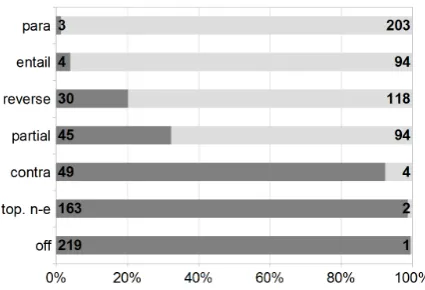
Figure 1 shows the distribution of our entailment labels compared to the binary CREG labels that indicate whether an answer is correct or incorrect. We can see that some of our labels clearly cor-respond to correct (paraphrase, entailment) or
in-Figure 1: Distribution of entailment labels over bi-nary labels, relative and absolute values (correct: light grey, incorrect: dark grey).
correct answers (contradiction, off-topic, topical-non-entailment). From the definition of these la-bels, this is an expected result: Whenever a LA is a paraphrase of a TA or more specific than a TA it should be correct and whenever a LA contra-dicts the TA, does not answer the question or an-swers the question without overlap with the target answer, it is most likely incorrect. However, the labels partial entailment and reverse entailment
cannot be as easily mapped to binary scores, pro-viding evidence for the existence of some substan-tial differences between the two tasks of RTE and SAS. These two labels have in common, that only some information from the TA is entailed by the LA (while inpartial entailmentthe LA addition-ally entails information not present in the TA). One possible explanation why such answers sometimes are still scored as correct is that often TAs are for-mulated in an exhaustive way and more elaborate than the teacher would expect the learner to an-swer. It is not clear however from the TA which facts are necessary to make the LA correct and which facts are not. Example 3 shows one such answer pair, where the binary label iscorrect, al-though the entailment type clearly isreverse en-tailment.5
(3) Q:What is needed for paper production?
TA:You need wood, water and energy to produce paper.
5An answer just statingwater is neededdoes not occur in
[image:5.595.308.521.61.206.2]para entail reverse partial contra top. n-e off
para 180 4 12 9 0 2 0
entail 6 78 0 15 0 2 0
reverse 7 5 112 28 2 1 3
partial 5 8 15 75 8 3 10
contra 0 0 0 2 47 1 1
top. n-e 1 0 2 10 35 100 30
[image:6.595.150.450.61.149.2]off 0 1 3 3 5 31 169
Table 2: Confusion matrix between the two annotators for our labels. Abbreviations: paraphrase, en-tailment,reverseentailment,partialentailment,contradiction,topicalnon-entailment,off-topic.
LA: Wood is needed for paper produc-tion.
There are a few curious cases of label score combinations that seem implausible, such as answers with a negative entailment label that are scored as correct answer. The following example (4) illustrates this. While our schema clearly labels the LA asoff-topic, since question material is paraphrased in a wrong way, the teacher decided to accept the answer by implicitly substituting the location ofErfurtwithFrankfurt.
(4) Q:For how long does the company hold a branch at Frankfurt?
TA: The company holds a branch at Frankfurt for 15 years.
LA: It holds a branch at Erfurt for 15 years.
Similarly, there are rare examples ofentailment
orparaphraseitems that are labeled asincorrect. Example 5 shows one such pair, where, both for the entailment label and the correctness score, dif-ferent options are plausible depending on the inter-pretation ofwarm light(temperature vs. colour): (5) Q:Why did the man put the wood into the
plate oven?
TA: He put the wood into the oven to make the room warmer.
LA:For a warm light through the room. The findings from this evaluation show that, in our labeling scenario, SAS and RTE are two sep-arate tasks – in contrast to findings by Dzikovska et al. (2013a), who assume that the two tasks do not differ essentially from each other. Thus, their label set contains labels for scoring the LA and exploring its entailment relation simultaneously: They distinguish the label correct for complete paraphrases of the TA – which they expect to
be the only correct type of answers – and Par-tially correct incompletefor LAs that lack infor-mation; furthermoreContradictory andIrrelevant
for answers that are on-topic, but either contradic-tory to the TA or containing the wrong informa-tion; and finally Non domainfor answers that do not address the question. Our labels are slightly more fine grained: Partial entailmenthas no cor-respondence in their 5-way label set, but forms for our data the most interesting case for further in-vestigation because of its coverage of both correct and incorrect answers. There is also no correspon-dence for ourentailment label. From a SAS per-spective, the difference between paraphrase and
entailmentseems not to be crucial, as both labels almost exclusively cover answers that are scored binary as correct in our data.
correct missing extra blend non-concept non-concept answer
para 194 7 3 2 0
entail 73 3 16 6 0
reverse 74 53 1 20 0
partial 50 37 8 46 0
contra 1 10 0 42 0
top.
n-e 1 15 1 148 0
off 1 40 0 175 4
Table 3: Confusion matrix for teacher assessments and entailment labels.
[image:6.595.307.526.444.553.2]non-answerwas used for LAs that did not address the question as with ouroff-topic.
From the label descriptions, we would have ex-pected to see a good fit between the two label sets. Instead, we find that a clear mapping between our labels and the 5-way scores is not possible, as can be seen in the confusion matrix in table 3. Simi-lar to the comparison to the SemEval7 labels, this is mainly the case because the 5-way scores mix aspects of SAS and RTE in an unsuitable way.
5 Machine Learning Experiments
We explore the relation between RTE and SAS through a series of machine learning evaluations. In the first part, we evaluate a SAS classifier ask-ing which LAs in terms of entailment type are most difficult for automatic labeling. We then present a modeling experiment that explores the impact of using our entailment labels as features for a SAS system and finally a series of experi-ments that aim at testing how well entailment in-formation is modeled by alignment-based machine learning features.
For all experiments, we used theLogistic classi-fier in theWekapackage, that is based on a logistic regression algorithm (Hall et al., 2009). We use alignment-based features in a re-implementation of Meurers et al. (2011) that reaches an accuracy of 86% on CREG. All experiments were evaluated via leave-one-out cross validation.
Task Setting Accuracy Kappa
teacher-alignment 0.861 0.723
teacher-entailment 0.922 0.843
entailment-7 0.473 0.36
entailment-5 0.641 0.489
entailment-3 0.749 0.562
[image:7.595.306.521.59.219.2]entailment-2 0.837 0.668
[image:7.595.73.292.482.610.2]Table 5: Overview of the classifier performances Abbreviations:teacherscores as class with align-ment features and alignment+entailment fea-tures. 7-way entailment type as class and col-lapsed entailment class sets by combining entail-ment types into5,3or2classes, all with alignment features
Figure 2: Correctly (light grey) and incorrectly (dark grey) classified instances per entailment class, relative and absolute values.
5.1 Distribution of correctly and incorrectly automatically scored instances over the entailment types
We investigate if some of the entailment types are challenging for a SAS system. Figure 2 shows the distribution of incorrectly classified instances over our entailment types.
In general, LAs that are labeled withpartial en-tailmentorreverse entailment are more problem-atic for the SAS model than the other labels. This observation reminds of the finding that these la-bels do not clearly correspond to one correctness score: An alignment based SAS model that cov-ers among its features the percentage of TA tokens and chunks covered in the LA can not differenti-ate whether a unit not covered was crucial or not. The machine learner also struggles in general with thecontradictionclass. This is because many con-tradicting answer pairs still provide a high overlap but differ in just a small but critical detail.
Our finding again underlines the difficulty which the evaluation of the semantic overlap be-tween two texts, as can be found in thepartial en-tailmentgroup, poses to SAS approaches and re-inforces the need for more sophisticated semantic features for modeling these entailment phenomena and consequently for a better shortanswer scoring.
5.2 Can entailment classes improve an SAS feature set?
ad-real classified para entail reverse partial contra top. n-e off recall
para 136 11 26 18 1 3 11 0.66
entail 20 44 2 24 0 1 7 0.449
reverse 24 1 82 17 0 1 23 0.554
partial 20 15 20 46 0 9 32 0.324
contra 5 2 7 7 1 3 28 0.019
top. n-e 2 3 10 13 2 16 119 0.097
off 6 3 14 7 1 26 163 0.741
[image:8.595.106.494.62.172.2]precision 0.638 0.557 0.51 0.348 0.2 0.271 0.426
Table 4: Confusion matrix for the machine learner on our labels with precision and recall for all classes.
ditional feature in order to explore whether our an-notations, could they be determined automatically, would be helpful in a SAS task. This raises the classifier’s performance from86.1% (κ=0.723)to
92.2% (κ=0.843), as can be seen in table 5. Al-though we showed that the RTE and SAS scenario differ substantially, this outcome emphasizes that they also have a lot in common.
However, the obvious problem here is that the usage of a manually annotated feature is compara-ble to the use of a human oracle and is therefore not feasible for a fully automatic approach. Thus, further research has to concentrate on how we can automatically model entailment types compu-tationally. To do so, we will for example try to enhance the current TA-LA alignment based SAS approach. This leads to the question in how far the model is already able to predict our entailment types. One first evaluation trial of this question is presented in the next section.
5.3 Are entailment relations learnable with an SAS system?
In this last set of experiments we address the ques-tion in how far the automatic predicques-tion of entail-ment labels is possible with the feature sets of an alignment based SAS approach. Although the fo-cus in an educational application would be the au-tomatic scoring of the correctness of a LA rather than its entailment relation to its TA, this experi-ment might shed additional light on the relatedness of the two tasks.
We therefore train our classifier on the LA data and use the entailment labels as class, which leads to an accuracy of 47% (table 5) and a kappa in-dicating poor agreement. The confusion matrix for this classification (table 4) shows that the ma-chine learner especially struggles with labeling the negative classes, because the features it uses are computed based on the alignment between TA
and LA, while the question is not taken into ac-count. Therefore the machine learner is unable to decide if an answer addresses the question or not. Partial entailment poses a large difficulty again as well, resulting in an F1-Score of 0.336 (P=0.348/R=0.324)for that class. In contrast, the F1-Score for paraphrase reaches a modest level of
0.649 (P=0.638/R=0.66).
To narrow down the difficulties for our machine learner, we stepwise collapsed our entailment la-bels, by first subsuming the negative entailment classestopical non-entailment,off-topic and con-tradictionas one class, which leads to only 5 en-tailment classes and an accuracy of64.1%. In the next step, we subsumed entailment, reverse en-tailmentandparaphraseunder one “positive” la-bel, but left partial entailment out, which lead to 3 classes (positive, negative, partial) and an accu-racy of 74.9%. Finally, we added partial entail-ment to the positive class and achieved a perfor-mance of83.7%. Although it is in general not sur-prising that the performance increases as the num-ber of labels decreases, it is interesting that the inclusion or exclusion ofpartial entailmenthas a rather high impact on the performance.
6 Conclusions and Future Work
This paper presented a study that labels LA TA pairs from the CREG corpus with a set of fine-grained textual entailment annotations. Our main finding is that there is a clear correspondence be-tween some textual entailment classes and a bi-nary correctness score. But there is also an area that needs further investigation. This concerns the
partialandreverse entailmentcases and illustrates that the tasks of RTE and SAS are related, but not equivalent for our scenario.
particu-larly problematic for automatic SAS. For advances in automatic scoring it is important to determine which parts of a target answer are crucial for a cor-rect LA and which are not.
In the next step of this annotation project, we will focus on the relation between reading texts and answers. We expect that the combination of this variant of the RTE setting with our current an-notations helps us to gather further insights into the nature of shortanswer questions.
Acknowledgements
We thank the three anonymous reviewers for their helpful comments. We also thank our annotators Fernando Ardente, Sophie Henning and Maximil-ian Wolf for their help with this study and alexis Palmer for valuable feedback for our annotation guidelines.
This work was funded by the Cluster of Excel-lence “Multimodal Computing and Interaction” of the German Excellence Initiative.
References
Stacey Bailey and Detmar Meurers. 2008. Diagnos-ing meanDiagnos-ing errors in short answers to readDiagnos-ing com-prehension questions. InProceedings of the Third ACL Workshop on Innovative Use of NLP for Build-ing Educational Applications, page 107115, Colum-bus, Ohio, USA, June.
Steven Burrows, Iryna Gurevych, and Benno Stein. 2015. The eras and trends of automatic short an-swer grading. International Journal of Artificial In-telligence in Education, 25(1):60–117.
Ido Dagan and Oren Glickman. 2004. Probabilistic textual entailment: Generic applied modeling of lan-guage variability.
Ido Dagan, Dan Roth, Mark Sammons, and Fabio Mas-simo Zanzotto. 2013. Recognizing Textual Entail-ment: Models and Applications. Synthesis Lectures on Human Language Technologies. Morgan & Clay-pool Publishers.
Myroslava O. Dzikovska, Johanna D. Moore, Natalie Steinhauser, Gwendolyn Campbell, Elaine Farrow, and Charles B. Callaway. 2010. Beetle ii: A sys-tem for tutoring and computational linguistics ex-perimentation. InProceedings of the ACL 2010 Sys-tem Demonstrations, ACLDemos ’10, pages 13–18, Stroudsburg, PA, USA. Association for Computa-tional Linguistics.
Myroslava O Dzikovska, Rodney D Nielsen, and Chris Brew. 2012. Towards effective tutorial feedback for explanation questions: A dataset and baselines. InProceedings of the 2012 Conference of the North American Chapter of the Association for Computa-tional Linguistics: Human Language Technologies, pages 200–210. Association for Computational Lin-guistics.
Myroslava O. Dzikovska, Rodney Nielsen, Chris Brew, Claudia Leacock, Danilo Giampiccolo, Luisa Ben-tivogli, Peter Clark, Ido Dagan, and Hoa Trang Dang. 2013a. Semeval-2013 task 7: The joint stu-dent response analysis and 8th recognizing textual entailment challenge. *SEM 2013: The First Joint Conference on Lexical and Computational Seman-tics.
Myroslava O Dzikovska, Rodney D Nielsen, Chris Brew, Claudia Leacock, Danilo Giampiccolo, Luisa Bentivogli, Peter Clark, Ido Dagan, and Hoa T Dang. 2013b. Semeval-2013 task 7: The joint stu-dent response analysis and 8th recognizing textual entailment challenge. Technical report, DTIC Doc-ument.
Rod Ellis. 1994. The Study of Second Language Ac-quisition. Oxford University Press.
and Paraphrasing, RTE ’07, pages 1–9, Strouds-burg, PA, USA. Association for Computational Lin-guistics.
Aria Haghighi, Andrew Y. Ng, and Christopher D. Manning. 2005. Robust textual inference via graph matching. In Proceedings of Human Language Technology Conference and Conference on Empiri-cal Methods in Natural Language Processing, pages 387–394, Vancouver, British Columbia, Canada, October. Association for Computational Linguistics. Michael Hahn and Detmar Meurers. 2012. Evaluating the meaning of answers to reading comprehension questions - a semantics-based approach. The 7th Workshop on the Innovative Use of NLP for Building Educational Applications.
Mark Hall, Eibe Frank, Geoffrey Holmes, Bernhard Pfahringer, Peter Reutemann, and Ian H. Witten. 2009. The weka data mining software: An update.
SIGKDD Explor. Newsl., 11(1):10–18, November. Manfred Krifka. 2001. For a structured meaning
ac-count of questions and answers. Audiatur Vox Sapi-entia. A Festschrift for Arnim von Stechow, pages 287–319.
J. Richard Landis and Gary G. Koch. 1977. The mea-surement of observer agreement for categorical data.
Biometrics, 33(1):pp. 159–174.
Omer Levy, Torsten Zesch, Ido Dagan, and Iryna Gurevych. 2013. Recognizing partial textual entail-ment. InProceedings of the 51st Annual Meeting of the Association for Computational Linguistics, page 451455, Sofia, Bulgaria, August 4-9.
Anke L¨udeling. 2008. Mehrdeutigkeiten und kate-gorisierung: Probleme bei der annotation von lern-erkorpora.Fortgeschrittene Lernervariet¨aten, pages 119–140.
Bill MacCartney and Christopher D Manning. 2009a. An extended model of natural logic. In Proceed-ings of the eighth international conference on com-putational semantics, pages 140–156. Association for Computational Linguistics.
Bill MacCartney and Christopher D. Manning. 2009b. An extended model of natural logic. In Proceed-ings of the Eighth International Conference on Com-putational Semantics, IWCS-8 ’09, pages 140–156, Stroudsburg, PA, USA. Association for Computa-tional Linguistics.
Detmar Meurers, Ramon Ziai, Niels Ott, and Stacey Bailey. 2011. Integrating parallel analysis modules to evaluate the meaning of answers to reading com-prehension questions. Special Issue on Free-text Au-tomatic Evaluation. International Journal of Contin-uing Engineering Education and Life-Long Learn-ing (IJCEELL), 21(4):355–369.
Michael Mohler and Rada Mihalcea. 2009. Text-to-text semantic similarity for automatic short answer grading. InProceedings of the 12th Conference of the European Chapter of the Association for Com-putational Linguistics, EACL ’09, pages 567–575, Stroudsburg, PA, USA. Association for Computa-tional Linguistics.
Michael Mohler, Razvan Bunescu, and Rada Mihal-cea. 2011. Learning to grade short answer questions using semantic similarity measures and dependency graph alignments. In Proceedings of the 49th An-nual Meeting of the Association for Computational Linguistics: Human Language Technologies-Volume 1, pages 752–762. Association for Computational Linguistics.
Rodney D Nielsen, Wayne Ward, James H Martin, and Martha Palmer. 2008. Annotating students’ under-standing of science concepts. InLREC.
Rodney D. Nielsen, Wayne Ward, and James H. Martin. 2009. Recognizing entailment in intelligent tutoring systems. Natural Language Engineering, 15:479– 501.
Niels Ott, Ramon Ziai, and Detmar Meurers. 2012. Creation and analysis of a reading comprehension exercise corpus: Towards evaluating meaning in context. In Thomas Schmidt and Kai W¨orner, ed-itors, Multilingual Corpora and Multilingual Cor-pus Analysis, Hamburg Studies in Multilingualism (HSM). Benjamins, Amsterdam. to appear.
Jana Zuheir Sukkarieh and John Blackmore. 2009. c-rater: Automatic content scoring for short con-structed responses. InFLAIRS Conference.
Arnim von Stechow and Thomas Ede Zimmermann. 1984. Term answers and contextual change. Lin-guistics, 22:3–40.
Arnim von Stechow, 1990. Discourse Particles, chap-ter Focusing and Background Operators.
Seid Muhie Yimam, Iryna Gurevych, Richard Eckart de Castilho, and Chris Biemann. 2013. Webanno: A flexible,web-based and visually supported system for distributed annotations. In Proceedings of the 51st Annual Meeting of the Association for Compu-tational Linguistics (System Demonstrations) (ACL 2013), pages 1–6, Stroudsburg, PA, USA, August. Association for Computational Linguistics.