PROCEEDINGS OF SPIE
SPIEDigitalLibrary.org/conference-proceedings-of-spie
Optical eigenmode description of
single-photon light-matter interactions
Kyle Ballantine, Michael Mazilu
Optical eigenmode description of single-photon light-matter
interactions
Kyle Ballantine and Michael Mazilu
SUPA, School of Physics and Astronomy,
University of St Andrews, St Andrews, United Kingdom
ABSTRACT
When light scatters from an object, it can impart some physical quantity such as momentum or angular mo-mentum. This can act as a measurement on the photon, which collapses on to an eigenstate of the measurement operator. However the corresponding operator is not the same as that describing the total linear or angular momentum in free space. Optical eigenmodes provide a powerful method to describe this interaction by ex-panding the field as a linear combination of some basis modes and examining the eigenvalues and eigenvectors of the quadratic measure in question. We extend this to the quantum case by writing the quantum operator corresponding to a given measurement such as energy, momentum or angular momentum as a superposition of creation and annihilation operators for each eigenmode. Upon measurement we find that the possible states of a single photon are simply the classical eigenmodes of the measurement. As an application, we examine the force and torque on a general, possibly anisotropic, material. By looking at eigenvalues of the measurement operator we show that the amount of a given quantity transferred in an interaction with matter is not in general the expected amount which a photon carries in free space, even at the single photon level. In particular the difference in linear or angular momentum from before and after is in general not equal to~kor~which are the eigenvalues of these quantities in free space.
Keywords: Manuscript format, template, SPIE Proceedings, LaTeX
1. INTRODUCTION
The decomposition of fields into eigenmodes is a common technique to solve various proplems. Such a decom-position can be used to describe the propagation of light in a variety of setups such as waveguides, photonic crystals, and optical cavities. The method of Optical Eigenmodes (OEi) has been introduced as a generalization of this mode decomposition going beyond describing the propagation properties.1 This method applies to any quadratic measure of the electromagnetic field such as energy density, momentum, angular momentum, etc.2 In addition, we can describe the change in these quantities when interacting with matter, giving the forces or torques experienced by particles. This method consists of finding the eigenmodes of the quadratic measure in question. These input light fields contribute to the measure independently, without interference, allowing for example the addressing of individual plasmonic nano-antennas of an array without cross-talk.3 It is worth noting
that as this method results in a set of eigenmodes which contribute an amount equal to the corresponding real eigenvalue, optimisation of a quantity such as spot size or energy transmission is as trivial as choosing the mode with the highest or lowest eigenvalue.
While a single photon is known to carry both spin and orbital angular momentum quantised in units of~,4,5
and momentum quantised in units of~k, wherek is the wave-vector, the photon need not be in an eigenstate of any of these quantites before or after an interaction with matter. Hence, it is not necessarily the case that an integer number of these units is transferred when a photon scatters from a nanoparticle. As mechanical resonators have been brought well into the quantum regime,6,7 the interaction between single quanta of optical
and mechanical degrees of freedom becomes increasingly important. In this paper we apply the method of optical
Further author information: (Send correspondence to M.M.) K.B.: E-mail: [email protected]
eigenmodes to quantum measurements, which correspond to Hermitian operators acting on quantum states. We show that it is these eigenmodes which deliver a quantised amount of linear or angular momentum which is differrent to the quanta of these observables in free space. For a given input state, each eigenmode will be selected with a probability proportional to its overlap with the input. After the measurement, the quantum state will collapse exactly into one of the classical optical eigenmodes of the measurement. Hence, optical eigenmodes provide a natural framework to consider the interaction of quantum light states with macroscopic matter.
2. OPTICAL EIGENMODES FOR QUANTUM OPERATORS
Expanding the electric field as a superposition of some basis fieldsE=P
iαiEi, we can write a general quadratic function of the fields as a Hermitian form of these coefficientsm(E) =α∗Mαwhere Mis a Hermitian matrix. For the expansion to be exact we require a complete set of basis fields; in practice we can keep only a finite number of basis functions which span a subspace, for example a set of low-order Hermite-Gauss beams. Since
Mis Hermitian, it has a spectrum of real eigenvalues which can be ordered to find the maximum or minimum possible value of the quantity of interest and the corresponding optical eigenmode which produces it.
The quantization of the free electro-magnetic field is similarly done by expanding over some basis, for example plane waves,
E(r, t) =iωX k,σ
ek,σak,σ(t)eik·r−h.c., (1)
and then promoting the coefficients to operators, ˆak,σ with canonical commutation relations
h
ˆ
ak,σaˆ†k0,σ0
i
=
δkk0δσσ0.8
In analogy with the classical case, an observable in quantum mechanics is describes by some operator ˆm. If the classical observable is quadratic, then we also have the quantum operator as a Hermitian form of the creation and annihilation operators ˆm= ˆa†Mˆa. Again,Mis Hermitian and has real eigenvalues which may be ordered. These eigenvalues have an additional significance; they are the only possible results of a measurement ofm, and after the measurement the system will collapse into the corresponding eigenvector.
To expand the concept of optical eigenmodes to the quantum case, we find a unitary transformation U
such thatD =U†MU is diagonal. The creation and annihilation operators transform in a corresponding way, ˆ
Ai = Uijaˆj. SinceU is unitary, this preserves the canonical commutation relations
h
ˆ
Ai,Aˆ†j
i
=haˆi,ˆa†j
i
=δij. These operators ˆA†i, ˆAi correspond to creating and annihilating a single photon in the eigenmodei, which will contribute an exact amount to the measurement m. Crucially, performing the measurement will project the quantum state on to one of these eigenmodes, which are just those described by the classical matrixM. Again, the real eigenvalues can be ordered to find the state which maximises or minimises any quantum observable.
3. APPLICATIONS
As an example of the above we look at the quantum of force or torque when light is incident on a slab of ho-mogenous, but anisotropic material. The quantum operator of interest here is the difference in linear momentum or angular momentum between the incoming and outgoing beams. The creation and annihilation operators cor-responding to the outgoing beams are related to those in the incoming beams via the transfer matrix method.9
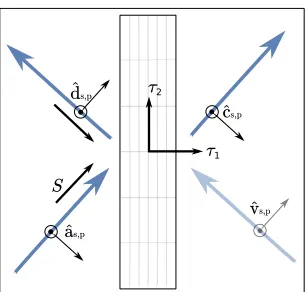
Consider a birefringent, uniaxial material whose optic axis is perpendicular to its surface such that s and p polarized rays have independent transmission amplitudests,p and reflection amplitudes rs,p. The scattering is illustrated in Fig.1. We consider a plane wave incoming from the left, labeled by the operator ˆa, being trans-mitted and reflected in to plane waves labeled by ˆc and ˆd respectively. We must also take in to account the corresponding input ˆb which is incident on the opposite side with the same angle of incidence. For the majority of this section we will further simplify to a wave-plate which has|tp|=|ts|=t, withts= exp (iφ)tpand similarly
âs,p
d̂s,p
ĉs,p
v̂s,p
τ1
τ2
[image:4.612.230.384.68.214.2]S
Figure 1. Illustration of light scattering from a material labeling the incoming and outgoing beams.
We have the linear and spin angular momentum operators for the incoming beam;
ˆ
Pa=
X
k
~k
ˆ
a†k,+ˆak,++ ˆa†k,−aˆk,−
(2)
ˆ
Sa=
X k ~ k |k| ˆ
a†k,+ˆak,+−ˆa†k,−aˆk,−
(3)
where + and−refer to left and right circular polarization respectively, ˆa± = (ˆap±iˆas), and similarly for the other incoming and outgoing beams. While these operators have the expected eigenvalues~kand~respectively, if we measure the deflection or rotation of a particle it is the difference in these quantities before and after the interaction which is transferred. Defining ˆF≡Pˆc+ ˆPd−Pˆa−Pˆb and ˆT≡Sˆc+ ˆSd−Sˆa−Sˆb, we can write these as Hermitian forms of the input operators, i.e. ˆF=ψ†F ψ, ˆT=ψ†T ψ, withψ= (ˆa+,ˆa−,ˆb+,ˆb−)T. We find
Fx=~kx
|t|2− |r|2−1 0 2i|r||t| 0
0 |t|2− |r|2−1 0 −2i|r||t|
−2i|r||t| 0 1 +|r|2− |t|2 0
0 2i|r||t| 0 1 +|r|2− |t|2
. (4)
This has eigenvalues ±2~kx
p
1− |t|2. That is, a photon reflecting from a partially reflective surface does not
transfer a momentum 2~kx with some probability, but rather transfers a fractional amount of this with 100% probability. This may seem suprising, but it is a result of measuring only the difference in momentum before and after the interaction; where we to measure the momentum of the photon itself before and after the scattering, both results would have magnitude~k.
A similar form exists for the torque on the plate, defined as the difference in angular momentum between the incoming and outgoing beams, which is more complex due to the mixing of polarizations in the birefringent material. The eigenvalues of Tx are ±~kx
p
2(1−cosφ), again corresponding to a fractional amount of spin angular momentum of the incoming photon. The eigenvalues ofTy are±
√
2p1 + cosφ(|r|2− |t|2)±2|r||t|sinφ.
These values can be understood by considering some special cases. For a plate with no birefringence (φ= 0) there is no torque around thex-axis as there is no change in angular momentum. However there is a torque in the y-direction of ±2~|r| due to the reversal of circular polarization upon reflection. For a quarter-wave plate (φ=π/2) the eigenvalues of Txare ±
√
2~while those ofTy are±
p
2(1± |r||t|). For a half-wave plate (φ=π) these are±2~and±2|t|~, respectively, corresponding to the conversion of right circular polarization to left and vice-versa.
on interference between the different input ports, but not the different polarizations which each have the same momentum, while the torque in thex-direction depends on the coupling between different polarizations, but not the different input ports. This is a consequence of the choice|tp|=|ts|, and will no longer be true if these two differ.
Another simple limiting case is that where the plate acts as a polarizing beam-splitter, i.e. tp = rs = 0,
ts=rp= 1. In this caseTxandTy have the same eigenvalues of 0,±2~, whileFxhas the similar set of 0,±2~kx.
However these three operators all have different eigenvectors and so do not commute. The eigenvectors ofFx correspond to a single input with a polarization which is either reflected or transmitted. The eigenvalues ofFx andFy correspond to an input in both ports with either opposite or identical circular polarizations respectively. The interference between the reflectedppolarization and the transmittedspolarization from each circular state leads to another circular polarization in each output.
4. SCATTERING FROM A FINITE OBJECT
While considering infinite homogeneous slabs allows some simple analytic results, we are primarily interested in the scattering of light from finite objects which may not be homogeneous or isotropic. To calculate the quantized forces and torques on such objects, we can consider a surface which fully encloses the object, and consider the momentum and angular momentum into and out of that surface.
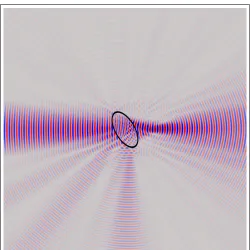
As an example, consider an elliptical scatterer in two dimensions. To probe momentum transfer to this particle, we use a basis of Gaussian beams with a direction relative to thexaxis which varies from 0 to 2π in steps of 5◦. For each input beam we calculate, using finite element method, the scattered field in the far-field. An example of the scattering of one such input beam is shown in Fig. 2. The momentum in each incoming and outgoing beam has the same form as Eq.2. The angular spectrum decomposition allows a change of basis between plane waves and the input Gaussian beams. This results in a quadratic form for the total change of momentum, i.e. the force on the scatterer, in terms of the input basis,
Fx=
X
ˆ
a†ifx,ijˆaj (5)
Fy =
X
ˆ
a†ify,ijaˆj, (6)
where ˆai now label our basis of input beams. Diagonalising either of these operators via a unitary transforma-tion leads to a corresponding change of basis of optical eigenmodes which are the quantum eigenmodes of the corresponding operator, and deliver the corresponding eigenvalue of force when that component is measured.
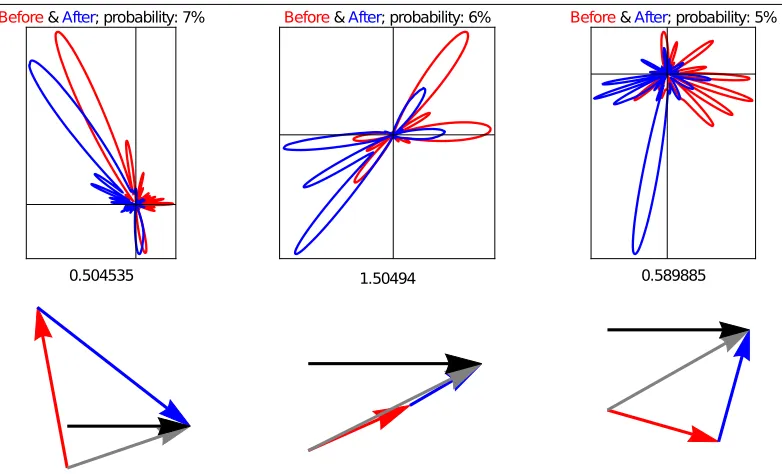
One such eigenmode is shown in Fig.3(a). This is an input optical eigenmode of thexcomponent of force, i.e. if there is a single incident photon in this field distribution, and thex-component of scattering of the particle is measured, the result will be the corresponding eigenvalue with 100% probability. An arbitrary incident beam will in general not be in one of these eigenmodes. In that case the result of a single measurement will be one of the eigenvalues of the operator, with a probability given by the overlap of the incoming beam with each optical eigenmode. These probabilities are shown in Fig.3(b) for one of our original basis functions, a Gaussian beam with initial direction along thexaxis.
Figure 2. Numeric calculation of scattered field from an ellipse for an Gaussian beam incident along the +xdirection.
0.00 0.02 0.04 0.06 0.08 fx
a)
b)
[image:6.612.109.504.457.628.2]Before&After; probability: 7% Before&After; probability: 6% Before&After; probability: 5%
[image:7.612.112.503.70.307.2]0.504535 1.50494 0.589885
Figure 4. Top row: The amplitude of the incoming (red) and outgoing (blue) optical eigenmodes highlighted in Fig.3. Bottom row: An illustration of the average momentum in the incoming (red) and outgoing (blue) optical eigenmodes. The difference between them (grey) gives the average force on the particle, but they are only eigenmodes of thex-component (black).
ACKNOWLEDGMENTS
We would like to thank the UK Engineering and Physical Sciences Research Council for the funding of this work (EP/M000869/1).
REFERENCES
[1] Mazilu, M., Baumgartl, J., Kosmeier, S., and Dholakia, K., “Optical eigenmodes; exploiting the quadratic nature of the energy flux and of scattering interactions,”Opt. Express19, 933–945 (Jan 2011).
[2] Mazilu, M.Journal of Optics13, 064009.
[3] Kosmeier, S., De Luca, A. C., Zolotovskaya, S., Di Falco, A., Dholakia, K., and Mazilu, M., “Coherent control of plasmonic nanoantennas using optical eigenmodes,”Scientific Reports 3, 1808 EP – (May 2013). Article.
[4] Allen, L., Beijersbergen, M. W., Spreeuw, R. J. C., and Woerdman, J. P., “Orbital angular momentum of light and the transformation of laguerre-gaussian laser modes,”Phys. Rev. A45, 8185–8189 (Jun 1992). [5] Leach, J., Padgett, M. J., Barnett, S. M., Franke-Arnold, S., and Courtial, J., “Measuring the orbital angular
momentum of a single photon,”Phys. Rev. Lett.88, 257901 (Jun 2002).
[6] Genes, C., Vitali1, D., and Tombesi, P.New Journal of Physics, 095009 (2008).
[7] Mancini, S., Vitali, D., and Tombesi, P., “Optomechanical cooling of a macroscopic oscillator by homodyne feedback,”Phys. Rev. Lett.80, 688–691 (Jan 1998).
[8] Loudon, R., [The Quantum Theory of Light], vol. 42 (01 2000).