Tufted capuchin monkeys (Sapajus sp) learning how to crack nuts: does variability decline
1
throughout development?
2
Briseida Dogo Resende, Mariana Baldy Nagy-Reis, Fernanda Neves Lacerda, Murillo Pagnotta,
3
Carine Savalli
4
5
Abstract
6
We investigated the process of nut-cracking acquisition in a semi-free population of tufted capuchin
7
monkeys (Sapajus sp) in São Paulo, Brazil. We analyzed the cracking episodes from monkeys of
8
different ages and found that variability of actions related to cracking declined. Inept movements
9
were more frequent in juveniles, which also showed an improvement on efficient striking. The most
10
effective behavioral sequence for cracking was more frequently used by the most experienced
11
monkeys, which also used non-optimal sequences. The nature of the elements that compose the nut
12
cracking task channels development, comprising some variation in behavior sequences and actions.
13
14
Keywords:primates; tool use; ontogenesis
15
16
17
18
19
20
Tufted capuchins from different populations spontaneously crack nuts using tools (Fragaszy, Izar,
21
Visalberghi, Ottoni, & Oliveira, 2004; Moura & Lee, 2004; Ottoni & Mannu, 2001). They usually
22
place the nut on a horizontal surface (usually a stone, called anvil) and strike it with a second stone
23
(called hammer) using one or both hands. This is a complex behavior, shared with chimpanzees, in
24
which several elements and actions must be coordinated, and it takes combinatorial manipulation of
25
objects to develop (Inoue-Nakamura & Matsuzawa, 1997; Resende, Ottoni, & Fragaszy, 2008).
26
Similarly, wild chimpanzees at Mahale Mountains National Park process the fruit of Saba florida to
27
eat its pulp. This complex task requires manual dexterity and the process involves several stages.
28
Corp & Byrne (2002) investigated the variation in the manual processing techniques used by
29
different individuals and across age. When compared with adults, infants used a wider variety of
30
actions. They usually co-fed with their mothers, and paid them close attention. The authors
31
attributed some aspects of the development of processing skills to physical maturation (leading to
32
increased manual abilities) and trial and error learning, but they argued that the social environment
33
could also scaffold the learning process.
34
35
Insert Figure 1: Adult capuchin is cracking nuts, while a juvenile explores the site at Tietê
36
Ecological Park, SP, Brazil. Some Syagrus nuts are on the anvil. Photo: Mariana B. Nagy-Reis.
37
38
Longitudinal studies of the development of manipulative behavior in free-living non-human
39
primates are rare (e.g. Corp & Byrne, 2002, Inoue-Nakamura & Matsuazawa, 1997; Resende et al.,
40
2008.) Accordingly, while several studies of the nut-cracking behavior in capuchin monkeys have
41
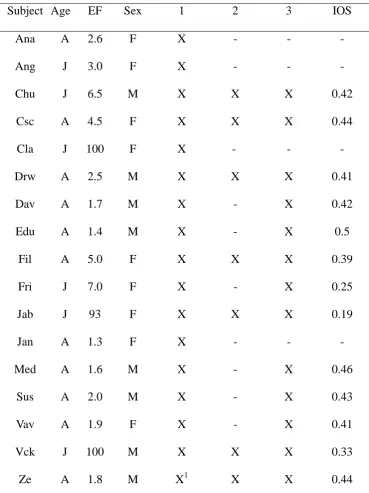
focused on aspects such as biomechanics and selectivity (e.g. Fragaszy et al., 2010; Liu et al., 2009;
42
Visalberghi et al., 2009), few of them focus on developmental aspects. Resende et al. (2008)
conducted a longitudinal study of the emergence of tool using skills of capuchins living at Tietê
44
Ecological Park, São Paulo State, Brazil (hereafter TEP), where the monkeys spontaneously crack
45
nuts of Syagrus romanzoffiana (Figure 1). Adults frequently succeed with one or two strikes
46
(Resende, Hirata, Nagy, & Ottoni, 2011). Resende et al. (2008) found that manipulation of nuts and
47
stones and percussive actions with these objects emerged when the monkeys were as young as six
48
months old. Moreover, in order to fully succeed in cracking nuts, they had to learn the correct action
49
sequence: (1) take the nut, (2) place it on the anvil, (3) take the hammer stone and (4) hit it against
50
the nut. The monkeys initially performed the elements of the action sequence in variable order
51
before producing the correct one consistently. This is similar to nut-cracking behavior of wild
52
chimpanzees (Inoue-Nakamura & Matsuzawa, 1997).
53
In this study, we investigated the process of nut-cracking acquisition using a dynamic systems view
54
of development. This view predicts high variability in configuration during exploration stage and
55
progressive stability (Smith & Thelen, 2003). We first compared efficiency across different age
56
classes, and then used longitudinal analysis and behavior sequence analysis to check if variability
57
declined over time. We predicted that actions not associated with efficient nut-cracking would tend
58
to disappear, as behavior stabilizes, and that effective behavioral sequence would be used more
59
frequently by the most experienced monkeys.
60
Methods
61
Subjects and Study Area
62
Our subjects were tufted capuchin monkeys living in a semi-free group in Tiete Ecological Park
63
(TEP). We identify them as Sapajus sp, given that the present population descended from released
64
animals likely representing what are now considered separate species (Sapajus apella, Sapajus
65
nigritus, and Sapajus libidinosus) (for a taxonomic review, see Lynch-Alfaro, Silva Jr., & Rylands,
66
2012). This group has been studied since 1995 (Otonni & Mannu, 2001) and was already habituated
67
to researchers and equipment when this study began.
The animals were provisioned but also foraged on naturally available food items such as fruits,
69
leaves and small birds and mammals (Ferreira, Resende, Mannu, Ottoni, & Izar, 2002). The palm
70
tree Syagrus romanzoffiana grows in the park and produces nuts, which the monkeys could collect
71
from the ground to crack open and eat the kernel (Ottoni & Mannu, 2001). The group consisted of
72
28 monkeys, but 11 of them were excluded from our analysis because they were rarely present at
73
the filming site. Table 1 shows the subjects included in our different analyses.
74
75
Insert Table 1
76
77
Data Collection and Transcription
78
We collected data using four video cameras (Sony HC90), with the frequency of acquisition =
79
60Hz. The cameras were placed inside plexiglass boxes for protection and were positioned from
80
orthogonal directions, covering an area of approximately 1 m2 of the nut-cracking site (Figure 2). To
81
ensure the capture of the best angle for analysis, we used the images of the camera in which the
82
sagittal plane of the monkey was perpendicular to the camera. As soon as any monkey approached
83
the site, we started filming using remote controls. Researchers stayed at the nut-cracking site five
84
days a week, usually from 8h30 am to 4h00 pm. The monkeys used the site for cracking nuts in 48
85
days distributed from April/2006 to February/2007.
86
87
Insert Figure 2: Scheme of the nut-cracking site (at the center) and the relative positions of the four
88
video cameras (C1-C4).
89
Following Resende et al. (2008), a cracking episode started when one or more monkeys,
91
simultaneously or sequentially, struck an object (usually a stone) against an anvil, whether or not
92
another object had been placed on the anvil beforehand. The episode ended when the last subject
93
visiting the site stopped pounding, did not look for other nuts and started performing activities
94
unrelated to nut-cracking. Brief interruptions associated with moving and searching for nuts, or
95
observing other monkeys cracking nuts were included within an ongoing episode.
96
We transcribed the behaviors in each episode using the categories defined in Table 2. For the
97
longitudinal analysis, we transcribed the data using EthoLog 2.25 software (Ottoni, 2000). For each
98
episode, we recorded the absolute frequencies of adequate placement and effective striking, inept
99
movements and successful cracking of nuts (see Table 2 for detailed descriptions). The software
100
built first order matrices with antecedent and subsequent behaviors, which we used in the behavior
101
sequence analysis.
102
103
Insert Table 2
104
105
Analysis
106
107
1) Comparing the cracking behavior across different age classes
108
We measured the proficiency of each subject (n=17) using the three following variables: 1)
109
Efficiency (EF), defined as the number of strikes needed to open a nut. To calculate this we divided
110
the total number of strikes performed by each monkey by the total number of nuts it opened. Values
111
closer to 1 indicate higher efficiency. When the subject did not open any nut, we arbitrarily
112
considered EF = 100. Those who had EF ≤ 2 were considered more efficient monkeys; those with
EF>2 were considered less efficient. 2) Index of Nut-placement Adequacy, a measure of the
114
perceptual-motor skills necessary to place a nut on the anvil. To calculate this, we divided the
115
number of adequate nut placement by the total number of nut placements on any surface available
116
to the monkey. We considered nut placement to be adequate if a nut was placed on the anvil before
117
the strike and if it did not fall off. 3) Index of Efficient Strikes, a measure of the perceptual-motor
118
skills necessary to strike a nut and open it. To calculate this, we divided the total number of efficient
119
strikes by the total number of strikes performed by each subject. Efficient strikes happened when
120
the hammer hit the nut that was on the anvil.
121
We used Mann-Whitney tests to determine if Efficiency, Index of Nut-Placement Adequacy, Index
122
of Efficient Strikes, and Number of Strikes, were different between adults and juveniles. To
123
determine if efficiency increased with age, we correlated Age with a) Efficiency; b) the Index of
124
Nut-placement Adequacy; and c) the Index of Efficient Strikes using Spearman Rank Correlation.
125
126
2) Longitudinal analysis
127
We followed the longitudinal changes in the cracking behavior of only the subjects that were filmed
128
throughout the whole period of data-collection (n = 7). Following the dynamic systems view, we
129
expected to find an optimization of actions throughout the learning processes, with an increase in
130
the rates of Adequate Placement and Efficient Strikes, followed by stabilization.
131
To characterize the changes in the frequency of the different nut-cracking behavioral categories
132
throughout development, we calculated the following rates for each subject: Adequate Placement
133
(number of adequate placements / time), Efficient Strikes (number of efficient strikes / time),
Non-134
adequate Strikes (number of non-adequate strikes / time) and Inept Movements (number of inept
135
movements / time). “Time” was defined as the total duration of filmed episodes of cracking per
136
month.
For the longitudinal analysis of Efficiency, Efficient Strikes, Non-efficient Strikes, Inept
138
Movements and Adequate Placement, we used a two-month-period data: April/May, June/July,
139
August/September, October/November, December/January, and the month of February. Friedman
140
non-parametric test was used to determine whether these frequencies changed throughout the
141
months.
142
All the non-parametric tests were done using the software BioEstat 3.0 (Ayres, Ayres Jr., Ayres, &
143
Santos, 2007).
144
145
3) Behavioral Sequences Analysis
146
We used all nut-cracking episodes from subjects (N=13) that were successful in opening nuts
147
(Average number of episodes/subject=15.1, SD = 11.1). We considered that there is an optimal
148
sequence of behavior for cracking nuts: Take nut – Place nut – Take hammer – Strike. Here
149
“optimal” is used in terms of the highest benefit-cost ratio, since this is the shortest sequence that
150
can be used to open a nut. We hypothesized that the more efficient the monkey was, the more it
151
would use the optimal sequence. To test this, we analyzed the behavioral sequences considering
152
only the behavioral categories involved in the sequence (Take nut; Place nut; Take hammer; Strike).
153
The other categories were collapsed into the label “Others”. We then built a symmetric matrix with
154
antecedent and subsequent behavior, and, for each nut-cracking episode, we divided the number of
155
optimal pairs of behavioral sequences (i.e. Take nut / Place nut; Place nut / Take hammer; Take
156
hammer / Strike) by the total number of possible pairs. This represented the proportion of optimal
157
sequences used in each episode of each individual. This proportion was then averaged by episodes,
158
so that, for each monkey we calculated an Index of Optimal Sequence that ranges from 0 to 1
159
(optimal sequences = 1). We used Spearman test to correlate their Efficiency to the Index of
160
Optimal Sequence, predicting a positive correlation. We also predicted that the least efficient
161
monkeys would frequently use several sequences of behavior, and the most efficient monkeys
would preferably use the most efficient sequence for cracking the nut, indicating a decline in
163
variability. We used Mann-Whitney test to compare the most efficient (EF≤2) subjects with the least
164
efficient ones (EF>2) to test this.
165
This study is in agreement with ASP Principles for the Ethical Treatment of Non Human Primates
166
and it was approved by institutional animal care committees. All research reported in this
167
manuscript adhered to the Brazilian legal requirements.
168
169
Results
170
1) Comparing the cracking behavior across different age classes
171
Adults showed the majority of strikes (85%) and their Number of Strikes was different from the
172
juveniles’ (Mann-Whitney test: Z(U)=20.10, N=17, p<0.05). There was a strong correlation
173
between Age and Efficiency (Spearman Rank Correlation: rS=0.80, p<0.01, N=16), and adults were
174
more efficient than juveniles (Mann-Whitney test: Z(U)=3.12, N=17, p<0.01). Adults and juveniles
175
also differed on the Index of Efficient Strikes (Mann-Whitney test: Z(U)=3.01, N=17, p<0.01).
176
Adult males showed the highest scores (61%) followed by adult females (34%), juvenile females
177
(23%) and juvenile males (11%). The Index of Efficient Strikes was positively correlated with Age
178
(Spearman Rank Correlation: rS=0.71, p<0.01, N=16). Considering that a previous study showed
179
that the animal's weight can predict its success in nut-cracking (Fragaszy et al., 2010), we wondered
180
if these findings were a consequence of adults being heavier than juveniles. We thus compared adult
181
females (lighter) to adult males (heavier), and found that they did not differ on Efficient Strikes
182
(Mann-Whitney test: Z(U)=1.46, N=11, p=0.14), nor on Efficiency (Mann-Whitney test:
183
Z(U)=1.28, N=11, p=0.20).
184
Adults and juveniles differed upon the Index of Nut-placement Adequacy (Mann-Whitney test:
185
Z(U)=3, N=17, p<0.01), but there was no correlation between the Index of Nut-placement
Adequacy and Age (Spearman Rank Correlation: rS =0.418, p=0.11, N=16). This index increases
187
with age until around 4 years old and then it seems to stabilize (Figure 3).
188
189
Figure 3: Index of Nut-placement increases with age and it stabilizes in adults.
190
191
2) Longitudinal analysis
192
Contrary to what we expected, the overall Efficiency and the Rate of Adequate Placement did not
193
change over time (Efficiency: Fr=2.34; gl=3; p=0.5; Adequate Placement: Fr=2.16, gl=4; p=0.7).
194
However, when only juveniles who started to succeed in the cracking task during this study were
195
considered, there was an improvement in Efficiency (Chu = from 4.9 to 3.6 hits to crack a nut; Jab =
196
from no cracking to 2.7 hits to crack a nut). The Rate of Efficient Strikes differed significantly over
197
the months (Fr=9.32; gl=4; p<0.05), increasing (Figure 4). The rate of Non-efficient Strikes did not
198
significantly differ throughout the study as a whole. But when we considered the ratio Efficient
199
Strikes/Non-efficient Strikes, we found a significant difference, indicating that efficient strikes
200
increased and non-efficient strikes declined with experience (Figure 5), as predicted (Fr=0.04; gl=4;
201
p<0.05). Inept Movements were more frequent in younger monkeys (Mann-Whitney test:
202
Z(U)=2.738, p<0.05), indicating that younger monkeys performed more irrelevant acts for solving
203
the task.
204
205
Figure 4: ES (Number of Efficient Strikes/Seconds) throughout 9 months of data collection.
206
207
Figure 5: ES/NS (Efficient Strikes/Non-efficient Strikes) throughout 9 months of data collection.
208
Chu and Jab, the younger monkeys who learned to crack open nuts during this study, behaved as
210
predicted after they started cracking: their rates of Efficiency, Adequate Placement and Efficient
211
Strikes increased, and the rates of Non-efficient Strikes and Inept Movements declined.
212
213
3) Behavioral Sequences Analysis
214
The “More efficient” monkeys (which used up to 2 strikes to open the nut) were Drw, Dav, Edu,
215
Med, Sus, Ze and Vav, and the “Less efficient” (which used more than 2 strikes) were Csc, Chu, Fil,
216
Fri, Jab. Their Index of Optimal Sequence and their Efficiency are shown on Table 1. As we
217
expected, higher Efficiency was strongly correlated with higher use of Optimal Sequence
218
(Spearman rs=-0.82, n=13, p<0.05), and, as predicted, the most efficient monkeys differed from the
219
least efficient subjects in their use of the Optimal sequence (Mann-Whitney test: Z(U)=2, n=13,
220
p=0.05). Adults and juveniles also differed in the predicted direction (Mann-Whitney test:
221
Z(U)=2.16, n=13, p<0.05). We also found a positive correlation between Age and the Index of
222
Optimal Sequence (r2=0.56; n=12; p<0.01).
223
224
Discussion
225
As the monkeys grew older, activities related to cracking nuts first increased, then stabilized and
226
variability declined, according to what we expected. Thelen and Corbetta (2002) stated that
227
variability in behavior is a way of detecting instability: when a system stabilizes, variability
228
declines. Our results corroborated the predictions: the older and the more efficient the monkey was,
229
the more it used the optimal sequence for cracking nuts, and variability declined.
230
Adequate Nut-placement increased until up to four years of age, then it stabilized. Most of our
231
juvenile subjects were older than four years. At this age, tufted capuchins are closer to being
232
considered young adults, and this might explain why we found no difference on the Index of
Adequate Nut-placement between juveniles and adults. Efficient Strikes increased for all subjects
234
through time: as predicted, variability declined and tool users channeled their actions toward those
235
that would result in opening up the nut. Juveniles that achieved success in the cracking task also
236
increased Adequate Placement and Efficient Strikes, and declined Inept Movements and
Non-237
efficient Strikes. Our subjects were all above 36 months-old: by this age, capuchins are juveniles
238
able to combine actions and objects of the nut-cracking task in the correct order (Resende et al.,
239
2008). Similarly, Corp and Byrne (2002), studying chimpanzee’s development of complex
240
extractive foraging task, noticed that infants showed more variability in actions then adults,
241
including some which were not efficient for processing the fruit and reaching its pulp. This
242
variability declined as they got older and more proficient: procedures present in adult repertoire
243
persisted and increased with age, whereas procedures absent in adult repertoire tended to disappear.
244
They highlighted the importance of physical maturation for understanding the development of the
245
studied technique, followed by trial and error learning. In the present study, physical maturation is
246
less important for explaining the differences we found because we compared older juveniles and
247
adults. Although weight is a strong predictor of efficiency (Fragaszy et al., 2010), the monkeys´
248
experience needs to be considered to explain our results. None of our subjects reached the highest
249
Index of Optimal Sequence, meaning that non-optimal sequences of behavior persisted even in
250
adults. These “errors” (i.e. deviance from the optimal sequence) might be considered as
self-251
generated opportunities for perceptual learning that can guide subsequent acts (Lockman, 2000). In
252
other words, capuchins from our study might be seeking perceptual variation, using this as a source
253
of information that guides the acquisition of tool use.The monkey's body is constantly changing
254
throughout its development, including its size, weight and strength. This means that, with age, it has
255
to adjust its movements and strategies to maintain proficiency in nut-cracking (or in other tasks).
256
For this reason, even after a certain behavior seems stabilized, it might be beneficial to keep
257
exploring and trying different manipulations periodically. These hypotheses must be further
258
investigated.
The persistence of variability is important for a generalist monkey such as the tufted capuchin, who
260
survives well in different kinds of environments. They are always exploring different forms of
261
doing things, so they must use their actions in flexible ways. On the other hand, some stable and
262
socially transmitted behaviors (traditions) have been described in groups of capuchins (Ottoni &
263
Izar, 2008), and social life might be partially responsible for maintaining them (Fragaszy et al.,
264
2013; Gunst, Boinsky, & Fragaszy, 2008; Ottoni, Resende, & Izar, 2005). If we consider cracking
265
nuts, the nature of the elements that compose the task channels a way of acting, which comprises
266
some variation. Initial variability in manipulative behavior can make way for developmental
267
changes in skills. But social life, the growth and biomechanics of the body and the nature of the task
268
also constrain the possible changes and must be taken in consideration.
269
270
Acknowledgements
271
We thank the Tietê Ecological Park, where we conducted our study and all the students who helped
272
in the data collection. This work was supported by CAPES and FAPESP grants (99/11573-2;
273
2007/57618-5). We also thank two anonymous reviewers for valuable comments on previous
274
versions of the manuscript, Andrés Ballesteros Ardila for our discussions about development and
275
learning, and Dr. Jerry Hogan and Dr. Patrícia Izar for their useful advices.
276
277
278
References
279
280
Ayres, M., Ayres Jr., M., Ayres, D. L., & Santos, A. S. (2003). BioEstat 3.0. Aplicações estatísticas
281
nas áreas das ciências biológicas e médicas. Belém: Sociedade Civil de Mamirauá.
282
Corp, N., & Byrne, R. (2002). The ontogeny of manual skill in wild chimpanzees: evidence from
283
feeding on the fruit of Saba florida. Behaviour, 139, 137-168.
Ferreira R., Resende B.D., Mannu M., Ottoni E.B., & Izar P. (2002). Bird predation and
prey-285
transfer in brown capuchin monkeys (Cebus apella). Neotropical Primates, 10, 84-89.
286
Fragaszy, D. M., Biro, D., Eshchar, Y., Humle, T., Izar, P., Resende, B. D., & Visalberghi, E. (2013).
287
The fourth dimension of tool use: temporally enduring artefacts aid primates learning to use
288
tools. Philosophical Transactions - Royal Society. Biological Sciences, 368, 20120410.
289
Fragaszy, D. M., Izar, P., Visalberghi, E., Ottoni, E., & Oliveira, M. (2004). Wild capuchin monkeys
290
(Cebus libidinosus) use anvils and stone pounding tools. American Journal of Primatology, 64,
291
359–366.
292
Fragaszy, D., Pickering, T., Liu, Q., Izar, P., Ottoni, E. B., & Visalberghi, E. (2010). Bearded
293
capuchin monkeys’ and a human’s efficiency at cracking palm nuts with stone tools: field
294
experiments. Animal Behaviour, 79, 231-332.
295
Gunst, N., Boinski, S., & Fragaszy, D. M. (2008). Acquisition of foraging competence in wild
296
brown capuchins (Cebus apella), with special reference to conspecifics´ foraging artefacts as an
297
indirect social influence. Behaviour, 145, 195–229.
298
Inoue-Nakamura, N., & Matsuzawa, T. (1997). Development of stone tool use by wild chimpanzees
299
(Pan troglodytes). Journal Comparative Psychology, 111(2), 159-173.
300
Liu, Q., Simpson, K., Izar, P., Ottoni, E. B., Visalberghi, E., & Fragaszy, D. (2009). Kinematics and
301
energetics of nut-cracking in wild capuchin monkeys (Cebus libidinosus) in Piauí, Brazil.
302
American Journal of Physical Anthropology, 138, 210–220.
303
Lockman, J. J. (2000). Perception-action perspective on tool use development. Child Development,
304
71(1), 137-144.
305
Lynch-Alfaro, J., Silva Jr, J. S., & Rylands, A. B. (2012). How different are robust and gracile
306
capuchin monkeys? An argument for the use of Sapajus and Cebus. American Journal of
307
Primatology, 74(4), 273-286.
308
Moura, A. C. A., & Lee, P. C. (2004). Capuchin stone tool use in Caatinga dry forest. Science, 306,
309
1909.
Ottoni, E. (2000). EthoLog 2.2: a tool for the transcription and timing of behavior observation
311
sessions. Behavior Research Methods, Instruments & Computers, 32, 446–449.
312
Ottoni, E. B., & Mannu, M. (2001). Semifree-ranging tufted capuchins (Cebus apella)
313
spontaneously use tools to crack open nuts. International Journal of Primatology, 22, 347-358.
314
Ottoni, E., Resende, B., & Izar, P. (2005). Watching the best nutcrackers: what capuchin monkeys
315
(Cebus apella) know about others’ tool-using skills. Animal Cognition, 24, 215-219.
316
Ottoni, E., & Izar, P. (2008). Capuchin monkey tool use: overview and implications. Evolutionary
317
Anthropology, 17, 171–178.
318
Resende, B., Ottoni, E. B., & Fragaszy, D. (2008). Ontogeny of manipulative behavior and
nut-319
cracking in young capuchin monkeys (Cebus apella): A Perception-action perspective.
320
Developmental Science, 11, 828-840.
321
Resende, B., Hirata, R., Nagy-Reis, M. B., & Ottoni, E. B. (2011). Resolução de problemas em
322
primatas: aspectos ligados à ontogenia da quebra de cocos. In F. .R. Melo, & I. Mourthé (Eds.), A 323
Primatologia no Brasil, 11 (pp. 141-162). Belo Horizonte: Sociedade Brasileira de Primatologia.
324
Smith, L.B., & Thelen, E. (2003). Development as a dynamic system. Trends in Cognitive Science,
325
7, 343-348.
326
Thelen, E., & Corbetta, D. (2002). Microdevelopment and dynamic systems: applications to infant
327
motor development. In N. Granott and J. Parziale (Eds.), Microdevelopment: transition processes
328
in developing and learning. (pp. 59-60). Cambridge: Cambridge University Press.
329
Visalberghi, E., Addessi, E., Truppa, V., Spagnoletti, N., Ottoni, E., Izar, P., & Fragaszy, D. (2009).
330
Selection of effective stone tools by wild bearded capuchin monkeys. Current Biology, 19,
213-331
217.
332
333
Table 1
335
Subjects, Age (J=Juvenile; A=Adult), Efficiency = EF = (N strikes/cracked nuts);Sex (M=Male; F=
336
Female), studies they took part in. and IOS = Index of Optimal Sequence (refers to the subjects
337
from Part 3).
338
Subject Age EF Sex 1 2 3 IOS
Ana A 2.6 F X - - -
Ang J 3.0 F X - - -
Chu J 6.5 M X X X 0.42
Csc A 4.5 F X X X 0.44
Cla J 100 F X - - -
Drw A 2.5 M X X X 0.41
Dav A 1.7 M X - X 0.42
Edu A 1.4 M X - X 0.5
Fil A 5.0 F X X X 0.39
Fri J 7.0 F X - X 0.25
Jab J 93 F X X X 0.19
Jan A 1.3 F X - - -
Med A 1.6 M X - X 0.46
Sus A 2.0 M X - X 0.43
Vav A 1.9 F X - X 0.41
Vck J 100 M X X X 0.33
Ze A 1.8 M X1 X X 0.44
1
Removed from analysis where his exact age was required, because it is unknown
339
[image:15.595.113.483.164.658.2]340
Table 2 – Behavioral categories used in the transcription of the cracking episodes.
Categories Label Description
Arrive at the site - Subject gets closer to the anvil stone.
Take nut - Subject takes the nut using the hands.
Position Nut
Adequate
Subject puts the nut on the anvil stone, so it does not fall, and
where the hammer stone can hit it.
Non-adequate
Subject leaves the nut on the anvil stone in an unstable
position, so that it falls off the anvil, or in such a way that it is
impossible for the hammer to strike the nut correctly, or places
something other than a nut.
Take the hammer
Adequate hammer
Hard object used to hit against another object or surface,
usually stone, weighing between 0,30 and 0,85kg and an area
between 10X15 cm and 20X30 cm, and at least one flat side.
Non-adequate hammer
Hard or soft object, with no flat side, used to hit against an
object or surface.
Strike
Effective
Positioned nut
Subject strikes the plain side
of an adequate hammer
against the nut that he placed
on the anvil (even if the nut
is not cracked open).
Pre- existent nut
Subject strikes the plain side
of an adequate hammer
against the nut that was
already placed on the anvil
(even if the nut is not
cracked open).
Non-effective
Subject strikes the hammer against the nut, which falls or flies
away.
Successful nut-cracking
Inspect -
Subject closely examines nuts or other objects on the site’s
ground, or around.
Ingest - Subject eats the cracked nuts or crumbs of nuts.
Inept movements - Subject rolls, presses, or throws nuts or stones.
Leave - Subject leaves the site.
Other -
Subject watches, grooms, threatens or attack other monkeys or
animals. It may also lick, or play
C1
C4 C3
C2
2.15 m
2.10 m
2.20m