Generators and Relations for Subsemigroups via
Boundaries in Cayley Graphs
R. Gray
∗and N. Ruˇskuc
†Abstract
Given a finitely generated semigroup S and subsemigroup T of S we define the notion of the boundary of T in S which, intuitively, describes the position of T inside the left and right Cayley graphs of S. We prove that if S is finitely generated andT has a finite boundary inS then T is finitely generated. We also prove that if S is finitely presented andT has a finite boundary in S thenT is finitely presented. Several corollaries and examples are given.
Keywords: Semigroup, generators, presentations, Cayley graph, subsemi-group, Reidemeister–Schreier rewriting.
2000 Mathematics Subject Classification: 20M05.
1
Introduction
Given a semigroupS and a subsemigroup T of S it is natural to consider which properties S and T have in common. In the case of groups, for example, it is known that a group shares many of its properties with its subgroups of finite index. In particular we have the Reidemeister–Schreier theorem which says that subgroups of finitely presented groups with finite index are finitely presented; see [18, Proposition 4.2]. The general study of subgroups of finitely presented groups continues to receive a lot of attention; see for example [2], [8] and [26]. An im-portant problem in the development of a similar theory for arbitrary monoids has been the search for a suitable notion of index for subsemigroups. One approach is
∗Corresponding author. Address for correspondence: Centro de ´Algebra da Universidade de
Lisboa, Av. Prof. Gama Pinto 2, 1649-003 Lisboa, Portugal. e-mail: [email protected]. This work was supported by an EPSRC Postdoctoral Fellowship EP/E043194/1 held by the first author at the School of Mathematics & Statistics of the University of St Andrews, Scotland. The first author was partially supported by FCT and FEDER, project POCTI-ISFL-1-143 of Centro de ´Algebra da Universidade de Lisboa, and by the project PTDC/MAT/69514/2006.
†School of Mathematics and Statistics, University of St Andrews, St Andrews KY16 9SS,
to define the index ofT inSto be the cardinality of the setS\T. This is normally known as theRees index ofT inS. In [16] and [17] Jura discussed the problem of finding all the ideals of a given Rees index in a finitely presented semigroup. In order to obtain this result he proved the Hilbert–Schreier theorem for semigroups i.e. that ifS is a finitely generated semigroup andT is a subsemigroup ofS with finite Rees index then T is finitely generated. This result was reproved in [22] where, in addition, it was also shown that subsemigroups of finitely presented semigroups with finite Rees index are themselves finitely presented. An impor-tant tool that was used in the proof of this result is the Reidemeister–Schreier rewriting theorem for semigroups introduced in [4].
In [28] and [29] the groups of units of finitely presented monoids were inves-tigated. The author considered so called special monoids and proved that, for this class of monoid, from a finite presentation for the monoid one may obtain a finite presentation for the group of units (with the same number of defining rela-tions). In [23] and [24] presentations for arbitrary subgroups of finitely presented monoids were considered. In particular in [23] an example was given of a finitely presented monoid whose group of units is not finitely presented. Presentations of ideals of finitely presented semigroups were considered in [6] and of those of arbitrary subsemigroups in [5].
In [14] automatic semigroups were investigated and it was shown that if T is a finite Rees index subsemigroup ofS then S is automatic if and only ifT is.
The theory of monoid presentations is closely linked to that of string-rewriting systems. An important problem in this area is to classify all monoids that may be presented by some finite complete string-rewriting system. Monoids that may be defined by such presentations have nice properties: for example they all have solvable word problem. On the other hand, in [25] Squier showed that not every monoid that has solvable word problem is presented by some finite complete string-rewriting system. In a subsequent paper Squier introduced the notion of finite derivation type, proving that a monoid has finite derivation type if it can be presented by a finite complete rewriting system. In [27] it was shown that if T is a finite Rees index subsemigroup ofS and T has finite derivation type then so doesS. In the same paper it was also shown that ifT has finite Rees index in S then S can be presented by a finite complete rewriting system if T can. The converses of both of these results are still open problems.
In this paper we introduce a new notion of index for subsemigroups which is significantly weaker than Rees index but is still strong enough to force T to inherit certain properties fromS. The general idea is that rather than forcing the entire complementS\T to be finite we need only restrict the number of points whereT and S\T meet each other in the Cayley graphs to be finite.
and only if sa =t. The left Cayley graph is defined analogously. We define the
right boundary edges of T in Γr(A, S) to be those edges whose initial vertex is
inS\T and terminal vertex is in T. The left boundary edges are defined in the same way but using the left Cayley graph. We define the right boundary of T
in S with respect to A to be the set of terminal vertices of the right boundary
edges ofT in Γr(A, S) together with the elements ofA that belong toT. Theleft
boundary ofT in S with respect to A is defined to be the set of terminal vertices
of the left boundary edges ofT in Γl(A, S) together with the elements of A that belong to T. We define the (two-sided) boundary of T in S to be the union of the left and right boundaries. We use Bl(A, T), Br(A, T) and B(A, T) to denote the left, right and two-sided boundaries, respectively, of T in S with respect to A. Formally these sets are given by
Bl(A, T) =AU1∩T ={au:u∈U1, a∈A} ∩T,
Br(A, T) =U1A∩T ={ua:u∈U1, a∈A} ∩T and
B(A, T) =Bl(A, T)∪ Br(A, T)
where S1 denotes S with an identity adjoined (even if it already has one), U denotes the complementS\T and U1 denotesS1\T. We say thatT has a finite
boundary in S if for some finite generating set A of S the boundary B(A, T) is
finite.
Clearly the sets defined above depend on the choice of generating set A. However, the finiteness (or otherwise) of these sets is independent of the choice of generating set (see Proposition 2.1). Thus we may speak of T being a sub-semigroup with finite (left, right or two-sided) boundary without reference to the generating set for S.
Our notion of boundary is consistent with the way the term is used in the theory of ends of groups and graphs; see [9] and [20]. Boundaries are also encoun-tered in the definition of the Cheeger constant of a graph, which gives rise to one of the equivalent definitions of amenable group; see [11, Section 7]. Correspond-ingly, boundaries of subsets in semigroup Cayley graphs appear in the study of amenable semigroups, and semigroups satisfying various Følner-type conditions; see for instance [13, 21]. More generally, boundaries of subsets of vertices in di-rected graphs are used in the definition of the Cheeger-type constant for didi-rected graphs introduced and investigated in [7].
Our main results show that the properties of finite generation and presentabil-ity are inherited by subsemigroups with finite boundary.
Theorem A. If S is a finitely generated semigroup and T is a subsemigroup of
S with finite boundary then T is finitely generated.
Theorem B. Let S be a semigroup andT be a subsemigroup ofS. IfS is finitely
The paper is structured as follows. We begin by describing the basic prop-erties of boundaries in §2. In §3 we show the connection between boundaries and generating sets of subsemigroups and in the process prove Theorem A. We consider semigroup presentations in §4 and we prove Theorem B. In §5 we give some illustrative examples, applications and corollaries of our main results. The question of finite presentability when only one of the right or left boundaries is finite is the subject of§6 and in §7 we consider the converse of Theorem B.
2
Properties of subsemigroups with finite
bound-aries
Let S be a semigroup generated by a finite set A. Let A+ denote the set of all non-empty words over the alphabetA, and letA∗ denote the set of all words over the alphabet A including the empty word . There is a natural homomorphism θ:A+ →S mapping each word inA+ to its corresponding product of generators in S. Since A generates S the map θ is surjective. Associated with the map θ is a congruence η on the free semigroup A+ given by (w, v) ∈ η if and only if wθ = vθ. Then the quotient A+/η is isomorphic to S under the natural map w/η 7→ wθ. Given some w∈ A+ we will, where there is no chance of confusion, often omit reference to the function θ or the relation η altogether and talk of w inS rather thanwθ inS or w/η ∈A+/η.
Given a word w ∈A+ we will use |w| to denote its length. Given w, v ∈A+ we write w = v if they represent the same element of S (i.e. if wθ = vθ) and write w ≡ v if they are identical as words in A+. Furthermore, given w ∈ A+ and s∈S we write w=s meaning that wθ =s inS. We write S1 to denote the semigroupS with an identity adjoined (even ifS already has an identity) and we extend the definition of θ so that θ :A∗ →S1 by setting θ= 1.
For two words w, v ∈A∗ we say that w is a prefix (respectively suffix) of v if v ≡ wβ (respectively v ≡ βw) for some β ∈ A∗. In particular, the empty word is both a prefix and a suffix of every word from A∗. We say that w is asubword of v if v ≡αwβ where α, β ∈A∗ (in the literature w is also often called a factor of v). Also, for a subset Y of S1 we define L(A, Y) = {w ∈ A∗ : wθ ∈ Y} and call this set the language of Y in A∗. Note that from the convention described in the previous paragraph it follows that, forY ⊆S, we have that L(A, Y) does not contain the empy word, andL(A, Y1) =L(A, Y)∪ {}.
We now show that whether the boundary is finite or not is independent of the choice of generating set.
Proposition 2.1. Let S be a finitely generated semigroup, let T be a
subsemi-group of S and let A and B be two finite generating sets for S. Then Br(A, T)
is finite if and only if Br(B, T) is finite. Also, Bl(A, T) is finite if and only if
Proof. We will prove the first statement only. The second may be proved using a dual argument. For each b∈B letπA(b)∈A+ be some fixed decomposition of b into generators from A so that b= πA(b) in S. Let m = max{|πA(b)|: b ∈B} which exists sinceB is finite. We claim that
Br(B, T)⊆
m−1
[
i=1
Br(A, T)Ai
which is a finite set since both A and Br(A, T) are finite. To verify our claim first let t ∈ Br(B, T). By the definition of Br(B, T) we can write t = ub = uπA(b) =ua1. . . ak where u∈ (S\T)1, b ∈B, ai ∈A for 1≤i≤ k and k ≤m. Letl be the smallest subscript such that ua1. . . al belongs to T. It follows that ua1. . . al∈ Br(A, T) and we have
t= (ua1. . . al)(al+1. . . ak)∈ Br(A, T)Ak−l⊆
m−1
[
i=1
Br(A, T)Ai
since k−l ≤m−1.
Finite boundaries arise in many natural situations. Some of the most obvious such situations are listed in the following proposition. The proof follows straight from the definition of the boundary.
Proposition 2.2. Let S be a semigroup generated by a finite set A and let T be
a subsemigroup of S. Then we have:
(i) if T is finite then B(A, T) is finite;
(ii) if S\T is finite then B(A, T) is finite;
(iii) if S\T is a right (resp. left) ideal in S then Br(A, T) (resp. Bl(A, T)) is
finite;
(iv) if S\T is an ideal in S then B(A, T) is finite.
We shall see further examples of subsemigroups with finite boundary in Sec-tion 5.
Thedepth of an elements ∈S is defined to be the minimal possible length of
a product in A+ that equals s inS, and is denoted by d(s). In other words:
d(s) = min{|w|:w∈A+, w =s in S}.
For a subset X of S we define the depth of X to be:
when it exists and say that X has infinite depth otherwise. Also, given a word w∈A+ we define the depth of w by d(w) =d(wθ), and we denote by w a fixed word such that w=w and |w|=d(w).
The next result gives a characterization of subsemigroups with finite boundary that does not refer to the generating set of S. The properties described in the proposition will be used frequently in later sections.
Proposition 2.3. LetS be a finitely generated semigroup with T a subsemigroup
of S and U =S\T. If T has finite boundary in S then the following properties
hold:
(i) for every finite subset X of S the set U1X∩T is finite;
(ii) for every finite subset X of S the set XU1∩T is finite;
(iii) the set U2∩T is finite.
Proof. Suppose that T has a finite boundary in S. We now show that each of
the three conditions given in the proposition must hold.
(i) LetX be a finite subset ofS. DefineB =X∪Awhich is a finite generating set for S. Now we have:
U1X∩T ⊆U1B∩T =Br(B, T)
whereBr(B, T) is finite by Proposition 2.1. Condition (ii) is proved using a dual argument.
(iii) Let m = d(B(A, T)), the depth of the boundary of T in S, which is well defined since B(A, T) is finite. Define Z = {w ∈ L(A, T) : |w| ≤ 3m}, Y = (Zθ)∩U2 and let
k = max
y∈Y min{|v|:u, v ∈U, uv =y} which must exist since Y is finite.
Claim 1. For allu, v ∈ L(A, U) where uv ∈ L(A, T)there exist u1, v1 ∈ L(A, U)
such that |v1| ≤k and uv =u1v1 in S.
Proof. We prove the claim by induction on the length of the word |uv|. Let
u, v ∈ L(A, U) where uv ∈ L(A, T). If |uv| = 2 then the result holds trivially. Now suppose that the result holds for all pairsγ, δ∈ L(A, U) whereγδ∈ L(A, T) and |γδ|<|uv|. We prove the result for uv by considering the following cases.
u0β1 ∈ L(A, T). We can, therefore, write u0β1 =β2γ where β2 ∈ L(A,Br(A, T)), u0 is a prefix ofβ2 and γ is a suffix of β1. Therefore uv =β2γ =β2γ where
|β2γ|=|β2|+|γ| ≤ |β2|+|β1| ≤2m≤3m.
It follows that d(uv)≤ 3m which implies that (uv)θ ∈ Y and, by the definition of k, we can write uv =u1v1 where |v1| ≤k.
Case 2: uhas a prefix inL(A, T). In this case, sinceuhas a prefix inL(A, T), we write uv ≡ βu0v = βu0v where β ∈ L(A,Br(A, T)) is nonempty and, since T is a subsemigroup of S, u0 ∈ L(A, U). This case now splits into two subcases depending on whether or notu0v ∈ L(A, T).
Case 2.1: u0v 6∈ L(A, T). Since βu0v ∈ L(A, T) we can write βu0v ≡ γβ2 whereβ2 ∈ L(A,Bl(A, T)),γ is a prefix ofβandu0v is a suffix ofβ2. Now we have uv = βu0v = γβ2 which satisfies |γβ2| ≤ 2m ≤ 3m. It follows that d(uv) ≤ 3m which implies that (uv)θ∈Y and, by the definition ofk, we can write uv =u1v1 where|v1| ≤k.
Case 2.2: u0v ∈ L(A, T). In this case u0, v ∈ L(A, U), u0v ∈ L(A, T) and
|u0v|<|uv|, so we can apply induction writingu0v =u2v2where|v2| ≤k. Now we haveuv ≡βu0v =βu2v2. If βu2 ∈ L(A, U) then we are done since uv = (βu2)v2 where βu2, v2 ∈ L(A, U) and |v2| ≤ k. On the other hand, if βu2 ∈ L(A, T) then since u2 ∈ L(A, U) and βu2 ∈ L(A, T) we can write βu2 ≡ γβ1 where β1 ∈ L(A,Bl(A, T)), γ is a prefix of β and u2 is a suffix of β1. Now we have uv = βu0v = βu2v2 = γβ1v2. Since v2 ∈ L(A, U) and γβ1v2 ∈ L(A, T) we can write γβ1v2 ≡ δβ2 where β2 ∈ L(A,Bl(A, T)), δ is a prefix of γβ1 and v2 is a suffix ofβ2. Therefore uv =δβ2 where
|δβ2| ≤ |δ|+|β2| ≤ |γ|+|β1|+|β2| ≤ |β|+|β1|+|β2| ≤3m.
It follows that d(uv)≤ 3m which implies that (uv)θ ∈ Y and, by the definition of k, we can write uv =u1v1 where |v1| ≤k.
This completes the proof of the claim.
Returning to the proof of Proposition 2.3, letW be the set of words ofL(A, U) that have length no greater than k. This set is finite and as a consequence so is the set W θ. It now follows from the claim that U2∩T ⊆U(W θ)∩T which, by condition (i), is a finite set.
Note that if (i) and (ii) hold, thenT has finite boundary in S trivially (taking X =A), and it follows that the converse of Proposition 2.3 also holds.
3
Generating subsemigroups using boundaries
Theorem A. If S is a finitely generated semigroup and T is a subsemigroup of
S with finite boundary then T is finitely generated.
The right (or left) boundary of a subsemigroup T of a semigroup S may be used to construct a generating set forT.
Proposition 3.1. Let S be a finitely generated semigroup, let A be a finite
gen-erating set forS, let T be a subsemigroup of S, and let U =S\T. Then each of
the sets
Xρ=Br(A, T)U1∩T, Xλ =U1Bl(A, T)∩T
generatesT.
Proof. Let t ∈ T be arbitrary. Write t = a1. . . ak where ai ∈ A for 1 ≤ i ≤
k. Let m be the smallest subscript such that β1 = a1. . . am belongs to T, let γ1 = am+1. . . ak and note that β1 ∈ Br(A, T). If γ1 ∈ U or is empty then stop. Otherwise repeat the same process on the wordam+1. . . akwriting it asβ2γ2where β2is the shortest prefix that belongs toL(A, T) so thatβ2 ∈ Br(A, T). Continuing in this way, in a finite number of steps, we can write t=β1. . . βm−1βmγm where β1, . . . , βm ∈ Br(A, T) and γm ∈U1. The elements β1, . . . , βm−1, βmγm all belong to Xρ and, since t was arbitrary, it follows that Xρ generates T. The fact that Xλ generates T follows from a dual argument.
Proof of Theorem A. If Bl(A, T) and Br(A, T) are finite then Xρ is finite by
Proposition 2.3(ii), and generatesT by Proposition 3.1.
Note that if only the right (or left) boundary is finite thenT need not inherit the property of being finitely generated as the following example demonstrates.
Example 3.2. Let F = A+, the free semigroup over the alphabet A, where A={a, b}. Let R be the subsemigroup of all words that begin with the lettera. Then Br(A, T) ={a} which is finite but R is not finitely generated since all the elementsabi where i∈
Nmust be included in any generating set.
4
Presentations
Preliminaries: definitions and notation
A semigroup presentation is a pair P = hA|Ri where A is a an alphabet and
R ⊆ A+ ×A+ is a set of pairs of words. An element (u, v) of R is called a
relation and is usually written u = v. We say that S is the semigroup defined
by the presentation P if S ∼= A+/η where η is the smallest congruence on A+
example the free semigroup on the alphabet {a, b} is given by the presentation
ha, b|iand hence is finitely presented. At the other extreme, every finite semigroup is finitely presented, by including the entire multiplication table in the set of relations if necessary. Not every semigroup is finitely presented: consider the semigroup defined by the presentation ha, b| abia=aba, (i∈
N)i for example.
We say that the word w ∈ A+ represents the element s ∈S if s =w/η. As in §2 given two words w, v ∈ A+ we write w =v if w and v represent the same element of S and write w≡ v if w and v are identical as words. Also, given an elements ∈S and a word w∈A+ we write w=s whenw/η =s in S.
We say that w is obtained from v by one application of a relation from R if there exist α, β ∈ A∗ and (x= y)∈ R∪R−1 such that w≡ αxβ and v ≡ αyβ. We say that the relation w = v is a consequence of the relations R (or of the presentation P) if there is a finite sequence of words (α1, . . . , αm) such that w≡α1, v ≡αm and, for all k, αk+1 is obtained from αk by one application of a relation from R. We now state a basic result that will be used frequently in the paper.
Proposition 4.1. Let P = hA|Ri be a semigroup presentation, let S = A+/η
be the semigroup defined by it, and let α, β ∈ A+ be any two words. Then the
relation α=β holds in S if and only if it is a consequence of P.
The rest of this section will be devoted to proving the following result.
Theorem B. Let S be a semigroup andT be a subsemigroup ofS. IfS is finitely
presented and T has a finite boundary in S then T is finitely presented.
Proof of Theorem B: bars and hats
Before proving Theorem B we give an overview of our method. We will use the Reidemeister–Schreier theorem for semigroups described in [4] to construct a presentation for T from a given presentation of S. This presentation will be of the formhB|Qi where B is finite andQ is infinite. We then go on to prove that there exists a finite set of relations D that all hold in T with the property that every relation of Q is a consequence of the relations D. It will follow that T is defined byhB|Di where B and D are both finite.
LetS be the semigroup defined by the presentation P=hA|Ri withA finite and let η be the smallest congruence on A+ containing R. Let T be a subsemi-group ofS with a finite boundary, and letU =S\T.
Fix a transversal R of the η-classes of A+ chosen so that every w ∈ R is a word of shortest length in its η-class. Recalling the bar notation from Section 2 we let w= (w/η)∩ R: the fixed shortest length word in R that equals w in S.
DefinePI(A, T)⊆ L(A, T) to be the set of words wsuch that every prefix of w (with the exception of w itself) belongs to L(A, U1). We call PI(A, T)/η the
a subset of the right boundary of T. In Section 3 we found a generating set for T by multiplying the elements of the right boundary on the right by elements of U. In fact, if we just take the strict right boundary and multiply on the right by elements ofU we obtain a generating set. This is the generating set with respect to which we will write a presentation for T. Let SBr(A, T) = PI(A, T)/η and define
Xρ=SBr(A, T)U1∩T
which is a generating set for T by exactly the same argument as in the proof of Lemma 3.1.
We will now partition the elements of U into classes depending on how they interact withT.
Definition 4.2. Choose a symbol 0 6∈ S and for each u ∈ U1 define f
u, gu :
T ∪ {0} →T ∪ {0} by:
xfu =
xu if x∈T, xu∈T
0 otherwise, xgu =
ux if x∈T, ux∈T 0 otherwise.
Then, given a subsetX of T and given u, v ∈U1 we write u∼X v if and only if fuX=fvX and guX=gvX. (WherehX denotes the restriction of the mapping h to the set X.)
The relation ∼X so defined is clearly an equivalence relation. Moreover, if X is finite then, by Proposition 2.3, ∼X has finitely many equivalence classes. Indeed, we havefuX:X →(XU1∩T)∪{0}andguX:X →(U1X∩T)∪{0}and, by Proposition 2.3, the ranges of both of these functions are finite. In particular, since the generating setXρ is finite, the subsetU1 has finitely many ∼Xρ-classes.
Given w, u ∈ L(A, U1) we write w ≈
X u if w/η ∼X u/η. Again, this is an equivalence relation. Let Σ ⊆ L(A, U1) be a set of smallest length word representatives of the ≈Xρ classes. Clearly ∈Σ.
We define the operation hat (w 7→ wb) on the words of L(A, U1) by {
b
w} = (w/≈Xρ)∩Σ andb=. Note that any word in A
∗ may be barred but only words inL(A, U1) may be hatted.
The following lemma summarizes several properties of the hat operation. Its proof is an immediate consequence of the above definitions and discussion.
Lemma 4.3. The following properties hold:
(i) For u∈ L(A, U1) we have |
b
u| ≤ |u|.
(ii) The set Σ is finite.
(iii) If γ ∈ L(A, Xρ), u∈ L(A, U1) and uγ ∈ L(A, T) then uγ =buγ.
Proof (continued): representation and rewriting mappings
In this subsection we find a presentation for T. It will have infinitely many relations and the rest of the proof will be devoted to reducing this infinite set to a finite one.
In view of Lemma 4.3(iv), the generating set Xρ can be represented by the following set of words inA+:
{vu:v ∈ PI(A, T), u∈Σ, vu∈ L(A, T)}.
We construct a new alphabetB in one-one correspondence with these generating words:
B ={bv,u :v ∈ PI(A, T), u∈Σ, vu∈ L(A, T)}.
This set is finite since A and Σ are finite and T has a finite boundary in S. Let ψ : B+ → A+ be the unique homomorphism extending b
v,u 7→ vu and,
following [4], call this map the representation mapping. It has the property that for every w ∈ B+, the words w and wψ ∈ A+ represent the same element of S (and, of course, ofT).
Now define a map φ : L(A, T) → B+ as follows. For w ∈ L(A, T) write w ≡ αβ where α ∈ A+, β ∈ A∗ and α is the shortest prefix of w belonging to
L(A, T): so α is the unique prefix of w that belongs to PI(A, T). Then φ is defined inductively by:
wφ=
bα,βb if β6∈ L(A, T) bα,(βφ) if β∈ L(A, T).
It is easy to see that for everyw∈ L(A, T) the relationwφψ =wholds inS. (But we usually have wφψ 6≡ w.) In the terminology of [4], the map φ is a rewriting
mapping.
It now follows from [4, Theorem 2.1] that the semigroup T is defined by the presentation with generators B and relations:
bv,u = (vu)φ (4.1)
(w1w2)φ = (w1φ)(w2φ) (4.2)
(w3xw4)φ = (w3yw4)φ (4.3)
where v ∈ PI(A, T), u ∈ Σ, vu ∈ L(A, T), w1, w2 ∈ L(A, T), w3, w4 ∈ A∗, (x=y)∈R, w3xw4 ∈ L(A, T).
The set of relations (4.1) is finite sinceB is finite. The remainder of the proof is concerned with proving that the relations (4.2) and (4.3) are all consequences of a fixed finite set of relationsD that we define below.
Lemma 4.4. Let w∈ L(A, T) be arbitrary. The word w can be written uniquely as
w≡α1. . . αk−1αkαk+1
where k ≥ 1, α1, . . . , αk ∈ PI(A, T), αk+1 ∈ L(A, U1) and αkαk+1 ∈ L(A, T).
When applying the rewriting mapping we obtain:
wφ≡(α1φ). . .(αk−1φ)(αkαk+1)φ≡bα1,. . . bαk−1,bαk,αdk+1.
We call the words α1, . . . , αk−1, αkαk+1 the principal factors of w and when we write w ∈ L(A, T) as α1. . . αk−1αkαk+1 we say that it has been decomposed into principal factors.
Proof (continued): a finite set
D
of relations
We use the fact that T has a finite boundary in S and that, by Proposition 2.3, U2∩T is finite to define the following four numbers:
(i) MB = max{|γδ|: γ ∈ PI(A, T), δ ∈ L(A, U1), γδ ∈ L(A, T)} (well defined by Proposition 3.1);
(ii) MΣ = max{|σ|:σ∈Σ}= max{|ub|:u∈ L(A, U1)} (by Lemma 4.3(ii)); (iii) MU U = max{|uv|:u, v ∈ L(A, U1), uv ∈ L(A, T)} (by Proposition 2.3); (iv) MR = max{|uv|: (u=v)∈R} (well defined since R is finite).
LetD be the set of all relations in the alphabetB which hold in T and have length that does not exceed
N = 4(max{MB, MΣ, MU U, MR}+ 1).
In other words D = {(u, v) ∈ B+×B+ : |uv| ≤ N, uψ = vψ holds in S}. The rest of this section will be spent proving the following theorem.
Theorem 4.5. The presentation hB|Di defines T.
Proof (continued): three technical lemmas
We now present three key lemmas that are used to prove Theorem 4.5.
Lemma 4.6. The relations (uv)φ = (uv)φ where u, v ∈ L(A, U) and uv ∈
Proof. Note that since, by definition, all of the relations inD hold in S, once we have shown that the relations (uv)φ = (uv)φ are consequences of D it will also follow that these relations all hold in S.
We proceed by induction on the length of the word uv. When |uv| ≤ 2 the relation (uv)φ= (uv)φ is in D since
|(uv)φ(uv)φ|=|(uv)φ|+|(uv)φ| ≤ |uv|+|uv| ≤2 + 2 = 4.
Now letu, v ∈ L(A, U) whereuv ∈ L(A, T) and suppose that the result holds for allu1, v1 ∈ L(A, U) with u1v1 ∈ L(A, T) and |u1v1|< |uv|. There are two cases to consider depending on whether or notu has a prefix in L(A, T).
Case 1: u has a prefix in L(A, T). Write u ≡ u0u00 where u0 is the shortest such prefix. Since T is a subsemigroup, u∈ L(A, U) and u0 ∈ L(A, T) it follows that u006∈ L(A, T). The case now splits into two subcases.
Case 1.1: u00v 6∈ L(A, T). In this case (uv)φ is a single letter and (uv)φ = (uv)φ belongs toD since
|(uv)φ(uv)φ|= 1 +|(uv)φ| ≤1 +|uv| ≤1 +MU U.
Case 1.2: u00v ∈ L(A, T). In this case since u00, v ∈ L(A, U), u00v ∈ L(A, T) and |u00v|<|uv| we can apply induction giving
(uv)φ ≡ (u0)φ(u00v)φ (by definition of φ) = (u0)φ(u00v)φ (induction)
= (uv)φ (in D).
In the last step the relation (u0)φ(u00v)φ = (uv)φ is in D since
|(u0)φ(u00v)φ(uv)φ|= 1 +|(u00v)φ|+|(uv)φ| ≤1 +|u00v|+|uv| ≤1 + 2MU U.
Case 2: u has no prefix in L(A, T). First decompose uv ≡ uβ1. . . βbβb+1 where the principal factors areuβ1, β2, . . . , βb−1, βbβb+1. We follow the convention thatβ1 always exists and βb+1 may be the empty word. This case now splits into two subcases.
Case 2.1: b = 1. In this case (uv)φ is a single letter and (uv)φ = (uv)φ is in
D since it has length|(uv)φ(uv)φ| ≤1 +|uv| ≤1 +MU U.
Case 2.2: b ≥ 2. First note that since βbβb+1 ∈ L(A, T) and v 6∈ L(A, T) it follows thatβ1. . . βb−1 6∈ L(A, T). Then we have:
(uv)φ ≡ (uβ1. . . βb−1βbβb+1)φ
≡ (uβ1. . . βb−1)φ(βbβb+1)φ (by Lemma 4.4) = (uβ1. . . βb−1)φ(βbβb+1)φ (induction)
= (uv)φ (in D).
In the last step the relation (uβ1. . . βb−1)φ(βbβb+1)φ= (uv)φ is in D since
|(uβ1. . . βb−1)φ(βbβb+1)φ(uv)φ| = |(uβ1. . . βb−1)φ|+|(βbβb+1)φ|+|(uv)φ|
as required.
Lemma 4.7.The relations(βγδ)φ= (β γδb )φwhereβ ∈ L(A, U1), γ ∈ PI(A, T), δ∈
L(A, U1), γδ∈ L(A, T) and βγδ∈ L(A, T) are consequences of D.
Proof. Note that since, by definition, all of the relations inD hold in S, once we
have shown that the relations (βγδ)φ = (β γδb )φ are consequences of D it will also follow that these relations all hold in S.
We proceed by induction on the length of the word |βγδ|. When |βγδ| ≤ 3 the relation (βγδ)φ = (β γδb )φ is in D since
|(βγδ)φ(β γδb )φ| ≤ |βγδ|+|βb|+|γδ| ≤3 +MΣ+MB.
Now letβ ∈ L(A, U1), γ ∈ PI(A, T), δ ∈ L(A, U1) be such thatγδ∈ L(A, T) and βγδ ∈ L(A, T), and suppose that the result holds for all β1, γ1, δ1 satisfying the analogous conditions with |β1γ1δ1| <|βγδ|. First observe that if β is empty then the relation becomes (γδ)φ = (γδ)φwhich has length|(γδ)φ(γδ)φ| ≤1+MB and so belongs to D. When β is not empty there are two cases to consider depending on whether or notβ has a prefix in L(A, T).
Case 1: β has a prefix inL(A, T). Letβ0be the shortest such prefix and write β≡β0β00. Note that sinceβ ∈ L(A, U1),β0 ∈ L(A, T) andT is a subsemigroup of
Sit follows thatβ00 ∈ L(A, U1). This case now splits into two subcases depending on whether or notβ00γδ∈ L(A, T).
Case 1.1: β00γδ6∈ L(A, T). In this case (βγδ)φis a single letter and (βγδ)φ = (β γδb )φ is in D since
|(βγδ)φ(β γδb )φ|= 1 +|(β γδb )φ| ≤1 +|β γδb |= 1 +|βb|+|γδ| ≤1 +MΣ+MB.
Case 1.2: β00γδ∈ L(A, T). In this case we have:
(βγδ)φ ≡ (β0β00γδ)φ
≡ (β0)φ(β00γδ)φ (by definition of φ) = (β0)φ(cβ00γδ)φ (induction)
= (β γδb )φ (in D).
In the last step the relation (β0)φ(cβ00γδ)φ= (β γδb )φ is in D since
|(β0)φ(cβ00γδ)φ(β γδb )φ| = 1 +|(βc00γδ)φ|+|(β γδb )φ| ≤1 +|cβ00γδ|+|β γδb | = 1 +|βc00|+|γδ|+|βb|+|γδ| ≤1 + 2MΣ+ 2MB.
Case 2: β has no prefix in L(A, T). In this case we decompose:
whereγ ≡γ1. . . γc+1,δ ≡δ1. . . δd+1 and the principal factors of βγδ are βγ1, γ2, . . . , γc, γc+1δ1, δ2, . . . , δd−1, δdδd+1.
A few words of explanation are in order here. As usual, we think of the principal factors as being obtained by reading the wordβγδfrom left to right, and writing successive prefixes that belong toPI(A, T), as long as the remaining suffix is in
L(A, T). Thus,βγ1 is the first such prefix, provided it is also a prefix ofβγ. If the first such prefix is longer than βγ we take c= 0 and γc+1 ≡ γ1 ≡γ. Also, γc is the last of these prefixes which ends insideγ, and γc+1 is the rest ofγ. Of course, it may happen thatγcends at the last letter of γ, in which case we takeγc+1 ≡. Furthermore, in this case, γδ is the final principal factor since δ 6∈ L(A, T) and so we taked= 0 and δd+1 ≡δ1 ≡δ.
This case now splits into two subcases.
Case 2.1: d≥2. In this case, by Lemma 4.4, we have (βγδ)φ ≡(βγδ1. . . δd−1)φ(δdδd+1)φ.
This subcase now splits into two further subcases depending on whether or not γδ1. . . δd−1 ∈ L(A, T).
Case 2.1.1: γδ1. . . δd−1 6∈ L(A, T). Then since β 6∈ L(A, T) we can apply the previous lemma to give:
(βγδ)φ ≡ (βγδ1. . . δd−1)φ(δdδd+1)φ
= (βγδ1. . . δd−1)φ(δdδd+1)φ (by Lemma 4.6)
= (β γδb )φ (in D).
In the last step the relation (βγδ1. . . δd−1)φ(δdδd+1)φ= (β γδb )φ is in D since
|(βγδ1. . . δd−1)φ(δdδd+1)φ(β γδb )φ| = |(βγδ1. . . δd−1)φ|+ 1 +|(β γδb )φ|
≤ |βγδ1. . . δd−1|+ 1 +|βb|+|γδ|
≤ MU U + 1 +MΣ+MB.
Case 2.1.2: γδ1. . . δd−1 ∈ L(A, T). Then, since δdδd+1 ∈ L(A, T), δ ∈
L(A, U1) and T is a subsemigroup of S, we have δ
1. . . δd−1 6∈ L(A, T) and so γδ1. . . δd−1 ∈ L(A, Xρ) and we can apply induction giving:
(βγδ)φ ≡ (βγδ1. . . δd−1)φ(δdδd+1)φ (by Lemma 4.4) = (β γδb 1. . . δd−1)φ(δdδd+1)φ (induction)
= (β γδb )φ (in D).
In the last step the relation (β γδb 1. . . δd−1)φ(δdδd+1)φ= (β γδb )φ is in D since
|(β γδ1b . . . δd−1)φ(δdδd+1)φ(β γδb )φ| = |(β γδ1b . . . δd−1)φ|+ 1 +|(β γδb )φ|
≤ |βb|+|γδ1. . . δd−1|+ 1 +|βb|+|γδ|
Case 2.2: d∈ {0,1}. This subcase splits into two further subcases depending on the value of c.
Case 2.2.1: c ≥ 2. Since γ ∈ PI(A, T) no strict prefix of γ belongs to
L(A, T). In particular we haveγ1. . . γc−1 ∈ L(A, U1). Now we have:
(βγδ)φ ≡ (βγ1. . . γc−1γcγc+1δ)φ
≡ (βγ1. . . γc−1)φ(γcγc+1δ)φ (by Lemma 4.4 and since c≥2) = (βγ1. . . γc−1)φ(γcγc+1δ)φ (by Lemma 4.6)
= (β γδb )φ (in D).
In the last step the relation (βγ1. . . γc−1)φ(γcγc+1δ)φ = (β γδb )φ belongs to D since
|(βγ1. . . γc−1)φ(γcγc+1δ)φ(β γδb )φ| = |(βγ1. . . γc−1)φ|+|(γcγc+1δ)φ|+|(β γδb )φ|
≤ |βγ1. . . γc−1|+ 2 +|βb|+|γδ|
≤ MU U + 2 +MΣ+MB.
Case 2.2.2: c∈ {0,1}. In this case c∈ {0,1} and d ∈ {0,1} and β has no prefix in L(A, T). It follows that |(βγδ)φ| ≤2 and so (βγδ)φ = (β γδb )φ is in D since
|(βγδ)φ(β γδb )φ| ≤ |(βγδ)φ|+|(β γδb )φ| ≤2 +|βb|+|γδ|= 2 +MΣ+MB
as required.
Lemma 4.8. The relations (αβγδ)φ = (αβ)φ(γδ)φ where α, γ ∈ PI(A, T),
β, δ∈ L(A, U1), αβ ∈ L(A, T) and γδ∈ L(A, T) are consequences of D.
Proof. First note that if β is the empty word then, by definition of φ, we have:
(αβγδ)φ≡(αγδ)φ ≡αφ(γδ)φ≡(αβ)φ(γδ)φ.
Now suppose thatβ is non-empty. There are two cases to consider depending on whether or not βγδ∈ L(A, T).
Case 1: βγδ 6∈ L(A, T). In this case (αβγδ)φ is a single letter and the relation (αβγδ)φ = (αβ)φ(γδ)φ is in D since
|(αβγδ)φ(αβ)φ(γδ)φ|=|(αβγδ)φ|+|(αβ)φ|+|(γδ)φ| ≤3.
Case 2: βγδ∈ L(A, T). In this case we have:
(αβγδ)φ ≡ αφ(βγδ)φ
In the last step the relation αφ(β γδb )φ= (αβ)φ(γδ)φ is in D since
|αφ(β γδb )φ(αβ)φ(γδ)φ| ≤ |αφ|+|(β γδb )φ|+|(αβ)φ|+|(γδ)φ|
≤ 1 +|βb|+|γδ|+ 1 + 1
≤ 3 +|βb|+|γδ| ≤3 +MΣ+MB
as required.
Completing the proof of Theorem B
We now complete the proof by proving that the relations (4.2) and (4.3) are all consequences of our fixed finite set D of relations.
Lemma 4.9. The relations (w1w2)φ = (w1)φ(w2)φ where w1, w2 ∈ L(A, T) are
consequences of D.
Proof. We proceed by induction on the length of the wordw1w2. When|w1w2| ≤
2 the relation (w1w2)φ= (w1)φ(w2)φ is in D since:
|(w1w2)φ(w1)φ(w2)φ|=|(w1w2)φ|+|w1φ|+|w2φ| ≤2 + 1 + 1 = 4. Letw1, w2 ∈ L(A, T) and suppose that the result holds for all w01, w
0
2 ∈ L(A, T) such that|w01w20|<|w1w2|. Decompose the word w2:
w2 ≡β1. . . βbβb+1
where the principal factors are β1, . . . , βb−1, βbβb+1. Now consider the following prefixes of the wordw1w2:
ξ0 ≡w1, ξi ≡w1β1. . . βi (1≤i≤b−1).
These words all belong toL(A, T) since they are products of elements ofL(A, T). There are two cases to consider:
Case 1: |ξkφ|= 1 for all 0≤k ≤b−1. In this case we can repeatedly apply Lemma 4.8 to get:
(w1φ)(w2φ) ≡ (w1)φ(β1β2. . . βb−1βbβb+1)φ
≡ (w1)φ(β1)φ(β2)φ . . .(βb−1)φ(βbβb+1)φ = (w1β1)φ(β2)φ . . .(βb−1)φ(βbβb+1)φ = (w1β1β2)φ . . .(βb−1)φ(βbβb+1)φ = . . .
= (w1β1β2. . . βb−1)φ(βbβb+1)φ = (w1β1β2. . . βb−1βbβb+1)φ
Case 2: |ξkφ| > 1 for some 0 ≤ k ≤ b−1. Let k be the smallest number such that|ξkφ|>1. Decomposeξk into principal factors:
ξk≡γ1. . . γcγc+1
where, since |ξkφ| > 1, we know that c ≥ 2. Proceeding as in Case 1 we first obtain
(w1φ)(w2φ) = (w1β1β2. . . βk)φ(βk+1. . . βbβb+1)φ.
This time we continue as follows:
(w1β1β2. . . βk)φ(βk+1. . . βbβb+1)φ
≡ (γ1. . . γcγc+1)φ(βk+1. . . βbβb+1)φ
≡ (γ1)φ(γ2. . . γc+1)φ(βk+1. . . βbβb+1)φ (by Lemma 4.4 and since c≥2) = (γ1)φ(γ2. . . γc+1βk+1. . . βbβb+1)φ (induction)
≡ (γ1γ2. . . γc+1βk+1. . . βbβb+1)φ (by Lemma 4.4)
≡ (w1w2)φ
as required.
Lemma 4.10. The relations (w3xw4)φ = (w3yw4)φ where w3, w4 ∈ A∗,(x =
y)∈R and w3xw4 ∈ L(A, T) are consequences of D.
Proof. We proceed by induction on the combined length of w3xw4 and w3yw4.
When |w3xw4w3yw4| = 2 the words w3 and w4 are empty and the relation (w3xw4)φ= (w3yw4)φ belongs toD since
|(w3xw4)φ(w3yw4)φ|=|(w3xw4)φ|+|(w3yw4)φ| ≤ |w3xw4|+|w3yw4|= 2.
Let w3, w4 ∈ A∗,(x = y) ∈ R and w3xw4 ∈ L(A, T) and suppose that the result holds for allw03, w40 and (x0 =y0) satisfying the analogous conditions where
|w30x0w04w03y0w04|< |w3xw4w3yw4|. There are two cases to consider depending on whether or not w3 has a prefix that belongs to L(A, T).
Case 1: w3 has a prefix that belongs toL(A, T). Then writew3 ≡w30w003 where w30 is the shortest such prefix. This case now splits into two subcases depending on whether or notw003xw4 ∈ L(A, T).
Case 1.1: w003xw4 6∈ L(A, T). Then we also have w300yw4 6∈ L(A, T) and so (w3xw4)φ and (w3yw4)φ are both single letters and the relation (w3xw4)φ = (w3yw4)φ is trivial.
Case 1.2: w003xw4 ∈ L(A, T) . Then we have:
(w3xw4)φ ≡ (w30w003xw4)φ
≡ (w30)φ(w003xw4)φ (by Lemma 4.4) = (w30)φ(w003yw4)φ (induction)
Case 2: w3 has no prefix that belongs toL(A, T). In this case we decompose our words into principal factors:
w3xw4 ≡w3β1. . . βb+1γ1. . . γc+1, w3yw4 ≡w3β10 . . . β
0
b0+1γ10 . . . γc00+1
where x ≡ β1. . . βb+1, y ≡ β10 . . . βb00+1 and the principal factors of w3xw4 are
w3β1, β2, . . ., βb, βb+1γ1, γ2, . . ., γc−1 and γcγc+1, and those of w3yw4 are w3β10, β20, . . ., βb00, βb00+1γ10, γ02, . . ., γc00−1 and γc00γc00+1. There are two cases to consider
depending on the values of cand of c0.
Case 2.1: c≥2 or c0 ≥2. If c≥2 we have: (w3xw4)φ ≡ (w3xγ1. . . γcγc+1)φ
≡ (w3xγ1. . . γc−1)φ(γcγc+1)φ (by Lemma 4.4) = (w3yγ1. . . γc−1)φ(γcγc+1)φ (induction) = (w3yγ1. . . γc−1γcγc+1)φ (by Lemma 4.9)
≡ (w3yw4)φ.
The case c0 ≥2 is dealt with analogously.
Case 2.2: c, c0 ∈ {0,1}. In this case first note that |(w3xw4)φ| = b + c ≤ MR + 1. Likewise |(w3yw4)φ| = b0 +c0 ≤ MR + 1 and we conclude that
|(w3xw4)φ(w3yw4)φ| ≤2MR+ 2 and therefore the relation (w3xw4)φ= (w3yw4)φ belongs toD.
5
Applications
In this section we shall give some examples, corollaries and illustrative applica-tions of Theorems A and B.
As already observed in Proposition 2.2, two situations where the boundary of a subsemigroupT of a semigroupS is obviously finite are (a) when|S\T|is finite, or (b) when S\T forms an ideal of S. In particular this means that the main result of [22], which states that finite presentability is inherited by subsemigroups with finite Rees index, is an immediate corollary of Theorem B. Recall that by the Rees index of a subsemigroupT in a semigroupSwe simply mean the cardinality of the complement S\T. So, as a corollary of Theorem B we have:
Corollary 5.1. [22, Theorem 1.3] Let S be a semigroup and let T be a
sub-semigroup of S. If S is finitely presented and S \T is finite then T is finitely
presented.
This is an appropriate place for us to point out that in the process of writing this paper it was discovered that there is a slight problem in the proof of [22, Theorem 1.3] given in [22]. Specifically, at the end of what is called ‘Stage 2 of the proof’ three cases, Cases 4–6, are considered. It turns out that for each of these cases, using the notation of [22], the step that claims a relation fromD is being applied is only valid when the words γi appearing in the expressions represent elements in the complement of the subsemigroup. As a result of this, each of these cases splits into further subcases that need to be dealt with, and are not handled in [22]. However, as it turns out, these cases can be patched up without too much difficulty. Since the fix is straightforward, and since Theorem B generalises [22, Theorem 1.3] in any case, we shall not go to the trouble of working through the details here of a direct fix of the proof of [22, Theorem 1.3], leaving it as an entertaining exercise for the interested reader.
Applications of our main theorems go way beyond merely providing a common generalisation for the finite Rees index case and the ideal complement case. For instance, subsemigroups of groups can have finite boundaries in their parent groups (consider the very easy example of the natural numbers inside the infinite cyclic group for instance) while it is easy to see that an infinite group does not have either any proper ideals, or any proper subsemigroups of finite Rees index. Of course, many other such examples exist. Let us now present one such example in detail showing that subsemigroups with finite boundary can be simultaneously very far away from having finite Rees index, and from having an ideal complement.
LetS be the monoid defined by the presentation
ha, b|ba=a, a4b4 =a4bi.
It is an easy exercise to check that this is a finite complete rewriting system, and hence a set of normal forms for the elements of the semigroup is given by the set of all words in {a, b}∗ not containing either of the left hand sides ba ora4b4 as a subword (see [3] for background on string rewriting systems). Let
T ={aibj : 0≤j ≤3, i≥2} ≤S.
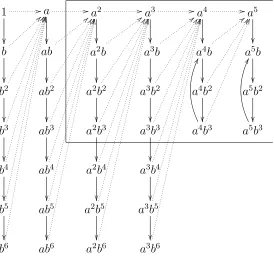
The elements of this subsemigroup are indicated in Figures 1 and 2 where the left and right Cayley graphs of the semigroup S are illustrated. It is clear that T has a finite boundary in S, the complement S\T of T is infinite, and S\T is not an ideal. What is more, S \T is in a sense far from being an ideal: for every ideal I of S the symmetric difference (S\T)∆I is infinite. This example generalises in a natural way to a family of semigroups
Sk,l,m =ha, b|ba=a, akbl =akbm i
1
/
/a //a 2 //a3 //a4 //a5
b
/
/ab //a 2b //a 3b //a 4b //a 5b
b2
/
/ab 2 //a2b2 //a3b2 //a4b2 //a5b2
b3
/
/ab 3 //a2b3 //a3b3 //a4b3 //a5b3
b4
/
/ab 4 //a2b4 //a3b4
H H b5 /
/ab 5 //a2b5 //a3b5
H
H
b6 //ab6
/
/a2b6 //a3b6
H
[image:21.612.172.443.99.363.2]H
Figure 1: A partial view of the left Cayley graph of S where → corresponds to multiplication by b and 99K corresponds to multiplication bya. The elements of the subsemigroupT are those in the rectangle.
1 / /a /
/a2
/
/a3
/
/a4
/
/a5
b > > ab < <
a2b
;
;
a3b
;
;
a4b
;
;
a5b
b2 F F ab2 E E
a2b2
D
D
a3b2
D
D
a4b2
E
E
a5b2
b3 ab3
a2b3
a3b3
a4b3
G
G
H
H
a5b3
G G b4 K K ab4 J J
a2b4
J
J
a3b4
J J b5 ab5
a2b5
a3b5
b6 L L ab6 L L
a2b6
K
K
a3b6
K
K
[image:21.612.169.443.441.700.2]We now move on to give some general results that can be derived from The-orems A and B.
Semigroups with tree-like Cayley graphs
Since Theorems A and B are geometric in nature, one could justifiably hope for applications with a geometric flavour. In this subsection we provide one such application.
Geometrically, free groups are precisely those groups that have a tree as a Cayley graph. So a natural next step is to investigate groups that are ‘tree-like’. This way of thinking has been very fruitful in the study of finitely generated infi-nite groups, giving rise to numerous interesting areas such as the study of Gromov hyperbolic groups, and the theory of ends of groups and Stallings theorem; see [12] for more background on these topics from geometric group theory.
Analogously, the Cayley graph of a free semigroup is a directed tree, and so it is not unreasonable to investigate finitely generated semigroups and monoids whose Cayley graphs are ‘directed tree-like’. Of course there are many possible ways that one can try and capture the notion of tree-like in a definition. Here we shall consider one possible such definition which, in particular, will include all the standard examples that one would regard as ‘obviously’ having tree-like Cayley graphs, such as free semigroups, free products of finite semigroups, the bicyclic monoid etc.
It is well known that, in stark contrast to the situation in group theory, finitely generated subsemigroups of free semigroups need not be finitely presented (see [19, page 7]). But what if we instead try restricting our attention to ideals? For instance, [5, Theorem 3.5] asserts that if an ideal I of a free semigroup F is finitely generated (as a subsemigroup), then it has finite Rees index, and hence it is finitely presented. In what follows we prove a much more general theorem, and show in the process that boundaries, rather than Rees index, provide the appropriate framework for these considerations. Note that in general it is not true that ideals of finitely presented semigroups that are finitely generated as subsemigroups are necessarily finitely presented; see [6, Theorem 3.1]. So the tree-like restriction we are about to introduce will be playing a crucial role.
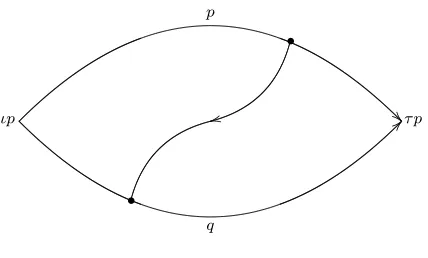
Let S be a semigroup generated by a finite set A, and as usual let Γr(A, S) and Γl(A, S) be the right and left Cayley graphs ofS. By awalk pin Γr(A, S) we simply mean a sequence of (not necessarily distinct) vertices (v0, v1, . . . vn) such that vi → vi+1 for all i. A path is a walk where all the vertices in the walk are distinct. We call v0 the initial vertex of the walk and vn the terminal vertex of the walk, and we denote these vertices byιp and τ p, respectively. Thelength of the walk p is n. Given to vertices s and t in the Cayley graph Γr(A, S) we use dA(s, t) to denote the shortest length of a path from s to t in Γr(A, S) if such a path exists, and set dA(s, t) = ∞ otherwise. We say that the walks p and q are
p
q
?
?
ιp τ p
•
s
s
[image:23.612.186.400.108.237.2]•
Figure 3: The splitting parallel paths property.
disjoint if they have no other vertices in common.
Ifp is a path in a Cayley graph Γr(A, S), and v is a vertex in the path p, we say that v is an interior point of p if v is neither the initial nor terminal vertex of the path p.
Definition 5.2. LetS be a semigroup generated by a finite set A. We say that the right Cayley graph Γr(A, S) has splitting parallel paths (SPP) if there is a constant K > 0 such that for every (ordered) pair (p, q) of parallel paths in Γr(A, S), ifdA(ιp, τ p)> K then there is a path in Γr(A, S) from an interior point ofp to an interior point of q (we say that (p, q) splits). A dual definition applies to the left Cayley graph Γl(A, S).
Intuitively this condition says that any sufficiently large directed 2-cell in the Cayley graph can be split into two directed 2-cells (although these new directed 2-cells need not be smaller than the original). This is illustrated in Figure 5. Note that, in particular, any pair of paths (p, q) that is not disjoint automatically splits, by taking an interior point in the intersection of the two paths, along with the empty path from that vertex to itself. Thus if there is a bound on the size (i.e. distance between endpoints) of pairs of disjoint parallel paths in the Cayley graph, then it will have SPP. It is in this sense that SPP generalises the property of being a directed tree, since in a directed tree there is at most one directed path between any pair of vertices, and so there are no pairs of disjoint parallel paths and thus the Cayley graph automatically has SPP.
Even though the definition of SPP refers to a particular generating set it turns out this is not needed.
Lemma 5.3. Let S be a finitely generated semigroup and let A and B be two
finite generating sets for S. Then Γr(A, S) (resp. Γl(A, S)) has splitting parallel
paths if and only if Γr(B, S) (resp. Γl(B, S)) has splitting parallel paths.
and right Cayley graphs of S both have splitting parallel paths.
The proof of Lemma 5.3 is straightforward, and is relegated to the end of this subsection so that we can first state the result we want to present about such semigroups.
The class of semigroups with SPP includes: finite semigroups, all groups, free semigroups, the bicyclic monoid, the semigroups Sk,l,m defined above, any semigroup defined by h A, B | αβ = γδ i where α ∈ A+, β ∈ B+, γ ∈ A∗,
δ ∈B∗, and A∩B =∅. In contrast, it is easy to see that the free commutative semigroup h a, b | ab = ba i does not have splitting parallel paths (nor would we expect it to, since its Cayley graph is not at all tree-like). Further, the semi-group free product of two semisemi-groups with SPP again has SPP, and the monoid free product of two monoids with SPP again has SPP. All these assertions are straightforward to prove. Less trivially, generalising Lemma 5.3, the SPP prop-erty is a quasi-isometry invariant of finitely generated semigroups (in the sense of quasi-isometry between semigroups considered in [10]). Thus any semigroup that looks sufficiently tree-like when ‘viewed from far away’ will have SPP.
Applying Theorem B we can now characterise finite generation and pre-sentability for ideals of SPP monoids in terms of boundaries in Cayley graphs.
Theorem 5.5. Let S be a finitely presented monoid with splitting parallel paths,
and let I be an ideal of S. Then the following are equivalent:
(i) I is finitely generated (as a subsemigroup of S);
(ii) I is finitely presented;
(iii) I has finite boundary in S.
Proof. Clearly (ii) implies (i). That (iii) implies (ii) follows from Theorem B.
the right boundary, this shows that |Br(A, S)| is finite. A dual argument shows
|Bl(A, S)|is finite, completing the proof.
Note that part (iii) of Theorem 5.5 cannot be replaced by the statement ‘I has finite Rees index in S’. Indeed, let S be the monoid defined by the presentation S =ha, b|ba=a, a4b4 =a4b i, which we discussed above, and which has SPP. The ideal I = {aibj | i≥ 4,0≤ j ≤3} of S is finitely generated and presented, since it has finite boundary, but it clearly does not have finite Rees index in S. Therefore the right way to prove Theorem 5.5 is via the notion of boundaries and by applying Theorem B.
Let us end this subsection by verifying Lemma 5.3: the invariance of SPP under change of generators.
Definition 5.6. Let S be a semigroup generated by a finite set A. We say that the right Cayley graph Γr(A, S) has splitting parallel walks (SPW) if there is a constant K > 0 such that for every (ordered) parallel pair of walks (p, q), where p = (pi)0≤i≤n = (p0, p1, . . . , pn) and q = (qi)0≤i≤m = (q0, q1, . . . , qm), if dA(ιp, τ p) ≥ K then there exist some pk (k 6∈ {0, n}) and ql (l 6∈ {0, m}) such that there is a walk from pk to ql in Γr(A, S) (i.e. such that ql ∈ pkS1). A dual definition applies to the left Cayley graph Γl(A, S).
Note that in the above definition the vertex p0 might possibly be visited multiple times in the course of the walkp, and that the definition of SPW includes the possibility that the pk that is asserted to exist actually satisfies pk=p0.
For the rest of this subsectionS will denote a semigroup generated by a finite setA.
Lemma 5.7. The Cayley graph Γr(A, S)(resp. Γl(A, S)) has SPP if and only if
Γr(A, S) (resp. Γl(A, S)) has SPW.
Proof. One implication is obvious, since every path in Γr(A, S) is a walk. Now
consider the converse. Suppose that Γr(A, S) has SPP with constant K >0. We claim that Γr(A, S) has SPW with the same constant K >0. Let (p, q) be a pair of parallel walks in Γr(A, S) with dA(ιp, τ p)> K. Then each of the walks p and q can be cut down (by removing circuits one at a time) to obtain a pair of paths p0 and q0 fromιp to τ p where{p0} ⊆ {p} (where {p} is the set of vertices in the path p) and {q0} ⊆ {q}. Then (p0, q0) splits by assumption and since {p0} ⊆ {p}
and {q0} ⊆ {q}this also constitutes a splitting for (p, q).
Roughly speaking, the next lemma tells us that by increasing the constantK we can force the crossing path in the splitting to be between vertices that are not close to the endvertices.
p= (pi)0≤i≤n and q = (qi)0≤i≤m, ifdA(ιp, τ p)> K+ 2N then there exits pk with N < k < n and ql with 0< l < m−N such that there is a walk in Γr(A, S) from
pk to ql (i.e. ql ∈pkS1).
Proof. LetL =K + 2N. Let (p, q) be a pair of parallel walks in Γr(A, S), with
p = (pi)0≤i≤n and q = (qi)0≤i≤m, and dA(ιp, τ p) > L. This implies n > N and m > N. Now Γr(A, S) has SPW with constantK and so in particular this implies that there is a walk π1 from p1 toqm−1. (Note that we could have p1 =p0 here, and similarly could have qm−1 = qm). By the definition of L, and the triangle inequality, we see that d(p1, pn) > K and so we may apply SPW to the pair of walks
((p1, p2, . . . , pn),(π1, qm))
to obtain a walk π2 from p2 to qm−1. Continuing in this way after N + 1 steps we obtain a walk πN+1 from pN+1 to qm−1. At each step we use the definition of L, together with the triangle inequality, to conclude that d(pi, pn) > K (for 0≤i≤N + 1) and hence SPW may be applied.
Next we go through the whole process again, beginning with
((p1, p2, . . . , pN, πN+1),(q0, q1, . . . , qm−1)),
and finding walks from p1 to qm−2, p2 toqm−2 and so on until we obtain a walk from pN+1 to qm−2. At each step we make use of the fact that d(pi, qm−2) (for 0≤i≤N+ 1) is greater thanK, which follows from the definition ofLtogether with the triangle inequality. In this way we eventually obtain (after (N + 1)2 steps) a walk from pN+1 toqm−N−1 , proving the lemma.
Proof of Lemma 5.3. LetS =hAiwhere Ais finite, and let b ∈S\A. We claim
that Γr(A, S) has SPP if and only if Γr(A∪ {b}, S) has SPP. By Lemma 5.7 this is equivalent to proving that Γr(A, S) has SPW if and only if Γr(A∪ {b}, S) has SPW, so we shall prove this instead. This clearly suffices to prove the lemma, since once proved it will imply that Γr(A, S) has SPP if and only if Γr(A∪B, S) has SPP if and only if Γr(B, S) has SPP.
Write b = w ∈ A+ and set N = |w| ≥ 1. Now Γr(A, S) is naturally a subdigraph of Γr(A∪ {b}, S). Let s, t ∈ S be arbitrary and such that t ∈ sS1. Then clearly we have
dA∪{b}(s, t)≤dA(s, t)≤N dA∪{b}(s, t),
since any path from s to t in Γr(A∪ {b}, S) can be transformed into a path in Γr(A, S) from s to t by replacing every occurrence of x → xb by a path from x toxb in Γ(A, S) labelled by the wordw∈A+.
(⇐) Suppose Γr(A∪ {b}, S) has SPW with constant K > 0. We claim that Γr(A, S) has SPW with constantL=N K. Indeed, let (p, q) be a pair of parallel walks in Γr(A, S) with dA(ιp, τ p)> L. Then
dA∪{b}(ιp, τ p)> 1
Therefore (p, q) splits when viewed as a pair of parallel walks in Γr(A∪ {b}, S). This clearly immediately implies that (p, q) splits in Γr(A, S) as well.
(⇒) Suppose that Γr(A, S) has SPW with constantL > 0. Recall thatN =
|w| where w ∈ A+ is a fixed word representing b. We claim that Γr(A∪ {b}, S) has SPW with constant K = L+ 2N. Let (p, q) be a pair of parallel walks in Γr(A∪ {b}, S), where p= (pi)0≤i≤n and q = (qi)o≤i≤m, such that dA∪{b}(ιp, τ p)>
K. Replacing each occurrence ofx→xbinpandqby a path fromxtoxblabelled byw∈A+we obtain a pair of walksp0 = (p0
i)0≤i≤n0 andq0 = (q0
i)0≤i≤m0 in Γr(A, S)
fromιptoτ p. NowdA(ιp, τ p)≥dA∪{b}(ιp, τ p)> K and by Lemma 5.8, it follows that qm0 0−N−1 ∈ p0N+1S1. But then since |w| =N this implies that qm−1 ∈p1S1, as required.
As mentioned above, with just a little extra work one can adapt the above arguments to show that SPP is a quasi-isometry invariant of finitely generated semigroups, in the sense of [10].
Unions of semigroups and partial actions
Let S be a semigroup that can be decomposed as a disjoint union of two sub-semigroups T and V. Then the right multiplicative action of S on itself induces a right action (t, v) 7→t·v of the semigroup V on the set T ∪ {0} (where 0 is a new symbol not inS) where
t·v = (
tv if t∈T and tv∈T 0 otherwise.
By theorbit of t∈T under this action we simply mean the set t·V1. Dually V acts onT ∪ {0}on the left in a natural way.
Corollary 5.9. Let S = T ∪V, a disjoint union, where T and V are
subsemi-groups ofS. IfS is finitely generated (resp. presented), and the natural right and
left multiplicative actions of V on T ∪ {0} have finite orbits, then T is finitely
generated (resp. presented).
Proof. Since all the orbits are finite and V is a subsemigroup of S it follows
that properties (i) and (ii) of Proposition 2.3 both hold. But this implies, taking X =A, thatT has finite boundary inS and is therefore finitely generated (resp. presented) by Theorem A (resp. Theorem B).
In general if S = T ∪V, a disjoint union of two subsemigroups, is finitely presented it need not be the case that eitherT orV is finitely presented; see the comment that immediately follows Corollary 7.2 below. We shall return to the subject of unions of semigroups again below in Section 7.
Z from S into the infinite cyclic group Z, such that S≤ = θ−1(Z≤) 6= ∅ and
S> = θ−1(
Z>) 6= ∅ where Z≤ = {0,−1,−2, . . .} and Z> = {1,2, . . .}. Then
S = S≤ ∪S> a disjoint union of subsemigroups. If the homomorphism θ has finite fibres (that is, θ−1(z) is finite for every z ∈ Z) then the hypotheses of Corollary 5.9 will be satisfied. Thus ifS is finitely presented then so are bothS≤ and S>. In fact, combining with Theorem 7.1 below, we have that S is finitely presented if and only ifS≤ and S> both are.
Virtual ideals
The symmetric difference between two sets can be considered a measure of how ‘far apart’ they are. Let us say that a subsetX (not necessarily a subsemigroup) of a semigroup S is a virtual ideal if there exists an ideal I of S such that the symmetric difference X∆I is finite.
Corollary 5.10. Let S be a semigroup and let T be a subsemigroup of S such
thatS\T is a virtual ideal. If S is finitely generated (resp. presented) then T is
finitely generated (resp. presented).
Proof. Let U = S \ T. Let I be an ideal of S such that U∆I is finite. So
I =Z∪X, a disjoint union, where X is a finite subset ofT, and Z =U \Y for some finite subsetY ofU. With this notation, for any finite subsetF of S, since ZF ∩T ⊆I∩T =X, we have
U1F ∩T = (Z∪Y)1F ∩T ⊆(X∪Y F ∪F)∩T
which is finite since all ofX, Y andF are. Dually we see thatF U1∩T is finite. It follows, taking F = A, that T has finite boundary in S, and the corollary follows by applying Theorems A and B.
Subsemigroups of subsemigroups
In this subsection we shall give an example of a chain of semigroups S≥T ≥V where T has finite boundary in S, and V has finite boundary in T, but V does not have finite boundary in S. Thus finite presentability is inherited byV from S by applying Theorem B twice, going via T. This shows that Theorems A and B may sometimes even be applied in situations when the subsemigroup under consideration does not have a finite boundary in its containing semigroup.
Example 5.11. LetS be the semigroup with underlying set
S = [N0 ×N0 ×
N0\ {(0,0,0)}]∪ {0}
and multiplication that we describe below.
L:S\ {0} → {1,2,3}where L(α) is the position of the last non-zero entry of α (e.g. L(0,1,1) = 3). Now multiplication inS is given by:
(x1, y1, z1)(x2, y2, z2) =
(x1+x2, y1+y2, z1+z2)
if L(x1, y1, z1)≤F(x2, y2, z2)
0 otherwise
and
(x, y, z)0 = 0(x, y, z) = 0·0 = 0.
So for example (1,2,3)(4,5,6) = 0 since L(1,2,3) = 3 >1 = F(4,5,6). On the other hand (1,2,0)(0,5,6) = (1,7,6) since L(1,2,0) = 2 ≤ 2 = F(0,5,6). It is routine to check that the multiplication is associative.
The semigroupSis finitely generated by the setA={(1,0,0),(0,1,0),(0,0,1)}
since for (x, y, z)∈S\ {0} we can write
(x, y, z) = (1,0,0)x(0,1,0)y(0,0,1)z
and we generate 0 with (0,0,1)(1,0,0) = 0. In fact, S is defined by the presen-tation
ha, b, c,0 | ba= 0, cb= 0, ca= 0,02 =a0 = 0a=b0 = 0b =c0 = 0c= 0i
where a, b and c correspond to the generators (1,0,0),(0,1,0) and (0,0,1), re-spectively. LetB ={(1,0,0),(0,1,0),(0,1,1)}, C ={(1,0,0),(1,1,1)}, T =hBi
andK =hCi. ClearlyK ≤T ≤S. We begin with a straightforward observation concerning the elements of these subsemigroups:
T ={(x, y,0) :x≥0, y ≥0, xand y not both zero} ∪{(x, y,1) :x≥0, y ≥1} ∪ {0}
and
K ={(x,0,0) :x≥1} ∪ {(x,1,1) :x≥1} ∪ {0}. Claim 1. The boundary of K in S is infinite.
Proof. We will show thatB(A, K) inSis infinite. For allx≥1 we have (x,1,0)6∈
K. However (x,1,0)(0,0,1) = (x,1,1)∈K where (0,0,1)∈A. Thus {(x,1,1) : x≥1} is an infinite subset of the boundary of K inS.
Claim 2. The boundary of K in T is finite.
Proof. We will show that B(B, K) in T is finite. Let Q1 = {(x, y,0) : y ≥ 1},
Q2 ={(x, y,1) :y ≥2}, and note that T \K =Q1∪Q2∪ {(0,1,1)}. Next note that every (x, y, z)∈K has y≤1 so that the intersection of each of the sets
{(0,1,1)}{(0,1,0),(0,1,1)}, {(0,1,0),(0,1,1)}{(0,1,0)}
with K is either empty or equal to {0}. Also
Q1{(1,0,0)}={0}={(0,1,1)}{(1,0,0)}
by the definition of multiplication. Hence the right boundary is equal to{(1,0,0),0}. For the left boundary we have
B(T \K)1∩K = (B ∪(1,0,0)Q1∪ {(1,0,0),(0,1,0)}{(0,1,1)} ∪ {0})∩K = (B ∪ {(x, y,0) : x, y ≥1} ∪ {(1,1,1),(0,2,1)} ∪ {0})∩K = {(1,0,0),(1,1,1),0}.
We conclude that the boundary ofK in T is equal to {(1,0,0),(1,1,1),0}. Claim 3. The semigroup T has a finite boundary in S.
Proof. We will show that B(A, T) in S is finite. Let P1 = {(x,0,1) : x ≥ 0},
P2 ={(x, y, z) :z ≥2}noting thatS\T =P1∪P2. Note that every (x, y, z)∈T has z ≤1 and so the intersections of each of the sets
(0,0,1)P1, P1(0,0,1), P2A, AP2
with T is either empty or is equal to {0}. In addition P1(1,0,0) = P1(0,1,0) =
{0} and so the right boundary is equal to {0,(1,0,0),(0,1,0)}. For the left boundary we have
A(S\T)1∩T = (A∪(1,0,0)P1∪(0,1,0)P1)∩T
= (A∪ {(x,0,1) : x≥1} ∪ {(0,1,1),0})∩T = {(0,1,1),(1,0,0),(0,1,0),0}.
We conclude that the boundary ofT inSis equal to{(1,0,0),(0,1,0),(0,1,1),0}.
6
One sided boundaries
In §3 we saw that subsemigroups of finitely presented semigroups with only the right (or left) boundary finite need not be finitely generated, never mind finitely presented. This still leaves us with the question of whether finitely generated subsemigroups of finitely presented semigroups, with only a finite right (or left) boundary are always finitely presented. We now answer this question in the negative.
Let M be a monoid and let θ be an endomorphism ofM. The Bruck–Reilly extension of M with respect to θ is the semigroup of triples N0 ×M ×N0 with multiplication defined by:
where t = max(n, p). Bruck–Reilly extensions are an important class of infinite simple semigroups. (For more details on Bruck–Reilly extensions see [15].)
Proposition 6.1. Suppose that the Bruck–Reilly extension S =BR(M, θ) of a
monoidM is finitely generated and consider the subsemigroupT ={(0, a, n) :a∈
M, n∈N0}. Then the right boundary of T in S is finite, while the left boundary
is infinite.
Proof. LetU = BR(M, θ)\T. Since
m−n+t =m−n+ max(n, p)≥m−n+n =m
it follows that U is a right ideal in BR(M, θ) and thus, by Proposition 2.2, the right boundary ofT in BR(M, θ) is finite.
Let X be a finite generating set for BR(M, θ). Since, by Proposition 2.1, the finiteness or otherwise of the left boundary is independent of the choice of generating set, we may assume without loss of generality that (0,1M,0)∈X. For n∈N we have:
(0,1M,1)(1, s, n) = (0, s, n);
note that here (1, s, n)∈ U and (0, s, n) ∈T. Therefore, the left boundary ofT inS is infinite (and equal to the whole of T).
Example 6.2. Let M be a non-finitely presented monoid which has a finitely presented Bruck–Reilly extension S = BR(M, θ). One possible choice for M is the group defined by the presentation:
ha, b, c, d| a2ib2i =c2id2i (i∈N0)i
where θ: M →M extends the map xθ =x2 for x∈ {a, b, c, d}. This example is taken from [23, Proposition 3.3] where it was shown thatM is finitely generated but not finitely presented and BR(M, θ) is finitely presented.
Let T be as in the proposition and let N = {(0, a,0) : a ∈ M}. Clearly N ∼= M, N ⊆ T and T \N is an ideal of T. Hence, by Corollary 5.10, T is not finitely presented, although, it is finitely generated: any finite generating set for N together with the element (0,1M,1) is a generating set for T. It now follows from Proposition 6.1 that T has a finite right boundary.