https://www.scirp.org/journal/jss ISSN Online: 2327-5960
ISSN Print: 2327-5952
DOI: 10.4236/jss.2019.710013 Oct. 21, 2019 144 Open Journal of Social Sciences
An Evaluation of the Engine-Room Resources
Based on the Analytic Hierarchy Process
Approach
Ji An
1, Yun Liu
1, Dongdong Du
2, Tingchen Wang
1, Runze Liu
1, Ling Fang
1, Yujie Sun
3, Chen Liu
31Merchant Marine College, Shanghai Maritime University, Shanghai, China 2Wu Song Maritime Safety Administration, Shanghai, China
3Yangshan Port Maritime Safety Administration, Shanghai, China
Abstract
The resources in the engine room are comprised of many factors, meanwhile, numerous factors affecting these resources. All of these factors are necessarily simplified and hierarchized so that the studies or practice on the engine-room resource management (ERM) have clear priorities. As such, the analytic hie-rarchy process (AHP) was utilized as the study technique for this purpose. Five categories of resources in the engine room were specified as top criteria. These resources include personnel resources, consumable resources, informa-tion resources, equipment resources, and environmental resources. Twen-ty-two sub-criteria were identified in accordance with the five resources of the ERM. The ERM principles such as assertiveness and leadership were considered as sub-criteria for personnel resources. The sub-criteria were ranked by using a 1 - 9 Saaty scale. Results revealed that personnel resources were the most important resources in the ERM, followed by equipment re-sources, information rere-sources, environmental rere-sources, and consumable resources. And assertiveness and leadership were the most important factor in the personnel resources, followed by consideration of team experience, effec-tive communication, obtaining and maintaining situational awareness, plan-ning and time management, and allocation, assignment, and prioritization of resources. The findings imply that personnel resources are of vital im-portance in the ERM. Due to the significance of assertiveness and leader-ship in personnel resources, it is recommended that the non-technical skills of seafarers ought to be taken into account in seafarer training and ship re-source management.
How to cite this paper: An, J., Liu, Y., Du, D.D., Wang, T.C., Liu, R.Z., Fang, L., Sun, Y.J. and Liu, C. (2019) An Evaluation of the Engine-Room Resources Based on the Ana-lytic Hierarchy Process Approach. Open Journal of Social Sciences, 7, 144-160.
https://doi.org/10.4236/jss.2019.710013
Received: September 12, 2019 Accepted: October 18, 2019 Published: October 21, 2019 Copyright © 2019 by author(s) and Scientific Research Publishing Inc. This work is licensed under the Creative Commons Attribution International License (CC BY 4.0).
http://creativecommons.org/licenses/by/4.0/
DOI: 10.4236/jss.2019.710013 145 Open Journal of Social Sciences
Keywords
Engine-Room Resource Management, Analytic Hierarchy Process, Personnel Resources, Assertiveness, Leadership
1. Introduction
Engine room resources are comprised of numerous factors, and apparently we cannot treat them as important as equally. It is necessary for manager in the en-gine-room resource management (ERM) to analyze engine room resources in terms of relative importance as well as relationship between each other. At this insight, the hierarchy analysis towards engine room resources is the core objec-tive of this paper.
As an extensively adopted management method, ERM dedicates to achieve ma-rine vehicle’s effective operation by effectively utilizing and managing personnel resources, consumable resources, information resources, equipment resources and environmental resources in the engine-room [1]. To further prevent the merchant shipping accidents caused by the human factor, ERM was listed in the Manila Amendment to the International Convention on Standards of Training, Certifica-tion, and Watch-keeping (STCW) for Seafarers as part A for mandatory require-ments by International Maritime Organization (IMO) [2]. Since the ERM had been upgraded as mandatory requirements of STCW, the shipping industry has great responsibilities to make certain the elaborated requirements of ERM.
The STCW 2010 requirements regarding ERM principally comprised with five key concerns, which are effective communication, allocation, assignment, and prioritization of resources, obtaining and maintaining situational awareness, consideration of team experience, and assertiveness and leadership [3]. Plenty of factors composing engine room resources, and we cannot treat these factors equally as they play different roles in ERM. It is thus necessary for the manager in the ERM to analyze the priority of engine room resources in terms of relative importance as well as the relationship between each other. In this way, the ref-erences are provided for crew training regarding ERM. More importantly, the shipping industry will thereby determine the focus of ERM and make corres-ponding measures for improvement in the efficacy of the ERM.
This study aims to assess engine room resources to decide a clear priority be-tween these resources. The analytic hierarchy process (AHP) method is utilized for providing a ranking and prioritization weights of engine-room resources. Section 2 presents the technical background of AHP and its related application in literature. Section 3 interprets the method we proposed. Section 4 provides the results and demonstrates its implication with a discussion. Section 5 ends with a conclusion.
2. A Literature Review of AHP
DOI: 10.4236/jss.2019.710013 146 Open Journal of Social Sciences technique was first proposed by Saaty [4]. The method aims to obtain compara-tive weights for each element of a systematic hierarchy structure bases on several criteria. The hierarchical structure comprises of top and sub-criteria would be constructed by composing pairwise comparisons of individual judgments. And the comparative importance of the decision for sub-criteria is determined by adopting the pairwise comparison. The AHP method consists of three parts [5]: organizing and dividing the complex problems into a hierarchy; evaluating the comparative importance of the factors at every single level of the hierarchy; syn-thesizing relative importance of the factor in the hierarchy and determining a ranking and the prioritization weights of decision alternatives.
Because the AHP approach is competent to solve complicated decision-making problems with both subjective and objective evaluations methods, it has been so far applied in a wide range of decision problems, such as supplier selecting [6] [7], the human settlement [8], respiratory protection program [9], hospital site selection [10], measuring the sustainability of cities [11], etc. Owing to easy to use and simplicity, the AHP has been studied abundantly and widely applied in nearly all applications related to MCDM by integrating other methods such as quality function deployment (QFD), factor analysis (FA), fuzzy set theory, goal programming (GP), genetic algorithm (GA), and so on.
The AHP method has been successfully used in a number of MCDM applica-tions. For instance, M.C. Carnero [12] performed modeling of decision making for selecting the instrumentations and diagnostic techniques in the predictive maintenance programs combine using FA and AHP. Another study on MCDM applications was conducted by Dweiri and Al-Oqla [13] for material selection. In this study, the authors used AHP to decide a material for a product by means of Expert Choice software. Likewise, Sachdeva et al. [14] had provided a mul-ti-criteria failure mode analysis for a paper mill to determine the most suitable maintenance strategy by using AHP. Also, Meddaoui and Bouami [15] proposed to select a proper maintenance strategy for the heavy industry by utilizing the AHP technique.
Apart from applying in MCDM situations among shore-based sphere, AHP have been caught sight of personnel who work on maritime field due to its unique strength in evaluating different criteria. For instance, Wu et al. [1] pro-posed a developed quantitative performance evaluation method for ERM. In this method, AHP was utilized to construct evaluation criteria through surveying to collection opinions of experts who was proficient in one aspect of ERM. Like-wise, in order to evaluate maritime labor convention requirements at the opera-tional level, Akyuz et al. [16] integrated AHP and balanced scorecard (BSC) to design an evaluation model and this model was applied successfully in the eval-uation process. Given the study on AHP utilization in the maritime field is defi-cient and the advantage of AHP in resolving MCDM problems, we first attempt to adopt the AHP technique to evaluate several resources in the ERM.
DOI: 10.4236/jss.2019.710013 147 Open Journal of Social Sciences Since there are multiple factors constituting every single engine room resource, we must set the priority of engine room resources according to the importance weights of these factors. In other words, several important factors composing every single resource of five engine room resources are equivalent to multiple criterions, which determines the eventual priority of five engine room resources. Stated another way, this paper attempts to assess several resources in the engine room, sub-resources of which were taken into evaluation criterions. Therefore, the evaluation of engine room resources can be considered as an MCDM prob-lem. As previously noted, since the AHP approach has been applied successfully in solving MCDM problems, the AHP method is thus employed to assess a ranking of engine room resources in this study.
3. Method
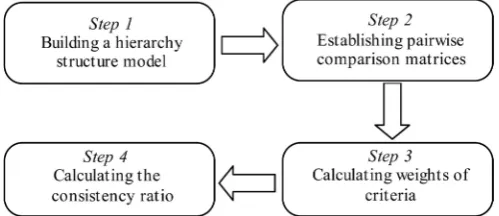
A flow chart for our method is shown in Figure 1. First of all, a hierarchy struc-ture of the ERM will be built to form a questionnaire which is comprised of pairwise comparison matrixes. After that, participants’ understanding and judg-ments about the ERM are obtained through the completion of the table. The priority weight of every engine-room resource and its consistency will be deter-mined by applying the AHP approach. Finally, a final result will be concluded after checking the participants’ opinions for consistency. A detailed description of proposed method can be stated as follows:
Step 1. Building a hierarchy structure model by five categories of engine-room resources. A hierarchy structure model is built according to five categories re-sources of engine-room [1]: personnel rere-sources (B1), equipment resources (B2), consumable resources (B3), information resources (B4), and environmental re-sources (B5).
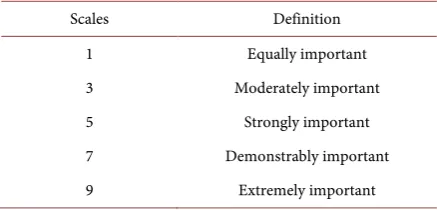
Step 2. Establishing pairwise comparison matrices: a relative importance scale suggested by Saaty [17] is used to compose pairwise comparison matrices of cri-teria. As indicated in Table 1, the numbers 1, 3, 5, 7 and 9 in the scale 1 - 9 of the AHP stands for “equally important”, “moderately important”, “strongly impor-tant”, “demonstrably imporimpor-tant”, and “extremely important”. The remaining numbers which belong to intermediate values are applied only if the compro-mise is required.
[image:4.595.249.499.596.704.2]Each criterion aij
(
i j, =1, 2, 3,,n)
in matrix A represents the comparativeDOI: 10.4236/jss.2019.710013 148 Open Journal of Social Sciences Table 1. Comparative importance scaling of AHP.
Scales Definition 1 Equally important 3 Moderately important 5 Strongly important 7 Demonstrably important 9 Extremely important
importance of ith elements with comparison to the jth elements. Namely, a higher value of aij means a stronger priority of criteria ai over aj. Amongst, aij = 1 when aji = 1/aij and i = j.
( )
11 11
0; 1 ; 1
n ij n n
n nn
ij ij ji ij
a a
A a
a a
a a a a
× = =
> = =
(1)
Step 3. Calculating weights of criteria: Equation (2) can be used to calculate the priority weights of every criterion (w w w1, 2, 3,,wj).
1 1
1 n ij
i j n
kj k a w
n = = a
=
∑
∑
(2)
Step 4. Calculating the consistency ratio (CR): To do the consistency test and provide consistency of data, Saaty [17] proposed consistency index (CI) to check whether the judgments on every single pairwise as well as the whole hierarchy is consistent or not. CI can be computed as follows:
max CI 1 n n
λ
− =− (3)
where λmax is the maximum eigenvalue of the matrix, n denotes the dimension of the matrix. In order to calculate the λmax, Vargas [18] suggested an equation as follow: 1 max n ij j j i a w w
λ =
∑
=
(4)
Then, CR is computed to decide satisfactory consistency. In order to obtain an acceptable consistency, the CR value should be smaller than 0.1. The following equation is used to calculate CR:
CI CR
RI
= (5)
Table 2 presents the random index (RI) values. The CR should be equal to or
Table 2. Random index values.
DOI: 10.4236/jss.2019.710013 149 Open Journal of Social Sciences less than 10% for being considering a reasonable consistency level of the matrix.
3.1. Sample and Data
To realize the proposed method, survey based on brainstorming meetings which aims to collect data for the study was conducted. Initially, survey questionnaires were sent to relevant personals, including experts, engine room resource man-agers, and human resource managers of shipping companies. Thereafter, the purpose and procedures of the survey were explained appropriately. Following which, discussions by the way of brainstorming sessions were performed. The discussions principally revolve around the comparison of five engine room re-sources and sub-criteria such as ERM principles. Participants were asked to give judgment concerning the comparison of each element in the comparison matrix established by their views. Finally, survey results were received.
In this survey, a total of 80 questionnaires were issued. 76 questionnaires were received, for a response rate of 95%. After 2 ineligible questionnaires were left out, 74 usable samples were obtained, yielding an eligible rate of 92.5%.
3.2. Determining Sub-Hierarchy Evaluation Criteria
Personnel resources in the engine room indicate all the manual and non-manual workers available in the engine-room, which includes engineers, master me-chanic, oilers, coppersmith, and cadets, etc. Allocation, assignment, and priori-tization of resources refer to resources are assembled and distributed as required in appropriately priority for achieving optimal job performance. When seafarers perform tasks, it is necessary for them to make a priority on the resources which influence their working arrangement. Under these circumstances, considering some factors such as safety is necessary for them to make proper decisions. At this insight, allocation, assignment, and prioritization of resources is one of the sub-criteria for personnel resources.
Seafarer is the occupation whose schedule is regular. In term of work ar-rangements, the crewmembers in the engine room should make elaborated working plans in order to ensure the work assignments finish as efficiently as possible. Given the necessity of planning and the characteristics of the schedule for seafarers, planning and time management was considered as one of sub-criteria for personnel resources.
DOI: 10.4236/jss.2019.710013 150 Open Journal of Social Sciences result in safety incidents on board if not to be properly resolved. There are vari-ous difficulties for intercultural communication and the significance of effective communication is therefore highlight. IMO [20] proclaimed that all the seafarers in the ship should be capable of using one common language, English in partic-ular, so that the communication between each other is unambiguous, and mes-sage can be transmitted on consistently successful. Therefore, effective commu-nication was also selected to be one of the sub-criteria for personnel resources.
Consideration of team experience in the ERM in general means all members of the engine room share experience of a precise comprehension of concurrent associated systems state, and predict external environment in order to carry out assignments safely and efficiently. From this, consideration of team experience was chosen as a sub-criterion of personnel resources.
According to Endsley’s point of view [21], situation awareness is the percep-tion of various factors in specific situapercep-tions or environments, understanding the meaning of the situation and the projections regarding how the situation devel-ops. Grech et al. [22] pointed out that from 1987 to 2000, 71% of 177 maritime accidents as a result of human error in the ship operations reports on eight dif-ferent countries can be ascribed to situation awareness. It is seen that obtaining and maintaining situational awareness is paramount for seafarers to achieve safe watch-keeping and navigation. Thus, we think that obtaining and maintaining situational awareness can be classified as sub-criteria of personnel resources.
Assertiveness refers to a kind of psychological state which enables a person to communicate equally and authentically with others without infringing on the le-gitimate interests of the others. It is often imperative for a seafarer to be assertive within the engine room. Namely, when made a judgment concerning safe navi-gation, a seafarer has to assert his judgment without any hesitation, irrespective of his rank or station within the ship. In particular, in emergency times, after in-depth consideration, a seafarer who is responsible at that moment has to as-sert his decision without compromising stances.
It is perhaps no surprise that leadership is an important skill for ERM. By re-searching on airline crews, Ginnett [23] posited that more effective leaders in the plane (e.g., captains) played a positive role in the work involving the whole group of crew and addressing task requirements. Situations sometimes arise in the engine room are fairly alike with those on an airplane. It may be thought that every single member of the ERM is a leader under some specific conditions at the time they manage engine room resources. Meanwhile, seafarers will work by their leader and carry out assignments as instructed. Overall, good leadership can be conducive to motivate seafarers to higher performance. To sum up, asser-tiveness and leadership was identified as another sub-criterion for personnel re-sources.
con-DOI: 10.4236/jss.2019.710013 151 Open Journal of Social Sciences sideration of team experience (C14), obtaining and maintaining situational aware-ness (C15), and assertiveness and leadership (C16).
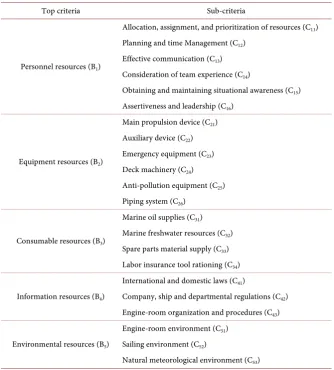
Equipment resources refer to all of installations, machinery and instruments on shipboard, encompassing auxiliary device, main propulsion device, emer-gency equipment, anti-pollution equipment, deck machinery, and piping system. In this sense, sub-criteria for equipment resources (B2) are main propulsion de-vice (C21), auxiliary device (C22), emergency equipment (C23), deck machinery (C24), anti-pollution equipment (C25), and piping system (C26). Consumable sources are a generic term of all such resources which include oils, water re-sources, supplies, spare parts, and tools. Hence, marine oil supplies (C31), marine freshwater resources (C32), spare parts material supply (C33), and labor insurance tool rationing (C34) are considered as four sub-criteria for consumable resources (B3).
Information resources (B4) are all the information in the ship including all the used documents such as company, ship and departmental regulations. In this paper, we specified international and domestic laws (C41), company, ship and departmental regulations (C42), and engine-room organization and procedures (C43) as three sub-criteria for information resources. Ship navigation environ-ment and seafarer working conditions are environenviron-mental resources (B5). At this insight, engine-room environment (C51), sailing environment (C52), and natural meteorological environment (C53) were specified as sub-criteria for environ-mental resources.
The number of 22 sub-resources was determined based on the five categories of resources in the ERM. As shown in Table 3, while six sub-criteria are used and evaluated for personnel resources (B1) and equipment resources (B2), con-sumable resources (B3) are evaluated by the four sub-criteria. Besides, the infor-mation resources (B4) and environmental resources (B5) are both assessed by the three sub-criteria.
3.3. Constructing Pairwise Comparison Matrix
After the engine room resources were further categorized, pairwise comparison matrices of criteria are composed by means of a comparative importance scale which expresses comparisons numerically. The survey results derived from dif-ferent respondents were transformed into numeric data.
First of all, top criteria (five resources of ERM) were compared. Every single participant was required to decide the importance level of each criterion ac-cording to a relative importance scale. The comparison results are shown in Table 4.
DOI: 10.4236/jss.2019.710013 152 Open Journal of Social Sciences Table 3. Sub-criteria for five resources of the ERM.
Top criteria Sub-criteria
Personnel resources (B1)
Allocation, assignment, and prioritization of resources (C11)
Planning and time Management (C12)
Effective communication (C13)
Consideration of team experience (C14)
Obtaining and maintaining situational awareness (C15)
Assertiveness and leadership (C16)
Equipment resources (B2)
Main propulsion device (C21)
Auxiliary device (C22)
Emergency equipment (C23)
Deck machinery (C24)
Anti-pollution equipment (C25)
Piping system (C26)
Consumable resources (B3)
Marine oil supplies (C31)
Marine freshwater resources (C32)
Spare parts material supply (C33)
Labor insurance tool rationing (C34)
Information resources (B4)
International and domestic laws (C41)
Company, ship and departmental regulations (C42)
Engine-room organization and procedures (C43)
Environmental resources (B5)
Engine-room environment (C51)
Sailing environment (C52)
[image:9.595.207.540.489.581.2]Natural meteorological environment (C53)
Table 4. Comparison matrix of top criteria.
B1 B2 B3 B4 B5
B1 1 4 9 8 7
B2 1/4 1 7 3 5
B3 1/9 1/7 1 1/4 1/2
B4 1/8 1/3 4 1 3
B5 1/7 1/5 2 1/3 1
Table 5. Comparison matrix for personnel resources.
C11 C12 C13 C14 C15 C16
C11 1 1 1/4 1/3 1/2 1/7
C12 1 1 1/2 1/4 1/3 1/6
C13 4 2 1 1 2 1/5
C14 3 4 1 1 3 1/3
C15 2 3 1/2 1/3 1 1/2
[image:9.595.194.540.612.745.2]DOI: 10.4236/jss.2019.710013 153 Open Journal of Social Sciences Table 6. Comparison matrix for equipment resources.
C21 C22 C23 C24 C25 C26
C21 1 7 9 7 8 7
C22 1/7 1 5 5 6 3
C23 1/9 1/5 1 2 3 1
C24 1/7 1/5 1/2 1 2 1
C25 1/8 1/6 1/3 1/2 1 1/2
[image:10.595.207.538.236.319.2]C26 1/7 1/3 1 1 2 1
Table 7. Comparison matrix for consumable resources.
C31 C32 C33 C34
C31 1 3 2 3
C32 1/3 1 1 2
C33 1/2 1 1 2
C34 1/3 1/2 1/2 1
Table 8. Comparison matrix for information resources.
C41 C42 C43
C41 1 5 2
C42 1/5 1 1/3
C43 1/2 3 1
Table 9. Comparison matrix for environmental resources.
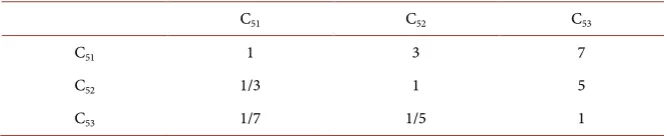
C51 C52 C53
C51 1 3 7
C52 1/3 1 5
C53 1/7 1/5 1
3.4. Calculating Criteria Weights
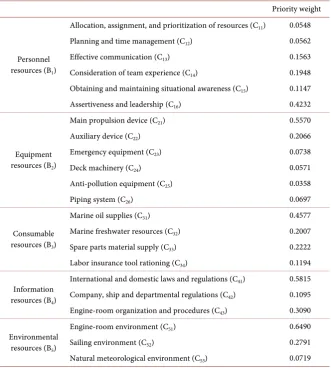
After establishing the comparison matrix, the priority weights of each criterion were computed by using Equation (2). The priority weights of the top criteria are shown in Table 10. Table 11 displays the priority weights of sub-criteria for every resource.
3.5. Calculating Criteria Weights
The consistency of the matrix was verified for the sake of checking the consis-tency level of judgments in the pairwise comparison. Equations (3)-(5) can be used to calculate the CR of matrixes. As a result, Table 12 illustrates the CR for top criteria and sub-criteria.
[image:10.595.206.539.349.417.2] [image:10.595.206.540.446.514.2]DOI: 10.4236/jss.2019.710013 154 Open Journal of Social Sciences Table 10. Priority weights of top criteria.
Engine room resources Priority weight
B1 0.5645
B2 0.2369
B3 0.0355
B4 0.1073
[image:11.595.208.540.215.584.2]B5 0.0558
Table 11. Priority weights of sub-criteria for each resource.
Priority weight
Personnel resources (B1)
Allocation, assignment, and prioritization of resources (C11) 0.0548
Planning and time management (C12) 0.0562
Effective communication (C13) 0.1563
Consideration of team experience (C14) 0.1948
Obtaining and maintaining situational awareness (C15) 0.1147
Assertiveness and leadership (C16) 0.4232
Equipment resources (B2)
Main propulsion device (C21) 0.5570
Auxiliary device (C22) 0.2066
Emergency equipment (C23) 0.0738
Deck machinery (C24) 0.0571
Anti-pollution equipment (C25) 0.0358
Piping system (C26) 0.0697
Consumable resources (B3)
Marine oil supplies (C31) 0.4577
Marine freshwater resources (C32) 0.2007
Spare parts material supply (C33) 0.2222
Labor insurance tool rationing (C34) 0.1194
Information resources (B4)
International and domestic laws and regulations (C41) 0.5815
Company, ship and departmental regulations (C42) 0.1095
Engine-room organization and procedures (C43) 0.3090
Environmental resources (B5)
Engine-room environment (C51) 0.6490
Sailing environment (C52) 0.2791
Natural meteorological environment (C53) 0.0719
Table 12. Consistency ratio for top criteria and sub criteria.
CR Engine room resources (Top criteria) 0.0619
[image:11.595.201.537.613.735.2]DOI: 10.4236/jss.2019.710013 155 Open Journal of Social Sciences
4. Results and Discussion
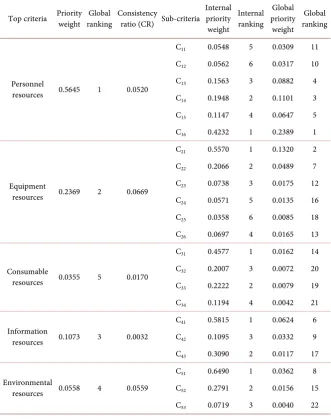
The results of the overall internal and global ranking are shown in Table 13. As shown in Table 13, assertiveness and leadership (C16) is the most crucial factor in terms of ERM principles as its internal priority weight is highest. Moreover, consideration of team experience (C14) can be viewed as the most important element, which is followed by effective communication (C13), obtaining and maintaining situational awareness (C15), and planning and time management (C12). Furthermore, allocation, assignment, and prioritization of resources (C11) are obtained as the least significant factor for the ERM principles. It seemly means that the actualization of C11 depends on other ERM principles’ successful proceeding.
[image:12.595.207.539.302.722.2]From the perspective of internal ranking, C16 is the most superior sub-factor for personnel resources and C14 follows it. It is of note that the priority weight of
Table 13. Overall performance result of evaluation.
Top criteria Priority weight ranking Global Consistency ratio (CR) Sub-criteria Internal priority weight
Internal ranking
Global priority weight
Global ranking
Personnel
resources 0.5645 1 0.0520
C11 0.0548 5 0.0309 11
C12 0.0562 6 0.0317 10
C13 0.1563 3 0.0882 4
C14 0.1948 2 0.1101 3
C15 0.1147 4 0.0647 5
C16 0.4232 1 0.2389 1
Equipment
resources 0.2369 2 0.0669
C21 0.5570 1 0.1320 2
C22 0.2066 2 0.0489 7
C23 0.0738 3 0.0175 12
C24 0.0571 5 0.0135 16
C25 0.0358 6 0.0085 18
C26 0.0697 4 0.0165 13
Consumable
resources 0.0355 5 0.0170
C31 0.4577 1 0.0162 14
C32 0.2007 3 0.0072 20
C33 0.2222 2 0.0079 19
C34 0.1194 4 0.0042 21
Information
resources 0.1073 3 0.0032
C41 0.5815 1 0.0624 6
C42 0.1095 3 0.0332 9
C43 0.3090 2 0.0117 17
Environmental
resources 0.0558 4 0.0559
C51 0.6490 1 0.0362 8
C52 0.2791 2 0.0156 15
DOI: 10.4236/jss.2019.710013 156 Open Journal of Social Sciences C16 is much more than that of C14. This result suggested to us that assertiveness and leadership plays a significantly important role in the personnel resources of the ERM. As Horberry et al. [24] pinpointed, many shipwrecks caused by human errors were found correlated with seafarer poor psychological quality such as low in assertiveness. Likewise, Ginnett [23] noted in his research that leader ef-fective behaviors exert a proactive impact in addressing the interactions required on group work. As leaders in the engine-room, the chief engineer and the second engineer leader behavior impose great influence on ordinary seafarers. Further-more, seafarers’ psychological capital such as assertiveness can impose great in-fluence on ordinary working assignments. Based on literature and results analy-sis, we argued that assertiveness and leadership are irreplaceable factors in the ERM. And assertiveness and leadership have to be borne in mind when cultivat-ing and traincultivat-ing seafarers.
Thereafter, for equipment resources, C21 is indicted to be the most crucial sub-factor, and C22 follows it. It indicates that the main propulsion and auxiliary machine device have incredible importance in the ERM from managers’ stand-point. Understandably, the main propulsion device and auxiliary machine device constitutes the main body of the engine room in terms of hardware apparatus, the role of which is salient. Amongst, main propulsion device is much more im-portant than other sub-criteria of B2, which can be derived from priority weight in Table 11.
In information resources, C41 can be observed as the most significant sub-factor, followed by C43 and C42, respectively. It shows that laws and regulations have remarkable significance for managers in the ERM. Generally speaking, the ob-jective of the ERM is to make the efficacy of the engine room maintain a rational level, so that the ship’s safe navigation is warranted. On the other hand, the management of engine room resources must conform to relevant laws and regu-lations, so the laws and regulations related to ERM are also caught attention in daily work in the engine room. Consumable resources are considered to be the least superior factor, in which C31 can be obtained to be the most important sub-factor as its internal priority weight is highest. C33 follows it as the second crucial sub-factor. Lastly, C51 is observed to be the most significant sub-factor in environmental resources, followed by C52 and C53, respectively. As workplace where seafarers perform management assignments, engine room environment directly exert influence on seafarers by a number of ways. It enlightens us that change engine room environment better is an urgent task which in need of strug-gle from the whole shipping industry.
DOI: 10.4236/jss.2019.710013 157 Open Journal of Social Sciences the natural meteorological environment will no more an extremely crucial factor affecting ERM.
5. Practical Implications
The findings demonstrate that personnel resources are the most important source in the ERM. Namely, it implies that the sub-criteria of personnel re-sources such as effective communication, assertiveness and leadership, consider-ation of team experience, obtaining and maintaining situconsider-ational awareness play an overwhelmingly important role in the ERM. Hence, it is extremely significant that the training regarding non-technical skills should be conducted on seafarers intentionally. The second most important resource is the equipment resources, which demonstrates the comparative importance of the equipment within the ERM. And it means that main propulsion device, auxiliary device, emergency equipment, deck machinery, anti-pollution equipment, and piping system are important equipment which should be treated in earnest for the ordinary man-agement in the engine room. In addition, the findings also indicate that consid-eration of team experience is another important principle of ERM from the point of managers and experts. It reminds us that when seafarers work in the engine room, keep close communication with colleagues and pay attention to changes in the surroundings is pretty necessary.
ERM is one of the principal topics in STCW 2010. Despite there are a large number of requirements in maritime regulations, the potential impact of the ERM are very profound and far-reaching. The ERM not only contributes to safe navigation for the ships but also provides training guidelines for seafarers. Thus, the ERM is considered as the necessary instrument which will be the pillar of ship resource management. Our results indicated that personnel resources were the most important resources in the ERM. In this sense, the shipping industry should struggle to put the ERM requirements regarding personnel resources into practice. Moreover, it was observed that assertiveness and leadership was the most important factor in personnel resources. Hence, crew training concerning non-technical skills should be promptly and effectively put into action by mari-time administrators and ship management companies.
6. Limitation and Future Direction
DOI: 10.4236/jss.2019.710013 158 Open Journal of Social Sciences that can be generalized. Therefore, we recommend that, in future research, fur-ther sub-criteria should be included in case that a more accurate result is achieved. Furthermore, a relatively large-scaled sample is advocated to attain by selecting from the state-own shipping company and private shipping company. Also of note, although AHP we adopted in this study is commonly regarded as an available methodological tool for solving MCDM problems, other methods (e.g., fuzzy logic) are strongly recommended to combine with AHP for obtaining more precise results.
7. Conclusions
This study aims to assess all kinds of resources in the ERM. To this end, a me-thod based on the AHP technique is adopted. A comprehensive survey was con-ducted, and priority weight of resources in the engine room was provided by the AHP technique. The study demonstrated that personnel resources were the most important resources in the ERM. Furthermore, assertiveness and leadership, as one of the ERM principles, was the most important factor in personnel re-sources. In sum, it was concluded that personnel resources undoubtedly play a considerately crucial role in the ERM. And the significance of ERM principles for managers is salient.
Based upon the results of this study, it is recommended that, in the ERM, the managers such as chief engineer should attach importance to personnel resources. Put differently, seafarers as the subject in the ERM, whose role is noteworthy. Furthermore, ERM principles, especially assertiveness and leadership should be kept in mind when seafarer training institutions evaluate seafarers. In view of the amount of time been spent in the ERM, training is limited and short at present, whereas the amount of training content regarding ERM is large in accordance with STCW 2010 [25], we suggested that presently the training focus of ERM should be transfer to personnel resources. We hope our work will shed some lights on seafarer training and evaluation regarding ERM and the improvement in the efficacy of the ERM.
Acknowledgements
The authors are grateful for the help received from Wu Song Maritime Safety Ad-ministration and Yangshan Port Maritime Safety AdAd-ministration. Without their unselfish assistant, this study would have not been completed successfully.
Conflicts of Interest
The authors declare no conflicts of interest regarding the publication of this pa-per.
References
DOI: 10.4236/jss.2019.710013 159 Open Journal of Social Sciences
[2] International Maritime Organization (2011) STCW: Including 2010 Manila Amend-ments: STCW Convention and STCW Code: International Convention on Stan-dards of Training, Certification and Watch-Keeping for Seafarers. International Maritime Organization, London.
[3] STCW (2011) International Convention on Standards of Training, Certification and Watch-Keeping for Seafarers, (STCW) 1978, as Amended in 1995/2010. Interna-tional Maritime Organization, London.
[4] Saaty, T.L. (1977) A Scaling Method for Priorities in Hierarchical Structures. Jour-nal of Mathematical Psychology, 15, 234-281.
https://doi.org/10.1016/0022-2496(77)90033-5
[5] Saaty, R.W. (1987) The Analytic Hierarchy Process—What It Is and How It Is Used.
Mathematical Modelling, 9, 161-176.https://doi.org/10.1016/0270-0255(87)90473-8
[6] Liu, F.H.F. and Hai, H.L. (2005) The Voting Analytic Hierarchy Process Method for Selecting Supplier. International Journal of Production Economics, 97, 308-317.
https://doi.org/10.1016/j.ijpe.2004.09.005
[7] Sevkli, M., Lenny Koh, S.C., Zaim, S., Demirbag, M. and Tatoglu, E. (2007) An Ap-plication of Data Envelopment Analytic Hierarchy Process for Supplier Selection: A Case Study of BEKO in Turkey. International Journal of Production Research, 45, 1973-2003.https://doi.org/10.1080/00207540600957399
[8] Wang, Y. and Xu, Z. (2018) Evaluation of the Human Settlement in Lhasa with In-tuitionistic Fuzzy Analytic Hierarchy Process. International Journal of Fuzzy Sys-tems, 20, 29-44.https://doi.org/10.1007/s40815-017-0422-y
[9] Kolahi, H., Jahangiri, M., Ghaem, H., Rostamabadi, A., Aghabeigi, M., Farhadi, P. and Kamalinia, M. (2018) Evaluation of Respiratory Protection Program in Petro-chemical Industries: Application of Analytic Hierarchy Process. Safety and Health at Work, 9, 95-100.https://doi.org/10.1016/j.shaw.2017.05.003
[10] Şahin, T., Ocak, S. and Top, M. (2019) Analytic Hierarchy Process for Hospital Site Selection. Health Policy and Technology, 8, 42-50.
https://doi.org/10.1016/j.hlpt.2019.02.005
[11] Kara, Y. (2019) Measuring the Sustainability of Cities in Turkey with the Analytic Hierarchy Process. Open Journal of Social Sciences, 7, 322-334.
https://doi.org/10.4236/jss.2019.74025
[12] Carnero, M.C. (2005) Selection of Diagnostic Techniques and Instrumentation in a Predictive Maintenance Program. A Case Study. Decision Support Systems, 38, 539-555.https://doi.org/10.1016/j.dss.2003.09.003
[13] Dweiri, F. and Al-Oqla, F.M. (2006) Material Selection Using Analytical Hierarchy Process. International Journal of Computer Applications in Technology, 26, 182-189.https://doi.org/10.1504/IJCAT.2006.010763
[14] Sachdeva, A., Kumar, D. and Kumar, P. (2008) A Methodology to Determine Main-tenance Criticality Using AHP. International Journal of Productivity and Quality Management, 3, 396-412.https://doi.org/10.1504/IJPQM.2008.019757
[15] Meddaoui, A. and Bouami, D. (2014) Decision Making in Maintenance Using Ana-lytical Hierarchy Process and Time-Driven Activity Based Costing. International Journal of Productivity and Quality Management, 13, 450-470.
https://doi.org/10.1504/IJPQM.2014.062222
[16] Akyuz, E., Karahalios, H. and Celik, M. (2015) Assessment of the Maritime Labour Convention Compliance Using Balanced Scorecard and Analytic Hierarchy Process Approach. Maritime Policy & Management, 42, 145-162.
DOI: 10.4236/jss.2019.710013 160 Open Journal of Social Sciences
[17] Saaty, T.L. (1980) The Analytic Hierarchy Process. McGraw-Hill, New York. [18] Vargas, L.G. (1982) Reciprocal Matrices with Random Coefficients. Mathematical
Modelling, 3, 69-81.https://doi.org/10.1016/0270-0255(82)90013-6
[19] Hetherington, C., Flin, R. and Mearns, K. (2006) Safety in Shipping: The Human Ele-ment. Journal of Safety Research, 37, 401.
https://doi.org/10.1016/j.jsr.2006.04.007
[20] International Maritime Organization (2010) The Manile Amendments to the Sea-farers’ Training, Certification and Watchkeeping (STCW) Code. International Ma-ritime Organization, London.
[21] Endsley, M.R. (1995) Toward a Theory of Situation Awareness in Dynamic Systems.
Human Factors, 37, 32-64.https://doi.org/10.1518/001872095779049543
[22] Grech, M.R., Horberry, T. and Smith, A. (2002) Human Error in Maritime Opera-tions: Analyses of Accident Reports Using the Leximancer Tool. Human Factors & Ergonomics Society Annual Meeting Proceedings, 46, 1718-1721.
https://doi.org/10.1177/154193120204601906
[23] Ginnett, R.C. (1987) First Encounters of the Close Kind: The Formation Process of Airline Flight Crews. Air Force Institute of Tech Wright-Patterson AFB OH School of Systems and Logistics, Ohio.
[24] Horberry, T., Grech, M. and Koester, T. (2008) Human Factors in the Maritime Domain. CRC Press, Boca Raton.