Account manager turnover and the influence of context: An exploratory study.
Introduction
There is wide recognition of the importance of a selling firm’s account managers to
maintaining, developing, and enhancing relationships with customer firms (Biong and
Selnes, 1996; Guenzi and Pelloni, 2004; Karantinou and Hogg, 2009; Murry and Heide,
1998). Prior (2012) suggests that the bonds that develop between principal actors in an
inter-firm relationship are valuable and contribute to competitive advantage. The higher the
level of personal bonds that exist between these actors, the greater key account success is
likely to be (Sharma, 2006). Face-to-face contact is seen as an essential marketing element
of service delivery with services varying from high to low on the service employee-customer
contact continuum (Chase and Tansik, 1983). In business-to-business professional services,
service delivery is characterised by a high degree of interaction between the client and
service firm (Nätti and Ojasalo, 2008). While there is interdependence between the account
manager and other service firm employees, marketing services, the context for this study,
typify the type of service where the account manager is the primary customer contact (Mayer
et al., 2009). In fact, Sharma (1994) maintains that the account manager is the single most
important source of the relationship with the client, while Evans et al. (1995) identify the
account manager as playing a pivotal role in the success of the organization. The
heightened importance of the human element can lead to a situation where the relationship
that develops between individual key contacts at contracting firms can become stronger than
the relationship between the firms themselves (Halinen, 1997).
Given the significance of the account manager to the well-being of the
inter-organizational relationship, it is surprising that the issue of account manager turnover – the
voluntary or involuntary departure of the account manager from the seller firm – and its
potential effect on the inter-firm relationship, has been largely neglected (Madill et al., 2007;
fewer still (Perrien et al., 1995; Perrien and Ricard, 1995; Beatty et al., 1996; Bendapudi and
Leone, 2002; Madill et al., 2007; Subramony and Holtom, 2012) base their conclusions on
empirical inquiry. On the crucial issue of the influence account manager turnover might have
on the relationship between buyer and seller firms, there is a lack of consensus, since much
will depend on the circumstances in which turnover takes place (Madill et al., 2007).
Subramony and Holtom (2012) argue that turnover can have significant negative effects on
business performance, particularly in situations where customers interact with the same
employee on multiple occasions and where understanding of a customer’s idiosyncratic
needs is critical. Perrien and Ricard (1995) on the other hand are more sanguine and
suggest the inter-organizational relationship can survive account manager turnover.
To date, no study has been identified that specifically examines the role of context on
the effects of account manager turnover. With a view to contributing to the scant literature on
this subject and addressing ambiguity in current knowledge, this paper will adopt a case
study approach to explore account manager turnover in client-agency relationships within
the UK design industry. Design agencies are professional service organizations offering
consultancy and creative services to the marketing departments of client organizations. As
with other similar services such as advertising, it is a project-based, high-contact service that
is high in credence qualities (Gummesson, 1996). The context is particularly appropriate for
this investigation because of the high incidence of staff turnover within UK design agencies,
currently estimated to be about 35% per annum (Design Industry Voices, 2011). Although
the study’s narrow contextual focus will limit its generalizability, the findings should be
transferable to other related professional services that share similar characteristics and will
provide useful guidance for professional practice. The research questions this study will
address are:
client-How do these contextual factors influence the impact of account manager turnover?
A conceptual framework covering individual and organizational factors is developed
to examine the contextual issues impacting account manager turnover. The research
explores the views of both parties in the relationship, and seeks the perceptions of senior
and junior managers on the agency side of the dyad. A multi-level approach coupled with the
incorporation of the opinions of upstream and downstream firms is likely to lead to a greater
depth of information about relational exchange (Rajamma et al., 2011). Findings are
presented and a number of implications for professional practice and academic theory are
proposed.
Literature review and conceptual framework
Berry (1995) highlighted the need for greater understanding of the association between
employee turnover and customer defection. Despite the passage of time, Madill et al. (2007)
highlight the paucity of empirical research investigating the effect of account manager
turnover on inter-firm relationships. Kim et al. (2010) also recommend that the influence of
employee turnover on inter-firm relationships, especially in industries where turnover is
particularly high, would be worthy of investigation. Of the limited number of empirical studies
that have explored the repercussions of turnover – as opposed to buyer attitudes towards
hypothetical turnover – the majority suggests that the departure of an account manager can
inflict a detrimental effect on the inter-organizational relationship (Bendapudi and Leone,
2002; Perrien et al., 1995). This is attributed to the discontinuance of the individual-level
relationship that often develops between customer and account manager. Such is the
strength of this personal relationship, often overshadowing the customer’s relationship with
the service firm (Anderson and Robertson, 1995), and such is the level of client-specific
knowledge held by the account manager (Fincham, 1999), that the demise of the
However, a minority of studies disagrees with this pessimistic assessment. Zaheer et
al. (1998) suggest that the relationship between buyer and seller firms is sufficiently stable to
withstand the loss of an account manager, while Perrien and Ricard’s (1995) empirical
research into the commercial banking sector found that customers were untroubled by the
prospect of account manager turnover. Bendapudi and Leone’s (2002) study identified a
small number of customers who actually welcomed the departure of their account manager.
The fact that some clients regard account manager turnover as damaging while
others view it with equanimity suggests that the context in which turnover takes place may
be a contributory factor in the evaluation of its impact. Furthermore, Perrien and Ricard’s
(1995) study reveals differences of opinion across the relationship dyad. They found that,
contrary to the attitude of their clients, account managers considered turnover as a
potentially destabilising event for the client-service firm relationship. While interesting, and
notwithstanding the possibility that account managers have an over-inflated view of their
importance, this difference of opinion amongst relationship partners remains an isolated
finding because much of the research into relationships tends to focus on one, rather than
both, partners in the buyer-seller dyad.
Given the scarcity of research in this area, this study will specifically address the
influence of context on the effects of account manager turnover – the situational factors that
might impact the outcome of turnover.
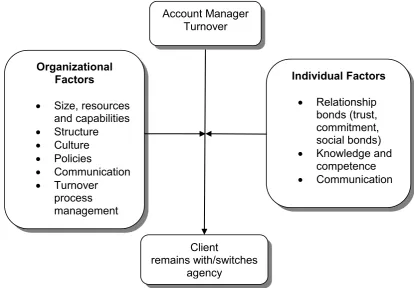
(insert figure 1)
Figure 1 shows the conceptual framework for the research. Interpretations of context
vary across and within business disciplines. Critical realism, the approach adopted for this
scope of this study will be limited to investigating contextual influences within the internal
environment. While the macro environment will influence relationship development, this
study will focus on the micro contextual forces over which the organization exerts some
control. Organizational factors comprising size, resources and capabilities, structure, culture,
policies, and management of the turnover process will be considered. The influence of
individual factors such as relationship bonds, knowledge and competence, and
communication will also be investigated. The framework is based in part on Halinen’s (1997)
model of client-agency relationship development. The model emerged from Halinen’s (1997)
longitudinal case study of relationship development and is particularly relevant because it
includes contextual factors that were found to influence the content and development
process of advertising agency-client relationships.
Organizational size and resources have been shown to influence relationship
longevity (Davies and Prince, 2011; Michell, 1988). It is possible that larger agencies, with
greater human, financial and reputational assets, may withstand account manager turnover
more successfully than smaller agencies. Organizational structure has been shown to
influence the development and management of social capital (Kirsch et al., 2010; Ramezan,
2010). It is conceivable that some agency structures may be more conducive to the
development of a cluster of relationships across the dyad, creating a protective buffer
against turnover. Culture – the set of largely tacit assumptions and beliefs that define
appropriate behaviour (Ravasi and Schultz, 2006) – influences knowledge sharing within a
firm (Janz and Prasarnphanich, 2003). Knowledge sharing would counteract the propensity
for the knowledge silos within consulting organizations that exacerbate the effects of
employee turnover. Wackman et al.’s (1986) research into client-advertising agency
relationships demonstrates the influence of organizational policies and communication on
relationship development. Thus, agencies may be able to instigate systems and processes
that strengthen the relationship with the client at the firm level, lessening the effects of
findings that careful management of the account manager change-over process can lessen
the impact of turnover on the customer-firm relationship.
Liljander and Strandvik (1995) suggest ten relational bonds: legal, economic,
technical, geographical, time, knowledge, social, cultural, ideological, and psychological.
Wendelin (2011) suggests that not all bonds are of equal importance in a relationship. Within
a client-agency relationship, the first five ‘concrete’ bonds are of less importance than the
five ‘abstract’ bonds, given the rarity of legal contracts and relationship-specific financial
investments, the ability to deliver the core service output via IT networks, and the
consultative, ambiguous, complex, and intangible nature of the service being offered. The
social bonds of commitment and trust are key relational bonds in relationship marketing
theory (Palmatier et al., 2006) and have been shown to be the principal determinants of
relationship development and maintenance (Morgan and Hunt, 1994). Both constructs may
exist simultaneously at the level of the individual and the firm, such that a buyer trusts in,
and is committed to, the firm and the account manager simultaneously (Blois, 1999;
Karantinou and Hogg, 2009). If these bonds are stronger at the individual level than the firm
level, the effect of account manager turnover may be more pronounced. On the other hand,
trust may become institutionalized at the firm level and be preserved beyond changes in
personnel (Kroeger, 2012). Measures of trust at the firm level include willingness to adapt
and firm size, while trust at the individual level is based on the representative’s expertise,
likeability, similarity with buyer firm personnel, and frequency of communication (Doney and
Cannon, 1997). For the purposes of this study, commitment is defined as the ‘enduring
desire to maintain a valued relationship’ (Moorman et al., 1992, p. 316). Trust is
dimensionalised as integrity and reliability (Morgan and Hunt, 1994). Integrity can be
regarded as the unwillingness of the seller to do anything that might be detrimental to the
buyer (Ganesan, 1994) while reliability can be interpreted as consistently competent
delivering non-standardized creative services, is likely to be more tacit than collective
(Fincham, 1999). Whereas collective knowledge is a shared set of principles and techniques
(Alvesson, 2001), tacit knowledge is unarticulated and is made up of insights, judgement and
know-how residing in the head of the account manager (Baker et al., 1997). If knowledge is
largely tacit, the loss of the account manager is likely to have a detrimental effect on the
firm’s ability to maintain a high standard of service delivery.
Palmatier et al. (2006) suggest that expertise (competence), together with
communication, are the most effective relationship-building strategies. For this study,
communication is regarded as the formal and informal exchange of information between two
or more parties (Anderson and Narus, 1990). Pine et al. (1995) regard account managers as
gatekeepers for all communication passing between the customer and the service firm, thus
enhancing their status and authority.
Finally, social bonds between respective boundary spanners at the buyer and seller
firm have also been identified as a prerequisite for relationship development (Day and
Barksdale, 2003; Gedeon et al., 2009; Guenzi and Georges, 2010), a driver of trust (Hawke
and Heffernan, 2006; Nicholson et al., 2001) and a motivator for the buyer to stay with the
supplier firm (Young and Denize, 1995). Wilson (1995) defines social bonding as mutual
personal liking and friendship that can drive relationship continuation. Where this personal
chemistry exists between client and account manager, it is conceivable that the client will
follow the account manager who leaves for another firm.
Methodology
The research takes a critical realist orientation. Critical realism concerns itself with what
causes events to occur (or not to occur) and in what specific contexts. As such, it is
appropriate for revealing the influence of context on the impact of account manager turnover.
well suited to complex phenomena such as inter-organizational relationships. Applying the
principles of critical realism to this study, an account manager (entity) with expertise and
personality traits (structures) has the power to leave an agency and end the interpersonal
relationship with a client. This could occur were the account manager, for example, offered a
more attractive position elsewhere (trigger). When this happens, the majority view in the
literature suggests that the relationship between the client and the service firm will terminate
(event). However, there may be contexts, instigated by the agency or the client, that prevent
this outcome, resulting instead in the continuation rather than termination of the
client-service firm relationship. Pawson and Tilley (1997) suggest these contexts can include
interrelationships, rules, and/or values.
Qualitative research was used because of its appropriateness for explaining why and
in what contexts phenomena occur and how processes unfold over time. It can provide rich
descriptions of interactions between individuals and organizations and places emphasis on
situational detail. There is precedent for the use of qualitative research to explore account
manager turnover (Bendapudi and Leone, 2002; Halinen, 1997; Perrien et al., 1995).
Similarly, there is sound justification for using case study inquiry because of its suitability for
exploring bounded systems such as relationships and for situations where meaning needs to
be contextualised (Hammersley, 1992; Perry, 1998).
Research into business relationships frequently focuses on just one partner in the
dyad. Selling firms are highly protective of their customer relationships and are seldom
willing to grant permission for researchers to contact their clients (Athanasopoulou, 2009).
Notwithstanding this barrier, the intention in this study was to collect data from both sides of
the relationship dyad (matched pairs) and furthermore to talk with senior managers as well
A purposive sampling method was used to locate client-agency relationships within
the UK design industry that had witnessed a recent change of account manager. 110 firms
were contacted from a range of sectors including food and drink, retail, finance and
insurance. The response rate was low (20%) and of those responding, only six design
buyers, with their respective agencies, agreed to participate, giving an effective response
rate of 5%. The main reasons cited for non-participation were lack of time and issues of
confidentiality. However, despite the sample being small, the fact that cases consisted of
both partners in the relationship gave it a richness often lacking in buyer-seller relationship
research. The duration of the client-agency relationship under investigation varied from one
year to a maximum of nine years and all relationships had witnessed anything from one to
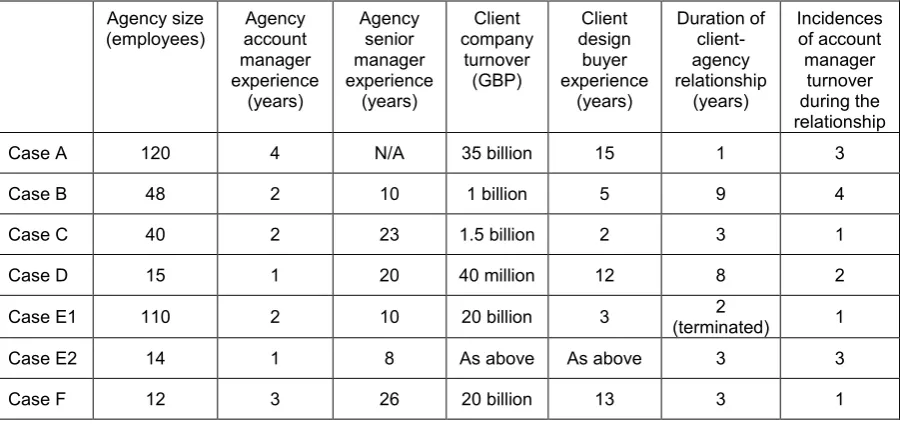
three account manager changes. Descriptive information for the cases is provided in table 1.
(insert table 1)
One-to-one, semi-structured interviews were conducted with the design buyer,
agency senior manager, and ‘replacement’ account manager for each case. Interview
duration was between 30-50 minutes. The exception was case A where no senior manager
from the agency was available. The other anomaly was case E1 where, at the request of the
client, the researcher did not interview agency staff. There were separate interview
schedules for the three respondent types and themes in the schedules were based on the
factors contained within the conceptual framework. All interviews were conducted, recorded,
transcribed, and analysed by the researcher.
Data analysis was conducted using ‘Framework’, a thematic matrix method
developed by Ritchie and Spencer (1994) for applied qualitative data analysis. It is a
systematic and disciplined approach with five stages. Familiarization, the first stage, involved
the researcher personally transcribing all the interviews. Next, a thematic framework was
drawing on a priori themes identified in the literature review. A total of nine categories and 31
constituent subcategories were identified for the framework. For example, the subcategories
of communicators, frequency, mode, style (formal-informal), content, policy, and sharing,
were grouped under the communications category. The third stage, indexing, involved the
application of the thematic framework to the data using Nvivo. Charting involved the creation
of a respondent/subcategory matrix to facilitate within- and cross-case comparison. The final
stage was mapping and interpretation. Mapping is the identification of the nature and range
of a category or subcategory through close investigation of respondent attitudes and
experiences. An example of mapping for the theme of tacit knowledge led to the distillation
of several dimensions: knowledge is power, resistance to sharing, intimate knowledge of
client, intimate knowledge of client’s business, intimate knowledge of how client prefers to
interact. Interpretation is the search for explanations to account for patterns of behaviour,
attitudes, or events.
Findings
All cases had experienced at least one recent (within the previous 12 months) instance of
account manager turnover and some had witnessed several changes over the course of the
client-agency partnership. All clients and all senior managers were able to draw on actual
experience rather than responding hypothetically. Surprisingly, of the six cases, there was
only one instance of account manager turnover leading to the termination of the
client-agency relationship. Importantly, there was no instance of organizational partners being
bound together by formal contractual agreement.
Three core contexts influenced the consequences of account manager turnover on
the client-agency relationship: the extent of standardization of client-specific knowledge
within the agency, the breadth and depth of relational bonds between client and account
turnover. Table 2 shows the three core contexts, the ‘factors’ nested within them, and the
way in which they influence the impact of account manager turnover.
(insert table 2)
Client-specific knowledge
When client-specific knowledge within the agency is collective rather than tacit, the negative
effects of account manager turnover are significantly reduced. Clients notice little or no
reduction in service quality when their account manager leaves because there are several
individuals within the agency who can provide as good a service. Very little of this
standardized knowledge is codified. Rather, through a process of ‘osmosis’, it is assimilated
and becomes embedded within individuals across the agency. Several factors appear to
contribute to this process. Agency size is an important factor. Five out of the seven agencies
in the sample employed 50 or fewer staff, and three of these five employed 15 or fewer.
Single-site locations, open-plan offices and close social relationships are hallmarks of these
organizations. This physical and cultural environment is conducive to frequent, informal,
spontaneous and oral communication which is rich in content. Meetings, when they take
place, are ad hoc and are often convened in the open-plan work area, within earshot of all
staff. Information is widely transferred on a continual basis.
“We all sit next to each other so it’s easy to keep up to date with what’s happening
across all the accounts.” (Account manager F)
Agency culture also appears to play an important role in knowledge sharing. The
smaller agencies spoke of having an organizational culture that encouraged close
interdependence, collaboration, and interpersonal trust, with little sense of hierarchy. This
type of environment fosters communication and a voluntary sharing of knowledge.
positive culture can have on reducing staff turnover, leading to a continuity and depth of
knowledge within the agency that surpassed the knowledge that some clients had of their
brand and market.
Also contributing to frequent communication and knowledge standardization was the
practice in most agencies of implementing a matrix structure of multidisciplinary and multiple
level teams for each client account. This ensured that knowledge of the client’s business
became widespread throughout the agency. In return, the client benefited from the
experience and knowledge of a team of experts. As a result, dependency on a single
individual is reduced:
“The benefit is, if my account manager isn’t there, there’s always somebody else…to
make things happen for me.” (Client B)
Formal procedures for knowledge sharing appeared to be less important than
informal methods, but still played a part. Some agencies aimed at having a company
meeting once a week in which each live project was discussed. Others had recently
instigated client ‘dossier’ sheets’. Although basic, the system acted as a knowledge
externalization process.
Although there was only one instance in this study, account manager rotation was
identified by agency B as a means of dispersing knowledge in order to reduce client
dependence on a single individual:
“If you ring up and can’t get hold of your new person, the old person would pick up
The dispersion of knowledge throughout the agency contributed to a relatively
relaxed approach taken by clients and senior agency management towards account
manager turnover:
“It’s not a panic because everyone in the team knows what’s going on.” (Account
director B)
In contrast, account managers placed greater emphasis on what they described as
the upheaval and uncertainty that could be triggered by their departure, though none went so
far as to suggest it would cause the client to switch agency:
“I’d say the majority [of clients] do mind because we build up very good relationships
and it’s a big change. The client is thinking ‘who will my next account manager be?
Will they be as good? Will I like them? Will I have to work twice as hard to make sure
they understand what I’m talking about?’” (Account manager B).
Agencies A and E1 displayed a different profile to the other agencies. They were
both larger agencies with over 100 staff and one (agency A) was a dual-site agency. At both,
there was much less evidence of knowledge sharing. Although no interviews were permitted
with staff at agency E1, the client in the partnership spoke of only having had one contact at
the agency:
“He absolutely shielded me from anything going on in the agency…he was my
absolute right-hand man.” (Client E)
On the departure of the key contact from the agency, it became evident that no one
else in the agency possessed knowledge of the client’s business, prompting a
“The quality of the work and the knowledge wasn’t there...everything just went to
pot.” (Client E)
The absence of a team approach, coupled with the obstacles to knowledge sharing
inherent in a larger organization, inhibited the externalization of client-specific knowledge.
Agency A underlined the link between culture and knowledge sharing. The account manager
spoke of an environment of hostility between designers and account managers such that
information was filtered in order to restrict knowledge and protect individual power.
Multiple relationship ties
Several of the factors driving the collectivization of client-specific knowledge were also
responsible for relationship development, in particular the client-firm relationship. A small
agency, a positive agency culture, rotation (where practised), and a policy of service teams
not only encouraged the sharing of knowledge internally, but also contributed to the
development of a bond between the client and the entire agency, reducing the importance of
the individual-level relationship. When the agency is small, there is greater opportunity for
the client to meet and interact with all the staff, both from the account management and
creative functions – “because they’re a small agency, it’s pretty easy to get to know
everyone there” (Client D). Most importantly, it was the deployment of agency teams that
facilitated client communication with several agency members, leading to the development of
multiple ties. Frequent interaction with a variety of staff encouraged clients to attribute
service quality not just to their account manager, but also to a consortium of talented and
knowledgeable people.
“She [client 6] has people depending on her; deadlines to meet. That’s why the trust
thing is so important. So when she appoints us, she’s putting a lot of faith in
us…Trust is something you build. If we’ve helped her out two or three times, then
you’re putting credit in the bank.” (Account director 6)
Clients spoke of their agency’s reliability, competence, transparency, and goodwill –
“they’ll work weekends if they have to; they’re committed, completely flexible.” (Client C).
Interpersonal social bonds never developed to the extent that clients were prepared
to sacrifice the agency relationship for their personal bond with an account manager. While
all clients acknowledged the importance of liking, with good rapport and socialising outside
office hours, liking and business friendships never developed into personal friendships. Most
account directors and account managers agreed with this perspective:
“Friend is a powerful word. I don’t think I’d use that word.” (Account manager E2)
In four out of six cases, the client seemed more committed to the agency than to the
key contact. This created a buffer against the potential negative impact of turnover. The
exception was cases A and F. Although both agencies were using teams to service the
accounts in question, the respective clients both acknowledged a commitment primarily to
the senior manager in the team and both admitted that, were the senior manager to leave,
they would re-assess their relationship with the agency. The explanation for the inability of
both teams to build links with their respective clients appears to lie in the level of experience
of the two clients. Both are senior managers with substantial design-buying experience and
both preferred to interact with a senior agency representative, with perceived superior
knowledge and experience, in preference to an agency subordinate.
Clients understand that turnover is inevitable. However, the manner in which the agency
manages the process of turnover has a significant effect on a client’s reaction to the loss of
an account manager and the effects of turnover. Agency to client communication was
highlighted as a critical tool in the management of the process. Clients appreciate timely
warning of impending changes. They are reassured when the communication emanates
from a senior member of the agency management team because it signifies that the agency
takes seriously the issue of frontline personnel changes. A period of transition with an
orderly hand-over between outgoing and incoming account managers acts as reassurance
that there will be no loss of agency performance:
“They very skilfully managed to replace him before he left. It was kind of, Meg
[account director C] rang me up and said ‘got some news for you. Brendan’s leaving
but Becky [account manager C] is starting next week’.” (Client C)
Where it is not possible to recruit a replacement account manager in sufficient time,
clients are reassured when there is a senior manager in the agency team who understands
the client’s business and can act as an interim key contact until a new account manager is
recruited.
An interesting feature of agency E2’s turnover management process was client
involvement in the recruitment of a new account manager. This secured the client’s ‘buy-in’
and increased the likelihood of compatibility between client and new account manager. In
contrast, a badly managed process can create dissatisfaction, though in case D, this in itself
was still not sufficient to cause client switching:
“The change-over was poor. Firstly, Gemma left and then I was told that this other
Communication to me was poor…it detracted from my overall view of [agency D]…it
does force you to reappraise where you are, but ultimately, I don’t believe the work
has suffered.” (Client D)
Discussion and implications
A review of the relationship management literature revealed a limited number of empirical
studies focusing on account manager turnover and, in particular, highlighted a gap with
respect to the influence of context on the effects of turnover. This study provides some
significant insights into the role of context by identifying factors that influence the outcome of
turnover.
While account manager turnover may be unavoidable, its influence on the client-firm
relationship is by no means a foregone conclusion. The theoretical contribution this study
makes is in identifying three core contexts, each with component factors that influence the
outcome of turnover. These are, the extent to which client-specific knowledge is explicit
within the service firm, the extent to which the client is relationally connected to the service
firm (one or several relationship ties), and the manner in which the service firm manages the
process of turnover. The first two contexts are interrelated in the sense that, where there are
multiple relationships between the client and service firm, it is inevitable that, to a greater or
lesser extent, knowledge relating to the client’s business will be dispersed amongst those in
contact with the client. By creating account teams, the service firm takes a first step towards
standardizing knowledge, thus reducing the importance of any one individual within the
service firm.
The size of the service firm was shown to be important in facilitating communication
within the firm and encouraging the spread of knowledge, thus increasing explicit, and
reducing tacit, knowledge. ‘Micro’ firms, defined as those with 20 or fewer employees
regardless of the greater resources of larger firms. Similarly, the identification of
organizational culture as an influential contextual factor is an important insight. Internally, it
can create an environment in which employees strongly identify with the firm’s vision and
objectives and are motivated to share knowledge with their colleagues, voluntarily reducing
their hold over a specific client. For this to occur, employees need to feel a psychological
safety (Bogenreider and Nooteboom, 2004) – the feeling that knowledge-sharing will not
diminish their authority within the firm. Furthermore, the client’s perception that all the
agency’s employees display a high level of commitment and behave according to a similar
value set, only serves to strengthen the bond at the level of the firm rather than the level of
the individual. Smaller firms appeared to be more successful in creating this positive,
unifying culture and in avoiding the development of detrimental subcultures. This appears to
correspond with research from the field of organizational management (Connell, 2001).
The implementation of a multidisciplinary team also has a dual effect: creating a
multiple relationship ties between the client and several members of the service firm and
dispersing knowledge throughout the agency. The implementation of a team and the
reduction of account manager autonomy are critical in altering the client’s perception that the
account manager is solely responsible for delivering value. The client learns to trust, and
develops commitment towards, the service firm. An exception to this was found in two cases
with experienced buyers whose preference was to interact with the most senior agency
manager rather than members of the team. Where this person is the owner of the firm, there
is little danger to the client-service firm relationship. However, when it is a senior manager,
who is free to move to a competitor agency, the absence of a cluster of relationships
increases the possibility of client defection.
While liking, rapport, and socialising outside office hours were present in most cases,
the word friendship. In fact, more experienced clients were ‘friendship-averse’ (Price and
Arnould, 1999), arguing that friendships could complicate business negotiations. The
absence of personal friendship reduces the likelihood of an account manager taking a client
to a new agency.
Perhaps unsurprisingly, the formal codification of client-specific knowledge was
haphazard. A lack of resources inevitably limits a small firm’s ability to implement and
maintain knowledge management systems and procedures. It is also possible that many
small firms feel it unnecessary or even futile to establish systematic mechanisms, given the
informal practices for capturing and disseminating client knowledge and given the difficulty of
codifying ‘intangible’ knowledge such as a client’s likes and dislikes, personality traits and
special needs.
Although staff rotation was deployed to good effect in case B, it was not a commonly
adopted strategy across the other cases. This may be because the frequency of account
manager turnover renders rotation unnecessary. It may also be because senior managers
are reluctant to impose change on clients. While clients may accept the departure of agency
staff as a fact of life, they may be less inclined to accept change, in the form of rotation,
which is implemented by the agency primarily for its own benefit.
In common with Madill et al.’s (2007) research, the way in which the agency
manages the process of turnover was found to be important. However, this study identifies
several additional process management factors that influence the impact of turnover. Timely
agency-client communication, a visible hand-over process from the departing account
manager to the new account manager, the guarantee of a senior manager to step in and fill
the hiatus prior to the appointment of the new account manager, and client involvement in
impact of turnover. All four factors are confidence-building contexts, offering reassurance
and ensuring minimal disruption and performance gap.
Perspectives across the various relationship dyads were surprisingly similar. One
might have expected, based on previous research into professional services (Fullerton and
West, 1996; Wills, 1992), that clients and agencies would hold contrasting views on, for
example, the importance and strength of relationship bonds, with agencies likely to inflate
the importance of personal bonds. On the whole, this was not the case. Client and senior
agency managers agreed on most issues. Although account manager perspectives were
broadly in line with those of clients and their line managers, there were some negative
responses towards the policy of rotation and the implementation of service teams. While the
former may be a useful mechanism for agencies in terms of knowledge sharing and
relationship building, two account managers resented the forced dissolution of their
relationships with clients. With regard to service teams, some account managers identified
instances of role ambiguity and role conflict. They resented the reduction in their autonomy
and the interference of account directors and creative staff. They felt that being part of a
team could sometimes reduce their ability to respond promptly to client demands.
Managerial implications
From a managerial perspective, the data, though limited, suggests that agencies
should be reassured. Account manager turnover does not necessarily mean the end of the
client-service firm relationship. Agencies can create contexts that mitigate the potential
negative effects. Small firms appear to have advantages inherent in their size, but larger
firms can take steps to emulate some of the contexts found in micro firms. Knowledge
sharing can be encouraged by a variety of mechanisms including the implementation of
formal ‘audited’ procedures for recording client intelligence (both ‘tangibles’ such as order
the formation of multidisciplinary, multilevel teams. This latter will also encourage the client
to attribute value creation and delivery to several members of the agency rather than one
individual. Furthermore, the regular intervention of a senior manager such as an account
director or creative director will reassure the client of service continuity in the event of
account manager turnover. However, senior managers should be aware of the potential for
role ambiguity and conflict and must ensure that they establish clarity from the outset in
order that both agency staff and client understand role boundaries. Finally, agencies should
conspicuously manage the process of turnover in order to impress upon clients that the
agency is committed to maintaining service quality. Immediate notification of who will be the
client’s new or interim key contact, reassurance of senior management involvement, a visible
hand-over process where old and new key contacts visit the client together, and client
involvement in the account manager recruitment process will all help to assuage client
concerns.
Study limitations and future research
There are a number of limitations that could be addressed in future research. The first is the
limited number of cases. While there is a good degree of commonality across the cases,
there may be other contextual factors undetected because of the limited sample. A larger
qualitative and/or quantitative study is required to reveal contexts that have not been
identified by this study. In addition, the limited study sample raises issues of sample
composition bias because of its lack of comprehensiveness in reflecting the full spectrum of
characteristics in the population. A broader range of client company sizes and sector types,
and a larger range of agencies of different sizes, would improve the validity of the results.
That said, there was no discernible pattern in those companies that did not respond or
responded but refused to participate in the research. The second limitation concerns the
study context. While it is likely that the findings can be transferred to other marketing
services such as advertising and public relations, research is required in these and other
confines of the design industry. Third, all of the account managers in this study were
relatively junior both in age and in experience and this may have acted as a barrier to closer
relationship development with clients, thus reducing the negative effects of turnover. Future
research examining the influence of demographic profile and personality traits of account
managers and clients would be beneficial. Finally, the study used a cross-sectional approach
and relied on respondents accurately recalling events, attitudes, and behaviours from as
long ago as 12 months. With this in mind, and given the processual and dynamic nature of
References
Alvesson, M. (2001), “Knowledge work: Ambiguity, image, and identity”, Human Relations,
Vol. 54 No.7, pp. 863-886.
Anderson, J., and Narus, J. (1990), “A model of distributor firm and manufacturer firm
working partnerships”, Journal of Marketing, Vol. 54 No. 1, pp. 42-58.
Anderson, E., and Robertson, T. (1995), “Inducing multiline salespeople to adopt house
brands”, Journal of Marketing, Vol. 59 No. 2, pp. 16-31.
Athanasopoulou, P. (2009), “Relationship quality: A critical literature review and research
agenda”, European Journal of Marketing, Vol. 43 No. 5/6, pp. 583-610.
Baker, M., Barker, M., Thorne, J., and Dutnell, M. (1997), “Leveraging human capital”,
Journal of Knowledge Management, Vol. 1 No. 1, pp. 63-74.
Beatty, S., Mayer, M., Coleman, J., Reynolds, K. and Lee, J. (1996), “Customer-sales
associate retail relationships”, Journal of Retailing, Vol. 72 No. 3, pp. 223-247.
Bendapudi, N., and Leone, R. (2002), “Managing business to business customer
relationships following key contact employee turnover in a vendor firm”, Journal of
Marketing, Vol. 66 No. 2, pp. 83-101.
Berry, L. (1995), “Relationship marketing of services – growing interest, emerging
perspectives”, Journal of the Academy of Marketing Science, Vol. 23 No. 4, pp.
Biong, H., and Selnes, F. (1996), “The strategic role of the salesperson in established
buyer-seller relationships”, Journal of Business-to-Business Marketing, Vol. 3, pp. 39-78.
Blois, K. (1999), “Trust in business-to-business relationships; an evaluation of its status”,
Journal of Management Studies, Vol. 36 No. 2, pp. 197-216.
Bogenrieder, I., and Nooteboom, B. (2004), “Learning groups: What types are there?”,
Organization Studies, Vol. 25 No. 2, pp. 287-313.
Chase, R., and Tansik, D. (1983), “The customer contact model for organization design”,
Management Science, Vol. 29 No. 9, pp. 1037-1050.
Connell, J. (2001), “The influence of firm size on organizational culture and employee
morale”, Journal of Management Research, Vol. 1 No. 4, pp. 220-232.
Davies, M. and Prince, M. (2011), “Switching costs and ad agency-client relationship
longevity: an exploratory study”, Services Marketing Quarterly, Vol. 32 No. 2, pp.
146-159.
Day, E. and Barksdale, H. (2003), “Selecting a professional service provider from the
shortlist”, Journal of Business and Industrial Marketing, Vol. 18 No. 6/7, pp. 564-579.
Design Industry Voices (2011), “Faltering economy puts squeeze on agencies”, available at:
http://www.designindustryvoices.com/ (accessed 7 March 2012).
Doney, P. and Cannon, M. (1997), “An examination of the nature of trust in buyer-seller
Easton, G. (2010), “Critical realism in case study research”, Industrial Marketing
Management, Vol. 39 No. 1, pp. 118-128.
Evans, K., Gremler, D., Schlacter, J., and Wolfe, W. (1995), “The impact of salesperson
socialization on organizational commitment, satisfaction, and performance in a
professional service organization”, Journal of Professional Services Marketing, Vol.
11 No. 2, pp. 139-156.
Fincham, R. (1999), “The consultant-client relationship: Critical perspectives on the
management of organizational change”, Journal of Management Studies, Vol. 36 No.
3, pp. 335-351.
Fullerton, J., and West, M. (1996), “Consultant and client working together?”, Journal of
Managerial Psychology, Vol. 11 No. 6, pp. 40-49.
Ganesan, S. (1994), “Determinants of long-term orientation in buyer-seller relationships”,
Journal of Marketing, Vol. 58 No. 2, pp. 1-19.
Gedeon, I-M., Fearne, A., and Poole, N. (2009), “The role of inter-personal relationships in
the dissolution of business relationships”, Journal of Business and Industrial
Marketing, Vol. 24 No. 3, pp. 218-226.
Guenzi, P., and Georges, L. (2010), “Interpersonal trust in commercial relationships:
Antecedents and consequences of customer trust in the salesperson”, European
Guenzi, P., and Pelloni, O. (2004), “The impact of interpersonal relationships on customer
satisfaction and loyalty to the service provider”, International Journal of Service
Industry Management, Vol. 15 No. 4, pp. 365-384.
Gummesson, E. (1996), “Relationship marketing and imaginary organizations: a synthesis”,
European Journal of Marketing, Vol. 30 No. 2, pp. 31-44.
Halinen, A. (1997), Relationship Marketing in Professional Services, Routledge, London.
Hammersley, M. (1992), What’s Wrong with Ethnography? Routledge, London.
Hawke, A., and Heffernan, T. (2005), “Interpersonal liking in lender-customer relationships in
the Australian banking sector”, International Journal of Bank Marketing, Vol. 24 No. 3,
pp. 140-157.
Janasick, V. (2000), “The choreography of qualitative research design: Minuets,
improvisations and crystallization”, in Denzin, N. and Lincoln, Y. (Eds.), Handbook of
Qualitative Research, 2nd Edition, Sage, Thousand Oaks, CA., pp. 379-399.
Janz, B. and Prasarnphanich, P. (2003), “Understanding the antecedents of effective
knowledge management: The importance of a knowledge-centred culture”, Decision
Sciences, Vol. 34 No. 2, pp. 351-85.
Karantinou, K. and Hogg, M. (2009), “An empirical investigation of relationship
Kim, W., Ok, C., and Gwinner, K. (2010), “The antecedent role of customer-to-employee
relationships in the development of customer-to-firm relationships”, The Service
Industries Journal, Vol. 30 No. 7, pp. 1139-1157.
Kirsch, L., Ko, D., and Haney, M. (2010), “Investigating the antecedents of team-based clan
control”, Organization Science, Vol. 21 No. 2, pp. 469–489.
Kroeger, F. (2012), “Trusting organizations: The institutionalization of trust in
inter-organizational relationships”, Organization, Vol. 19, pp. 743-763.
Liljander, V., and Strandvik, T. (1995), “The nature of customer relationships in services”, in
Swartz, T., Bowen, D., and Brown, S. (Eds.), Advances in Services Marketing and
Management, JAI Press, Vol. 4, London, pp. 141-167.
Madill, J., Haine, G., and Riding, A. (2007), “Managing customer relationships: Account
manager turnover and effective account management”, Industrial Marketing
Management, Vol. 36 No. 2, pp. 241-248.
Mayer, D., Ehrhart, M., and Schneider, B. (2009), “Service attribute boundary conditions of
the service climate-customer satisfaction link”, Academy of Management Journal,
Vol. 52 No. 5, pp. 1034-1050.
Merrilees, B., Rundle-Thiele, S., and Lye, A. (2010), “Marketing capabilities: Antecedents
and implications for B2B SME performance”, Industrial Marketing Management, Vol.
Mitchell, V-M. (1994), “Problems and risks in the purchasing of consultancy services”,
Service Industries Journal, Vol. 14 No. 3, pp. 315-340.
Michell, P. (1988), “The influence of organizational compatibility on account switching”,
Journal of Advertising Research, Vol. 28, pp. 33-38.
Moorman, C., Zaltman, G., and Deshpande, R. (1992), “Relationships between users and
providers of market research: The dynamics of trust within and between
organizations”, Journal of Market Research, Vol. 29 No. 3, pp. 314-328.
Morgan, R., and Hunt, S. (1994), “The commitment-trust theory of relationship marketing”,
Journal of Marketing, Vol. 58 No. 3, pp. 20-38.
Murry, J., and Heide, J. (1998), “Managing promotion program participation within
manufacturer-retailer relationships”, Journal of Marketing, Vol. 62 No. 1, pp. 58-68.
Nätti, S. and Ojasalo, J. (2008), "Loose coupling as an inhibitor of internal customer
knowledge transfer: findings from an empirical study in B-to-B professional services",
Journal of Business and Industrial Marketing, Vol. 23 No. 3, pp. 213-223.
Nicholson, C., Compeau, L., and Sethi, R. (2001), “The role of interpersonal liking in building
trust in long-term channel relationships”, Journal of the Academy of Marketing
Science, Vol. 29 No. 1, pp. 3-15.
Palmatier, R., Dant, R., Grewal, D., and Evans, K. (2006), “Factors influencing the
effectiveness of relationship marketing: a meta-analysis”, Journal of Marketing, Vol.
Pawson, R., and Tilley, N. (1997), Realistic Evaluation, Sage London.
Perrien, J. and Ricard, L. (1995), “The meaning of a marketing relationship”, Industrial
Marketing Management, Vol. 24 No. 1, pp. 37-43.
Perrien, J., Paradis, S., and Banting, P. (1995), “Dissolution of a relationship: The salesforce
perception”, Industrial Marketing Management, Vol. 24, pp. 317-327.
Perry, C. (1998), “Processes of a case study methodology for postgraduate research in
marketing”, European Journal of Marketing, Vol. 32 No. 9/10, pp. 785-802.
Pine, B., Peppers, D. and Rogers, M. (1995), “Do you want to keep your customers
forever?”, Harvard Business Review, Vol. 73 No. 2, pp. 103-114.
Price, L., and Arnould, E. (1999), “Commercial friendships: Service provider-client
relationships in context”, Journal of Marketing, Vol. 6 No. 4, pp. 38-56.
Prior, D. (2012), "The effects of buyer-supplier relationships on buyer competitiveness",
Journal of Business and Industrial Marketing, Vol. 27 No. 2, pp. 100-114.
Rajamma, R., Zolfagharian, M., and Pelton, L. (2011), "Dimensions and outcomes of B2B
relational exchange: a meta-analysis", Journal of Business and Industrial Marketing,
Vol. 26 No. 2 pp. 104-114.
Ramezan, M. (2010), “Intellectual capital and organizational organic structure in knowledge
Ravasi, D., and Schultz, M. (2006), “Responding to organizational identity threats: Exploring
the role of organizational culture”, Academy of Management Journal, Vol. 49 No. 3,
pp. 433-458.
Ritchie, J., and Spencer, L. (1994), “Qualitative data analysis for applied policy research”, in
Bryman, A. and Burgess, R. (Eds.), Analysing Qualitative Data, Routledge, London,
pp. 173-194.
Ryan, A., Tähtinen, J., Vanharanta, M., and Mainela, T. (2009), “Putting critical realism to
work in business relationship research”, available at:
http://www.impgroup.org/uploads/papers/7261.pdf (accessed 3 February 2012).
Sayer, A. (2000), Realism and Social Science, Sage, London.
Sharma, D. (1994), “Classifying buyers to gain marketing insight: A relationship approach to
marketing services”, International Business Review, Vol. 3 No. 1, pp. 15-30.
Sharma, A. (2006), “Success factors in key accounts”, Journal of Business and Industrial
Marketing, Vol. 21 No. 3, pp. 141-150.
Sirdeshmukh, D., Singh, J., and Sabol, B. (2002), “Consumer trust, value, and loyalty in
relational exchanges”, Journal of Marketing, Vol. 66 No. 1, pp. 15-37.
Smith, J., and Barclay, D. (1997), “The effects of organizational differences and trust on the
effectiveness of selling partner relationships”, Journal of Marketing, Vol. 61 No. 1, pp.
Stanko, M., Bonner, J., and Calantone, R. (2007), “Building commitment in buyer-seller
relationships: A tie strength perspective”, Industrial Marketing Management, Vol. 361
No. 8, pp. 1094-1103.
Subramony, M., and Holtom, C. (2012), “The long-term influence of service employee
attrition on customer outcomes and profits”, Journal of Service research, Vol. 15 No.
4, pp. 460-473.
Wackman, D., Salmon, C., and Salmon, C. (1986), “Developing an advertising agency-client
relationship”, Journal of Advertising Research, Vol. 26 No. 6, pp. 21-28.
Wendelin, R. (2011), “Bond audit, a method for evaluating relationships”, Journal of
Business and Industrial Marketing, Vol. 26 No. 3, pp. 211-217.
Wills, J. (1992), “Winning new business: An analysis of advertising agency activities”,
Journal of Advertising Research, Vol. 32 No. 5, pp. 10-16.
Wilson, D. (1995), “An integrated model of buyer-seller relationships”, Journal of the
Academy of Marketing Science, Vol. 23 No. 4, pp. 335-45.
Young, L. and Denize, S. (1995), “A concept of commitment: Alternative views of relational
continuity in business service relationships”, Journal of Business and Industrial
Marketing, Vol. 10 No. 5, pp. 22-37.
Zaheer, A., McEvily, B., and Perrone, V. (1998), “Does trust matter? The effects of
inter-organizational and interpersonal trust on performance”, Organization Science, Vol. 9
Table 1
Descriptive information for the cases
Agency size (employees) Agency account manager experience (years) Agency senior manager experience (years) Client company turnover (GBP) Client design buyer experience (years) Duration of client-agency relationship (years) Incidences of account manager turnover during the relationship
Case A 120 4 N/A 35 billion 15 1 3
Case B 48 2 10 1 billion 5 9 4
Case C 40 2 23 1.5 billion 2 3 1
Case D 15 1 20 40 million 12 8 2
Case E1 110 2 10 20 billion 3 (terminated) 2 1
Case E2 14 1 8 As above As above 3 3
Table 2
Contextual factors influencing the impact of account manager turnover
Core Context Component Factors Nature of Influence
Client-specific
knowledge Communication quality: Agency size
Agency structure
Agency culture
Policies/procedures for knowledge management
Policy of account manager rotation
Small agency = single site, open plan office, and close relationships, encouraging frequent communication and knowledge sharing Multidisciplinary teams = knowledge dispersal across multiple
hierarchical levels
Collaborative culture = interdependence, trust, and voluntary knowledge sharing
Regular meetings and client dossier sheets = knowledge externalization
Regular rotation = collectivization of client-specific knowledge
Multiple relationship
ties Agency structure
Agency culture
Policy of account manager rotation
Client expertise and seniority
Multidisciplinary teams = lessening of client dependence on account manager and attribution of service quality to broader team
Single-minded, positive agency culture = development of client-agency relationship and commitment to agency rather than account manager Rotation = creation of multiple ties between client and agency staff
Senior client = preference to liaise with senior agency management rather than account manager
Agency management of the turnover process
Communication quality
Hand-over process
Senior manager involvement
Client involvement in recruitment process
Timely, detailed communication from senior management = client reassurance
Orderly hand-over process from departing to incoming account manager = seamless service quality
Interim involvement of senior manager prior to recruitment of new account manager = client reassurance
Figure 1
Conceptual framework
Client
remains with/switches agency
Account Manager Turnover
Individual Factors
Relationship bonds (trust, commitment, social bonds)
Knowledge and competence
Communication Organizational
Factors
Size, resources and capabilities
Structure
Culture
Policies
Communication