RES. AGR. ENG., 55, 2009 (2): 45–51 45 Barley (Hordeum vulgare L.) is a member of the
grass family Poaceae. In Iran, barley is widely cul-tivated on approximately 1.8 million hectares with an annual production of 2.9 × 10⁶ ton (FAO 2006). Several million tonnes of straw are produced from this crop annually. The straw usually serves as feed for animals and sometimes is incorporated into the plowed layer or used as mulch. For these purposes, straw must be processed after harvesting. For the selection of the design and operational parameters of the equipment used in harvesting, i.e. thresh-ing, handlthresh-ing, and other barley straw processthresh-ing, it is necessary to know its physical and mechanical properties.
Most studies on the mechanical properties of plants have been carried out during their growth using failure criteria (force, stress, and energy). The studies have focused on the plant anatomy, lodg-ing processes, harvest optimisation, animal nutri-tion, industrial applications, and decomposition of wheat straw in soil (McNulty & Mohsenin 1979; Annoussamy et al. 2000). The properties of cellular materials that are important in cutting are compression, tension, bending, shearing, den-sity, and friction. These properties depend on the
species, variety, stalk diameter, maturity, moisture content, and cellular structure (Bright & Kleis 1964; Persson 1987). These physical properties are also different at different heights of the plant stalk and loading rates.
As well known, the resistance of plants to lodg-ing is closely related to the mechanical properties of their stems. This fact has been reflected in many years of research on the mechanical properties of plant stems (Blahovec et al. 1983, 1984, 1985; Skubisz et al. 1989; Blahovec & Skubisz 1990; Skubisz 1996, 1998, 2001; Skubisz & Muller 1991; Skubisz & Blahovec 1997; Grundas & Skubisz 2008).
The resistance of forage stalks to bending was determined by McClelland and Spielrein (1958) and by Prince et al. (1969). These investigations showed a linear relationship between the ultimate force and weight per unit length of the stalk using two-inch specimens. Curtis and Hendrick (1969) found that the section modulus in bending varied with the third power of the diameter for cotton stalks of diameters ranging from 7 to 16 mm. The Young’s modulus varied from 600 to 3500 MPa. O’Dogherty et al. (1995) showed that the Young’s
Effects of moisture content, internode position and
loading rate on the bending characteristics
of barley straw
H. Tavakoli, S.S. Mohtasebi, A. Jafari
Department of Agricultural Machinery Engineering, Faculty of Biosystems Engineering,
University of Tehran, Iran
Abstract: This study was conducted with the aim to evaluate the effects of the moisture content, internode position, and loading rate on the bending characteristics of barley straw including bending stress and Young’s modulus. In the study, 9 treatments were performed as randomised complete block design with 5 replications. The characteristics were determined at three moisture levels: 10%, 15%, and 20% wet basis, three loading rates: 5, 10, and 15 mm/min, and three internodes: the first, second, and third internodes. The results showed that both the bending stress and Young’s modu-lus decreased with an increase in the moisture content and towards the third internode position. The average bending stress was obtained as 8.41 MPa varying from 6.32 to 12.41 MPa, while the average Young’s modulus was calculated as 473.88 MPa ranging from 330.94 to 618.91 MPa. As shown by the results obtained, the values of the characteristics increased with increasing loading rate.
46 RES. AGR. ENG., 55, 2009 (2): 45–51 modulus for wheat straw varied between 4.76 GPa
and 6.58 GPa. Chattopadhyay and Pandey (1999) found that the bending stress for sorghum stalks at the seed stage and forage stage were 40.53 MPa and 45.65 MPa, respectively.
Similar studies have been conducted in recent years such as: Ince et al. (2005) on sunflower stalks and Nazari Galedar et al. (2008)on alfalfa stems.
The objective of this study was to investigate the effects of the moisture content, internode position, and loading rate on the bending characteristics of barley straw in terms of the bending stress and Young’s modulus.
MATERIAL AND METHODS
The barley stems (cv. Nosrat) used for the present study came from one of the prevalent varieties of barley in Iran and were obtained from the agronomy farm of the Seed and Seedling Research Institute, Karaj, Iran. The stems were collected at harvest and their internodes were separated according to their position down wards from the ear (Figure 1) (An-noussamy et al. 2000). The leaf blades and sheaths were removed prior to any treatment or measure-ment. To determine the average moisture content of the barley stems, the specimens were weighed and oven-dried at 103°C for 24 h (ASAE 2006) and then reweighed. To obtain stems with different moisture contents, a fine spray of water was applied using a spray gun. The duration of spray was varied to obtain stems with different moisture contents. The
quantity of water which should be added to the stems was determined by the following equation (Shaw & Tabil 2006):
m
i(Mwf – Mwi)
mw = ––––––––––––– (1)
1 – Mwf
where:
mw – amount of water added to the sample (g)
mi – initial weight of the sample (g)
Mwf – final desired moisture content of the sample (% wet
basis)
Mwi – initial moisture content of the sample (% wet basis)
[image:2.595.89.247.59.289.2]The rewetted samples were then transferred to separate plastic bags and the bags were sealed tightly. The samples were kept at 5°C in a refrigerator for a week to enable the moisture to distribute uniformly throughout the samples. After that, the specimens were taken out of the refrigerator and allowed to warm up to room temperature for about 2 h. The specimens were then reweighed to specify the amounts of water absorbed by them. On calculating the amounts of water absorbed and using Eq. (1), the moisture contents of the straw specimens were obtained. The experiments were conducted at mois-ture levels of 10%, 15%, and 20% wet basis. Three internodes of barley stem, namely the first, second, and third internodes were studied in this research (Figure 1). The fourth and further stem internodes from the ear were not investigated because these internodes are usually left on the field. The experi-ments were also done at loading rates of 5, 10, and 15 mm/min.
Figure 1. Diagram of straw identifying internodes
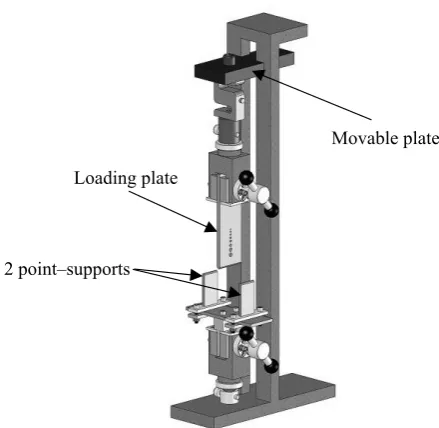
[image:2.595.308.528.512.726.2]Figure 2. Apparatus for the measurement of bending charac-teristics of straw internodes
Fig.1. Diagram of straw identifying internodes
Fig.2. Apparatus for the measurement of bending characteristics of straw internodes. 2 point–supports
Loading plate
RES. AGR. ENG., 55, 2009 (2): 45–51 47 Experimental procedure
The mechanical properties of barley straw were assessed using a three-point bending test similar to those described by Crook and Ennos (1994), An-noussamy et al. (2000), and Nazari Galedar et al. (2008) (Figure 2). The measurements were made using a proprietary tension/compression testing ma-chine (Instron Universal Testing Mama-chine/SMT-5, SANTAM Company, Tehran, Iran).
Bending test
To determine the Young’s modulus and maximum bending stress, the specimens were arranged with their major axis of the cross-section in the horizontal plane and placed on two rounded metal supports located 50 mm apart and then loaded in the midway between the supports with a blade driven by movable supports (Figure 2). The edge radius of the supports and blade was 0.3 mm. The force applied was meas-Table 1. Physical characteristics of barley straw in different moisture contents and internode positions (N = 15)
Moisture content (% wet basis)
10 15 20
Height IN1 IN2 IN3 IN1 IN2 IN3 IN1 IN2 IN3
d1 (mm) (0.15)*3.75 (0.26)4.59 (0.51)4.98 (0.16)3.79 (0.41)4.89 (0.34)5.11 (0.14)3.88 (0.31)5.02 (0.45)5.18
d2 (mm) (0.15)3.33 (0.21)4.15 (0.29)4.30 (0.14)3.40 (0.23)4.21 (0.25)4.39 (0.16)3.49 (0.19)4.33 (0.25)4.58
t (mm) (0.03)0.26 (0.04)0.31 (0.05)0.36 (0.02)0.29 (0.02)0.33 (0.04)0.35 (0.03)0.30 (0.05)0.36 (0.06)0.38
Ib (mm4) (0.59)3.37 (1.58)7.66 (3.14)10.09 (0.42)3.72 (1.45)8.39 (2.11)10.37 (0.49)3.96 (1.35)9.17 (2.89)11.87
[image:3.595.69.533.73.240.2]*Figures in parentheses are standard deviations; N – number of observations; IN1, IN2 and IN3 – first, second and third internodes, respectively; d1, d2 – major and minor diameters; t – thickness of stem; Ib – second moment of area
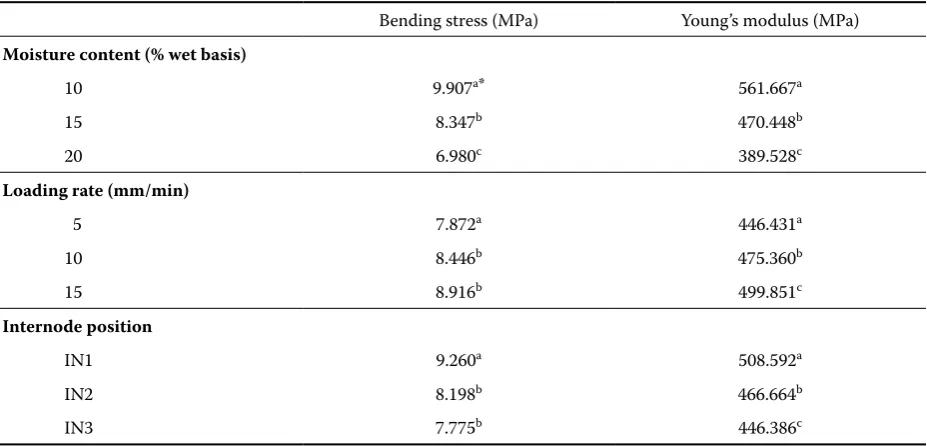
Table 2. Mean comparison of bending stress and Young’s modulus of barley straw at different moisture contents, loading rates and internode positions
Bending stress (MPa) Young’s modulus (MPa)
Moisture content (% wet basis)
10 9.907a* 561.667a
15 8.347b 470.448b
20 6.980c 389.528c
Loading rate (mm/min)
5 7.872a 446.431a
10 8.446b 475.360b
15 8.916b 499.851c
Internode position
IN1 9.260a 508.592a
IN2 8.198b 466.664b
IN3 7.775b 446.386c
[image:3.595.68.532.502.725.2]ured by the strain-gauge load cell and force-time record obtained up to the failure of the specimen. As shown in Table 1, most specimens were slightly elliptical in the cross-section, thus the second mo-ment of the area in bending about the major axis (Ib) was calculated as (Gere & Timoshenko 1997):
π
Ib = ––– [ab3 – (a – t) × ( b – t)3] (2) 4
where:
Ib – second moment of area (mm4)
a – semi-major axis of the cross–section (mm) b – semi-minor axis of the cross-section (mm) t – mean wall thickness (mm)
The Young’s modulus, E, was calculated from the following expression for a simply supported beam located at its centre(Gere & Timoshenko 1997):
Fbl3
E = ––––– (3)
48δlb
where:
E – Young’s modulus (MPa) Fb – bending force (N)
l – distance between the two metal supports (mm) δ – deflection at the specimen centre (mm)
Maximum bending stress, σb, has been defined by (Crook & Ennos 1994; Gere & Timoshenko 1997):
F
bal
σb = ––––– (4)
4Ib
where:
σb – bending stress (MPa)
Experimental design and statistical analysis
This study was planned as a completely randomised block design. The experiments were conducted with
five replications in each test. The experimental data were analysed using the analysis of variance (ANOVA) and the means were separated at the 5% and 1% probability levels applying Duncan’s multiple range tests in SPSS software (vers. 15, SPSS, Inc., Chicago, IL, USA).
RESULTS AND DISCUSSION
The variance analysis of the data indicated that the moisture content, internode position, and loading rate have a significant effect on the bending stress and Young’s modulus (P < 0.01). The average bending stress was obtained as 8.41 MPa varying from 6.32 to 12.41 MPa, while the average Young’s modulus was calculated as 473.88 MPa ranging from 330.94 to 618.91 MPa. Based on the statistical analysis, the interaction effects of the moisture content × loading rate, internode × loading rate, and moisture content × internode × loading rate on the bending stress and Young’s modulus were not significant (P > 0.05). The interaction effect of the moisture content × internode on the bending stress was significant at 5% probability level but the effect on the Young’s modulus was not significant (P > 0.05).
In the following paragraphs, the effects of each factor on the bending stress and Young’s modulus are comprehensively discussed.
Moisture content
[image:4.595.64.532.617.724.2]The moisture content had a significant effect (P < 0.01) on the bending stress and Young’s modulus as shown in Table 2. The bending stress and Young’s modulus decreased with an increase in the moisture content indicating a reduction in the brittleness of the stem. Such a result was also reported by Ince et al. (2005) for sunflower stalk and Nazari Galedar et al. (2008) for alfalfa stem. The bending stress of
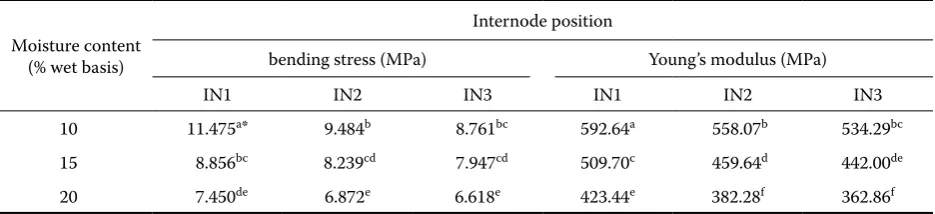
Table 3. Mean comparison of bending stress and Young’s modulus of barley straw considering interaction effect of moisture content and internode position
Moisture content (% wet basis)
Internode position
bending stress (MPa) Young’s modulus (MPa)
IN1 IN2 IN3 IN1 IN2 IN3
10 11.475a* 9.484b 8.761bc 592.64a 558.07b 534.29bc
15 8.856bc 8.239cd 7.947cd 509.70c 459.64d 442.00de
20 7.450de 6.872e 6.618e 423.44e 382.28f 362.86f
RES. AGR. ENG., 55, 2009 (2): 45–51 49 barley straw decreased from 11.47 to 7.45 MPa,
9.48 to 6.87 MPa, and 8.76 to 6.62 MPa for the first, second, and third internodes, respectively, as the moisture content increased. The Young’s modulus of the straw also varied from 423.44 to 592.64 MPa, 382.28 to 558.07 MPa, and 362.86 to 534.29 MPa for the first, second, and third internodes, respectively, at different moisture contents studied. The values of the bending stress, as obtained in the current study for barley straw, were lower than that of sorghum stalk (45.65 MPa) at the forage stage and those of alfalfa stems (9.71 to 47.49 MPa) in the moisture content range of 10 to 80% wet basis (Chatto-padhyay & Pandey 1999; Nazari Galedar et al. 2008). Furthermore, the values of the bending stress for barley straw were close to those of wet wheat straw (6.4 to 10.5 MPa), and were lower than those of dry wheat straw (15.0 to 26.9 MPa) (Annoussamy et al. 2000). Therefore, barley straw is more flexible in comparison with sorghum stalk, alfalfa stem, and wheat straw.
The values of the Young’s modulus for barley straw were found to be lower than those of wheat straw (4.76 to 6.58 GPa) and of alfalfa stems (0.63 to 4.60 GPa) (O’Dogherty et al. 1995; Nazari Gal-edar et al. 2008). The interaction effect of moisture content × internode on the bending stress and Young’s modulus is presented in Table 3.
Loading rate
The mean values of the bending stress and Young’s modulus at different loading rates are presented in Table 2. It was observed that the bending stress and Young’s modulus of the straw increased significantly (P < 0.01) with an increase in the loading rate. Such an effect of the loading rate was also reported by El Hag et al. (1971) for cotton stalk. Mohsenin et al. (1963) also found that the rate of deformation
affected the maximum force that could be exerted by a steel plunger on apples. As the rate of deformation increased, the maximum force of rupture increased. The bending stress of barley straw increased from 8.53 to 9.84 MPa, 7.75 to 8.73 MPa, and 7.33 to 8.18 MPa for the first, second and third internodes, respectively, as the loading rate increased from 5 to 15 mm/min. The Young’s modulus of the straw var-ied from 419.03 to 538.84 MPa in the third internode under the lowest loading rate, and the first internode under the highest loading rate, respectively. The interaction effect of the loading rate × internode on the bending stress and Young’s modulus is presented in Table 4.
Internode position
The bending stress and Young’s modulus were significantly affected by the internodes at 1% prob-ability level. The values decreased towards the third internode position. The mean values of the charac-teristics with different internodes are presented in Table 2. It was observed that the bending stress and Young’s modulus of the straw decreased from 9.26 to 7.77 MPa, and 508.59 to 446.38 MPa, respectively, towards the third internode position. A similar effect of the stem level on the bending stress and Young’s modulus was also reported by Ince et al. (2005) for sunflower stalk and Nazari Galedar et al. (2008) for alfalfa stems. The interaction effects of the inter-node × moisture content and interinter-node × loading rate on the bending stress and Young’s modulus are presented in Table 3 and 4, respectively.
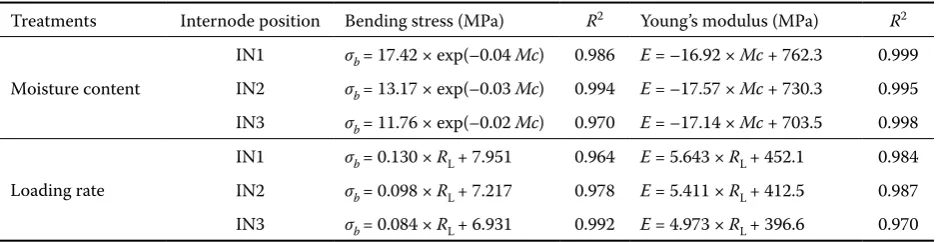
[image:5.595.64.532.619.721.2]The equations representing the relationships be-tween the bending stress and Young’s modulus of barley straw and the moisture content and loading rate for each internode position and their respective coefficients of determination (R2) are presented in Table 5.
Table 4. Mean comparison of bending stress and Young’s modulus of barley straw considering interaction effect of loading rate and internode position
Loading rate (mm/min)
Internode position
bending stress (MPa) Young’s modulus (MPa)
IN1 IN2 IN3 IN1 IN2 IN3
5 8.533bc* 7.750cd 7.332d 482.41bcd 437.85ef 419.03f
10 9.405ab 8.114cd 7.818cd 504.52b 470.19cde 451.37de
15 9.842a 8.731bc 8.176cd 538.84a 491.96bc 468.76cde
This paper concludes with the information on the engineering properties of barley straw which may be useful for designing the equipment used for harvest-ing, threshharvest-ing, and processing. It is recommended that other engineering properties such as the co-efficient of friction, bulk density, shear strength, shearing energy, tensile strength, rigidity modulus, and Poisson’s ratio should be measured or calculated to provide fairly comprehensive information on the design parameters involved in barley straw harvest-ing and processharvest-ing.
CONCLUSIONS
The following conclusions are drawn from the investigation of the effects of the moisture content, internode position, and loading rate on the bending stress and Young’s modulus of barley straw.
Both the bending stress and Young’s modulus de-creased with an increase in the moisture content and towards the third internode position and increased with the increasing loading rate.
The bending stress varied from 6.32 to 12.41 MPa and the Young’s modulus ranged from 330.94 to 618.91 MPa.
The bending stress of barley straw decreased from 11.47 to 7.45 MPa, 9.48 to 6.87 MPa, and 8.76 to 6.62 MPa for the first, second, and third internodes, respectively, as the moisture content increased. The Young’s modulus of the straw also varied from 423.44 to 592.64 MPa, 382.28 to 558.07 MPa, and 362.86 to 534.29 MPa for the first, second, and third internodes, respectively, at different moisture contents studied.
Acknowledgments
The authors wish to thank the Seed and Seedling Institute Research for providing the test stems of
barley straw and the University of Tehran for pro-viding the laboratory facilities and financial support for this project.
References
Annoussamy M., Richard G., Recous S., Guerif J. (2000): Change in mechanical properties of wheat straw due to decomposition and moisture. Applied Engineering in Agriculture, 16: 657–664.
ASAE Standards (2006): S358.2: 1:1 Measurement – Forages. 52nd Ed., ASAE, St. Joseph.
Blahovec J., Skubisz G. (1990): Mechanical traits of winter rape stalk and root. Zemědělská Technika, 36: 257–268. Blahovec J., Patočka K., Řezniček R., Szot B. (1983):
Mechanical properties of winter rape straw. In: Sbornik MF VŠZ, Praha, 31–54.
Blahovec J., Patočka K., Řezniček R. (1984): Mechani-cal properties of cereal stems and winter rape stalks. In: Physical Properties of Agricultural Materials. VŠZ, Praha, 29–77.
Blahovec J., Patočka K., Szot B. (1985): Compression of dry straw of basic cereals at lower pressures. Zemědělská Technika, 31: 129–142.
Bright R.E., Kleis R.W. (1964): Mass shear strength of haylage. Transactions of the ASAE, 7: 100–101.
Chattopadhyay P.S., Pandey K.P. (1999): Mechanical properties of sorghum stalk in relation to quasi-static de-formation. Journal of Agricultural Engineering Research,
73: 199–206.
Crook M.J., Ennos A.R. (1994): Stem and root character-istics associated what lodging resistance in poor winter wheat cultivars. Journal of Agricultural Science, 126: 167–174.
Curtis L.M., Hendrick J.G. (1969): A study of bending strength properties of cotton stalk. Transactions of the ASAE, 12: 39–45.
El Hag H.E., Kunze O.R., Wilkes L.H. (1971): Influence of moisture, dry-matter density and rate of loading on ulti-Table 5. Equations representing relationships between bending stress and Young’s modulus of barley straw and moisture content and loading rate for each internode position
Treatments Internode position Bending stress (MPa) R2 Young’s modulus (MPa) R2
Moisture content
IN1 σb = 17.42 × exp(–0.04 Mc) 0.986 E = –16.92 × Mc + 762.3 0.999
IN2 σb = 13.17 × exp(–0.03 Mc) 0.994 E = –17.57 × Mc + 730.3 0.995
IN3 σb = 11.76 × exp(–0.02 Mc) 0.970 E = –17.14 × Mc + 703.5 0.998
Loading rate
IN1 σb = 0.130 × RL + 7.951 0.964 E = 5.643 × RL + 452.1 0.984 IN2 σb = 0.098 × RL + 7.217 0.978 E = 5.411 × RL + 412.5 0.987
IN3 σb = 0.084 × RL + 6.931 0.992 E = 4.973 × RL + 396.6 0.970
R2 –determination correlation; E – Young’s modulus; Mc – moisture content; R
[image:6.595.64.534.83.204.2]RES. AGR. ENG., 55, 2009 (2): 45–51 51 mate strength of cotton stalks. Transaction of the ASAE,
4: 713–716.
FAO (2006): Available at: http://faostat.fao.org/faostat/ Gere J.M., Timoshenko S.P. (1997): Mechanics of Materials.
4th Ed., Mass: PWS Publishing Company, Boston.
Grundas S., Skubisz G. (2008): Physical properties of cereal grain and rape stem. Research in Agricultural Engineer-ing, 54: 80–90.
Ince A., Uđurluay S., Güzel E., Özcan M.T. (2005): Bend-ing and shearBend-ing characteristics of sunflower stalk residue. Biosystems Engineering, 92: 175–181.
McClelland J.H., Spielrein R.E. (1958): A study of some design factors affecting the performance of mower knives. Journal of Agricultural Engineering Research,
3: 137–146.
McNulty P.B., Mohsenin N.N. (1979): Compaction of bulk corn carnal to failure. Transactions of the ASAE,
22: 264–269.
Mohsenin N.N., Cooper H.E., Tukey L.D. (1963): Engineer-ing approach to evaluatEngineer-ing textural factors in fruits and vegetables. Transactions of the ASAE, 6: 85–88, 92. Nazari Galedar M., Jafari A., Mohtasebi S.S.,
Tabata-baeefar A., Sharifi A., O’Dogherty M.J., Rafee S., Richard G. (2008): Effects of moisture content and level in the crop on the engineering properties of alfalfa stems. Biosystems Engineering, 101: 199–208.
O’Dogherty M.J., Hubert J.A., Dyson J., Marshall C.J. (1995): A study of the physical and mechanical proper-ties of wheat straw. Journal of Agricultural Engineering Research, 62: 133–142.
Persson S. (1987): Mechanics of Cutting Plant Material. ASAE Publications, Michigan.
Prince R.P., Bartok T.W., Bradway D.M. (1969): Shear stress and Young’s modulus of selected forages. Transac-tions of the ASAE, 12: 426–429.
Shaw M., Tabil L. (2006): Mechanical properties of selected biomass grinds. In: ASABE Annual International Meeting. July 9–12, 2006, Portland.
Skubisz G. (1996): The effect of differentiated sowing density on the lodging and the variability of mechanical properties of rape stalks. International Agrophysics, 10: 303–307. Skubisz G. (1998): Studies on the Mechanical Properties
of Black Currant Bush Shoots. Flow and Deformation in Biology and Environment. Czech University of Agriculture in Prague, 133–136.
Skubisz G. (2001): Development of studies on the mechanical properties of winter rape stems. International Agrophys-ics, 15: 197–200.
Skubisz G., Muller Z. (1991): Results of bending-breaking investigation of rape stalk. Zeszyty Problemowe Postepow Nauk Rolniczych, 389: 97–103.
Skubisz G., Blahovec J. (1997): A method for rapid quasi static testing of the mechanical properties of plant stalks. Zemědělská Technika, 48: 93–97.
Skubisz G., Tys J., Blahovec J. (1989): Mechanical proper-ties of the stems of winter rape. International Agrophysics,
5: 205–220.
Received for publication November 27, 2008 Accepted after corrections March 13, 2009
Corresponding author:
H. Tavakoli,University of Tehran, Faculty of Biosystems Engineering,
Department of Agricultural Machinery Engineering, P.O. Box 4111, Karaj 31587-77871, Iran tel.: + 98 261 280 10 11, fax: + 98 261 280 81 38, e-mail: [email protected]
Abstrakt
Tavakoli H., Mohtasebi S.S., Jafari A. (2009): Vliv obsahu vlhkosti, polohy internodia a zátěžové rychlosti na ohybové vlastnosti ječné slámy. Res. Agr. Eng., 55: 45–51.
Cílem studie bylo stanovení vlivu vlhkosti, polohy internodia a zátěžové rychlosti na ohybové vlastnosti ječné slámy včetně ohybového napětí a Youngova modulu. Ve studii bylo provedeno 9 pokusů v náhodném kompletním blokovém uspořádání s pěti replikacemi. Stanovení vlastností bylo provedeno při třech hladinách vlhkosti 10 %, 15 % a 20 %, při třech zátěžových rychlostech 5, 10 a 15 mm/min, a se třemi internodii, prvním, druhým a třetím shora. Bylo zjištěno, že napětí v ohybu a Youngův modulus klesaly při vyšším obsahu vlhkosti a směrem ke třetímu internodiu. Průměrné napětí v ohybu bylo 8,41 MPa při rozsahu od 6,32 do 12,41 MPa, průměrná hodnota Youngova modulu byla 473,88 MPa a rozsah od 330,94 do 618,91 MPa. Výsledky ukázaly, že hodnoty sledovaných vlastností se zvyšovaly s rostoucí zátěžovou rychlostí.