In recent years, there has been growing interest in a new species of cultivated plants. They pre -dominantly originate from other climatic zones and are termed ‘alternative plants’ (Raig et al. 2001). Multi-directional studies carried out in Central-Eastern Poland (Symanowicz et al. 2013, 2014) on the adaptation of eastern galega (Galega orientalis
Lam.) indicated the possibility of its cultivation. In plants intended for animal feed is important to monitor the content of heavy metals, because their excess adversely affect plant growth and development, and ultimately the health of the animals. Cu, Zn and Cr are among the micronu-trients necessary for animals, if their content in the feed does not exceed the permissible levels (Kabata-Pendias and Pendias 2001). The anthro-pogenic sources of the trace elements pollution of soils and plants are: fertilizers, dust emissions,
burning fossil fuels, pesticides, waste products (Haygarth and Jones 1992, Gorlach and Gambuś 2000, Leszczyńska and Kwiatkowska-Malina 2011, Rutkowska et al. 2014). The most toxic elements that threaten the health of humans and animals include cadmium and lead (Kabata-Pendias and Pendias 2001). The nitrogen fertilization con- tributes to a decrease of soil pH and this en-hances mobility of trace elements (Rutkowska et al. 2014).
Complete fertilization of eastern galega is poorly investigated and no studies on the impact of ni-trogen fertilization on the content and bioaccu-mulation of trace elements.
The aim of this paper was to study the effect of ammonium sulphate application and year on con-centration of Cu, Zn, Cr, Pb and Cd in herbage of eastern galega.
Effect of nitrogen application and year on concentration of
Cu, Zn, Ni, Cr, Pb and Cd in herbage of
Galega orientalis
Lam.
B. Symanowicz, S. Kalembasa, D. Jaremko, M. Niedbała
Soil Science and Plant Nutrition Department, University of Natural Sciences
and Humanities in Siedlce, Siedlce, Poland
ABSTRACT
Eastern galega is promising forage species for Central Europe, but little is known about its forage quality in terms of elemental composition. We asked how the concentrations of Cu, Zn, Ni, Cr, Pb and Cd in its herbage are af-fected by application of ammonium sulphate and by year. Changes in the content and bioaccumulation of trace elements of herbage eastern galega fertilized with 15N were investigated in a field three-year experiment. The study
was conducted with a legume plant, i.e. eastern galega (Galega orientalis Lam.). The experiment was completely randomized and carried out in four replications with the following mineral fertilization: control, and nitrogen fer-tilization (15NH
4)2SO4. The second factor was years of research (1st, 2nd, 3rd). Nitrogen 15N at 10.3 at % enrichment
was applied in a form of (15NH
4)2SO4 at the amount of 1.66 g/m2 in early spring. The measured concentrations of
the selected heavy metals (except for Pb and Cd) were within the permissible limits for trace elements in feedstuffs specified by Polish and European standards. The applied nitrogen fertilization significantly influenced a reduction in the content of Cu, Zn and Cr in soil. Calculated average values of bioaccumulation factors for heavy metals: Cd > Cu > Zn = Ni > Pb > Cr. The low dose of a nitrogen fertilizer in the form of ammonium sulphate does not signifi-cantly affect an increase of the availability of heavy metals.
Keywords: micronutrient; mobility; isotope; uptake; pollution
MATERIAL AND METHODS
Study site and experimental design. The 3-year field experiment was carried out in plantation es-tablished in 1997 on an experimental field owned by the University of Natural Sciences and Humanities in Siedlce (52°17'N, 22°28'E). Soil had the texture of loamy sand. The soil was of neutral reaction (pH in 1 mol KCl/dm3 – 7.04). Its abundance in available phosphorus and potassium was considered as very high (Table 1). At very high soil fertility in available phosphorus and potassium (Table 1), phosphorus and potassium fertilizer was not applied.
The experiment was performed in a completely randomized block with four replace included by two treatments. First treatment: 1. control (with no fertilization); 2. (15NH
4)2SO4. The second factor was the years of research (1st, 2nd, 3rd). Nitrogen 15N at 10.3 at % enrichment was applied in a form of (15NH
4)2SO4 at the amount of 1.66 g/m2 in early spring. In the trial eastern galega (cv. Gale) was cultivated. Experimental microplot area was 3 m2 (1.5 m × 2 m). 1st, 2nd, and 3rd cut of eastern galega was harvested at budding stage in each year of the study.
Sampling and analyses. During the harvesting eastern galega of subsequent cuts at budding phase of, samples of herbage were collected, dried and ground. A collection of three consecutive swaths eastern galega performed at a height of 15 cm above the soil surface. Analysis was performed using the samples of each swath, the results are presented as the average between the respective elements. Each year in April, soil samples were collected from the sub-surface horizon (0–20 cm), air-dried and sieved through a 2 mm mesh, and subsamples were then stored in plastic bottles for further chemical analysis. Plant material was dried at 105°C, and then ground. The samples were mineralized following the wet chemistry method in concentrated HCl and HNO3 at 3:1 in an mul-tiwave sample preparation System Magnum II, Ertec (Wroclaw, Poland). The total content of Cu,
Zn, Ni, Cr, Pb and Cd in tested plant and soil was determined with the ICP-OES Optima 3200RL, Perkin Elmer (Waltham, USA). In the soil samples, the following parameters were measured: pH – by potentiometric method after extraction in 1 mol KCl/dm3 (soil:solution extraction ratio 1:2.5) us-ing a pH meter HI pH 301 with electrode Hi 1131 Hanna Istruments (Póvoa de Varzim, Portugal); total carbon and total nitrogen-by dry combustion using a autoanalyser series II CHNS/O 2400, Perkin Elmer (Waltham, USA). The bioaccumulation fac-tors (BF) of the trace elements were determined as the ratio of their content in plant dry matter (DM) and the total content in soil.
Meteorological conditions. The average month-ly temperature in the consecutive vegetation sea-sons was comparable (15–15.8°C) and significantly higher compared to the multi-annual records. The average precipitation during the vegetation seasons was lower than the multi-annual sum, except for second year of the research, when it was slightly higher (by 15.5 mm) because of heavy rainfalls in August, which were three-fold higher than the multi-annual sum.
Statistical analysis. Results from chemical de-terminations were subjected to statistical analysis using analysis of variance Statistica 10 PL software (StatSoft Inc. 2014) and significant differences determined by the Tukey’s test. The criterion for significance was set at P < 0.05.
RESULTS AND DISCUSSION
[image:2.595.64.537.683.742.2]Dry matter yield of eastern galega obtained from plots fertilized with 15N of the next three swaths and in subsequent years of the study are presen-ted in Table 2. Statistical calculations showed a significant increase in yield under the influence of nitrogen fertilization in early spring (average 29.7%) in relation to plots without fertilization. Indeed, the greatest total (three swaths) yield of dry weight of the test plant was obtained in the first
Table 1. Chemical characteristics of experimental soils
Sample pHKCl pHH2O pHCaCl2 Ntot Ctot P* K*
(g/kg) (mg/kg)
Control 7.04 7.31 6.64 2.0 29.8 230 187
N 6.68 7.00 6.38 2.4 27.2 210 183
Control – with no fertilization; N – after nitrogen fertilization (15NH
year of the study (10.92 t/ha). Eastern galega crop harvested in the next swath and years of research significantly reduced. The yield of the second cut was 2-fold, and the third swath 3.8 times smaller in relation to the first cut. Similar results were reported in studies Raig et al. (2001).
The applied nitrogen fertilization in the form of ammonium sulphate (15(NH
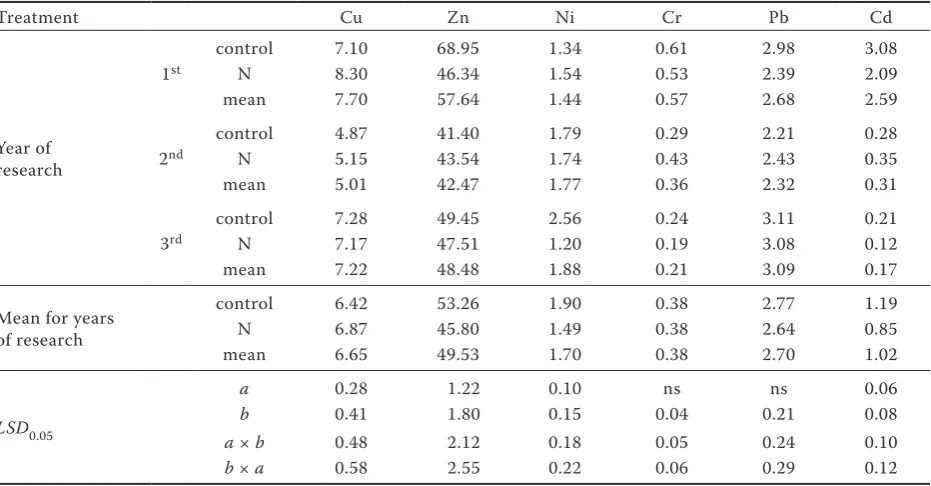
4)2SO4) at a dose of 1.66 g/m2, which corresponds to 16.6 kg N/ha, significantly reduced the content of Zn, Ni and Cd (the mean of three experimental years) in herbage eastern galega biomass (Table 3). The statistical calculations only demonstrated a significant in-crease in the content of Cu under the influence of nitrogen fertilization. Analyzing the changes in the concentration of tested elements in the herbage eastern galega in the subsequent years of
[image:3.595.63.532.114.185.2]the studies, a significant reduction in the content was observed in the second year of the experiment (except for Ni) in relation to the results recorded in the first year of the study. This fact should be linked to meteorological conditions during the vegetation season in the second year of the studies and to the uptake of heavy metals with herbage eastern galega yields in the first year of the experi-ment. High temperatures and low precipitation during the vegetation season in the second year halted the uptake of Cu, Zn, Cr, Pb and Cd. For Fabaceae family i.e. eastern galega cultivation, Zn is very important in intensive process of bio-logical N2 reduction (Broos et al. 2005). In the studies Baran and Jasiewicz (2009) carried out on light soils with a pH of 6.2 and higher Zn content twice higher amounts of Zn (39.05–93.98 mg/kg
Table 3. Changes in the content of trace elements in herbage eastern galega (mg/kg of dry matter)
Treatment Cu Zn Ni Cr Pb Cd
Year of research
1st controlN 7.108.30 68.9546.34 1.341.54 0.610.53 2.982.39 3.082.09
mean 7.70 57.64 1.44 0.57 2.68 2.59
2nd controlN 4.875.15 41.4043.54 1.791.74 0.290.43 2.212.43 0.280.35
mean 5.01 42.47 1.77 0.36 2.32 0.31
3rd controlN 7.287.17 49.4547.51 2.561.20 0.240.19 3.113.08 0.210.12
mean 7.22 48.48 1.88 0.21 3.09 0.17
Mean for years of research
control 6.42 53.26 1.90 0.38 2.77 1.19
N 6.87 45.80 1.49 0.38 2.64 0.85
mean 6.65 49.53 1.70 0.38 2.70 1.02
LSD0.05
a 0.28 1.22 0.10 ns ns 0.06
b 0.41 1.80 0.15 0.04 0.21 0.08
a × b 0.48 2.12 0.18 0.05 0.24 0.10
b × a 0.58 2.55 0.22 0.06 0.29 0.12
Control – with no fertilization; N – nitrogen fertilization (15NH
4)2SO4; a – N fertilization; b – years of research;
[image:3.595.66.532.485.728.2]a × b, b × a – interaction; ns – no significant difference. The data in the table are means of 3 cuts Table 2. Yields of herbage eastern galega (t of dry matter/ha)
Treatment Cut – mean for c Year of research – sum of b Mean for c
I II III 1st 2nd 3rd
Control 3.50 2.08 1.19 7.45 7.52 5.34 6.77
N 5.33 2.30 1.15 10.92 8.31 5.09 8.78
Mean 4.41 2.19 1.17 9.18 7.91 5.21 7.77
LSD0.05: a – 0.45; b – 0.48; c – 0.48; a × b – 0.97; a × c – 0.99; c × b – 0.99
Control – with no fertilization; N – nitrogen fertilization (15NH
4)2SO4; LSD – least significant difference; a – N
DM) were determined. The bioaccumulation factors were 10 times higher (3.14–3.40). The measured concentrations of the selected heavy metals (except for Pb and Cd) were within the permissible limits for trace elements in feedstuffs specified by the Polish and European standards (Anke 1987, Gorlach 1991, Decree of Minister of Agriculture and Rural Development 2002). The main reason for the slight excess of Pb in herbage of eastern galega was an-thropogenic pollution (dust emissions of industrial and traffic – tire wear) since the experimental plots were situated near a road with a low traffic intensity.
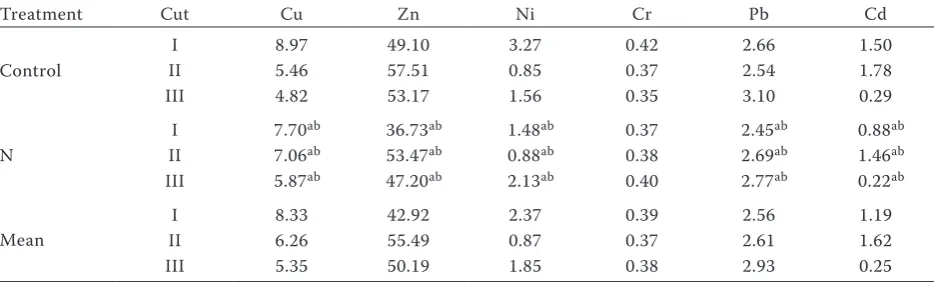
Pelleted simple superphosphate (which contained a substantial amount of Cd) that had been used in the preceding year, had a direct impact on exceeding the borderline value (1 mg/kg DM) for permissible Cd concentration in plants destined to be used as feed materials. In the research of Spiak et al. (2004) ecologically grown plants were not free of heavy metals contamination, as over 15% of tested plants exceeded permissible cadmium level, similarly like in conventionally grown plants. Applied nitrogen fertilization significantly influenced the decrease (except Cr) of labelled elements in the biomass of the first cut eastern galega (Table 4). The contents of Cu, Zn, Ni and Cr were in the range of permis-sible values in plants intended for animal feed (Anke 1987, Gorlach 1991, Kabata-Pendias and Pendias 2001). Tagged Pb content in all swaths slightly exceeded the legal limit, and for Cd it was exceeded in the biomass of the first and second cut. It must be assumed that in the case of Cd we deal with the exhaustion of this element from the soil. The biomass of the second and third cut
had increased content of Cu, Ni, Cr and Pb and a decrease in Zn and Cd.
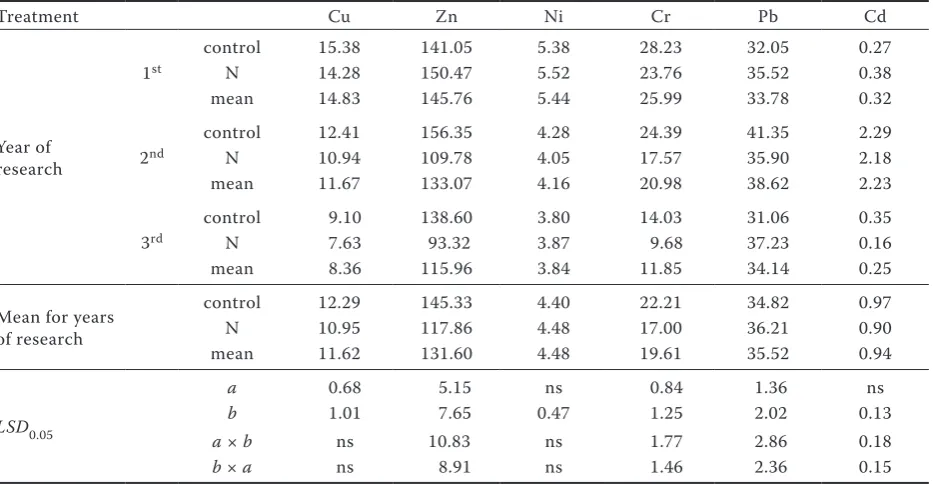
The applied nitrogen fertilization significantly influenced a reduction in the content of Cu, Zn and Cr in soil (Table 5). The determined con-tent of Ni and Cd also showed an insignificant reduction. A significant increase generated by nitrogen fertilization was recorded only for Pb. It is supposed that in the case of Pb, an anthro-pogenic factor played the main role (dust emis-sions of industrial and traffic – tire wear). In the subsequent experimental years, the content of the analyzed elements in soil systematically decreased. It was associated with their uptake with herbage eastern galega yields.
[image:4.595.64.532.585.726.2]The concentration of Pb and Cd determined in the second year of the studies increased in relation to the first year. Anthropogenic contamination of soil, meteorological conditions and low yields in the second year of the studies were the main reasons. Cadmium contamination of agricultural soils is expected to increase in the future, due to the prolonged application of Cd-containing phos-phate fertilizers (Arduini et al. 2014). The flooded soil have higher concentrations of heavy metals as compared to riverside soils (Vollmannová et al. 2011). Due to various anthropogenic activities, potentially toxic metals are accumulated in soils, with a risk of biota and groundwater contamina-tion (Leszczyńska and Kwiatkowska-Malina 2011). The fertilization with ammonium sulphate gener-ated a slight increase of bioaccumulation factors for Cu and Zn, yet a reduction for Pb and Cd (Table 6). The experimental factors (nitrogen fertilization
Table 4. The content of trace elements (mg/kg of dry matter) in the cuts (I, II, III) herbage eastern galega (mean for 3 years)
Treatment Cut Cu Zn Ni Cr Pb Cd
Control
I 8.97 49.10 3.27 0.42 2.66 1.50
II 5.46 57.51 0.85 0.37 2.54 1.78
III 4.82 53.17 1.56 0.35 3.10 0.29
N
I 7.70ab 36.73ab 1.48ab 0.37 2.45ab 0.88ab
II 7.06ab 53.47ab 0.88ab 0.38 2.69ab 1.46ab
III 5.87ab 47.20ab 2.13ab 0.40 2.77ab 0.22ab
Mean
I 8.33 42.92 2.37 0.39 2.56 1.19
II 6.26 55.49 0.87 0.37 2.61 1.62
III 5.35 50.19 1.85 0.38 2.93 0.25
aletters indicate significant differences only with respect to control; bletters indicate significant differences among
and subsequent experimental years) did not have any impact on the values of BF for Cr. They were on a comparable level (0.01–0.02).
The values of the discussed BF in the subsequent years of the studies were diversified. The main reasons for these differences were changes in the content of the analyzed heavy metals in herbage eastern galega and soil. The values of indices were within permissible limits (Kloke et al. 1984). The BF for Cd calculated for a control object in the first year of the studies exceeded 10 (permissible value)
and was 11.41. The calculated average values of BF for heavy metals may be arranged in the following order of decreasing values: Cd (1.08) > Cu (0.57) > Zn (0.38) = Ni (0.38) > Pb (0.08) > Cr (0.02). Similarly values of bioaccumulation index for cadmium (0.40–1.16) were obtained in studies on grasses (Kwiatkowska-Malina and Maciejewska 2013), the highest values were observed for Pb (0.12–0.26) and Zn (0.92–1.22).
[image:5.595.66.533.113.355.2]The determined Cu, Zn, Ni and Cr content in herbage eastern galega harvested in subsequent
Table 5. Changes in the content of trace elements in soil (mg/kg)
Treatment Cu Zn Ni Cr Pb Cd
Year of research
1st
control 15.38 141.05 5.38 28.23 32.05 0.27
N 14.28 150.47 5.52 23.76 35.52 0.38
mean 14.83 145.76 5.44 25.99 33.78 0.32
2nd controlN 12.4110.94 156.35109.78 4.284.05 24.3917.57 41.3535.90 2.292.18
mean 11.67 133.07 4.16 20.98 38.62 2.23
3rd controlN 9.107.63 138.6093.32 3.803.87 14.039.68 31.0637.23 0.350.16
mean 8.36 115.96 3.84 11.85 34.14 0.25
Mean for years of research
control 12.29 145.33 4.40 22.21 34.82 0.97
N 10.95 117.86 4.48 17.00 36.21 0.90
mean 11.62 131.60 4.48 19.61 35.52 0.94
LSD0.05
a 0.68 5.15 ns 0.84 1.36 ns
b 1.01 7.65 0.47 1.25 2.02 0.13
a × b ns 10.83 ns 1.77 2.86 0.18
b × a ns 8.91 ns 1.46 2.36 0.15
Explanations as under Table 3
Table 6. Bioaccumulation factors of trace elements
Treatment Cu Zn Ni Cr Pb Cd
Year of research
1st controlN 0.460.58 0.490.31 0.250.28 0.020.02 0.090.07 11.416.81
mean 0.52 0.39 0.26 0.02 0.08 8.09
2nd controlN 0.390.47 0.260.40 0.420.43 0.010.02 0.050.07 0.120.16
mean 0.43 0.32 0.42 0.02 0.06 0.14
3rd controlN 0.800.94 0.360.51 0.670.31 0.020.02 0.100.08 0.600.75
mean 0.86 0.42 0.49 0.02 0.09 0.68
Mean for years of research
control 0.52 0.37 0.42 0.02 0.08 1.23
N 0.63 0.39 0.33 0.02 0.07 0.94
mean 0.57 0.38 0.38 0.02 0.08 1.08
[image:5.595.63.533.555.741.2]years of cultivation and fertilized with (15NH 4)2SO4 was within the limit values of acceptable content of trace elements in feed (Anke 1987, Kabata-Pendias and Pendias 2001) and according to Gorlach (1991) the value was within the optimal range. The long-term use of organic and mineral fertilizers at normal application rates on mineral-rich soils does not appear to represent any risk for contamination of cereals by risk-elements (Hejcman et al. 2013).
Based on the research of multi-eastern goat’s rue it can recommend to the crop for fodder purposes in Central Europe. It is a long-term (up to 17 years) bean plant with great possibilities of biological reduction of N2 – 379.7 kg N/ha (Kalembasa and Symanowicz 2010). It can be used as feed for li-vestock and poultry in the form of green fodder, hay, dried, silage and protein concentrate.
The results of the present studies indicate that the use of a low dose of a nitrogen fertilizer (1.66 g N/m2) in the form of ammonium sulphate (soil acidi-fying fertilizer) does not significantly influence a re-duction of pHKCl in soil (7.04–6.68) and, consequently, the increase of the availability of heavy metals.
REFERENCES
Arduini I., Masoni A., Mariotti M., Pampana S., Ercoli L. (2014): Cadmium uptake and translocation in durum wheat varieties differing in grain-Cd accumulation. Plant, Soil and Environ- ment, 1: 43–49.
Anke M. (1987): Kolloquien des Instituts für Planzenernährung. Jena, 2: 110–111.
Baran A., Jasiewicz Cz. (2009): Toxic content of zinc and cadmium in soil and in different plant species. Environmental Protection and Natural Resources, 40: 157–164. (In Polish)
Broos K., Beyens H., Smolders E. (2005): Survival of rhizobia in soil is sensitive to elevated zinc in the absence of the host plant. Soil Biology and Biochemistry, 37: 573–579.
Gorlach E. (1991): The content of trace elements in fodder plants, as matter of their value. Academy of Agricultural Science Ex-ercise Books in Krakow, 262: 13–22. (In Polish)
Gorlach E., Gambuś F. (2000): Potentially toxic trace elements in soils (excess, harmfulness and counteracting). Zeszyty Prob-lemowe Postepów Nauk Rolniczych, 472: 275–296. (In Polish) Haygarth P.M., Jones K.C. (1992): Atmospheric deposition of
metals to agricultural surface. In: Adriano D.C. (ed.): Biochem-istry of Trace Elements. Boca Raton, David Lewis Publishing.
Hejcman M., Berková M., Kunzová E. (2013): Effect of long-term fertilizer application on yield and concentrations of elements (N, P, K, Mg, As, Cd, Cu, Cr, Fe, Mn, Ni, Pb, Zn) in grain of spring barley. Plant, Soil and Environment, 7: 329–334. Kabata-Pendias A., Pendias H. (2001): Trace Elements in Soils
and Plants. 3rd Ed. Boca Raton, CRC Press.
Kalembasa S., Symanowicz B. (2010): Quantitative abilities of biological nitrogen reduction for Rhizobium galegae cultures by goat’s rue. Ecological Chemistry and Engineering A, 17: 757–764.
Kloke A., Sauerbeck D.R., Vetter H. (1984): The contamination of plants and soils with heavy metals and the transport of metals in terrestrial food chains. In: Nriagu J.O. (ed.): Changing Metal Cycles and Human Health. Berlin, Springer-Verlag.
Kwiatkowska-Malina J., Maciejewska A. (2013): Uptake of heavy metals by darnel multifloral (Lolium multiflorum Lam.) at diverse soil reaction and organic matter content. Soil Science Annual, 64: 19–23.
Leszczyńska D., Kwiatkowska-Malina J. (2011): Effect of organic matter from various sources on yield and quality of plant on soils contaminated with heavy metals. Ecological Chemistry and Engineering S, 18: 501–507.
Raig H., Metlitskaja J., Meripõld H., Nõmmsalu H. (2001): The history of adaptation and introduction of fodder galega. In: Nõmmsalu H. (ed.): Fodder Galega. Saku, Estonian Research Institute of Agriculture, 7–12.
Rutkowska B., Szulc W., Sosulski T., Stępień W. (2014): Soil micronutrient availability to crops affected by long-term in-organic and in-organic fertilizer applications. Plant, Soil and Environment, 5: 198–203.
Spiak Z., Romanowska M., Radoła J. (2004): Trace metals content in plants from ecological and conventional cultivation systems. Chemistry for Agriculture, 5: 181–186.
Symanowicz B., Kalembasa S., Niedbała M. (2013): Effect of phosphorus and potassium fertilisation on the contents and chromium and nickel uptake by goat’s rue (Galega orientalis
Lam.). Environmental Protection and Natural Resources, 24: 59–62.
Symanowicz B., Kalembasa S., Malinowska E., Wysokiński A. (2014): Changes in the content of zinc and cobalt in plants and soil, absorption of these elements by goat’s rue (Galega orientalis Lam.) biomass and bioaccumulation factors induced by phosphorus and potassium fertilization. Journal of Elemen-tology, 19: 219–228.
Statsoft Inc. (2014): Statistica (data analysis Software system), version 10 PL, Tulsa.
Vollmannová A., Kujovsky M., Arvay J., Harangozo L., Toth J. (2011): Heavy metals in upper Nitra riverside. Environmental Protection and Natural Resources, 49: 365–372.
Received on July 8, 2014 Accepted on December 5, 2014
Corresponding author: