Boundary Detection
Tibor Kiss
∗Ruhr-Universit¨at Bochum
Jan Strunk
∗∗Ruhr-Universit¨at Bochum
In this article, we present a language-independent, unsupervised approach to sentence boundary detection. It is based on the assumption that a large number of ambiguities in the determination of sentence boundaries can be eliminated once abbreviations have been identified. Instead of relying on orthographic clues, the proposed system is able to detect abbreviations with high accuracy using three criteria that only require information about the candidate type itself and are independent of context: Abbreviations can be defined as a very tight collocation consisting of a truncated word and a final period, abbreviations are usually short, and abbreviations sometimes contain internal periods. We also show the potential of collocational evidence for two other important subtasks of sentence boundary disambiguation, namely, the detection of initials and ordinal numbers. The proposed system has been tested extensively on eleven different languages and on different text genres. It achieves good results without any further amendments or language-specific resources. We evaluate its performance against three different baselines and compare it to other systems for sentence boundary detection proposed in the literature.
1. Introduction
The sentence is a fundamental and relatively well understood unit in theoretical and computational linguistics. Many linguistic phenomena—such as collocations, idioms, and variable binding, to name a few—are constrained by the abstract concept ‘sentence’ in that they are confined by sentence boundaries. The successful determination of these boundaries is thus a prerequisite for proper sentence processing. Sentence boundary detection is not a trivial task, though. Graphemes often serve more than one purpose in writing systems. The period, which is employed as sentence boundary marker, is no exception. It is also used to mark abbreviations, initials, ordinal numbers, and ellipses. Moreover, a period can be used to mark an abbreviation and a sentence boundary at the same time. In such cases, the second period is haplologically omitted and only one pe-riod is used as end-of-sentence and abbreviation marker.1Sentence boundary detection
∗Sprachwissenschaftliches Institut, Ruhr-Universit¨at Bochum, 44780 Bochum, Germany.
E-mail: [email protected].
∗∗Sprachwissenschaftliches Institut, Ruhr-Universit¨at Bochum, 44780 Bochum, Germany.
E-mail: [email protected].
1 See Nunberg (1990) for a linguistic discussion of punctuation and the ambiguity of the period.
thus has to be considered as an instance of ambiguity resolution. The ambiguity of the period is illustrated by example (1).
Example 1
CELLULAR COMMUNICATIONS INC. sold 1,550,000 common shares at $21.75 each yesterday, according to lead underwriter L.F. Rothschild & Co.
(cited fromWall Street Journal05/29/1987)
Periods that form part of an abbreviation but are taken to be end-of-sentence markers or vice versa do not only introduce errors in the determination of sentence boundaries. As has been reported in Walker et al. (2001) and Kiss and Strunk (2002b), segmentation errors propagate into further components, which rely on accurate sen-tence segmentation, and subsequent analyses are affected negatively.
In this article, we present an approach to sentence boundary detection that builds on language-independent methods and determines sentence boundaries with high accuracy. It does not make use of additional annotations, part-of-speech tagging, or precompiled lists to support sentence boundary detection, but extracts all necessary data from the corpus to be segmented. Also, it does not use orthographic information as primary evidence and is thus suited to processing single-case text. It focuses on robustness and flexibility in that it can be applied with good results to a variety of languages without any further adjustments. At the same time, the modular structure of the system makes it possible to integrate language-specific methods and clues to further improve its accuracy. The basic algorithm has been determined experimentally on the basis of an unannotated development corpus of English. We have applied the resulting system to further corpora of English text as well as to corpora from ten other languages: Brazilian Portuguese, Dutch, Estonian, French, German, Italian, Nor-wegian, Spanish, Swedish, and Turkish. Without further additions or amendments to the system produced through experimentation on the development corpus, the mean accuracy of sentence boundary detection on newspaper corpora in the eleven languages is 98.74%.
We approach sentence boundary detection by first determining possible abbrevi-ations in the text. Quantitatively, abbreviabbrevi-ations are a major source of ambiguities in sentence boundary detection since they often constitute up to 30% of the possible candidates for sentence boundaries in running text; see Section 6.1. Abbreviations can be characterized by a set of robust as well as cross-linguistically valid properties. The same cannot be said of the concept ‘sentence boundary’. The end of a sentence cannot easily be characterized as either appearing after a particular word, between two par-ticular words, after a parpar-ticular word class, or in between two parpar-ticular word classes. But, as we will show, an abbreviation can be cross-linguistically characterized in such a way.
errors, an abbreviation shouldalwaysend in a final period.2Hence, we characterize an abbreviation as a very strict collocation and use standard techniques for the detection of collocations. These techniques will be modified appropriately to account for the stricter tie between an abbreviated word and the following period. It should be clear from the outset that abbreviations cannot simply be handled by listing them because they form a productive and hence open word class; see also M ¨uller, Amerl, and Natalis (1980, pages 52ff.) and Mikheev (2002, page 291). We corroborate this fact with an experiment in Section 6.4.4.
We offer a formal characterization of abbreviations in terms of three major proper-ties, which only rely on the candidate word type itself and not on the local context in which an instance of the candidate type appears. First, as was already mentioned, an abbreviation looks like a very tight collocation in that the abbreviated word preceding the period and the period itself form a close bond. Second, abbreviations have the tendency to be rather short. This does not mean that we have to assume a fixed upper bound for the length of a possible abbreviation, but that the likelihood of being an abbreviation declines if candidates become longer. Using the length of a candidate as a counterbalance to the collocational bond between candidate and final period allows our method to identify quite long abbreviations, as long as the collocational bond between the candidate type and the period is very strong. As a third characteristic property, we have identified the occurrence of word-internal periods contained in many abbre-viations. While we have determined the aforementioned properties experimentally, we believe that they indeed represent crucial traits of abbreviations.
Using just these three characteristics, our system is able to detect abbreviations with a mean accuracy of 99.38% on newspaper corpora in eleven languages. The effectiveness of the three properties is further corroborated by an experiment we have carried out with a log-linear classifier; compare Section 6.4.7. The reported figure does not include initials and ordinal numbers because these subclasses of abbreviations cannot be discov-ered using these characteristics and have to be treated differently. Thecompletesystem with special heuristics for initials and ordinal numbers achieves an accuracy of 99.20% for the detection of abbreviations, initials, and ordinal numbers.
The determination of abbreviation types already yields a large percentage of all sentence boundaries because all periods occurring after non-abbreviation types can be classified as end-of-sentence markers. Such a disambiguation on the type level, however, is insufficient by itself because it still has to be determined for every period following an abbreviation whether it serves as a sentence boundary marker at the same time. The detection of initials and of ordinal numbers, which are represented by digits followed by a period in several languages, also requires the application of token-based methods because these subclasses of abbreviations are problematic for type-based meth-ods. These observations suggest a two-stage treatment of sentence boundary detection, which is both type and token based. We define a classifier as type based if it uses global evidence, for example, the distribution of a type in a corpus, to classify a type as a whole. In contrast, a token-based classifier determines a class for each individual token based on its local context.
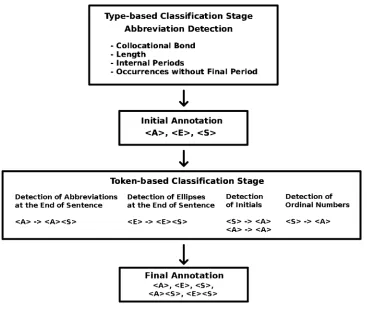
In the first stage, a resolution is performed on the type level to detect abbreviation types and ordinary word types. After this stage, the corpus receives an intermediate
Figure 1
Architecture of the Punkt System.
annotation where all instances of abbreviations detected by the first stage are marked as such with the tag<A>and all ellipses with the tag<E>. All periods following non-abbreviations are assumed to be sentence boundary markers and receive the annotation <S>.3 The second, token-based stage employs additional heuristics on the basis of the intermediate annotation to refine and correct the output of the first classifier for each individual token. The token-based classifier is particularly suited to determine abbreviations and ellipses at the end of a sentence giving them the final annotation <A><S> or <E><S>. But it is also used to correct the intermediate annotation by detecting initials and ordinal numbers that cannot easily be recognized with type-based methods and thus often receive the wrong annotation from the first stage. The overall architecture of the present system, which we have baptizedPunkt(German for period), is given in Figure 1.
The present article is structured as follows: Likelihood ratios can be considered the heart of the present proposal. Both the type-based and the token-based classifiers employ likelihood ratios to determine collocational bonds between a possible abbrevi-ation and its final period, between the sentence boundary period and a word following
it, and between words that surround a period. Section 2 introduces the concept of a likelihood ratio and discusses the specific properties of the likelihood ratios employed by Punkt. Section 3 describes the type-based classification stage, while Section 4 in-troduces the token-based reclassification methods. Section 5 gives a short account of how Punkt was developed and how we determined some necessary parameters. The experiments carried out with the present system are discussed in Section 6. In Section 7, we compare Punkt to other sentence boundary detection systems proposed in the literature.
2. Likelihood Ratios
Punkt employs likelihood ratios to determine collocational ties in the type-based as well as in the token-based stage. The usefulness of likelihood ratios for collocation detection has been made explicit by Dunning (1993) and has been confirmed by an evaluation of various collocation detection methods carried out by Evert and Krenn (2001). Kiss and Strunk (2002a, 2002b) characterize abbreviations as collocations and use Dunning’s log-likelihood ratio (logλ) to detect them on the type level. The present proposal differs from Kiss and Strunk’s earlier suggestion in employing a highly modified log-likelihood ratio for abbreviation detection in the type-based stage. The reasons for this divergence will be discussed in Section 2.1. In the token-based stage, we employ Dunning’s original logλ, but add an additional constraint to make it one-sided. This version of logλwill be described in Section 2.2.
2.1 Likelihood Ratios in the Type-based Stage
The log-likelihood ratio by Dunning (1993) tests whether the probability of a word is dependent on the occurrence of the preceding word type. When applied to abbrevi-ations, the following two hypotheses are compared in a Dunning-style log-likelihood ratio.
Null hypothesis H0: P(•|w)=p=P(•|¬w) (1)
Alternative hypothesis HA: P(•|w)=p1=p2=P(•|¬w) (2)
The null hypothesis in (1) states that the probability of occurrence of a period is not dependent on the preceding word. The alternative hypothesis in (2) assumes a depen-dency between the period and the preceding word. The log-likelihood ratio is calculated using the binomial distribution to estimate the likelihoods of the two hypotheses as in (3). As the probabilities p,p1, and p2 are determined by maximum-likelihood esti-mation (MLE) and the null hypothesis includes fewer parameters than the alternative hypothesis, the ratio log λis asymptoticallyχ2-distributed and can thus be used as a test statistic.
logλ=−2 logPbinom(H0)
However, we have decided to employ different hypotheses for abbreviation detec-tion. While the revised null hypothesis given in (4) is quite close to (1), the revised alternative hypothesis in (5) differs sharply from the one suggested by Dunning.4
Revised null hypothesis H0: P(•|w)=PMLE(•)= CN(•) (4)
Revised alternative hypothesis HA: P(•|w)=0.99 (5)
The formulation of the alternative hypothesis in (5) reflects that we do not only require that a period occurs together with an abbreviated word more often than expected, but instead that a period almost always occurs after the truncated word. By choosing the value 0.99 instead of 1, we can provide for a certain probability that an abbre-viation type sometimes erroneously occurs without a final period in a corpus. The hypothesis in (5) captures our intuitions about abbreviations better than the original version in (2) because it is no longer sufficient that a word type appears more often than average with a following period to yield a high log-likelihood score. Instead, the likelihood of a period appearing after a type should be almost 1 in order for it to get assigned a high log-likelihood score and thus a high likelihood of being classified as an abbreviation.
Due to the revision of the hypotheses H0 and HA, the log-likelihood ratio for abbreviation detection is no longer asymptoticallyχ2-distributed. However, this is not a disadvantage since the resulting log-likelihood value expresses only one of three crucial properties of abbreviations. Since this value is counterbalanced by other factors and the resulting log-likelihood score thus scaled in various ways, theχ2distribution could not be retained anyway, as will become clear in Section 3.
2.2 Likelihood Ratios in the Token-based Stage
In the token-based classification stage, Dunning’s log-likelihood ratio is used in two different heuristics. The collocation heuristic, described in Section 4.1.2, takes a pair of wordsw1 and w2 surrounding a period and tests whether a collocational tie exists between them. A positive answer to this question is used as evidence against an intervening sentence boundary. The frequent sentence starter heuristic, described in Section 4.1.3, makes use of the results of the type-based classifier and searches for word types that form a collocation with a preceding sentence boundary, that is, which occur particularly often after end-of-sentence periods.
Dunning’s formulation of the log-likelihood ratio is a two-tailed statistical test. For a pair of word typesw1andw2, the null hypothesis H0:P(w2 |w1)=p=P(w2| ¬w1), and the alternative hypothesis HA:P(w2|w1)=p1=p2=P(w2| ¬w1), the logλvalue is high ifp1 andp2 significantly diverge from each other. But in fact, one should only consider those pairs of words as collocations for whichp1is much higher thanp2. Only the latter case means thatw2 occurs more often than expected afterw1, whereas ifp1is less thanp2 this means thatw2 occurs less often afterw1 than expected. Manning and
Sch ¨utze (1999, page 172) comment in their description that “[w]e assume thatp1 >>p2 if Hypothesis 2 [i.e., the alternative hypothesis, TK/JS] is true. The casep1<<p2is rare, and we will ignore it here.” To us, this step seems to be premature since it ignores that Dunning’s logλis a two-tailed test, where the equation in (6) holds.
logλ= 0 iff C(w2)
N =
C(w1,w2)
C(w1) (6)
If the two sides of this equation diverge, log λ will take a value greater than 0. In the usual case considered by Dunning (1993) and discussed by Manning and Sch ¨utze (1999), the right-hand side of the equation is larger than the left-hand side. A high logλvalue thus properly expresses the fact thatw1 andw2 form a collocation because the occurrence of w2 after w1 is more likely than expected from the unconditional likelihood ofw2. If, however, the left side of the equation is greater than the right side, we still get a log λ value greater than 0, but this time, this indicates that w2 occurs less often than expected after w1. This is obviously at odds with the general idea of a collocation.
For collocations in general, the assumption made by Manning and Sch ¨utze (1999) can indeed be considered safe, since the typesw1andw2are likely to occur only rarely. For this reason, we do not expect a large negative deviation, where the right-hand side of equation (6) is significantly smaller than the left-hand side. However, some of the types that we test for collocational ties in the token-based stage occur very often. The frequent sentence starter heuristic, for example, tests whether a given word w2 forms a collocation with a preceding sentence boundaryw1, that is, with the sentence boundary symbol<S>inserted by the type-based first stage of Punkt. The abstract type ‘sentence boundary’ (i.e.,<S>) may be very frequent in many corpora, as can be wit-nessed from a sample from a German newspaper corpus, whereC(<S>) = 35,775 and N= 847,206.
[image:7.486.54.442.598.662.2]In Table 1, we have tested for four words in the German newspaper corpus whether they are frequent sentence starters or not. The first two words, ist (the third-person singular form of the verbsein‘to be’) andzu(infinitive marker or preposition ‘to’) occur very often, while the latter two words do not occur so often. Neitheristnorzushould be considered frequent sentence starters, while bothdennoch(‘nevertheless’) anderstens (‘first’) are true frequent sentence starters. Yet, all four words receive very high log λ values, since in all cases p1 diverges significantly fromp2. However, it holds only for dennochanderstensthat they occur more often after<S>than expected, whileistand zu occur much less often than expected after <S>. In order to exclude cases like ist and zufrom being detected as collocates of a preceding sentence boundary, we add
Table 1
Correct and incorrect frequent sentence starters.
w1 w2 C(w1) C(w2) C(w1,w2) logλ
the constraint in (7) to logλcalculations for the frequent sentence starter heuristic and similarly apply it to the collocation heuristic.
w1,w2is a collocation if logλ >threshold andCC(w(1w,w1)2) >
C(w2)
N (7)
In general, it seems to be a good idea to add the one-sidedness condition given in (7) to the log-likelihood ratio used for the purpose of collocation detection. The version of the likelihood ratio that is calculated for the type-based classifier in Section 3 is not affected by this problem since it does not follow aχ2distribution and is in fact no longer two-tailed because of the form of the two hypotheses that are compared.
3. Type-based Classification
The type-based classification stage of Punkt employs three characteristic properties of abbreviations:
1. Strong collocational dependency: Abbreviations always occur with a final period.5
2. Brevity: Abbreviations tend to be short.
3. Internal periods: Many abbreviations contain additional internal periods.
As these three characteristics do not change for each individual instance of a type, we combine them in a type-based approach to abbreviation detection.
The implementation of the first property makes use of a likelihood ratio with the revised hypotheses introduced in (4) and (5). The list of all types that ever occur with a following period in the corpus is sorted according to this likelihood ratio. The resulting value for a type expresses the assumption that this type is more likely to be an abbreviation than all types having lower values.
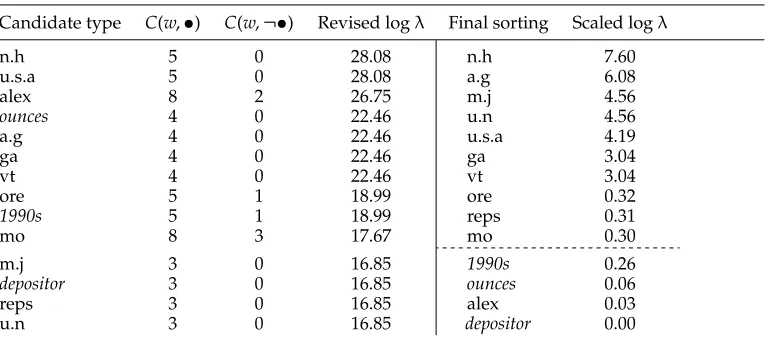
The first four columns of Table 2 show a section of this sorted list, where non-abbreviations are indicated in italics. The figures of occurrence in Table 2, which are drawn from an actual corpus sample comprising 351,529 tokens ofWall Street Journal text, also illustrate a potential problem, namely, that most of the candidate types are quite rare. As has been pointed out by Dunning (1993), the calculation of logλassumes a binomial distribution. It is therefore better suited to deal with sparse data than statistics that are based on a normal distribution, such as thettest. This consideration carries over to the modified log-likelihood ratio employed here.
Some true abbreviations in the left half of Table 2 are either ranked lower than non-abbreviations or receive the same log-likelihood value as non-non-abbreviations. According to the criterion of strong collocational dependency,ouncesis a very good candidate for an abbreviation, as it never occurs without a final period in the corpus. The collocational criterion alone is thus not sufficient to detect abbreviations with high precision.
Table 2 confirms that abbreviations tend to be rather short: Each non-abbreviation is longer than the longest abbreviation. We therefore use brevity as a further characteristic
Table 2
Candidate list from an English test corpus.
Candidate type C(w,•) C(w,¬•) Revised logλ Final sorting Scaled logλ
n.h 5 0 28.08 n.h 7.60
u.s.a 5 0 28.08 a.g 6.08
alex 8 2 26.75 m.j 4.56
ounces 4 0 22.46 u.n 4.56
a.g 4 0 22.46 u.s.a 4.19
ga 4 0 22.46 ga 3.04
vt 4 0 22.46 vt 3.04
ore 5 1 18.99 ore 0.32
1990s 5 1 18.99 reps 0.31
mo 8 3 17.67 mo 0.30
m.j 3 0 16.85 1990s 0.26
depositor 3 0 16.85 ounces 0.06
reps 3 0 16.85 alex 0.03
u.n 3 0 16.85 depositor 0.00
property to counterbalance the likelihood ratio. In contrast to other proposals such as the one by Mikheev (2002, page 299), we refrain from using a fixed maximum length for abbreviations. Instead, we multiply the likelihood ratio for each candidate with an inversely exponential scaling factor derived from the length of that candidate. The length of the candidate is defined as the number of characters in front of the final period minus the number of internal periods, as illustrated in example (8).
length(u.s.a.)=3 (8)
We exclude internal periods from the count because they are good evidence that a candidate should be classified as an abbreviation (see below). We thus prevent a coun-terintuitive, higher penalty for candidates with internal periods. The exact form of the length factor is given in (9).
Flength(w)= 1
elength(w) (9)
We have chosen an inversely exponential scaling factor since it reflects well the likeli-hood that a type of a certain length is an abbreviation. Typically, short types are more likely to be abbreviations than longer types. The validity of this assumption can be witnessed from Figure 2. It shows that the ratio of the number of abbreviation types to the number of non-abbreviation types decreases with growing length in a Dutch newspaper corpus. While about 96% of all types of length one are abbreviations, this percentage drops rapidly to 59% for types of length two and to 15% for types of length three and so on.
Figure 2
Percentage of types of different lengths that are abbreviations in a Dutch corpus.
a true abbreviation. The scaling factor has been designed to leave unchanged the values of candidates that do not contain internal periods, while those candidates that contain internal periods receive an extra advantage.
Fperiods(w)=number of internal periods inw+1 (10)
Multiplying the log-likelihood ratio with these two scaling factors leads to a signifi-cantly better sorting of the candidate list.
The scaled log-likelihood ratio does not exclude a candidate from being classified as an abbreviation just because it has occurred without a final period once or twice in the corpus if there is otherwise good evidence that it is a true abbreviation. For most lan-guages, this increased robustness is unproblematic because almost all ordinary words occur without a period a sufficient number of times. However, for some languages, the scaled log-likelihood ratio is not restrictive enough. Verb-final languages, such as Turkish, where certain very common verbs appear at the end of a sentence most of the time, are one example. In such a case, the scaled log-likelihood ratio described so far runs into difficulties because it mistakes the occurrences of these verbs without a period as exceptions. To remedy this problem, the calculated logλvalues are multiplied by a third factor, which penalizes occurrences without a final period exponentially:
Fpenalty(w)= 1
length(w)C(w,¥) (11)
abbreviation type is dependent on the length of the candidate. Homographic non-abbreviations occur particularly often with non-abbreviations of length 1, and accordingly, there will be no penalty at all. With a length of 2, the penalty factor is still moderate, but increases with length to reflect that longer abbreviations are not very likely to have homographic non-abbreviations. Furthermore, the penalty factor is exponentially scaled. Hence, it will mostly affect candidate types with a high number of occurrences without a final period. A candidate type that occurs six times in all and one time without a final period is much less affected by (11) than a candidate that occurs 600 times in all and 100 times without a final period. This reflects our intuition that homographic non-abbreviations and typing errors can always occur, but that a high number of instances without a final period requires a strong penalty.
As we cannot rely any longer on the asymptoticχ2distribution of the log-likelihood ratio (cf. Section 2.1), we propose a new threshold value. All candidates above it will be considered abbreviations; all candidates below it will be classified as ordinary words. We use the classification function defined in (12) with a threshold value of 0.3— represented by a dashed line in Table 2. We have determined the threshold value by manual experimentation (cf. Section 5) and have used it throughout the evaluation in Section 6.
For each candidate word typew:
If logλ(w)×Flength(w)×Fperiods(w)×Fpenalty(w)≥0.3→wis an abbreviation. If logλ(w)×Flength(w)×Fperiods(w)×Fpenalty(w)<0.3→wis not an abbreviation.
(12)
The last two columns of Table 2 show the final sorting of the candidates after applying the three scaling factors to the log-likelihood value for each candidate. Multiplication with the three factors has led to a much cleaner separation of the true abbreviation types from the non-abbreviations.
4. Token-based Classification
The second classification stage of Punkt operates on the token level and improves the intermediate annotation of the corpus provided by the type-based classification stage. For every token with a final period, the system decides on the basis of its immediate right context whether the intermediate annotation has to be modified or corrected. For this classification step, the relevant tokens are separated into different classes (cf. Figure 1). Each class triggers a reexamination with a different combination of a few basic heuristics. The most important classes are ordinary abbreviations and ellipses, which may appear at the end of a sentence. Moreover, there are two special classes of abbreviations, which are problematic for a type-based approach, namely, possible initials and possible ordinal numbers.
4.1 Heuristics in the Token-based Stage
4.1.1 The Orthographic Heuristic.At first sight, it might seem reasonable to rely on orthographic conventions for the detection of sentence boundaries. For instance, a capitalized word usually indicates a preceding sentence boundary in mixed-case text. However, such a procedure is perilous for various reasons. To begin with, certain word classes are capitalized even if they occur sentence-internally as is the case with the majority of proper nouns in English and all nouns in German. Even a lowercase first letter does not guarantee that the word in question is not preceded by a sentence boundary. This is particularly evident for mathematical variables or names that are conventionally written without capitalization such as amnesty international; see also Nunberg (1990, pages 54ff.). Finally, any method that relies solely on capitalization will not help at all with single-case text.
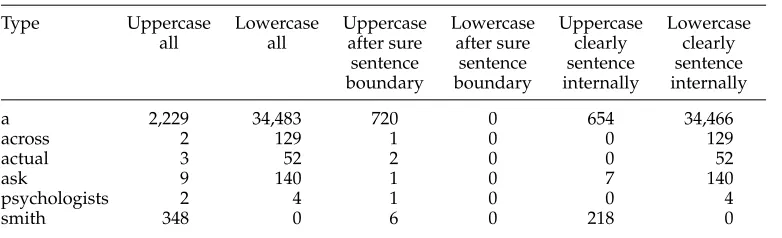
Still, we think that capitalization information—if used cautiously—can help to determine whether an abbreviation or ellipsis precedes a sentence boundary or not; see Section 6.4.5 for a discussion of the importance of orthographic information in comparison to other types of evidence. In order to make the usage of orthographic information safer and more robust, Punkt counts how often every word type occurs with an uppercase and lowercase first letter at the beginning of a sentence and sentence-internally in the corpus; see Table 3 for some example statistics. It bases its calculations on the sentence boundaries determined by the type-based classification stage. It does not count tokens occurring after an abbreviation or an ellipsis because we have not yet determined whether they start a new sentence or not. The algorithm also ignores tokens that occur after possible initials and numbers. Again, a reclassification is likely to happen; see Section 4.3. In sum, as the counts are based on imperfectly annotated data, we try to exclude most doubtful cases.
Figure 3 gives a pseudocode description of the orthographic heuristic, which de-cides for a token following an abbreviation or an ellipsis on the basis of the orthographic statistics gathered for all word types whether it represents good evidence for a preced-ing sentence boundary or not.
[image:12.486.49.440.545.664.2]If the word following an abbreviation or ellipsis is capitalized, the heuristic deter-mines whether it occurs with a lowercase first letter in the text and whether it occurs with an uppercase first letter sentence-internally. Only if it occurs with a lowercase first letter at least once and never occurs with an uppercase first letter sentence-internally, the heuristic opts for a sentence boundary after the abbreviation or ellipsis. Otherwise, it returnsundecided.
Table 3
Example data for the orthographic heuristic.
Type Uppercase Lowercase Uppercase Lowercase Uppercase Lowercase all all after sure after sure clearly clearly
sentence sentence sentence sentence boundary boundary internally internally
a 2,229 34,483 720 0 654 34,466
across 2 129 1 0 0 129
actual 3 52 2 0 0 52
ask 9 140 1 0 7 140
psychologists 2 4 1 0 0 4
Figure 3
Pseudo code of the orthographic heuristic.
If the token following the abbreviation or ellipsis has a lowercase first letter, the heuristic decides against a sentence boundary if that type also occurs with an uppercase first letter or if it never occurs with a lowercase first letter after a sentence boundary. In all other cases, the heuristic returnsundecided.
For example, if the input of the orthographic heuristic is the capitalized token A, the heuristic would returnundecidedgiven the data in Table 3, because the typeaoccurs capitalized both at the beginning of and inside a sentence. If the input is the lowercase token a, it would return no sentence boundary. For the proper name Smith, the result would beundecidedsince the name never occurs with a lowercase first letter at all. For the input tokensAcross,Actual, andPsychologists, the heuristic would decide in favor of a sentence boundary. If the same tokens were not capitalized, the decision would beno sentence boundary.
In the worst-case scenario of an all-uppercase corpus, the orthographic heuristic would always returnundecided. If all tokens in the corpus begin with a lowercase letter, it would either returnundecidedorno sentence boundary, which we think is the safest option since in this case, the heuristic cannot adduce any additional token-based evidence and most sentence boundaries have already been discovered by the type-based stage. The option to refuse a decision on the basis of capitalization information thus makes the orthographic heuristic very robust.
4.1.2 The Collocation Heuristic.The basic intuition behind the collocation heuristic is that sentence boundaries block collocational ties; compare, for example, Manning and Sch ¨utze (1999, page 195). If a period is surrounded by two words that form a collocation, we do not expect it to act as a sentence boundary marker. A period should therefore be interpreted as an abbreviation marker and not as a sentence boundary marker if the two tokens surrounding it can indeed be considered as a collocation according to Dunning’s (1993) original log-likelihood ratio amended with the one-sidedness con-straint introduced in Section 2.2. Following the asymptoticχ2distribution of Dunning’s original proposal, we require a logλvalue of at least 7.88, which represents a confidence of 99.5%. If this condition is met, we assume that the two words surrounding the potential sentence boundary form a collocation and hence represent evidence against an intervening sentence boundary.
types that occur particularly often after a sentence boundary. We take the viewpoint of collocation detection and define a frequent sentence starter as a word type that has a strong collocational tie to a preceding sentence boundary. The occurrence of such a frequent sentence starter after a period can thus be used to adduce further evidence that the preceding period marks a sentence boundary.
In contrast to Mikheev (2002, page 297), we do not extract the list of frequent sentence starters from an additional corpus but use the test corpus itself. The basic idea is to build a list of frequent sentence starters on the fly by counting how often every word type occurs following a sure sentence boundary, as determined by the type-based first stage. Sure sentence boundaries are all single periods following words that have been classified as non-abbreviations and are not possibly initials or numbers, that is, single letters or a sequence of one or more digits. Once the problem has been formulated as a problem of collocation detection, we can use the amended version of Dunning’s logλ, as described in Section 2.2, to test the candidate word types for a collocational tie to a preceding sentence boundary. Since we are relying on uncertain information, namely, the intermediate annotation, we assume an exceptionally high threshold value of 30 for the classification. Only if this value is reached or exceeded do we put the candidate on the list of frequent sentence starters. The high cutoff value has been determined experimentally during the development of Punkt (cf. Section 5).
Finally, there exists an interaction between the frequent sentence starter heuristic and the collocation heuristic described in the preceding section in that the frequent sentence starter heuristic may help to counterbalance the collocation heuristic. Some-times, the collocation heuristic will detect a collocation across a sentence boundary, particularly if the word preceding the boundary occurs quite often at the end of a sentence and the word following the sentence boundary is a frequent sentence starter. By determining the frequent sentence starters in the corpus and preventing the detection of collocations with these types as second elements, collocation detection is made safer.
4.2 Token-based Reclassification of Abbreviations and Ellipses
The main question for all tokens classified as abbreviations by the type-based first stage and all ellipses is whether they precede a sentence boundary or not. A sentence bound-ary after these two classes of candidate tokens is assumed by Punkt if the orthographic heuristic applied to the token following the abbreviation or ellipsis decides in favor of a sentence boundary, or the token following the abbreviation or ellipsis is a capitalized fre-quent sentence starter. However, only abbreviations that are longer than one letter and thus not possibly initials are reclassified in this way. Initials present special problems and are therefore reclassified differently, as will be discussed in the following section.
4.3 Token-based Detection of Initials and Ordinal Numbers
Initials are a subclass of abbreviations consisting of asingleletter followed by a period.6 As there are only about thirty different letters in the average Latin-derived alphabet, the
likelihood of being a homograph of an ordinary word is very high for initials; consider, for example, the Portuguese definite articlesoandaor the Swedish prepositioni(‘in’). Moreover, there are also various other uses for single letters: in formulas, enumerations, and so on. Initials are therefore often not detected by the type-based first stage of the Punkt system. For this reason, all single letters followed by a token-final period are treated as possible initials during the token-based reclassification—regardless of whether they have been classified as abbreviations or not by the type-based stage.
Luckily, initials are very often part of a complex name and can often be identified using collocational evidence. If a possible initial forms a collocation with the following token and the following token is not a frequent sentence starter, the period in between is reclassified as an abbreviation marker. Alternatively, if the orthographic heuristic decides against a sentence boundary on the basis of the token following the possible initial, the period is also reclassified as an abbreviation period. Last but not least, we employ a special heuristic for initials: If the orthographic heuristic returnsundecidedand the type following the possible initial always occurs with an uppercase first letter, it is assumed to be a proper name and the period between the two tokens is again classified as an abbreviation marker. The system never reclassifies a period following a possible initial as a sentence boundary marker because we assume that if a single letter is indeed not used as an abbreviation but, for example, as a mathematical symbol or if it is an ordinary word, there will usually be enough occurrences of this type without a final period so that the type-based stage will classify all periods following instances of the type in question as sentence boundary periods.
In many languages, such as German, ordinal numbers written in digits are also marked by a token-final period; compare example (2).
Example 2
Was sind die Konsequenzen der Abstimmung vom12.Juni? What are the consequences of the poll of the 12thof June?
(cited from NZZ 06/13/1994)
As every numeric type can also be used as a cardinal number, it cannot be decided by a type-based algorithm whether a period after a number is an abbreviation marker or a sentence boundary marker. Numbers are therefore treated in the same way as initials. If the token following a number with a final period forms a collocation with the abstract type##number##7and is not a frequent sentence starter, the period in between is classified as an abbreviation period. The same conclusion is reached if the orthographic heuristic decides against a sentence boundary on the basis of the following token.
5. Development of the Punkt System
The three scaling factors used to improve on the initial sorting by the collocational criterion for abbreviation detection were obtained by manual experiments on a 10 MB development corpus of American English containingWall Street Journal(WSJ) articles. This corpus is distinct from the portions of the WSJ we use for evaluation purposes in Section 6. From this development corpus, a candidate list of possible abbreviation types was extracted and sorted according to the log-likelihood ratio described in Section 2.1.
7 As specific numbers often occur very infrequently, we fold all numeric types into one abstract type
We experimented with different factors and measured their impact in terms of precision and recall on the candidates above a given threshold value. Our goal was to maximize precision and recall for the top part of the list, that is, to get a clear separation of true abbreviations at the top of the list from non-abbreviations at the bottom of the list. The factors Flength (9) and Fperiods (10) were conceived and tested solely on the basis of the WSJ development corpus. We have added the third factorFpenalty(11) to cope with the problem of very common ordinary words that precede a sentence boundary most of the time. We encountered this problem in the Turkish test corpus, but it would probably arise for other verb-final languages as well. After fixing the final form of the scaling factors, we also used the candidate list from the development corpus to determine the ideal threshold value for type-based abbreviation detection by manual inspection. The best combination of the different methods in the token-based stage and the threshold value 30 used for finding frequent sentence starters were also determined by manual experimentation on the development corpus. The same parameters and combinations of heuristics have been employed in all tests described in Section 6 unless otherwise noted.
6. Evaluation
We have tested our system extensively for a number of different languages and under different circumstances. We report the results that we obtained from our experiments in Section 6.4, after giving a short characterization of the test corpora on which we did our evaluation in Section 6.1, defining the performance measures we use in Section 6.2 and proposing three baselines as lower bounds and standards of comparison in Section 6.3. We compare our approach to other systems for sentence boundary detection proposed in the literature in Section 7.
6.1 Test Corpora
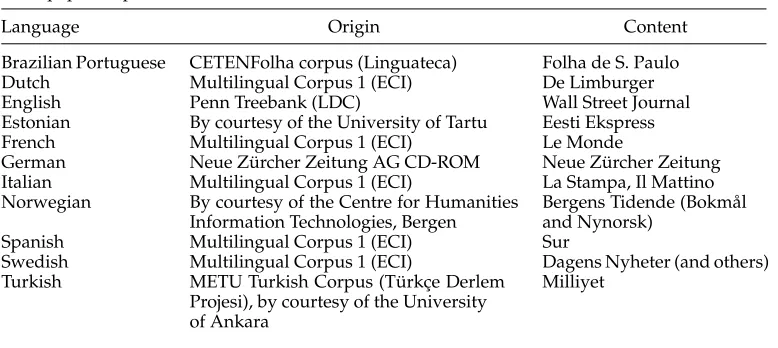
We have evaluated Punkt on corpora from eleven different languages: Brazilian Portuguese, Dutch, English, Estonian, French, German, Italian, Norwegian, Spanish, Swedish, and Turkish. For all of these languages, we have created test corpora con-taining newspaper text, the genre that is most often used to test sentence boundary detection systems; compare Section 7. Table 4 provides a short description for each one of these newspaper corpora. Five of them—Dutch, French, Italian, Spanish, and Swedish—are parts of corpora taken from the CD-ROM Multilingual Corpus 1 dis-tributed by the European Corpus Initiative (ECI). For English, we have used sections 03-06 of theWSJportion of the Penn Treebank (Marcus, Santorini, and Marcinkiewicz 1993) distributed by the Linguistic Data Consortium (LDC), which have frequently been used to evaluate sentence boundary detection systems before; compare Section 7. For the other languages, we have chosen newspaper corpora that were either available on the Internet (Brazilian Portuguese), distributed by the newspaper itself (German), or kindly provided to us by other research institutions (Estonian, Norwegian, and Turk-ish). While the Swedish corpus contains a small amount of literary fiction in addition to newspaper articles from several Swedish newspapers, the other corpora consist solely of newswire text.
Table 4
Newspaper corpora used in the evaluation.
Language Origin Content
Brazilian Portuguese CETENFolha corpus (Linguateca) Folha de S. Paulo
Dutch Multilingual Corpus 1 (ECI) De Limburger
English Penn Treebank (LDC) Wall Street Journal
Estonian By courtesy of the University of Tartu Eesti Ekspress
French Multilingual Corpus 1 (ECI) Le Monde
German Neue Z ¨urcher Zeitung AG CD-ROM Neue Z ¨urcher Zeitung Italian Multilingual Corpus 1 (ECI) La Stampa, Il Mattino Norwegian By courtesy of the Centre for Humanities
Information Technologies, Bergen
Bergens Tidende (Bokm˚al and Nynorsk)
Spanish Multilingual Corpus 1 (ECI) Sur
Swedish Multilingual Corpus 1 (ECI) Dagens Nyheter (and others) Turkish METU Turkish Corpus (T ¨urkc¸e Derlem
Projesi), by courtesy of the University of Ankara
Milliyet
Table 5
Other corpora used in the evaluation.
Language Origin Content
English Brown corpus Balanced corpus of American English, different text genres English Project Gutenberg The Works of Edgar Allan Poe in Five Volumes, Volumes I–III,
literary fiction
also tested it on the Brown corpus of American English (Francis and Kucera 1982), which has often been used to evaluate other sentence boundary detection systems. This corpus contains a mixture of text genres including news, scientific articles, and literary fiction.
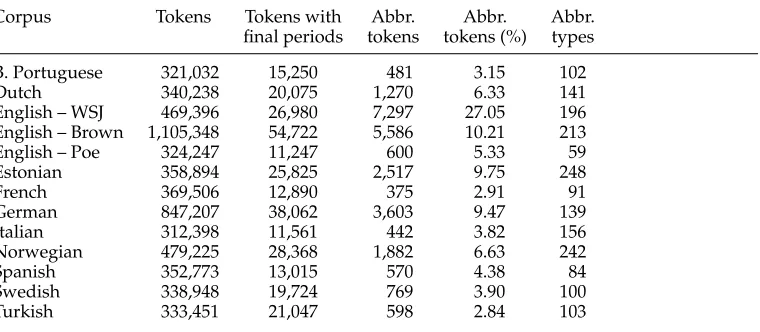
For the evaluation, we have created annotated versions of the test corpora, in which all periods were disambiguated by hand and labeled with the correct tag from Table 6. Table 7 illustrates some statistical properties of the test corpora. For each corpus, we provide the number of tokens it contains and the number of all tokens with a final period, that is, all periods that had to be classified by Punkt. As an indication of the difficulty of the sentence boundary detection task, we also give information on how many abbreviations each corpus contains and what percentage of all the tokens with a final period actually are abbreviations. Finally, the last column shows the number of different abbreviation types occurring in each test corpus.
Table 6
Tags used in the evaluation.
<S> Sentence boundary <A> Abbreviation <E> Ellipsis
Table 7
Statistical properties of the test corpora.
Corpus Tokens Tokens with Abbr. Abbr. Abbr.
final periods tokens tokens (%) types
B. Portuguese 321,032 15,250 481 3.15 102
Dutch 340,238 20,075 1,270 6.33 141
English – WSJ 469,396 26,980 7,297 27.05 196
English – Brown 1,105,348 54,722 5,586 10.21 213
English – Poe 324,247 11,247 600 5.33 59
Estonian 358,894 25,825 2,517 9.75 248
French 369,506 12,890 375 2.91 91
German 847,207 38,062 3,603 9.47 139
Italian 312,398 11,561 442 3.82 156
Norwegian 479,225 28,368 1,882 6.63 242
Spanish 352,773 13,015 570 4.38 84
Swedish 338,948 19,724 769 3.90 100
Turkish 333,451 21,047 598 2.84 103
6.2 Performance Measures
The most important measure we use is the error rate given in (13). It is defined as the ratio of the number of incorrectly classified candidates to the number of all candidates.
error rate= false positives+false negatives
number of all candidates (13)
In addition, we use precision and recall to provide better information on what kinds of errors were made by Punkt. Precision is the ratio between the number of candidate tokens that have been correctly assigned to a class and the number of all candidates that have been assigned to this class.
precision= true positives
true positives+false positives (14)
Recall is defined as the proportion of all candidates truly belonging to a certain class that have also been assigned to that class by the evaluated system.
recall= true positives
true positives+false negatives (15)
Finally, the so-called F measure is the harmonic mean of precision and recall (van Rijsbergen 1979).
Fmeasure= 2×precision×recall
All the measures we use are based on counting true and false positives and true and false negatives. There are, however, three possibilities of what classifications could be regarded as a positive or a negative outcome because Punkt actually performs three classification tasks at the same time. The most important one is the decision whether a token-final period marks a sentence boundary or not. But the system also decides for each candidate token ending in a period whether it is an abbreviation or not and whether it is an ellipsis or not; compare Table 6. The performance measures for sen-tence boundary detection, abbreviation detection, and ellipsis detection do not directly depend on each other because a candidate can be an abbreviation (or an ellipsis) and precede a sentence boundary at the same time. We thus calculate error rate, precision, recall, and F measure for the sentence boundary detection problem and for the ab-breviation detection problem separately. For sentence boundary detection, we count the following tags as positives: <S>, <A><S>, and <E><S>. The tags <A> and <A><S>are considered positives for the abbreviation detection task. As the correct classification of ellipses is straightforward, we do not give figures for the detection of ellipses.
6.3 Baselines
In Sections 6.4.1 and 6.4.2, we evaluate Punkt against three different baseline algorithms. These baselines serve several purposes. First, they establish a lower bound for the task of sentence boundary detection. Any sentence boundary detection system should perform significantly better than these baseline algorithms. Second, although we compare Punkt to other systems proposed in the literature in Section 7, most previous work on sentence boundary detection considered at most three different languages so that no direct comparison is possible for many of the corpora and languages that we have used in our evaluation. A comparison with the performance of the three baselines can at least give an indication of how well our system did on these corpora. Third, there is still an assumption held in the field that simple algorithms such as the baselines presented here are sufficiently reliable to be used for sentence boundary detection. This opinion was, for example, held by a reviewer of Kiss and Strunk (2002a). As will become clear in the following sections, a baseline algorithm may perform pretty well on one corpus, but this performance typically does not carry over to other languages or corpora. The baselines thus also serve to illustrate the complexity of the sentence boundary detection problem. The absolute baseline (AbsBL) is the simplest approach to sentence boundary de-tection we can think of. It simply assumes that all token-final periods in a test corpus represent sentence boundaries. Consequently, all periods are tagged with<S>.
Table 8
Results of classification—newspaper corpora (mixed case).
Corpus Error Prec. Recall F Error Prec. Recall F
(<S>) (<S>) (<S>) (<S>) (<A>) (<A>) (<A>) (<A>)
(%) (%) (%) (%) (%) (%) (%) (%)
B. Port. 1.11 99.14 99.72 99.43 0.99 96.88 70.89 81.87
Dutch 0.97 99.25 99.72 99.48 0.66 99.31 90.24 94.55
English 1.65 99.13 98.64 98.89 0.71 99.86 97.52 98.68
Estonian 2.12 98.58 99.07 98.83 1.75 98.22 83.51 90.27
French 1.54 99.31 99.08 99.19 0.72 95.19 79.20 86.46
German 0.35 99.69 99.93 99.81 0.26 99.91 97.34 98.61
Italian 1.13 99.32 99.49 99.41 0.74 96.60 83.48 89.56
Norw. 0.81 99.45 99.68 99.56 0.72 98.16 90.81 94.34
Spanish 1.06 99.66 99.23 99.45 0.35 98.70 93.33 95.94
Swedish 1.76 98.82 99.36 99.09 1.48 94.10 66.32 77.80 Turkish 1.31 99.40 99.24 99.32 0.43 95.35 89.13 92.13
Mean 1.26 99.25 99.38 99.31 0.80 97.48 85.62 90.93
SD 0.49 0.33 0.38 0.29 0.46 1.99 10.19 6.69
candidate types are treated as ordinary words and a period following them is classified as a sentence boundary marker. No sentence boundary is assumed after ellipses.
6.4 Experiments
We have tested Punkt on the various corpora introduced in Section 6.1. In all cases, it was only provided with the unannotated test corpus as input and no further data whatsoever, most importantly, no lexicon and no list of abbreviations. Its main classifi-cation task was to decide for all token-final periods whether they indicated the end of a sentence or not.8In addition, it had to decide for all token-final periods whether they were used as an abbreviation marker or were part of an ellipsis.
The results Punkt achieved on the newspaper corpora are presented in Section 6.4.1. Those obtained for the remaining corpora are given in Section 6.4.2. In Section 6.4.3, we provide the results of an experiment in which we evaluated our system on all-uppercase and all-lowercase corpora. As many competing systems require a list of abbreviations, we have carried out an experiment to determine the usefulness of abbreviation lists derived from general-purpose dictionaries. The results are reported in Section 6.4.4. Last but not least, we take a closer look at the architecture of Punkt in Section 6.4.5 by examining the contributions of its individual parts, look at remaining errors and problems in Section 6.4.6, and discuss the hypothesis that the methods and heuristics we use can be called language independent in Section 6.4.7.
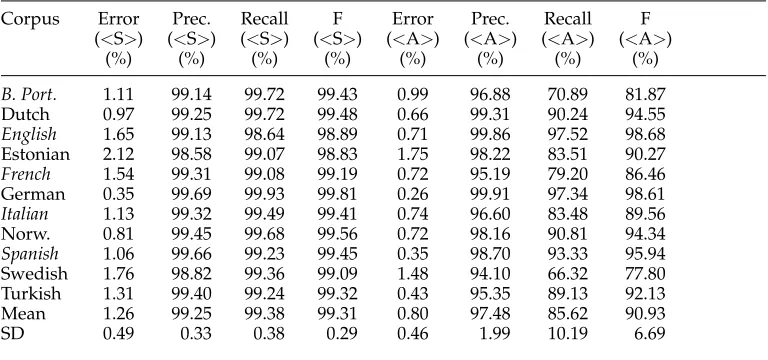
6.4.1 Results on the Newspaper Corpora.Table 8 shows the results that we obtained for the tasks of sentence boundary detection and abbreviation detection on the eleven newspaper corpora. We performed two test runs for each language: one with detection
Table 9
Comparison with the baselines—newspaper corpora (mixed case).
Error<S> Error<A>
Corpus Punkt AbsBL TokBL TypeBL Punkt AbsBL TokBL TypeBL
(%) (%) (%) (%) (%) (%) (%) (%)
B. Port. 1.11 3.17 2.01 1.74 0.99 3.15 2.11 1.51
Dutch 0.97 6.50 5.66 1.63 0.66 6.33 5.59 1.36
English 1.65 25.60 13.37 7.14 0.71 27.05 14.96 5.40
Estonian 2.12 10.03 4.86 7.45 1.75 9.75 4.94 6.53
French 1.54 4.20 3.02 2.87 0.72 2.91 2.20 1.19
German 0.35 9.50 6.23 8.74 0.26 9.47 6.22 8.60
Italian 1.13 4.45 3.40 3.14 0.74 3.82 3.11 2.53
Norw. 0.81 6.57 2.98 5.44 0.72 6.63 3.09 5.10
Spanish 1.06 4.23 3.17 2.61 0.35 4.38 3.40 1.75
Swedish 1.76 4.02 1.68 2.58 1.48 3.90 1.83 1.79
Turkish 1.31 3.47 5.25 26.40 0.43 2.84 4.66 25.44
Mean 1.26 7.43 4.69 6.23 0.80 7.29 4.74 5.56
SD 0.49 6.46 3.24 7.48 0.46 7.01 3.69 7.05
of ordinal numbers and one without a special treatment of numbers. For languages such as English, which do not usually mark ordinal numbers with a final period, it is obviously preferable not to try to detect them. In Table 8, we only report the best result from the two test runs for each language.9 Those languages in which the period is not usually used to mark ordinal numbers and for which the test without special treatment of numbers achieved better results are italicized in the following tables. How-ever, even if the special treatment of numbers was not turned off for such languages, the resulting increase in the error rate was not very high, maximally 0.03%; see also Section 6.4.5.
For the sentence boundary detection task, the error rates Punkt achieved on the eleven newspaper corpora range from 2.12% on the Estonian corpus to only 0.35% on the German corpus with an average error rate of 1.26%. The error rates for abbreviation detection are slightly lower, lying between 1.75% on the Estonian corpus and 0.26% on the German corpus with an average of 0.80% for all eleven corpora.
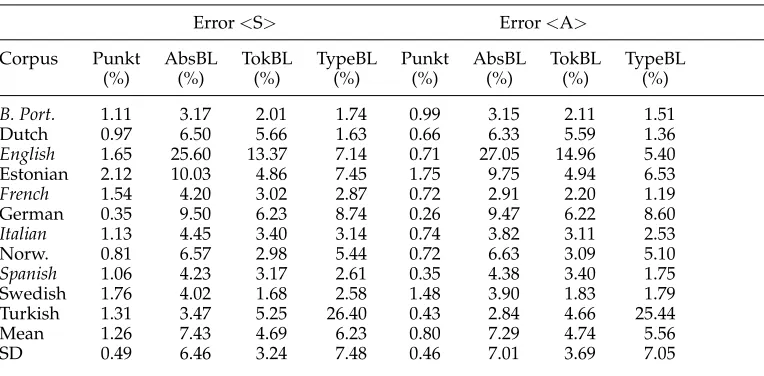
Table 9 compares Punkt’s performance to that of the three baseline algorithms. The error rates achieved by Punkt for the sentence boundary task are reduced by about 83% on average compared to the absolute baseline, by about 73% compared to the token-based baseline, and by almost 80% compared to the type-based baseline. The error rates for the abbreviation detection task have decreased even more considerably, namely, by approximately 89% in comparison to the absolute baseline, by about 83% in comparison to the token-based baseline, and by almost 86% in comparison to the type-based baseline. Table 9 also shows that whereas the good performance of our system is quite stable across the eleven corpora with a standard deviation of only 0.49% for
sentence boundary detection and 0.46% for abbreviation detection, the performance of the baselines is not reliable at all. Although one of the baselines sometimes performed well on one corpus—such as TokBL on the Swedish corpus, the only case where Punkt was not better than all of the baselines, or TypeBL on the Brazilian Portuguese and Dutch corpora, the baselines exhibit a very large standard deviation in their error rates across the eleven corpora and sometimes seem to fail completely, such as TokBL on the English corpus and TypeBL on the Turkish corpus.
6.4.2 Results on the Other Corpora.In order to show that Punkt is also suited to process text genres different from newspaper text and that its performance carries over to other text types, we have tested it on two additional corpora of American English—the entire Brown corpus andThe Works of Edgar Allan Poe(volumes I–III). Table 10 provides the results Punkt achieved on the two additional corpora.
The error rate on the Brown corpus is 1.02% for the sentence boundary detection task and 0.82% for the abbreviation detection task. This represents a reduction of about 90% compared to the absolute baseline, a reduction of more than 85% compared to the token-based baseline, and a reduction of more than 70% compared to the type-based baseline; see Table 11. The error rate onThe Works of Edgar Allan Poeis 0.80% for sentence boundary detection and 0.46% for abbreviation detection, which corresponds to a reduction of about 85% in comparison to AbsBL, a reduction by more than 80% compared to TokBL, and by about 75% compared to TypeBL. These results achieved on the literary Poe corpus and the Brown corpus with its balanced content fall within the range of the error rates achieved on the newspaper corpora and thus indicate that Punkt is also well suited to deal with literary texts and corpora containing mixed content.
[image:22.486.50.432.464.554.2]6.4.3 Experiments with Single-case Corpora. We have also tested the applicability of Punkt to single-case text. The newspaper test corpora have been converted to all-uppercase and all-lowercase versions in order to determine how much Punkt is affected by the loss of capitalization information. In fact, one should keep in mind
Table 10
Results of classification—other corpora (mixed case).
Corpus Error Prec. Recall F Error Prec. Recall F
(<S>) (<S>) (<S>) (<S>) (<A>) (<A>) (<A>) (<A>)
(%) (%) (%) (%) (%) (%) (%) (%)
Brown 1.02 99.14 99.75 99.44 0.82 98.92 92.17 95.43
[image:22.486.48.433.590.665.2]Poe 0.80 99.71 99.45 99.58 0.46 95.36 96.00 95.68
Table 11
Comparison with the baselines—other corpora (mixed case).
Error<S> Error<A>
Corpus Punkt AbsBL TokBL TypeBL Punkt AbsBL TokBL TypeBL
(%) (%) (%) (%) (%) (%) (%) (%)
Brown 1.02 9.83 7.17 3.59 0.82 10.21 7.55 3.27
that single-case text does not only lack useful capitalization information, but actually contains information that is highly misleading for systems that rely primarily on cap-italization. Table 12 shows the performance of our system on the single-case corpora. The left half of the table contains the error rates and Fvalues for sentence boundary detection and abbreviation detection on the lowercase corpora. The right half gives the corresponding values for the tests on the uppercase corpora. The last two rows of the table compare these results with those Punkt achieved on the mixed-case (MC) versions of the newspaper corpora; compare Section 6.4.1. As can be seen in Table 12, the performance of our system is only minimally affected by the loss of capitalization information, slightly more so on the all-lowercase corpora. The error rate our system produces for the task of sentence boundary detection is 0.41% higher on average on the lowercase corpora than on the mixed-case corpora. The increase in the error rate on the uppercase corpora is slightly lower: 0.29%. For the task of abbreviation detection, the increase in the error rates is even lower: 0.14% on the lowercase corpora and 0.13% on the uppercase corpora. This is expected because Punkt only uses capitalization information as evidence during the token-based correction and reclassification stage and not as primary evidence for the detection of abbreviations. The experiments on the single-case corpora show that Punkt is quite robust and well suited also to process single-case text.
[image:23.486.53.432.450.663.2]6.4.4 Experiments with Additional Abbreviation Lists. Punkt is able to dynamically detect abbreviations in the test corpus itself. It therefore does not depend on precom-piled abbreviation lists like some of its competitors; compare Section 7. But even though an abbreviation list is not necessary for Punkt to perform well, such a list can easily be integrated into its architecture. The abbreviations read from such a list are simply added to those the system has detected in the test corpus after the type-based
Table 12
Results of classification—newspaper corpora (single case).
All-lowercase corpora All-uppercase corpora
Corpus Error F Error F Error F Error F
(<S>) (<S>) (<A>) (<A>) (<S>) (<S>) (<A>) (<A>)
(%) (%) (%) (%) (%) (%) (%) (%)
B. Port. 1.25 99.36 1.11 82.68 1.19 99.39 1.04 81.28
Dutch 1.00 99.47 0.72 94.12 0.85 99.55 0.57 95.34
English 2.30 98.44 0.71 98.66 2.04 98.63 0.72 98.65
Estonian 2.57 98.57 1.66 91.01 2.80 98.45 2.10 88.13
French 2.56 98.65 0.85 84.36 1.99 98.96 0.85 84.38
German 0.40 99.78 0.26 98.62 0.47 99.74 0.30 98.38
Italian 1.48 99.23 0.83 88.38 1.37 99.29 0.80 88.97
Norwegian 1.55 99.17 1.32 89.73 1.41 99.25 1.18 90.54
Spanish 1.31 99.31 0.45 94.69 1.12 99.41 0.32 96.24
Swedish 2.39 98.76 1.86 72.88 2.28 98.82 1.74 74.25
Turkish 1.53 99.20 0.57 89.74 1.54 99.20 0.58 89.30
Mean 1.67 99.09 0.94 89.53 1.55 99.15 0.93 89.59
SD 0.70 0.42 0.50 7.54 0.67 0.40 0.56 7.56
stage. Ideally, one would use a domain-specific abbreviation list if the domain of the test corpus is known beforehand. However, we wanted to determine the usefulness of general-purpose abbreviation lists derived from general-purpose dictionaries. We have therefore built such abbreviation lists by extracting by hand all abbreviations from a German spelling dictionary—the Rechtschreibduden (Dudenredaktion 2004)— and all English abbreviations from a bilingual dictionary—the small Muret-Sanders English-German dictionary by Langenscheidt (Willmann and Messinger 1996). This yielded a total number of 769 abbreviations for German and 1,537 for English; compare Table 13.
We then made three additional versions of these lists from which we deleted po-tentially harmful entries: one from which we removed all abbreviations that had ob-vious non-abbreviation homographs, one from which we removed all single-character abbreviations, and one from which we removed both. Table 13 gives the number of remaining abbreviations for these different versions. We produced these additional versions to test how much care is needed when preparing abbreviation lists for a system like Punkt.
We then carried out two experiments on the German and English newspaper corpora and the Brown corpus. In the first experiment, we tested how well Punkt performed when it was provided with the different abbreviation lists in addition to the abbreviations it was able to detect on the fly; see Table 14 for the results.
The results show that Punkt can indeed benefit from additional abbreviation lists, but only if these are prepared with care. Providing such a carefully prepared
Table 13
Abbreviation lists.
List English German
All abbreviations 1537 769
No homographs 1115 729
No single characters 1513 742
[image:24.486.50.441.515.665.2]No homographs and no single characters 1112 703
Table 14
Results of classification—using an additional abbreviation list.
Error<S>
Corpus No list (%) All (%) No homogr. (%) No single chars. (%) Neither (%)
WSJ 1.65 1.97 1.58 1.96 1.58
Brown 1.02 1.75 0.93 1.72 0.92
NZZ 0.35 0.37 0.32 0.37 0.32
Error<A>
Corpus No list (%) All (%) No homogr. (%) No single chars. (%) Neither (%)
WSJ 0.71 0.89 0.63 0.88 0.63
Brown 0.82 1.44 0.69 1.42 0.70
abbreviation list reduced the error rate of our system on the WSJ corpus from 1.65% to 1.58%, the error rate on the Brown corpus from 1.02% to 0.92%, and the error rate on the German NZZ corpus from 0.35% to 0.32%. Additional general-purpose abbreviation lists thus do improve the performance of our system, but the decrease of the error rate is not very great. Table 14 also shows that abbreviation lists from which abbreviations homographic to ordinary words and single-character abbreviations have not been re-moved are not helpful at all and instead lead to an increased error rate on all of the three corpora.
In the second experiment, Punkt could only use the abbreviations on the different lists and was not allowed to add any additional abbreviations on the fly. This experi-ment thus really tests the coverage of general-purpose abbreviation lists and also the productivity of abbreviation use in the test corpora. Table 15 contains the results from this experiment. The columnOn the flygives the error rates that Punkt achieved in its normal configuration detecting abbreviations on the fly without being provided with an additional abbreviation list. The remaining columns show the results it produced when it could use a fixed list of abbreviations only. A comparison between the first column and the other columns makes clear that abbreviation use in the corpora is quite productive and that fixed general-purpose abbreviation lists are clearly not sufficient for sentence boundary detection. A versatile sentence boundary detection system should therefore always be able to detect unknown abbreviations on the fly.
6.4.5 Contributions of the Individual Parts of the System.In this section, we take a look at the contributions of the individual parts of the system to its overall performance. First, we tried to determine the effectiveness of reclassifying the different candidate classes in the token-based stage separately using specific combinations of evidence, namely, ordinary abbreviations, ellipses, initials, and numbers. We therefore built four different versions of our system, which are described in Table 16. The different config-urations become cumulatively more specialized in their treatment of the different can-didate classes from System 1 with no token-based reclassification at all to the complete System 4.
[image:25.486.54.444.515.665.2]Table 17 gives the results that the four different configurations achieved on the eleven newspaper corpora. It shows that the cumulatively more specialized treatment
Table 15
Results of classification—using only a fixed abbreviation list.
Error<S>
Corpus On the fly (%) All (%) No homogr. (%) No single chars. (%) Neither (%)
WSJ 1.65 5.33 16.62 5.35 16.65
Brown 1.02 2.53 5.24 2.60 5.26
NZZ 0.35 2.55 2.64 2.59 2.67
Error<A>
Corpus On the fly (%) All (%) No homogr. (%) No single chars. (%) Neither (%)
WSJ 0.71 4.57 16.70 4.58 16.73
Brown 0.82 2.32 5.32 2.43 5.36
Table 16
Configurations for testing the effectiveness of separate reclassification in the token-based stage.
System Description
1 Only type-based stage
2 Type-based stage + Reclassification of abbreviations (including initials) and ellipses
3 Type-based stage + Reclassification of abbreviations and ellipses + Separate treatment of initials
4 Type-based stage + Reclassification of abbreviations and ellipses + Separate treatment of initials + Detection of ordinal numbers (Complete System)
of the different candidate classes helps to improve on the error rate of the type-based stage considerably. Moreover, a separate reclassification of initials and numbers is quite effective for reducing the error rate on the newspaper corpora, often even more so than the detection of sentence boundaries after abbreviations and ellipses. The separate treatment of initials is quite beneficial for the English corpus, for example, reducing the error rate from 2.06% to 1.65% (System 2 vs. System 3), but also for Dutch, French, Italian, Norwegian and Spanish, while the detection of ordinal numbers is a very important factor for the German newspaper corpus, reducing the error rate from 2.25% to only 0.35% (System 3 vs. System 4), and also for the Estonian, Norwegian, and Turkish corpora. For all languages that use the period to mark ordinal numbers, the detection of ordinal numbers thus turns out to be a very important subtask of sentence boundary disambiguation. A comparison between System 3 and System 4 also shows that leaving the detection of ordinal numbers on for languages that do not mark them with a final period is not really harmful, resulting in a maximal increase in the error rate of 0.03%.
[image:26.486.54.433.508.663.2]In a second experiment, we have tested the usefulness of the different heuristics used during the token-based stage. Table 18 provides information on the five different configurations we have evaluated. We have again added heuristics cumulatively: first, the collocation heuristic; next the frequent sentence starter heuristic; then the ortho-graphic heuristic; and finally, the special orthoortho-graphic heuristic for initials.
Table 17
Contributions of separate reclassifications—newspaper corpora (mixed case).
Error<S>
Corpus System 1 (%) System 2 (%) System 3 (%) System 4 (%)
B. Portuguese 1.37 1.27 1.11 1.12
Dutch 1.96 2.73 1.27 0.97
English 2.71 2.06 1.65 1.68
Estonian 7.37 6.88 6.46 2.12
French 2.94 2.04 1.54 1.33
German 2.38 2.32 2.25 0.35
Italian 2.18 1.90 1.13 1.14
Norwegian 4.09 3.92 3.38 0.81
Spanish 1.81 1.67 1.06 1.08
Swedish 2.42 2.16 1.95 1.76