An Exploration of Features for Phrase-Level
Sentiment Analysis
Theresa Wilson
∗ University of EdinburghJanyce Wiebe
∗∗ University of PittsburghPaul Hoffmann
∗∗ University of PittsburghMany approaches to automatic sentiment analysis begin with a large lexicon of words marked with their prior polarity (also called semantic orientation). However, the contextual polarity of the phrase in which a particular instance of a word appears may be quite different from the word’s prior polarity. Positive words are used in phrases expressing negative sentiments, or vice versa. Also, quite often words that are positive or negative out of context are neutral in context, meaning they are not even being used to express a sentiment. The goal of this work is to automatically distinguish between prior and contextual polarity, with a focus on understanding which features are important for this task. Because an important aspect of the problem is identifying when polar terms are being used in neutral contexts, features for distinguishing between neutral and polar instances are evaluated, as well as features for distinguishing between positive and negative contextual polarity. The evaluation includes assessing the performance of features across multiple machine learning algorithms. For all learning algorithms except one, the combination of all features together gives the best performance. Another facet of the evaluation considers how the presence of neutral instances affects the performance of features for distinguishing between positive and negative polarity. These experiments show that the presence of neutral instances greatly degrades the performance of these features, and that perhaps the best way to improve performance across all polarity classes is to improve the system’s ability to identify when an instance is neutral.
1.Introduction
Sentiment analysis is a type of subjectivity analysis (Wiebe 1994) that focuses on iden-tifying positive and negative opinions, emotions, and evaluations expressed in natural language. It has been a central component in applications ranging from recognizing
∗School of Informatics, Edinburgh EH8 9LW, U.K. E-mail: [email protected].
∗∗Department of Computer Science, Pittsburgh, PA 15260, USA. E-mail:{wiebe,hoffmanp}@cs.pitt.edu.
inflammatory messages (Spertus 1997), to tracking sentiments over time in online discussions (Tong 2001), to classifying positive and negative reviews (Pang, Lee, and Vaithyanathan 2002; Turney 2002). Although a great deal of work in sentiment analy-sis has targeted documents, applications such as opinion question answering (Yu and Hatzivassiloglou 2003; Maybury 2004; Stoyanov, Cardie, and Wiebe 2005) and re-view mining to extract opinions about companies and products (Morinaga et al. 2002; Nasukawa and Yi 2003) require sentence-level or even phrase-level analysis. For exam-ple, if a question answering system is to successfully answer questions about people’s opinions, it must be able not only to pinpoint expressions of positive and negative sentiments, such as we find in sentence (1), but also to determine when an opinion isnot
being expressed by a word or phrase that typically does evoke one, such ascondemned
in sentence (2).
(1) African observers generally approved (positive) of his victory while Western governments denounced (negative) it.
(2) Gavin Elementary School was condemned in April 2004.
A common approach to sentiment analysis is to use a lexicon with information about which words and phrases are positive and which are negative. This lexicon may be manually compiled, as is the case with the General Inquirer (Stone et al. 1966), a resource often used in sentiment analysis. Alternatively, the information in the lexicon may be acquired automatically. Acquiring the polarity of words and phrases is itself an active line of research in the sentiment analysis community, pioneered by the work of Hatzivassiloglou and McKeown (1997) on predicting the polarity or semantic orientation of adjectives. Various techniques have been proposed for learning the polarity of words. They include corpus-based techniques, such as using constraints on the co-occurrence in conjunctions of words with similar or opposite polarity (Hatzivassiloglou and McKeown 1997) and statistical measures of word association (Turney and Littman 2003), as well as techniques that exploit information about lexical relationships (Kamps and Marx 2002; Kim and Hovy 2004) and glosses (Esuli and Sebastiani 2005; Andreevskaia and Bergler 2006) in resources such as WordNet.
Acquiring the polarity of words and phrases is undeniably important, and there are still open research challenges, such as addressing the sentiments of different senses of words (Esuli and Sebastiani 2006b; Wiebe and Mihalcea 2006), and so on. However, what the polarity of a given word or phrase is when it is used in a particular context is another problem entirely. Consider, for example, the underlined positive and negative words in the following sentence.
(3) Philip Clapp, president of the National Environment Trust, sums up well the general thrust of the reaction of environmental movements: “There is no reason at all to believe that the polluters are suddenly going to become reasonable.”
andreasonable.Out of context, we would consider both of these words to be positive.1 In context, the word reason is being negated, changing its polarity from positive to negative. The phraseno reason at all to believechanges the polarity of the proposition that follows; becausereasonablefalls within this proposition, its polarity becomes negative. The wordpollutershas a negative connotation, but here in the context of the discussion of the article and its position in the sentence, polluters is being used less to express a sentiment and more to objectively refer to companies that pollute. To clarify how the polarity ofpollutersis affected by its subject role, consider the purely negative sentiment that emerges when it is used as an object:They are polluters.
We call the polarity that would be listed for a word in a lexicon the word’sprior polarity, and we call the polarity of the expression in which a word appears, con-sidering the context of the sentence and document, the word’s contextual polarity. Although words often do have the same prior and contextual polarity, many times a word’s prior and contextual polarities differ. Words with a positive prior polarity may have a negative contextual polarity, or vice versa. Quite often words that are positive or negative out of context are neutral in context, meaning that they are not even being used to express a sentiment. Similarly, words that are neutral out of context, neither positive or negative, may combine to create a positive or negative expression in context.
The focus of this work is on the recognition of contextual polarity—in particular, disambiguating the contextual polarity of words with positive or negative prior polar-ity. We begin by presenting an annotation scheme for marking sentiment expressions and their contextual polarity in the Multi-perspective Question Answering (MPQA) opinion corpus. We show that, given a set of subjective expressions (identified from the existing annotations in the MPQA corpus), contextual polarity can be annotated reliably.
Using the contextual polarity annotations, we conduct experiments in automatically distinguishing between prior and contextual polarity. Beginning with a large lexicon of clues tagged with prior polarity, we identify the contextual polarity of the instances of those clues in the corpus. The process that we use has two steps, first classifying each clue as being in a neutral or polar phrase, and then disambiguating the contextual polarity of the clues marked as polar. For each step in the process, we experiment with a variety of features and evaluate the performance of the features using several different machine learning algorithms.
Our experiments reveal a number of interesting findings. First, being able to accu-rately identify neutral contextual polarity—when a positive or negative clue isnotbeing used to express a sentiment—is an important aspect of the problem. The importance of neutral examples has previously been noted for classifying the sentiment of documents (Koppel and Schler 2006), but ours is the first work to explore how neutral instances affect classifying the contextual polarity of words and phrases. In particular, we found that the performance of features for distinguishing between positive and negative po-larity greatly degrades when neutral instances are included in the experiments.
We also found that achieving the best performance for recognizing contextual po-larity requires a wide variety of features. This is particularly true for distinguishing
between neutral and polar instances. Although some features help to increase polar or neutral recall or precision, it is only the combination of features together that achieves significant improvements in accuracy over the baselines. Our experiments show that for distinguishing between positive and negative instances, features capturing negation are clearly the most important. However, there is more to the story than simple negation. Features that capture relationships between instances of clues also perform well, indi-cating that identifying features that represent more complex interdependencies between sentiment clues may be an important avenue for future research.
The remainder of this article is organized as follows. Section 2 gives an overview of some of the things that can influence contextual polarity. In Section 3, we describe our corpus and present our annotation scheme and inter-annotator agreement study for marking contextual polarity. Sections 4 and 5 describe the lexicon used in our experiments and how the contextual polarity annotations are used to determine the gold-standard tags for instances from the lexicon. In Section 6, we consider what kind of performance can be expected from a simple, prior-polarity classifier. Section 7 describes the features that we use for recognizing contextual polarity, and our experiments and results are presented in Section 8. In Section 9we discuss related work, and we conclude in Section 10.
2.Polarity Influencers
Phrase-level sentiment analysis is not a simple problem. Many things besides negation can influence contextual polarity, and even negation is not always straightforward. Negation may be local (e.g.,not good), or involve longer-distance dependencies such as the negation of the proposition (e.g.,does not look very good) or the negation of the subject (e.g.,no one thinks that it’s good). In addition, certain phrases that contain negation words intensify rather than change polarity (e.g.,not only good but amazing). Contextual polarity may also be influenced by modality: whether the proposition is asserted to be real (realis) or not real (irrealis) (no reason at all to believeis irrealis, for example); word sense (e.g.,
Environmental Trustvs.He has won the people’s trust); the syntactic role of a word in the sentence: whether the word is the subject or object of a copular verb (considerpolluters areversusthey are polluters); and diminishers such aslittle(e.g.,little truth,little threat). Polanyi and Zaenen (2004) give a detailed discussion of many of these types of polarity influencers. Many of these contextual polarity influencers are represented as features in our experiments.
Contextual polarity may also be influenced by the domain or topic. For example, the word cool is positive if used to describe a car, but it is negative if it is used to describe someone’s demeanor. Similarly, a word such asfeveris unlikely to be expressing a sentiment when used in a medical context. We use one feature in our experiments to represent the topic of the document.
Another important aspect of contextual polarity is the perspective of the person who is expressing the sentiment. For example, consider the phrase failed to defeat
3.Data and Annotations
For the experiments in this work, we need a corpus that is annotated comprehensively for sentiment expressions and their contextual polarity. Rather than building a corpus from scratch, we chose to add contextual polarity annotations to the existing annota-tions in the Multi-perspective Question Answering (MPQA) opinion corpus2 (Wiebe, Wilson, and Cardie 2005).
The MPQA corpus is a collection of English-language versions of news documents from the world press. The documents contain detailed, expression-level annotations of attributions and private states (Quirk et al. 1985). Private states are mental and emotional states; they include beliefs, speculations, intentions, and sentiments, among others. Although sentiments are not distinguished from other types of private states in the existing annotations, they are a subset of what already is annotated. This makes the annotations in the MPQA corpus a good starting point for annotating sentiment expressions and their contextual polarity.
3.1 Annotation Scheme
When developing our annotation scheme for sentiment expressions and contextual polarity, there were three main questions to address. First, which of the existing annota-tions in the MPQA corpus have the possibility of being sentiment expressions? Second, which of the possible sentiment expressions actually are expressing sentiments? Third, what coding scheme should be used for marking contextual polarity?
The MPQA annotation scheme has four types of annotations: objective speech event frames, two types of private state frames, and agent frames that are used for marking speakers of speech events and experiencers of private states. A full description of the MPQA annotation scheme and an agreement study evaluating key aspects of the scheme are found in Wiebe, Wilson, and Cardie (2005).
The two types of private state frames,direct subjective framesandexpressive sub-jective element frames, are where we will find sentiment expressions. Direct subsub-jective frames are used to mark direct references to private states as well as speech events in which private states are being expressed. For example, in the following sentences,fears, praised,andsaidare all marked as direct subjective annotations.
(4) The U.S.fearsa spill-over of the anti-terrorist campaign.
(5) Italian senator Renzo Gubertpraisedthe Chinese government’s efforts. (6) “The report is full of absurdities,” hesaid.
The word fears directly refers to a private state; praised refers to a speech event in which a private state is being expressed; and said is marked as direct subjective because a private state is being expressed within the speech event referred to by
said.Expressive subjective elements indirectly express private states through the way something is described or through a particular wording. In example (6), the phrase
full of absurditiesis an expressive subjective element.Subjectivity(Banfield 1982; Wiebe
1994) refers to the linguistic expression of private states, hence the names for the two types of private state annotations.
All expressive subjective elements are included in the set of annotations that have the possibility of being sentiment expressions, but the direct subjective frames to include in this set can be pared down further. Direct subjective frames have an attribute, expres-sion intensity, that captures the contribution of the annotated word or phrase to the overall intensity of the private state being expressed. Expression intensity ranges from
neutraltohigh. In the given sentences,fearsandpraisedhave an expression intensity of medium, andsaidhas an expression intensity of neutral. A neutral expression intensity indicates that the direct subjective phrase itself is not contributing to the expression of the private state. If this is the case, then the direct subjective phrase cannot be a sentiment expression. Thus, only direct subjective annotations with a non-neutral
expression intensity are included in the set of annotations that have the possibility of being sentiment expressions. We call this set of annotations, the union of the expres-sive subjective elements and the direct subjective frames with a non-neutral intensity, thesubjective expressionsin the corpus; these are the annotations we will mark for contextual polarity.
Table 1 gives a sample of subjective expressions marked in the MPQA corpus. Although many of the words and phrases express what we typically think of as sentiments, others do not, for example,believes, very definitely,and unconditionally and without delay.
Now that we have identified which annotations have the possibility of being sen-timent expressions, the next question is which of these annotated words and phrases are actually expressing sentiments. We define a sentiment as a positive or negative emotion, evaluation, or stance. On the left of Table 2 are examples of positive sentiments; examples of negative sentiments are on the right.
Table 1
Sample of subjective expressions from the MPQA corpus.
victory of justice and freedom such a disadvantageous situation
grown tremendously must
such animosity not true at all
throttling the voice imperative for harmonious society
disdain and wrath glorious
so exciting disastrous consequences
could not have wished for a better situation believes
freak show the embodiment of two-sided justice
if you’re not with us, you’re against us appalling
vehemently denied very definitely
everything good and nice once and for all
under no circumstances shameful mum
most fraudulent, terrorist and extremist enthusiastically asked
number one democracy hate
seems to think gross misstatement
indulging in blood-shed and their lunaticism surprised, to put it mildly
take justice to pre-historic times unconditionally and without delay
Table 2
Examples of positive and negative sentiments.
Positive sentiments Negative sentiments
Emotion I’m happy I’m sad
Evaluation Great idea! Bad idea!
Stance She supports the bill She’s against the bill
The final issue to address is the actual annotation scheme for marking contextual polarity. The scheme we developed has four tags: positive,negative,both, andneutral. The positivetag is used to mark positive sentiments. Thenegativetag is used to mark negative sentiments. Thebothtag is applied to expressions in which both a positive and negative sentiment are being expressed. Subjective expressions withpositive,negative, or
bothtags are our sentiment expressions. Theneutraltag is used for all other subjective expressions, including emotions, evaluations, and stances that are neither positive or negative. Instructions for the contextual-polarity annotation scheme are available at
http://www.cs.pitt.edu/mpqa/databaserelease/polarityCodingInstructions.txt.
Following are examples from the corpus of each of the different contextual-polarity annotations. Each underlined word or phrase is a subjective expression that was marked in the original MPQA annotations.3In bold following each subjective expression is the contextual polarity with which it was annotated.
(7) Thousands of coup supporters celebrated (positive) overnight, waving flags, blowing whistles . . .
(8) The criteria set by Rice are the following: the three countries in question are repressive (negative) and grave human rights violators (negative) . . .
(9) Besides, politicians refer to good and evil (both) only for purposes of intimidation and exaggeration.
(10) Jerome says the hospital feels (neutral) no different than a hospital in the states.
As a final note on the annotation scheme, annotators are asked to judge the con-textual polarity of the sentiment that is ultimately being conveyed by the subjective expression, that is, once the sentence has been fully interpreted. Thus, the subjective expression, they have not succeeded, and will never succeed, is marked as positive in the following sentence:
(11) They have not succeeded, and will never succeed (positive), in breaking the will of this valiant people.
The reasoning is that breaking the will of a valiant people is negative, so to not succeed in breaking their will is positive.
Table 3
Contingency table for contextual polarity agreement.
Neutral Positive Negative Both Total
Neutral 123 14 24 0 161
Positive 16 73 5 2 9 6
Negative 14 2 167 1 184
Both 0 3 0 3 6
[image:8.486.49.433.230.309.2]Total 153 92 196 6 447
Table 4
Contingency table for contextual polarity agreement, borderline cases removed.
Neutral Positive Negative Both Total
Neutral 113 7 8 0 128
Positive 9 59 3 0 71
Negative 5 2 156 1 164
Both 0 2 0 2 4
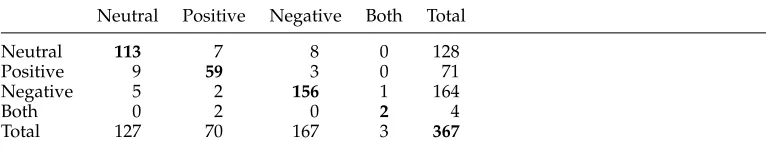
Total 127 70 167 3 367
3.2 Agreement Study
To measure the reliability of the polarity annotation scheme, we conducted an agree-ment study with two annotators4using 10 documents from the MPQA corpus. The 10 documents contain 447 subjective expressions. Table 3 shows the contingency table for the two annotators’ judgments. Overall agreement is 82%, with a kappa value of 0.72.
As part of the annotation scheme, annotators are asked to judge how certain they are in their polarity tags. For 18% of the subjective expressions, at least one annotator used theuncertaintag when marking polarity. If we consider these cases to be borderline and exclude them from the study, percent agreement increases to 90% and kappa rises to 0.84. Table 4 shows the revised contingency table with the uncertain cases removed. This shows that annotator agreement is especially high when both annotators are certain, and that annotators are certain for over 80% of their tags.
Note that all annotations are included in the experiments.
3.3 Contextual Polarity Annotations
In total, all 19,962 subjective expressions in the 535 documents (11,112 sentences) of the MPQA corpus were annotated with their contextual polarity as just described.5Three annotators carried out the task: the two who participated in the annotation study and a third who was trained later.6Table 5 gives the distribution of the contextual polarity tags. Looking at this table, we see that a small majority of subjective expressions (54.6%)
4 Both annotators are authors of this article.
5 The revised version of the MPQA corpus with the contextual polarity annotations is available at
http://www.cs.pitt.edu/mpqa.
Table 5
Distribution of contextual polarity tags.
Neutral Positive Negative Both Total
9,057 3,311 7,294 299 19,961
45.4% 16.6% 36.5% 1.5% 100%
are expressing apositive,negative, orboth(positive and negative) sentiment. We refer to these expressions as polar in context. Many of the subjective expressions are neutral and do not express a sentiment. This suggests that, although sentiment is a major type of subjectivity, distinguishing other prominent types of subjectivity will be important for future work in subjectivity analysis.
As many NLP applications operate at the sentence level, one important issue to consider is the distribution of sentences with respect to the subjective expressions they contain. In the 11,112 sentences in the MPQA corpus, 28% contain no subjective expressions, 24% contain only one, and 48% contain two or more. Of the 5,304 sentences containing two or more subjective expressions, 17% contain mixtures of positive and negative expressions, and 61% contain mixtures of polar (positive/negative/both) and neutral subjective expressions.
4.Prior-Polarity Subjectivity Lexicon
For the experiments in this article, we use a lexicon of over 8,000 subjectivity clues. Subjectivity clues are words and phrases that may be used to express private states. In other words, subjectivity clues have subjective usages, though they may have objective usages as well. For this work, only single-word clues are used.
To compile the lexicon, we began with the list of subjectivity clues from Riloff and Wiebe (2003), which includes the positive and negative adjectives from Hatzivassiloglou and McKeown (1997). The words in this list were grouped in previous work according to their reliability as subjectivity clues. Words that are subjective in most contexts are considered strong subjective clues, indicated by the strongsubjtag. Words that may only have certain subjective usages are consideredweak subjective clues, indicated by theweaksubjtag.
We expanded the list using a dictionary and a thesaurus, and added words from the General Inquirer positive and negative word lists (Stone et al. 1966) that we judged to be potentially subjective.7 We also gave the new wordsstrongsubjandweaksubjreliability tags. The final lexicon has a coverage of 67% of subjective expressions in the MPQA corpus, where coverage is the percentage of subjective expressions containing one or more instances of clues from the lexicon. The coverage of just sentiment expressions is even higher: 75%.
The next step was to tag the clues in the lexicon with their prior polarity:positive, negative, both, or neutral. A word in the lexicon is tagged aspositive if out of context it seems to evoke something positive, and negative if it seems to evoke something negative. If a word has both positive and negative meanings, it is tagged with the polarity that seems the most common. A word is tagged asbothif it is at the same time
both positive and negative. For example, the wordbittersweetevokes something both positive and negative. Words likebragare also tagged asboth, because the one who is bragging is expressing something positive, yet at the same time describing someone as bragging is expressing a negative evaluation of that person. A word is tagged asneutral
if it does not evoke anything positive or negative.
For words that came from positive and negative word lists (Stone et al. 1966; Hatzivassiloglou and McKeown 1997), we largely retained their original polarity. However, we did change the polarity of a word if we strongly disagreed with its original class.8 For example, the word apocalypse is listed as positive in the General Inquirer; we changed its prior polarity to negative for our lexicon.
By far, the majority of clues in the lexicon (92.8%) are marked as having either positive (33.1%) or negative (59.7%) prior polarity. Only a small number of clues (0.3%) are marked as having both positive and negative polarity. We refer to the set of clues marked aspositive,negative, orbothassentiment clues. A total of 6.9% of the clues in the lexicon are marked asneutral. Examples of neutral clues are verbs such asfeel,look, andthink, and intensifiers such asdeeply,entirely, andpractically. Although the neutral clues make up a small proportion of the total words in the lexicon, we retain them for our later experiments in recognizing contextual polarity because many of them are good clues that a sentiment is being expressed (e.g.,feels slighted,feels satisfied,look kindly on,
look forward to). Including them increases the coverage of the system.
At the end of the previous section, we considered the distribution of sentences in the MPQA corpus with respect to the subjective expressions they contain. It is interesting to compare that distribution with the distribution of sentences with respect to the instances they contain of clues from the lexicon. We find that there are more sentences with two or more clue instances (62%) than sentences with two or more subjective expressions (48%). More importantly, many more sentences have mixtures of positive and negative clue instances than actually have mixtures of positive and negative sub-jective expressions. Only 880 sentences have a mixture of both positive and negative subjective expressions, whereas 3,234 sentences have a mixture of positive and negative clue instances. Thus, a large number of positive and negative instances are either neutral in context, or they are combining to form more complex polarity expressions. Either way, this provides strong evidence of the need to be able to disambiguate the contextual polarity of subjectivity and sentiment clues.
5.Definition of the Gold Standard
In the experiments described in the following sections, the goal is to classify the con-textual polarity of the expressions that contain instances of the subjectivity clues in our lexicon. However, determining which clue instances are part of the same expression and identifying expression boundaries are not the focus of this work. Thus, instead of trying to identify and label each expression, in the following experiments, each clue instance is labeled individually as to its contextual polarity.
We define the gold-standard contextual polarity of a clue instance in terms of the manual annotations (Section 3) as follows. If a clue instance is not in a subjective expression (and therefore not in a sentiment expression), its gold class is neutral. If a clue instance appears in just one subjective expression or in multiple subjective
expressions with the same contextual polarity, its gold class is the contextual polarity of the subjective expression(s). If a clue instance appears in a mixture of negative and neutral subjective expressions, its gold class isnegative; if it is in a mixture of positive and neutral subjective expressions, its gold class ispositive. Finally, if a clue instance appears in at least one positive and one negative subjective expression (or in a subjective ex-pression marked as both), then its gold class isboth. A clue instance can appear in more than one subjective expression because in the MPQA annotation scheme, it is possible for direct subjective frames and expressive subjective elements frames to overlap.
6.A Prior-Polarity Classifier
Before delving into the task of recognizing contextual polarity, an important question to address is how useful prior polarity alone is for identifying contextual polarity. To answer this question, we create a classifier that simply assumes the contextual polarity of a clue instance is the same as the clue’s prior polarity. We explore this classifier’s performance on a small amount of development data, which is not part of the data used in the subsequent experiments.
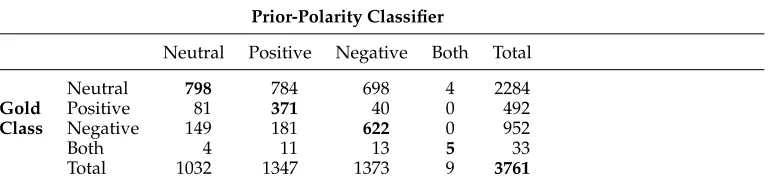
This simple classifier has an accuracy of 48%. From the confusion matrix given in Table 6, we see that 76% of the errors result from words with non-neutral prior polarity appearing in phrases with neutral contextual polarity. Only 12% of the errors result from words with neutral prior polarity appearing in expressions with non-neutral contextual polarity, and only 11% of the errors come from words with a positive or negative prior polarity appearing in expressions with the opposite contextual polarity. Table 6 also shows that positive clues tend to be used in negative expressions far more often than negative clues tend to be used in positive expressions.
Given that by far the largest number of errors come from clues with positive,
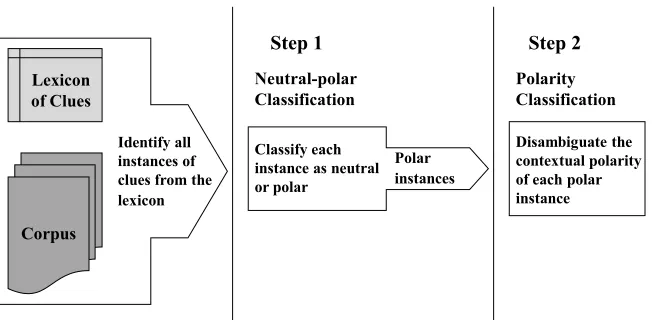
negative, orbothprior polarity appearing in neutral contexts, we were motivated to try a two-step approach to the problem of sentiment classification. The first step,Neutral– Polar Classification, tries to determine if an instance is neutral or polar in context. The second step, Polarity Classification, takes all instances that step one classified as polar, and tries to disambiguate their contextual polarity. This two-step approach is illustrated in Figure 1.
7.Features
[image:11.486.54.438.570.662.2]The features used in our experiments were motivated both by the literature and by exploration of the contextual-polarity annotations in our development data. A number
Table 6
Confusion matrix for the prior-polarity classifier on the development set.
Prior-Polarity Classifier
Neutral Positive Negative Both Total
Neutral 798 784 698 4 2284
Gold Positive 81 371 40 0 492
Class Negative 149181 622 0 9 52
Both 4 11 13 5 33
Figure 1
Two-step approach to recognizing contextual polarity.
of features were inspired by the paper on contextual-polarity influencers by Polanyi and Zaenan (2004). Other features are those that have been found useful in the past for recognizing subjective sentences (Wiebe, Bruce, and O’Hara 1999; Wiebe and Riloff 2005).
7.1 Features for Neutral–Polar Classification
For distinguishing between neutral and polar instances, we use the features listed in Table 7. For ease of description, we group the features into six sets: word features, gen-eral modification features, polarity modification features, structure features, sentence features, and one document feature.
Word FeaturesIn addition to the word token (the token of the clue instance being classified), the word features include the parts of speech of the previous word, the word itself, and the next word. Theprior polarityandreliability classfeatures represent those pieces of information about the clue which are taken from the lexicon.
General Modification Features These are binary features that capture different types of relationships involving the clue instance.
The first four features involve relationships with the word immediately before or af-ter the clue instance. Thepreceded by adjectivefeature is true if the clue instance is a noun preceded by an adjective. Thepreceded by adverbfeature is true if the preceding word is an adverb other than not. Thepreceded by intensifierfeature is true if the preceding word is an intensifier, and theself intensifierfeature is true if the clue instance itself is an intensifier. A word is considered to be an intensifier if it appears in a list of intensifiers and if it precedes a word of the appropriate part of speech (e.g., an intensifier adjective must come before a noun). The list of intensifiers is a compilation of those listed in Quirk et al. (1985), intensifiers identified from existing entries in the subjectivity lexicon, and intensifiers identified during explorations of the development data.
Table 7
Features for neutral–polar classification.
Word Features word token word part of speech
previous word part of speech next word part of speech
prior polarity:positive, negative, both, neutral
reliability class:strongsubjorweaksubj
General Modification Features preceded by adjective:binary
preceded by adverb (other thannot):binary
preceded by intensifier:binary
self intensifier:binary
modifies strongsubj:binary
modifies weaksubj:binary
modified by strongsubj:binary
modified by weaksubj:binary
Polarity Modification Features
modifies polarity:positive, negative, neutral, both, notmod
modified by polarity:positive, negative, neutral, both, notmod
conjunction polarity:positive, negative, neutral, both, notmod
Structure Features in subject:binary
in copular:binary
in passive:binary
Sentence Features
strongsubj clues in current sentence:0, 1, 2, 3 (or more)
strongsubj clues in previous sentence:0, 1, 2, 3 (or more)
strongsubj clues in next sentence:0, 1, 2, 3 (or more)
weaksubj clues in current sentence:0, 1, 2, 3 (or more)
weaksubj clues in previous sentence:0, 1, 2, 3 (or more)
weaksubj clues in next sentence:0, 1, 2, 3 (or more)
adjectives in sentence:0, 1, 2, 3 (or more)
adverbs in sentence (other thannot):0, 1, 2, 3 (or more)
cardinal number in sentence:binary
pronoun in sentence:binary
modal in sentence (other thanwill):binary
Document Feature document topic/domain
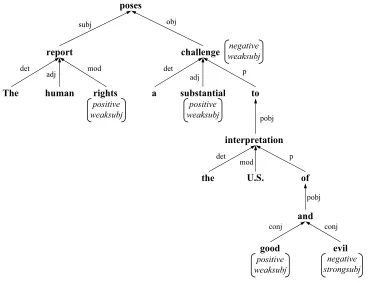
edge between a parent and a child specifies the grammatical relationship between the two words. Figure 2 shows an example of a dependency parse tree. Instances of clues in the tree are marked with the clue’s prior polarity and reliability class from the lexicon.
For each clue instance, the modifies/modifed by features capture whether there are
Figure 2
The dependency tree for the sentenceThe human rights report poses a substantial challenge to the U.S. interpretation of good and evil.Prior polarity and reliability class are marked in parentheses for words that match clues from the lexicon.
feature is true for a clue instance if one of its children is an instance of a strongsubj
clue, and if the clue instance and its child share anadj,mod, orvmodrelationship. The
modified by weaksubj feature is the same, except that it looks for instances of weaksubj
clues in the children. Although the adjand vmodrelationships are typically local, the
modrelationship involves longer-distance as well as local dependencies. Figure 2 helps to illustrate these features. Themodifies weaksubjfeature is true forsubstantial,because
substantial modifies challenge, which is an instance of a weaksubj clue. For rights, the
modifies weaksubjfeature is false, becauserightsmodifiesreport,which is not an instance of aweaksubjclue. Themodified by weaksubjfeature is false forsubstantial,because it has no modifiers that are instances ofweaksubjclues. Forchallenge,themodified by weaksubj
feature is true because it is being modified by substantial, which is an instance of a
weaksubjclue.
lexicon, its prior polarity isneutral. If the clue instance is not in a conjunction, the value for this feature isnotmod. Figure 2 also helps to illustrate these modification features. The wordsubstantialwith positive prior polarity modifies the wordchallengewith negative prior polarity. Therefore themodifies polarityfeature is negative forsubstantial, and the
modified by polarityfeature is positive forchallenge. The wordsgoodandevilare in a con-junction together; thus theconj polarityfeature is negative forgoodand positive forevil.
Structure FeaturesThese are binary features that are determined by starting with the clue instance and climbing up the dependency parse tree toward the root, looking for particular relationships, words, or patterns. Thein subjectfeature is true if we find a subjrelationship on the path to the root. Thein copularfeature is true ifin subjectis false and if a node along the path is both a main verb and a copular verb. Thein passive
feature is true if a passive verb pattern is found on the climb.
Thein subjectandin copularfeatures were motivated by the intuition that the syn-tactic role of a word may influence whether a word is being used to express a sentiment. For example, consider the wordpollutersin each of the following two sentences.
(12) Under the application shield,pollutersare allowed to operate if they have a permit.
(13) “The big-city folks are pointing at the farmers and saying you are polluters. . . ”
In the first sentence, polluters is simply being used as a referring expression. In the second sentence,pollutersis clearly being used to express a negative evaluation of the farmers. The motivation for thein passivefeature was previous work by Riloff and Wiebe (2003), who found that different words are more or less likely to be subjective depending on whether they are in the active or passive.
Sentence Features These are features that previously were found useful for sentence-level subjectivity classification (Wiebe, Bruce, and O’Hara 1999; Wiebe and Riloff 2005). They include counts of strongsubjand weaksubjclue instances in the cur-rent, previous and next sentences, counts of adjectives and adverbs other than notin the current sentence, and binary features to indicate whether the sentence contains a pronoun, a cardinal number, and a modal other thanwill.
Document FeatureThere is one document feature representing the topic or domain of the document. The motivation for this feature is that whether or not a word is expressing a sentiment or even a private state in general may depend on the subject of the discourse. For example, the words fever and sufferer may express a negative sentiment in certain contexts, but probably not in a health or medical context, as is the case in the following sentence.
(14) The disease can be contracted if a person is bitten by a certain tick or if a person comes into contact with the blood of a congofever sufferer.
Table 8
Topics in the MPQA corpus.
Topic Description
argentina Economic collapse in Argentina
axisofevil U.S. President’s State of the Union Address guantanamo Detention of prisoners in Guantanamo Bay humanrights U.S. State Department Human Rights Report kyoto Kyoto Protocol ratification
settlements Israeli settlements in Gaza and the West Bank space Space missions of various countries
taiwan Relationship between Taiwan and China venezuela Presidential coup in Venezuela
zimbabwe Presidential election in Zimbabwe
following general domain categories: economics, general politics, health, report events, and war and terrorism.
7.2 Features for Polarity Classification
Table 9lists the features that we use for step two, polarity classification. Word token, word prior polarity,and the polarity-modification features are the same as described for neutral–polar classification.
We use two features to capture two different types of negation. Thenegatedfeature is a binary feature that is used to capture more local negations: Its value is true if a negation word or phrase is found within the four words preceding the clue instance, and if the negation word is not also in a phrase that acts as an intensifier rather than a negator. Examples of phrases that intensify rather than negate arenot onlyandnothing if not. Thenegated subjectfeature captures a longer-distance type of negation. This feature
Table 9
Features for polarity classification.
Word Features word token
word prior polarity:positive, negative, both, neutral
Negation Features negated:binary
negated subject:binary
Polarity Modification Features
modifies polarity:positive, negative, neutral, both, notmod
modified by polarity:positive, negative, neutral, both, notmod
conj polarity:positive, negative, neutral, both, notmod
Polarity Shifters
general polarity shifter:binary
negative polarity shifter:binary
is true if the subject of the clause containing the clue instance is negated. For example, thenegated subjectfeature is true forsupportin the following sentence.
(15) No politically prudent Israeli couldsupporteither of them.
The last three polarity features look in a window of four words before the clue instance, searching for the presence of particular types of polarity influencers. Gen-eral polarity shiftersreverse polarity (e.g.,littletruth,littlethreat). Negative polarity shifterstypically make the polarity of an expression negative (e.g.,lackof understand-ing). Positive polarity shifters typically make the polarity of an expression positive (e.g.,abatethe damage). The polarity influencers that we used were identified through explorations of the development data.
8.Experiments in Recognizing Contextual Polarity
We have two primary goals with our experiments in recognizing contextual polarity. The first is to evaluate the features described in Section 7 as to their usefulness for this task. The second is to investigate the importance of recognizing neutral instances— recognizing when a sentiment clue is not being used to express a sentiment—for classi-fying contextual polarity.
To evaluate features, we investigate their performance, both together and sep-arately, across several different learning algorithms. Varying the learning algorithm allows us to verify that the features are robust and that their performance is not the artifact of a particular algorithm. We experiment with four different types of machine learning: boosting, memory-based learning, rule learning, and support vector learning. For boosting, we use BoosTexter (Schapire and Singer 2000) AdaBoost.MH. For rule learning, we use Ripper (Cohen 1996). For memory-based learning, we use TiMBL (Daelemans et al. 2003b) IB1 (k-nearest neighbor). For support vector learning, we use SVM-light and SVM-multiclass (Joachims 1999). SVM-light is used for the experi-ments involving binary classification (neutral–polar classification), and SVM-multiclass is used for experiments with more than two classes. These machine learning algorithms were chosen because they have been used successfully for a number of natural language processing tasks, and they represent several different types of learning.
For all of the classification algorithms except for SVM, the features for a clue in-stance are represented as they are presented in Section 7. For SVM, the representations for numeric and discrete-valued features are changed. Numeric features, such as the count ofstrongsubj clue instances in a sentence, are scaled to range between 0 and 1. Discrete-valued features, such as thereliability classfeature, are converted into multiple binary features. For example, the reliability classfeature is represented by two binary features: one for whether the clue instance is astrongsubjclue and one for whether the clue instance is aweaksubjclue.
All experiments are performed using 10-fold cross validation over a test set of 10,287 sentences from 494 MPQA corpus documents. We measure performance in terms of accuracy, recall, precision, and F-measure. Accuracy is simply the total number of instances correctly classified. Recall, precision, and F-measure for a given classC are defined as follows. Recall is the percentage of all instances of classCcorrectly identified.
Rec(C)= |instances of C correctly identified| |all instances of C|
Precision is the percentage of instances classified as classCthat are classCin truth.
Prec(C)= |instances of C correctly identified| |all instances identified as C|
F-measure is the harmonic mean of recall and precision.
F(C)= 2×Rec(C)×Prec(C) Rec(C)+Prec(C)
All results reported are averages over the 10 folds.
8.1 Neutral–Polar Classification
In our two-step process for recognizing contextual polarity, the first step is neutral–polar classification, determining whether each instance of a clue from the lexicon is neutral or polar in context. In our test set, there are 26,729instances of clues from the lexicon. The features we use for this step were listed above in Table 7 and described in Section 7.1.
In this section, we perform two sets of experiments. In the first, we compare the results of neutral–polar classification using all the neutral–polar features against two baselines. The first baseline uses just the word tokenfeature. The second baseline (word+priorpol) uses the word token and prior polarity features. In the second set of experiments, we explore the performance of different sets of features for neutral–polar classification.
Table 10
Algorithm settings for neutral–polar classification.
Algorithm Settings
BoosTexter 2,000 rounds of boosting TiMBL k=25, MVDM distance metric Ripper -!n, -S 0.5
SVM linear kernel
8.1.1 Classification Results. The results for the first set of experiments are given in Table 11. For each algorithm, we give the results for the two baseline classifiers, followed by the results for the classifier trained using all the neutral–polar features. The results shown in bold are significantly better than both baselines (two-sided t-test, p≤0.05) for the given algorithm.
Working together, how well do the neutral–polar features perform? For BoosTexter, TiMBL, and Ripper, the classifiers trained using all the features improve significantly over the two baselines in terms of accuracy, polar recall, polar F-measure, and neutral precision. Neutral F-measure is also higher, but not significantly so. These consistent results across three of the four algorithms show that the neutral–polar features are helpful for determining when a sentiment clue is actually being used to express a sentiment.
[image:19.486.54.438.442.663.2]Interestingly, Ripper is the only algorithm for which the word-token baseline per-formed better than the word+priorpol baseline. Nevertheless, the prior polarityfeature is an important component in the performance of the Ripper classifier using all the features. Excluding prior polarity from this classifier results in a significant decrease in
Table 11
Results for neutral–polar classification (step one).
Polar Neutral
Acc Rec Prec F Rec Prec F
BoosTexter
word token baseline 74.0 41.977.0 54.3 92.7 73.3 81.8 word+priorpol baseline 75.0 55.6 70.2 62.1 86.2 76.981.3 neutral–polar features 76.5 58.3 72.4 64.6 87.1 78.2 82.4
TiMBL
word token baseline 74.6 47.973.958.1 90.1 74.8 81.8 word+priorpol baseline 74.6 48.2 73.7 58.3 90.0 74.9 81.7 neutral–polar features 76.5 59.5 71.7 65.0 86.3 78.5 82.3
Ripper
word token baseline 66.3 11.2 80.6 19.6 98.4 65.6 78.7 word+priorpol baseline 65.5 07.7 84.5 14.1 99.1 64.8 78.4 neutral–polar features 71.4 49.4 64.6 56.0 84.2 74.1 78.8
SVM
performance for every metric. Decreases range from 2.5% for neutral recall to 9.5% for polar recall.
The best SVM classifier is the word+priorpol baseline. In terms of accuracy, this classifier does not perform much worse than the BoosTexter and TiMBL classifiers that use all the neutral–polar features: The SVM word+priorpol baseline classifier has an accuracy of 75.6%, and both the BoosTexter and TiMBL classifiers have an accuracy of 76.5%. However, the BoosTexter and TiMBL classifiers using all the features perform notably better in terms of polar recall and F-measure. The BoosTexter and TiMBL classifiers have polar recalls that are 7% and 9.2% higher than the SVM baseline. Polar F-measures for BoosTexter and TiMBL are 3.9% and 4.5% higher. These increases are significant for p≤0.01.
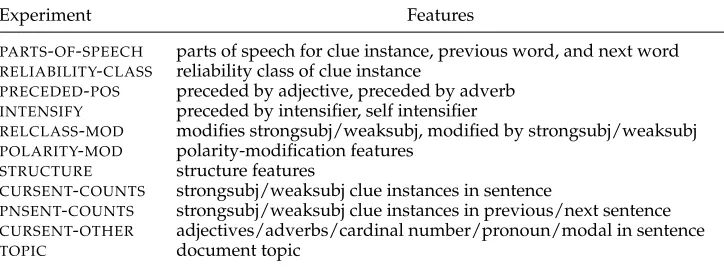
8.1.2 Feature Set Evaluation. To evaluate the contribution of the various features for neutral–polar classification, we perform a series of experiments in which different sets of neutral–polar features are added to the word+priorpol baseline and new clas-sifiers are trained. We then compare the performance of these new clasclas-sifiers to the word+priorpol baseline, with the exception of the Ripper classifiers, which we compare to the higher word baseline. Table 12 lists the sets of features tested in these experiments. The feature sets generally correspond to how the neutral–polar features are presented in Table 7, although some of the groups are broken down into more fine-grained sets that we believe capture meaningful distinctions.
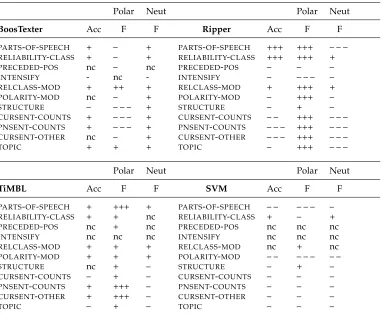
Table 13 gives the results for these experiments. Increases and decreases for a given metric as compared to the word+priorpol baseline (word baseline for Ripper) are indicated by + or –, respectively. Where changes are significant at the p≤0.1 level, ++ or – – are used, and where changes are significant at the p≤0.05 level, +++ or – – – are used. An “nc” indicates no change (a change of less than±0.05) compared to the baseline.
[image:20.486.50.412.529.666.2]What does Table 13 reveal about the performance of various feature sets for neutral– polar classification? Most noticeable is that no individual feature sets stand out as strong performers. The only significant improvements in accuracy come from the PARTS -OF-SPEECH and RELIABILITY-CLASSfeature sets for Ripper. These improvements are perhaps not surprising given that the Ripper baseline was much lower to begin with. Very few feature sets show any improvement for SVM. Again, this is not unexpected given that all the features together performed worse than the word+priorpol baseline
Table 12
Neutral–polar feature sets for evaluation.
Experiment Features
PARTS-OF-SPEECH parts of speech for clue instance, previous word, and next word RELIABILITY-CLASS reliability class of clue instance
PRECEDED-POS preceded by adjective, preceded by adverb INTENSIFY preceded by intensifier, self intensifier
RELCLASS-MOD modifies strongsubj/weaksubj, modified by strongsubj/weaksubj POLARITY-MOD polarity-modification features
STRUCTURE structure features
CURSENT-COUNTS strongsubj/weaksubj clue instances in sentence
PNSENT-COUNTS strongsubj/weaksubj clue instances in previous/next sentence CURSENT-OTHER adjectives/adverbs/cardinal number/pronoun/modal in sentence
Table 13
Results for neutral–polar feature ablation experiments.
Polar Neut Polar Neut
BoosTexter Acc F F Ripper Acc F F
PARTS-OF-SPEECH + – + PARTS-OF-SPEECH +++ +++ – – –
RELIABILITY-CLASS + – + RELIABILITY-CLASS +++ +++ +
PRECEDED-POS nc – nc PRECEDED-POS – – –
INTENSIFY - nc - INTENSIFY – – – – –
RELCLASS-MOD + ++ + RELCLASS-MOD + +++ +
POLARITY-MOD nc – + POLARITY-MOD – +++ –
STRUCTURE – – – – + STRUCTURE – + –
CURSENT-COUNTS + – – – + CURSENT-COUNTS – – +++ – – – PNSENT-COUNTS + – – – + PNSENT-COUNTS – – – +++ – – –
CURSENT-OTHER nc – + CURSENT-OTHER – – – +++ – – –
TOPIC + + + TOPIC – +++ – – –
Polar Neut Polar Neut
TiMBL Acc F F SVM Acc F F
PARTS-OF-SPEECH + +++ + PARTS-OF-SPEECH – – – – – –
RELIABILITY-CLASS + + nc RELIABILITY-CLASS + – +
PRECEDED-POS nc + nc PRECEDED-POS nc nc nc
INTENSIFY nc nc nc INTENSIFY nc nc nc
RELCLASS-MOD + + + RELCLASS-MOD nc + nc
POLARITY-MOD + + + POLARITY-MOD – – – – – – –
STRUCTURE nc + – STRUCTURE – + –
CURSENT-COUNTS – + – CURSENT-COUNTS – – –
PNSENT-COUNTS + +++ – PNSENT-COUNTS – – –
CURSENT-OTHER + +++ – CURSENT-OTHER – – –
TOPIC – + – TOPIC – – –
Increases and decreases for a given metric as compared to the word+priorpol baseline (word baseline for Ripper) are indicated by + or –, respectively; ++ or – – indicates the change is significant at the p<0.1 level; +++ or – – – indicates significance at the p<0.05 level; nc indicates no change.
for SVM. The performance of the feature sets for BoosTexter and TiMBL are perhaps the most revealing. In the previous experiments using all the features together, these algorithms produced classifiers with the same high performance. In these experiments, six different feature sets for each algorithm show improvements in accuracy over the baseline, yet none of those improvements are significant. This suggests that achieving the highest performance for neutral–polar classification requires a wide variety of fea-tures working together in combination.
Although no feature sets stand out in Table 13 as far as giving an overall high performance, there are some features that consistently improve performance across the different algorithms. The reliability class of the clue instance (RELIABILITY-CLASS) improves accuracy over the baseline for all four algorithms. It is the only feature that does so. TheRELCLASS-MODfeatures give improvements for all metrics for BoosTexter, Ripper, and TiMBL, as well as improving polar F-measure for SVM. The PARTS-OF -SPEECHfeatures are also fairly consistent, improving performance for all the algorithms except for SVM. There are also a couple of feature sets that consistently do not improve performance for any of the algorithms: theINTENSIFYandPRECEDED-POSfeatures.
8.2 Polarity Classification
For the second step of recognizing contextual polarity, we classify the polarity of all clue instances identified as polar in step one. The features for polarity classification were listed in Table 9and described in Section 7.2.
We investigate the performance of the polarity features under two conditions: (1) perfect neutral–polar recognition and (2) automatic neutral–polar recognition. For condition 1, we identify the polar instances according to the gold-standard, manual contextual-polarity annotations. In the test data, 9,835 instances of the clues from the lexicon are polar in context according to the manual annotations. Experiments under condition 1 classify these instances as having positive, negative, or both (positive and negative) polarity. For condition 2, we take the best performing neutral–polar classifier for each algorithm and use the output from those algorithms to identify the polar instances. Because polar instances now are being identified automatically, there will be noise in the form of misclassified neutral instances. Therefore, for experiments under condition 2 we include the neutral class and perform four-way classification instead of three-way. Condition 1 allows us to investigate the performance of the different polarity features without the noise of misclassified neutral instances. Also, because the set of polar instances being classified is the same for all the algorithms, condition 1 allows us to compare the performance of the polarity features across the different algorithms. However, condition 2 is the more natural one. It allows us to see how the noise of neutral instances affects the performance of the polarity features.
The following sections describe three sets of experiments. First, we investigate the performance of the polarity features used together for polarity classification under condition 1. As before, the word and word+priorpol classifiers provide our baselines. In the second set of experiments, we explore the performance of different sets of features for polarity classification, again assuming perfect recognition of the polar instances. Finally, we experiment with polarity classification using all the polarity features under condition 2, automatic recognition of the polar instances.
As before, we use the development data to select the parameter settings for each al-gorithm. The settings for polarity classification are given in Table 14. They were selected based on the performance of the word+priorpol baseline classifier under condition 2.
Table 14
Algorithm settings for polarity classification.
Algorithm Settings
BoosTexter 2,000 rounds of boosting TiMBL k=1, MVDM distance metric Ripper -!s, -S 0.5
[image:23.486.57.436.219.439.2]SVM linear kernel
Table 15
Results for polarity classification (step two) using gold-standard polar instances.
Positive Negative Both
Acc Rec Prec F Rec Prec F Rec Prec F
BoosTexter
word token baseline 78.7 57.7 72.8 64.4 91.5 80.8 85.8 12.9 53.6 20.8 word+priorpol baseline 79.7 70.5 68.8 69.6 87.2 85.1 86.1 13.7 53.7 21.8 polarity features 83.2 76.7 74.3 75.5 89.7 87.7 88.7 11.8 54.2 19.4
TiMBL
word token baseline 78.5 63.3 69.2 66.1 88.6 82.5 85.4 14.1 51.0 22.1 word+priorpol baseline 79.4 69.7 68.4 69.1 87.0 84.8 85.9 14.6 53.5 22.9 polarity features 82.2 75.4 73.3 74.3 88.5 87.6 88.0 18.3 34.6 23.9
Ripper
word token baseline 70.0 14.5 74.5 24.3 98.3 69.7 81.6 09.1 74.4 16.2 word+priorpol baseline 78.975.5 65.2 70.0 83.8 86.4 85.1 09.8 75.4 17.4 polarity features 83.2 77.8 73.5 75.6 89.2 87.8 88.5 09.8 74.9 17.4
SVM
word token baseline 69.9 62.4 69.6 65.8 76.0 84.1 79.9 14.1 31.2 19.4 word+priorpol baseline 78.2 76.7 63.7 69.6 82.2 86.7 84.4 09.8 75.4 17.4 polarity features 81.6 74.971.1 72.9 88.1 86.6 87.3 09.5 77.6 16.9
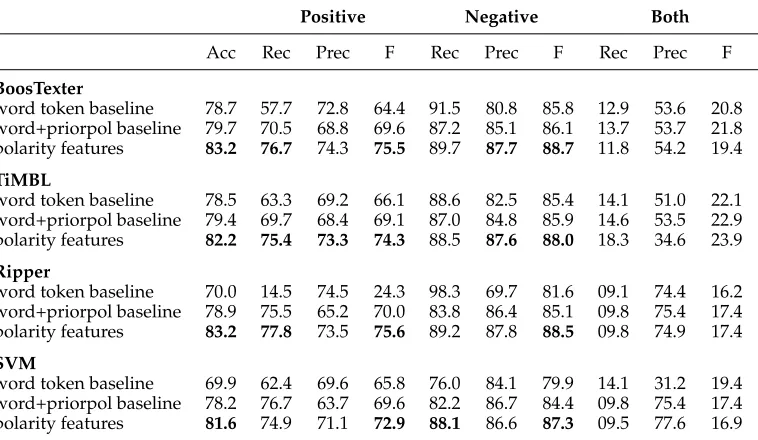
How well do the polarity features perform working all together? For all algorithms, the polarity classifier using all the features significantly outperforms both baselines in terms of accuracy, positive F-measure, and negative F-measure. These consistent improvements in performance across all four algorithms show that these features are quite useful for polarity classification.
One interesting thing that Table 15 reveals is that negative polarity words are much more straightforward to recognize than positive polarity words, at least in this corpus. For the negative class, precisions and recalls for the word+priorpol baseline range from 82.2 to 87.2. For the positive class, precisions and recalls for the word+priorpol baseline range from 63.7 to 76.7. However, it is with the positive class that polarity features seem to help the most. With the addition of the polarity features, positive F-measure improves by 5 points on average; improvements in negative F-measures average only 2.75 points.
Table 16
Polarity feature sets for evaluation.
Experiment Features
NEGATION negated, negated subject
[image:24.486.50.431.217.438.2]POLARITY-MOD modifies polarity, modified by polarity, conjunction polarity SHIFTERS general, negative, positive polarity shifters
Table 17
Results for polarity feature ablation experiments.
Positive Negative
Acc Rec Prec F Rec Prec F
BoosTexter
NEGATION +++ ++ +++ +++ +++ + +++
POLARITY-MOD ++ +++ + +++ + ++ +
SHIFTERS + + + + + + +
TiMBL
NEGATION +++ +++ +++ +++ +++ +++ +++
POLARITY-MOD + + + + – + +
SHIFTERS + + + + – + +
Ripper
NEGATION +++ – – +++ +++ +++ – +++
POLARITY-MOD + +++ ++ +++ + + +
SHIFTERS + – + + + – +
SVM
NEGATION +++ – +++ +++ +++ + +++
POLARITY-MOD + – +++ + + – +
SHIFTERS + – + + + + +
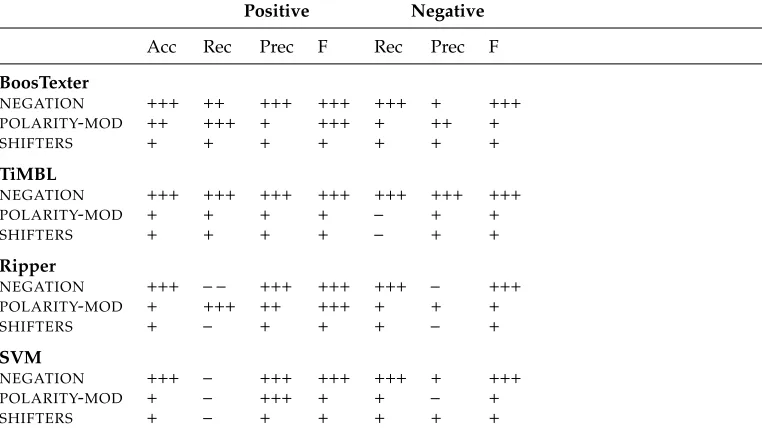
Increases and decreases for a given metric as compared to the word+priorpol baseline are indicated by + or –, respectively; ++ or – – indicates the change is significant at the p<0.1 level; +++ or – – – indicates significance at the p<0.05 level.
Table 16 lists the sets of features tested in each experiment, and Table 17 shows the results of the experiments. Results are reported as they were previously in Section 8.1.2, with increases and decreases compared to the baseline for a given metric indicated by + or –, respectively.
Looking at Table 17, we see that all three sets of polarity features help to increase performance as measured by accuracy and positive and negative F-measures. This is true for all the classification algorithms. As we might expect, including the negation features has the most marked effect on the performance of polarity classification, with statistically significant improvements for most metrics across all the algorithms.9 The
polarity-modification features also seem to be important for polarity classification, in particular for disambiguating the positive instances. For all the algorithms except TiMBL, including the polarity-modification features results in significant improvements for at least one of the positive metrics. The polarity shifters also help classification, but they seem to be the weakest of the features: Including them does not result in significant improvements for any algorithm.
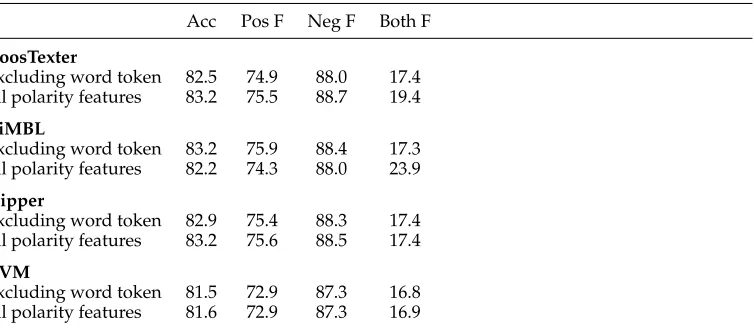
Another question that is interesting to consider is how much theword tokenfeature contributes to polarity classification, given all the other polarity features. Is it enough to know the prior polarity of a word, whether it is being negated, and how it is related to other polarity influencers? To answer this question, we train classifiers using all the polarity features except for word token. Table 18 gives the results for these classifiers; for comparison, the results for the all-feature polarity classifiers are also given. Inter-estingly, excluding the word token feature produces only small changes in the overall results. The results for BoosTexter and Ripper are slightly lower, and the results for SVM are practically unchanged. TiMBL actually shows a slight improvement, with the exception of the both class. This provides further evidence of the strength of the polarity features. Also, a classifier not tied to actual word tokens may potentially be a more domain-independent classifier.
8.2.3 Classification Results: Condition 2. The experiments in Section 8.2.1 show that the polarity features perform well under the ideal condition of perfect recognition of polar instances. The next question to consider is how well the polarity features perform under the more natural but less-than-perfect condition of automatic recognition of polar instances. To investigate this, the polarity classifiers (including the baselines) for each algorithm in these experiments start with the polar instances identified by the best performing neutral–polar classifier for that algorithm (from Section 8.1.1). The results for these experiments are given in Table 19. As before, statistically significant improvements over both baselines are given in bold.
[image:25.486.60.437.498.665.2]How well do the polarity features perform in the presence of noise from misclas-sified neutral instances? Our first observation comes from comparing Table 15 with Table 19: Polarity classification results are much lower for all classifiers with the noise of neutral instances. Yet in spite of this, the polarity features still produce classifiers that
Table 18
Results for polarity classification without and with theword tokenfeature.
Acc Pos F Neg F Both F
BoosTexter
excluding word token 82.5 74.988.0 17.4 all polarity features 83.2 75.5 88.7 19.4
TiMBL
excluding word token 83.2 75.988.4 17.3 all polarity features 82.2 74.3 88.0 23.9
Ripper
excluding word token 82.975.4 88.3 17.4 all polarity features 83.2 75.6 88.5 17.4
SVM
Linguistics
V
olume
35,
Number
[image:26.486.73.656.147.376.2]3
Table 19
Results for polarity classification (step two) using automatically identified polar instances.
Positive Negative Both Neutral
Acc R P F R P F R P F R P F
BoosTexter
word token 61.5 62.3 62.7 62.5 86.4 64.6 74.0 11.4 49.3 18.5 20.8 44.5 28.3 word+priorpol 63.3 70.0 57.963.4 81.3 71.5 76.1 12.5 47.3 19.8 30.947.5 37.4 polarity feats 65.9 73.6 62.2 67.4 84.972.3 78.1 13.4 40.7 20.2 31.0 50.6 38.4
TiMBL
word token 60.1 68.3 58.963.2 81.8 65.0 72.5 11.2 39.6 17.4 21.6 43.1 28.8 word+priorpol 61.0 73.2 53.4 61.8 80.6 69.8 74.8 12.7 41.7 19.5 23.0 44.2 30.3 polarity feats 64.4 75.3 58.6 65.9 81.1 73.0 76.9 16.932.7 22.3 32.1 50.0 39.1
Ripper
word token 54.4 22.2 69.4 33.6 95.1 50.7 66.1 00.0 00.0 00.0 21.7 76.5 33.8 word+priorpol 51.4 24.0 71.7 35.997.7 48.965.1 00.0 00.0 00.0 09.2 75.8 16.3 polarity feats 54.8 38.0 67.2 48.5 95.5 52.7 67.9 00.0 00.0 00.0 14.5 66.8 23.8
SVM
outperform the baselines. For three of the four algorithms, the classifier using all the polarity features has the highest accuracy. For BoosTexter and TiMBL, the improvements in accuracy over both baselines are significant. Also for all algorithms, using the polarity features gives the highest positive and negative F-measures.
Because the set of polarity instances being classified by each algorithm is different, we cannot directly compare the results from one algorithm to the next.
8.3 Two-step versus One-step Recognition of Contextual Polarity
Although the two-step approach to recognizing contextual polarity allows us to focus our investigation on the performance of features for both neutral–polar classification and polarity classification, the question remains: How does the two-step approach compare to recognizing contextual polarity in a single classification step? The results shown in Table 20 help to answer this question. The first row in Table 20 for each algorithm shows the combined result for the two stages of classification. For BoosTexter, TiMBL, and Ripper, this is the combination of results from using all the neutral–polar features for step one, together with the results from using all of the polarity features for step two.10For SVM, this is the combination of results from the word+priorpol baseline from step one, together with results for using all the polarity features for step two. Recall that the word+priorpol classifier was the best neutral–polar classifier for SVM (see Table 11). The second rows for BoosTexter, TiMBL, and Ripper show the results of a single classifier trained to recognize contextual polarity using all the neutral–polar and polarity features together. For SVM, the second row shows the results of classifying the contextual polarity using just the word token feature. This classifier outperformed all others for SVM. In the table, the best result for each metric for each algorithm is highlighted in bold.
When comparing the two-step and one-step approaches, contrary to our expecta-tions, we see that the one-step approach performs about as well or better than the two-step approach for recognizing contextual polarity. For SVM, the improvement in accuracy achieved by the two-step approach is significant, but this is not true for the other algorithms. One fairly consistent difference between the two approaches is that the two-step approach scores slightly higher for neutral F-measure, and the one-step approach achieves higher F-measures for the polarity classes. The difference in negative F-measure is significant for BoosTexter, TiMBL, and Ripper. The exception to this is SVM. For SVM, the two-step approach achieves significantly higher positive and negative F-measures.
One last question we consider is how much the neutral–polar features contribute to the performance of the one-step classifiers. The third line in Table 20 for BoosTexter, TiMBL, and Ripper gives the results for a one-step classifier trained without the neutral– polar features. Although the differences are not always large, excluding the neutral– polar features consistently degrades performance in terms of accuracy and positive, negative, and neutral F-measures. The drop in negative F-measure is significant for all three algorithms, the drop in neutral F-measure is significant for BoosTexter and TiMBL, and the drop in accuracy is significant for TiMBL and Ripper (and for BoosTexter at the p≤0.1 level).