Business process trends
VON ROSING, Mark and POLOVINA, Simon
<http://orcid.org/0000-0003-2961-6207>
Available from Sheffield Hallam University Research Archive (SHURA) at:
http://shura.shu.ac.uk/9614/
This document is the author deposited version. You are advised to consult the
publisher's version if you wish to cite from it.
Published version
VON ROSING, Mark and POLOVINA, Simon (2015). Business process trends. In:
The complete business process handbook. Elsevier, 187-216.
Copyright and re-use policy
See
http://shura.shu.ac.uk/information.html
Sheffield Hallam University Research Archive
187 The Complete Business Process Handbook. http://dx.doi.org/10.1016/B978-0-12-799959-3.00011-2
Copyright © 2015 LEADing Practice ApS. Published by Elsevier Inc. All rights reserved.
Mark von Rosing, August-Wilhelm Scheer, Henrik von Scheel, Adam D.M. Svendsen, Alex Kokkonen, Andrew M. Ross, Anette Falk Bøgebjerg, Anni Olsen, Antony Dicks, Asif Qumer Gill, Bas Bach, Bob J. Storms, Callie Smit, Cay Clemmensen, Christopher K. Swierczynski, Clemens Utschig-Utschig, Dan Moorcroft, Daniel T. Jones, David Coloma, Deb Boykin, Dickson Hunja Muhita, Duarte Gonçalves, Fabrizio Maria Maggi, Fan Zhao, Fatima Senghore, Fatma Dandashi, Fred Cummins, Freek Stoffel, Gabriel von Scheel, Gabriella von Rosing, Gary Doucet, Gert Meiling, Gert O. Jansson, Hans Scheruhn, Hendrik Bohn, Henk de Man, Henk Kuil, Henrik Naundrup Vester, Jacob Gammelgaard, James P. Womack, Jeanne W. Ross, Jeff Greer, Jens Theodor Nielsen, John A. Zachman, John Bertram, John Golden, John M. Rogers, Jonnro Erasmus, Joshua von Scheel, Joshua Waters, Justin Tomlinson, Karin Gräslund, Katia Bartels, Keith D. Swenson, Kenneth Dean Teske, Kevin Govender, Klaus Vitt, Krzysztof Skurzak, LeAnne Spurrell, Lloyd Dugan, Lotte Tange, Mads Clausager, Maria Hove, Maria Rybrink, Marianne Fonseca, Mark Stanford, Marlon Dumas, Mathias Kirchmer, Maxim Arzumanyan, Michael D. Tisdel, Michel van den Hoven, Mikael Munck, Mike A. Marin, Mona von Rosing, Nathaniel Palmer, Neil Kemp, Nils Faltin, Partha Chakravartti, Patricia Kemp, Peter Franz, Philippe Lebacq, Rich Hilliard, Richard L. Fallon, Richard N. Conzo, Rod Peacock, Ronald N. Batdorf, Sarel J. Snyman, Scott Davis, Simon M. Polovina, Stephen White, Steve Durbin, Steve Willoughby, Sven Vollbehr, Thomas Boosz, Thomas Christian Olsen, Tim Hoebeek, Tom Preston, Ulrik Foldager, Victor Abele, Vincent Snels, Volker Rebhan, Wim Laurier, Yr
Gunnarsdottir, Yury Orlov, Zakaria Maamar, Ekambareswaran Balasubramanian, Mai Phuong, Régis Dumond
INTRODUCTION
Business process and business process management (BPM) concepts have matured over the years and new technology, concepts, standards and solutions appear. In this chapter we will therefore focus on the current and future process trends. We will elaborate on the importance of trends, the maturity of the subject, giving a perspective on what emerging trends, industry trends, mega trends are, what is hyped at the moment, and what has reached a market adoption where it has started to become the de facto standard in terms of mega trends that has achieved a dominant position by public acceptance.
THE IMPORTANCE OF TRENDS
A trend is defined as a general direction in which something is developing or chang-ing.1 Trends involve looking at the statistical analysis of historical data over a
Business Process Trends
188
increases, decreases, or even constancy or flatness, a trend exists. Businesses of all sizes use these kinds of data to help predict the future or shape strategic decisions.
So why are trends important? Because trends help you prepare for the future! From a business perspective, there are three main types of trend: emerging, industry, and mega trends. If organizations ignore any of them, the business drivers or trends may eventually evolve to become a direct threat to their existing business model. If embraced, they hold the key for the next opportunity for growth.
For example, business processes has matured over a decade into a manage-ment discipline that treats processes as assets that directly contribute to enter-prise performance by driving operational excellence and business process agility. Today, business processes has become an essential source of performance that sup-ports business success, some of which are:
• Optimizing the performance of end-to-end business processes that span func-tions as well as processes that might extend beyond the enterprise to include partners, suppliers, and customers (the value chain).
• Making the business processes visible (and thus explicit) to business and information technology (IT) constituents through business process modeling, monitoring, and optimization/simulation.
• Keeping the business process model in sync with process execution and empow-ering business users and analysts to use the model to improve process perfor-mance and outcomes.
• Enabling the effective integration of process activities, business measurements, rule management, content integration, and greater collaboration to set the base for continuous improvement.
• Enabling rapid iterations of processes and underlying systems for continuous process improvement and optimization.
• Delivering measurable improvement to enterprise performance that directly contributes to organizational success and competitive advantage.
• BPM is just one approach to the larger challenge known as business process improvement (BPI). Other approaches to BPI include business process re-engi-neering (BPR) and business process automation.
Hence, both executives and practitioners are focusing on process trends to gain a competitive advantage by being the early adopter. Our focus is on process mega trends and emerging trends as the driving force that will change how orga-nizations work with and apply these trends successfully to their process landscape in order to gain a competitive advantage in the future.
MATURITY OF THE SUBJECT
The adoption of trends is tightly connected to the maturity. The rise of business process engineering and re-engineering results from a paradigm shift2 that has
enterprise strategy, structure, and culture that are required to support the new infrastructure.
According to a survey done by PriceWaterhouseCoopers AG,3 organizations are
critically aware of the importance of BPM to the future success of their business. To remain competitive, senior executives have identified the importance of the continuous optimization of business processes in terms of quality and efficiency for their administrative and production business processes4 while retaining the
differentiation among core competitive, core differentiating, and non-core pro-cesses. The survey found that many of these executives believed that their business would no longer exist in as little as 10 years if efforts to continuously improve and optimize their business processes were not pursued. In a similar tone, many of these executives saw that another key factor to the success of an organization is the collec-tion and analysis of appropriate key process performance indicators.
Often when a trend emerges and the maturity is low, early adoption investors take advantage of the opportunity and develop unique leading solutions. Such practices from the leaders are called leading practices. Leading practices define and strengthen competi-tive advantage, innovation, and efficiency in the core differentiating competencies with a focus on the revenue model and value model. They are called the out-performers and are the first to take advantage of the new emerging trends and thereby outperform the market.
When a trend is in its early hype stages and become more mature, industry lead-ers adopt, invest, and develop industry practices to out-compete their pelead-ers. This is called industry adoption. Industry practices improve competitive parity and standard-ize core competitive competencies with a focus on performance models and service models. They are called industry leaders because they have the advantage of emerging trends and outperform the majority of the competition in their respective markets.
Finally, as the trend matures with wide adoption and years of experience it has becomes a standard or a best practice. The adoption becomes a best practice when organizations begin to improve and standardize their non-core competencies that focuses on the cost model and the operating model. Such organizations are consid-ered followers who take advantage of best practices that are non-core to their busi-ness, while gaining the full advantage of trends with low risk and cost.
MEGA TRENDS
Mega trends are changes that are slow to form a tendency, but are likely to affect the future in all areas in the next 10–15 years, such as globalization, technology, econ-omy, the workforce, demographics, politics, and the environment (Figure 1). Once in place, mega trends influence a wide range of activities, processes, and perceptions in businesses, governments, and societies, possibly for decades to come. They are the underlying forces that drive trends (i.e., aging population).
Process mega trends are already shaping the future. No one should dwell in neither the past nor the present, and there some trends that will definitely have a significant impact on how organizations apply and take advantage of processes in the next 10 years.
Business Process Trends
190
provides the context and best mechanism to achieve the full potential of technology trends for the next decade. BPM is at the inflection of underlying technologies and human participants, providing the perfect place to leverage technology trends while providing a business context.
EMERGING TRENDS
Emerging trends are maturing tendencies driven by mega trends that influence industry trends at different levels, such as process-driven case management, a tech-nology mega trend and a trend in the insurance industry.
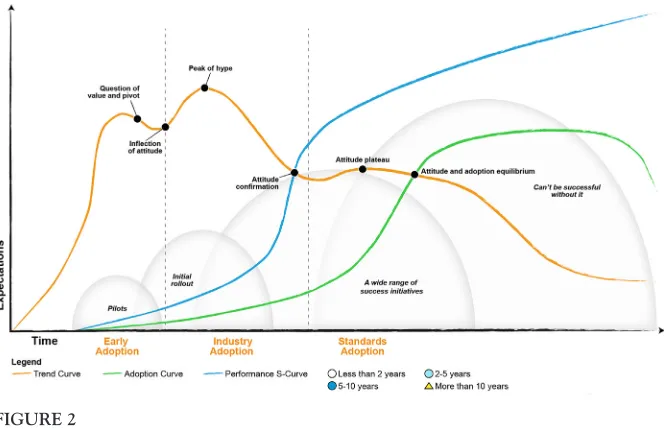
Emerging trends can be illustrated in many ways, e.g., hyper cycles (Gartner), radar systems (Forrester), mind-map footprints (Frost & Sullivan), usage curves and product lifecycles (Boston Consulting Group), and underground station lines. Com-mon to all of them is an emphasis on a specific view that misleads the reader; the most popular one is the annually published Gartner Hyper-Cycle.
For those unfamiliar with these charts, the basic structure starts with a tech-nology trigger near the origin of time and is visibly followed by a quick rise to the “peak of inflated expectations” that is often driven by a combination of unrealistic claims by proponents and the hopes of users desperate to believe those claims. The exaggerated peak of hype is inevitably followed by a crash of popularity into the so-called “trough of disillusionment.” Many ideas just die here and drop off the curve, but for others a more realistic set of expectations develops as believers and early adopters begin to experience measurable benefits. It serves to push the idea (sometimes with changes) up the “slope of enlightenment.”6 This gradual advance
[image:5.540.119.457.78.267.2]passes an important point of inflection on the performance S curve known as the attitude confirmation. The next landmark is crossing a social chasm at another critical inflection point called the attitude plateau.7 Once an idea successfully FIGURE 1
crosses the chasm, it plateaus as a generally recognized productivity concept for that industry. Some ideas fly quickly along these curves, passing older ideas that seem to just plod along at a much slower pace.
Hence, we have chosen to illustrate the emerging process trends in a hype trend model to give an independent and agnostic view of process trends, which incorpo-rates trends, actual adoption, performance, and the maturity life cycle (Figure 2).
PROCESS TRENDS
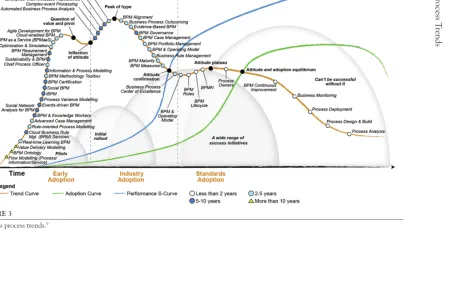
Based on agnostic and vendor neutral research with the Global University Alliance and in consensus with their key authorities and leaders, we agreed on the following emerging process trends (Figure 3) that will influence the future of how organiza-tions will adapt to, work with and apply processes.
EARLY ADOPTION
Trend phase: Pilots to initial
rollout Market penetration: Low Maturity: Emerging
Benefit rating: Very high Investment required: High Risk: Very high
[image:6.540.87.419.78.293.2]Characteristic: A potential trend breakthrough kicks things off. Early proof-of-concept stories and media interest trigger significant publicity. Often no usable
FIGURE 2
Business Process T
rends
[image:7.540.72.585.136.432.2]192
FIGURE 3
products exist and commercial viability is unproven. Early publicity produces a number of success stories—often accompanied by scores of failures. Few organiza-tions take action; many do not.
Trends are less than 5–10 years from mainstream adoption. It requires a high level of investment and high risk with the potential to deliver core differentiating aspects.
Business Performance Impact: Early adoption invests to take advantage of the opportunity and develop LEADing Practices. The LEADing Practices define and strengthen competitive advantage, innovation, and efficiency in the core differen-tiating competencies with focus on the revenue model and value model. They are called the outperformers and are the first to take advantage of the new emerging trends, and thereby outperform the market.
EARLY ADOPTER OF PROCESS TRENDS
1. Extended Flow Modeling (a part of X-BPMN). The next generation of BPM will benefit from the evolution of modeling approaches currently being advanced in architecture and engineering, enhancing a structured way of thinking, working, and modeling. Learning from other principles enables reuse of models as well as standardization of various concepts. What is especially rel-evant is the interlink between process flow, information flow, and service flow. Organizations realize the need to model the various flows both separately and together. We already see the first technology enabling such modeling; see exam-ple from iGrafx: www.igrafx.com/solutions/business-challenges/process-modeling 2. BPM Ontology. Many BPM and/or process frameworks, methods, and
Business Process Trends
194
that defines fundamental process concepts and the relations between them (e.g., the ability to define a sequence of process steps) could be used as the reference vocabulary to describe, document, and structure process knowledge. Both inter-pretations would profit from a validated reference ontology. Hence, the need for a BPM ontology that can be applied within the areas of process modeling, process engineering, and process architecture is clear.
3. Value-Oriented Process Modeling. Often referred to as value-oriented process design or value delivery modeling (VDML), emerged in an era focused on the automation and optimization of business processes in the context of established business organizations. As such, they tended to focus on process flow within and between organizations, typically within individual lines of business. As the scope of automation expanded, processes were linked electronically but tended to preserve existing organizations and relationships, optimizing processes within lines of business, optimizing processes at an operating level. Value planning, value identification, value creation, and value realization are not really methods and approaches used by process teams today. However, advances in technology, global competition, and continuous business change have increased the need for business agility with a focus on the creation of customer value and optimization of business processes across the enterprise. This requires the ability of top man-agement to analyze and guide the design of the business focusing on customer value, consolidating sharable capabilities, and linking business strategy to business transformation through a shared understanding of the desired business design and key objectives. In this area, we also see technology move in this direction, where VDML has been adopted as an object management group (OMG) modeling standard and is expected to be available in 2015.
4. Real-time Learning BPM. Organizations around the world struggle to crack the code for improving the effectiveness of managers, salespeople, scientists, and others whose jobs consist primarily of interactions with other employees, customers, and suppliers, and complex decision making based on knowledge and good judgment. As process and BPM adoption rise in organizations, enabling processes and continuous improvement around the knowledge work-ers and similar employees working in complex processes is a new challenge. Business processes are the heart of an organization and the support of the busi-ness processes by application systems is central to each organization. Introduc-ing new applications requires employees to become trained and educated for them, often by multi-day presence trainings in advance.
section, we show how real-time learning based on business process guidance (BPG) can help employees to get along better with new processes. It is expected that real-time learning through BPG will grow in importance in the future. a. More changes: Processes and applications will change even more frequently
in the future, triggering a need for training and support among the employ-ees using them.
b. More collections of applications: Instead of one large system installed and configured on premise, we will often see a collection of applications pro-vided as a service out of the cloud. This asks for process guidance that works across applications and that can be configured and equipped with content by the user organization.
c. Social networks will be used more at work: We will also see more knowledge sharing and peer support using social network technologies at the work-place. Social BPG will provide users with access to social network com-munication channels and will help filter and display only messages that are relevant based on the process and application context of the user.
d. Users will influence provision of content: Statistics from software usage and user feedback will become an important source for content authors to provide additional content and improve the existing support content in the BPG system.
e. BPG will extend beyond the office: Mobile devices will bring process guid-ance to new areas such as repair and maintenguid-ance of machines. First proto-types are built in research projects where information and work instructions will be displayed with augmented reality techniques on top of live pictures taken through the built-in camera. Users can call experts that support them directly, seeing the machine in real time through the camera.
f. BPG is already a good concept supporting the introduction of new processes and applications and its potential will grow in the future as it enables the organization.
Business Process Trends
196
distinction between a traditional BRE and a BRMS is that a BRMS incorpo-rates support for seven capabilities: the execution engine (the BRE), reposi-tory, integrated development environment rule model simulation, monitoring and analysis management and administration rule templates. When BRMS or BRE functionality is provided as a core capability hosted in a cloud, it is called cloud BRM services. Cloud BRM services are a type of platform as a service (PaaS).Cloud BRM services can be obtained either as a separate offering or as a feature of a BPM PaaS. The primary business impact of cloud BRM services will derive from the business impact of BRM proper; cloud BRM services are just an alternative delivery vehicle for a concept BRM that can increase quality decision making when properly understood. Although BRM concepts have been prevalent in certain industries (for example, financial services) and in well-documented processes (for example, underwriting), there is no inherent limit to BRM’s industry and process reach. Therefore, cloud BRM services have a similar potential reach, with an emphasis on “potential.”
6. Role-Oriented Process Modeling. Traditional BPM and requirement con-cepts are insufficient for today’s EA, business model, and value-driven approach to organization operational execution and strategic management, whereas requirements must support, link, and be decomposed from top objec-tives down to technology requirements. Consequently, business processes are architected and designed as a system of activities reflecting and supporting achievement of an organization’s goals, strategies, and objectives. All of these can be classified as high-level business requirements. A role-oriented (people oriented) process modeling approach and discipline is required to create process-centric organizations as high level requirements must be decomposed, layered, and used to identify, model, architect, design, implement, and operate cross-functional process scenarios, each with a defined purpose, value–driven activity, and measurable outcomes (performance indicators) that relates directly to the desired business objectives (high-level requirements). All of these are functional capabilities, which are also requirements.
7. Advanced Case Management. This is at the nexus of BPM and enterprise content management (ECM) usage scenarios, and involves a mix of collabora-tive, unstructured, and structured processes. We see in multiple organizations requirements beyond traditional process modeling; among others, it is about empowering participants in a process by removing context tunneling and pro-viding better support for exception handling, the ability to control flow and cross-flow information visibility. Organizations around the world have there-fore started to invest in case management. The information model includes both data and documents, so changes in values, metadata, and life cycle state can all be used to model the case.
However, user errors slow down the efficiency of the new software and with it the execution of the connected business processes. Although they have been trained, employees are not able to use the new technology efficiently. Organizations are looking for better ways to provide the needed knowledge to their employees at the time of need. A new approach is real-time learning, in which information about the business process is presented to users automati-cally together with support on using software applications. It is gaining stron-ger acceptance in the market as a supplement or replacement to traditional software rollout training.
9. Social Network Analysis for BPM. Social network analysis (SNA) tools analyze patterns of relationships among people in groups. They are useful for examining the social structure and interdependencies (or work patterns) of individuals and organizations. SNA involves collecting data from mul-tiple sources (such as surveys, e-mails, blogs, and other electronic artifacts), analyzing the data to identify relationships, and mining it for new information (such as the quality or effectiveness of a relationship). Organizational network analysis is a form of SNA that examines the information flow among indi-viduals, and it depicts the informal social network, typically of groups work-ing in the same enterprise. Value network analysis examines the deliverables exchanged among roles, typically groups of people from multiple organizations who need to work together. SNA scans social media to identify influential people, associations, or trends in the collective.
10. Evidence-Based BPM. As organizations gain awareness of the latent business value locked in their back-end systems’ data stores, evidence-based BPM will become a day-to-day management tool rather than the subject of ad hoc ini-tiatives triggered by punctual process performance issues. This shift will lead to the emergence of evidence-based process governance frameworks, allowing managers to effectively set up and steer long-term evidence-based BPM pro-grams that deliver measurable value via continuous process improvement. In turn, increased evidence-based BPM maturity will spawn the deployment of real-time and predictive evidence-based BPM methods that will allow process stakeholders to respond to fine-grained process performance issues as they arise or even before they arise. In other words, evidence-based BPM methods will push the boundaries of contemporary business process monitoring prac-tices by extending them with real-time predictive analytics. Evidence-based BPM will also enable continuous process auditing, whereby compliance viola-tions are detected on a day-to-day basis, in contrast to contemporary postmor-tem process auditing approaches. Combined, these developments will bring BPM to the level of modern data-driven marketing approaches. Ultimately, every business process redesign decision will be made with data, backed by data, and continuously put into question based on data.
Business Process Trends
198
processes that represent the core-differentiating competencies of the organi-zation. This will allow an enterprise to develop its own practice and deliver unique value to clients and other stakeholders. For non-core and core-com-petitive competencies, best practice and industry best practice should suffice. Business process variance can be modeled in three different ways, depending on what is expected. If the aim is only to capture slight differences in the inputs, outputs, controls, and mechanisms of processes, it will be adequate to create only variances at the process activity or task levels. However, if the actual steps of the variant processes are different, true process variances can be used by presenting all the variances together in a single model or document, or a separate distinct process may even be developed. The modeling approach taken has a major impact on the management of the business processes and variances. When certain commonality between the master process and its variants is important, additional BPM techniques are necessary to maintain this traceability. This will require a great deal of attention to be given to establishing and maintaining the traceability links between the variants. Separate and distinctive processes introduce more process content, but stan-dard BPM is applied because traceability to the master process is unnecessary. When introducing process variance, caution should be taken and the amount of variation should be minimized. If the development and modeling are not sufficiently controlled, the amount of additional and unnecessary content will quickly become unmanageable. However, if it is done well, it is an excellent way for organizations to acknowledge and embrace unique value enablers without losing out on the many benefits of business process modeling and management.
12. Intelligent BPM (iBPM). Recent evolution towards iBPM strategies and technology is the inclusion of more sophisticated reporting capabilities within the BPM environment itself. This is both enabled and in many ways neces-sitated by the greater flexibility of the architectures introduced with the BPM suites that provide BPM Phase 2 capabilities. With these environments, the ability to support non-sequential, goal-driven models is greatly increased, requiring more feedback (reporting) to enable successful execution of this type of less deterministic process models. With few exceptions, reporting on pro-cess events and business performance was previously done only after a propro-cess had executed, or otherwise within a separate environment disjointed from the process. This obviously prevented any opportunity to affect the direction or a process, but was based on a limitation of the management process as well as system and software architectures. Specifically with regard to BPM, process models were most commonly defined as proprietary structures, and in many cases compiled into software. Thus, changes either required bringing down and recompiling an application or were otherwise limited to discrete points in the process (such as exceptions and yes/no decision points).
perspective and experienced from a receiver’s perspective. Social BPM is a concept that describes collaboratively designed and iterated processes. These processes mirror the way that work is performed from a doer’s perspective and experienced from a receiver’s perspective to harness the power of continuous learning. Social BPM resides at the intersection of process and collabora-tive activity. It is supported by BPM and social software that makes process design more visible and holistic. This includes the ability to support all process activities, such as collaboration, social networking, collective activities, and communications, that are a natural part of work to create a holistic process design that is open to influence and change from a variety of perspectives (for example, from customers, partners, suppliers, and employees). The value of social BPM is that it connects structured and unstructured knowledge-centric tasks by understanding the needs of each user (internal and external) and combines social technologies to achieve the process outcome. As such, social BPM moves BPM closer to design by doing. In practice, there are two distinct implementations of social BPM: one for process design and the other for process iteration. Social BPM design enables a group to collaboratively work on the design of a process. Social BPM iteration is the act of harnessing knowledge about how the process is experienced while it is being performed, and acting on this to change the process to better reflect preferences and shifts in the user experience. The business practice director will be the driving force to integrate social BPM techniques into process analysis and design.
14. BPM Certification. The need for skilled and experienced personnel to lead and participate in BPM activities is clear. The BPM profession requires a vendor neutral and agnostic Process eXpert and Process Architect certi-fication with cross-disciplines, e.g., Business Process Principles (BPR, Six Sima, TQM, Lean, etc.), BPMN 2.0, eXtended BPMN, Process Monitoring, Value-Based Process Modeling, Continuous Improvement Approach, and Architectural Layer Modeling (Business, Application, and Technology). The eclectic nature of that skill and, by definition, the individuals who possess it, is also clear. Given the diversity of skills and experiences needed, would recruiters be better off looking for someone who is already certified in BPM? Certification in BPM, as discussed here, refers not only to certification in methodologies used in BPM (such as Six Sigma or IT Infrastructure Library) or a vendor-specific tool or methodology. Instead, we are referring to more generic, broadly scoped training in BPM as a discipline. There is growing interest in this type of certification, and a number of organizations have established their own distinct approaches to curricula, exams, assessments, and certifications for BPM.
Business Process Trends
200
there is no unified BPM methodology. Instead, there are discrete methodolo-gies that can be applied depending on the change or improvement being sought. The BPM methodologies apply across BPI (such as Six Sigma, Lean thinking, kaizen, Rummler-Brache, and business process re-engineering), application development (such as scrum, feature-driven development, and extreme programming), project management as well as implementation (PRINCE2, PMBOK, etc.), and change/transformation management. A growing number of BPM vendors provide methodologies that range from project implementation to broader BPI approaches. Consulting and system integration vendors are also incorporating BPM methods into their service delivery methodologies. However, choosing the right agnostic and vendor-neutral overachieving approach to methodologies that interconnect with all of them is required. Business process management methodologies initially operate with performing and driving business process intelligence (BPI) projects and rely on expert knowledge from seasoned BPI practitioners to be effectively used.
17. Chief Process Officer. We increasingly see in organizations a new top manage-ment position emerging, which we call the chief process officer (CPO). The CPO oversees the BPM-discipline of an organization, which creates significant value by moving business strategy systematically into people and IT-based execution at a pace and with certainty. The CPO works as a value scout across organizational boundaries, building an agility network for the organization. The need for this development is driven through digitalization in many companies. The CPO makes sure that IT is used in a way that produces the best business value. In a time when most technology moves to the cloud, business processes become a critical asset of an organization. The CPO manages these process assets using an outcome-driven process management discipline.
18. Sustainability and BPM. The management of organizations has experienced some interesting trends. The first one is a stronger focus on delivering value with a more comprehensive definition of it, encompassing not only financial aspects but also other stakeholder interests that put pressure on building more sustainable societies. Secondly, process management is a way of improving an organization’s performance. And the third is the pervasiveness of IT as both a resource and an enabler. The need for organizations to become more sustain-able from an economic, ecological, and social point of view through the man-agement of processes and with a strong IT bend is clear. Therefore, a growing trend is to codify and guide through specific practices that, by linking strategy to operations, drive joint improvements in shareholder returns, the ecological footprint, and social impact, ideally from a life cycle point of view.
19. BPM Requirements Management. Whether for business innovation, trans-formation, or technology development, requirements management is the most widely used concept influencing design of anything in any industry. Consequently, it also influences design of business processes, both functional and end-to-end scenarios (“Our enterprise is our processes”). As a result, it impacts how well the organization operates.
Business Process Trends
202
BPM requirements management requires a standardized terminology, builds common understanding, and makes available the standardized and integrated BPM requirement templates, enabling users of the BPM requirements man-agements body of knowledge to:
a. Identify the relevant objects to which the requirements have a relationship. b. Decompose the business, application, and technology objects into the
smallest parts that can, should, and need to be modeled, and then compose the detailed requirements to the objects’ entities before building them (through mapping, simulation, and scenarios).
c. Visualize requirement relations to the specific object with the requirements templates/artifacts by using the requirements maps, matrices, and models. d. Reduce and/or enhance complexity of requirements modeling,
require-ments engineering, and the use of requirerequire-ments within architecture when applying the decomposition and composition standards.
e. Model the relevant requirements through the objects within the enterprise layers.
f. Add value perspective to requirements management.
g. Provide structured blueprinting and implementation that has specific phases for incorporating high-level and detailed business, application and technology requirements.
understand and diagnose the business process, as well as the behavior of all the participating constituents within the process. Whereas process modeling is generally a static representation of the business process under study, simulation adds a dynamic component to this model. This technology profile specifically reflects the use of optimization and simulation tools when applied to design-ing and improvdesign-ing business processes by usdesign-ing explicit process models. It does not cover constraint-based optimization and simulation tools that are used for digital control systems, factory scheduling, transportation route scheduling, and other operations research and decision management applications that are not centered on process models.
21. Business Process Modeling as a Service (BaaS). BaaS gives you the oppor-tunity to outsource your complete BPM so you can concentrate on your core business. The BPM as a service model (BaaS) is a service-oriented solution. Explained simply, BaaS is the outer shell of infrastructure as a service, BaaS, and software as a service: for example, combining all BPM services, from process analysis to real-time enterprise management, to integrated on-demand services: (1) automation of business processes, (2) process analysis and modeling with different specifications and scenarios, (3) process automation and process simulation using IBM BPM standard, (4) BPM and real-time enterprise management using new intelligence methods based on the BPM suite and BPM standard, (5) integration of technologies, e.g., RFID, and (6) integration of mobile devices (e.g., smartphones).
Business Process Trends
204
optionally include a variety of design-time BPM capabilities, such as business process modeling and automated business process discovery.
23. Agile Development for BPM. This represents a development methodol-ogy that is a highly accelerated, incremental approach aimed at delivering high-priority, demonstrable business value. Agile development for BPM combines management disciplines as well as agile software development methods. The nature of agile BPM means process improvement or physical process implementation starts before the models are fully complete, avoid-ing the big design up-front problem, which delays benefits realization. Agile development for BPM methods is defined in terms of values, principles, and best practices rather than overly prescriptive plan-driven processes. Lean and agile practices of collaboration, customer focus, short cycles, and value delivery are applied to BPM suites (BPMSs) and BPM technologies, as well as the BPM (the process of process improvement) cycle. Agile BPM builds on the growing trends of social BPM and business process analysis (BPA) for the masses, both of which increase user involvement in process discovery, modeling, and implementation. Agile BPM methods attempt to establish a high level of collaboration among business process owners, architects, and the IT organization. They also attempt to flatten the project and organiza-tional structure, often through self-organizing teams. Agile BPM methods are based on empirical process control, which accepts requirements changes and validates project direction with short, business-focused delivery cycles. Use of agile BPM is most necessary in situations requiring frequent process change, and is particularly important for continuous process improvement use scenarios.
INDUSTRY ADOPTION
Trend phase: “Initial roll out” to “a wide range of successful initiatives”
Market penetration: Medium–Low Maturity: Medium
Benefit rating: High Investment required: Medium–High
Characteristic: Early publicity produces a number of success stories, often accom-panied by scores of failures. Some companies take action; many do not. More instances of how the technology can benefit the enterprise start to crystallize and become more widely understood. Second- and third-generation products appear from technology providers. More enterprises fund pilots; conservative companies remain cautious.
Performance impact: Industry leaders adopt, invest, and develop industry practices to outcompete their peers. Industry practices improve their competitive parity and standardize core competitive competencies with a focus on the performance model and service model.
They are called the industry leaders because they outperform their peers with their advantage of emerging trends.
Industry Adoption of Process Trends
1. Automated Business Process Analysis (BPA). (BPA for the masses) This provides a simpler modeling approach tailored to business roles rather than technical roles, enabling BPA tools to become popular among businesspeople. The resulting benefits will include faster realization of the desired business performance improvements and better ability to meet time and budget targets, owing to better process understanding as well as extra insight into process impacts to avoid unpleasant surprises. Business process analysis for the masses is a developing trend toward a simpler modeling approach tailored to business roles, rather than a technical or BPA expert. It is simpler in that it uses familiar business terms, with attention to business goals and outcomes, and less inclu-sion of technical terms to support implementations. Because this trend will enable BPA tools to become popular among business people, Gartner referred to it as “BPA for the masses.” The traditional BPA tool category has focused on the need of business architects and analysts to collaborate with others, requir-ing more robust methods and toolrequir-ing than many business process modelers care to deal with. However, BPA for the masses will be targeted directly at business staff regardless of position or role, to provide them with easy-to-grasp insights into their own business processes. The goal is to capture the informal shadow process, concepts, and information often missing in more formal in-process modeling and user requirements definitions. BPA for the masses tooling allows for collaboration around communities of interest to develop peer interactions, knowledge exchanges, and consensus building. Harvesting information from common formats such as Microsoft’s Excel, Word, PowerPoint (EVP) and Visio is a key requirement, as is the ability to communicate either with BPA tradi-tional models or with common business formats. We expect BPA for the masses to be increasingly delivered via thin clients on-premise or the cloud through SaaS, because this will allow for communities to grow unimpeded. We see increased use of mobile technology for capturing at the source process-related information, which allows for BPA where needed.
Business Process Trends
206
derived by combining information from multiple data points (event objects). A CEP system uses algorithms and rules to process streams of event data that it receives from one or more sources. It generates new summary-level facts (called complex events) and puts them in context to identify threat and opportunity situations. This information is then used to guide the response in sense-and-respond business activities. CEP is event-driven because the computation is triggered by the receipt of event data. CEP systems run continuously, so they are available to act as soon as the data arrive. Data is processed immediately upon arrival. In contrast, time-driven and request-driven IT systems store the data when it arrives, and processing is triggered later by a clock (in a time-driven system) or by a request from a person or computer program (in a request-driven system). One can produce complex events in a scheduled computation (time-driven processing) or in response to an ad hoc user query or method call (request-driven processing). However, the term “CEP” is generally only applied to event-driven processing.
Here, we focus on general-purpose, reusable event-processing software plat-forms that are customized at development time to implement CEP applications. The core of these platforms is a software engine that runs the CEP algorithms and rules. Commercial event-processing platform products typically include develop-ment and administrative tools; other tools to impledevelop-ment graphical business dash-boards and alert end users; and adapters for various input event data sources and output devices.
a more enterprise-wide fashion. Here, we focus on the state of the repository markets—because there are now many sub-markets—in terms of this need to federate and consolidate metadata in an enterprise-wide manner. We are seeing more and more organizations, even those that already own enterprise reposito-ries, acquiring several other best-of-breed repositoreposito-ries, each focused on different communities of users in projects and programs involving data warehousing, master data management, business process modeling and analysis, service-ori-ented architecture (SOA), and data integration - just to name a few - types of communities. In each case, these community-focused repositories have shown benefits in improved quality and productivity through an improved understand-ing of the artifacts, the impact queries, and the reuse of assets, such as data and process artifacts, services, and components. This has resulted in the subsetting of what once was the enterprise repository market into smaller communities of interest, using solutions that are less expensive and easier to manage. However, attempting to federate metadata across multiple repositories to provide an enterprise-wide view of metadata is no simple task, but rather a cornerstone of advanced process modeling.
4. Process Templates. “Process templates” is an overarching term that describes pre-built business process design, execution, and management artifacts that accelerate time to solution. They are also known by various names such as “solution frameworks,” “solution templates,” “solution kits,” “starter kits,” “process accelerators,” and “process pods.” Process templates should be agnostic and vendor neutral. Typically, process templates are graphical and are based on process flows, rules or SOA. The contents vary dramatically among vendors or providers. Some offer simple visual process models that are useful in jump-starting discussions about target processes for improvement. Others provide pre-built detailed process models, technical reference models, candidate service definitions, technical service libraries, rule sets, user interface templates, simu-lation scenarios, recommended governance policies, delivery and deployment guides, and process improvement methodologies. Some vendors sell process templates as products, whereas others treat them as software assets primarily intended for use in professional service engagements. Process templates are not intended to deliver 100% of a solution. Instead, they are meant to be changed by an implementer. A process template can be extended (that is, the imple-menter can add capability beyond what was provided by the original assets). It can also be adjusted or configured to accommodate the unique requirements of a process. In many cases, process templates are designed to allow business stakeholders to extend the solution, not just IT personnel.
Business Process Trends
208
With process templates, the resulting application is driven by the metadata reflected in the process model. This means that the application’s behavior is determined by direct manipulation of the explicit process model, rather than through the setting of parameters or by writing code. Instead of parameters, which restrict application behavior to predetermined options only, a process orchestration engine reads the explicit business process model and directly executes it.
5. BPM Change Management. The implementation of a BPM change man-agement program demands a whole new way of working in an organization, and also implies looking differently at your organization. This is something that many organizations underestimate. Old, existing ways of working and managing/directing people must be changed. This fact alone begs for a clear change at the management level, but it also requires change at lower orga-nization levels. This new way of working should be accepted before working in a process-oriented manner can become successful. When organizations decide to implement process improvements and/or BPM, they must not only pay attention to the new possibilities and the factors that stimulate suc-cessful implementation; they must also be aware of the restrictions. These restrictions or barriers are often bound to the organization culture, to the comfort one obtains from holding a certain position, and to power and status. Management must deal with these barriers and actively deal with the factors that stimulate implementation as well. Clear and accurate communication is important for successful change management. This implies a need to build integrity and trust, which will have implications for the specific tactics that will be adopted in implementing the changes required. There are many tac-tics that can be selected from the tool kit for each area, and the actual tactac-tics adopted will need to match the particular business, but if you have a frame-work from which to select, the likely success of your BPM change manage-ment project is increased.
6. BPM Alignment. BPM alignment focused on reusability and accelerated automation needs an understanding of what alignment is, how to develop an alignment competency, and what considerations should be made by organiza-tions to ensure alignment is adequately adopted. Alignment of BPM provides for the policy or strategy of the organization to drive the alignment of BPM portfolios, programs, and projects that require the relevant stakeholders (busi-ness process owners) to the develop a common understanding of their busi(busi-ness process so that there is a transformation of business process from as-is through to-be. The to-be business processes that have been aligned can then be used in enterprise transformation and innovation to enable improved financial mea-sures of performance and replication of the same success across project, portfo-lio, and programs. The BPM alignment objective is combined with BI MDM, SOA, and/or the cloud; the strategic value and the effect on the organizational performance are significant.
7. Business Process Outsourcing (BPO). This is likely to yield high benefits to BPO providers as well as buyers. To gain maximum benefit, a BPO program should go through a formal close-down. There is no point in arguing lost causes once irrevocable decisions have been taken. Staff and companies alike need to accept the new situation and move forward. However, there will be a lot of information generated during the life of the program, and this will have been stored with varying degrees of formality by the team members. This information needs to be formally filed away for future reference. In this light, there are no simple criteria to conduct an outsourcing versus in-house analysis. The benefits associated with outsourcing are numerous, and one should consider each proj-ect on its individual merits. Ongoing operational costs that may be avoided by outsourcing are also a consideration. In a nutshell, outsourcing allows organiza-tions to be more efficient, flexible, and effective, while often reducing costs.
8. Evidence-Based BPM. As organizations gain awareness of the latent business value locked in their back-end systems’ data stores, evidence-based BPM will become a day-to-day management tool rather than the subject of ad hoc ini-tiatives triggered by punctual process performance issues. This shift will lead to the emergence of evidence-based process governance frameworks, allowing managers to effectively set up and steer long-term evidence-based BPM pro-grams that deliver measurable value via continuous process improvement. In turn, increased evidence-based BPM maturity will spawn the deployment of real-time and predictive evidence-based BPM methods that will allow process stakeholders to respond to fine-grained process performance issues as they arise or even before they arise. In other words, evidence-based BPM meth-ods will push the boundaries of contemporary business process monitoring practices by extending them with real-time predictive analytics. Evidence-based BPM will also enable continuous process auditing, whereby compliance violations are detected on a day-to-day basis, in contrast to contemporary postmortem process auditing approaches. Combined, these developments will bring BPM to the level of modern data-driven marketing approaches. Ultimately, every business process redesign decision will be made with data, backed by data, and continuously put into question based on data.
9. BPM Governance. Governance in organizations is not a new trend; as a mat-ter of fact, few industries are not demanded to prove compliance in multiple areas. Governance in terms of monitoring, evaluation, and audits are part of all organizations, daily tasks. The trend we have seen for years and now with the advanced abilities of process intelligence, evidence-based process mining, rules modeling and performance management. BPM governance become a part most organizations apply. By tackling compliance as well as continuous improve-ment via BPM governance, the organizations have an agile way to more easily respond to regulatory change, enable faster decision making, and link it to the continuous improvement loop.
Business Process Trends
210
10. BPM and Enterprise Architecture. BPM and enterprise architecture (EA) should be an integrated part of the enterprise modeling, engineering, and archi-tecture concepts. There are multiple benefits and different ways to combine the disciplines to create the needed business transformation and innovation, that could achieve the quality and longevity for enterprises. The key distinction for BPM as a discipline is added focus on flexible and dynamic process design and process orchestration and automation through enabling architecture. In addi-tion to reduced costs through continued improvement and automaaddi-tion, BPM provides the foundation for converged and agile business and IT responsiveness and is the key to applying the principles. The success of interlinking BPM with EA derives from the proper coordination between planning and execution of the overlapping principles in the approaches. This, in turn, requires a com-pany’s understanding of EA and the process life cycles of the enterprise and the establishment of appropriate collaboration between EA and BPM governance approaches to ensure interlinking of the described approaches.
Whereas value management, BPM, and EA each have value on their own, we have described how they are naturally synergetic and work best when used together for better business performance and value outcomes and strategic alignment of busi-ness and IT. When these approaches are used together, performance drivers and operational excellence and thereby possible improvement areas are provided by the BPM context that outlines where to change the input–output model and provides an understanding of where to create the value and how and where to measure perfor-mance. Business architecture provides the design principles for solution transforma-tion, and the rest of EA provides the discipline for translating business vision and strategy into architectural change. Although governance principles can apply the needed standards and rules, all are required for sustainable continuous improvement, optimization, and innovation. It is important to realize the value of direct collabora-tion across the described boundaries. Only when supported by appropriate collabo-ration and governance processes can BPM and EA roles work effectively together toward the common goals of the enterprise. The key to business–IT alignment and what glues it all together is the processes and activities. The notion of having busi-ness process optimization and integration of approaches has been around for a long time. Yet, around the same time that EA and governance became a mainstream topic in the context of business and IT alignment, the focus in many process optimi-zation communities shifted subtly to BPM to go beyond an optimioptimi-zation approach.
between ECM and BPM technology. Vendors are incorporating collaboration technology for knowledge workers to manage the data and outcome of each process instance. The result is that BPM products are becoming more flexible, are better integrated with ECM technology, and provide better collaboration environments for knowledge workers.
STANDARD ADOPTION
Trend phase: “A wide range of successful initiatives” to “Cannot be successful without”
Market penetration: High Maturity: High
Benefit rating: Low–Medium Investment required: Low
Characteristic: Mainstream adoption starts to take off. Criteria for assessing pro-vider viability are more clearly defined and become a standard of whom to apply it to. The technology’s broad market applicability and relevance are clearly paying off.
Trends are widely mainstream adopted and deliver out-of-the-box functionality.
Performance Impact: Wide adoption and years of experience have become stan-dard or best practice. Organizations adopt to best practices to improve and stanstan-dard- standard-ize the non-core competencies with focus on the cost model and operating model. Organizations such as these are referred to as followers, and take advantage of best practices that are non-core to their business while gaining full advantage of trends with low risk and cost.
STANDARDS ADOPTION OF PROCESS TRENDS
1. BPM and Operating Model. Is an abstract representation of how anorganiza-tion operates across resource, process, organizaorganiza-tion, and technology domains to accomplish its functions. This includes decision as to how a company wants to operate with regard to standardizing and integrating processes across various orga-nizational domains (e.g. business units, geographies, product lines, franchises). It facilitates discussions as to how a company wants to pursue its business model. The purpose of an operating model is to categorize the organization into groups of how it operates, to increase understanding and suggest opportunities for improve-ment. In the context of BPM, an operating model can be used in various ways: a. A BPM operating model refers to both the level of integration and
stan-dardization of the BPM concepts, the BPM team, a shared facility, and how it operates in enabling process innovation and transformation for the organization.
Business Process Trends
212
c. BPM portfolio management also needs to consider the organizational operating model as well as the level of process standardization and integra-tion across the BPM portfolio.
d. For BPM alignment management, it is essential to define the level of pro-cess standardization and integration for any alignment initiative.
e. The BPM teams develop process templates that need to be integrated and standardized across various operating components.
2. Business Rule Management (BRM). BRM guides business rule definitions, categorizations, governance, deployments, and use throughout the business life cycle. When combined with other BPMTs, BRMs simplify process change and accelerate process agility. Two level-setting definitions are required before dis-cussing BRMs: (1) Business rules: implicit and explicit business directives that define and describe guidance for taking a business action (a decision, constraint, option, or mandate—for example, if an applicant wants more than $1 million in insurance coverage and he has high blood pressure, he will be charged at a higher rate). (2) BRM: a structured discipline guiding business rule definition, categorization, governance, deployment, and use throughout the business life cycle. BRM is defined as a comprehensive business rule offering that facilitates the creation, registration, classification, verification, deployment, and execu-tion of business rules in the support of BRM. A BRM is the next-generaexecu-tion evolution of the more-mature technological foundation known as a business rule engine (BRE). A critical distinction between a traditional BRE (execu-tion engine only) and a BRM is that the latter is much more than an execu(execu-tion engine and development environment. A BRM goes well beyond a BRE and broadens the historical technology ecosystem to incorporate rich support for seven key component areas: execution engine, repository, integrated develop-ment environdevelop-ment rule model simulation, monitoring and analysis manage-ment and administration, and rule template.
standards and proven techniques to ensure that they deliver business value and can be leveraged for future efforts supporting business agility. It delivers a standard methodology (or methodology toolbox where multiple approaches are required), repository, and best practices for engaging in process redesign and transformation activities. These may cover the disciplines of modeling, real-time measurement, and content management rules. The center offers multi-disciplined senior process improvement staff who support work ranging from consulting on small projects to turnkey program management for large and complex transformation efforts.
The implementation models for a BPM CoE will vary. The BPM CoE can be centralized or federated, and may report into the business, IT, or a blended relation-ship. Business process directors who understand the necessary capabilities to guide the enterprise’s BPM efforts and what capabilities already exist in the organization may choose to incorporate the needed components into existing competency cen-ters or governance groups to achieve the same outcomes. The BPM CoE is not just for large enterprises; midsized and small organizations can have a fully functional BPM CoE. The requirement is not staffing, but functionality. One person can man-age this function and establish a BPM program. Some organizations use alternative naming for the BPM CoE: for example, “business process CoC” or “process and service improvement group.”
4. BPM Roles. To succeed with any business process initiative today, it is crucial to understand the BPM roles, features of a role, motivation, measurements, and challenges faced in identifying and using business process-centric roles today. Clarity shed regarding the BPM roles will provide accountability. The concept of “role” is separate and distinct from the persons or things that access the rights of and perform its responsibilities. Given the rights granted in a business context and supported by the skills and knowledge needed to exercise those rights, a role can be treated and managed as a conceptual thing of significance in the design of enterprises and organizations. Therefore, a standard way of thinking, work-ing, modelwork-ing, and governing is applied to exploration of the nature of roles to create a standardized and repeatable method for identifying, characterizing, and documenting roles and then this approach is applied to finding and describing the roles needed within the BPM COE.
Business Process Trends
214
for fulfilling the strategy of an organization; and ultimately, that is the goal. Most BPM and process life cycles focus almost exclusively on process-oriented solu-tions and goals and more or less circle around technical problems and other non–business related challenges. That is where many organizations go about it the wrong way. As mentioned earlier, processes are but a tool to fulfill the goals of the business. With that in mind, it is important to maintain a strong focus on business objectives and goals when designing the structure and the steps involved with the BPM life cycle. Process goals have to serve the needs of the business, and designing a tight collaboration between process objectives and goals and business objectives and goals is of the utmost importance.
6. Business Process Model and Notation (BPMN). BPMN is a standard for busi-ness process modeling that provides a graphical notation for specifying busibusi-ness processes in a Business Process Diagram, based on a flowcharting technique similar to activity diagrams from a unified modeling language. The objective of BPMN is to support BPM for both technical users and business users by providing a notation that is intuitive to business users, yet able to represent complex process semantics. The BPMN specification also provides mapping between the graphics of the notation and the underlying constructs of execu-tion languages, particularly business process execuexecu-tion language. The primary goal of BPMN is to provide a standard notation readily understandable by all business stakeholders. These include the business analysts who create and refine the processes, the technical developers responsible for implementing them, and the business managers who monitor and manage them. Consequently, BPMN serves as a common language bridging the communication gap that frequently occurs between business process design and implementation. Currently there are several competing standards for business process modeling languages used by modeling tools and processes. Widespread adoption of the BPMN will help unify the expression of basic business process concepts (e.g., public and private processes, choreographies), as well as advanced process concepts (e.g., excep-tion handling, transacexcep-tion compensaexcep-tion). BPM initiative developed BPMN, which has been maintained by the OMG.
7. BPM Continuous Improvement. Organizations continue to invest massive amounts of money and time in improving their business processes. Why? Because of the imperative to optimize their business operations for their markets, even as their markets shift with changing customer expectations and the accelerating drumbeat of competition. The pull away from structured processes to more ad hoc and exception management, with a higher degree of process flexibility, as well as the need to support mobile solutions, are the core drivers of the current BPM landscape10. BPM is charging toward a market
8. Business Monitoring or Business Activity Monitoring (BAM)—This describes the processes and technologies that provide real-time situation awareness, as well as access to and analysis of critical business performance indicators, based on event-driven sources of data. BAM is used to improve the speed and effectiveness of business operations by keeping track of what is happening now and raising awareness of issues as soon as they can be detected. BAM describes the processes and technologies that provide real-time situation awareness, as well as access to and analysis of critical business performance indicators, based on event-driven sources of data. BAM is used to improve the speed and effectiveness of business operations by keeping track of what is happening now and raising awareness of issues as soon as they can be detected. BAM applications may emit alerts about a business opportunity or problem, drive a dashboard with metrics or status, make use of predictive and historical information, display an event log, and offer drill-down features. Events from a BAM system may trigger another application or service, com-municated via a messaging system. The processing logic of a BAM system may use query, simple-stream or CEP.
9. Process Development. Process deployment is where the organization launches, implements, executes, deploys, activates, completes, concludes and transitions the processes to execution (go live). The process release and deployment management in the BPM life cycle aims to plan, schedule, and control the movement of releases to test in live environments. The primary goal of release management and deployment management is to ensure that the integrity of the live environment is protected and that the correct compo-nents are released on time and without errors.
10. Process Design and Build. Business process design is the concept by which an organization understands and defines and design the business activities that enable it to function. Process design is concerned with designing the processes of a business to ensure that they are optimized and effective, meet customer requirements and demands, and support and sustain organizational develop-ment and growth. A well-designed process will improve efficiency, deliver greater productivity, and create more business value. The most common initiatives behind business process design projects are:
a. Customer and supply chain management b. Operational performance improvement
c. Business process integration, standardization, and automation d. Cost reduction
e. Creating new business opportunities
Business process design typically occurs as an early, critical phase in BPM proj-ects rather than as an end in itself.
Business Process Trends
216
the business does in a hierarchy of detail from a high level down to the level where processes of the business become visible. In this content process analy-sis is a step-by-step breakdown of all the relevant process aspects, including the inputs, outputs, and the BPM COE operations that take place during the phase. It can be a milestone in continuous improvement. The process analysis approach consists of the following steps: (1) definition of the scope and the objectives of the study, (2) documentation of the status quo and definition of performance measures, (3) assessment and performance evaluation, and (4) development of recommendations.
CONCLUSION
In this chapter we have focused on the current and developing process trends. We have given a perspective on emerging trends, industry trends, and mega trends and have detailed and explained the trends for organizations to be able to learn from others to see what new trends are emerging and what others do successfully. Our recommendation is clear: Executives and process practitioners should make adoption decisions based on the ability to learn from others. Our experience has shown that it has a much higher benefit–risk ratio and perfor-mance curve.
End Notes
1. The Oxford English Dictionary (published by the Oxford University Press, 2014).
2. van Rensburg A., “A framework for business process management,” Computers & Indus-trial Engineering 35, (1998): 217–220.
3. Müller T. Zukunftsthema geschäftsprozessmanagement. ‘Zukunftsthema
Geschäftsprozessmanagement.’pwc-PricewaterhouseCoopers. Februar 2011. Pricewater-houseCoopers AG (2012).
4. Business Process Intelligence, Daniela Grigori et al., Computers in Industry Vol. 53, Elsevier B.V., 2004.
5. LEADing Practice Driver & Forces Modelling Reference Content #LEAD-ES20001PG. 6. Everett M, Diffusion of innovations: Technology & Engineering (Rogers: Press of Glencoe,
1962).
7. Geoffrey A. Moore, Crossing the Chasm (Publisher Capstone, 2000). 8. LEADing Practice Business Process Reference Content #LEAD-ES20005BP. 9. Ibid.