A QBD APPROACH IN SPRAY DRIED SOLID DISPERSION
TECHNOLOGY
Snehal Eknath Bhusare*1, Anandrao Dayaram Savkare2, Pallavi Tanaji Kare1, Neha Jalindra Bhor1
1Department of Pharmaceutics, M.V.P. Samaj’s College of Pharmacy, Near K.T.H.M. Campus, Gangapur road, Nashik- 422002, Maharashtra, India.
2Assistant Professor, Department of Pharmaceutics, M.V.P. Samaj’s College of Pharmacy, Near K.T.H.M. Campus, Gangapur road, Nashik- 422002, Maharashtra, India.
ABSTRACT
Most of the New Chemical Entities (NCEs) discovered are poorly soluble or lipophilic in nature which can cause poor bioavailability after oral administration. Poor solubility and bioavailability posechallenge in the development of efficient pharmaceutical formulation. The application of solid dispersions is a useful method to increase the dissolution rate of these drugs and thereby improve their bioavailability. Numerous technologies canbe used for development of solid dispersion, among them spray dryingtechnology can be successfully useful for development of product from lab scale to commercial scale dueto rapid solvent evaporation during the process, cost effectiveness,possibility of continuous manufacturing and ease of scalability. In recent time, there is an increased demand from regulatory authorities to implement Quality by Design (QbD) approach in product development stage. Objective behind this is to understand the manufacturing process together to achieve final product within predefined excellence. This review covers the theoretical framework for QbD approach in spray dryingtechnology, the effect of process parameters such as feed flow rate, inlet temperature, outlet temperatureand formulation parameters such as feed composition and feed concentration on critical quality attributes.
KEYWORDS: Spray drying, solid dispersion, Quality by design (QbD), solubility enhancement, selection of polymer and solvent.
Volume 4, Issue 4, 1461-1476. Review Article ISSN 2277– 7105
Article Received on 06 Feb 2015,
Revised on 03 March 2015, Accepted on 28 March 2015
*Correspondence for
Author
Snehal Eknath Bhusare
Department of
Pharmaceutics, M.V.P.
Samaj’s College of
Pharmacy, Near
K.T.H.M. Campus,
Gangapur road, Nashik-
422002, Maharashtra,
INTRODUCTION
It is estimated that most compounds undergoing development at the present time are poorly water-soluble which limit formulation approaches, clinical application and marketability because of their low dissolution and bioavailability. According to the Biopharmaceutical ClassificationSystem (BCS), a drug compound is poorly soluble if the highest dose strength is not soluble in 250 ml aqueous media over the pH ranges at 37°C. These compounds mostly belong to ClassII, which are poorly soluble and highly permeable according to the pH of the gastrointestinal fluid and tend to present solubility or dissolution rate-limited absorption. [2] Various approaches to overcome the poor aqueous solubility ofdrug candidates have been investigated in drug research and development such as salt formation, prodrug formation, particle size reduction, complexation, microemulsions, nanoemulsions, nanosuspensions, solid–lipid nanoparticle and solid dispersion which is considered one of the most successful strategies to improve the dissolution profile of poorly soluble drugs (Table 1).
Table 1: Solubility enhancing technologies for poorly soluble drugs.
Physical methods Chemical modification
Particle size reduction (micronization or
nanosuspensions) Salt formation
Polymorphism Prodrug approach
Change in crystal habit Complexation/ solubilisation Solid dispersion
SOLID DISPERSION TECHNOLOGY
drug in solid dispersion is mainlybecause drug remains in amorphous form which is associatedwith a higher energy state as compared to crystalline counterpartand due to that it required very less external energy to dissolve. Additionally, formation of smallparticle size with better porosity, wettability and surface areaare the main reasons for the improvement in bioavailability.
There are basically two types of solid dispersions depending upon the physical state of the carrier: crystalline and amorphous solid dispersions.Former system contains the crystalline drug dispersed within a crystalline or semi-crystalline carrier. Later system contains a carrier which is amorphous rather than crystalline, and it can be additionally classified into solid crystalline suspension, solid glassy suspension, and solid glassy solution.
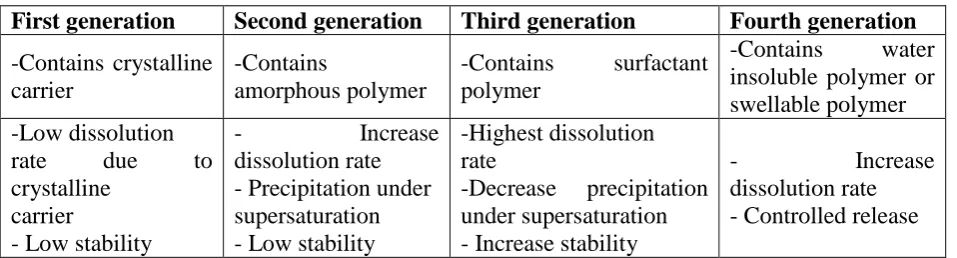
Table 2: Classification of solid dispersion based on composition.
First generation Second generation Third generation Fourth generation
-Contains crystalline carrier
-Contains
amorphous polymer
-Contains surfactant polymer
-Contains water insoluble polymer or swellable polymer -Low dissolution
rate due to
crystalline carrier
- Low stability
- Increase
dissolution rate - Precipitation under supersaturation - Low stability
-Highest dissolution rate
-Decrease precipitation under supersaturation - Increase stability
- Increase
dissolution rate - Controlled release
There are two main mechanisms of drug release from immediate release solid dispersions: drug-controlled release and carriercontrolledrelease. When solid dispersions are dispersed in water, the carriers often dissolve or absorb water rapidly due to their hydrophilic property and form concentrated carrier layer or gel layer in some cases. If the drug dissolves in this layer and the viscosity of this layer is high enough to prevent the diffusion of the drug through it, the rate limiting step will be the diffusion of the carrier into the bulk phase and this mechanism is carrier-controlled release. If the drug is insoluble or sparingly soluble in the concentrated layer, it can be released intact to contact with water and the dissolution profile will depend on the properties of drug particles (polymorphic state, particle size, drug solubility). Infact, these two mechanisms often occur simultaneously becausethe drug may be partly soluble or entrapped in the concentratedcarrier layer. [2]
Table 3: Preparation methods of solid dispersion.
1. Melting method
• Ice bath agitation • Thin film cooling • Liquid nitrogen • Spray congealing • Hot-melt extrusion • MeltrexTM
• Melt agglomeration
2. Melting solvent method
3. Solvent evaporation
• Rotary evaporation • Heating on hot plate • Spray drying
• Freeze drying
• Supercritical anti-solvent • Co-precipitation
• Electrostatic spinning • Spray freeze drying • Ultra-rapid freezing • Fluid-bed coating
SPRAY DRYING TECHNOLOGY
[image:4.595.102.496.490.670.2]process known as atomization) into a glass compartment where they come in contact with hot gas and get dried into fine particles, which are further separated from the drying gas using a cyclone or a bag-filter. It’s a moderate drying technique where gentle temperatures and little exposure times are used (as compared to other solid dispersion technology like melt extrusion) that yields powder with reasonable particle. Moreover, the fast drying process within few seconds or milliseconds is also important to prevent phase separation between the drug and polymer components.
The spray drying process consists of four basic stages: atomizationof the liquid, mixing of the liquid with the drying gas, evaporation of the liquid and separation of the dried particles fromthe gas. The liquid solution or suspension is transported from thecontainer to the nozzle entrance via a pump system.[1]
[image:5.595.114.490.504.641.2]To fully understand the characteristics of spray-dried powders, one needs to examine the mechanism for drying within a single droplet (Figure 1). Typically, there are many very small particles suspended in a sphere of liquid. When the droplet is first exposed to hot gas, rapid evaporation takes place. Material dissolved in the liquid will tend to form a thin shell at the surface of the sphere. Although the evaporation has kept the particle itself quite cool, as the liquid concentration decreases, the particle will begin to heat. Evaporation then takes only as quickly as the liquid can diffuse to the surface of the sphere. This phase of the drying process is called first-order drying or is said to be diffusion-rate-limited.
Fig. 1: Mechanism of drying of SDD
Selection of polymerfor spray dried dispersion (SDD)
With the aim to accomplish the desired solubility and stability ofamorphous form of drugs, selection of right polymer(s) or carrier(s) is required in the initial stage of formulation development.The ideal polymer to formulate as SDDs are identified by their physicochemical properties like glass transition temperature (Tg) of polymer, nature of polymer (anionic/cationic) and presence of functional group, hygroscopicity of polymer, solubility in common organic solvent, thermal stability, etc.Some polymers work as a wetting agent tosolubilize the released drug, where as others will also help to stabilize the supersaturated drug solution. The existence of useful moieties like hydrogen donors or acceptors is a surplus advantage which helps to inhibit crystallization of a drug from a glass solution. Generally physical instability or nucleation occurs below Tg of polymer due to higher molecular mobility, so polymer with higher Tg value is usually preferred in solid dispersion to improve shelf life of final formulation. Polymers can boost the physical stability of system by increasing the Tg of miscible mixtures and for that it should be also molecularly miscible with drug. There are numerous carriers like enteric polymers, hydrophilic polymers, amphiphilic polymers and surfactants are used in spray drying technology.
Table 4: List of carriers used for SDD.
Carriers Example
Enteric polymers
Hydrophilic polymers
Surfactants
Amphiphilic polymers
Methylacrylate polymers, hydroxypropyl methyl cellulose phthalate (HPMCP), Cellulose acetyate phthalate(CAP)
Starch, Sodium carboxy methyl cellulose, sodium alginate, polyethylene glycol(PEG), polyvinyl pyrollidone(PVP), β-cyclodextrin Lecithin, polyethylene-polypropylene glycol, bile salt
PEG modified starches, polyethylene oxides/polypropylene glycol copolymer, polyacrylic acids and polyacrylates
Solvent systems for SDD preparation
Selection of an acceptable solvent system is an equally important prerequisite for the formation of amorphous SDD. The first indispensablecondition is indeed to find out a common solvent(s)system to solubilize all feed components viz., API, carrier and otheradditives.[1]
the generation of a feed solutionwith acceptable viscosity, low toxicity
high volatility for the ease of solvent evaporation during droplet drying, appreciable chemical stability offeed components in the selected solvent and non-combustive in spray drying environment
In general, lower boiling solvents are very easy to evaporate and it results in higher solid production yield. The addition of a co-solvent can increase the solubilityof hydrophobic molecules by reducing the dielectricconstant of the solvent.
Table 5: List of commonly used solvents for SDD.
Solvents Boiling
point(°c) Density(g/ml)
Dielectric constant Solubility in water(g/100g) Methanol Ethanol Acetone Chloroform Methylene chloride Dimethylsulfoxide Water Ethyl acetate 64.6 78.5 56.2 61.7 39.8 189 100 77 0.791 1.049 1.498 1.326 1.092 0.998 0.895 32.6 24.6 20.7 4.81 9.08 47 78.54 6 Miscible Miscible Miscible 0.795 1.32 25.3 - 8.7
QUALITY BY DESIGN (QBD) APPROACH IN SPRAY DRYING
The modern concept of the pharmaceutical quality systems focuses on the pharmaceutical development based on the concept of Quality by design (QbD). ICH Q8 defines quality as “The suitability of either a drug substance or drug product for its intended use. This term includes such attributes as the identity, strength, and purity.” ICH Q6A[15]
emphasizes the role of specifications stating that “Specifications are critical quality standards that are proposed and justified by the manufacturer and approved by regulatory authorities.”
manufacturing process variables (including drug substance and excipient attributes and process parameters) and product characteristics are established and sourcesof variability identified. This knowledge is then used to implement a flexible and robust manufacturing process that can adapt and produce a consistent product over time. [16]
Following are the key steps involved in QbD:
Defining the quality target product profile(QTPP). Identifying potential critical quality attributes(CQAs).
Risk assessment: Linking Material Attributes and Process Parametersto Drug Product CQAs.
Defining design space. Define control strategy.
Product Lifecycle Management and Continual Improvement.
Quality target product profile (QTPP)
The QTPP forms the basis of design for the development of the product, which may include: intended use in clinical setting, route of administration, dosage form, delivery systems, dosage strength(s), container closure system, dissolution or drug product quality criteria (e.g., sterility, purity, stability and drug release) appropriate for the intended marketed product. As per the ICH guidance Q8 R2, QTPP is defined as a prospective summary of the quality characteristics of a drug product that ideally will be achieved to ensure the desired quality, taking into account safety and efficacy of the drug product. [5]
Critical Quality Attribute (CQA)
variables and their ranges within which consistent quality can be achieved. These process parameters and material attributes can thus be selected for inclusion in the design space.
Use of a risk assessment tool
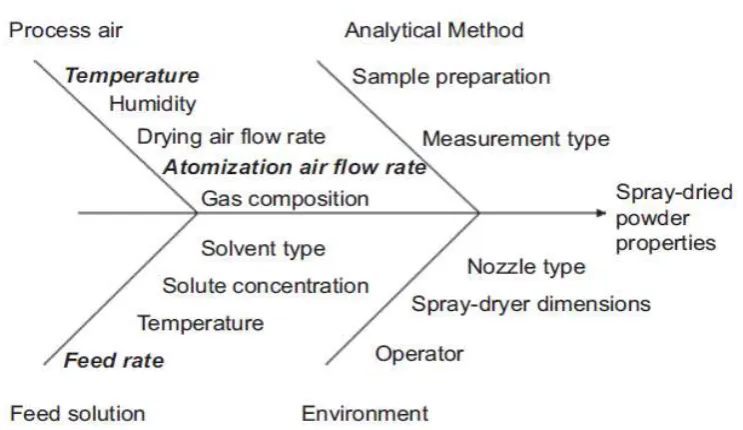
Ishikawa (fishbone) diagram identifies potential variables which can have animpact on the desired quality attribute. Here the variables are ranked based on probability, severity, and detectability using failure mode effects analysis(FMEA) or similar tools based on prior knowledge and initial experimental data.Design of experiments or other experimental approaches could then be used toevaluate the impact of the higher ranked variables, to gain greater understanding ofthe process, and to develop a proper control strategy.[5]
[image:9.595.115.487.302.517.2]Following is an example of Ishikawa diagram for spray drying operation: [8]
Fig 2: Ishikawa diagram for spray drying operation.
Design Space
approval. Working within the design space is not considered as a change. Movement out of the design space is considered to be a change and would normally initiate a regulatory post approval change process.[5]
Control Strategy
A control strategy is designed to ensure that a product of required quality will be produced consistently. It is defined as a planned set of controls, derived from current product and process understanding that ensures process performance and product quality. The controls can include parameters and attributes related to drug substance and drug product materials and components, facility and equipment operating conditions, in-process controls, finished product specifications, and the associated methods and frequency of monitoring and control.
Product Lifecycle Management and Continual Improvement
Throughout the product lifecycle, companies have opportunities to evaluate innovative approaches to improve product quality. Process performance can be monitored to ensure that it is working as anticipated todeliver product quality attributes as predicted by the design space. This monitoring could include trend analysis of the manufacturing process as additional experience isgained during routine manufacture.
Case studies
Kumar S. et al [8] have applied the Quality by Design (QbD) approach in spray drying process for the conversion of liquid nanosuspensions into solid nano-crystalline dry powders using indomethacin as a model drug. The effects of critical process variables: inlet temperature, flow and aspiration rates on critical qualityattributes (CQAs): particle size, moisture content, percent yield and crystallinity were investigated employing a full factorial design. A central cubic design was employed to generate the response surfacefor particle size and percent yield. Multiple linear regression analysis and ANOVA were employed to identifyand estimate the effect of critical parameters, establish their relationship with CQAs, create designspace and model the spray drying process. Inlet temperature was identified as the only significant factor(p value <0.05) to affect dry powder particle size. Higher inlet temperatures caused drug surface meltingand hence aggregation of the dried nano-crystalline powders. Aspiration and flow rates were identifiedas significant factors affecting yield (p value <0.05). Higher yields were obtained at higher aspiration andlower flow rates. All formulations had less than 3% (w/w) moisture content. Formulations dried at higherinlet temperatures had lower moisture compared to those dried at lower inlet temperatures.
CQAs IN SPRAY DRIED SOLID DISPERSION
Spray drying is a complicated process and understanding the relationship between process parameters and formulation parameters is essential for the reproducible production of high quality material. Process parameters to consider during a spray drying process are: inlet temperature, drying gas properties (humidity, flow rate), feed rate, compressed air flow rate etc. On the other hand, formulation parameters to consider are feed composition (API, carrier, solvent), feed concentration, solvent type etc.[1]
Feed composition
show an immense composition dependent intermolecular interaction with solvents. The outer skin formation during droplet drying and hencethe retardation of evaporation rate is highly dependent on the solution concentration of carrier having film forming properties like PVP. The other latent feed solution properties that can be altered with the variation in drug to polymer ratio are viscosity, surface tension, specific gravity, pH, etc. This would impact the droplet size (distribution) during spray drying and inturn the rate of solvent removal.[1] The rate of core to surface transportof solvent and then evaporation from a droplet surface decrease with the increase in feed viscosity due to higher fraction and/ormolecular weight of polymer present in solution. [1] Also, breakup length of liquid jet during atomization increases with increasing feed viscosity resulting into larger droplets. The shift in rheological regime of feed solution from Newtonian to non-Newtonian can drastically change the spray rate, droplet size (distribution) and density. Paudel and Van den Mooter observed the marked difference in overall solvent evaporation rate from naproxen-PVPsolutions containing same total solute content but different drugto polymer ratio. [13]The solution state properties such as polymer diffusion coefficient and solute–solvent supramolecular interactions are drastically altered with the different drug to polymerratio. Besides, it is well known, especially from polymer literature, that the influence of composition on non-covalent interactions (dispersive, polar, H-bonding) in metastable solutions is governed by specific ternary interaction attributes among two solutes and solvent rather than binary parameters Therefore, polymer folding/unfolding and dispersed state of drug in solution (monomer or multimer) as a function of composition are key attributes for the unique solid state structure in SDD. [13] These facts imply the utmost importance of composition dependent solution dynamics in predictingthe phase behaviour of the resulting SDD.
Feed concentration
spray dried particles is directly proportionalto the feed concentration. Additionally, it is reported that a concentrated feed solution may also lead to the formation of hollow spray dried particles with rough surface, higher porosity andbulk density. The feed concentration effecton the surface morphology depends upon the chemical nature offeed solution components.
The process yield increases when the feed concentration increases, but starts to decrease at higher (above the experimental range) feed concentrations. These phenomena can be explained by the fact that, at higher feed concentrations there could be an increase in tendency of droplets to coalesce on collision with each other or the wall, which might result in a lower yield. On the other hand according to Raoult’s law the evaporation rate is inversely proportional to the feed concentration, owing to a decrease in the evaporation rate at high feed concentrations. These could increase the adhering tendency of particles at higher feed concentrations due to insufficient drying and could result in a loweryield. A lower process yield from a dilute solution is generallydue to the formation of smaller particles which are highly electrostatic and have increased wall adhering tendencies and thuscould be difficult to collect using a cyclone.
Feed flow rate
The feed rate is the foremost parameter to start with for attaining the balance between throughput and proper drying considering the drying capacity of a particular spray drier set up. Apart from the atomization pattern and droplet size (distribution), feed rate primarily governs the time period a particle remains in the drying chamber, conveyer, cyclone and bag filters during the spray drying operation. As feed rate directly affects the saturation degree of exiting gas, it influences the outlet temperature at the given drying set up. Therefore the upper limit of flow ratefor a given feed solution is set to attain sufficient drying of the particles before they hit the spray dryer wall.
Inlet and outlet temperature
responsible for the development of the unique phase structure and controlling the level of residual content and bulk/particulate level properties of the final product.
Outlet air temperature is one of the most critical parameters which exclusively affect the product morphology like particlesize, surface roughness, density, stickiness of particles, residual solvent or moisture levels, product yield, etc. Outlet temperature of drying gas is the derived process parameter dependent upon inlet temperature, drying gas flow rate and enthalpy of evaporation of solvent in feed. After performingspray drying process, secondary drying of powder is generallyrequired to remove the excess residual solvent because, presence of solvents may plasticize the solid dispersion by increasing molecular mobility and it results in the development ofcrystal growth. Spray drying process carried out at a loweroutlet temperature gives a product with high residual solventlevels and poor flow property. The overall process efficiency of spray drying is highly dependent on the ratio of inlet to outlet temperature.
CONCLUSION
Spray drying is a time-tested manufacturing process for amorphous solid dispersion of poorly water soluble drugs. The understanding on the influence of various formulation and process parameters on the molecular to particulate/bulk level properties of spray dried dispersions is the current need in this field. Spray drying process involves interactions between various formulation variables (like feed concentration, solvent type, type of polymer) and process conditions (drying gas flow rate, feed rate, outlet temperature, atomization rate) which can significantly influence the particle characteristics (yield, particle size, residual solvent content, flow property, surface area and release profile) of the solid dispersion. Thus the implementation of QbD approach in the drying of feed solution containing poorly water soluble API, polymer and additives can result in the robust process development and subsequent scale up with the desired product properties as per predefined objectives.
REFERENCES
1. Paudel A, Zelalem AW, Meeus J, Sandra G, Guy VM. (Review: Manufacturing of solid dispersions of poorly water soluble drugs by spray drying: Formulation and process considerations).Int J of Pharm, 2013; 453: 253-284.
3. ICH Quality Implementation Working Group Points to consider (R2)-ICH-Endorsed Guide for ICH Q8/Q9/Q10 Implementation, (2011). International Conference on Harmonization of Technical Requirements for Registration of Pharmaceuticals for
Human use.
http://www.ich.org/fileadmin/Public_Web_Site/ICH_Products/Guidelines/Quality/Q8_9_ 10_QAs/PtC/Quality_IWG_PtCR2_6dec2011.pdf
4. ICH Harmonised Tripartite Guideline. Quality Risk Management Q9 (2005) International Conference on Harmonisation of technical requirements for registration of
pharmaceuticals for human use.
http://www.ich.org/fileadmin/Public_Web_Site/ICH_Products/Guidelines/Quality/Q9/Ste p4/Q9_Guideline.pdf.
5. ICH Harmonised Tripartite Guideline. Pharmaceutical Development Q8(R2) (2009) International Conference on Harmonisation of technical requirements for registration of
pharmaceuticals for human use.
http://www.ich.org/fileadmin/Public_Web_Site/ICH_Products/Guidelines/Quality/Q8_R1 /Step4/Q8_R2_Guideline.pdf.
6. Morten JM, Simon B, Lars H, Svend H, Marco W. (Quality by design – Spray drying of insulin intended for inhalation).Eur J Pharm Bio, 2008; 70: 828–838.
7. Kumara S, Gokhaleb R, Burgessa DJ. (Quality by Design approach to spray drying processing of crystalline nanosuspensions).Int J Pharm, 2014; 464: 234-242.
8. Rathore AS, Winkle H. (Quality by design for biopharmaceuticals). Nat Biotechnol 2009; 27(1): 26-34.
9. Patel AD, Agrawal A, Dave RH. (Investigation of the effects of process variables on derived properties of spray dried solid-dispersions using polymer based response surface model and ensemble artificial neural network models). Eur J Pharm Bio, 2014; 86: 404– 417.
10.Vasconcelos T, Sarmentol B, Costa P. (Solid dispersions as strategy to improve oral bioavailability of poor water soluble drugs). Drug Discov Today, 2007; 12(23-24): 1068-75.
11.Baldinger A, Clerdent L, Rantanen J, Yang M, Grohganz H. (Quality by design approach in the optimization of the spray-drying process). Pharm DevTechnol, 2012; 17(4): 389– 397.
pharmaceuticals for human use. http://www.ich.org/fileadmin/Public_Web_Site/ICH_Products/Guidelines/Quality/Q10/St ep4/Q10_Guideline.pdf.
13.Paudel, A., Van den Mooter, G., 2012. (Influence of solvent composition on the miscibility and physical stability of naproxen/PVP K 25 solid dispersions prepared by cosolvent spray-drying). Pharm. Res. 2012; 29: 1–20.
14.Marasini N, Tran TH, Poudel BK, Cho HJ, Young Keun Choi YK, Chi SC et.al. (Fabrication and evaluation of pH-modulated solid dispersion for telmisartan by spray-drying technique). Int J Pharm, 2013; 441: 424– 432.
15.Ich Harmonised Tripartite Guideline. Specifications: Test Procedures and Acceptance criteria for new drug substances and new drug products: Chemical substances Q6A (1999). International Conference on Harmonisation of technical requirements for registration of pharmaceuticals for human use.
http://www.ich.org/fileadmin/Public_Web_Site/ICH_Products/Guidelines/Quality/Q6A/S tep4/Q6Astep4.pdf.
16.Yu1 LX. (Pharmaceutical Quality by Design: Product and Process Development, Understanding, and Control). Pharm Res, 2008; 25(4): 781-791.