FORMULATION DEVELOPMENT AND EVALUATION OF
EXTENDED RELEASE TABLETS OF TAPENTADOL HCl
S. Maheswara Rao*, P. Prem Kumar and Manohar Babu S.
Department of Pharmaceutics, SIMS College of Pharmacy, SIMS Group of Institutions,
Mangaldas Nagar, Guntur,-522001, Andhra Pradesh, India.
ABSTRACT
Patients experiencing acute or chronic pain require an analgesic agent
that is both effective and well tolerated for management of moderate to
severe pain. Therefore to overcome such pain there is need to
formulate effective and stable dosage form of Tapentadol HCl with
following objectives. Development and evaluation of the extended
release oral tablet, which matches with innovators formulation.
Performed the preformulation studies to study compatibility between
drug and excipients. Evaluated the physical parameters for the prepared
tablets. The marketed product was characterized for various properties
of the dosage forms like assay, dissolution and other physical
properties. F10 formulation found pharmaceutical equivalent to
competitor product. The Final trial was packed in PVC/PVDC blister
packing and kept at 40°C/75%RH±5% for 6 month and
25°C±2°C/60%RH±5% upto 24 month. Formulation found to be robust and stable.
KEYWORDS: Chronic pain, Tapentadol HCl, Dissolution Studies, pharmaceutical equivalent.
1. INTRODUCTION
In the search for safe, economical and efficient means of providing for the health and well
being of mankind, modern science has produced numerous active agents through the methods
of drug discovery that manipulate the biological environment around and within us. However,
inability to deliver these agents to their targets at the right time and in right amounts cause
some inefficiency that makes a useful drug unsuitable. This inability results in their loss,
Volume 5, Issue 9, 1358-1368. Research Article ISSN 2277– 7105
*Corresponding Author
S. Maheswara Rao
Department of
Pharmaceutics, SIMS
College of Pharmacy, SIMS
Group of Institutions,
Mangaldas Nagar,
Guntur,-522001, Andhra Pradesh,
India.
Article Received on 11 June 2016,
Revised on 31 July 2016, Accepted on 21 August 2016
undesirable side effects and leads to a regimen requiring repeated treatment to produce and
sustain the desired effects.[1-4]
Conventional drug dosage forms do not maintain the drug blood levels within the
therapeutic range for an extended period of time. To achieve the same, a drug may be
administered repetitively using a fixed dosing interval. This causes several potential problems
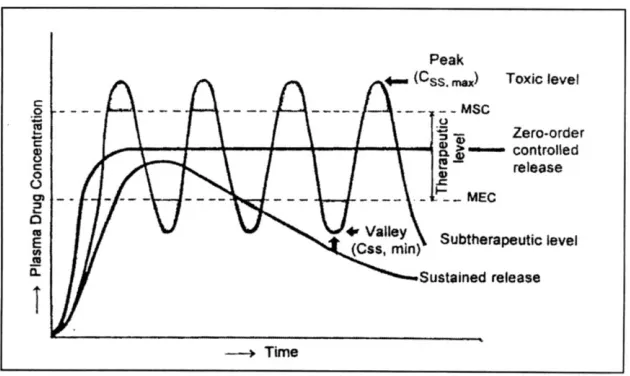
like saw tooth kinetics characterized by large peaks and troughs in the drug
concentration-time curve.[5-8]
Figure No.1: Hypothetical plasma concentration-time profile from conventional multiple dosing and single doses of sustained and controlled delivery formulations
1.1 EXTENDED RELEASE DRUG DELIVERY SYSTEM
The goal of drug delivery system is to provide therapeutic amount of drug at proper site in
body and then maintain the desired plasma drug profile. It should deliver drug at a rate
dictated by the need of the body over the period of treatment. An extended release dosage
form allows at least a two-fold reduction in dosing frequency or significant increase in patient
compliance or therapeutic performances as compared to a conventional release dosage form.
So, the goal in designing extended or controlled release system is to reduce the frequency of
dosing and /or to increase effectiveness of the drug by localization at the site of action,
[image:2.596.142.457.243.431.2]Advantages
Extended release products offer three potential benefits as follows[13-15]:
Sustained blood levels
Attenuation of adverse effects Improved patient compliance
[image:3.596.83.516.250.491.2]2. MATERIALS AND METHODS 2.1. MATERIALS USED
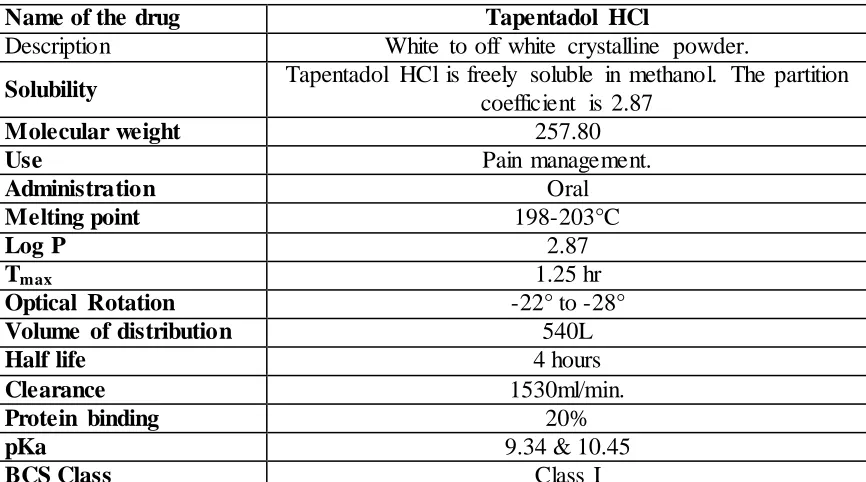
Table No 1: Pharmacokinetics /Pharmacodynamic properties of Tapentadol HCl.
Name of the drug Tapentadol HCl
Description White to off white crystalline powder.
Solubility Tapentadol HCl is freely soluble in methanol. The partition coefficient is 2.87
Molecular weight 257.80
Use Pain management.
Administration Oral
Melting point 198-203°C
Log P 2.87
Tmax 1.25 hr
Optical Rotation -22° to -28°
Volume of distribution 540L
Half life 4 hours
Clearance 1530ml/min.
Protein binding 20%
pKa 9.34 & 10.45
BCS Class Class I
Table No 2: Excipient Profile
S. No. Excipients Brand Name Functional
category
1 Microcrystalline cellulose Avicel PH 101 Diluent
2 Hydroxypropyl methylcellulose
K100M CR Methocel K00M Polymer
3 Carbopol 971P Lubrizol Polymer
4 Hydroxypropyl methylcellulose
K15M Premium Methocel K15M Polymer
5 Ethylcellulose Ethocel Binder
6 Colloidal silicone dioxide Aerosil 200 Glidant
7 Magnesium stearate --- Lubricant
2.2. METHODS USED
EVALUATION OF FORMULATION[15-18] Physical characterization of Blend
All physical tests of blend were performed like Bulk density, Tapped density,
Compressibility index, Hausner’s ratio and Loss on drying.
Tablet evaluation
The tablets were evaluated for the following tests.
Average weight
20 Tablets were taken randomly and weighed accurately and the average weight of the tablets
from each batch was calculated.
Hardness/ Crushing strength
The term hardness indicates the ability of a tablet to withstand mechanical shocks while
handling. It is generally expressed in Kg/cm2 or in Newton (N). Hardness of a tablet was
measured using hardness testers. (Erweka).
Thickness
Three samples were selected randomly and thickness was measured using “Mitutoyo”
Vernier caliper.
Friability
Friability test is performed to assess the effect of friction and mechanical shocks, which may
often cause tablet to chip, cap, laminate or break during packaging or transportation.
Method
Samples of 20 tablets were taken. Tablets were de-dusted prior to testing. Tablet samples
were accurately weighed and were placed in the drum of friability tester (Electrolab). Drum
was rotated for 100 revolutions. Tablets were deducted and reweighed.
Formula
W initial – W final
% F = x 100 W initial
Where, W initial – Initial weight of tablets
Dissolution test
This test provides evaluation of physiological availability of drug candidate. For FDA
approval and bioequivalent product, it is important to compare the dissolution profile of
product with the dissolution profile of reference-listed drug. Therefore similarity factor (f2) is
recommended by various regulatory committees that demonstrated the similarity in the
percent (%) dissolution of test product with reference product. Dissolution profiles are
[image:5.596.77.512.241.328.2]considered similar if the calculated f2 value is between 50 and 100.
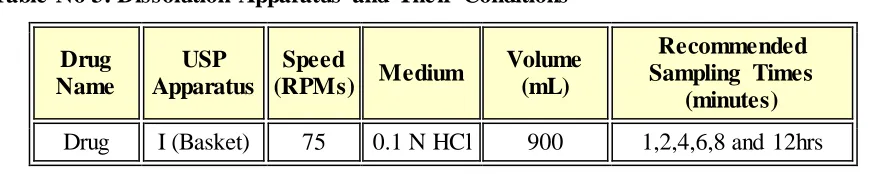
Table No 3: Dissolution Apparatus and Their Conditions Drug
Name
USP Apparatus
Speed
(RPMs) Medium
Volume (mL)
Recommended Sampling Times
(minutes)
Drug I (Basket) 75 0.1 N HCl 900 1,2,4,6,8 and 12hrs
Assay
This method is used to analyze or quantify a substance in a sample. Assay is an analytical
process to determine not only the presence of substance and the amount of substance but also
the biological and pharmacological potency of a drug.
Stability study
In any rational design and evaluation of dosage forms for drugs, the stability of the active
component must be a major criterion in determining their acceptance or rejection.
Table No 4: Time period of storage condition
Study Storage Condition Time Period
Long term 25°C±2°C/60%RH±5 RH 24 month
Accelerated 40°C±2°C/75%RH±5%RH 6 month
3. RESULTS
Table No 5: Different Formulation Batches of Tapentadol HCl
S. No F1 F2 F3 F4 F5 F6 F7 F8
Tapentadol HCl 116.48 117.04 117.04 117.04 117.04 117.04 117.04 117.04
MCC 101 - 178.36 178.36 127.36 167.92 107.36 97.36 96.36
Prosolve 228.52 - - - - -
HPMC K15M 150 49.00 - - - -
Carbopol 971P - - - - 60 - - -
Ethyl cellulose 10CPS - - - 20.00 30.00 40.00
Aerosil 200 - 3.50 3.50 3.50 3.50 3.50 3.50 3.50
Mg.Stearate 5.0 2.10 2.10 2.10 2.10 2.10 2.10 2.10
Table No 6: Evaluation of Physical parameters all formulations Trial Avg. Wt. of
tab (mg) Hardness (N) Thickness (mm) Friability (%)
F1 500 91-96 5.2-5.3 1.04
F2 350 89-95 4.4-4.5 0.3
F3 350 80-82 4.4-4.5 0.35
F4 350 99-105 4.48-4.51 0.02
F5 350 99-104 4.64-4.66 0.25
F6 350 100-110 4.6-4.8 0.31
F7 350 110-126 4.5-4.6 0.31
F8 350 100-110 4.6-4.7 0.08
F9 350 110-120 4.6-4.7 0.12
F10 350 106-118 4.7-4.76 0.18
Table No 7: Dissolution Profile of Different Formulations
Time (hr) %Cummulative Drug Dissolved
F2 F3 F4 F5 F6 INNOVATOR
1 35 34 37 28 27 30
2 47 52 55 44 38 41
4 72 75 77 64 62 68
6 89 89 91 78 78 80
8 102 97 99 88 95 93
Fig.No-2: Dissolution profile of all formulations and comparison with Innovator
[image:7.596.90.505.287.590.2]
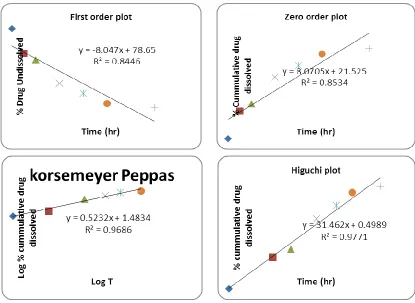
Fig.No-3: Drug Release Kinetics of Optimized formulation
Table No 8: Comparison of Dissolution Profile of Trial 10 with Innovator Product Time (hrs) Cumulative % Release
Trial 10 Nucynta ER
1 30 30
2 40 41
4 70 68
6 81 80
8 95 93
Figure No.4: Dissolution Profile of Trial 10 Table No 9: Assay evaluation of Trial batches
Trial No. Assay Of Drug %
Trial I -
Trial II 98.6
Trial III 98.7
Trial IV 97.2
Trial V 95.3
Trial VI 96.1
Trial VII 97.9
Trial VIII 98.4
Trial IX 98.2
Trial X 97.4
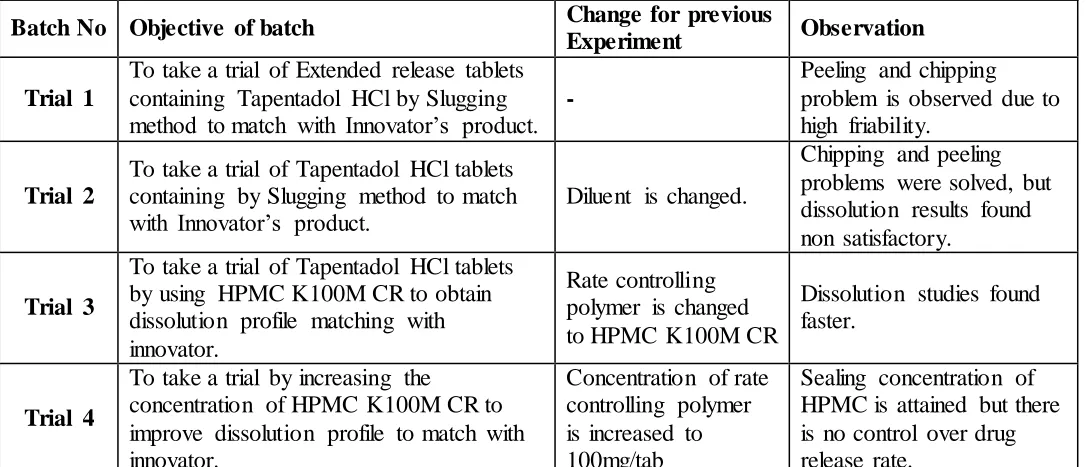
4. SUMMARY AND DISCUSSION Table No 10: Summary and discussion
Batch No Objective of batch Change for previous
Experiment Observation Trial 1
To take a trial of Extended release tablets containing Tapentadol HCl by Slugging method to match with Innovator’s product.
-
Peeling and chipping problem is observed due to high friability.
Trial 2
To take a trial of Tapentadol HCl tablets containing by Slugging method to match
with Innovator’s product. Diluent is changed.
Chipping and peeling problems were solved, but dissolution results found non satisfactory.
Trial 3
To take a trial of Tapentadol HCl tablets by using HPMC K100M CR to obtain dissolution profile matching with innovator.
Rate controlling polymer is changed to HPMC K100M CR
Dissolution studies found faster.
Trial 4
To take a trial by increasing the
concentration of HPMC K100M CR to improve dissolution profile to match with innovator.
Concentration of rate controlling polymer is increased to 100mg/tab
[image:8.596.206.390.293.457.2] [image:8.596.29.572.512.746.2]Trial 5
To take a trial by replacing HPMC K100M CR with Carbopol 971P to control the rate of dissolution.
Rate controlling polymer is changed to Carbopol 971P
Rate of drug release found much faster than previous formulations
Trail 6
To take a trial of Extended release tablets of Tapentadol HCl by non-aqueous granulation technique by using ethyl cellulose (binder) & HPMC K100M CR as a rate controlling polymer.
Ethyl cellulose is used as a binder in the concentration of 20mg/tab.
Weight variation problem is observed due to high content of fines.
Trail 7
To take a trial of Extended release tablets of Tapentadol HCl by non-aqueous granulation technique by increasing the concentration of ethyl cellulose to
30mg/tab to decrease the quantity of fines.
Concentration of binder is increased to 30mg/tab.
Weight variation problem is overcome, but
dissolution profile is on lower side.
Trail 8
To take a trial batch of Extended release tablets. Containing Tapentadol HCl by increasing the concentration of binder to 40mg per tab.
Concentration of binder is increased to 40mg/tab.
Dissolution profile is matching with the innovator product.
Trail 9
To take a trial of Tapentadol ER tablets as reproducible trial of trial 8 by wet
granulation method and to evaluate different packaging materials on stability.
Trial batch is taken and evaluated for different packing materials.
Tablets packed in Alu/Alu founds stable.
Trail 10 To take a scale-up trial of Tapentadol HCl by wet granulation method (scale up trial).
Taken as a Scale up trial.
All physical and chemical parameters found stable and reproducible.
5. CONCLUSION
It is imperative to summarize the findings of the dissertation entitled “Formulation
Development and Evaluation of Extended Release Tablets of Tapentadol HCl”. Prior to the
development of dosage form, all the fundamental physical and chemical properties of the
drug molecule are evaluated and the results were found satisfactory. This information will
dictate the subsequent events and possible approaches in formulation development viz.
selection of suitable process, selection of the correct technical grade of excipients.
Preformulation studies were carried out and it was concluded from the observations that the
drug was compatible with the studied excipients.
The marketed product was characterized for various properties of the dosage forms like
assay, dissolution and other physical properties. Wockhardt formulation found
pharmaceutical equivalent to competitor product.
The Final trial was packed in PVC/PVDC blister packing and kept at 40°C/75%RH±5% for 6
month and 25°C±2°C/60%RH±5% upto 24 month. Formulation found to be robust and
6. FUTURE SCOPE
This research project has a wide future scope with respect to delivery of drug for the
treatment of acute pains.
Following are the certain future scopes for the above study:
1. Pilot-Bioequivalence study of the final formulation.
2. To be launched commercially for domestic market.
3. Development of the formulation in different strengths with the same API
7. REFERENCES
1. Jain K K, Walker J M, Drug Delivery System, Humana press, 2008; pp 1.
2. Williams L, Wilkins, Remington, The Science and Practice of Pharmacy, 21st editions,
vol-I, B I Publications, 2006; 889: 939.
3. Krowczynski L, Extended Release Dosage Form, CRC Press, 1987; pp 1.
4. Jon Gabrielsson, Nils-Olof Lindberg and Torbjorn Lundstedt, Multivariate Methods in
Pharmaceutical Applications, J. Chemom, 2002.
5. Mehta R.M, 2002. Tablet: pharmaceutics-1. Vallabh Prakashan, 3, 7 and 238.
6. Lachman, L., Liberman, H. A., Kanig, J. L., 1987.The theory and practice of industrial
pharmacy. Varghese Publishing House, 3: 293-342.
7. Huijun Xie, Yong Gan, Suwei Ma, Li Gan and Qinghua Chen, this review give the
information about the Optimization and Evaluation of Time Dependent Tablets
Comprising an Immediate and Sustained Release Profile Using Artificial Neural Network
Drug Development.
8. Handbook of pharmaceutical granulation technology. NY: Marcel Dekker, 2: 1-4,
228-290.
9. Robert A Nash, Alfred H Watcher; 2003. Pharmaceutical Process Validation. NY:
Marcel Dekker, 129: 198-224.
10.Azeem S, Marc Hochberg, Jay L. Goldstein, John G. Fort Sharm S, Immediate Release
Drug Delivery System: A Review, International Journal of Biopharmaceutical &
Toxicological Research”, May2011; I(1).
11.Lachman L, Liberman H A, Kanig J L, The Theory and Practice of Industrial Pharmacy,
Varghese Publishing House, 3rd edition, pp 293-342.
12.Hale M, Upmalis D, Okamoto tolerability of drug immediate release in patients with
13.www.pharmpedia.com/Tablet, Manufacturing method/ Direct Compression.
14.www.pharmpedia.com/Tablet, Formulation of tablets/ Binders.
15.www.pharmpedia.com/Tablet, Manufacturing method/ Granulation.
16.The United States Pharmacopoeia-32, National Formulary-27, 2008, Tablet hardness:
General information. United State Pharmacopial Convention, pp 3: 1260.
17.Brahmaiah Bonthagarala, Sreekanth Nama, Sudarshan Donthiboina, Formulation and
Evaluation of Sustained Release Matrix Tablets of Ozacarbazepine by Using Various
Polymers, Singapore Journal of Pharmaceutical Research, e-ISSN No-1456-9126, Print
ISSN NO-1278-9118, 2014; 1(1): 1-7.
18.Brahmaiah. B , Prasanna Kumar Desu, Sreekanth Nama, S. Satish Babu, Formulation and
evaluation of extended release mucoadhesive microspheres of simvastatin, International
Journal of Pharmaceutical and biomedical Research, ISSN No. 0976-0350, March 2013;