www.wjpr.net Vol 4, Issue 06, 2015.
1917
FORMULATION AND EVALUATION OF CONTROLLED RELEASE
TABLETS OF LAMIVUDINE BY 2
2FACTORIAL DESIGN
K. P. R. Chowdary*, K. Ravi Shankar and M. Ravi Kumar
Vikas Institute of Pharmaceutical Sciences, Nidigatla Road, Rajahmundry- 533103.
ABSTRACT
Lamivudine is a potent antiviral agent used in the treatment of AIDS.
Conventional oral formulations of lamivudine are administered
multiple times a day because of its moderate biological half-life (t1/2)
of 5-7h. Treatment of AIDS using conventional formulations of
lamivudine is found to have many drawbacks, such as adverse side
effects resulting from accumulation of drug in multidose therapy,poor
patient compliance, and high cost. Controlled release formulation of
lamivudine can overcome some of these problems. The objective of the
present study is development of oral controlled release tablets of
Lamivudine employing a combination of hydrophilic polymer, HPMC
K 100M and hydrophobic polymer, ethyl cellulose using 22 factorial
design. Matrix tablets each containing 120 mg of Lamivudine were formulated employing
HPMC K100M and ethyl cellulose as per 22 factorial design and were prepared by wet
granulation method and were evaluated. All the CR tablets of lamivudine prepared were of
good quality with regard to drug content, hardness, friability, disintegration and were suitable
for controlled release. Lamivudine release from the CR tablets prepared was slow and spread
over 10 h and depended on the composition of the tablets. The order of increasing release rate
(K0) from various formulations was Fab < F1 < Fa < Fb. ANOVA of release rate (K0) values
indicated that individual and combined effects of the two factors are highly significant (P <
0.01) in influencing the release rate of drug from the CR matrix tablets. Non-Fickian
diffusion was the release mechanism from formulations F1, Fa and Fab which gave relatively
slow drug release. Fickian diffusion was the release mechanism in the case of formulation Fb,
that gave rapid release of drug. The polynomial equation describing the relationship between
the response, Y (percent drug released in 4h) and the variables, X1 (concentration of HPMC
K100M)and X2 (concentration of ethyl cellulose)based on the observed data was found to be
Volume 4, Issue 6, 1917-1925. Research Article ISSN 2277– 7105
Article Received on 14 April 2015,
Revised on 08 May 2015, Accepted on 29 May 2015
*Correspondence for
Author
Prof. K. P. R. Chowdary
Vikas Institute of
Pharmaceutical Sciences,
Nidigatla Road,
www.wjpr.net Vol 4, Issue 06, 2015.
1918 Y = 83.75 - 6.75 (X1) + 5.75 (X2) – 3.75 (X1 X2). As per the above polynomial equation
factor A (HPMC K100M) has greater effect in influencing the drug release from the matrix
tablets, followed by factor B (ethyl cellulose) and the combined effect of the two factors (AB)
is least. Among all formulation Fab provided lamivudine slowly over 8-10h at a release rate
(K0) of 13.50 mg/h which is nearer to the desired release rate (12.5 mg/h) based on its
pharmacokinetics and hence it is considered as the best controlled release formulation of
lamivudine for b.i.d administration.
KEYWORDS: Lamivudine, Controlled release tablets, HPMC K100M, Ethyl cellulose, Factorial design
INTRODUCTION
The last 40 years have seen the development of several antiviral drugs with therapeutic value
in treating life-threatening or debilitating diseases such as those caused by HIV, hepatitis B
virus, herpes viruses (such as herpes simplex virus and varicella zoster virus) and influenza
virus. These developments are due to technical breakthroughs in the cultivation of viruses in
the laboratory, identification of viral enzymes and, more recently, their molecular biology.
Antiretroviral drugs[1] are active against human immunodeficiency virus (HIV) which is a
retrovirus. They are useful in prolonging and improving the quality of life and postponing
complications of acquired immunodeficiency syndrome (AIDS) or AIDS related complex
(ARC), but do not cure the infection. The clinical efficacy of antiretrovirus drugs is
monitored primarily by plasma HIV-RNA assays and CD4 lymphocytes count carried out at
regular intervals. The first antiretroviral (ARV) drug, zidovudine was developed in
1987.Over the past 20 years, more than 20 drugs belonging to the following three classes
have been introduced and a large number of others are under development.
The oral route is the route most often used for administration of drugs. Tablets are the most
popular oral formulations available in the market and are preferred by patients and physicians
alike. In long-term therapy for the treatment of chronic disease conditions, conventional
formulations are required to be administered in multiple doses and therefore have several
disadvantages.[2] Controlled release (CR) tablet formulations are preferred for such therapy
because they offer better patient compliance, maintain uniform drug levels, reduce dose and
www.wjpr.net Vol 4, Issue 06, 2015.
1919
Lamivudine is a potent antiviral agent used in the treatment of AIDS. It is phosphorylated
intracellularly and inhibits HIV reverse transcriptase as well as hepatitis B virus (HBV) DNA
polymerase. Its incorporation into DNA results in chain termination. Lamivudine is used in
combination with other anti-HIV drugs, and appears to be as effective as AZT. It is also
frequently used for chronic hepatitis B. Conventional oral formulations of lamivudine are
administered multiple times a day because of its moderate biological half-life (t1/2) of 5-7h.
[4-5]
Treatment of AIDS using conventional formulations of lamivudine is found to have many
drawbacks, such as adverse side effects resulting from accumulation of drug in multidose
therapy,poor patient compliance, and high cost. Controlled release formulation of lamivudine
can overcome some of these problems.
The objective of the present study is development of oral controlled release tablets of
Lamivudine employing a combination of hydrophilic polymer, HPMC K 100M and
hydrophobic polymer, ethyl cellulose using 22 factorial design. The individual and combined
(interaction) effects of the two polymers on drug release from the CR matrix tablets was
evaluated. The drug release data were fitted into a polynomial equation to establish the
relationship between the response, percent drug release (Y) and concentration of the two
polymers, HPMC K100M (X1) and ethyl cellulose (X2).
EXPERIMENTAL MATERIALS
Lamivudine was a gift sample from M/s Natco Pharma Ltd.,Hyderabad. Hydroxypropyl
methyl cellulose (HPMC K 100M), ethyl cellulose (18-22 cps), talc and magnesium stearate
were procured from commercial sources. All other materials used were of pharmacopoeial
grade.
METHODS
Estimation of Lamivudine
An UV Spectrophotometric method based on the measurement of absorbance at 270 nm in
0.1N hydrochloric acid was used for the estimation of lamivudine. The method was validated
for linearity, accuracy, precision and interference. The method obeyed Beer’s law in the
concentration range of 1 – 10 µg/ ml. When a standard drug solution was repeatedly assayed
(n=6), the relative error and coefficient of variance were found to be 0.85% and 1.25%
www.wjpr.net Vol 4, Issue 06, 2015.
1920 Formulation of CR Tablets of Lamivudine
Matrix tablets each containing 120 mg of lamivudine were formulated employing HPMC
K100M and ethyl cellulose. Lamivudine CR tablets were formulated as per 22 factorial
design. The two factors involved in the 22 factorial design are HPMC K100M (Factor A) and
ethyl cellulose (Factor B). The two levels of HPMC K100M (Factor A) are 80 % and 150 %
of drug content and the two levels of ethyl cellulose (Factor B) are 20% and 40% of drug
content. Four lamivudine CR tablet formulations were prepared employing selected
combinations of the levels of the two factors as per 22 factorial design. The CR tablets of
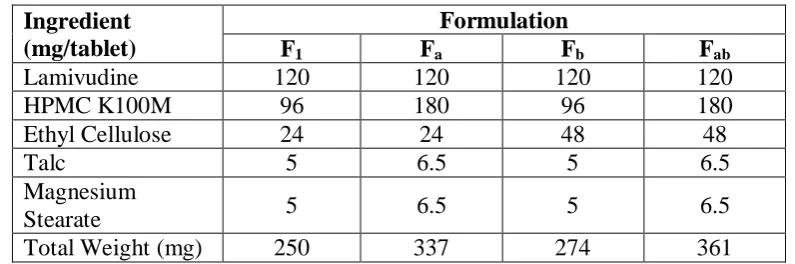
lamivudine were prepared by wet granulation method as per the formula given in Table 1.
Method of Preparation of CR Tablets of Lamivudine
The required quantities of lamivudine, HPMC K100M and ethyl cellulose were thoroughly
mixed in a dry mortar by following geometric dilution technique. The granulating fluid,
water- alcohol (1:1) solution was added and mixed thoroughly to form a dough mass. The
mass was pressed through mesh No. 16 to obtain wet granules. The wet granules were dried
at 650C for 1h. The dried granules formed were passed through mesh No. 16 to break the
aggregates. The lubricants talc and magnesium stearate were passed through mesh No. 60 on
to the dry granules and blended in a closed polyethylene bag. The tablet granules were then
compressed into tablets on a 8-station tablet punching machine (Karnavathi Rimek Minipress
II) to a hardness of 4-5 Kg/cm2.
Evaluation of CR Tablets of Lamivudine
Hardness of the tablets was tested using a Monsanto hardness tester.
Friability of the tablets was determined in a Roche friabilator.
Disintegration time of the tablets was determined using a Paramount tablet disintegration test
machine using water, 0.1N HCl and phosphate buffer of pH 7.4 as the test fluids.
Drug Release Study
Drug release from the CR tablets of lamivudine prepared was studied using 8-station
dissolution rate test apparatus (Labindia, DS 8000) employing a paddle stirrer at 50 rpm and
at a temperature of 37±0.5⁰C. Hydrochloric acid, 0.1N (900 mL) was used as dissolution
fluid. A 5mL aliquot of dissolution medium was withdrawn through a filter (0.45μm) at
different time intervals and assayed spectrophotometrically by measuring absorbance at 270
www.wjpr.net Vol 4, Issue 06, 2015.
1921 Data Analysis
Drug release data were analysed as per zero order, first order, Higuichi[6] and Korsemeyer –
Peppas[7] equation models to assess drug release kinetics and mechanism from the floating
tablets prepared. Drug release rates (K0) were subjected to ANOVA to find out the
significance of the individual and combined effects of the two factors involved on the drug
release from the CR matrix tablets prepared.
RESULTS AND DISCUSSION
CR tablets of lamivudine were designed employing combination of a hydrophilic polymer
(HPMC K100M) and a lipophilic polymer (ethyl cellulose). Matrix tablets each containing
120 mg of Lamivudine were formulated employing HPMC K100M and ethyl cellulose.
Lamivudine CR tablets were formulated as per 22 factorial design. The two factors involved
in the 22 factorial study are HPMC K100M (Factor A) and ethyl cellulose (Factor B). The
two levels of HPMC K100M (Factor A) are 80% and 150 % of drug content and the two
levels of ethyl cellulose (Factor B) are 20% and 40% of drug content. Four Lamivudine CR
tablet formulations were prepared employing selected combinations of the levels of the two
factors as per 22 factorial design. The CR tablets were prepared by wet granulation method as
per the formula given in Table 1. All the CR tablets prepared were evaluated for drug content,
hardness, friability, disintegration and drug release characteristics.
Hardness of the CR tablets prepared was in the range 4.0-5.0 Kg/cm2.Weight loss in the
friability test was less than 0.85% in all the cases. All the tablets prepared contained
Lamivudine within 100±2% of the labelled claim. All the CR tablets prepared were found to
be non-disintegrating in water and aqueous acidic (pH 1.2) and alkaline (pH 7.4) fluids. As
such the prepared CR tablets were of good quality with regard to drug content, hardness,
friability, disintegration and were suitable for controlled release.
Lamivudine release from the CR tablets prepared was studied in 0.1N hydrochloric acid. The
drug release profiles of CR tablets prepared are shown in Fig.1. Drug release parameters of
the CR tablets prepared are summarized in Table 3. Lamivudine release from the CR tablets
prepared was slow and spread over 10 h and depended on the composition of the tablets. The
order of increasing drug release rate (K0) from various formulations was Fab < F1 < Fa < Fb.
The release data were analysed as per zero order, first order, Higuchi and Korsemeyer -
www.wjpr.net Vol 4, Issue 06, 2015.
1922
data as per various kinetic models are given in Table 2. The R2 values in all the models with
all the products were greater than 0.914 indicating that the release data equally obeyed all the
four kinetic models. ANOVA of release rate (K0) values (Table 4) indicated that individual
and combined effects of the two factors are highly significant (P < 0.01) in influencing the
release rate of drug from the CR matrix tablets.
Drug release from all the CR tablets prepared was diffusion controlled as indicated by the
linear Higuchi plots. When the release data were analysed as per Korsemeyer- Peppas
equation, the release exponent ‘n’ was found to be in the range 0.467-0.574 in all the cases
except formulation Fb indicating ‘non-Fickian diffusion’ as the release mechanism from these
CR tablets. In the case of formulation Fb, that gave rapid release of drug, the release exponent
‘n’ was found to be 0.410 indicating fickian diffusion as the drug release mechanism.
The drug release data were fitted into a polynomial equation to establish the relationship
between the response, percent drug released (Y) and concentration of the two polymers,
HPMC K100M (X1) and ethyl cellulose (X2). For this purpose percent drug released in 4h
was taken as response (Y) and the concentration of HPMC K100M as (X1) and the
concentration of ethyl cellulose as (X2). The polynomial equation describing the relationship
between the response, Y and the variables, X1 and X 2 based on the observed data was found
to be Y = 83.75 - 6.75 (X1) + 5.75 (X2) – 3.75 (X1 X2). The coefficients in above polynomial
equation indicate the magnitude of the effect of the factors involved. The increasing order of
the coefficients of the two factors was 6.75 (X1) > 5.75 (X2) > 3.75 (X1 X2). Hence the factor
A (HPMC K100M) has greater effect in influencing the drug release from the matrix tablets,
followed by factor B (ethyl cellulose) and the combined effect of the two factors (AB) is
least.
Based on the pharmacokinetics[8], lamivudine CR tablets for b. i. d administration shall
provide the drug at a desired rate of 12.5 mg/h. Among the lamivudine CR tablets prepared
formulation Fab provided lamivudine slowly over 8-10h at a release rate (K0) of 13.50 mg/h
which is nearer to the desired release rate. Hence formulation Fab, which is formulated
employing HPMC K100M at a strength of 150 % of drug content and ethyl cellulose at a
strength of 40% of drug content is considered as the best controlled release formulation of
www.wjpr.net Vol 4, Issue 06, 2015.
1923 Table 1: Formulae of CR Tablets of Lamivudine Prepared Employing HPMC K100M and Ethyl Cellulose as per 22 Factorial Design
Ingredient (mg/tablet)
Formulation
F1 Fa Fb Fab
Lamivudine 120 120 120 120
HPMC K100M 96 180 96 180
Ethyl Cellulose 24 24 48 48
Talc 5 6.5 5 6.5
Magnesium
Stearate 5 6.5 5 6.5
Total Weight (mg) 250 337 274 361
Table 2: Coefficient of Determination (R2) Values in the Analysis of Release Data as Per Various Kinetic Models
Formulation
R2 Values
Zero Order First Order Higuchi Model
Korsemayer Peppas
F1 0.995 0.994 0.995 0.989
Fa 0.975 0.960 0.993 0.995
Fb 0.935 0.914 0.991 0.949
Fab 0.947 0.988 0.996 0.996
Table 3: Drug Release Parameters of Various CR Tablets of Lamivudine Prepared Formulation Percent Drug
Released in 4 h
Release Rate n’ in Korsemayer Peppas K0 (mg/h) K1 (h-1)
F1 81 14.22 0.410 0.542
Fa 75 15.27 0.485 0.574
Fb 100 23.14 1.45 0.410
[image:7.595.98.496.111.243.2]Fab 79 13.50 0.416 0.467
Table 4: ANOVA of Release Rates (K0) of CR Tablets of Lamivudine Prepared Source of
Variation d.f
Sum of Squares (ss)
Mean Sum of Squares
(mss)
F- ratio Critical F- ratio
Total 11 293.9267 26.72061 ---
F0.01 (3, 8) = 7.59
F0.01 (1, 8) = 11.3
Treatment 3 282.1467 94.04889 63.87021
Error 8 11.78 1.4725 ---
Fa 1 87.48 87.48 59.40917
Fb 1 33.33333 33.33333 22.63724
www.wjpr.net Vol 4, Issue 06, 2015.
1924 Fig.1: Drug Release Profiles of Various CR Tablets of Lamivudine Prepared CONCLUSIONS
1. All the CR tablets of lamivudine prepared were of good quality with regard to drug
content, hardness, friability, disintegration and were suitable for controlled release.
2. Lamivudine release from the CR tablets prepared was slow and spread over 10 h and
depended on the composition of the tablets.
3. The order of increasing release rate (K0) from various formulations was Fab < F1 < Fa < Fb.
4. ANOVA of release rate (K0) values indicated that individual and combined effects of the
two factors are highly significant (P < 0.01) in influencing the release rate of drug from the
CR matrix tablets.
5. Non-Fickian diffusion was the release mechanism from formulations F1, Fa and Fab which
gave relatively slow drug release. Fickian diffusion was the release mechanism in the case of
formulation Fb, that gave rapid release of drug.
6. The polynomial equation describing the relationship between the response, Y (percent drug
released in 4h) and the variables, X1 (concentration of HPMC K100M)and X2 (concentration
of ethyl cellulose)based on the observed data was found to be Y = 83.75 - 6.75 (X1) + 5.75 (X2) – 3.75 (X1 X2).
7.As per the above polynomial equation factor A (HPMC K100M) has greater effect in
influencing the drug release from the matrix tablets, followed by factor B (ethyl cellulose)
and the combined effect of the two factors (AB) is least.
8.Among all formulation Fab provided lamivudine slowly over 8-10h at a release rate (K0) of
www.wjpr.net Vol 4, Issue 06, 2015.
1925
pharmacokinetics and hence it is considered as the best controlled release formulation of
lamivudine for b.i.d administration
REFERENCES
1. Tripathi KD, Essentials Of Medical Pharmacology, Jaypee Bothers Medical Publishers,
2010; 767-779.
2. Chien YW. Novel drug delivery systems, In: Chien YW, ed. Oral Drug Delivery and
Delivery Systems, New York, NY: Marcel Dekker., 1992; 139Y196.
3. Vyas SP, Khar RK., Controlled drug delivery: concepts and advances, In: Vyas SP, Khar
RK, eds. Controlled Oral Administration, Delhi, India: Vallabh Prakashan., 2002;
155Y195.
4. Anthony SF, Clifford HL. Human immunodeficiency virus (HIV) disease: AIDS and
related disorders. In: Braunwald E, Fauci AS, Kasper DL, Hauser SL, Longo DL,
Jameson JL, eds. Harrison’s Principles of Internal Medicine, New York, NY:
McGraw-Hill., 2001; 1852Y1913.
5. Betty JD. Human immunodeficiency virus (HIV) - antiretroviral therapy In: Herfindal
ET, Gourley DR, eds. Textbook of Therapeutics: Drug and Disease Management,
Philadelphia, PA: Lippincott Williams & Wilkins., 2000; 1555Y1582.
6. Higuichi T, J .Pharm. Sci., 1963; 52: 1145.
7. Korsmeyer RW, Gurny R, Doelkar E, Buri P and Peppas NA. Int. J .Pharm, 1983; 15: 25.
8. Katariya Chaitali Ramesh, Goli Ravali, Chaudhari Shilpa Praveen, Formulation
Development and in Vitro Evaluation of Sustained Release Matrix Tablet of Lamivudine,