Knowledge transformation and representation : Towards
more informed provision and use of information.
SUTTON, Yvonne M.
Available from Sheffield Hallam University Research Archive (SHURA) at: http://shura.shu.ac.uk/20411/
This document is the author deposited version. You are advised to consult the publisher's version if you wish to cite from it.
Published version
SUTTON, Yvonne M. (2000). Knowledge transformation and representation :
Towards more informed provision and use of information. Doctoral, Sheffield Hallam University (United Kingdom)..
Copyright and re-use policy
■ i■ icd die unargea ai oup per nour
1 8 APR 2062
1 0 JijN 2002
. o ^ p v n
1 5 MAR 200A
tp'-11 ^
0 9 MAR 2005
ProQuest Number: 10701057
All rights reserved INFORMATION TO ALL USERS
The quality of this reproduction is dependent upon the quality of the copy submitted. In the unlikely event that the author did not send a com plete manuscript and there are missing pages, these will be noted. Also, if material had to be removed,
a note will indicate the deletion.
uest
ProQuest 10701057
Published by ProQuest LLC(2017). Copyright of the Dissertation is held by the Author.
All rights reserved.
This work is protected against unauthorized copying under Title 17, United States C ode Microform Edition © ProQuest LLC.
ProQuest LLC.
789 East Eisenhower Parkway P.O. Box 1346
Knowledge Transformation and Representation:
Towards More Informed Provision and Use of Information
Yvonne Marie Sutton
A thesis submitted in partial fulfilment of the requirements of Sheffield Hallam University
for the degree of Doctor of Philosophy
Abstract
This thesis seeks to better understand the nature of, and relationships between knowledge, data and information. The context selected for this work was clinical practice in the UK National Health Service (NHS) beginning with the generation and use of clinical knowledge. The thesis undertakes a critical examination of the relationship between that knowledge and the data it produces, and the large-scale statistical data sets generated from it via a number of human, technological, systemic and mathematical processes. The statistical data sets were regarded as important because they were highly influential, being used as the basis for significant and far- reaching decisions about healthcare in the NHS. These decisions included policy making, financial allocations, and allocations of services and other resources. This situation provided fertile ground for this research because the clinical knowledge and data were believed to be subjective to some unknown degree. The statistical data sets, however, were endowed with objective and scientific value. The thesis explores and explains this apparent contradiction.
Application of this abstract, meta-level theory to this real-world situation also led to one of the main contributions to theory. This engagement with reality enabled refinement of its underpinning model. It also demonstrated its explanatory power. This strengthens the validity of the theory and renders it more accessible to other researchers.
Contents
Pg-List of Figures vi
List of Tables vii
List of Appendices viii
Acknowledgements ix
Chapter 1 Introduction to the Research 1
1.1 Overview of the Research Problem 2
1.2 The Background to the Research: 4 The Researcher and the Research Problem
1.3 The Aims of the Research and the 7 Research Questions
1.4 Overview of Approaches used to Address the 9 Research Problem
Chapter 2 The Organisational Context 11
2.1 Before the NHS 11
2.2 The Birth and Development of the NHS, 1948-1999 12
2.3 The Internal Market and the Research Problem 13
2.4 NHS Systems and the Flow of Clinical Information 15
2.4.1 The Medical Casenote 16
2.4.2 Patient Administration Systems (PAS) 16
2.4.3 The Read Coded Clinical Thesaurus, Version 3 16 (Read 3)
2.4.4 The International Statistical Classification 18 of Diseases and Related Health Problems
Tenth Revision (ICD-10)
2.4.7 NHS Clinical Data Flows 23
Chapter 3 Addressing the Problem: Philosophical Considerations 27
3.1 Introduction 27
3.2 Philosophy and the Researcher: Defining 27 the Problem Situation
3.2.1 Worldviews and their Validity 32
3.2.2 Worldviews: Conclusions and How they Relate 38 to the Researcher’s Perceptions of Reality
3.3 Summary 43
Chapter 4 The Research Problem Addressed through the Literature 45
4.1 Introduction 45
4.2 The Question of Data, Information and Knowledge 45
4.3 The Implications of Philosophical Considerations for 49 the Conceptual Areas of Work Reviewed
4.4 Findings from the Literature Review 60
4.4.1 The Organisational Context: Structure and the 61 Research Problem
4..4.1.a The Organisational Context: An Initial 67 Summary
4.4.2 Hardware and Software Systems 67
4.4.2.a Digital Computers, A Description 68
4.4.2.b Digital Computers, A Discussion 69
4.4.2.C Digital Computers, An Initial 80 Summary
4.4.3 Statistical Classifications and Coded 81 Systematised Nomenclatures
4.4.3.a Statistical Classifications, A Description 81
4.4.3.C Statistical Classifications, An Initial 86 Summary
4.4.4 Coded Systematised Nomenclatures, 87 A Description
4.4.4.a Coded Systematised Nomenclatures, 89 A Discussion
4.4.5 Statistics 90
4.4.5.a The Discipline of Statistics, A 90 Description
4.4.5.b Statistics, A Discussion 91
4.4.5.C Statistics, An Initial Summary 94
4.4.6 People 95
4.4.6.a People as Professionals 96
4.4.6.b People as Professionals, the Clinical 98 Perspective
4.4.6.C People as Clinical Professionals, 108
An Initial Summary
4.4.7 Ministers and Managers, A Discussion 110
4.4.7.a Ministers and Managers, An Initial 111 Summary
4.5 The Literature Review: a Summary of Key Issues 112 and Some Initial Hypotheses
4.5.1 The Aims of the Research Revisited 112 and Addressed
Chapter 5 Approaches to Field Research, A Methodological Discussion 116
5.1 Introduction 116
5.2 Methodological Approach Chosen 117
5.3 Argument for the Methodological Approach 117
5.4.2 Data Collection Methods: Observation 130
5.5 The Researcher’s Role 131
5.6 Research Design and the Application of the Methodology 134
5.6.1 Research Participants 134
5.6.2 Gaining Access 142
5.6.3 Interview Schedules 146
Chapter 6 The Problem Addressed through the Data 149
6.1 First Level Analysis: Process 149
6.2 First Level Analysis: Findings 150
Chapter 7 Field Work: The Clinical Domain, Clinical Knowledge 161 and Data, The Process of Generation and Application
Examined
7.1 Clinical Knowledge and Data 161
7.1.1 Patient A 168
7.1.2 Patient B 171
7.2 Clinical Data, The Medical Casenote 180
Chapter 8 Field Work Continued: Beyond the Clinical Domain 191 8.1 Coding Clinical Information 191
8.1.1 The Coding Process 195
8.1.1.a Patient A 195
8.2 The Coding Process: Further Findings and 202 Reflections from the Field Work
8.3 HRGs: Findings from the Field Work 206
8.4 The Managers 212
9.1 Summary of Second Level Analysis 234
Chapter 10 A Return to the Literature: Social Construction of Reality 235
10.1 Structuration, ANT and Further Findings 236
10.2 Social Construction of Reality Extended: The Issue 242 of Ontological Security
10.3 Structural Contradiction and Conflict 244
10.4 Actor Network Theory 247
Chapter 11 Final Conclusions, Implications and Recommendations 250
11.1 Conclusions for Healthcare Practice and 250 Management
11.2 Implications and Recommendations for 253 Healthcare Practice and Management
11.3 General Conclusions and Recommendations 258
Chapter 12 Contribution of the Research to the Literature 261
12.1 Contributions to the Sociology of Knowledge 261
12.2 Contributions to the Sociology of Scientific 265 Knowledge
12.3 Contributions to Knowledge Management 266
12.4 Contributions to IS, OT and Medical Informatics 269
12.5 Contributions to Healthcare Management 270
12.6 General Contributions 270
Chapter 13 Personal Reflections 272
Appendix 1 Read 3, Contents 275
Appendix 2 ICD-10, Contents 278
Appendix 3 Hospital Consultation Transcript 279
List of Figures Pg*
Figure 1, The Structure of the Thesis 10
Figure 2, Macro Information Systems Flows 24
Figure 3, MitrofFs Cognitive Style Matrix 65
Figure 4, Clinical and Classification Domains 204
Figure 5, Two Domains 227
Figure 6, Giddens; Structuration Model, Adaptation 1 238
Figure 7, Giddens’ Structuration Model, Adaptation 2 240
List of Tables
Pg-Table 1, The Scientific Paradigm 33
Table 2, The Interpretive Paradigm 34
Table 3, The Scientific View of Interpretation 36
Table 4, The Interpretive View of Scientism 37
List of Appendices Pg*
Appendix 1 Read 3, Contents 275
Appendix 2 ICD-10, Contents 278
Acknowledgements
It is a pleasure to acknowledge the great debt I owe to a number of individuals who have made this work possible.
Sincere thanks go to my colleague and mentor, Dr Don White, who guided me through an MSc and supported and encouraged my interest in this piece of research. Together with Dr Phil Johnson, he then expertly supported and nurtured this work to completion. Their criticisms and suggestions guided the research and ultimately stimulated a much better piece of work than could otherwise have been the case.
I must also express gratitude to all of those outside that immediate academic sphere, and here I include the participants in the research, who gave generously of their time, experience and expertise at every request, and the numerous authors upon whose work I have been able to draw.
Chapter 1, Introduction to the Research
This chapter provides an introduction to the thesis. It contains an overview of the research problem. This is then expanded upon in a discussion of the researcher’s relationship to the problem and the problem situation. This discussion also describes the reasons why the research was developed. The chapter goes on to describe the specific research questions designed to address the problem. Lastly, it discusses the broad approach taken to the research, and the rationale behind it.
This thesis describes a piece of research undertaken in order to better understand the nature of, and relationships between, certain kinds of knowledge, data and information. The context selected for this work was clinical practice in the UK National Health Service (NHS) beginning with the generation and use of clinical knowledge. The thesis undertakes a critical examination of the relationship between that knowledge and the data it produces, and the large-scale statistical data sets which are generated from it via a number of human, technological, systemic and mathematical processes. The statistical data sets were regarded as important because they are highly influential, being used as the basis for significant and far-reaching decisions about healthcare in the NHS. These decisions include policy-making, financial allocations, and allocations of services and other resources. This situation provided fertile ground for this research because the clinical knowledge and data were believed to be subjective to some unknown degree. The statistical data sets, however, are endowed with objective and scientific value. The thesis explores and explains this apparent contradiction.
In doing this, the thesis does not assert that quantification is invalid; as noted by Porter (1995) firstly quantification:
‘.... has an overwhelming appeal.... in Government, business and social research ....’ (Porter, 1995: viii)
‘.... a technology of distance .... it is well suited for communication that goes beyond the bounds of locality and community.’ ( Porter, 1995: ix)
The need for pragmatic tools in an organisation as distended as the NHS is, therefore, accepted. However, as Porter (1995) goes on to note:
‘....a highly disciplined discourse helps to produce knowledge independent of the particular people who make it.’ (Porter, 1995: ix)
This raises two issues. Firstly, acceptance of pragmatic need is not believed to preclude a requirement to understand the effects of those tools and associated processes, so that more informed use and provision of information might take place. Secondly, it is the exact nature of that ‘independence’ which is a key area for this research. Independence could be taken to mean that knowledge is easily transportable, that it is not anchored irretrievably in one location. This independence may also, however, underpin the apparent contradiction referred to above, by enabling unnoticed and unexplored change in the basic content and meaning of that knowledge. This issue is at the heart of this thesis and is explored by addressing philosophical, sociological and technological aspects of the problem domain.
1.1 Overview of the Research Problem
The research problem was based on the researcher’s perception of a paradox pertaining to clinical data in the NHS. The paradox involved the fact that the practice of medicine was socially accepted as being imbued with all the rigour and certainty of science. As noted by Higgs (1999) the history of medicine has:
‘ .... culminated in the dominance of ‘western scientific medicine.’ (Higgs, 1999: 162)
However, as the researcher became involved with clinical knowledge and data, key elements of it began to emerge as being opinion-laden, uncertain and vague. In short, these elements seemed to be characterised by subjectivity at least as often as they were by objectivity. Yet both objective and subjective types of data were all regularly transformed into a homogeneous body of objective, statistical ‘facts’, which were the Government’s national clinical datasets (known as Hospital Episode Statistics or HES data). Moreover, these ‘facts’ were being used by the Government and various healthcare managers as the basis of significant and far-reaching decisions about healthcare in the NHS. Herein lay the paradox, and the problem. Subjective knowledge, it appeared, was being objectivised as a matter of routine, and with far- reaching consequences. As noted by Felligi (1996):
‘Given the magnitude of our problems, the leverage of the right kind of statistical information system has seldom been as great.’ (Felligi, 1996: 166)
This comment was made in reference to the use of statistical information to inform national public policy in Canada. It was known to be equally relevant to the UK, where the national clinical datasets were used as follows:
• ‘Policy development.
• Illustrating variations in health status and health delivery through time and across geographic areas.
• Providing answers to Parliamentary Questions (PQs).
• Production of comparative statistics to assist in performance management.
• Medical research - HES contains a wealth of information of use to clinicians and others who are developing new treatments, investigating causal factors and monitoring trends.
• Helping to determine how much of the taxpayers money should be spent on healthcare, and how it should be distributed.’ (DH, 1997a: 1)
such a situation, and an increasing reliance on such data, such confidence was considered to be misplaced without serious study of the underpinning knowledge and the data it generated.
1.2 The Background to the Research: The Researcher and the Research Problem
To expand upon the above overview, initial perception of the research problem began for the researcher during her first work assignment for the NHS. This required direct involvement with NHS clinical work and information at all stages of its generation and use. The researcher’s assignment focused on the development of a statistical classification for clinical data. This tool, Healthcare Resource Groups (HRGs) is more fully described in chapters 2 and 8, although some description is useful at this stage.
To this work of classification development the researcher brought the socially accepted view of the clinical world, its knowledge and data coming from it. In other words, clinical work was considered to be characterised by certainty and ‘scientific’ rigour. Data based upon it was, in principle, considered to be the same. It was, therefore, considered valid for the purposes of computer coding and statistics. This was despite the knowledge that, as noted by Krause and Clark (1993):
‘Uncertainty pervades life and can arise from many sources. It is present in most tasks that require intelligent behaviour, such as planning, reasoning, problem solving, decision-making .... and many others dealing with real world entities.’ (Krause and Clark, 1993: 1)
However, such was the socially-held perception of clinicians and their work that this was not perceived as applying there.
The researcher’s involvement with healthcare data then extended as she became responsible at national level for development and maintenance of all statistical clinical classifications for the NHS. With the overview brought by this position it became clear that clinicians were generally unhappy with these classifications, particularly in terms of the way they represented their clinical work. It also became clear that managers, while believing that the data coming out of the classifications could accurately reflect clinical work, were generally unhappy with the quality of that data. It was obvious that something would have to be done if the classifications were to fulfil their allotted role and justify the investment made in them.
by close work, not only with managers, but also with clinicians, using a mixture of approaches. These were most noticeably characterised by their appropriateness to gaining understanding of conflicting views of the same issues, and included for instance, Checkland’s Soft Systems Methodology (Checkland, 1981). This process is fully described in the researcher’s Masters thesis (Drennan, 1991).
result, impacts on the meaning of the original clinical data, or the integrity of the resulting statistics were not considered.
These insights immediately raised the possibility for the researcher of incompatibility between medical casenote data and ICD-10 and, to a lesser extent, OPCS-4. They also indicated that the original clinical statements written in the medical casenote were being transformed, not transferred. This led to two key questions for the researcher. The first was how such ‘facts’ could arise out of what seemed to be subjective opinion. The second was what the specific effects and implications of the transformation were for the resulting information. Both of these questions then quickly assumed a wider relevance, as they led the researcher to question ‘objective’ knowledge and information more generally, and to question its handling via systems.
1.3 The Aims of the Research and the Research Questions
The research focused, therefore, on what was considered to be an unexplored, fundamental and important trichotomy. This involved firstly, the nature of clinical phenomena, secondly, the nature of the knowledge and data generated by clinical phenomena and, thirdly, the nature of the uses to which that data was being put.
a focus being placed both on the nature of the knowledge, data and information in question, and on the settings within which they were found as knowledge and data were passed between groups.
This research was, therefore, based upon the premise that information is underpinned by knowledge and that knowledge sits within a social framework, which may have an effect upon it and upon the information it generates. Information in this context, was not, therefore, approached as a standard, homogeneous entity, static at all points in terms of its characteristics and its place within its context. Rather it was considered in terms of whether and how it was relative to and, most importantly, reflective of social context, whether it was a manifestation of that as well as a medium.
Because of the specific and more general problems the research could address, it aimed to contribute to knowledge underpinning both healthcare management, and theory and practice in the field of Information Systems (IS). This wider application of findings was based on the fact that data, information and knowledge underpin many other key social processes and phenomena, including the law, finance, and personal and corporate decisions. They can, therefore, shape the world in which we live, the reality we perceive and our ability to maintain and change that reality. It was hoped, for instance, to expand upon work which emphasises the need to understand the relationship between problem domains and systems analysis and development methodologies (Jayaratna, 1994; Checkland, 1981; Avison and Fitzgerald, 1995). This kind of contribution could be achieved by contributing to an underpinning foundation of detailed insight into the contexts which shape information rather than solely into what real-world entities information purports to describe and the nature of their existence.
determine whether anything actually exists independently of man’s cognition of it. Nor was it to determine whether any absolute truths exist. As noted by Habermas (1972):
‘If we imagine the philosophical discussion of the modem period as a judicial hearing, it would be deciding a single question: how is reliable knowledge .... possible.’ (Habermas, 1972: 3)
However, what the research did seek to do was explore how a perception, or set of perceptions, became socially accepted as ‘knowledge’, in so far as they were received into and acted upon by a community. Validity therefore, in the context of this research, related to the relationship between the initial meanings with which this knowledge and associated data was endowed by its initiators, and the subsequent meanings attached by others.
The specific research questions that were developed in order achieve the aims of the research were as follows:
• Is there an objectivity inherent in clinical data?
• Can it be so readily translated into the body of statistical fact that underpins the data sets for healthcare decision-making?
• What is the relationship between the social knowledge processes involved in clinical decision-making and the nature of data produced from those actions?
• What is the impact on decision-making in healthcare management?
1.4 Overview of Approaches Used to Address the Research Problem
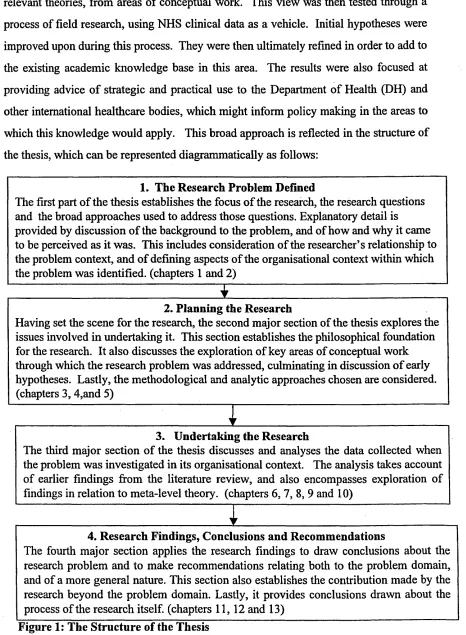
relevant theories, from areas of conceptual work. This view was then tested through a process of field research, using NHS clinical data as a vehicle. Initial hypotheses were improved upon during this process. They were then ultimately refined in order to add to the existing academic knowledge base in this area. The results were also focused at providing advice of strategic and practical use to the Department of Health (DH) and other international healthcare bodies, which might inform policy making in the areas to which this knowledge would apply. This broad approach is reflected in the structure of the thesis, which can be represented diagrammatically as follows:
3. Undertaking the Research
The third major section of the thesis discusses and analyses the data collected when the problem was investigated in its organisational context. The analysis takes account of earlier findings from the literature review, and also encompasses exploration of findings in relation to meta-level theory, (chapters 6, 7, 8, 9 and 10)
4. Research Findings, Conclusions and Recommendations
The fourth major section applies the research findings to draw conclusions about the research problem and to make recommendations relating both to the problem domain, and of a more general nature. This section also establishes the contribution made by the research beyond the problem domain. Lastly, it provides conclusions drawn about the process of the research itself, (chapters 11, 12 and 13)
2. Planning the Research
Having set the scene for the research, the second major section of the thesis explores the issues involved in undertaking it. This section establishes the philosophical foundation for the research. It also discusses the exploration of key areas of conceptual work through which the research problem was addressed, culminating in discussion of early hypotheses. Lastly, the methodological and analytic approaches chosen are considered, (chapters 3, 4,and 5)
1. The Research Problem Defined
[image:26.615.75.541.36.671.2]Chapter 2, The Organisational Context
Due to the nature of the problem, it is felt that it is important at this early stage to set the context for the research. Context both informs and dictates our understanding of practices inherent in the research domain. In order to establish that contextual setting, this chapter provides a description and discussion of the NHS as an organisation. The NHS of today is very much a product of social arrangements for the practice and organisation of healthcare prevailing before its inception. The history of the NHS is, therefore, addressed, starting with the situation before its inception in 1948, and including significant developments since then up to the present day. This discussion also provides an insight to the foundations of current roles and relationships amongst key actors in the research problem domain.
The discussion then continues to build a picture of the problem domain by describing the information systems at work there. The relationships between them are described in terms of the clinical data which flowed from one to the other. The systems included the medical casenote, which was manually created by the clinician and was the source of all clinical data thereafter. They also included several systems which were then used to process extracts of the contents of the medical casenote. These systems were computers, a coded, computerised nomenclature, statistical classifications, and statistical processes. People were addressed as part of the literature review and as part of the fieldwork. Discussion of them is included in the relevant chapters. A detailed organisational analysis is also provided as part of the discussion of the literature.
2.1 Before the NHS
board of trustees. These hospitals had no direct management. Their doctors did not, therefore, answer to a direct manager and to a large extent they managed themselves. They were in possession of enormous, independent power. This was based historically on the kind of expert and specialist knowledge that has made ‘professional syndicalism’ a feature of most, if not all, middle class professions.
The remaining hospital doctors worked at municipal hospitals. This was by far the larger of the two sectors. Local politicians controlled these hospitals at a macro level. At a local level they were controlled by a Medical Officer for Health who was, in effect, a doctor-manager. This person had great power, but within the constraints of direct management.
2.2 The Birth and Development of the NHS, 1948-1999
This was the situation into which the Government of 1948 introduced its proposals for a national health service. As noted by Cook (1987) its initial objectives were to:
‘ provide good medical care for all, free at the point of need ....’ (Cook, 1987: 11)
while receiving a salary from the NHS, doctors were allowed to dictate their own terms as to when and how they would work within it.
Thus, the expert power of clinicians persisted. No ‘outsider’ possessed the competence to judge practice, and no insider needed to, because practice was evidence of expertise, and expertise was a matter of judgement as well as skill. They continued to be nominally equal, fiercely independent and self-managing. Their actions, practices and general modus operandi, including production and provision of information, remained largely uncontrolled and uncontrollable by outsiders. The loyalty of the profession was, and remained, firmly and exclusively focused towards its patients, its members and its professional bodies. The latter was also the profession’s greatest and, for all practical purposes, only real source of both sanction and censure. The profession essentially, therefore, retained all of the power it previously held, in terms of autonomy, etc., and supplemented that with access to a pool of resources and a source of regular and guaranteed income.
This was largely the situation when the research was undertaken, the only potentially relevant development being the Internal Market.
2.3 The Internal Market and the Research Problem
The development of the Internal Market in healthcare in the 1990’s is worth consideration in terms of the situation which led to it. This is useful in order to fully appreciate the implications of the change for information within the NHS and, therefore, for the research problem.
This all changed again with the advent of the ‘Internal Market’. In the face of increasing demand for static or, in real terms, diminishing resources, every Government has espoused the view that the efficiency and effectiveness of the NHS must improve. However, the last Conservative administration also took the view that the traditional method of guaranteed annual funding offered insufficient incentive for this to happen. As a response to this the Internal Market was introduced.
This was a system which was being maintained by the Labour Government during the research, although the December 1997 White Paper, ‘The New NHS: Modem, Dependable’ (DH, 1997b) expressed an intention to modify it from 1999. The essence of the system was that, ultimately, hospitals would not receive any funding from central sources. This was being phased out so that during the research most hospitals still received a proportion of their funding in this way. Competitive packaging and marketing of healthcare services to GPs would acquire the remainder of the funding. GPs were provided with budgets from central funds to disburse on patient care, theoretically at least, anywhere within the NHS. They could also employ private practitioners where it could be justified. So, for example, a GP might traditionally have always sent hip replacement patients to the nearest local hospital. However, in the Internal Market, another hospital might convince the GP that their care was equally or more effective and cheaper. This persuasion could be achieved by use of local data, for instance, about shorter lengths of stay in hospital for given treatments or conditions, and low rates of readmission. The GP would be at liberty to send that work to the new hospital, which would then be appropriately reimbursed for the care delivered. Alternatively, or additionally, the GP might underpin any decisions of this nature by reference to published DH statistics.
In a different but equally significant way the activities of managers in the NHS was also affected by this changed operating environment. Managers, specifically Chief Executives of NHS hospitals, became responsible for the financial health of their organisations. This resulted in a much keener interest in the effectiveness and efficiency of clinical decisions than ever before. It was supposed by the researcher that this would partially manifest itself in a keen interest in clinical data.
The context of the problem was, therefore, one of deeply entrenched and significant structures and roles, but one in which change that had relevance for the research problem might be occurring.
2.4 NHS Systems and The Flow of Clinical Information
The remaining key elements of the context in which the research was undertaken were the information systems and flows. Because it is intended at this stage simply to provide a complete picture of the context, this section is largely confined to description and discussion of the systems’ external specifications and design purposes. This is followed by a description of the processes that linked them and the flow of clinical data through the NHS. This is, therefore, a first level analysis of them. Deeper explorations of systems types and of the specific systems at issue were undertaken later in the research, during the literature review and field research. They are, therefore, analysed in greater depth in the reports of those parts of the research.
2.4.1 The Medical Casenote
Each NHS hospital patient has a medical casenote. This is a file containing administrative details, for example demographic information, and a clinical sheet or document produced or added to solely by the clinician as a result of patent encounters. From the clinical perspective it appeared that the purpose of this document was as an action log. In other words, it was a document written by clinicians for clinicians, that was oriented possibly towards future action on the patient, possibly towards defence of past clinical action and opinion. It was used by the NHS as the main source of all clinical data for management purposes.
2.4.2 Patient Administration Systems (PAS)
PASs are modular information systems installed on hospital mainframe computers. Coders used these systems in order to complete their task. Access by coders to administrative and clinical coding modules was through remote terminals, linked to the central hospital databases. PASs were designed initially to collect patient administration data for local use and in order to fulfil statutory requirements for returns of data to the DH. With the addition of subsequent modules a variety of patient information could be collected and processed for a number of different users. This included clinical data of the type focused on by this research. All PASs offer users a number of field-based screens that are relevant to the particular module being accessed, the basic contents of which did not vary across the NHS.
2.4.3 The Read Coded Clinical Thesaurus, Version 3 (Read 3)
clinicians should enter their own data using this system, where it was used clinicians usually still completed medical casenotes as they always had, and these still went to coders. The coders then entered the data into the PAS by first using Read 3. They then achieved classification data through a mixture of manual work and automatic maps from Read 3 to ICD-10 and OPCS-4.
This system purports to move away from the inherent scientism of clinical classifications. It is, like all representational systems, a model of a view of the clinical domain, as it relates to both primary and secondary healthcare sectors. In terms of the detail of the model, it can be described as a concept-based systematised nomenclature. In other words, it is a system of terms which is elaborated according to pre-existing rules and has a concept system as its basic principle of organisation. Concepts are assumed to be non-linguistic abstract entities that are expressed by linguistic terms. Read 3 contains hundreds of thousands of clinical terms, catalogued by clinicians, and reflecting the words they normally use to describe their clinical work in the everyday care of patients. Types of data analysis to be undertaken were not specified at the design stage, beyond ensuring each clinical user could retrieve their own data as entered. Rules for use do not exist, and definitions of terms do not exist. To this extent Read 3 does not impose a framework.
The terms are arranged in a hierarchical file structure and each term has its own unique alphanumeric code. The code identifies the term and nothing else. It carries, for instance, no information about the place of the term in the conceptual hierarchy within which it sits.
This structure has knock-on effects for the ‘logical’ arrangement of some concepts within the system. A concept such as ‘pulmonary tuberculosis’ must appear twice, in both the ‘Respiratory Disorder’ and the ‘Infective Disorder’ hierarchies. A further feature of the system is that, in order to avoid a ‘term explosion’ and because of the area of the world it is addressing, Read 3 breaks ‘complex’ terms into what are known as ‘core terms’ and ‘qualifiers’. Therefore, ‘Emergency Appendectomy’ would appear as a core term of ‘Appendectomy’, with an option of selecting ‘Emergency’ from the available qualifiers. The grounds for deciding what is a core term and what is a qualifier seemed somewhat arbitrary.
Core terms are supplemented by synonyms, each also with their own unique code, but inextricably linked to their associated core term within the system. The criteria for deciding what was an acceptable core term or synonym was also somewhat arbitrary. Being in normal use by a number of clinicians seemed to be the most common criteria.
As mentioned above, the system holds no definitions of terms. Users are free to work with the terms in the contexts of their own frames of reference. The system gives no advice on what aspects of observed facts and medical language data should be reported or how it should be indexed. It just offers concepts (terms) for standardising medical language data in what was considered by the designers to be a passive manner, although this passivity is somewhat tempered by the existence within the system of established clinical relationships between entities. These relationships, however, broadly reflect clinical consensus, being based upon established texts and teachings in the field. In terms of definitions of clinical concepts and entities it is assumed that, at one level, users will apply their own definitions and meanings to the terms in the model. At another level it is hoped that groups will see the benefit to clinical care of being able to share clinical information about patients, and will be driven to agreeing and establishing definitions.
2.4.4 The International Statistical Classification of Diseases and Related Health Problems, Tenth Revision (ICD-10)
patient encountering the NHS must have defined clinical details coded according to one of these systems. As described above, this is either done manually using the medical casenote and the classification manuals or, where Read 3 was used as a front end, the codes in this classification were reached by means of mapping tables and some manual work. The differences in the levels of detail between these systems, which becomes more evident below, inevitably impact upon the original clinical data.
As its title suggests this is a statistical classification, i.e. an arrangement of concepts into classes and their subdivisions, expressing the semantic relationships between them. The criteria for subdivision are clear, and the division is exhaustive and exclusive. The characteristics used for subdivision reflect its purpose. It works, therefore, in a top- down, goal-oriented manner. In a statistical classification class frequencies do not differ too much from an equal distribution in some sort of reference population. Cote (1983) maintained that, in this sense, the ICD is not truly a statistical classification. Here the term ‘statistical classification’ should be defined as lists of statistically significant entities based predominantly on prevalence or considered importance.
ICD is produced and maintained by the World Health Organisation (WHO). The WHO (1993) defines its purpose as being:
‘.... to permit the systematic recording, analysis, interpretation and comparison of mortality and morbidity data collected in different countries or areas and at different times.’ (WHO, 1993: 2)
As noted by Porter (1995):
‘.... quantification is a technology of distance’. (Porter, 1995: ix)
characteristics and circumstances of the individuals affected. The WHO makes it clear that the ICD is neither intended nor suitable for indexing of distinct clinical entities. It is, however, routinely used in the NHS in this way. It also warns of some constraints on its use in billing or resource allocation, such as that engaged in by users of HRGs, which draw their data from ICD-10 and OPCS-4 data.
It was originally designed to classify causes of mortality as recorded on registration of death certificates. Its use and scope was only more latterly extended to include morbidity. The developers recognised that not every problem or reason for coming into contact with health services can be categorised as a disease or injury with a formal diagnosis. It also provides, therefore, a wide variety of signs, symptoms, abnormal findings, complaints and social circumstances that may take the place of a diagnosis in health records. Interestingly, NHS checks on the quality of ICD-10 data prohibit more than minimal use of these. Non-specific statements are deemed by DH statisticians to exist in medical casenotes only rarely.
ICD-10 can be used to classify data recorded under headings such as ‘ diagnosis’, ‘reason for admission’, ‘condition treated’, and ‘reason for consultation,’ all of which appear on the variety of health records from which statistics and other health-situation information are derived.
The ICD-10 classification is organised into hierarchical chapters, again reflective of the bureaucratic approach medicine takes. These are fully listed in Appendix 2. They include, for instance, Diseases of the Blood and Blood-Forming Organs and Certain Disorders Involving the Immune Mechanism; Congenital Malformations; Deformation and Chromosomal Abnormalities; Injury, Poisoning and certain other consequences of External Causes; Diseases of the Nervous System; Diseases of the Musculo-Skeletal System and Connective Tissues; and Symptoms, Signs and Abnormal Clinical Findings Not Elsewhere Classified.
Epidemic diseases
Constitutional or general diseases Local diseases arranged by site Developmental diseases Injuries
The first two and the last two of the groups listed above comprise ‘special’ categories, which bring together conditions that would be inconveniently arranged for epidemiological purposes if they were scattered. The remaining group includes the ICD chapters for each of the main body systems. The WHO (1993) warn that:
‘.... the distinction between the ‘special groups’ chapters and the ‘body systems’ chapters has practical implications for understanding the structure of the classification, for coding to it and for interpreting statistics based on it.’ (WHO,
1993:13)
They advise that generally, and where there is any doubt, conditions should be primarily classified to one of the special groups chapters.
Though the WHO admits the arbitrary nature of some of the characteristics of the ICD, they maintain that it has stood the test of time and is found to be a more useful structure for general epidemiological purposes than any of the others tested.
The basic ICD is a single coded list of three character categories, each of which can be divided up into ten four character sub-categories. Alphanumeric codes are used. Possible code numbers range from AOO.O to Z99.9. The letter ‘U’ is not used, being reserved for research purposes.
2.4.5 The Office of Population, Censuses and Surveys Classification of Surgical Operations and Procedures, Fourth Revision (OPCS-4)
This is the other mandated system for producing statutory data about NHS patients. This is a classification used for statistical purposes, although investigations to date do not indicate that statistics were the primary motive behind its design.
Its basic structure again follows the bureaucratic approach to medicine, with 23 anatomically-based chapters, most of which relate to procedures on the whole or part of a body system, e.g. Nervous System; Endocrine system and Breast; Eye; Ear; Respiratory Tract; etc. They follow the same principles as ICD-10 and are not, therefore, listed in an Appendix to this thesis.
Alphanumeric codes are used in a hierarchical structure. The authors maintain that:
\... strict anatomical allocation of operations has infused a readily understandable logic into the classification.’ (HMSO, 1990: viii)
This is interestingly described as necessary:
‘.... given the increased blurring of specialty boundaries.’ (HMSO, 1990: viii)
The classification contains over 10,000 coded labels.
Within each section procedures were generally sequenced in a way which was thought to reflect their comparative significance in resource use terms. This was done by arranging the procedures within each organ section in descending order of complexity, as understood in 1990. Notably this was before the emergence of ‘keyhole’ surgery as a main technique in surgery.
2.4.6 The Healthcare Resource (Statistical) Grouper (HRGs)
As with Read 3, it was not possible to collect primary data about the live use of this system. Once again, it is included for completeness.
At the time of the research this system was mandated for use in developing financial contracts for the sale and purchase of healthcare in some specialties within the NHS.
This statistical classification was designed for analysis of resource use in healthcare. It contains over 500 classes or groups. The system automatically draws its data from data classified using ICD-10 and OPCS-4 via a series of mapping tables. It implicitly follows the organising principles of ICD-10 and OPCS-4, although groups are labelled according to their HRG content as would be expected. Groups are not individually listed here due to their number. They are designed to contain disorders and treatments that have similarities, in that clinically they can be meaningfully grouped together and are also expected to consume similar amounts of healthcare resources. Thus they include, for example, groups titled Non-Surgical Treatment of Fibroids, Menstrual Disorders or Endometriosis; Spinal Cord Injury with Fusion or Depression; Complex Elderly with a Vascular System Primary Diagnosis; and Neonates with Multiple Major Diagnoses. Each group has an alphanumeric code.
2.4.7 NHS Clinical Data Flows
Clinician <„...> Patient
v
Medical record <... > clinicians (either manual or computerised via Read)
< c-— __ _
coding clerks
y
Coding clerk
v PAS
Read dataset > clinicians
> coding clerks
Maps and manual coding
y
^ ICD-10 and OPCS-4 datasets--- > Hospital managers > clinicians
i V
j D e p artm en t--- > Ministers
i of researchers
j Health clinicians
I hospitals
j DH depts.
y HRG grouper
[image:40.614.65.504.31.583.2]y HRG dataset
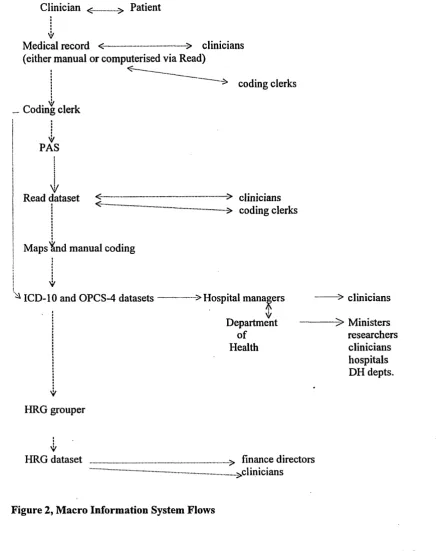
Figure 2, Macro Information System Flows
In the above model the flow of data through the systems progresses down the left- hand side. The right-hand side of the model describes those to whom the data is available.
Following the left side, clinicians engage in consultations with patients and produce from that a document, described here as the medical casenote. This is either solely in
clinicians deem relevant to patient care. The form and content of the medical casenotes can be idiosyncratic and incomplete. They can be composed of any of the following: clinical statements and observations, speculations, symbols, drawings, printouts, and numbers. As well as describing treatments, these often refer to illnesses, symptoms and conditions. They do not always contain, therefore, definitive diagnoses.
This data is then passed, either electronically or using the medical casenote, to coding clerks so that the clinical details of the consultation can be coded. The coding clerks do this by first accessing the patient’s administrative record, which is held on the PAS. This enables them to check, for instance, that they are coding the right patient. They then access the clinical coding module and enter the details of the patient’s condition(s) and treatment(s) if relevant. Certain data items from this collection are then manually abstracted from the medical casenote. They are then codified. Two alternatives are available for this initial coding process. They could be coded initially using Read 3. These codes would then be translated into their classification equivalents, using a mixture of manual coding and mapping tables. The mapping tables are software-based and contain the relationships between each thesaurus code and its classification equivalent(s). Alternatively, clinical data could be coded directly into ICD-10 and OPCS-4. This process would produce the ICD-10 and OPCS-4 statutory datasets used by hospitals and required by the DH and made available to its customers. Where Read was used it would also produce a Read database for use by the hospital.
ICD-10 and OPCS-4 coding is then sometimes followed by coding into the higher level classification, HRGs, using fully automated mapping schemes. This reclassifies the original coding in a different way for the purposes of analysing resource use in healthcare. It also produces an HRG dataset for use by the hospital.
Chapter 3 Addressing the Problem: Philosophical Considerations
3.1 Introduction
This chapter describes the philosophical issues which were addressed when starting to explore the research problem. Specifically, it describes how the researcher defined the problem situation in terms of key factors at work. It then explores the philosophical stance adopted by the researcher and seeks to make an argument for an open- mindedness amounting to a multi-view approach, particularly during the early stages. It also explores how that influenced definition of perceptions of the problem situation and the research problem itself. As noted by Popper (1957) the best we can do is write in a way which is consistent with a particular point of view, and that point of view ought to be clearly stated. The chapter also provides the rationale for the areas of theoretical work explored, which will be seen to span the philosophical divide of subjectivity and objectivity. Lastly, it provides the foundation for the approaches used in the field work stage of the project. As noted by Kirsch (1983):
‘ Perhaps the most obvious way philosophy can contribute to the human sciences is by questioning underlying methodological principles.’ (Kirsch, 1983:12)
3.2 Philosophy and the Researcher: Defining the Problem Situation
‘In order to know which design changes are really needed, it is first necessary to understand how various systems and structures fit and work together, what is the logic that holds them, what special peculiarities and relationships are essential, what constraints are unavoidable.’ (Kantrow, 1984: 41)
Thus, it was deemed relevant to this research that, as previously described, the NHS as an organisation was the product of an ‘agreement’ between the Government and the British medical profession in 1948. The nature of that agreement was of interest in terms of whether and how the consequently political character of the NHS might affect the research problem. In addition, the main objective of the Government in 1948 had apparently been, and ostensibly still was, to develop an organisation wherein the best medical care for all, free at the point of need, would be available. The core business would be patient care and the primary need to be satisfied would be that of the patient. The NHS was undeniably, therefore, the product of a particular political ideology which, it could be argued, was based on a belief that the State knows what is best for its people, and which forever placed the NHS firmly within the realm of public ‘ownership’ and political utility. This, in turn, characterised the demands to which non-clinical managers of the NHS would have to respond. These included, most significantly, that of public accountability, and methods of achieving and demonstrating that through information. Given that, account was taken of the work, for instance, of Barnes (1974, 1977) who considered such ideologically grounded knowledge as inherently including and concealing illegitimate interests. This was particularly interesting in terms of the NHS. As discussed by Mannheim (1970):
‘The higher the rank of an occupation, the more likely its is to have a highly developed occupational ideology.’ (Mannheim, 1970: 438)
‘What account of reality would lead others to act so that instead of furthering their own interests... .they furthered ours?’ (Barnes, 1977: 32)
Within this research, the extent to which this was so was particularly important from the perspective of understanding whether, when and where particular interests gained supremacy and what the ensuing effects were on knowledge gained and transferred.
It was also considered to be of relevance to examine the situation prior to inception of the NHS because medical models, power bases and relationships existing at that time were carried forward into the new NHS structure and persisted, in large part, to the period of the research. Thus, a focus was also placed on understanding whether the professional nature of clinical work had a bearing on the research problem. A key element of professional autonomy, which is discussed at greater length later in this thesis, is what might be termed ‘knowledge closure’ by professions, using various means, including language and other methods of communication. In other words, professionalism and its inherent autonomy both enable and are enabled by communication arrangements which are exclusive of non-members. This raised concerns about the validity of such knowledge and information when employed outside the direct clinical context.
Thus, clinical imperatives and public ownership, ideological derivation and political utility were considered to be worthwhile areas of study because of their potential influence on knowledge processing and use. The underpinning question revolved around the relativistic perception that, as noted by Urmson and Ree (1995):
‘What is true in one situation may not be true in another that the concepts used in one situation may be unintelligible in another....’ (Urmson and Ree, 1995: 275)
potential in explaining a situation where apparently subjective opinions emerged, after passage through a series of social circumstances and events, as ‘objective facts’.
Moving down a level into the processes of the organisation, the information in question passed through a number of handling centres, involving people, hardware, software and manual systems. Each of these would, therefore, also receive attention.
The above description of the key factors at work in the problem domain represents the researcher’s perception of some part of ‘reality’, namely the people, technology, structures, tasks and processes associated with the generation and use of specific sets of NHS clinical knowledge, data and information. This is a wide scope, and reflects two factors. Firstly, it reflects the researcher’s previous exposure to all parts of the process involved in the research problem, which indicated the need for such a focus. Secondly, it reflects the researcher’s belief that the context of the problem was organisational and that an organisation is not a machine, but what Checkland (1981:14) describes as a ‘human activity system’. In other words, the context involves a dynamic, complex and purposeful system of social relationships, including people, technology, structures, tasks and processes (taken from Jayaratna’s (1994: 59) modification of Leavitt’s (1972) model). This was not to discard notions of scientific mechanism, but rather to widen the method of enquiry sufficiently to ensure that both those concepts and humanistic, interpretive notions could be accommodated. A focus on all of the elements was deemed necessary to generating explanatory hypotheses.
The word ‘deemed’ is important, because the early stages of the research were intended to produce hypotheses which would later be tested and developed. The desire here was to ensure that, while not extending to random explorations, the scope did not exclude potentially important areas at an early stage.
‘....problem solvers, by being human, tend to select some elements of the situation as being relevant and useful for study...’ (Jayaratna, 1994: 64)
As he goes on to note, sometimes this selection is unconscious and based on unexamined assumptions, and sometimes it is based on explicit models and methodologies that are employed, although the author would argue that both assumptions and methodologies can be mutually influential. What is clear, however, is that individuals approach and understand situations via a cognitive framework or ‘mental construct’ (Jayaratna, 1994: 64). This can vary from individual to individual and have influential effects on what is perceived and how.
Among the characteristics active in influencing a researcher’s choices, Jayaratna (1994) goes on to identify such factors as the researcher’s perceptual process, which filters information from the real world and determines significance. He identifies values or beliefs assimilated from various societal sources, like peer groups and parents, and guiding choices between alternatives by helping individuals to pass judgement on situations, etc. He also includes ethics or expected standards and types of behaviour; motives, or needs individuals seek to satisfy; prejudices, or persistent opinions; experiences; reasoning ability and knowledge and skills. He further includes role characteristics, i.e. those that are assumed as part of holding responsibility for particular tasks. Lastly, he includes structuring processes or ways of structuring our thinking, whether or not we have access to methodologies, models and frameworks. Frameworks are described in this context as static structures which show the connections between a set of models. Jayaratna argues that the elements of this mental construct act together in a dynamic way in the process of enabling individuals to make sense of and negotiate reality.
3.2.1 Worldviews and Their Validity
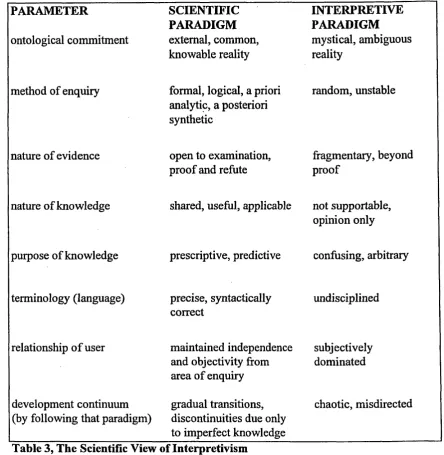
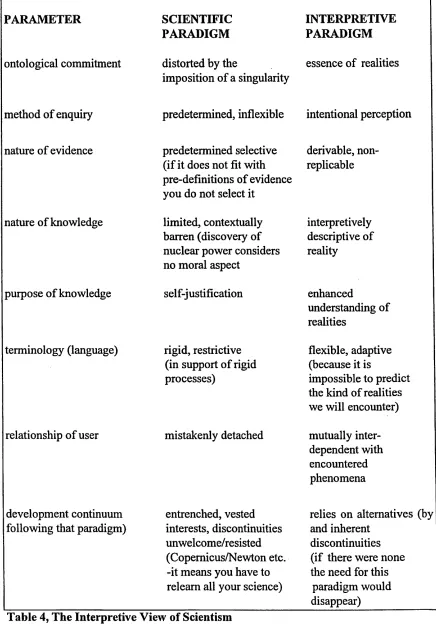
Fundamental to the mental construct described above are our beliefs about the nature of reality itself and our consequent beliefs on investigating it. The concepts of ‘subjectivity’ and ‘objectivity’, and of scientific and interpretive approaches to reality are significant here. Development and justification of an approach to exploring this problem clearly involved a need to explicitly clarify, first of all, what these positions meant to the researcher. The following tables, which draw on unpublished work by D’Arcy (1989) sought to do this and to create a foundation for the rationale behind the initial and subsequent approach used in this research. This approach is developed further later in the thesis, when research methods in connection with fieldwork are described and the role of the researcher in this regard is fully explored.
The framework distinguishes philosophically between the scientific and interpretive paradigms by means of laying out what are considered to be the key parametric characteristics of a paradigm. The term paradigm is used here to represent a commonality of perspective which binds the work of a group of theorists together in such a way that they can usefully be regarded as approaching social theory within the bounds of the same problematic. Each paradigm, therefore, has an underlying unity in terms of its basic, and often taken for granted, assumptions. In a very fundamental way these separate theorists located in one paradigm from those in another.
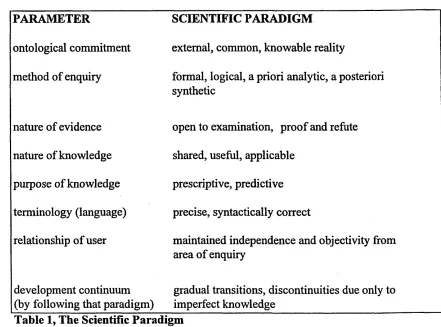
has strengths and weaknesses in relation to a particular worldview, and ultimately to show those strengths and weaknesses in relation to understanding particular types of phenomena. The first table describes the parameters of the scientific paradigm as seen from the perspective of the scientist:
PARAMETER SCIENTIFIC PARADIGM
ontological commitment external, common, knowable reality
method of enquiry formal, logical, a priori analytic, a posteriori synthetic
nature of evidence open to examination, proof and refute
nature of knowledge shared, useful, applicable
purpose of knowledge prescriptive, predictive
terminology (language) precise, syntactically correct
relationship of user maintained independence and objectivity from area of enquiry
development continuum
[image:49.615.60.501.136.463.2](by following that paradigm) gradual transitions, discontinuities due only to imperfect knowledge
Table 1, The Scientific Paradigm
However, this approach has two other major characteristics. Firstly, it rejects notions of experiential realities which are unique to individuals. Thus, the role of the clinician as investigator into that reality would be perceived as being independent of it. This would mean that clinicians must be a neutral medium in terms of the representations of reality which they made. The researcher’s professional experiences indicated this was not the case, although management actions indicated it was. Also, if the ‘user’ referred to above was completely independent of the object of enquiry, how would this paradigm explain its notion that discontinuities are due to imperfect knowledge? Knowledge resides within the individual and there is, therefore, an undeniable human influence at work.
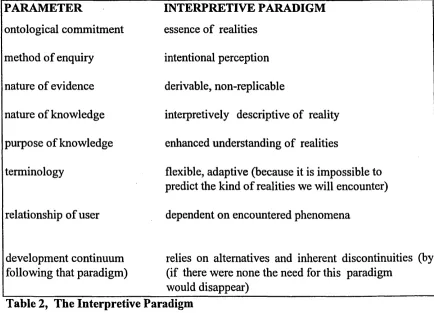
Turning now to the interpretivist approach, the following table describes the above paradigmatical parameters applied to the interpretivist position:
PARAMETER INTERPRETIVE PARADIGM
ontological commitment essence of realities
method of enquiry intentional perception
nature of evidence derivable, non-replicable
nature of knowledge interpretively descriptive of reality
purpose of knowledge enhanced understanding of realities
terminology flexible, adaptive (because it is impossible to predict the kind of realities we will encounter)
relationship of user dependent on encountered phenomena
development continuum
following that paradigm) relies on alternatives and inherent discontinuities (by (if there were none the need for this paradigm would disappear)
[image:50.615.69.503.335.648.2]The basis of this philosophical stance is that reality is relative to the individual’s perception of it. It cannot, therefore, be conceptualized as commonly knowable entities with regular relationships between them. This is a very different perspective, reflected in the work for instance of Barnes (1974) who asserts that all knowledge claims exist in the form we know them:
c.... as a response to particular interests in prediction and control, which are in turn related to social interests.’ (Barnes, 1974: 30)
For the research problem it would imply that the clinician was influential and that known clinical reality was not a concrete phenomena. If that was the case nothing could ever be known with certainty, and if that was the case the question was raised as to how medical effectiveness, e.g. in treating heart disease, could ever be explained.
PARAMETER
ontological commitment
SCIENTIFIC PARADIGM external, common, knowable reality
INTERPRETIVE PARADIGM
mystical, ambiguous reality
method of enquiry formal, logical, a priori analytic, a posteriori synthetic
random, unstable
nature of evidence open to examination,
proof and refute fragmentary, beyond proof
nature of knowledge shared, useful, applicable not supportable, opinion only
purpose of knowledge prescriptive, predictive confusing, arbitrary
terminology (language) precise, syntactically
correct undisciplined
relationship of user maintained independence and objectivity from area of enquiry
subjectively dominated
development continuum
(by following that paradigm) gradual transitions, discontinuities due only to imperfect knowledge
[image:52.615.62.507.52.508.2]chaotic, misdirected
Table 3, The Scientific View of Interpretivism
Thus science perceives interpretive accounts of reality to be fragmentary and beyond proof. It perceives interpretive method to be random and unstable, and the object of enquiry to be contaminated by researcher or user involvement.
PARAMETER SCIENTIFIC
PARADIGM INTERPRETIVEPARADIGM
ontological commitment distorted by the
imposition of a singularity essence of realities
method of enquiry predetermined, inflexible intentional perception
nature of evidence predetermined selective (if it does not fit with pre-definitions of evidence you do not select it
derivable, non- replicable
nature of knowledge limited, contextually barren (discovery of nuclear power considers no moral aspect
interpretively descriptive of reality
purpose of knowledge self-justification enhanced
understanding of realities
terminology (language) rigid, restrictive (in support of rigid processes)
flexible, adaptive (because it is
impossible to predict the kind of realities we will encounter)
relationship of user mistakenly detached mutually inter dependent with encountered phenomena
development continuum
following that paradigm) entrenched, vested interests, discontinuities unwelcome/resisted (Copernicus/Newton etc. -it means you have to relearn all your science)
relies on alternatives (by and inherent
discontinuities (if there were none the need for this
[image:53.612.65.501.37.668.2]