ProQuest Number: 10701303
All rights reserved INFORMATION TO ALL USERS
The qu ality of this repro d u ctio n is d e p e n d e n t upon the q u ality of the copy subm itted. In the unlikely e v e n t that the a u th o r did not send a c o m p le te m anuscript and there are missing pages, these will be note d . Also, if m aterial had to be rem oved,
a n o te will in d ica te the deletion.
uest
ProQuest 10701303
Published by ProQuest LLC(2017). C op yrig ht of the Dissertation is held by the Author.
All rights reserved.
This work is protected against unauthorized copying under Title 17, United States C o d e M icroform Edition © ProQuest LLC.
ProQuest LLC.
789 East Eisenhower Parkway P.O. Box 1346
The Economic Importance of Sport
A Case Study of Sheffield
Larissa E. Davies
A thesis submitted in partial fulfilment of the requirements of
Sheffield Hallam University
for the degree of Doctor of Philosophy
ABSTRACT
Over the last decade, the concept of using sport for regeneration purposes has gained increasing credibility in a number of cities throughout the UK. Despite this, little is known about the economic importance o f sport at the local level. Although research has been carried out on the economic activity generated through sport since the mid 1980s (Henley Centre for Forecasting, 1986), the majority of studies have been undertaken at the national and regional level. This thesis investigates the economic importance of sport at the local level, using Sheffield as a case study. It represents the first study of sport-related economic activity to be carried out at the city level, in the UK.
Following a critical evaluation o f the feasible methodologies for measuring the economic importance o f sport at the local level, the National Income Accounting framework was found to be most appropriate for measuring sport-related economic activity in Sheffield. To satisfy the data requirements of this framework, extensive primary data collection was undertaken in the voluntary, consumer and commercial sport sectors using questionnaires and structured interviews. This was used, together with data collected from secondary sources and previous economic impact studies in the UK, to estimate the value-added and employment created from sport-related economic activity in Sheffield.
The findings o f the research revealed that the economic importance o f sport in Sheffield in 1996/97 was approximately twice the level predicted from current national estimates'. The value-added by sport-related economic activity was found to be £165.61 million, which was approximately 4.11% o f GDP in Sheffield in 1996/97, compared with just 1.61% of GDP at the national level (LIRC, 1997). Whilst a number of explanations for these findings are explored within the thesis, one of the most significant findings o f the research is that previous estimates, established in other studies on the economic importance of sport in the UK, have been inaccurate and have essentially underestimated the size of the sport-related economic activity.
LIST OF CONTENTS
L i s t o f T a b l e s I
L i s t o f F i g u r e s V
A b b r e v i a t i o n s VI
G l o s s a r y IX
A c k n o w l e d g e m e n t s XI
Ch a p t e r o n e. In t r o d u c t i o n 1
1.1 Economic change and the development of the sports industry 2 in Sheffield
1.2 Aims and objectives of the research 7
Ch a p t e rt w o. Li t e r a t u r e Re v i e w 9
2.1 Consumer services and economic regeneration 9
2.1.1 The geography of consumer services: growth and location 10
2.1.2 Consumer services as wealth creators 11
2.1.3 Sport and local economic development 12
2.1.4 Cultural policy and urban development 13
2.2 Economic impact and importance studies 15
2.2.1 Measuring the economic impact and importance of tourism 16 and the arts
2.2.2 Measuring the economic impact and importance of sport 17
2.2.2.1 The econom ic importance o f the sports industry: 18 European studies
2.222 The econom ic importance o f the sports industry: 24
UK studies
2.2.2.3 Wider econom ic benefits o f sport 37
2.3 Summary 39
C h a p t e r t h r e e . A n a l y t i c a l F r a m e w o r k 41
3.1 Methodological review 41
3.1.1 Multiplier analysis 42
3.1.1.1 Economic Base approach 43
3.1.1.2 Keynesian approach 45
3.1.2 Input-Output analysis 49
3.2 The NIA framework 61
3.2.1 The NIA framework and the circular flow of income 61 3.2.2 The NIA framework: methodological considerations 64
3.2.2.1 The sectoral accounts 64
3.2.2.2 The definition of sport 69
3.3 The Base model 73
3.3.1 Derivation of the Base model 74
3.3.2 The economic importance of sport: The Base model 74
3.4 Summary 76
C h a p t e r f o u r . R e s e a r c h M e t h o d o l o g y 78
4.1 Quantitative or qualitative research? 78
4.2 Reliability and validity 80
4.2.1 Reliability 80
4.2.2 Validity 81
4.3 Research design 82
4.3.1 Research methods 84
4.3.2 Research techniques 86
4.3.2.1 Evaluating the methods o f administering a questionnaire 87
4.4 Data collection 90
4.4.1 Primary data collection 92
4.4.1.1 The voluntary sector 92
4.4.1.2 The consumer sector 101
4.4.1.3 The commercial sport sector 107
4.4.2 Secondary data collection 112
4 .5 Summary 1 1 4
Ch a p t e r f i v e. An a l y s i s o ft h e v o l u n t a r y s e c t o r 1 1 5
5.1 Profiling the voluntary sector: results 1 1 6
5.1.1 Characteristics of the voluntary sector 117
5.1.2 Core voluntary clubs 119
5.1.2.1 Profiling the core voluntary clubs 122
5.1.3 University sports clubs 132
5.1.3.1 Profiling the university clubs 133
5.1.4 Sport and Social Clubs and Working Mens Clubs 136
5.2 Aggregating the voluntary sector 140
5.2.1 Methodology 140
5.2.2 Income and expenditure profiles 142
5.2.2.1 Comparison between types o f voluntary clubs 148
5.2.3 Valuing volunteers in Sheffield 149
5.2.4 Sample bias in the voluntary sector 151
5.3 Summary 152
Ch a p t e r s i x. Co n s u m e r e x p e n d i t u r e o n s p o r t 1 5 3
6.1 Profiling consumer expenditure: results 154
6.1.1 Part A: The Sheffield Leisure Survey 154
6.1.1.1 Demographic characteristics o f the respondents 154 6.1.1.2 Behavioural patterns: sports participation 156 6.1.1.3 Behavioural patterns: sports spectating 160
6.1.1.4 The typology o f sports behaviour 162
6.1.2 Part B: The Consumer Expenditure Survey 164
6.1.2.1 Sports participation 166
6.1.2.2 Sports spectating 170
6.1.2.3 Sports goods 172
6.1.2.4 Expenditure on others doing and watching sport 173 6.1.2.5 Expenditure on sport outside the area: sporting holidays 175
6.2 Aggregating the consumer sector 176
6.2.1 Methodology 176
6.2.2 Consumer expenditure on sport by Sheffield residents 178
6.2.1.1 Expenditure on participation in Sheffield 178 6.2.1.2 Expenditure on spectating in Sheffield 182 6.2.1.3 Expenditure on sports goods in Sheffield 184 6.2.2.4 Other consumer expenditure in Sheffield 185
6.2.2.5 Expenditure on sporting holidays ' 185
6.2.3 Explaining consumer expenditure on sport in Sheffield 187
6.3 Summary 189
Ch a p t e rs e v e n. An a l y s i s o ft h e c o m m e r c i a ls e c t o r 1 9 0
7.1 Profiling the commercial sport sector 190
7.1.1 Sports services 192
7.1.1.1 Professional sports clubs 193
7.1.1.2 Commercial Leisure 200
7.1.2 Sports goods 202
7.1.2.1 Manufacturing 202
7.2 Aggregating the commercial sport sector 208
7.2.1 Methodology 208
7.2.2 Income and expenditure profile: sports services 209 7.2.3 Income and expenditure profile: sports goods 213 7.2.4 Capital expenditure in the commercial sport sector 216 7.2.5 Employment in the commercial sport sector 216
7.3 Summary 217
C h a p t e r e i g h t . S e c o n d a r y d a t a A n a l y s i s 218
8.1 The local government sector 218
8.1.1 Sheffield City Council (SCC) 221
8.1.2 Sheffield International Venues (SIV) 223
8.2 Economic impact of sports events 226
8.3 Consumer expenditure 228
8.4 Secondary data collection: The base model 231
8.5 Summary 232
Ch a p t e r n i n e. Th e e c o n o m i c s i g n i f i c a n c eo ft h e s p o r t in Sh e f f i e l d 2 3 3
9.1 The sectoral accounts 233
9.2 Value-added 238
9.3 Employment 242
9.4 Summary 244
C h a p t e r t e n . D i s c u s s i o n 245
10.1 Explaining the economic significance of sport in Sheffield 246
10.1.1 Measuring the economic importance o f sport 246
10.1.1.1 Data reliability and validity 247
10.1.1.2 Estimating sport-related econom ic activity 252
10.1.2 The spatial distribution of sport-related economic activity 254 10.1.3 The importance o f the commercial sector 256
10.2 The role of sport in economic regeneration 258
10.2.1 Sport as a wealth creator 258
10.2.2 Sport as a base industry 260
10.2.2.1 External generating capacity 261
10.3 Sport and local economic development in Sheffield 265
10.3.1 A review o f Sheffield’s sports led strategy 266
10.3.2 Developing sport in the future 268
10.4 The value of research at the city level 271
10.4.1 Data collection 271
10.4.2 Providing information for policy makers 273
Ch a p t e r e l e v e n. Co n c l u s i o n 276
11.1 Findings of the study 276
11.2 Implications and recommendations for further work 279
Bib l io g r a p h y
Ap p e n d ic e s
Appendix 1: Input-Output Analysis
Appendix 2: Activities included in the definition o f sport
Appendix 3: The Base Model
Appendix 4: Maps o f Sheffield
Appendix 5: Voluntary sector questionnaires
Appendix 6: Consumer sector questionnaires
Appendix 7: Commercial sport sector questionnaires
Appendix 8: Voluntary sector analysis
Appendix 9: Consumer sector analysis
Appendix 10: Commercial sport sector analysis
Appendix 11: Secondary data analysis
LIST OF TABLES
Table 2.1 Distribution o f sports expenditure by type of sports person 20 Table 2.2 Distribution o f per capita sports expenditure by type o f 20
sports person
Table 2.3 Expenditure categories by type o f sports person 21 Table 2.4 Distribution of sport-related expenditure by sex 21
Table 2.5 GRSP for Flanders 1996 and 1982 23
Table 2.6 Economic importance studies: UK 25
Table 2.7 Data collection: UK studies - voluntary sector 30 Table 2.8 Summary of voluntary sector data collection: UK 31
economic impact studies
Table 3.1 The 1990 coefficient matrix for sports 54
Table 3.2 The 1990 Leontief inverse for sports 55
Table 3.3 Summary of the practicalities and limitations of economic 60 methods under review
Table 3.4 Aspects of sport-related final expenditure included in 71 European economic impact studies
Table 3.5 The Base model: sport-related income and expenditure 75 flows 1996/7
Table 3.6 The Base model: value-added by sport-related economic 76 activity 1996/97
Table 4.1 A summary o f the advantages and disadvantages of 87 administering questionnaires
Table 4.2 Results of the core voluntary club pilot 97
Table 4.3 Core voluntary clubs: response by sport 98
Table 4.4 Reasons for non response: core voluntary clubs 99 Table 4.5 Summary of response rate: university sports clubs 100
Table 4.6 Summary of response rate: SSC and WMC 100
Table 4.7 Reasons for non response: WMC 100
Table 4.8 Sample and response rate: Part A 106
Table 4.9 Sample and response rate: Part B 107
Table 4.10 Sample and response rate: professional sports clubs and 109 commercial leisure
Table 4.12 Sample and response rate: sports retailers 112
Table 5.1 Summary of responses: voluntary sports clubs 116 Table 5.2 Characteristics o f the voluntary sector: mean values 117
Table 5.3 Size of sports clubs in Europe 118
Table 5.4 Average club size across selected sports 120
Table 5.5 Pearson correlation coefficients: core voluntary clubs 122 Table 5.6 Proportion o f income by each item: core voluntary clubs 124 Table 5.7 Proportion of current expenditure by each item: core 126
voluntary clubs
Table 5.8 Income and expenditure by clusters o f sports 128 Table 5.9 Mean capital expenditure, volunteers and club employees: 129
core voluntary clubs
Table 5.10 Volunteer characteristics by sports clusters 131
Table 5.11 Turnover: university sports clubs 132
Table 5.12 Spearman correlation coefficients: university clubs 133
Table 5.13 Income and expenditure: university clubs 134
Table 5.14 Volunteers and club employees: university clubs 136 Table 5.15 Turnover of clubs in the voluntary sector 137
Table 5.16 Income and expenditure: S S C and WMC 138
Table 5.17 Volunteers and club employees: SSC and WMC 140 Table 5.18 The voluntary sector: income and expenditure profiles 143 Table 5.19 Income and expenditure profile: The Base model 144 Table 5.20 Analysis of income profiles in the voluntary sector: 145
selected UK studies
Table 5.21 Analysis of expenditure profiles in the voluntary sector: 146 selected UK studies
Table 5.22 Core voluntary clubs: aggregated income and expenditure 149 Table 5.23 Volunteers in Sheffield: all sports clubs 150
Table 6.1 Sex of respondents: Part A 155
Table 6.2 Age of respondents: Part A and the 1991 Census 155
Table 6.3 Sports participation rates 156
Table 6.4 Participation rates according to age: 1996 GHS 158 Table 6.5 Participation in various sports activities during the last 4 158
Table 6.6 Participation in sport: sex 159 Table 6.7 Participation in various sports activities during the last 4
weeks: sex
159
Table 6.8 Participation in the last 4 weeks: sex 160
Table 6.9 Sports spectating: Part A respondents 161
Table 6.10 Attending a sporting event: age 162
Table 6.11 Typology of Part A respondents 164
Table 6.12 Typology of Part B respondents 165
Table 6.13 Pearson’s bivarate correlation and significance level matrix 166 Table 6.14 Average expenditure on participating in sport within
Sheffield during last 12 months
167
Table 6.15 Average expenditure on participating in sport within Sheffield during last 12 months
167
Table 6.16 Average expenditure by sporting activity on last occasion 169 Table 6.17 Average expenditure on attending sporting events within
Sheffield during the last 12 months
171
Table 6.18 Expenditure on sports goods in Sheffield during the last 12 months
173
Table 6.19 Average expenditure on sporting holidays during last 12 months
175
Table 6.20 Weighted typologies for age and sex: Part A respondents 177
Table 6.21 Profile of Sheffield resident population 177
Table 6.22 Consumer expenditure by residents in Sheffield: primary data (last 12 months)
180
Table 6.23 Consumer expenditure: Base model - selected items 181
Table 6.24 Expenditure of sports goods in Sheffield 184
Table 6.25 Consumer expenditure on sporting holidays 186
Table 6.26 Consumers expenditure on sport using the typology and average values
187
Table 7.1 Responses to the commercial sector surveys 191
Table 7.2 Turnover of professional sports clubs in Sheffield 193 Table 7.3 Income and expenditure profile: SWFC 1996/97 195 Table 7.4 Income and expenditure profile: SUFC 1996/97 197 Table 7.5 Income and expenditure profile: other professional clubs 199
Table 7.7 Average income and expenditure: commercial leisure 201 Table 7.8 Analysis of sports equipment manufacturers by turnover 203 Table 7.9 Average current expenditure: sports manufacturing 204 Table 7.10 Sports goods market: channels of retail distribution in the 205
UK 1996
Table 7.11 Current expenditure: sports retailers in Sheffield 207 Table 7.12 Income and expenditure profile: professional sports clubs 211
in Sheffield
Table 7.13 Income and expenditure profile: commercial leisure 212 Table 7.14 Income and expenditure profile: sports manufacturers 214 Table 7.15 Income and expenditure profile: Sports retailers 215 Table 7.16 Capital expenditure: commercial sport sector 216
Table 7.17 Employment: commercial sport sector 216
Table 8.1 UK Studies: Local Government income and expenditure 219 Table 8.2 Income received by Sheffield Leisure Services from 222
sport-related activities
Table 8.3 Expenditure by Sheffield Leisure Services on sport-related 222 activities
Table 8.4 Income and expenditure: Sheffield International Venues 224 Table 8.5 Income and expenditure: SLS, SIV, Base model 225 Table 8.6 The economic impact of sports events staged in Sheffield 227 Table 8.7 Secondary data collection: consumer expenditure on sport 229
Table 9.1 Sport-related income and expenditure flows in Sheffield 234 Table 9.2 Sectoral accounts: voluntary sector income 235 Table 9.3 Sectoral accounts: voluntary sector expenditure 235
Table 9.4 The expenditure flows matrix 237
Table 9.5 Value-added from sport-related economic activity in 239 Sheffield: actual and predicted figures
Table 9.6 Output by industrial category in Sheffield 1996/97 241 Table 9.7 Total employed in sport-related economic activity in 242
Sheffield (FTE)
Table 9.8 Employment by industrial sector in Sheffield 1997 243
LIST OF FIGURES
Figure 2.1 Model of the relationship between sport and the wider 38 economic benefits
Figure 3.1 The simple economy: circular flow of income 62
Figure 3.2 The complete model o f the economy 62
Figure 3.3 Measuring GDP: income = expenditure = output 63 Figure 3.4 Definition of the commercial sport sector 67
Figure 4.1 A range o f methods of research and techniques of data 85 collection
Figure 4.2 Boundary o f the research 91
Figure 5.1 Mean membership: Core voluntary clubs 121
Figure 6.1 Participation of Part A respondents according to age 157 Figure 6.2 Events watched during the last 4 weeks: Part A respondents 161 Figure 6.3 Mean expenditure on participation by sporting activity 168 Figure 6.4 Weekly average expenditure on sports goods 172
Figure 7.1 All sports retail shops in Sheffield: Sales turnover 206
Figure 8.1 The intra and inter relationships within local government 220 and between other sectors o f the sports industry in
ABBREVIATIONS
CBA Cost Benefit Analysis
CBCT Chapeltown Baths Community Trust
CG Central Government
CIPFA Chartered Institute o f Public Finance and Accountancy
CNS Commercial Non Sport
CONS Consumer
CS Commercial Sport
CSO Central Statistical Office CVM Contingent Valuation Method
DCMS Department for Culture, Media and Sport DSO Direct Service Organisations
DTI Department of Trade and Industry Euro 96 European Football Championships 1996 FES Family Expenditure Survey
FT Full Time
FTE Full Time Equivalent
GB Great Britain
GDP Gross Domestic Product GHS General Household Survey GNP Gross National Product GRP Gross Regional Product
GRSP Gross Regional Sports Product
JICNARS Joint Industry Committee for National Readership Survey KES King Edwards Swimming pool
LCS Local Cultural Strategy LEA Local Education Authority
LG Local Government
LIRC Leisure Industries Research Centre LSD Leisure Services Department NIA National Income Accounting
NSVA National Survey o f Voluntary Activity NTS National Travel Survey
ONS Office for National Statistics OUT Outside (Sheffield)
PP Per Person
PT Part Time
PW Per week
RCC Regional Cultural Consortium RDA Regional Development Agency RPI Retail Price Index
RSL Research Services Limited
see
Sheffield City CouncilSCLG Sheffield City Liaison Group SCT Sheffield City Trust
SDC Sheffield Development Corporation
SERC Sheffield Economic Regeneration Committee SHU Sheffield Hallam University
SIS Sheffield Information Service SIV Sheffield International Venues SSC Sports and Social Club
su
The University of SheffieldSUFC Sheffield United Football Club SWFC Sheffield Wednesday Football Club
T1 Type 1 respondent
T2 Type 2 respondent
T3 Type 3 respondent
T4 Type 4 respondent
T5 Type 5 respondent
T 6 Type 6 respondent
TEC Training and Enterprise Council
UK United Kingdom
UKSI United Kingdom Sports Institute
US United States
V2 Voluntary sector pilot questionnaire: Version 2 V3 Voluntary sector pilot questionnaire: Version 3
VOL Voluntary
WMC Working Mens Club
GLOSSARY
Factor cost
Factor expenditure
Factor income
Factor surplus
Final good
Gross Domestic Product (GDP)
Gross National Product (GNP)
Intermediate good
Market prices
National Income
National Income Accounting
Net National Product (NNP)
Transfers
A valuation o f the national income which excludes indirect taxes, net o f subsidies
Payments made to the factors which contribute to output e.g. wages paid to employees
Payments received by the various elements which contribute to the output o f an economy e.g. revenue gained from bar, clothing and food sales in the voluntary sector, wages received by employees of the sports industry, the rent received for land
The difference between factor income and factor expenditure
A good directly used by its ultimate consumer
The total output of goods and services produced within a given country in a particular time period
The total output o f goods and services produced by a country in a given period, plus the value of net property income (investments) from abroad, over a specific time period
A good used in the production of another
A valuation o f the national income which includes indirect taxes, net of subsidies i.e. the value of output in terms of what it would cost the consumer
The monetary value of goods and services resulting from the economic activities of the residents o f a country over a given time period
A measurement system used to estimate the total national income and its components
Gross National Product minus depreciation
Type 1 respondent (Tl)
Type 2 respondent (T2)
Type 3 respondent (T3)
Type 4 respondent (T4)
Type 5 respondent (T5)
Type 6 respondent (T6)
Value-added
Not participated in sport in the last 12 months
Participated sometime in the last 12 months but not in the last 4 weeks
Participated on one occasion in the last 4 weeks
Participated on 2-4 occasions in the last 4 weeks
Participated on 5-10 occasions in the last 4 weeks
Participated on more than 10 occasions in the last 4 weeks
ACKNOWLEDGEMENTS
I would like to express my thanks to the following people without whom the task of completing this thesis would have been considerably more difficult.
I would firstly like to thank my director of studies, Professor Chris Gratton for his guidance throughout the duration of my PhD. In particular, I would like to thank him for keeping me motivated and for his critical but constructive comments on my written work. Also, for not making me fully realise how far away my first draft was from completion. I would also like to thank my supervisor Professor Peter Taylor for helpful comments during the primary research stage.
Collecting primary data for any research o f this type can be an arduous task, however the help I received from staff at Sheffield City Council, in particular Paul Billington, Keith Crawshaw and Nick Mahy, who made this task much easier. A special thanks must also go to Heidi Witt for providing me with her database of voluntary organisations in South Yorkshire, which saved me many hours of tedious research. I am extremely appreciative of all those who filled in my questionnaires and were kind enough to allow me to interview them, particularly Mike Bracewell and Alan Joynes.
The support I have received from colleagues at Sheffield Hallam University has been invaluable throughout my PhD. Firstly, I would like to thank the technical staff in the School o f Leisure and Food Management, particularly to Dave, Ray and Andy for rescuing my work on many occasions. Thanks must also go to Paul Cormack for insightful comments on the analytical framework, to Paula, Graham and Keith for providing moral support during the writing up phase and to Themis, for allowing me to use his model and share his infinite wisdom!
CHAPTER ONE. INTRODUCTION
Over the last decade, the concept of using sport for economic and social regeneration has gained increasing credibility in a number of cities throughout the UK. Despite this, little evidence is available about the economic importance o f sport at the sub-regional and local level. Although research has been carried out on the economic activity generated through sport since the mid 1980s (Henley Centre for Forecasting, 1986), the majority o f studies in the UK have been carried out at the national and regional level. Only one economic impact study has been carried out at the local level (Henley Centre for Forecasting, 1989). However, this was not undertaken within a major city. Therefore, while cities such as Birmingham, Manchester and Sheffield are now developing sport-led strategies for regeneration purposes, no evidence exists to inform such policy initiatives.
Given this lack of evidence, there is clearly a need to investigate the amount of economic activity generated through sport at the local and in particular, the major city level, to provide policy makers with information on the economic importance o f sport. This research therefore uses a case study o f Sheffield to examine the contribution of sport to value-added1 and employment and to examine the role o f sport in regeneration at the local level. This research follows on from a tradition o f work on the economic importance of sport, initially developed by the Henley Centre for Forecasting (1986), which as outlined above has mainly been carried out at the national and regional level the UK. It uses the spreadsheet model constructed by Gratton and Kokolakakis (1997) for measuring the economic importance of sport in England, in order to derive a model for estimating the economic importance of sport in Sheffield.
Although the research focuses specifically on the economic importance of sport in Sheffield, the research will provide a platform from which to develop further studies on the economic importance of sport at the local level. Sport is now considered to be a cultural industry (DCMS, 1999) and the need for every Local Authority in England to develop a Local Cultural Strategy by 2002, which is essentially a vision of how an area
intends to develop its cultural services, indicates that an increasing number of cities are likely to place a substantial emphasis on evaluating the role o f sport in economic and social regeneration in the future.
This chapter will set the context for the research by outlining the changing economic climate in which the sports sector in Sheffield has developed and the key organisations which were instrumental in this change and development. The chapter will then go on to outline the overall aim and objectives o f the research and the structure of the ensuing thesis.
1.1
ECONOMIC CHANGE AND THE DEVELOPMENT OF THE
SPORTS INDUSTRY IN SHEFFIELD
From the early nineteenth century until the 1970s, Sheffield flourished as the steel capital of the world and one of the most prosperous and important regions in the UK. Nevertheless, by the mid 1980s, the economy of Sheffield was in a considerably different state. Increasing overseas steel production, new technology and automation in the industry, the collapse of the world market for steel and the widespread de industrialisation throughout the UK resulted in significant job loss in the city (Lawless and Ramsden, 1990; Lawless, 1990, 1994; Dabinett, 1995, Taylor et al, 1996). Local unemployment rose from 4.9% (against 5.4% nationally) in 1979, to 9.6% locally (against 6.8% nationally) in 1990 (Foley, 1991). In the city as a whole, jobs in steel fell from 45,000 in 1971 to 13,000 in 1987 (Dabinett 1991) and in 1991, just 22.7% of employees worked in manufacturing compared with 48% some twenty years previously (Williams, 1997). In addition, although the level o f manufacturing in Sheffield was still above the national average of 21%, service sector employment did not grow at a sufficient rate to off-set widespread job loss.
business image that dampened the market for investment and discouraged any retail, commercial or industrial investment for the first half of the 1980s (Lawless, 1990). The Employment Department, which was created by Sheffield City Council in 1981 to co ordinate its economic activities, was arguably working to restructure the economy for the benefit of labour rather than capital. For example, assistance was given to trade unions to resist job losses in manufacturing industries and equal opportunities were pursued for minority groups (Lawless, 1990). These initiatives were in contrast to the Conservative government polices o f the 1980s, that were promoting private sector development and market driven regeneration and as such, did little to entice new economic development into the city.
The mid-1980s marked a substantial paradigm shift in local policy from municipal socialism to public-private partnership (Dabinett, 1995). Amidst a growing national trend of partnerships and private sector intervention, Sheffield City Council
"was forced to concede that private sector investment would be necessary to meet the shortfall between available public resources and the investment needed to complete agreed projects for urban regeneration" (Dabinett, 1995: 226).
From 1986, the business community driven primarily by the Chamber o f Commerce and the City Council therefore began to work together. This partnership eventually led to the creation of the Sheffield Economic Regeneration Committee (SERC) in 1987, which represented a formal partnership between the local authority, the private sector, trade unions, higher education, community groups and subsequently the Sheffield Development Corporation (SDC) (Lawless, 1990).
was a relatively new concept. Poor imaging and market perception o f Sheffield were widely perceived as a deterrent to private sector investment in the city (Foley, 1991), thus the adoption o f sport, leisure and tourism as a regeneration theme for Sheffield in the late 1980s was part o f the re-imaging and marketing strategy for the city, in an bid to make the city more attractive to inward investment. In addition, tourism and leisure were perceived to have both economic and social value.
Several flagship projects in the late 1980s marked a shift in the regeneration and renewal strategy o f the city, away from traditional manufacturing to a property led service-orientated approach (Dabinett, 1991). In particular, the development of Meadowhall, a multi-million pound leisure and retail complex, four miles from the city centre and the successful bidding of the 1991 World Student Games (WSG), laid the foundation for the development o f consumer services, in particular the sport and leisure industry in the city.
The Sheffield City Liaison Group (SCLG) emerged as a important partnership for regeneration and a key player in policy formation in the city in 1992. It was comprised of senior representatives from the city council, the universities, the health authority, SDC, the Chamber of Commerce and Industry, the Training and Enterprise Council (TEC) and key representatives from industry. However, unlike the SERC it did not directly represent community and voluntary groups and trade unions. Whereas the emphasis of the SERC was on economic and physical development, the SCLG attempted to integrate both economic and social regeneration (Dabinett, 2000).
In January 1995, the SCLG published a discussion document titled ‘Shaping the Future’ which focused on plans for social regeneration (Sheffield City Liaison Group, 1995a) and in July 1995, it published ‘Growing Together’(Sheffield City Liaison Group, 1995) which was the first integrated economic and social strategy and plan for Sheffield. Within this document, there was a continued emphasis upon sport. Within the strategy it was stated that "there is now a need to explore the further potential for wealth and job creation from sport-related activities in the city" (Sheffield City Liaison Group, 1995: 16). It stated that a strategy for the development o f sport was to be produced, to be subsequently used in support of bids for funding from the National Lottery Sports Fund. In 1996, the last draft strategy from the SCLG titled ‘Sheffield Growing Together 1996’ was produced, updating the strategy of the previous year (Sheffield City Liaison Group,
1996). Again the need to develop an action plan for sport was emphasised.
In November 1998, the Sheffield City Liaison Group became the Sheffield First Partnership, comprising key members of public and private organisations in city. In Autumn 1998, it produced a draft strategy for regeneration o f the city (Sheffield First Partnership, 1998) which was finalised in July 1999 (Sheffield First Partnership, 1999). Within the document, it was acknowledged that the sector development plans for sport had not been completed but that leisure, tourism and sport were still key business sectors in the city which offered opportunities for investment and expansion. In the finalised strategy, the vision for Sheffield's future listed seven key points, one o f which was to see Sheffield become a distinct city o f European significance renowned as "A centre of excellence and opportunity and a leader in sport, education and culture" (Sheffield First Partnership, 1999: 8). In particular, sports science was highlighted as a key sector with the potential to create a new economic identity for the city.
canal basin at Victoria Quays has been renovated, the South Yorkshire Supertram has opened linking all of the new sporting facilities together, and other cultural venues such as the National Centre for Popular Music have been developed in the city. Sheffield was designated the first National City o f Sport in the UK in July 1995 and it was announced in 1998 that Sheffield was chosen as the city to host the headquarters of the UK Sports Institute (UKSI), although subsequently this has been withdrawn and Sheffield is to be a regional centre o f excellence.
Although evidence of physical renewal through retail, leisure and sporting industries can clearly be seen in fabric of the city, the approach to regeneration adopted by Sheffield, particularly with regard to sport has been controversial (Smith, 1991). Roche (1994: 9) has argued that Sheffield’s approach to sports events has been "crisis ridden, politically divisive and financially highly questionable", while Dabinett (2000) has argued that the approach has done little to address the question o f unemployment which in 1997 remained high at 7.2% some 1.9% above the UK rate (Local Economy Research Unit, 1998). It could further be argued that it has had little impact on GDP which in 1996 was £9,338 per head o f resident in Sheffield compared with the UK average of £10,711 per person, approximately 13% below average (Sheffield First Partnership, 1999a).
One of the major problems for Sheffield has been that no comprehensive evaluation of the medium and long term impacts of investment in sport has been undertaken in the city. While the local authority is still criticised for the £10.4 million debt it incurred through staging the WSG, little recognition has been given for the fact that much more income than this has subsequently been raised through the annual programme o f events which takes place in the city every year (KRONOS, 1997). Nevertheless, regardless of the fact that little is known about the economic activity generated by sport in Sheffield, as shown from the regeneration strategies discussed above, sport is clearly on its social and economic agenda.
research will be useful for policy makers in Sheffield for informing such initiatives, in addition to providing information that can be used to bid for Objective One Funding for developing sport in the future.
1.2
AIMS AND OBJECTIVES OF THE RESEARCH
The overall aim of the thesis is to estimate the economic importance o f sport in Sheffield and examine the role o f sport in economic regeneration. The research has the following objectives:
• to critically evaluate the alternative economic methodologies that can be used to measure the economic importance of sport at the local level;
• to follow through to empirical investigation, those methodologies found to be appropriate and feasible for measuring the importance o f sport at the local level, in order to estimate the economic importance of sport in Sheffield;
• to examine the potential role of sport in local economic development and to provide information for policy makers on the role of sport regeneration at the city level.
This research therefore seeks to become the first comprehensive evaluation of the economic activity generated by sport in a major city within the UK. It will provide valuable information for policy makers throughout the UK on the economic role of sport at the city level and also provide a platform for evaluating sport and economic regeneration in the future. The thesis is divided into three parts and will be structured as follows.
details of the base model which was derived to estimate the economic importance of sport in Sheffield if it were typical of the rest o f England.
The second part o f the thesis will focus on the methodology used to collect data and the results o f the primary and secondary research. Chapter Four outlines the research design, in terms o f the methods and techniques available for collecting data and the rationale for the chosen methods. Chapter Five presents and analyses the voluntary sector; Chapter Six, the consumer sector; Chapter Seven, the commercial sport sector and finally Chapter Eight analyses the secondary data collected in Sheffield. As there is limited information available on the economic importance o f sport at the city level, within each o f the analysis chapters, the data collected using primary and secondary methods will be compared to the results obtained from the base model, presented in Chapter Three.
CHAPTER TWO. LITERATURE REVIEW
The previous chapter indicated that while a number of cities in the UK are now using sport for regeneration purposes, limited research has actually been carried out on the economic importance o f sport at the local level. This chapter will review the literature relating to the proposed research outlined in Chapter One. It will examine previous studies on the economic importance of the leisure industry. However, it will primarily focus on evaluating research which has measured the economic activity generated by the sports sector in the UK and in Europe. Prior to this, the chapter will firstly commence by discussing the wider context of the research, with regard to consumer services and economic regeneration.
2.1
CONSUMER SERVICES AND ECONOMIC
REGENERATION
Traditionally manufacturing industries were viewed as the motors to economic development. However, widespread de-industrialisation and the growth of service industries in the post war period has forced this traditional view of advanced capitalist societies to be reconsidered (Allen and Massey, 1990). As the absolute and proportional importance of the services has become an increasingly prominent part of all developed economies, in terms o f output and employment, so the debates over their actual economic importance have become more intense (Johnston et al, 2000).
Johnston et al, 2000). Sport, tourism, retailing, universities and the cultural industries are all examples o f consumer services.
2.1.1 The Geography of Consumer Services: growth and location
The service sector has experienced a steady growth in the proportion of employment over the last century and is no longer a residual sector (Illeris, 1996). Williams (1997: 41) noted that "by 1991, more employees worked in the consumer services than in the primary and secondary sectors combined and nearly three times as many worked in the consumer services as the producer services". In total, the consumer sector currently employs over 40% of all employees in employment in the UK (Central Statistical Office, 1995).
Service activities and their locational patterns are diverse. However, the UK presents a dominant pattern of spatial centralisation in the location of services, with a clear concentration of services in metropolitan areas. Marshall and Wood (1995) note that studies as recent as the 1970s still used the Walter Christaller’s Central Place Theory (Christaller, 1966) as a framework for explaining the distribution of service activities. Christaller’s normative theory is based on the notions of range and threshold, which are the maximum distance that a consumer will travel to purchase a good, and the minimum volume o f business necessary for an establishment selling that good alone to be commercially viable (Johnston et al, 2000). He argued that different goods have different ranges and thresholds.
(CSO, 1995; Williams, 1997). This is in contrast to the distribution of producer and financial services which are heavily concentrated in the Southeast.
2.1.2 Consumer Services as Wealth Creators
There is an ongoing debate in geography, economics and other urban-related disciplines as to whether services can firstly, create wealth and secondly, contribute to economic development. Many would argue that services are non-productive and that their role is passive (Peck and Tickell, 1991; Campbell, 1996). However, Illeris (1996) has suggested that services create new production and employment and play an important role in economic regeneration. Nevertheless, Williams (1997: 1) argues that although producer services are now widely accepted as playing an important role in economic regeneration, consumer services are still "assumed to be residual activities simply dependant upon other economic sectors for their vitality and viability".
The economic base theory, derived by Isard and Czamanski (1965) is one method used in assessing the role o f economic activities in local and regional development. It divides economic activity into firstly, basic sector activities which generate external income for the area and act as engines of growth and secondly, dependent sector activities which circulate income within the economy. Although widely used, Illeris (1996: 132) notes that in recent years the traditional economic base theory has come under attack. He argues that "since service activities in each local area - as well as society as a whole have grown rapidly, it must be recognised that new employment, new economic development and new incomes are primarily created in service industries". He goes on to argue that service activities are undoubtedly basic and that they generate considerable external income to areas.
consequent inter-linkages between the various sectors of the local economy. This is supported by the work o f Marshall and Wood (1995: 230) who also acknowledge the role of services as ‘basic5 in that they contribute significantly to the wealth creation of localities, but argue that local economic development
"depends on a complex network of relationships and exchanges with other economic functions at the local, regional and national levels".
While a significant body o f literature exists on the contribution o f services to local economic development, much o f which has been reviewed by Marshall and Wood (1992), only a limited amount o f research has been carried out on consumer services. Williams (1997) was the first to focus exclusively on the role o f consumer services, and although he has used a wide range of local case studies such as Glasgow, Sheffield, Leeds and London and specific consumer service industries such as sport, tourism, cultural industries, universities and retailing to support his discussion, there is a clear need for additional research within various service sectors to further support the argument that consumer services can contribute to economic development.
2.1.3 Sport and Local Economic Development
Although there is growing recognition for the importance o f consumer services in economic regeneration in general, literature on the role of sport and local economic development has nevertheless been somewhat limited. While tourism and the cultural industries (excluding sport) are now widely recognised as important sectors of economic activity (Bianchini et al, 1991; Williams and Shaw, 1991; Sinclair and Stabler 1991, 1998; Bianchini and Parkinson, 1993; Law, 1994; Landry et al, 1996; Williams, 1998), the idea of using sport as an industrial sector for regeneration purposes in the UK, has only recently been considered. Lincoln and Stone (1999: 124) argue that
"the idea of treating the sports sector as an ‘industry5 (as has happened in relation to other non traditional areas such as the ‘cultural industries5) and exploiting its potential in terms of generating benefits - including economic development, job creation and urban regeneration - for society in general is a relatively new one".
and Dye, 1988, 1990; Colclough et al, 1994; Stevens, 1994; Baade, 1995; Bale and Moen, 1995, Loftmen and Spirou, 1996,), or the use o f sports events for regeneration (Getz, 1991; Law, 1994; Roche, 1994; Bramwell 1997, 1997a; Callicott, 1999). As will be seen later in the chapter, only limited research has been carried out on the economic activity generated by the sports industry at the local level in the UK (Henley Centre for Forecasting, 1989) and no comprehensive evaluation of sport-related economic activity has ever been undertaken within a major city. Regardless of this, the use o f the sports industry is increasingly being considered for local economic development within cities in the US and the UK (Loftmen and Spirou, 1996).
In North America, Indianapolis, Philadelphia, Kansas City, Baltimore and Denver provide examples of cities that have adopted sports orientated strategies (Bamberger and Parham, 1984; Collins, 1991; Owen, 1993; Loftman and Spirou, 1996) and in the UK, Glasgow (Booth and Boyle, 1993), Birmingham (Lister, 1991; Digaetano and Klemanski, 1993), Manchester (Manchester City Council, 1992) and Sheffield (Taylor
et al, 1996) have also heavily invested in the sports industry for economic purposes. Within these cities, sport has been developed not only to sustain and enhance the local community, but to attract inward investment, to improve the image of the city and to contribute to local economic development, irrespective of the absence o f academic research to support this.
2.1.4 Cultural Policy and Urban Development
the end o f the decade to integrate both social and economic objectives into urban development.
The broadest definitions of ‘culture’ and ‘cultural policy’ adopted by Western European city governments include
"not only the ‘pre-electronic’ performing and visual arts (theatre, music, painting and sculpture) but also ‘contemporary ‘cultural industries’ like film, video, broadcasting, advertising, electronic music, publishing, design and fashion. At the outer reaches, the phrase ‘cultural industries’ includes also the tourism, heritage and leisure industries” (Bianchini and Parkinson, 1993: 3),
Nevertheless, within the UK, much of the literature relating to cultural policy and urban regeneration, particularly up to the early 1990s focused upon a much narrower definition, basing its roots primarily within established cultural forms such as the arts and heritage (Gamham, 1983; Bianchini, 1991; Landry et al, 1996). Therefore, while cultural policy in the UK has essentially been used for economic development since the 1980s, the use of sport for urban development is a relatively new phenomenon. Nevertheless, the Department of Culture, Media and Sport (DCMS) now acknowledge that culture includes a wide range of activities including as arts, media, sports, parks, museums, libraries, the built heritage, the countryside, playgrounds and tourism (DCMS, 1999) and with local governments being encouraged embrace this term, rather than the well established concept of leisure (Lutz et al, 2000), it is likely that these broader definitions will become more widely adopted in the future.
rigorous academic research on the role of consumer services such as sport in economic regeneration at the local level.
2.2
ECONOMIC IMPACT AND IMPORTANCE STUDIES
In recent years, the need to justify both the use o f scarce public resources and private sector investment in the leisure industry has led to a significant growth in academic and practitioner research on the economic activity generated by the leisure industry. Studies on the economic impact and importance of leisure are now an established field o f research. However, sport studies are only a relatively small part o f this. Historically in the UK, literature has focused on aspects of the leisure industry such as the arts and tourism with research on the importance of sport as an industrial sector not emerging until the mid-1980s. While the majority of the chapter will focus upon the literature relating to the economic importance o f sport, within both the UK and Europe, the discussion will briefly outline research which has been undertaken in other areas o f the leisure industry. It will be shown within this chapter that the literature on the economic impact and importance of tourism and the arts, in contrast to research on sport, has been predominantly carried out at the local level and as outlined in Chapter Three, has used different methods to measure the economic activity generated.
2.2.1 Measuring the Economic Impact and Importance of Tourism
and the Arts
Since the 1970s, tourism has emerged as one o f the world’s major industries in terms of sales, employment and foreign currency earnings (Sinclair and Stabler, 1991). One estimate alone suggests that the industry generates at least 60 million jobs a year world wide (Urry, 1995) and some 1.5 million jobs within the UK (Foreign and Commonwealth Office, 1995). The growth of the tourism industry has been accompanied by the development o f extensive theoretical and empirical literature on the economic implications of this and in the UK, there is a significant body o f material on the importance of tourism dating back to the early 1970s (Richards 1972; Archer 1973; Bryden 1973; Henderson, 1975; Hanna 1976). While this will not be reviewed in detail here, spatially and analytically research on the tourism industry differs considerably from sport. Unlike sport, research in tourism has been carried out predominantly at the local and regional level and the methods used to measure this, which will be discussed in Chapter Three, are also significantly different.
Although research on the economic importance of the arts also did not emerge as a major field of study until the 1980s, the arts were measurably more successful than sport in raising its profile as an economically significant industrial sector. Myerscough (1988) was particularly instrumental in this and his work led to a proliferation of research on the economic importance o f arts events and cultural tourism in the 1990s (Getz, 1991; Gratton and Taylor, 1992; Rolfe, 1992; Scottish Tourist Board, 1993). Myerscough (1988) used three local areas, Glasgow, Ipswich and Merseyside to determine the additional spend generated by the arts (Myerscough, 1988a; 1988b; 1988c) and from these he aggregated up to a national estimate (Myerscough, 1988). He estimated that the arts sector in the UK had a turnover of approximately £10 billion and was responsible for direct employment o f almost half a million. Myerscough (1988) emphasised the role of the arts as a prime magnet for drawing people to a region or locality and as a consequence, awareness of the potential of the arts to act as a tool for regional and local development was greatly enhanced.
criticised by Hughes (1989), for adopting such a wide definition of the arts and by Peacock (1992), for over estimating the positive economic benefits reported, since this, the arts have increasingly been viewed as part o f the tourism resource base and an industrial sector in their own right (Law, 1994; Hewitson, 1995; Landry et al, 1996). In contrast, as noted by Lincoln and Stone (1999) earlier in the chapter, this recognition has not been achieved by the equivalent studies on the economic importance o f sport in the UK. This is possibly because research on the arts and cultural industries has been undertaken at the local level, thus providing information at the spatial level required by policy makers, whereas the equivalent sport studies have predominantly been carried out at the national level.
2.2.2 Measuring the Economic Impact and Importance of Sport
Until the early 1980s, very little work existed on the economic impact and importance of sport, despite its increasing prominence in the international economy as a large growth area (Collins, 1991). However, since this time, a highly diverse body of international literature has developed in the area of sport and economics. In particular two distinct strands of literature have developed. The first, on the contribution of the sports industry to output and employment and the second, on the economic impact o f sports events. Although the collection of literature on the economic importance o f sport is essentially the most relevant to the context o f the study and will be the focus o f the majority o f the discussion in this section, the literature on events provides an insight into an aspect of the sports industry, previously largely omitted from measurements of its contribution to GDP. In addition, sports events are an integral part o f the regeneration strategy o f Sheffield and will therefore also be reviewed briefly.
such as Meek (1997), little of this actually focuses on the contribution of the sports industry to output and employment. A large proportion of the literature on sport and economics in North America focuses on the economic impact of sports stadiums and professional sports teams (Baade and Dye, 1988, 1990; Colclough et al, 1994; Baade, 1995; Bale and Moen, 1995), much o f which has been initiated and published by local municipalities and promoters of stadiums and professional teams keen to convince citizens and electorates of the economic benefits to their city.
The following part o f the chapter will now focus on the literature relating to the economic importance of sport, which has been undertaken within Europe and in the UK. It will be demonstrated that the research undertaken in sport is significantly different from the literature outlined in the arts and tourism, both in its application and methodological approach and also in terms of the spatial level at which the research has been carried out.
2.2.2.1 The economic importance of the sports industry: European studies
Within the European Community, research on the importance of sport was initiated in 1983, following a Council of Europe seminar on ‘The Challenge o f Increasing Leisure Time to Sport and Recreation’. At this seminar, it was suggested that
"increasing leisure time was contributing to the development o f sport as a generalised recreational activity and hence creating a broad market open to the products of the sports goods industry and various services connected with sport" (Andreff, 1994: 7).
It was also pointed out that despite this, the economic impact and importance of sport remained largely unknown in the majority of countries. As a consequence of this, in
1984, a study was commissioned by the Council of Europe Committee for the Development of Sport, to analyse the impact of sport on the economies of the member states, with the UK taking the lead role. The conclusions of this study were published in a report henceforth referred to as the Jones Report (Jones, 1989).
(French and Flemish communities) Denmark, Finland, France Germany (formerly the Federal Republic o f Germany), Iceland, Netherlands Portugal and the UK. The aim of this pioneering study was to attempt to investigate the importance o f the sports industry in the economies o f the participating countries and then to compare these results.
The Jones Report raised the profile of the sports industry as an industrial sector within the participating member states and throughout the community. However, interpretation and cross-national comparison of the individual studies proved to be difficult due to a number o f reasons. As the following discussion will reveal, variations in the aims and objectives o f the respective studies, the chosen analytical frameworks, the structure o f sport within the different countries and the actual size of the national economies of the countries concerned made a comparison of national studies difficult.
Whereas the focus o f the majority of the studies was to measure the contribution of sport to the total economy, Belgium (French community), Denmark and France focused on partial or sectoral studies of sport and therefore data was incomplete. Furthermore, in terms of the methodologies used, several countries employed macro economic techniques (UK, Finland, Belgium (Flemish community), Germany, Netherlands), while other countries adopted microeconomic approaches (Belgium French community) or even sociological methods (Denmark, Portugal). Each o f these aspects made co ordination of results from individual member states difficult (Jones, 1989).
The micro economic study carried out by the Belgian French community focused on the distribution o f expenditure by sports participants (Les Pratique Sportives En Communaute Francaise, 1985) and found that consumer expenditure on sport accounted for 3.6% o f Total Final Consumption. The Belgian French study was particularly relevant to this research as a similar investigation o f consumer expenditure on sport was undertaken in Sheffield. In the study, 4,000 households were surveyed and 9,895 individuals were questioned. O f these 39.2% were sports participants o f which 62% were males and 38% females. The study categorised sports participants according to their intensity of participation and calculated the distribution o f sports expenditure by type of sports person, in addition it gave a detailed breakdown o f age, sex and socio economic status of sports participants. The study also looked at expenditure categories by type o f sports person and by sex.
The following tables taken from the Jones Report indicate some o f the key findings of the Belgian French community study. As can be seen from Table 2.1 nearly half of total sport-related consumer expenditure was by the intensive participants, which were those persons who had participated in sport four or more times per week.
T A B L E 2.1. D IS T R IB U T IO N O F SPO R T S E X P E N D IT U R E B Y T Y PE O F SPO R T S P E R S O N
Intermittent Occasional Regular Intensive Total
BF (billions) 5.2 9.1 11.4 21.3 47.0
% 11.1 19.4 24.2 45.3 100.0
Source: Jones (1989), Table 4.1
Table 2.2 shows that as the frequency o f participation increased, so did the amount spent per person on sport-related activity. This was also supported by the work of Taks
et al (1999) who found a positive significant correlation, when the relationship between
time spent doing sport and the amount of money spent on sport was tested using a Pearson correlation on data derived from 900 sportsmen in Belgium.
T A B L E 2.2. D IST R IB U T IO N O F P E R C A PIT A SPO R T S E X P E N D IT U R E B Y T Y PE O F SPO R T S P E R SO N
Intermittent Occasional Regular Intensive
BF 18,663 21,770 30,809 65,501
[image:40.612.76.505.416.463.2]Table 2.3 shows that as sport is participated in more regularly, the profile of expenditure on items change. The Jones Report makes the observation that as participants take part in more sporting activities, the expenditure on travel accounts for an increasing proportion of total expenditure, up to approximately 50%. The report goes on to compare this figure with the estimated 13% o f consumers expenditure that was allocated to travel in the UK study, noting that this may represent an underestimate.
T A B L E 2.3. E X PE N D IT U R E C A T E G O R IE S B Y T Y P E O F SPO R T S P E R SO N
% Intermittent Occasional Regular Intensive
Annual subscriptions 5 5 3 2
Admissions costs 9 22 19 23
Travel 19 34 46 51
Competition costs 12 7 9 7
Courses 4 3 3 3
Clothing 19 13 10 6
Equipment 32 17 10 8
Source: Jones (1989), Table 4.3
It is widely acknowledged that levels of sports participation are lower for women, than for men (Gratton and Tice, 1994; Lamb et al, 1992; Coalter, 1993, 1999) nevertheless, as shown from Table 2.4, it can also be seen that the distribution of consumer expenditure also varies. The Jones Report suggests that this distribution may be explained by the types o f activity undertaken by the different sexes, with females participating more in activities such as swimming and aerobics which have low equipment costs but relatively high admissions. In addition, these sports tend not to be competitive.
T A B L E 2.4. D IST R IB U T IO N O F SPO R T - R E L A T E D E X P E N D IT U R E B Y SEX
% Males Females
Annual subscriptions 3 4
Admissions costs 17 27
Travel 43 41
Competition costs 10 5
Courses 3 4
Clothing 9 10
Equipment 15 9
Source: Jones (1989), Table 4.4, pp. 33
[image:41.612.79.506.171.300.2] [image:41.612.75.506.510.630.2]carried out in the UK (Henley Centre for Forecasting, 1986), which will be discussed later in the chapter, used published data sources such as the Family Expenditure Survey (FES) to estimate consumer expenditure on sport and the level of detail obtained was consequently much less than the data presented in the tables above.
The third group of studies discussed in the Jones Report were those which adopted a sociological approach (Denmark, Iceland, Portugal) and were essentially concerned with the public and voluntary sector. The Danish study (Riiskjaer, 1987) as well as investigating the contribution o f sport to GDP, also focused on the financial structures o f the government and voluntary sector and the changing relationship between these. In addition, it was concerned with the resulting social changes as a consequence of these. The Icelandic study (Magnusson et al, 1989) focused essentially on the voluntary sector with considerable emphasis on the income and expenditure flows and again the role of the public sector. Finally, the Portuguese study concentrated on the effects o f changing public sector funding on the voluntary sector (Tenreiro, 1986). The studies aforementioned were all partial studies and were therefore of less relevance to the research.
The difficulties of undertaking cross national comparisons in the Jones Report have been highlighted above, nevertheless the report was a valuable study in that, not only did it initiate further research on the importance of sport in the respective countries, but it also raised methodological considerations on the chosen analytical frameworks and problems encountered with these techniques. It also highlighted the difficulty in obtaining sufficiently detailed published statistical data on sport in each country. However, although the report included a chapter on policy implications, it did little to raise the awareness of policy makers, particularly in the UK, to the potential role of sport for economic development.
research between member states, it did not lead to the further development of economic impact studies as occurred with the Jones Report, or to increased knowledge o f the economic role o f sport within the individual countries. Furthermore, the report made no contribution to the debate o f sport in regeneration and provided little information of relevance to policy makers in the member states.
Since the initial studies carried out in the member states which formed part of the Jones Report, subsequent national European studies have been undertaken in a number of countries including Italy (Brunelli, 1992), Germany (Federal Institute o f Sport Science and the Ministry o f Culture o f North Rhine-Westphalla, 1992) Denmark (Riiskaer, 1992), Croatia (Bartoluci, 1997) and the Netherlands (Oldenbroom et al, 1996). In addition, further studies have been carried out in the UK (Henley Centre for Forecasting, 1992, LIRC, 1997) which will be discussed later in the chapter.
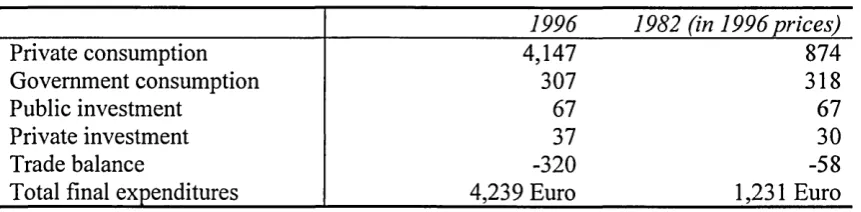
One study o f particular interest to this research, largely as a result of the comprehensive investigation of consumer expenditure on sport, was the research on the economic significance of sport in Flanders (Taks and Kesenne, 1999). Unlike the previous study on the economic importance of sport in the Flanders which used an Input-Output approach (Kesenne et al, 1987), the second Flanders study used the expenditure approach of the National Accounts to calculate economic impact. The study found that the Gross Regional Sports Product (GRSP) for the Flanders was $US 4314 billion or 3.7% of the total GRP, compared to the previous estimate which found the economic importance of sport totalled 1.35% of GRP. Table 2.5 shows a comparison o f total final expenditures as reported by the two studies.
T A B L E 2.5. G R SP F O R F L A N D E R S 1996 A N D 1982
1996 1982 (in