Vol. 40, No. 9, September 2002
Direct Numerical Simulation of Turbulent Trailing-Edge Flow
with Base Flow Control
Y. F. Yao¤and N. D. Sandham†
Southampton University, Southampton, England SO17 1BJ, United Kingdom
Direct numerical simulationhas been carried out for turbulent ow over a rectangular trailing edge at a Reynolds number of 1££ 103(based on the freestream quantities and the trailing-edge thickness) and ratio of boundary-layer displacement thickness to trailing-edge thickness close to unity. Two types of ow control were studied: base transpiration and secondary splitter plate. Simulation of base transpiration was performed using different slit heights and volume ow rates. It was found that even small ow rates could produce signi cant changes in overall aerodynamic performance, measured, for example, by the base pressure coef cient. It was also found that for the same volume ow rate, a greater increase in base pressure (drag reduction) was obtained by blowing slowly through a wide slit rather than quickly through a narrow slit. The effectiveness of a secondary splitter plate located on the trailing-edge centerline was investigated by varying the plate length from one to ve times the trailing-edge thickness. A signi cant increase in the base pressure coef cient (about 25%) was achieved, even with the shortest splitter plate equal to the trailing-edge thickness. The base pressure coef cient increased monotonically with the splitter plate length, and no intermediate maximum value was found.
Nomenclature
.Cp/b = base pressure coef cient
hs = base slit height (width)
k = turbulence kinetic energy
Lsp = length of secondary splitter plate
n = current time step
p = instantaneouspressure
pb = base pressure
pref = reference pressure
qb = base volume ow rate
Reh = Reynolds number based on freestream velocity and trailing-edge thickness
Re±¤ = Reynolds number based on freestream velocity and displacement thickness
t = time variable
U = streamwise mean velocity
ub = base transpiration velocity
ui.u; v; w/ = instantaneousvelocity variables
ur = maximum reverse velocity at centreline
u¿ = friction velocity, [.du=dy/w=Reh]1=2
xi.x;y;z/ = Cartesian coordinate axes
xr = recirculation length at centerline
yC = ycoordinate in wall units,yu
¿Reh 1t = increment of time step
1xC
i = increments of coordinatesxiin wall units ±99 = boundary-layerthickness
±¤ = boundary-layerdisplacement thickness ±¤
in = boundary-layerdisplacement thickness at inlet
Introduction
T
HE trailing-edgeregionof airfoilsand turbinebladesin uences the entire aerodynamic performance, measured, for example,Received 23 August 2001; revision received 28 March 2002; accepted for publication 28 March 2002. Copyright°c 2002 by Y. F. Yao and N. D. Sandham. Published by the American Institute of Aeronautics and Astronau-tics, Inc., with permission. Copies of this paper may be made for personal or internal use, on condition that the copier pay the $10.00 per-copy fee to the Copyright Clearance Center, Inc., 222 Rosewood Drive, Danvers, MA 01923; include the code 0001-1452/02 $10.00 in correspondence with the CCC.
¤Research Fellow, Aeronautics and Astronautics, School of Engineering Sciences; [email protected].
†Professor, Aeronautics and Astronautics, School of Engineering
Sci-ences; [email protected]. Senior Member AIAA.
by the base pressure coef cient or total pressure loss. Because the region is highly localized, it can be a good candidate for the intro-duction of ow control techniques aiming at drag reintro-duction. Nu-merically, it is dif cult to achieve an accurate simulation using the conventional Reynolds-averaged Navier–Stokes approach because of the complexity of the problem. In the immediate vicinity of the trailing edge, the ow may be highly unsteady and far from an equilibrium state, and, consequently,conventionalturbulence mod-els either prove to be inadequate or require special modi cations. However, simpli ed versionsof the problem can be computedusing direct numerical simulation (DNS). Previous experience1 showed
that good quality results can be obtained at moderate Reynolds number (»1£103based on the trailing-edgethicknessor
boundary-layer displacementthickness) with currently available computer re-sources. The intention of this paper is, therefore, to study mecha-nisms of ow control in a model trailing-edge ow using DNS.
Early research work on the applicationof ow control to the trail-ing edge was carried out by Nash,2Wood,3and Bearman4 around
the mid-1960s, when studies were made of the effects of base bleed (also called secondary air ow) on the aerodynamic performance of the two-dimensional blunt trailing edge, in particular, the increase in base pressure coef cient (and consequent decrease in drag co-ef cient). Since then, the base bleed concept has been applied to a wider range of practical problems, for example in transonic and supersonic ows.5In the gas-turbine industry, a similar technique
called gas coolant ejection has also been developed and used for the controlof turbineblade temperatureto extend the lifetime of blades. Experiments have shown that the method not only results in a lower heat transfer to the blade, but also leads to a signi cant reduction in total pressure loss.6When the ejection velocity and angle were
tuned, an overall optimization could be achieved.7 Although the
method clearly works, it is still important to understand the under-lying ow mechanism. On this point, experimentalists have made some progress, and the mechanism of drag reduction is believed to involve a change in the wake dynamics.8Computational studies
have progressed with improvements in computer power and numer-ical methods. Hannemann and Oertel9 tackled the laminar wake
unsteadinessproblem, and Hammond and Redekopp10analyzed the
global instability of the ow. These pilot investigationsshowed that the global dynamics associated with vortex shedding could be sup-pressed by base transpiration.Based on the success of these laminar calculations,a fully turbulent ow study is desirable.
An alternative way of achieving the base drag reduction is to use an additional (secondary) splitter plate along the wake centerline. An important theoretical investigation of the effect of such a split-ter plate on the drag and pressure distribution of bluff body ow
was carried out by Roshko.11Later, this simple but effective
con-cept was applied in experiments,12;13and a review paper was given
by Tanner.14 With developments in experimental and
computa-tional techniques, there have been addicomputa-tional investigations in re-cent years.15;16Compared to the blunt trailing-edge geometry, the
presence of a splitter plate modi es the near-wake vortex evolu-tion and, thus, limits the main vortex interacevolu-tions in the recircula-tion zone. It has been con rmed both by experiments12;13;15and by
two-dimensionalcomputation16that the drag coef cient and vortex
shedding can be signi cantly reduced by the use of a splitter plate of relatively short length.
The present study is focused on the two types of ow control just described. The computation includes a precursor simulation of turbulent boundary-layer ow and a successor simulation of turbu-lent trailing-edge ow. Flow characteristicswith no ow control are studied rst, providing a benchmark for reference and illustrating the main features of the vortex shedding and interaction mecha-nism. Simulations with ow control using base transpiration and a secondary splitter plate follow, with emphasis on the base pressure coef cient, ow structure, and mean properties.
Simulation
Governing Equations and Numerical Method
All variables de ned in the Nomenclature are nondimensional. Distances are normalized with trailing-edge thickness, velocities with freestreamvelocity,and pressurewith freestreamdensity times the square of freestream velocity.
We consider an incompressible uid moving with velocity
uiD.u; v; w/ and pressure p in a Cartesian coordinate system
xiD.x;y;z/and uset to denote the time. The uid motion sat-is es the dimensionless Navier–Stokes equations given by
@ui @t C
@ujui @xj D ¡
@p
@xi C 1
Reh @2ui @xj@xj
(1)
and the continuity equation
@ui @xi D
0 (2)
The Reynolds numberReh is based on the dimensional reference velocity (chosen as the freestream velocity) and the dimensional reference length (chosen as the trailing-edgethickness), which have been usedthroughoutthis paperto make all variablesdimensionless. The Navier–Stokes equations are discretized on a staggered grid using a second-ordercentral nite difference scheme and advanced in time with the projection method based on a second-orderexplicit Adams–Bashforth scheme. The provisionalvelocityu¤
i is projected using the data from the current time stepnand preceding time step
n¡1 as
u¤
i ¡uni 1t D
3 2H n i ¡ 1 2H
n¡1
i C 1 2
@pn¡1
@xi
(3)
where the quantityHiis de ned as
Hi D ¡@
ujui @xj C
1
Reh @2u
i @xj@xj
This is then corrected for continuity to yield the velocity at a time stepnC1 using
unC1
i Du¤i ¡ 3 21t
@pn @xi
(4)
where the pressure pn is obtained by the solution of the Poisson equation
@2pn @xi@xi D
2 31t
@u¤
i
@xi (5)
Turbulent Boundary-Layer Flow
Simulation of turbulent boundary-layer ow was performed rst, using a spatial DNS code that implemented the rescaling and feed-back technique developed by Lund et al.17A computation box of
size 50£20£6 (based on units of inlet displacement thickness ±¤
in) in the streamwisex, wall-normaly, and spanwisezdirections
was used, with 128£96£64 grid points, stretched in the wall-normal direction and uniformly distributed in the streamwise and spanwisedirections.A grid resolutionof1xCD19,1yC
1 D0:5, and
1zCD4:5 was achieved with about 10 points in the viscous
sub-layer (yC·10). The turbulent boundary layer was simulated with a
conditionofRe±¤D950 at the in ow plane. Results for skin-friction and turbulence statistics were in good agreement with other DNS data and experimental results.1A time sequence of ow variables
at a sampling plane near the exit was stored for later use as the in ow boundary condition in the following turbulent trailing-edge simulation.
Turbulent Trailing-Edge Flow
Simulations of turbulent ow over a rectangulartrailing-edgege-ometry were carried out at a Reynolds numberRehD1£103. The upper and lower incoming turbulent boundary-layerswere statisti-cally equivalent but uncorrelatedin time. They developed along the plate for a short distance before contacting each other at the trailing edge. The Cartesian coordinate system was built up with its origin
Oat the center of the trailing edge.
Computationswere carried out with a parallel complex-geometry simulation code (see Thomas and Williams18) that has been
par-allelized using the message passing interface (MPI) library and ported to the Cray-T3E parallel computer. Validations have been made for various cases such as backward-facing step ow, open-channel ow, and skewed ow past a wall-mounted cube, all giving good agreement with published computational results and experi-mental data.
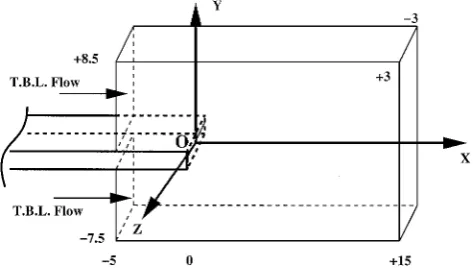
The computational box size is 20£16£6, with thexlength of 20 split into 5 along the at plate and 15 in the wake region in the streamwisexdirection. The upstream distance of 5 is chosen based on the experiment observation by Gough and Hancock19 that the
boundarylayer more than±99ahead of the trailingedge is unaffected
by the presence of the trailing edge, as well as the numerical study by Hannemann and Oertel9that the rms uctuationsat this location
were more than two orders of magnitude lower than the maximum rms uctuations occurring in the wake. Lengths of 8.5 on the upper side and 7.5 on the lower side in the wall-normalydirectionare used, whereas the length in the spanwisezdirection is 6 (Fig. 1). This asymmetric arrangement in ywas chosen mainly on the grounds of load balancing on the parallel computer used in this study but also as a check on the box size because any asymmetries in the results would imply that the computational box was too small in they direction. Grid points are uniformly distributed in all three directionswith 256£512£64 points inx;y, andz, respectively.A detailed study of domain size dependency and grid resolution was carried out by Yao et al.,1with the conclusionthat this con guration
and grid resolution are suitable for the current simulations. The boundary conditions are de ned as follows. At the inlet, the data are prescribed and taken from the precursor turbulent
[image:2.558.293.530.609.744.2]Fig. 2 Streamlines in the near-wake region with no ow control.
Top view Side view
Fig. 3 Instantaneous ow structures in the near-wake region from the simulation with no ow control; spanwise vortices appear in the darker shade, showing a pressure isosurface withp=¡ 0:035, whereas streamwise vortices, in the lighter shade, showP vortices withP = 0:4.
boundary-layer simulation. The outlet plane is treated with a stan-dard convective condition, so that outgoing disturbances can leave the domain smoothly. On the top and bottom boundaries of the do-main, free-slip conditions are used, and in the spanwise direction a periodic condition is applied. A no-slip condition is used on all solid walls, including the splitter plate when present.
Results and Discussion
Reference Case: No Flow Control
For reference,we rst give a brief overview of results for the case with no ow control. More complete sets of results for this case were reported by Yao et al.1and Thomas et al.20Figure 2 shows
the streamline plots in the near wake. (Only one half-domain is plotted due to the symmetry.) A recirculationregion with a length of
xr’2:0 (wherexris de ned as the dimensionlessdistance between the trailing-edge end plane and the stagnation point in the wake) exists after the trailing edge. The maximum reverse velocityur is about 10% of the freestream velocity. The turbulencekinetic energy reaches its peak value of about 0.03 at the centerline in the near wake and then decays downstream. The base pressure coef cient is de ned by
.Cp/bD2.pb¡pref/ (6)
where the averaged dimensionlessbase pressurepbis calculatedby integrating the static pressure over the trailing-edge end plane, and the reference dimensionless pressureprefis taken as the freestream
value at the inlet plane. The simulation (which itself uses a pressure relative to a xed point on the solid wall upstream of the trailing edge) gives pbD ¡0:0695 and prefD ¡0:036. The base pressure
coef cient is, therefore,¡.Cp/bD0:0669.
Snapshots of an instantaneous ow eld are shown in Fig. 3 in a subdomain of 10£6£6. This illustrates the interaction
be-a) b)
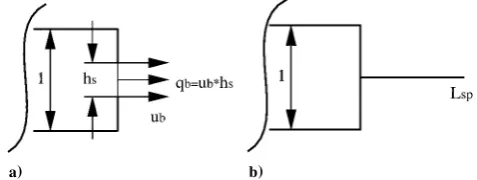
Fig. 4 Con gurations of the two types of ow control: a) base transpi-ration and b) secondary splitter plate; the trailing-edge thickness is set to be 1.
tween the large-scale spanwise vortices (presented in the darker shade, an isosurfaceof pressurecontaininga low-pressurecore) and smaller-scale streamwise vortices (presented in the lighter shade, an isosurface of the second invariant of the velocity gradient ten-sor [5D.@ui=@xj/.@uj=@xi)], named5vortices for later use). It can be seen that the well-known von K´arm´an vortex street exists in the near wake. The appearance of vortex shedding is related (via a global mode10) to the existence of absolute instability based on
linear stability theory (see Hannemann and Oertel19).
Flow Control by Base Transpiration
Simulations with base transpiration were carried out using the arrangement shown in Fig 4a. A total of 10 simulations (cases 1– 10) were carried out with different slit heights (hsD0:25, 0.5, and 1.0) and volume ow rates per unit span (qbD §0:025,§0:05, and §0:1), de ned asqbDubhs, whereub is the uniform base ow velocity. The particular combinations chosen forhs,ub, and the correspondingqbare shown in Table 1.
[image:3.558.95.467.41.235.2] [image:3.558.49.516.268.394.2] [image:3.558.291.530.439.529.2]These are plotted in Fig. 5. The near collapse of the curves, when plotted against volume ow rate in this manner, illustrates that vol-ume ow rate is the key parameter. Base pressure drops sharply when suction is applied. The corresponding base pressure coef -cient decreases (and consequently drag increases) by up to a factor of four for suction with volume ow rateqbD ¡0:1. For base blow-ing, the opposite effect is observed, with a maximum increase of base pressure coef cient (drag reduction) of approximately a fac-tor of two forqbD0:1. However, for blowing, the effectiveness is strongly affected by slit widthhs, and it is clear that, for the same volume ow rate, a greater increase in base pressure coef cient is obtained by blowing slowly through a wide slit rather than quickly through a narrow slit. This is in good agreement with the exper-imental observation that the best drag reduction for a given mass ow can be obtained by ejecting the bleed air at the lowest possible velocity.3;14
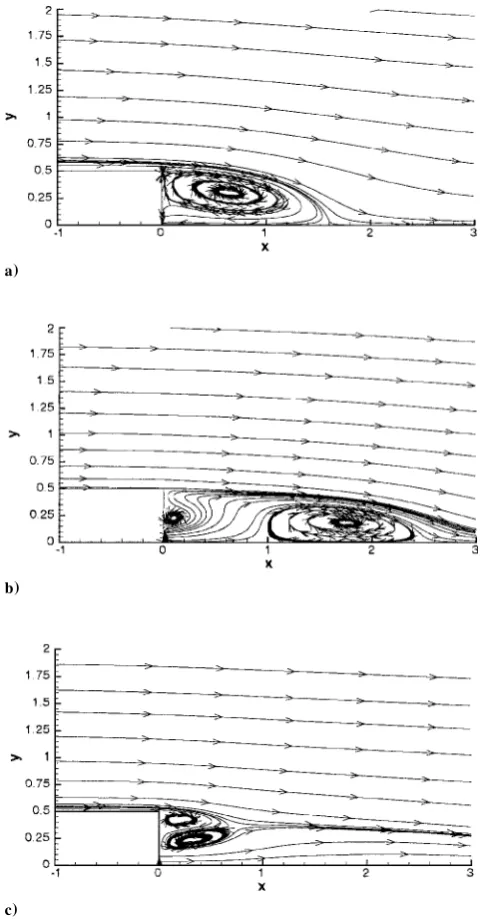
The effect of base transpiration on the mean ow is revealed by streamline plots. Figure 6 shows the effect of varying the base tran-spiration through a slit height ofhsD0:25. Three cases are shown withubD ¡0:1, 0.1, and 0.4 and, consequently,qbequal to¡0:025, 0:025, and 0:1. For weak suction ow,qbD ¡0:025, we see that the recirculation lengthxr has reduced to about 1.58, compared to 2.0 for the reference case of no ow control. The closed recirculation zone is locatedbetween the edge of the slit,yD0:0125, and the edge of the plate,yD0:5. For weak blowing ow,qbD0:025, the main recirculationhas moved downstream, starting atxD1:0 and ending atxD2:48, giving a total recirculation length ofxrD1:48. A sec-ondary recirculation is also observed just above the slit, adjacent
Table 1 Simulations with two types of ow control: base transpiration and a secondary splitter plate
Case hs ub qb xr ur Lsp
Ref. 0.0 0.0 0.0 2.0 ¡0.1 0
1 0.25 ¡0.4 ¡0.1 1.05 ¡0.4 ——
2 0.25 ¡0.1 ¡0.025 1.58 ¡0.124 ——
3 0.25 C0.1 C0.025 1.48 ¡0.046 ——
4 0.25 C0.4 C0.1 —— —— ——
5 0.5 ¡0.2 ¡0.1 0.98 ¡0.25 ——
6 0.5 ¡0.1 ¡0.05 1.45 ¡0.154 ——
7 0.5 C0.1 C0.05 —— —— ——
8 0.5 C0.2 C0.1 —— —— ——
9 1.0 ¡0.1 ¡0.1 1.0 ¡0.2 ——
10 1.0 C0.1 C0.1 —— —— ——
11 —— —— 0.0 3.00 ¡0.0849 1
12 —— —— 0.0 3.34 ¡0.0805 2
13 —— —— 0.0 3.63 ¡0.045 3
14 —— —— 0.0 3.91 —— 4
15 —— —— 0.0 4.21 —— 5
Fig. 5 Base pressure coef cient (left side, solid symbols) and base pressure (right-hand side, open symbols) as a function of volume ow rate. a)
b)
c)
Fig. 6 Streamlines for base transpiration through a slit of height
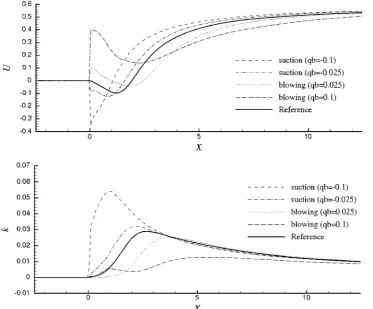
[image:4.558.290.531.41.501.2] [image:4.558.33.261.353.520.2] [image:4.558.71.488.551.749.2]to the trailing edge. For very strong blowing ow,qbD0:1, there is no downstream recirculationzone, but now two small recirculation zones are seen in the very near wake region, between the slit and the edge of the plate. Streamwise mean velocityUand turbulence kinetic energykvariations along the centerline (yD0) are shown in Figs. 7 and 8 for all of the cases with hsD0:25 andhsD0:5, respectively. It can be seen that, in general, asqb is decreased, the recirculation zone (negativeU) moves closer to the trailing edge, and the magnitudeof the (negative) peak increases,accompaniedby an increase ink. From Figs. 7 and 8, it appears that, except for the case with the strongest suction, the peak value ofkoccurs approx-imately twice as far from the trailing edge as the local minimum inU. As a summary, values of the maximum recirculation velocity
ur and the recirculation lengthxr for all cases run are shown in Table 1.
Instantaneous ow structures show the effect of base transpi-ration on the structure of the near wake. Figure 9 shows snap-shots from the cases of strong suction (hsD1:0,ubD ¡0:1, and
qbD ¡0:1) and strong blowing (hsD1:0,ubD0:1, andqbD0:1), illustrating the ow structure with isosurfaces of pressure and5, as shown earlier for the reference case in Fig. 3. For the strong suction case, it can be seen that the quasi-two-dimensional coher-ent structure has been strengthened considerably. The strong span-wise vortex structures even appear upstream of the trailing edge. Subsequently, the5vortices also become stronger because of the interactions. Conversely, with strong blowing, the structures are pushed farther downstreamand become much weaker. As a result, a smaller peak value ofkis evident (Figs. 7 and 8). There also seems to be tendency to lose the strong spanwise coherence of the pres-sure structures for the case with strong blowing, and the shedding has been moved farther downstream,agreeing qualitativelywith the experiment.4
Suction or blowing also affects the skin friction on the plate up-stream of the trailing edge, with suction increasing the friction drag and blowing decreasing it. However, this effect was at most only 9.7% of the base pressure drag change.
Fig. 7 Mean velocityUand turbulence kinetic energykdistributions for slit heighths= 0:25; the reference simulation of no ow control is shown by the solid line.
Flow Control by Secondary Splitter Plate
An alternative technique of ow control is the addition of a zero-thickness secondary splitter plate behind the trailing edge as illus-trated in Fig. 4b. In this study, the splitter plate lengthLspis varied
over a range of 1–5, and results are compared with those from the reference case of no ow control and experimental data.
Figure 10 gives the base pressure coef cient and base pressure variations as a function of splitter plate lengthLsp. WithLspD5, a
maximum reduction of¡.Cp/bof about 44% is achieved. However, a splitter plate withLspD1 already gives a 25% reduction. Shorter
platesare probablyalso preferredgiven practical(structural) consid-erations. A maximum drag reduction of 50% was achieved experi-mentally by Bearman13for a ow with Mach number approximately
0.1 and splitter plate lengthLspD4. However, compared to the
re-sults of Nash et al.,12who studied the secondary splitter plate for a
rectangular trailing-edge geometry at Mach number 0.4, there are large differences. The magnitudes of the reductions of¡.Cp/bare here much smaller than those in the Nash et al. experiment, which found a factor of two reduction forLspD1 and a factor of three
reduction forLspD4. One possible cause for the difference is the
referencepressure,here taken as the freestreamat the computational in ow upstream of the trailing edge, whereas in the experimentsit is presumablytakenfartheraway fromthe object.Other differencesare the Mach number (incompressible ow was assumed in the current computation) and Reynolds number (lower in the computations).
A phenomenon of a local maximum in the base pressure coef -cientas a functionofLspwas observedexperimentallyby Bearman13
at Reynolds numbers between 1:4£105 and 2:56£105in a
low-speed wind tunnel. A peak appeared at LspD1:5 and increased
signi cantly with the decrease of Reynolds number, indicating a strong Reynolds number effect. Such a peak was also observed in the experiments of Nash et al.12However, the phenomenon was not
found in a recent experimentby Rathakrishnan15using a rectangular
cylinder in a low-speed wind tunnel (Reynolds numbers 0:58£105
and 0:98£105). The experiments showed a signi cant decrease in
[image:5.558.97.471.430.739.2]Fig. 8 Mean velocityUand turbulence kinetic energykdistributions for slit heighths= 0.5; the reference simulation of no ow control is shown with the solid line.
a) b)
Fig. 9 Instantaneous ow structures in the near-wake region (shade de nition as in Fig. 3): a) side view with base suction,hs= 1.0,ub=¡ 0:1, and
qb=¡ 0:1 and b) top view with base blowing,hs= 1.0,ub= 0.1, andqb= 0.1.
[image:6.558.102.460.45.358.2] [image:6.558.45.516.392.519.2] [image:6.558.79.478.565.741.2]beyond that was found to be insigni cant. A satisfactory physical explanation for the appearance of a local drag minimum has not been offered to date. Experiments and simulations using a wider range of Reynolds number are needed.
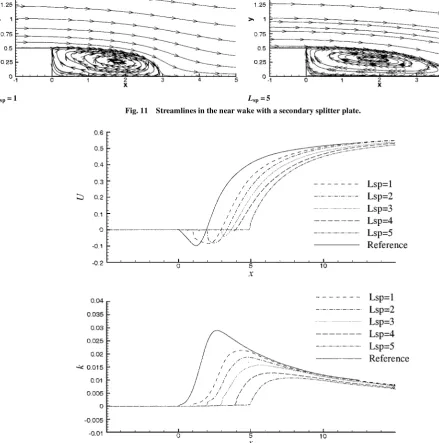
Figure 11 shows streamline plots with splitter plate lengths of
LspD1 and 5. The size of the recirculation grows as the splitter
plate length increases, although the bubble shape remains broadly unchanged. A summary of the ve cases (cases 11–15) is given in Table 1. Compared to the reference case of no ow control, the sep-aration lengthxr increases, and the maximum reverse velocityur decreases,with splitter plate length. The recirculationterminatesaf-ter the end of the secondaryplate forLspD1;2, and 3, which agrees
with the experimental observation by Bearman,13who claimed that
no reattachment was found for shorter splitter platesLspD1»2.
However, for the longest two plates, the simulated recirculation zone terminates on the plate, that is, the ow behaves broadly as a backward-facing step ow. These two cases have different reat-tachment lengths, indicating that the ow upstream of reatreat-tachment is affected by the ow developmentsdownstream. The recirculation lengths from the simulations (xrD3:91 for the LspD4 case and
Lsp= 1 Lsp= 5
Fig. 11 Streamlines in the near wake with a secondary splitter plate.
Fig. 12 Mean velocityUand turbulence kinetic energykdistributions ofLsp= 1¡ 5 compared with the reference simulation.
xrD4:21 for theLspD5 case) are longer than experiment,13where
a recirculationlength ofxrD2:9 was observed forLspD4. DNS of
a backward-facing step ow21gave a mean value of 6.28 (based on
the step height, that is, half of the trailing-edge thickness), equiv-alent to 3.14 based on the trailing-edge thickness. However, note that the Reynolds number used in the current simulation (5£102
based on the equivalent step height) is much lower than that in the experiment, and 10 times lower than that used in the Le et al.21
DNS (5:1£103 based on the step height). Also, the ratio of the
boundary-layer thickness to the step height is close to unity in the study of Le et al.,21whereas in the present case the boundary-layer
[image:7.558.33.531.264.403.2]thickness is about 13 times the half-thickness of the trailing edge. Another signi cant difference to the backward-facing step ow is that no secondaryseparationwas observedin the simulations,which may also be a low Reynolds number effect. The friction drag on the secondary plate was found to be small (6% at most) compared to the base pressure drag.
[image:7.558.36.476.303.747.2]a)
b)
c)
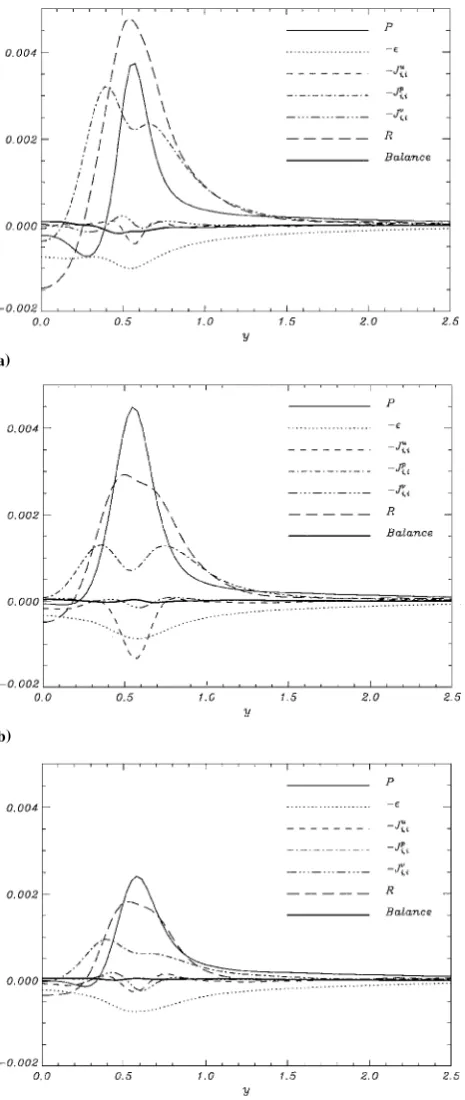
Fig. 13 Turbulence kinetic energy budget in the middle of the recir-culation region: a) no ow control,x= 1.0; b) base transpiration,x= 1.7 withhs= 0.25,ub= 0.1, andqb= 0.025; and c) secondary splitter plate,
x= 1.8 withLsp= 1. The thin solid line represents the production term, and the thick solid line represents the balance (sum of all terms).
to the trailing-edge thickness, has a signi cant effect on the mean velocity and the turbulence kinetic energy distributions.
Energy Budgets
Energy budgetshave been analyzed using statisticaldata from the simulations. The turbulence kinetic energy equation is
@k
@t CRD P¡²¡
@¡Ju i CJ
p i CJiº
¢
@xi
(7) where RD huii.@k=@xi) is the convection term; P is the produc-tion term;²is the dissipation; andJu
i , J p
i , andJiº are turbulence
a)
b)
c)
Fig. 14 Turbulence kinetic energy budgetat the end of the recirculation region: a) no ow control,x= 2.0; b) base transpiration,x= 2.5 withhs= 0.25,ub= 0.1, andqb= 0.025;and c) secondary splitter plate,x= 2.9 with
Lsp= 1. The thin solid line represents the production term, and the thick solid line represents the balance (sum of all terms).
triple-moment(transport), pressure-diffusion,and viscous transport terms, respectively, de ned in detail by Yao et al.1
Turbulence kinetic energy budgets were computed for three dif-ferent cases: no ow control, ow control with base transpiration (hsD0:25,ubD0:1, andqbD0:025), and ow control with sec-ondary splitter plate (LspD1). The comparisons were carried out at
two selected positions: the middle of the recirculation region and the end of the recirculation region. Results are shown in Figs. 13 and 14.
[image:8.558.296.528.36.600.2] [image:8.558.33.266.40.591.2]with a positivepeakaty’0:5 and a negativepeak (correspondingto a reverse ow) at the centerline,yD0. The productionterm also has a small negative peak near the centerline and a high positive peak away fromit. The negativeproductionwas studiedby Thomas et al.20
A strong pressure-diffusionterm, with the same order of magnitude as the production and convection terms, is also observed. It implies that the pressure-diffusioneffect cannot be neglected in the trailing-edge ow. The dissipation has a maximum at the same position as the maximum productionbut is only approximately30% of the peak production value. Hence, the ow is locally far from an equilibrium state. When base transpiration is applied (Fig. 13b), the production and dissipation terms remain broadly unchanged, whereas the con-vection and pressure-diffusion terms are both reduced. However, a signi cant negative peak in turbulence triple-moment (transport) term appears, again at the same peak position of the production and dissipationterms. With the secondary splitter plate (Fig. 13c), a sig-ni cant decrease in the peak production (almost half of the value compared to that in the reference case) is evident, whereas the other terms are, with the exception of the triple-moment term, similar to those found in the base transpiration case.
At the end of the recirculation region, for the case of no ow control (Fig. 14a), the production term dominates the energy bud-get, with signi cant contributions from the convection, turbulence triple-moment, pressure-diffusion,and dissipation terms. The pres-sure diffusion changes from positive to negative as the centerline is approached.For the two types of ow control considered (Figs. 14b and 14c), the peak value of all terms decreases, with the pressure diffusionbeing more signi cantly affectedthan the other terms. The triple-moment term is relatively less important for the base transpi-ration (blowing) case than for either the reference case or for the secondary splitter plate case,LspD1.
The detailedbehaviorof terms in the energy budget discussedear-lier is important for constructing models at the two-equation level, which can subsequently be used for higher Reynolds number stud-ies and optimization of control schemes. However, the main results can be summarized more simply. At the end of the recirculation zone (Figs. 14b and 14c) we are seeing the result of ow control, in that all turbulence activity is diminished, whereas in the middle of the recirculation we see differences in detail between the two control schemes. In particular, the secondary splitter plate method is more effective at reducing turbulence activity within the recircu-lation zone.
Conclusions
It can be concluded from this study that DNS is feasible for the parametric study of ow controlin the trailing-edge ow, using base transpiration and a secondary splitter plate. Both methods of ow control have a signi cant effect on the aerodynamic performance, measured, for example, by the base pressure coef cient. Simula-tions with base transpiration have been carried out with different slit heights and volume ow rates. It was revealed from the simula-tion that sucsimula-tion(even weak sucsimula-tion) enhances the near-wakevortex shedding, sustains the coherent structure over an extended region, and shortensthe recirculationregion,whereasstrongblowingmoves the entireinteractiondownstreamand diminishesthe coherentstruc-ture more quickly. It was also found that for the same volume ow rate, a greater base pressure increase can be obtained by blowing slowly through a wide slit rather than quickly through a narrow slit, in agreement with experiments.Simulations with secondary splitter plate showed a monotonic increase in base pressure coef cient with the splitter plate length. A 25% increase was achieved for the split-ter plate equal to the trailing-edge thickness, whereas a maximum 44% increase was achieved for the splitter plate length ve times the trailing-edge thickness. Note that in practical applications, the base pressure drag is not the only consideration, and the drag re-duction problem must be considered in the context of aerodynamic and structural constraints. The turbulence kinetic energy budget in the recirculation region shows that the pressure-diffusionterm has a signi cant contribution to the budget balance, whereas the peak
of dissipation is only about 30% of the peak production. The effect of ow control is, in general, to reduce the convection and pressure transport relative to the production in the core of the recirculation. At the end of the recirculation region, the structure of the budget is retained, but the magnitudes of all terms are reduced.
Acknowledgments
The authorswould like to thank the United Kingdom Engineering and Physical Science Research Council for nancial and parallel computer support through Grants GR/L 18570 and GR/M 08424.
References
1Yao, Y. F., Thomas, T. G., Sandham, N. D., and Williams, J. J. R.,
“Di-rect Numerical Simulation of Turbulent Flow over a Rectangular Trailing Edge,”Theoretical and ComputationalFluid Dynamics, Vol. 14, No. 5, 2001, pp. 323–336.
2Nash, J. F., “A Discussion of Two-Dimensional Turbulent Base Flows,”
Aeronautical Research Council, TR R&M 3468, London, 1967.
3Wood, C. J., “The Effect of Base Bleed on a Periodic Wake,”Journal of
the Royal Aeronautical Society, Vol. 68, July 1964, pp. 477–482.
4Bearman, P. W., “The Effect of Base Bleed on the Flow Behind a
Two-Dimensional Model with a Blunt Trailing Edge,”Aeronautical Quarterly, Vol. 18, Aug. 1967, pp. 207–224.
5Motallebi, F., and Norbury, J. F., “Effect of Base Bleed on Vortex
Shed-ding and Base Pressure in Compressible Flow,”Journal of Fluid Mechanics, Vol. 110, 1981, pp. 273–292.
6Deckers, M., and Denton, J. D., “Aerodynamics of Trailing-Edge-Cooled
Transonic Turbine Blades: Part 1—Experimental Approach,” American So-ciety of Mechanical Engineers, ASME Paper 97-GT-518, 1997.
7Pappu, K. R., and Schobeiri, M. T., “Optimization of Trailing Edge
Ejection Mixing Losses: A Theoretical and Experimental Study,” American Society of Mechanical Engineers, ASME Paper 97-GT-523, 1997.
8Bearman, P. W., “Near Wake Flows BehindTwo- and Three-Dimensional
Bluff Bodies,”Journal of Wind Engineering and Industrial Aerodynamics, Vol. 49, No. 71, 1997, pp. 33–54.
9Hannemann, K., and Oertel, H., “Numerical Simulationofthe Absolutely
and Convectively Unstable Wake,”Journal of Fluid Mechanics, Vol. 199, 1989, pp. 55–88.
10Hammond, D. A., and Redekopp, L. G., “Global Dynamics and
Aero-dynamic Flow Vectoring of Wakes,”Journal of Fluid Mechanics, Vol. 338, 1997, pp. 231–248.
11Roshko, A., “On the Wake and Drag of Blunt Bodies,”Journal of
Aerospace Sciences, Vol. 22, Feb. 1955, pp. 124–132.
12Nash, J. F., Quincey, V. G., and Callinan, J., “Experiments on
Two-Dimensional Base Flow at Subsonic and Transonic Speeds,” Aeronautical Research Council, TR R&M 3427, London, 1963.
13Bearman, P. W., “Investigation of the Flow Behind a Two-Dimensional
Model with a Blunt Trailing Edge and Fitted with Splitter Plates,”Journal of Fluid Mechanics, Vol. 21, 1965, pp. 241–255.
14Tanner, M., “Reduction of Base Drag,”Progress in Aerospace Sciences,
Vol. 16, No. 4, 1975, pp. 369–384.
15Rathakrishnan, E., “Effect of Splitter Plate on Bluff Body Drag,”AIAA
Journal, Vol. 37, No. 9, 1999, pp. 1125,1126.
16Park, W. C., and Higuchi, H., “Numerical Investigation of Wake Flow
Control by a Splitter Plate,”KSME International Journal, Vol. 12, No. 1, 1998, pp. 123–131.
17Lund,T. S., Wu, X., and Squires, K. D., “Generation of Turbulent In ow
Conditions for Boundary Layer Simulations,”Journal of Computational Physics, Vol. 140, No. 2, 1998, pp. 233–258.
18Thomas, T. G., and Williams, J. J. R., “Development of a Parallel Code
to Simulation Skewed Flow over a Bluff Body,”Journalof Wind Engineering and Industrial Engineering, Vol. 67–68, April–June 1997, pp. 155–167.
19Gough, T. D., and Hancock, P. E., “Lower Reynolds Number
Turbu-lent Near Wakes,”Advances in Turbulence VI, edited by S. Gavrilakis, L. Machiels, and P. A. Monkewitz, Kluwer Academic, Norwell, MA, 1996, pp. 445–448.
20Thomas, T. G., Yao, Y. F., and Sandham, N. D., “Structure and
Energet-ics of a Turbulent Trailing Edge Flow,”Computers and Mathematics with Applications(to be published).
21Le, H., Moin,P., and Kim, J., “Direct Numerical Simulationof Turbulent
Flow over a Backward-Facing Step,”Journal of Fluid Mechanics, Vol. 330, 1997, pp. 349–374.
W. J. Devenport