©2017 Cengage Learning®. May not be scanned, copied or duplicated, or posted to a publicly accessible website, in whole or in part, except for use as permitted in a license distributed with a certain product or service or otherwise on a password-protected website or school-approved learning management system for classroom use.
.
Chapter 9
The Information System
▪
Provides for data collection, storage, and retrieval
▪
Composed of:
▪
People, hardware, software
▪
Database(s), application programs, procedures
▪
Systems analysis: Process that establishes need for
and extent of information system
▪
Systems development: Process of creating
©2017 Cengage Learning®. May not be scanned, copied or duplicated, or posted to a publicly accessible website, in whole or in part, except for use as permitted in a license distributed with a certain product or service or otherwise on a password-protected website or school-approved learning management system for classroom use.
Performance Factors of an Information
System
▪
Database design and implementation
▪
Application design and implementation
▪
Administrative procedures
▪
Database development: Process of database design
and its implementation
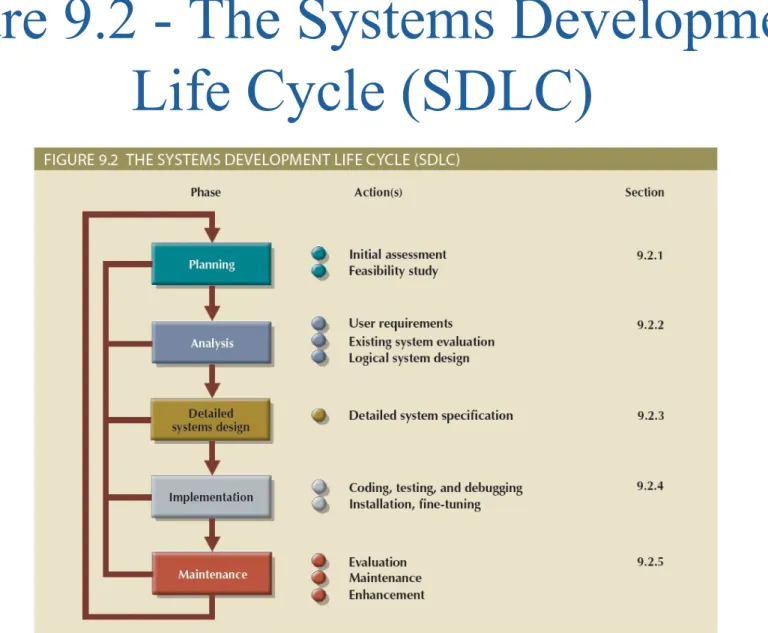
Systems Development Life Cycle
(SDLC)
▪
Traces history of an information system
▪
Provides a picture within which database design and
application development are mapped out and
evaluated
©2017 Cengage Learning®. May not be scanned, copied or duplicated, or posted to a publicly accessible website, in whole or in part, except for use as permitted in a license distributed with a certain product or service or otherwise on a password-protected website or school-approved learning management system for classroom use.
Figure 9.2 - The Systems Development
Life Cycle (SDLC)
Computer-Aided Systems Engineering
(CASE)
▪
Includes System Architect and Visio Professional
▪
Helps produce better systems in a reasonable amounts
of time and reasonable cost
▪
Applications are more structured, better documented
and standardized
▪
Prolongs operational life of systems
©2017 Cengage Learning®. May not be scanned, copied or duplicated, or posted to a publicly accessible website, in whole or in part, except for use as permitted in a license distributed with a certain product or service or otherwise on a password-protected website or school-approved learning management system for classroom use.
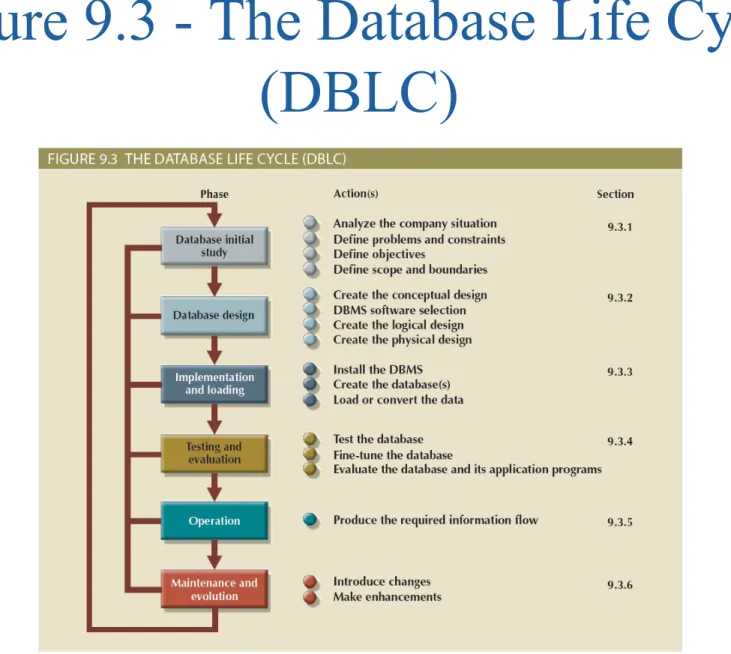
Figure 9.3 - The Database Life Cycle
(DBLC)
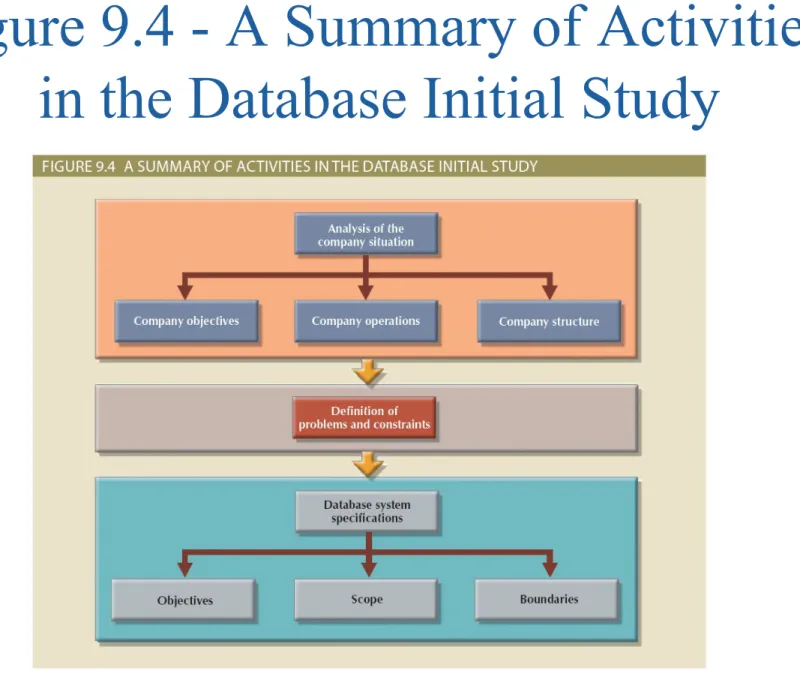
Purpose of Database Initial Study
Analyze company
situation
Define problems
and constraints
Define objectives
Define scope and
©2017 Cengage Learning®. May not be scanned, copied or duplicated, or posted to a publicly accessible website, in whole or in part, except for use as permitted in a license distributed with a certain product or service or otherwise on a password-protected website or school-approved learning management system for classroom use.
Figure 9.4 - A Summary of Activities
in the Database Initial Study
Database Design
▪
Supports company’s operations and objectives
▪
Most critical phase
▪
Ensures final product meets user and system
requirements
▪
Points for examining completion procedures
▪
Data component is an element of whole system
▪
System analysts/programmers design procedures to
convert data into information
©2017 Cengage Learning®. May not be scanned, copied or duplicated, or posted to a publicly accessible website, in whole or in part, except for use as permitted in a license distributed with a certain product or service or otherwise on a password-protected website or school-approved learning management system for classroom use.
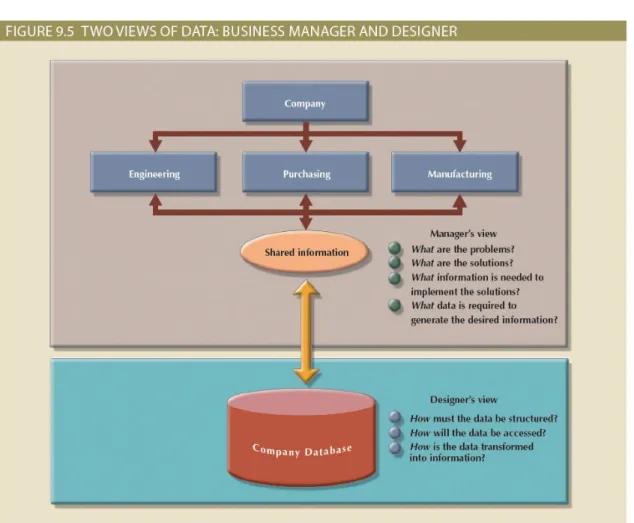
Figure 9.5 - Two Views of Data: Business
Manager and Database Designer
Implementation and Loading
▪
Install the DBMS
▪
Virtualization: Creates logical representations of
computing resources independent of underlying
physical computing resources
▪
Create the databases
▪
Requires the creation of special storage-related
constructs to house the end-user tables
▪
Load or convert the data
©2017 Cengage Learning®. May not be scanned, copied or duplicated, or posted to a publicly accessible website, in whole or in part, except for use as permitted in a license distributed with a certain product or service or otherwise on a password-protected website or school-approved learning management system for classroom use.
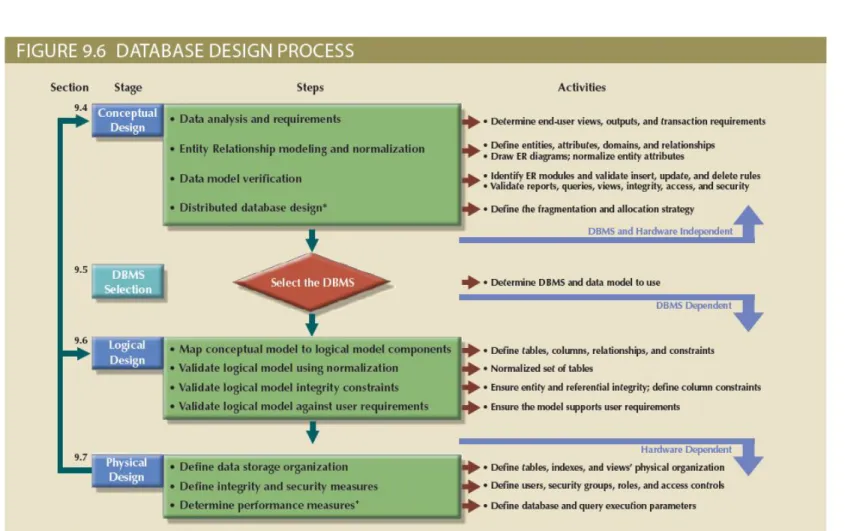
Figure 9.6 - Database Design Process
Testing and Evaluation
▪
Physical security
▪
Password security
▪
Access rights
▪
Audit trails
▪
Data encryption
▪
Diskless workstations
▪
Optimization
©2017 Cengage Learning®. May not be scanned, copied or duplicated, or posted to a publicly accessible website, in whole or in part, except for use as permitted in a license distributed with a certain product or service or otherwise on a password-protected website or school-approved learning management system for classroom use.
Levels of Database Backups
▪
Full backup/dump: All database objects are backed
up in their entirety
▪
Differential backup: Only modified/updated objects
since last full backup are backed up
▪
Transaction log backup: Only the transaction log
operations that are not reflected in a previous backup
are backed up
▪
Backups are provided with high security
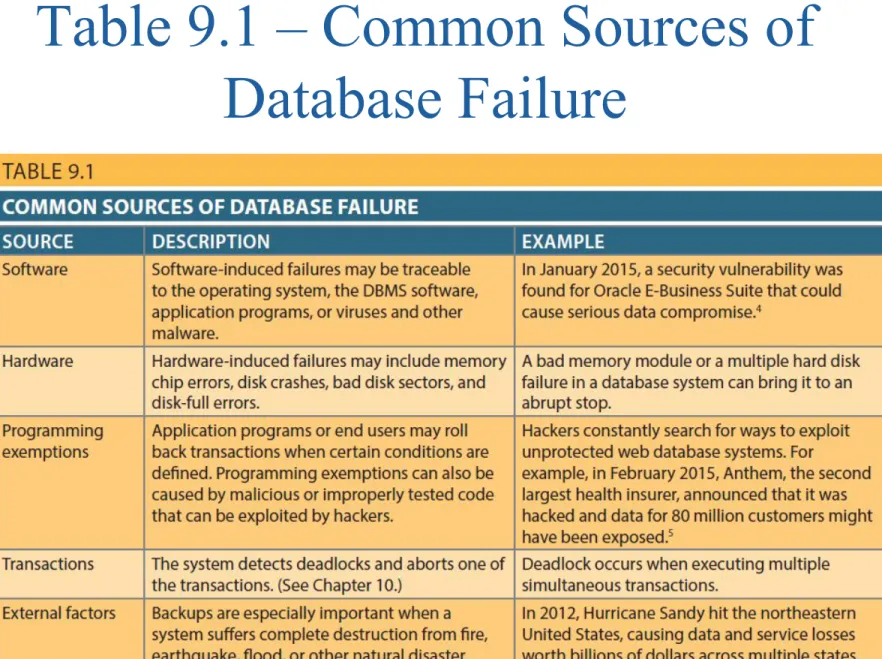
Table 9.1 – Common Sources of
Database Failure
©2017 Cengage Learning®. May not be scanned, copied or duplicated, or posted to a publicly accessible website, in whole or in part, except for use as permitted in a license distributed with a certain product or service or otherwise on a password-protected website or school-approved learning management system for classroom use.
Maintenance and Evolution
▪
Preventive maintenance (backup)
▪
Corrective maintenance (recovery)
▪
Adaptive maintenance
▪
Assignment of access permissions and their
maintenance for new and old users
▪
Generation of database access statistics
▪
Periodic security audits
▪
Periodic system-usage summaries
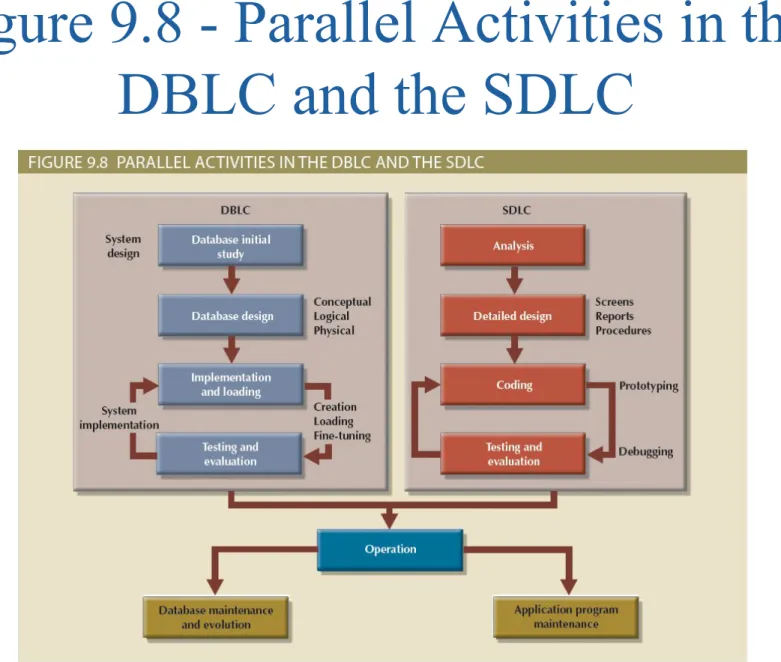
Figure 9.8 - Parallel Activities in the
DBLC and the SDLC
©2017 Cengage Learning®. May not be scanned, copied or duplicated, or posted to a publicly accessible website, in whole or in part, except for use as permitted in a license distributed with a certain product or service or otherwise on a password-protected website or school-approved learning management system for classroom use.
Conceptual Design
▪
Designs a database independent of database software
and physical details
▪
Conceptual data model - Describes main data entities,
attributes, relationships, and constrains
▪
Designed as software and hardware independent
▪
Minimum data rule: All that is needed is there, and
all that is there is needed
©2017 Cengage Learning®. May not be scanned, copied or duplicated, or posted to a publicly accessible website, in whole or in part, except for use as permitted in a license distributed with a certain product or service or otherwise on a password-protected website or school-approved learning management system for classroom use.
Data Analysis and Requirements
▪
Designers efforts are focused on
▪
Information needs, users, sources and constitution
▪
Answers obtained from a variety of sources
▪
Developing and gathering end-user data views
▪
Directly observing current system: existing and desired
output
▪
Interfacing with the systems design group
Description of Operations
Provides precise, up-to-date, and reviewed
description of activities defining an
©2017 Cengage Learning®. May not be scanned, copied or duplicated, or posted to a publicly accessible website, in whole or in part, except for use as permitted in a license distributed with a certain product or service or otherwise on a password-protected website or school-approved learning management system for classroom use.
Table 9.3 - Developing the Conceptual
Model Using ER Diagrams
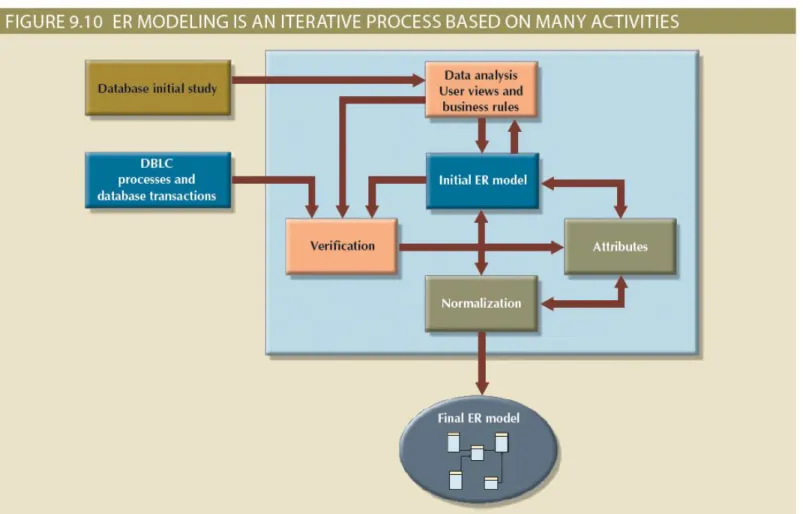
Figure 9.10 - ER Modeling is an Iterative
Process Based on Many Activities
©2017 Cengage Learning®. May not be scanned, copied or duplicated, or posted to a publicly accessible website, in whole or in part, except for use as permitted in a license distributed with a certain product or service or otherwise on a password-protected website or school-approved learning management system for classroom use.
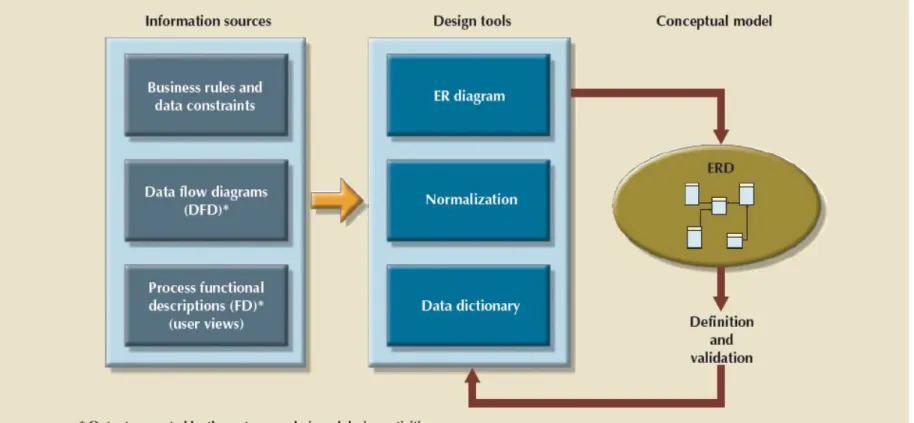
Figure 9.11 - Conceptual Design Tools
and Information Sources
Data Model Verification
▪
Verified against proposed system processes
▪
Module: Information system component that handles
specific business function
▪
Better if modules’ ER fragments are merged into a
single enterprise ER model which triggers
▪
Careful reevaluation of entities
▪
Detailed examination of attributes describing entities
▪
Resulting model verified against each of the module’s
processes
©2017 Cengage Learning®. May not be scanned, copied or duplicated, or posted to a publicly accessible website, in whole or in part, except for use as permitted in a license distributed with a certain product or service or otherwise on a password-protected website or school-approved learning management system for classroom use.
Table 9.5 - The ER Model Verification
Process
Figure 9.12 - Iterative ER Model
Verification Process
©2017 Cengage Learning®. May not be scanned, copied or duplicated, or posted to a publicly accessible website, in whole or in part, except for use as permitted in a license distributed with a certain product or service or otherwise on a password-protected website or school-approved learning management system for classroom use.
Cohesivity and Module Coupling
▪
Cohesivity: Strength of the relationships among the
module’s entities
▪
Module coupling: Extent to which modules are
independent to one another
▪
Low coupling decreases unnecessary intermodule
dependencies
Distributed Database Design
▪
Portions of database may reside in different physical
locations
▪
Database fragment: Subset of a database stored at a
given location
©2017 Cengage Learning®. May not be scanned, copied or duplicated, or posted to a publicly accessible website, in whole or in part, except for use as permitted in a license distributed with a certain product or service or otherwise on a password-protected website or school-approved learning management system for classroom use.
DBMS Software Selection
▪
Cost
▪
DBMS features and tools
▪
Underlying model
▪
Portability
▪
DBMS hardware requirements
Logical and Physical Design
▪
Logical design: Designs an enterprise-wide database
that is based on a specific data model but independent
of physical-level details
▪
Validates logical model:
▪
Using normalization
▪
Integrity constraints
▪
Against user requirements
▪
Physical design: Process of data storage organization
©2017 Cengage Learning®. May not be scanned, copied or duplicated, or posted to a publicly accessible website, in whole or in part, except for use as permitted in a license distributed with a certain product or service or otherwise on a password-protected website or school-approved learning management system for classroom use.
Table 9.6 - Logical Design Steps
Table 9.7 - Mapping the Conceptual
Model to the Relational Model
©2017 Cengage Learning®. May not be scanned, copied or duplicated, or posted to a publicly accessible website, in whole or in part, except for use as permitted in a license distributed with a certain product or service or otherwise on a password-protected website or school-approved learning management system for classroom use.
Table 9.8 - Physical Design Steps
Clustered Tables and Database Role
Clustered Tables: Technique that stores related
rows from two related tables in adjacent data
blocks on disk
Database Role: Set of database privileges that
could be assigned as a unit to a user or group
©2017 Cengage Learning®. May not be scanned, copied or duplicated, or posted to a publicly accessible website, in whole or in part, except for use as permitted in a license distributed with a certain product or service or otherwise on a password-protected website or school-approved learning management system for classroom use.
Figure 9.14 - Top-down vs. Bottom-up
Design Sequencing
©2017 Cengage Learning®. May not be scanned, copied or duplicated, or posted to a publicly accessible website, in whole or in part, except for use as permitted in a license distributed with a certain product or service or otherwise on a password-protected website or school-approved learning management system for classroom use.