BMC Structural Biology 2002,
2 x
Research article
A protein folding potential that places the native states of a large
number of proteins near a local minimum
Mukesh Chhajer
1
and Gordon M Crippen*
2
Address: 1Department of Chemistry, University of North Carolina, Chapel Hill, NC 27599, U.S.A and 2College of Pharmacy, University of Michigan, Ann Arbor, MI 48109-1065, U.S.A
E-mail: Mukesh Chhajer - [email protected]; Gordon M Crippen* - [email protected] *Corresponding author
Keywords: decoys, local minimum, pairwise interaction energy function, solvation energy
function
Abstract
Background: We present a simple method to train a potential function for the protein folding
problem which, even though trained using a small number of proteins, is able to place a significantly large number of native conformations near a local minimum. The training relies on generating decoys by energy minimization of the native conformations using the current potential and using a physically meaningful objective function (derivative of energy with respect to torsion angles at the native conformation) during the quadratic programming to place the native conformation near a local minimum.
Results: We also compare the performance of three different types of energy functions and find
that while the pairwise energy function is trainable, a solvation energy function by itself is untrainable if decoys are generated by minimizing the current potential starting at the native conformation. The best results are obtained when a pairwise interaction energy function is used with solvation energy function.
Conclusions: We are able to train a potential function using six proteins which places a total of
42 native conformations within ~4 Å rmsd and 71 native conformations within ~6 Å rmsd of a local minimum out of a total of 91 proteins. Furthermore, the threading test using the same 91 proteins ranks 89 native conformations to be first and the other two as second.
Background
For the development of an all-encompassing potential en-ergy function for the protein folding problem that can simulate both the thermodynamic and kinetic processes, it is argued that one must start from first principles [1]. However, given the complexity of the problem, involving thousands of atoms and an extremely large number of conformations available to these atoms, the available
computational power posses a serious restriction. Alterna-tively, one could use the available experimental results to develop empirical potential functions using a simplified representation for the system which does not require an explicit enumeration of the entire system. Here, we present one such simplified method to train a potential energy function using a small set of proteins which places Published: 6 August 2002
BMC Structural Biology 2002, 2:4
Received: 5 June 2002 Accepted: 6 August 2002 This article is available from: http://www.biomedcentral.com/1472-6807/2/4
© 2002 Chhajer and Crippen; licensee BioMed Central Ltd. This article is published in Open Access: verbatim copying and redistribution of this article are permitted in all media for any non-commercial purpose, provided this notice is preserved along with the article's original URL.
a significant number of additional native conformations near its minima.
Ideally, we would like to obtain a potential energy func-tion which assigns correct free energy to the native and non-native states for all the proteins. However, this re-quires knowing the complete distribution of energy states and total number of degeneracies for both the native and denatured states, quantities which are not readily availa-ble even for a simplified representation of our system. This has led to design of potential functions with restrict-ed objectives.
Knowledge-based potentials are obtained from a survey of protein crystal structures. In this case, there is no training of parameters. The residue-residue interaction can be de-fined as contact vs. no-contact type[2–4] or, alternatively, can also be defined as distance dependent[5–7]. The re-sulting potentials depend upon the training set of pro-teins, reference state, and the functional form[8]. Thomas and Dill[9,10] have pointed out that these potential func-tions do not assign the correct value to the energy param-eters, though they do rank them correctly.
On the other hand, the potential parameters are explicitly trained in the optimization-based methods. In these cas-es, the goal is to obtain a potential function which either maximizes the difference between the native and average non-native state energy (Z-score[11]), maximizes the ratio of folding to glass transition temperatures [12] or requires that all the non-natives be of energy higher than the native [13]. Here, the native state is represented by a single con-formation. While the first two approaches provide reason-able results, they do not guarantee complete success in terms of fold recognition even for the training set pro-teins. A somewhat better criterion is to require that all the non-native conformations have energy higher than the native. In this case, if the energy function is chosen such that the total energy of the conformation is a linear func-tion of its adjustable parameters, then the problem can be stated as a linear programming problem with a suitable objective function[13–20].
There are five factors that govern the training of a poten-tial function using optimization-based methods: (i) repre-sentation of amino acids, (ii) choice of the interaction energy function, (iii) training set of proteins, (iv) genera-tion of the alternative conformagenera-tions or decoys and (v) the objective function.
The representation of the amino acids depends upon the amount of atomic-level detail one wishes to incorporate in the calculations, starting from a single point per residue representation[9–11] to an all-heavy atom representa-tion[20,21]. As more and more details are included, the
complexity of the calculations increases; however, a coarse-grained model can not be expected to produce very refined structure predictions. While the lattice models have usually stayed with single point representation, the continuous state models have used different variations from a single point per residue to all-atom representation. The choice of the interaction energy function to some ex-tent depends upon the physical property of the amino acid which is deemed important, as well as on the type of amino acid representation used. The most commonly used pairwise inter-residue interactions can be treated as contact/no contact [14,15,22], discrete distance ranges [16,17,23], and continuously varying functions of dis-tance [13,18,19,24,25]. The energy function should be flexible enough without causing overfitting. While having more parameters does provide the flexibility, having too many of them is not always helpful, as seen by Park et. al. [25] where a 80,000 parameter potential performed worse than a simple contact type function. Such discontinuous functions could also lead to problems if used for kinetic calculations or for local optimization. Furthermore, it has been shown that distance dependent energy functions perform better than contact type in a continuous confor-mation space [24].
Furthermore, excluded-volume effects play an important role in the performance of a potential function. As Tho-mas & Dill [10] have pointed out, one of the reasons for failure of the potential functions is the absence of any ex-cluded-volume effects in the interaction energy models. Similarly, Park & Levitt [24] show that a van der Waals type energy function gives better results than contact type or solvation potential alone, and a combination of surface energy function with a van der Waals type energy function performs even better.
Another crucial requirement for the development of po-tential functions using optimization-based methods is the generation of realistic and challenging decoys. A great deal depends upon the set of decoys used to define the non-na-tive state. It has been demonstrated by various investiga-tors [14,19,26] that using a set of decoys obtained mostly by threading does not enforce a very stringent training cri-terion, and the potential functions so obtained fail to even place the training set native conformations near a local minimum, let alone the global minimum. Similarly, one can obtain low energy conformations by manipulation of conformations in a contact map representation, though this may lead to geometrically unrealizable conforma-tions [14]. Other methods which have been used to gen-erate low energy decoys include Monte-Carlo simulations [27] and molecular dynamics simulations [28,29], both of which require significant computation time,
discretiza-tion of conformadiscretiza-tional variables [24], and inclusion of rigid pieces of structures [30].
A necessary, though not sufficient, condition for a well be-haved potential function is that the native conformation be at or near a minimum of the potential function. As pointed out earlier [14,19,26], the potential functions de-rived with mostly threaded conformations fail to satisfy this condition, even when a large set of conformations is used. The reason for such a failure is that the training con-formations are fixed and not allowed to relax given a po-tential function. This results in most of the conformations being of significantly higher energy and only a small set of conformations end up providing an active constraint set. However, if the inactive conformations are allowed to re-lax, they would provide a much more stringent set of con-straints and will improve the performance of the potential function significantly. In this work, we place a milder con-dition on the training by only asking that the native be near a local minimum. No condition is placed for the glo-bal minimum. We use energy minimization to generate new decoys which are physically realizable low energy de-coys and provide better training. Furthermore, a physical-ly meaningful objective function is used during the quadratic programming. Here we train a potential func-tion using only a few single domain, monomeric proteins which do not require any hetero groups or ligands to sta-bilize their folded state. These chains have less than 10% sequence alignment (using MOE [31]) and significantly different crystal structures (average rmsd of ~11 Å). Once trained, the potential function is able to place 42 proteins, even including some multi-chain proteins and two CASP3 proteins, to within ~4 Å of the experimental native confor-mations. Here we present a method that trains a reasona-bly good potential function using only a few proteins.
Results and Discussion
As we have shown in an earlier work [26], the generation of good decoys is crucial for the training of the potential function. The potential functions trained mostly by the threaded conformations, even using a large set of training proteins, do not put the native conformations of even the training set proteins at a local minimum or near it, a nec-essary, though not a sufficient, condition for the stability of the native conformation. This is a serious shortcoming of the potential function, since without ensuring the local minimum condition, there is no hope of ensuring that the native is the global minimum conformation, much less that the native is thermodynamically stable. Here we use energy minimization starting from the native conforma-tion to generate new decoys which depend upon the cur-rent potential function. However, since this process is much more time consuming than using a library of con-formations, we use a small set of proteins to train our po-tential function, though the training is much more
rigorous. We also use small proteins since computation time increases roughly as a square of the chain length. The proteins we use have very little sequence identity and have very dissimilar crystal structures. This allows for various residues to be in different environments. For the first set of three proteins (Set A: {layi, 1bk2, 1ubi}; see Table 1), we perform calculations using all the three energy func-tions to find the one which works best and then use that energy function to get a better potential function using a slightly expanded set of proteins. All the proteins we use in the training set are single chain, single domain proteins which do not require any hetero groups or any other lig-ands to form a stable folded state in the aqueous solution. The potential function so trained is then used on the test set to evaluate its performance. The test set contains some close homologs but mostly quite distinct proteins com-pared to the training set in terms of their size, sequence, and crystal structures.
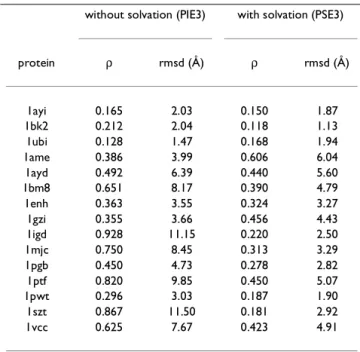
There are two additional constants, G and ρcut (described in Parameter Adjustment section), which need to be fixed before the calculation can be performed. In our previous calculations [26], we had fixed G = 0.3 and ρcut = 0.10. The value of G defines the minimum energy separation be-tween the native and an alternate conformation. We would like this value to be large so that the native is stable. The value of G depends upon the kind of energy function being used and in this work, we vary the value between 0.3 and 60.0. Similarly, the value of ρcut defines the basin of the native conformation and this value is varied be-Table 1: Effect of Solvation with three training proteins
without solvation (PIE3) with solvation (PSE3)
protein ρ rmsd (Å) ρ rmsd (Å) 1ayi 0.165 2.03 0.150 1.87 1bk2 0.212 2.04 0.118 1.13 1ubi 0.128 1.47 0.168 1.94 1ame 0.386 3.99 0.606 6.04 1ayd 0.492 6.39 0.440 5.60 1bm8 0.651 8.17 0.390 4.79 1enh 0.363 3.55 0.324 3.27 1gzi 0.355 3.66 0.456 4.43 1igd 0.928 11.15 0.220 2.50 1mjc 0.750 8.45 0.313 3.29 1pgb 0.450 4.73 0.278 2.82 1ptf 0.820 9.85 0.450 5.07 1pwt 0.296 3.03 0.187 1.90 1szt 0.867 11.50 0.181 2.92 1vcc 0.625 7.67 0.423 4.91
tween 0.05 and 0.25. To obtain the best potential func-tion, i.e., a potential function that places the maximum number of native conformations of test set proteins close to its minima, we vary these two parameters and repeat the training process.
PIE function
The PIE function, shown in Figure 1, has 3 parameters per interaction type, hence a total of 900 parameters. The po-tential function was so trained that when the native con-formations of the training set proteins are energy minimized, the resulting local minimum conformation is within 2.5 Å rmsd. For all choices of 0.3 ≤ G ≤ 60.0 and 0.05 ≤ ρcut ≤ 0.25, the potential was trainable, i.e., the po-tential function had enough flexibility that we did not run in to a situation where the QP could not come up with a solution, though at times solutions were suboptimal. The performance of these potential functions on the test set proteins varied greatly. In general high G and low ρcut val-ues resulted in a very rough energy surfaces which led to large energy changes for small conformational variations. On the other hand, low G and high ρcut values resulted in a potential function that is too flat and allows easy confor-mational changes. For these proteins, we found that a val-ue of G = 10.0 and ρcut = 0.12 gave us the best results. This potential function (PIE3) is able to place four of the 12 test protein native conformations to within ~4 Å rmsd of a local minimum (see Table 1). The other eight are be-tween 4–12 Å rmsd.
SE function
The SE function is very simple and has only 21 adjustable parameters, one for each residue and one for the over-crowding which prevents a complete collapse of the chain as well as prevents any unrealistic chain overlaps. Once again, we used the same three proteins and used various combinations of G and ρcut to obtain solutions. However, this time, with the SE function by itself, we failed to obtain a potential function even for a single protein, let alone all three proteins together. As soon as the conformations were generated by energy minimization process, we ob-tained a set of inequalities which resulted in a null feasible solution region for QP. This shows that the SE function by itself does not have enough flexibility to give a trained po-tential function when decoys are generated by more rigor-ous methods. Yet, this function was successfully trained by threading using experimental crystal structures [18].
PSE function
As with the PIE, the same three proteins are used for the training purposes. Since this is a sum of the other two en-ergy functions, there are 920 parameters, the one parame-ter for overcrowding in the SE function having been removed since the f0 part of the PIE function performs a similar function. Once again, we obtain various sets of
trained parameters depending upon the value of G and ρcut, and once again we find that G = 10.0 and ρcut = 0.12 give the best results for the test proteins. In this case (PSE3), six of these proteins remain within ~4 Å rmsd and all 12 are within ~6 Å. Considering that the test set con-tains both close homologs and significantly different pro-teins from the training propro-teins in terms of their size, sequence, and structure, this is a very encouraging result since all 12 test proteins remain within ~6 Å compared to ~12 Å for PIE. It shows that using a PSE function, one can train a potential function using only a few proteins which would be applicable to many other proteins. The compar-ison between the results of the PIE and PSE3 functions is shown in Table 1.
The training for PSE3 was performed using three proteins (Set A = {1ayi, 1bk2, 1ubi}), none of which contains Cys. However, there were many other interactions which re-mained untrained in the final version of PSE3. To get all 300 pairwise interactions to train at least moderately, we had to either select larger proteins which contain all resi-dues in sufficient number or enlarge the training set even if all the residues are not present in any one of the protein. Since computation time increases as square of the chain length, we chose to enlarge the training set using smaller proteins. A set of four proteins (Set B: {1enh, 1bk2, 2era, 1ubi}) contains all the 20 amino acids collectively. How-ever, in the final trained potential function (PSE4), eight of the interactions still remain completely untrained. This set was then further expanded by including two additional proteins (Set C: {1enh, 1bk2, 2era, 1ubi, 1ail, 1dsl}). The final trained potential function using Set C (PSE6) has all the pairwise interactions at least mildly trained. Set C con-tains two proteins (1enh and 1ail) with mostly α-helical
Figure 1
Terms of pairwise interaction energy function, eq. (2). Heavy solid line is f0, thin solid line is f1, dashed is f2, and dotted is
f3. 0.0 0.2 0.4 0.6 0.8 1.0 0 2 4 6 8 10 12 Distance (Å) f
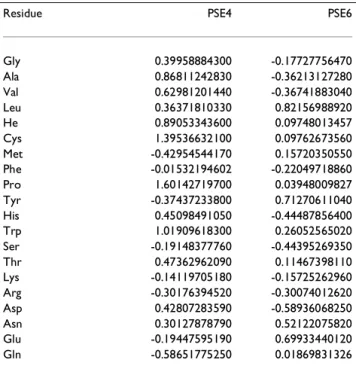
structure, three (1bk2, 2era and 1dsl) with mostly β-sheet structure and one (1ubi) with α/β structure. However, there is very little sequence identity between any of these proteins, and their crystal structures are also very different (less than 10% sequence alignment and rmsd of 8–14 Å in their crystal structures using MOE). The corresponding solvation parameters for various residues are shown in Ta-ble 2.
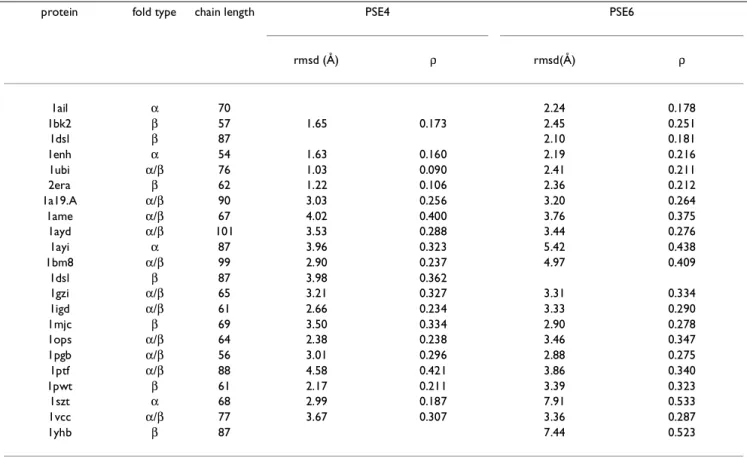
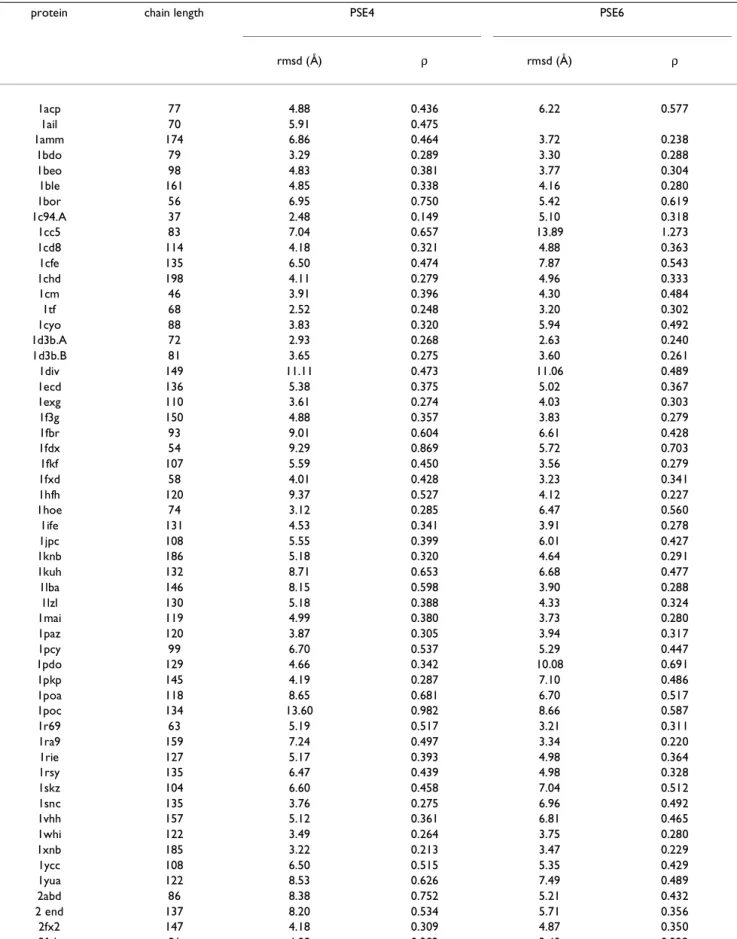
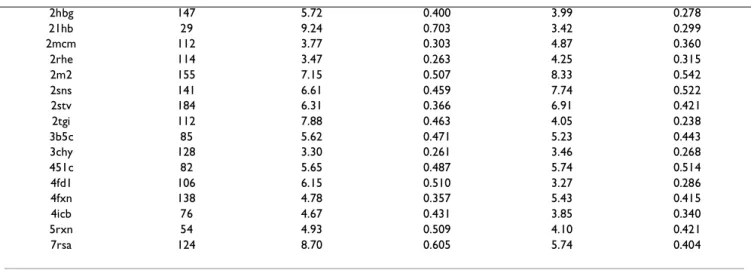
The best results for Set B (PSE4) are obtained using G = 9.9 and ρcut = 0.12. The potential function PSE4 places 14 of the 15 test set native conformations to within ~4 Å of a lo-cal minimum (see Table 3) which is a significant improve-ment over PSE3. The PSE4 was further applied to another 72 proteins (see Table 4) for a total of 87 test proteins. Of these 87 test proteins, 31 native conformations were placed within ~4 Å rmsd of a local minimum (including three CASP3 proteins), and 59 are within ~6 Å rmsd. Thus, PSE4 places a total of 35 native conformations (including the training set proteins) of very different sequences and crystal structures to within 4 Å rmsd and 63 to within 6 Å rmsd of a local minimum out of a total of 91 proteins. The set of 91 proteins contains a variety of proteins, some of which are multi-chain (e.g., 1d3b) or require a large group for stabilization (e.g., 1cc5).
The best result for Set C (potential function PSE6 with G = 13.1 and ρcut = 0.15) places 11 out of 14 test set proteins to within ~4 Å rmsd (see Table 3). In all, out of 91
pro-teins including the training set, 71 are within ~6 Å and 42 are within ~4 Å (including two CASP3 proteins). The fact that PSE6 is able to place 71 out of 91 native conforma-tions within ~6 Å rmsd of a local minimum for proteins of very different sequences, crystal structures, and length points to the robustness of the potential function, and, therefore, the usefulness of the approach.
Threading test
To further test the validity and usefulness of the final po-tential function PSE6, we performed an ungapped thread-ing test usthread-ing all the 91 proteins. We first energy minimized each of the native conformations and ob-tained the conformation of the local minimum using po-tential PSE6. These local minimum conformations were then used as decoys during ungapped threading tests for each protein. The threaded conformations were not ener-gy minimized. In the threading test, instead of the usual single point representation for each residue, we use a five point representation for each residue, since the potential PSE6 has been trained using this representation. Out of 91 proteins, 89 native conformations are ranked first and the other two (1dsl, 1snc) are ranked second. This test is con-ducted using a total of 180,878 decoys. Therefore, we see that a potential function trained using the procedure out-lined in this work also performs well when subjected to the threading test, whereas the potentials designed using only threaded conformations do not perform well when decoys are generated using energy minimization.
One of the drawbacks of this procedure is that the training process is not sequential and, therefore, quite time con-suming, i.e., addition of inequalities for a new protein af-ter the training for one protein is complete does not necessarily give better results. Any change in protein set,
G, ρcut or any other strategy change requires starting all over again, since the set of conformations generated for the training are based on the current set of parameters, i.e., the process is memory dependent. However, given that the potential energy surface is of very high dimension and highly irregular, it is to be expected.
By only considering the energy minimization of the exper-imental native conformation, we reduce the amount of time required to train the potential function. Each poten-tial function could be trained within a week running on four Sun workstations (CPU speeds: 135 MHz-450 MHz). However, we had to perform many training runs to get the best possible potential function for each set, and at this point it guarantees only the local minimum condition for the native state, not the global one.
Conclusions
A necessary, though not sufficient, condition for the sta-bility of the native state of a protein is that the experimen-Table 2: Solvation parameters
Residue PSE4 PSE6
Gly 0.39958884300 -0.17727756470 Ala 0.86811242830 -0.36213127280 Val 0.62981201440 -0.36741883040 Leu 0.36371810330 0.82156988920 He 0.89053343600 0.09748013457 Cys 1.39536632100 0.09762673560 Met -0.42954544170 0.15720350550 Phe -0.01532194602 -0.22049718860 Pro 1.60142719700 0.03948009827 Tyr -0.37437233800 0.71270611040 His 0.45098491050 -0.44487856400 Trp 1.01909618300 0.26052565020 Ser -0.19148377760 -0.44395269350 Thr 0.47362962090 0.11467398110 Lys -0.14119705180 -0.15725262960 Arg -0.30176394520 -0.30074012620 Asp 0.42807283590 -0.58936068250 Asn 0.30127878790 0.52122075820 Glu -0.19447595190 0.69933440120 Gln -0.58651775250 0.01869831326
tal native conformation be at or near a minimum of the potential function. We show that by using only a small set of proteins, potential functions can be trained that put a large number of native states near a local minimum of the potential function. While this does not guarantee the sta-bility of the native state, this does ensure that the native conformation is not sitting at highly unstable points on the potential surface, a condition which is encountered in other potential functions. Our best potential function (PSE6) obtained using training Set C (containing six pro-teins) is able to place a total of 42 native conformations to within ~4 Å rmsd and 71 native conformations to within ~6 Å rmsd of a local minimum of the potential function out of the 91 proteins. We also find that while the pairwise interaction energy function is trainable using the more rig-orously generated decoys, the solvation potential alone is not. The solvation potential has only 21 adjustable pa-rameters and can not provide enough flexibility to satisfy all the constraints in our case, though it was trainable us-ing threaded conformations from PDB. The best results are obtained using the pairwise energy function in combi-nation with the solvation energy function. We further test the final potential function PSE6 with threaded confor-mations for 91 proteins and find that 89 of the native
con-formations are ranked first and the remaining two are ranked second. The training process is further improved by the use of a physically meaningful quantity for the ob-jective function in the QP optimization which helps in identifying a better solution.
Methods
Generation of native structure
For the purposes of training, we select only single domain, monomeric proteins which do not require any hetero at-oms or ligands for their stabilization in the folded state. Furthermore, the atom positions are available for the main chain heavy atoms and at least the corresponding Cβ atom of the residue. The crystal structures (obtained from PDB[32]) for the protein chains are fitted to a standard ge-ometry continuous state model (very similar to the one used by Dill et. al.[33]). In the fitted model, each side chain is represented by a single interacting site, located at the Cβ, while keeping all the main chain heavy atoms, i.e., each residue is represented by five interacting sites (united atom types). Standard values for bond lengths and bond angles are used, and all peptide bonds are kept in the trans conformation. Thus, only torsion angles (φ, ψ) are al-lowed to vary between -180° and 180°. The details of the Table 3: Comparison of PSE4 and PSE6
protein fold type chain length PSE4 PSE6
rmsd (Å) ρ rmsd(Å) ρ 1ail α 70 2.24 0.178 1bk2 β 57 1.65 0.173 2.45 0.251 1dsl β 87 2.10 0.181 1enh α 54 1.63 0.160 2.19 0.216 1ubi α/β 76 1.03 0.090 2.41 0.211 2era β 62 1.22 0.106 2.36 0.212 1a19.A α/β 90 3.03 0.256 3.20 0.264 1ame α/β 67 4.02 0.400 3.76 0.375 1ayd α/β 101 3.53 0.288 3.44 0.276 1ayi α 87 3.96 0.323 5.42 0.438 1bm8 α/β 99 2.90 0.237 4.97 0.409 1dsl β 87 3.98 0.362 1gzi α/β 65 3.21 0.327 3.31 0.334 1igd α/β 61 2.66 0.234 3.33 0.290 1mjc β 69 3.50 0.334 2.90 0.278 1ops α/β 64 2.38 0.238 3.46 0.347 1pgb α/β 56 3.01 0.296 2.88 0.275 1ptf α/β 88 4.58 0.421 3.86 0.340 1pwt β 61 2.17 0.211 3.39 0.323 1szt α 68 2.99 0.187 7.91 0.533 1vcc α/β 77 3.67 0.307 3.36 0.287 1yhb β 87 7.44 0.523
Table 4: Comparison of PSE4 and PSE6 (additional tests)
protein chain length PSE4 PSE6
rmsd (Å) ρ rmsd (Å) ρ 1acp 77 4.88 0.436 6.22 0.577 1ail 70 5.91 0.475 1amm 174 6.86 0.464 3.72 0.238 1bdo 79 3.29 0.289 3.30 0.288 1beo 98 4.83 0.381 3.77 0.304 1ble 161 4.85 0.338 4.16 0.280 1bor 56 6.95 0.750 5.42 0.619 1c94.A 37 2.48 0.149 5.10 0.318 1cc5 83 7.04 0.657 13.89 1.273 1cd8 114 4.18 0.321 4.88 0.363 1cfe 135 6.50 0.474 7.87 0.543 1chd 198 4.11 0.279 4.96 0.333 1cm 46 3.91 0.396 4.30 0.484 1tf 68 2.52 0.248 3.20 0.302 1cyo 88 3.83 0.320 5.94 0.492 1d3b.A 72 2.93 0.268 2.63 0.240 1d3b.B 81 3.65 0.275 3.60 0.261 1div 149 11.11 0.473 11.06 0.489 1ecd 136 5.38 0.375 5.02 0.367 1exg 110 3.61 0.274 4.03 0.303 1f3g 150 4.88 0.357 3.83 0.279 1fbr 93 9.01 0.604 6.61 0.428 1fdx 54 9.29 0.869 5.72 0.703 1fkf 107 5.59 0.450 3.56 0.279 1fxd 58 4.01 0.428 3.23 0.341 1hfh 120 9.37 0.527 4.12 0.227 1hoe 74 3.12 0.285 6.47 0.560 1ife 131 4.53 0.341 3.91 0.278 1jpc 108 5.55 0.399 6.01 0.427 1knb 186 5.18 0.320 4.64 0.291 1kuh 132 8.71 0.653 6.68 0.477 1lba 146 8.15 0.598 3.90 0.288 1lzl 130 5.18 0.388 4.33 0.324 1mai 119 4.99 0.380 3.73 0.280 1paz 120 3.87 0.305 3.94 0.317 1pcy 99 6.70 0.537 5.29 0.447 1pdo 129 4.66 0.342 10.08 0.691 1pkp 145 4.19 0.287 7.10 0.486 1poa 118 8.65 0.681 6.70 0.517 1poc 134 13.60 0.982 8.66 0.587 1r69 63 5.19 0.517 3.21 0.311 1ra9 159 7.24 0.497 3.34 0.220 1rie 127 5.17 0.393 4.98 0.364 1rsy 135 6.47 0.439 4.98 0.328 1skz 104 6.60 0.458 7.04 0.512 1snc 135 3.76 0.275 6.96 0.492 1vhh 157 5.12 0.361 6.81 0.465 1whi 122 3.49 0.264 3.75 0.280 1xnb 185 3.22 0.213 3.47 0.229 1ycc 108 6.50 0.515 5.35 0.429 1yua 122 8.53 0.626 7.49 0.489 2abd 86 8.38 0.752 5.21 0.432 2 end 137 8.20 0.534 5.71 0.356 2fx2 147 4.18 0.309 4.87 0.350 2fxb 81 4.08 0.382 3.40 0.322
fitting procedure are described in ref. 20 and will not be repeated here. The fitted model is within 0.5 Å rmsd [34] of the PDB structure and is used as the native structure in our calculations. Thus, the native state is a single energy, non-degenerate state in our calculations.
Generation of the non-native decoys
The conformations of the non-native decoys are generated using the following procedures, (i) Parameter-Independ-ent Decoys: Starting from the native conformation, all pairs of torsional angles are perturbed by -30° ≤ δ ≤ 30° at a time. For example, for a chain of 50 residues, there are 100 torsion angles and, therefore, 4950 pairs of torsional angles. This would give us 4950 different decoys, but see the Solution Procedure section for the precise protocol used. These conformations do not depend upon the cur-rent potential function, (ii) Parameter-Dependent De-coys: The native conformation is energy minimized with respect to torsion angles using the current potential func-tion.
Energy functions
Since we generate conformations by energy minimization with respect to the torsion angles which are allowed to change continuously, we also need an energy function that is a continuous and differentiable function of angles. We use three different types of energy functions: the pair-wise interaction energy (PIE) function, the solvation ener-gy (SE) function, and the pairwise interaction with solvation energy (PSE) function. In our case, all these functions are continuous functions of separation between atoms and, therefore, the conformations can be energy minimized with respect to torsion angles to generate de-coys once we use the standard geometric representation for the conformations.
Pairwise interaction energy (PIE) function
The pairwise interaction between a pair of atoms is repre-sented by [19]
(1) where are adjustable parameters, ti is the type of united atom i, and xij is the distance between united at-oms i and j. The function fk(xij) is defined over a limited distance interval as follows:
(2) where b = 4.0, a0 = 0.0, a1 = 4.0, a2 = 6.0 and a3 = 8.0. The first term in each interaction, f0(xij), provides some steric repulsion for atoms sitting too close to each other and its coefficient is always fixed at 10 which prevents a complete collapse of the chain. The other three functions have adjustable coefficients which are allowed to vary between -20 and -20. The functional form of fk(xij)'s is shown in Fig-ure 1. Each interaction energy is represented by four pa-rameters. The maximum interaction distance is 12 Å. Equation (1) has following properties:
Å 2hbg 147 5.72 0.400 3.99 0.278 21hb 29 9.24 0.703 3.42 0.299 2mcm 112 3.77 0.303 4.87 0.360 2rhe 114 3.47 0.263 4.25 0.315 2m2 155 7.15 0.507 8.33 0.542 2sns 141 6.61 0.459 7.74 0.522 2stv 184 6.31 0.366 6.91 0.421 2tgi 112 7.88 0.463 4.05 0.238 3b5c 85 5.62 0.471 5.23 0.443 3chy 128 3.30 0.261 3.46 0.268 451c 82 5.65 0.487 5.74 0.514 4fd1 106 6.15 0.510 3.27 0.286 4fxn 138 4.78 0.357 5.43 0.415 4icb 76 4.67 0.431 3.85 0.340 5rxn 54 4.93 0.509 4.10 0.421 7rsa 124 8.70 0.605 5.74 0.404
Table 4: Comparison of PSE4 and PSE6 (additional tests) (Continued)
et t xij pk t t fk x k ij i j
( )
= i j( )
=∑
, 0 3 pk t t,i j f x x a b b for a b x a b otherwise k( )
ij =(
ij− k)
− k ij k − ≤ ≤ + 2 2 2 4 0 / et t i j( )
0 =10 et t xij xij i j( )
=0for ≥12 ∂ ∂xij et ti j( )
xij |xij=12=0The interaction energy function is continuous and differentiable for all xij ≥ 0, and is a linear function of adjustable parameters.
Furthermore, we consider 24 atom types: 20 side chain atom types representing 20 different amino acids and four main chain heavy atoms (Cα, C, N, and 0). This gives us a total of 24 × 25/2 = 300 different types of interactions and a total of 1200 parameters. In the present study, 300 of these parameters have a fixed value of 10, and 900 are ad-justable. The total pairwise energy is
(3) where the summation is over all pairs of united atom types separated by at least three covalent bonds. Since the total pairwise energy of any conformation is just the sum of individual pairwise interaction energies, the total pair-wise energy is also a linear function of the adjustable pa-rameters.
Solvation energy (SE) function
The solvation energy represents the change in energy due to the burial of various residues. This is an average contri-bution for each residue based upon how many other resi-dues are surrounding it and given by
(4) where pk(i) is the energy contribution for a residue of type
k at sequence position i along the chain surrounded by
other residues, and Ps is the penalty for overcrowding. Here, the first summation is over all residue pairs separat-ed by at least two residues along the chain backbone, and second summation is over all those residues for which the total number of contacts exceeds the maximum allowable number. The number of excess contacts Si are
(5)
The function determines the burial of each residue where xij is the separation between two side chain Cβ atoms situated at positions i and j. These are sigmoidal functions (see Figure 2). Both and Ck(i), max were obtained by Dombkowski and Crippen[18] from the survey of PDB crystal structures, and these functions are predetermined in our training procedure. Only the pk(i)'s and PS are determined here. This energy function has therefore only 21 adjustable parameters.
Pairwise interaction with solvation energy (PSE) function
The PSE function includes both the pairwise interaction energy and the solvation energy without the overcrowding part since the f0(xij) part of the PIE function ensures that the chain does not collapse to a point. The total energy in this case is given by
(6) and it has a total of 920 adjustable parameters.
Parameter adjustment using quadratic programming
Given the above energy functions, the total energy of any conformation is a linear function of the adjustable param-eters, irrespective of the energy function being used. This property allows us to use quadratic programming (QP) to adjust the values of these parameters. We choose the fol-lowing objective function for the optimization purpos-es:
(7) where αn,k is the sum of the coefficients of the Np param-eters pk when the derivative of the energy of a conforma-tion is evaluated at the native conformaconforma-tion of the n-th protein. While the first term minimizes the gradient of the energy with respect to dihedral angles at the native confor-mation for all training set proteins, the second term keeps the values of parameters small to reduce the roughness of the energy surface. Having a continuous energy function is essential for using such a physically meaningful objec-tive function. By minimizing the magnitude of the
gradi-et t xij i j
( )
EPIE et t xij i j i j =( )
− >∑
1 2| | 2 ESE pk iCt t xij P S i j S i i i j =( )
( )
+ − >∑
∑
| | 2 Si max Ct t xij C j k i max i j = ( )
− ∑
( )
0, , Ct t xij i j( )
Ct t xij i j( )
Figure 2Functional form of , eq. (4).
Ctti j xij () Distance xij(Å) Ct t ij i j
( )
x EPSE EPIE pk i Ct t x i j ij i j = + ( )( )
− >∑
| | 2 F F =( )
∇ + = + = = = =∑
∑
∑
∑
E k, nat pk p p k N n k k k N k k N n P P P P 2 2 1 1 2 2 1 1 α , kk P =∑
1ent of energy of the native conformation, we obtain a set of parameters such that the native conformation approxi-mates a stationary point of the potential function. The to-tal number of parameters NP depends upon the type of energy function is being used, namely 900 for the PIE function, 21 for the SE function, and 920 for the PSE func-tion. The constraints are of the form
∆E = Enon - Enat > g (8) where
(9) where G and ρcut are adjustable constants. If ρ < ρcut, we consider the decoy to be conformationally identical to the native and no inequality is generated even if the energy of the decoy is lower than that of the native. The constants G and ρcut define the minimum energy separation between the native and decoys, and the radius of the basin of the native, respectively. They may be changed from one train-ing run to another; however, not durtrain-ing the same traintrain-ing run. Here, ρ is given by [35]
(10) where Rgj is the radius of gyration of the jth conformation and D1,2 is the customary root mean square deviation in Cα coordinates after optimal superposition of the two conformations, taken to be the native and an alternate. By allowing g to vary linearly with ρ near the native structure, we avoid sudden jumps in the potential energy surface and keep the variation in the energy function smooth near the native. Finally, we need to provide bounds on our pa-rameters, and we have chosen pk = 10 for all pk's which multiply f0(xij)'s and -20 ≥ pk ≤ 20 for the rest of them. These values are chosen so that we are able to find a feasi-ble solution while keeping most of the parameters away from the extreme values. Due to the choice of , we use quadratic programming (QP) instead of linear program-ming to solve the set of inequalities. [36]
Solution procedure
We obtain the initial set of parameters by minimizing using QP. The decoys are generated using the methods de-scribed earlier. First, the decoys are generated by perturb-ing pairs of torsion angles by an amount δ. For a chain of
n residues, there are 2n(2n-1)/2 such pairs. Even for a
chain with 50 residues, this would produce 4950 confor-mations. Initially, since the parameter set is completely untrained, a large number of inequalities are generated for a training set of three to six proteins ranging in length from 50–90 residues. To keep the number of inequalities to a reasonable value, we first perturb pairs of angles
sep-arated by a certain number of covalent bonds n and its multiples. For example, in the first pass, we change the pair of angles separated by n = 9 covalent bonds or multi-ples of it, i.e., 9, 18, 27, etc. In this case, starting from the fifth torsion angle from the N-terminus, we perturb pairs of angles located at (5+9k, 5+9l) positions along the chain where k ≤ l = 0, 1, 2, etc, collect all the inequalities and run them through the QP to obtain a new set of parameters. Next, we take pairs of angles separated by 4 backbone bonds and add new inequalities to the previous set and obtain a new set of parameters by QP. This process is re-peated for pairs of angles separated by two, one and zero backbone bonds. Next, we repeat this process for all pairs of angles by perturbing them by δ ± 2°, δ ± 4° and δ ± 6° where 12° ≤ |δ| ≤ 20°. This is the parameter independent generation of decoys.
The next step is parameter dependent generation of de-coys. Here, we use energy minimization of native confor-mation (using BFGS method [37]) to generate new decoys. During each cycle, we begin from the native con-formation and energy minimize the concon-formations with respect to the torsion angles. After every 100 minimiza-tion steps, the conformaminimiza-tional distance of the current con-formation from the native is calculated in terms of ρ. If the ρ value is greater than the cutoff value ρcut, we say that the current conformation is sufficiently different from the na-tive one, i.e., it does not belong to the basin of nana-tive, and since the energy of this conformation is lower than the na-tive, a new constraint is generated. After complete mini-mization of the native conformations, if any new inequalities are generated, they are added to the set of in-equalities and a new set of parameters is obtained by QP. If no new inequalities are generated, then the training is complete and a trained potential has been obtained. To keep the number of inequalities within a manageable lim-it, we periodically discard inequalities corresponding to nonnatives having energy significantly higher than the na-tive state, i.e., having high slack value greater than S for the current parameter set. Initially, S is set at 500 and slowly reduced to 200.
Authors' Contributions
M.C. designed the fitting protocols, wrote the computer programs, chose training and test data, and carried out the calculations. G.M.C. contributed overall planning, advice, and discussions throughout. Both have read and ap-proved the manuscript.
Acknowledgements
This work was supported by a grant from NIH (Grant #1-R01-GM59097-01). The authors would like to thank Dr. Y. Z. Ohkubo for allowing us to use some of his computer code. We would also like to thank the PDB con-tributors. g G G cut = > < ≤ ρ ρ ρ ρ 0 3 0 3 0 3 . . . ρ = ⋅ +
(
)
− 2 2 1 2 1 2 2 2 1 22 D Rg Rg D , , F FReferences
1. Lazaridis T, Karplus M: Effective energy functions for protein structure prediction. Curr Opin Struct Biol 2000, 10:139-145 2. Miyazawa S, Jernigan R: Estimation of effective contact energies
from protein crystal structures: Quasi-chemical approxima-tion. Macromolecules 1985, 18:534-552
3. Miyazawa S, Jemigan R: Residue-residue potentials with a favo-rable contact pair term and an unfavofavo-rable high packing den-sity term, for simulation and threading. J Mol Biol 1996, 256:623-644
4. Hinds D, Levitt M: Exploring conformational space with a sim-ple lattice model for protein structure. J Mol Biol 1994, 243:668-682
5. Skolnick J, Jaroszewski L, Kolinski A, Godzik A: Derivation and testing of pair potentials for protein folding. When is the quasichemical approximation correct? Protein Sci 1997, 6:676-688
6. Sippl M: Boltzmann's principle, knowledge-based mean fields and protein folding. An approach to the computational de-termination of protein structures. J Comput-Aided Mol Design 1993, 7:473-501
7. Kocher J-P, Rooman M, Wodak S: Factors influencing the ability of knowledge-based potentials to identify native sequence-structure matches. J Mol Biol 1994, 235:1598-1613
8. Godzik A, Kolnski A, Skolnick J: Are proteins ideal mixtures of amino acids? Analysis of energy parameter sets. Protein Sci 1995, 4:2107-2117
9. Thomas P, Dill K: An interactive method for extracting energy-like quantities from protein structure. Proc Natl Acad Sci USA 1993, 93:11628-11633
10. Thomas P, Dill K: Statistical potentials extracted from protein structures: How accurate are they? J Mol Biol 1996, 257:457-469 11. Mirny L, Shakhnovich E: How to derive a protein folding poten-tial? A new approach to an old problem. J Mol Biol 1996, 264:1164-1179
12. Goldstein R, Luthey-Shulten Z, Wolynes P: Protein tertiary struc-ture recognition using optimized Hamiltonians with local in-teractions. Proc Natl Acad Sci USA 1992, 89:9029
13. Maiorov V, Crippen G: Contact potential that recognizes the correct folding of globular proteins. J Mol Biol 1992, 227:876-888 14. Vendruscolo M, Domany E: Pairwise contact potentials are un-suitable for protein folding. J Chem Phys 1998, 109:11101-11108 15. Vendruscolo M, Najmanovich R, Domany E: Can a pairwise
con-tact potential stabilize native protein folds against decoys obtained by threading? Proteins 2000, 38:134-148
16. Tobi D, Elber R: Distance-dependent, pair potential for pro-tein folding: Results from linear optimization. Propro-teins 2000, 41:40-46
17. Tobi D, Shafran G, Linial N, Elber R: On the design and analysis of protein folding potentials. Proteins 2000, 40:71-85
18. Dombkowski A, Crippen G: Disulfide recognition in an opti-mized threading potential. Protein Eng. 2000, 13:679-689 19. Ohkubo Y, Crippen G: Potential energy function for continuous
state model of globular proteins. J Comput Biol 2000, 7:363-379 20. Crippen G: Constructing smooth potential functions for
pro-tein folding. J Mol Graph Mod 2001, 19:87-93
21. Samudrala R, Moult J: An all-atom distance dependent condi-tional probability discriminatory function for protein struc-ture prediction. J Mol Biol 1998, 275:895-916
22. Clementi C, Vendruscolo M, Maritan A, Domany E: Folding Len-nard-Jones proteins by a contact potential. Proteins 1999, 37:544-553
23. Park K, Vendruscolo M, Domany E: Towards an energy function for the contact map representation of proteins. Proteins 2000, 40:237-248
24. Park B, Levitt M: Energy functions that discriminate X-ray and near native folds from well-constructed decoys. J Mol Biol 1996, 258:367-392
25. Park B, Huang E, Levitt M: Factors affecting the ability of energy functions to discriminate correct from incorrect folds. J Mol Biol 1997, 266:831-846
26. Chhajer M, Crippen G: A protein folding potential that has a stable native state and correct free energy of unfolding, 2002 27. Micheletti C, Seno F, Banavar J, Maritan A: Learning effective ami-no acid interactions through interactive stochastic tech-niques. Proteins 2001, 42:422-431
28. Wang Y, Zhang H, Li W, Scott R: Discriminating compact non-native structures from the non-native structure of globular pro-teins. Proc Natl Acad Sci USA 1995, 92:709-13
29. Huang E, Subbiah S, Tsai J, Levitt M: Using a hydrophobic contact potential to evaluate native and near-native folds generated by molecular dynamics simulations. J Mol Biol 1996, 257:716-725
30. Crippen G, Ohkubo Y: Statistical mechanics of protein folding by exhaustive enumeration. Proteins 1998, 32:425-437
31. MOE, Version 1999.09. Chemical Computing Group Inc 1999 [http:/ /www.chem-comp.com]
32. Berman H, Westbrook J, Feng Z, Gilliland G, Bhat T, Weissig H, Shindyalov I, Bourne P: The Protein Data Bank. Nucleic Acids Res 2000, 28:235-242
33. Dill K, Phillips A, Rosen J: Protein structure and energy land-scape dependence on sequence using a continuous energy function. J Comput Biol 1997, 4:227-239
34. Kabsch W: A discussion of the solution of the best rotation to relate two sets of vectors. Acta Cryst 1978, A34:827-828 35. Maiorov V, Crippen G: Size-independent comparison of protein
3-dimensional structures. Proteins 1995, 22:273-283 36. CPLEX, Version 6.6. ILOG, Inc 2000 [http://www.ilog.com] 37. Shanno D, Phua K: Remark on "Algorithm 500: Minimization of
unconstrained multi-variate function [E4]". ACM Trans Math Software 1980, 6:618-622
Publish with BioMed Central and every scientist can read your work free of charge
"BioMedcentral will be the most significant development for disseminating the results of biomedical research in our lifetime."
Paul Nurse, Director-General, Imperial Cancer Research Fund
Publish with BMC and your research papers will be:
available free of charge to the entire biomedical community peer reviewed and published immediately upon acceptance cited in PubMed and archived on PubMed Central yours - you keep the copyright
[email protected] Submit your manuscript here:
http://www.biomedcentral.com/manuscript/