O R I G I N A L R E S E A R C H
Open Access
Head-to-head comparison of image quality
between brain
18
F-FDG images recorded
with a fully digital versus a last-generation
analog PET camera
Julien Salvadori
1,2*, Laetitia Imbert
1,2,3,4, Mathieu Perrin
3, Gilles Karcher
2,3, Zohra Lamiral
5,
Pierre-Yves Marie
2,3,5and Antoine Verger
1,2,3Abstract
Background:The quality of phantom images was previously shown to be higher on digital (Vereos Philips®) compared to analog PET (Ingenuity Philips®) cameras. This study aimed to determine the extent to which this difference still remains significant on normal brain18F-FDG PET images.
Methods:Relative noise and contrast as well as border sharpness (a spatial resolution index) of central (striata) and peripheral (occiput) gray-matter structures were compared between 10 sets of normal brain18F-FDG PET images recorded and reconstructed on digital and analog last-generation PET cameras, together with a subjective visual analysis of image quality provided by experienced physicians.
Results:Compared with analog PET, digital PET provided marked improvements in image quality parameters. The median relative noise was decreased (−22%), while gray/white-matter contrast was increased (+ 27%/+ 41% for central/peripheral gray-matter structures), with these results being consistent with visual analysis. In addition, a clear enhancement in image sharpness was further documented for digital PET owing to the possible use of a 1-mm3 voxel size (+ 24%/+ 21%).
Conclusions:On normal brain18F-FDG images and compared with a last-generation analog PET, the fully digital PET camera offers marked improvements in image noise and contrast, as well as significant potential for further enhancing spatial resolution.
Keywords:Digital PET, Brain18F-FDG, Image quality, Contrast, Spatial resolution, Noise
Background
Fully digital PET cameras, such as the“Vereos”(Philips®, Cleveland, Ohio), feature small digital silicon photomul-tipliers instead of much larger photomultiplier tubes, providing true digital photon counting with 1-to-1 crys-tal coupling [1]. These properties are primarily likely to enhance the time-of-flight (TOF) capability and thus to favor signal-to-noise ratio [2].
According to the PET standards of the National Electrical Manufacturers Association (NEMA) [3], the Vereos digital PET camera exhibits certain advantages, particularly with regard to time of flight (TOF) resolution (~ 310 ps) leading to an enhanced signal-to-noise ratio gain [2] and ultimately to an improvement in image con-trast (concon-trast recovery ranging from 54–62% for 10-mm hot sphere to 84–88% for 22-mm hot sphere) and noise level (background variability ranging from 8.8–9.6% for 10-mm sphere to 2.5–2.6% for 37-mm sphere) [4, 5]. Spatial resolution is additionally enhanced with this digital PET camera (4.0–4.2 mm FWHM at the field of view cen-ter) presumably owing to the 1-to-1 crystal coupling (lower uncertainty in the interaction position) and to the
© The Author(s). 2019Open AccessThis article is distributed under the terms of the Creative Commons Attribution 4.0 International License (http://creativecommons.org/licenses/by/4.0/), which permits unrestricted use, distribution, and reproduction in any medium, provided you give appropriate credit to the original author(s) and the source, provide a link to the Creative Commons license, and indicate if changes were made.
* Correspondence:[email protected]
1
IADI, INSERM UMR-1254, Université de Lorraine, 54500 Vandœuvre-lès-Nancy, France
2Plateforme Nancyclotep, CHRU-Nancy, Université de Lorraine, 54500
Vandœuvre-lès-Nancy, France
smaller field of view (lower impact of the non-collinearity of coincident photons) [4,5]. Indeed, fields of view of this digital PET camera are respectively 9% (16.4 vs. 18 cm) and 15% (76.4 vs. 90.3 cm) smaller than those of a last-generation analog PET camera, the “Ingenuity TF” (Phi-lips®, Cleveland, Ohio), in axial and transversal directions.
Previous pilot clinical studies have also led to consider that digital PET might improve not only the image qual-ity of whole-body PET images, but also diagnostic confi-dence and accuracy for oncologic diseases, as compared with analog PET [6–8]. Such a significant enhancement in image quality and in diagnostic accuracy could prove helpful for various PET exams and particularly for brain imaging where it could additionally facilitate current dual PET/MRI analyses [9]—i.e. with a greater ability to delineate cortical gyri than with analog PET [10]. How-ever, it is not known whether digital PET objectively of-fers a significant and quantitative gain in the quality of brain PET images.
This study thus aimed to assess the image quality of normal brain 18F-FDG images, recorded and recon-structed with the Vereos digital PET camera, as compared with those obtained with a last-generation analog PET camera, the“Ingenuity TF”(Philips®, Cleveland, Ohio).
Methods
Study population
Two groups of 10 sets of normal brain 18F-FDG PET images, respectively recorded on analog (Ingenuity, Phi-lips®, Cleveland, Ohio) and digital (Vereos, PhiPhi-lips®, Cleveland, Ohio) PET cameras, were selected in our department. All patients had been referred in November or December 2017 as a part of an oncological workup for a whole-body 18F-FDG PET exam starting with a brain PET recording, performed 45 min after injection of 3 MBq/kg (81μCi/kg) of F-18 FDG. The selection was based on the following criteria: (1) absence of any known neurological or psychiatric disease, (2) absence of diabetes mellitus and of a blood glucose level > 2 g.L−1at the time of18F-FDG injection, (3) brain PET and CT im-ages considered definitely normal through a careful vis-ual analysis performed by an experienced observer (AV), and (4) matching between the 2 groups according to the patients’gender and age (±5 years). This study was ap-proved on April 23, 2018, by the local institutional re-view board (Comité d'éthique CHRU Nancy). The study was conducted in accordance with the Declaration of Helsinki and all patients from our institution are in-formed that their medical data can be rendered anonym-ous and used for scientific purposes.
PET imaging
The brain PET data from both cameras were recorded in list mode over a 15-min period in a single-bed
position. All images were first reconstructed as currently recommended by the manufacturer, namely with 2-mm isotropic voxels, using an ordered subset expectation maximization (OSEM) algorithm with the TOF informa-tion and by accounting for dead time losses as well as scatter, random, and attenuation corrections with CT images for both cameras.
Digital PET images were additionally reconstructed with the same method but with a 1-mm voxel size in order to assess the potential for further enhancing spatial resolution. The analog PET device was conversely not equipped with a reconstruction system yielding a voxel size of 1-mm.
In order to determine the number of OSEM iterations allowing the comparison of the two cameras under simi-lar convergence conditions, an IEC torso phantom was performed on both systems following the NEMA NU-2 2012 protocol (i.e. with 5.3 MBq/L in the background and a 4:1 sphere-to-background ratio) and reconstructed with 10 subsets and a number of iterations ranging from 1 to 10 for digital and from 1 to 15 for analog cameras, respectively. The convergence of the contrast recovery coefficient of the smallest 10-mm hot sphere was chosen as a convergence criterion for this study. As detailed in Fig. 1, where contrast recovery coefficients are plotted according to the relative noise (coefficient of variation in the background), this convergence was reached at about 5 iterations on the digital PET with either a 2-mm or 1-mm voxel size and about 10 iterations on the analog PET. Consequently, OSEM reconstructions were performed with 3 iterations and 15 subsets and 3 iterations and 33 subsets, respectively, for digital and analog cameras.
The reconstructed PET images were post-treated both without and with the additional use of a current method of resolution recovery obtained by a deconvolution of the point spread function (PSF) using a regularized ver-sion of the Richardson-Lucy algorithm [11, 12] (1 iter-ation and 6-mm regulariziter-ation kernel).
Performance parameters
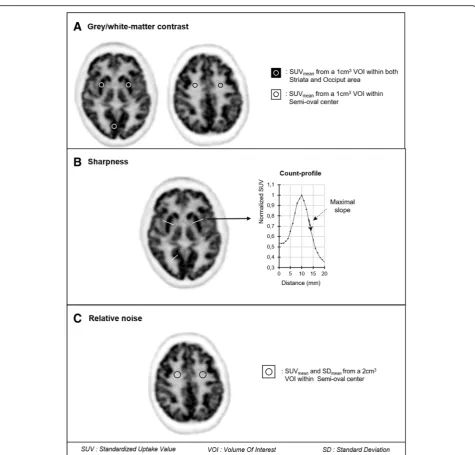
As detailed in Fig. 2a, gray/white-matter contrast values [13] were determined for both peripheral (occiput) and central gray-matter structures (averaged left and right stri-ata values), relative to the white-matter semi-oval center, with 1-cm3 volume of interests (VOI) and according to the following formula involving mean standardized uptake values (SUVmean) for gray and white matter:
Grey=white−matter contrast¼SUV grey−matter
mean −SUVwhitemean−matter SUVwhite−matter
mean
As detailed in Fig. 2b, spatial resolution was assessed through a sharpness index [14] computed as the maximum slope of count profiles. These count profiles were obtained
perpendicularly to the gray/white-matter interfaces of the striata and occiput and are expressed in percent of the maximal count values and per millimeter length. Values from the 2 striata were averaged for further analyses.
Relative noise was assessed through a coefficient of variation (standard deviation-to-mean ratio) of the SUV from a 2-cm3 spherical VOI placed within the white-matter semi-oval center (see Fig. 2c). A VOI having a volume of 2 cm3 represents approximately the largest VOI that can be placed in the homogeneous zone of the semi-oval center.
Visual analysis of image quality
A consensual visual assessment of 3 image quality pa-rameters, i.e., contrast, spatial resolution, and noise, was obtained from two experienced physicians (AV, MP) on the 30 sets of FDG PET images without PSF correction (10 from analog PET with 2-mm voxels, 10 from digital PET with 2-mm voxels, and 10 from digital PET with 1-mm voxels). These image sets were rendered anonymous and presented in random order, and each image set was graded visually and subjectively with a 3-point scale, ran-ging from 1 to 3 for each of the 3 image quality parame-ters (from 1, the lowest class of quality score for contrast and spatial resolution but also the lowest class for noise level, to 3, the highest class of quality score for contrast and spatial resolution but also the highest class for noise level). Results of this visual analysis were pre-sented through the sum-scores of the 10 sets of patient
images for each reconstruction and for each image qual-ity parameter (i.e., with a 30-point scale).
Statistical analysis
Quantitative variables, expressed as median values and interquartile ranges due to non-normality distribu-tions, were compared with the Mann-Whitney or Kruskal-Wallis test for 2-group or more-than-2-group comparisons, respectively. Paired comparisons of recon-structions obtained without or with PSF were performed using the Wilcoxon signed-rank test. Apvalue < 0.05 was considered significant.
Results
The two patient groups, respectively investigated with analog and digital PET cameras, were each comprised of 5 women and 5 men and were similar in terms of age (63 [58–67] years vs. 58 [55–64] years), body mass index (24 [22–27] kg m−2 vs. 29 [25–31] kg m−2), and blood glucose (0.90 [0.88–0.94] g/L vs. 0.91 [0.87–0.98] g/L).
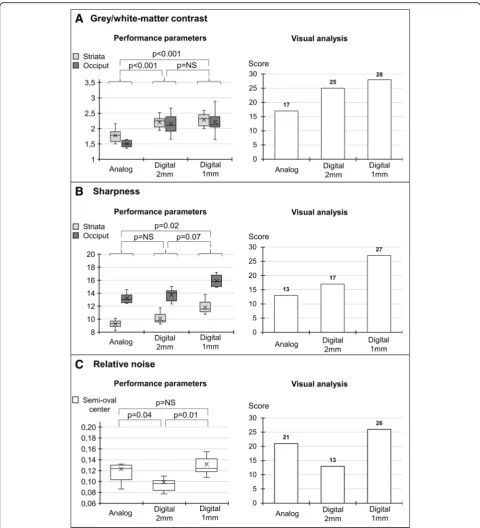
As detailed in Fig.3and in accordance with the corre-sponding results from visual analysis, most of the quan-titative parameters of image quality were enhanced with digital PET reconstructed with a conventional 2-mm voxel size, as compared with analog PET. This enhance-ment was particularly pronounced for gray/white-matter contrast (27% increase for the median value of the striata and 41% for that of the occiput, p< 0.001, Fig. 3a), as well as for relative noise (22% decrease in median value
(p= 0.04), Fig. 3c). A trend toward a better sharpness index was also documented for the same digital PET images (Fig. 3b) although this difference did not reach statistical significance.
However, the sharpness index was further enhanced for digital PET images reconstructed with the 1-mm voxel size, leading to reach a significant difference relative to the conventional images from analog PET (median increases of 24% for the striata and 21% for the occiput (p= 0.02), Fig.3b), whereas the gray/white-matter contrast was unchanged, remaining higher than that
of analog PET (median increases of 31% for the stri-ata and 42% for the occiput (p< 0.001), Fig. 3a). This digital PET reconstruction with 1-mm voxel size was nevertheless associated with an increase in image noise, reaching a comparable level to that of analog PET (Fig. 3c).
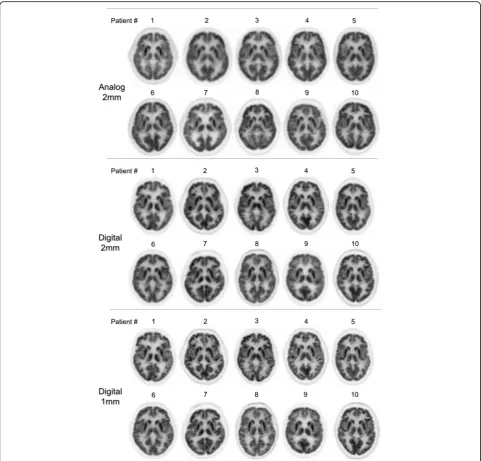
A gallery of axial slices, extracted from all analyzed sets of PET images, is depicted in Fig.4.
As detailed in the Additional file 1, all of the afore-mentioned differences remained significant when add-ing PSF deconvolution after the image reconstruction
Fig. 2Schematic representations of methods used on axial18F-FDG brain PET images toaquantify the contrast between central (striata) or
peripheral (occiput) gray-matter structures and a white matter structure (semi-oval center),bdetermine the sharpness index through the maximal slope of count profiles obtained perpendicularly to the gray/white-matter interfaces of striata and occiput and further normalized to the maximal curve value, andcquantify the noise level within the semi-oval area
processes. This addition led to a systematic improve-ment in image contrast and spatial resolution and to an increase in image noise for all analyzed sets of analog and digital PET images (all p< 0.001).
Finally, as depicted in Fig.3, the results from the sub-jective visual analysis of image contrast, noise, and spatial resolution were strongly comparable to those from the corresponding quantitative parameters, strengthening the
consideration that the aforementioned differences in these quantitative parameters are sufficiently high to be clearly noticeable through a simple visual analysis by experienced physicians.
Discussion
The present study shows that the image quality of normal brain 18F FDG PET images is improved with a fully digital PET, when compared with a last-generation analog PET camera and through an objective analysis of quantitative parameters. These improvements were
particularly pronounced for image contrast but addition-ally for either image noise or spatial resolution, depending on the voxel size of the digital PET images (2 vs. 1 mm).
Furthermore, all of these improvements were sufficiently perceptible to be easily noticeable through a subjective visual analysis by experienced physicians, as illustrated in Fig.3, and have thus the potential to enhance the routine examination of brain18F-FDG PET scans.
The analysis of brain18F-FDG PET images mainly relies on gray/white-matter contrast, the latter of which was found to be markedly enhanced with digital compared to
Fig. 4Gallery of axial brain18F-FDG PET images obtained with analog PET and a current reconstruction method using a 2-mm voxel size ( n= 10) (upper row), with digital PET and either a comparable reconstruction method with 2-mm voxel size (n= 10) (middle row) or a high-resolution reconstruction method with 1-mm voxel size (n= 10) (lower row)
analog PET, irrespective of the voxel size used for digital PET reconstruction. This contrast enhancement, reaching as high as 41% for the occiput, is of similar range to that documented between the same cameras for contrast re-covery coefficients obtained from 10-mm-diameter hot spheres from the NEMA phantom [4,5].
The amount of noise was also found to be significantly enhanced for digital PET with a greater than 20% noise reduction when using a conventional 2-mm voxel size reconstruction.
The enhancement in spatial resolution was however found to be rather poor for digital PET reconstructed with the routine 2-mm voxel size, although this reso-lution was clearly higher when voxels were reduced to a 1-mm size. These observations were strengthened through further experiments in which full-width at half maximum (FWHM) values were measured on a point source of F-18 according to the NEMA standard and thus, with filtered back projection reconstruction (exper-iments not shown). The 2- to 1-mm reduction in voxel size was associated with a decrease in FWHM of 15% for Vereos (from 4.73 mm to 4.0 mm at the center of field-of-view) and a much more limited change of 7% for Ingenu-ity (from 5.10 mm to 4.75 mm) [15]. Thus, it would appear that a 1-mm voxel size is more suited than the more con-ventional 2-mm size for taking advantage of the gain in spatial resolution which can be achieved with the Vereos. Such finding suggests that the voxel size should be adapted to the level of spatial resolution that can now be achieved with recent digital PET cameras.
The use of digital PET images with a 1-mm voxel size, as opposed to the more conventional 2-mm size, was not only associated with a high level of spatial resolution but also with a high image contrast, which remained higher than that of analog PET. These properties ultim-ately led to a very accurate delineation of the gray-matter structures, as evidenced in the images displayed in Fig. 4, reaching a level much closer to that currently obtained with MRI [16]. However, the drawback is a loss of advantage in terms of noise level, and therefore the clinical usefulness of such high-definition images re-mains to be fully investigated.
Of note, all of the above differences between digital and analog PET performances were independent of the use of PSF deconvolution recommended by the manu-facturer. This deconvolution allows reducing the partial volume effect and therefore offers further improvements in image contrast and spatial resolution. However, noise is also amplified by the PSF deconvolution and, similarly to the choice of voxel size, a compromise is necessary between the levels of resolution and noise that need to be achieved for diagnostic purposes.
It should be emphasized that these differences in image contrast, noise, and spatial resolution were documented
through optimization of the reconstruction processes in order to reach a high level of convergence for the contrast recovery coefficient for each camera and according to voxel size. This level of convergence was reached with a much lower number of iterations with the digital PET as opposed to the analog PET as evidenced in Fig. 1, a current observation due to the higher temporal resolution of the digital PET camera [17,18].
A limitation of this study is that no 1-mm reconstruc-tion software has been developed for routine examina-tions performed with the Ingenuity PET camera. Hence, no direct comparison could be performed between the 2 cameras for 1-mm voxel size images. However, it is likely that the higher levels of contrast and spatial resolution observed for digital PET on the present 2-mm brain im-ages constitute a more favorable setting for analyzing PET images reconstructed through a 1-mm voxel size. The sample of patients (n= 10) used in the present study in both the analog and digital PET systems is limited, even if only patients with normal 18F-FDG PET brain images were retrospectively selected. Further studies with larger sample sizes should be conducted to confirm these preliminary results.
Conclusions
On normal brain 18F-FDG PET images and compared with last-generation analog PET, fully digital PET offers clear improvements in contrast and image noise as well as a significant potential for further enhancing spatial resolution. These improvements are sufficiently note-worthy to be clearly noticeable visually and could be particularly appropriate in the setting of PET neuroim-aging, by facilitating the delineation of cortical gyri in combination with MRI analysis.
Additional file
Additional file 1:Box-plots for (A) grey/white-matter contrast, (B) sharpness and (C) relative noise index obtained with current 2-mm recon-struction processes of analog and digital PET images and with a 1-mm reconstruction process developed for digital PET images. Left panel with-out PSF deconvolution and right panel with PSF deconvolution. (TIF 2325 kb)
Abbreviations
IEC:International Electrotechnical Commission; NEMA: National Electrical Manufacturers Association; PSF: Point spread function; TOF: Time of flight
Acknowledgements
The authors thank Pierre Pothier for critical review of the manuscript.
Authors’contributions
Funding
None
Availability of data and materials
The datasets used and/or analyzed during the current study are available from the corresponding author on reasonable request.
Ethics approval and consent to participate
This study was approved on April 23, 2018, by the local institutional review board. All procedures performed in studies involving human participants were in accordance with the ethical standards of the institutional and/or national research committee and with the 1964 Helsinki declaration and its later amendments or comparable ethical standards.
Consent for publication
Not applicable
Competing interests
The authors declare that they have no competing interests.
Author details
1
IADI, INSERM UMR-1254, Université de Lorraine, 54500
Vandœuvre-lès-Nancy, France.2Plateforme Nancyclotep, CHRU-Nancy,
Université de Lorraine, 54500 Vandœuvre-lès-Nancy, France.3Service de
Médecine Nucléaire, CHRU-Nancy, Université de Lorraine, 54500 Vandœuvre-lès-Nancy, France.4Institut de Cancérologie de Lorraine, Université de Lorraine, 54500 Vandœuvre-lès-Nancy, France.5Centre
d’Investigations Cliniques Plurithématiques, INSERM UMR-1116, Université de Lorraine, 54500 Vandœuvre-lès-Nancy, France.
Received: 9 April 2019 Accepted: 5 June 2019
References
1. Frach T, Prescher G, Degenhardt C, de Gruyter R, Schmitz A, Ballizany R. The digital silicon photomultiplier—principle of operation and intrinsic detector performance. In: IEEE Nuclear science symposium conference record (NSS/ MIC); 2009. p. 1959–65.https://doi.org/10.1109/NSSMIC.2009.5402143. 2. Budinger TF. Time-of-flight positron emission tomography: status relative to
conventional PET. J Nucl Med. 1983;24:73–8.
3. NationalElectricalManufacturersAssociation. NEMA NU-2 2012: performance measurement of positron emission tomography. 2013.
4. Rausch I, Ruiz A, Valverde-Pascual I, Cal-Gonzalez J, Beyer T, Ignasi C. Performance evaluation of the Philips Vereos PET/CT system according to the NEMA NU2–2012 standards. J Nucl Med. 2018;60:561–7.
5. Zhang J, Maniawski P, Knopp MV. Performance evaluation of the next generation solid-state digital photon counting PET/CT system. Eur J Nucl Med Res. 2018;8:97.https://doi.org/10.1186/s13550-018-0448-7.
6. Nguyen NC, Vercher-Conejero JL, Sattar A, Miller MA, Maniawski PJ, Jordan DW, et al. Image quality and diagnostic performance of a digital PET prototype in patients with oncologic diseases: initial experience and comparison with analog PET. J Nucl Med. 2015;56:1378–85.https://doi.org/ 10.2967/jnumed.114.148338.
7. López-Mora DA, Flotats A, Fuentes-Ocampo F, Camacho V, Fernández A, Ruiz A. Comparison of image quality and lesion detection between digital and analog PET/CT. Eur J Nucl Med. 2018.https://doi.org/10.1007/s00259-019-4260. 8. Fuentes-Ocampo F, López-Mora DA, Flotats A, Paillahueque G, Camacho V,
Duch J, et al. Digital vs. analog PET/CT: intra-subject comparison of the SUVmax in target lesions and reference regions. Eur J Nucl Med. 2019.
https://doi.org/10.1007/s00259-018-4256-0.
9. Henriksen OM, Marner L, Law I. Clinical PET/MR imaging in dementia and neuro-oncology. PET Clin. 2016;11:441–52.https://doi.org/10.1016/j.cpet. 2016.05.003.
10. Salvadori J, Perrin M, Marie PY, Laetitia I, Verger A. High-resolution brain18
F-FDG images provided by fully digital PET. Clin Nucl Med. 2019;44:301–2.
https://doi.org/10.1097/RLU.0000000000002483.
11. Richardson WH. Bayesian-based iterative method of image restoration. JOSA. 1972;62:55–9.https://doi.org/10.1364/JOSA.62.000055. 12. Lucy LB. An iterative technique for the rectification of observed
distributions. Astron J. 1974;79:745–54.https://doi.org/10.1086/111605.
13. Peli E. Contrast in complex images. JOSA. 1990;7:2032–40.https://doi.org/10. 1364/JOSAA.7.002032.
14. Imbert L, Poussier S, Franken PR, Songy B, Verger A, Morel O, et al. Compared performance of high-sensitivity cameras dedicated to myocardial perfusion SPECT: a comprehensive analysis of phantom and human images. J Nucl Med. 2012;53:1897–903.https://doi.org/10.2967/jnumed.112.107417. 15. Salvadori J, Verger A, Chevalier E, Perrin M, Tissot H, Claudin M, et al.
Head-to-head comparisons of the PET performance measured using the NEMA standards between digital and analogic last-generation cameras. J Nucl Med. 2018;59(Suppl 1):574. Abstract.
16. Bahloul A, Perrin M, Amlal S, Marie PY, Verger A. Central nervous system myelomatosis delineated by high-resolution brain images from fully digital18F-FDG PET. Clin Nucl Med. 43:372–3.https://doi.org/10. 1097/RLU.0000000000002243.
17. Vandenberghe S, Mikhaylova E, D’Hoe E, Mollet P, Karp JS. Recent developments in time-of-flight PET. Eur J Nucl Med Phys. 2016;3:3.https:// doi.org/10.1186/s40658-016-0138-3.
18. Conti M. Focus on time-of-flight PET: the benefits of improved time resolution. Eur J Nucl Med. 2011;38:1147–57.https://doi.org/10.1007/s00259-010-1711-y.
Publisher’s Note
Springer Nature remains neutral with regard to jurisdictional claims in published maps and institutional affiliations.