O R I G I N A L R E S E A R C H
Open Access
SUVref: reducing reconstruction-dependent
variation in PET SUV
Matthew D Kelly
*and Jerome M Declerck
Abstract
Background:We propose a new methodology, reference Standardised Uptake Value (SUVref), for reducing the
quantitative variation resulting from differences in reconstruction protocol. Such variation that is not directly addressed by the use of SUV or the recently proposed PERCIST can impede comparability between positron emission tomography (PET)/CT scans.
Methods:SUVrefapplies a reconstruction-protocol-specific phantom-optimised filter to clinical PET scans for the
purpose of improving comparability of quantification. The ability of this filter to reduce variability due to differences in reconstruction protocol was assessed using both phantom and clinical data.
Results:SUVrefreduced the variability between recovery coefficients measured with the NEMA image quality
phantom across a range of reconstruction protocols to below that measured for a single reconstruction protocol. In addition, it enabled quantitative conformance to the recently proposed EANM guidelines. For the clinical data, a significant reduction in bias and variance in the distribution of differences in SUV, resulting from differences in reconstruction protocol, greatly reduced the number of hot spots that would be misclassified as undergoing a clinically significant change in SUV.
Conclusions:SUVrefsignificantly reduces reconstruction-dependent variation in SUV measurements, enabling
increased confidence in quantitative comparison of clinical images for monitoring treatment response or disease progression. This new methodology could be similarly applied to reduce variability from scanner hardware.
Keywords:PET, SUV, reconstruction, FDG, PERCIST
Background
The Standardised Uptake Value (SUV) is a widely used metric for quantifying radiotracer (particularly18 F-2-fluoro-2-deoxy-D-glucose) uptake in clinical positron emission tomography (PET) scans. Its use is intended to provide normalisation for differences in patient size and body composition along with the dose of radiotracer injected, thereby enabling inter-study comparison between and within individual patients [1,2].
While variations in body composition and injected dose represent one significant source of variation, differences in scanner hardware and reconstruction represent another; however, these differences are not addressed by the use of SUV. These unaddressed sources of variation impede wider acceptance of PET as a quantitative
imaging tool for lesion characterization, prognostic strati-fication and treatment monitoring, since differences in scanner hardware and reconstruction can significantly impact generated SUV [3].
A variety of proposals have been suggested to address the issue of scanner hardware/reconstruction-dependent variation in SUV. For example, the European Association of Nuclear Medicine (EANM) procedure guidelines [4], following on from the Netherlands protocol [5], provide specifications for activity concentration recovery coeffi-cients (RC), as measured with the National Electrical Manufacturers Association (NEMA) Image Quality phan-tom [6]. RCs measure the ability of an imaging system to recover the true activity concentration ratio between regions filled with different activity concentrations. They are a useful indicator of clinical scanner performance, incorporating the effects of scanner resolution, sensitiv-ity, accuracy of the various corrections performed along * Correspondence: [email protected]
Siemens plc, Healthcare Sector, Molecular Imaging, 23/38 Hythe Bridge Street, Oxford, OX1 2EP, UK
with the reconstruction parameters used (e.g. number of iterations and subsets, post-filter smoothing). Given these specifications, reconstruction settings should be determined for each scanner so as to generate RCs within the specified bounds. A similar approach has also been proposed by Weber and colleagues [7]. While following such an approach will reduce the variation in SUV due to differences in scanner performances and reconstruction protocol, it can negate the benefits of advances in tech-nology which improves image quality if reconstructions are constrained to produce RCs in line with those achiev-able using older models of scanner. Typically, the most sensitive and advanced scanners and reconstruction tech-niques produce RCs which exceed the upper bounds of the protocol. Conversely, RCs that fall below the lower bounds may be improved through modification of the reconstruction parameters; however, achieving this typically requires additional iterations or reduced post-filtering, both of which increase image noise.
A different approach is used by Joshi and colleagues
[8] as part of the Alzheimer’s Disease Neuroimaging
Initiative project. The authors apply an additional scan-ner-specific smoothing kernel to data from each scanner in a multi-centre trial in order to smooth all images to a common resolution. While this method succeeds in reducing the variability between datasets by 15% to 20%, it again produces images smoothed to that of the lowest resolution scanner. Furthermore, the requirement to register the clinical dataset to smoothed versions of the digital Hoffman brain phantom to determine the appro-priate smoothing kernel using a voxel-wise comparison, makes the method difficult to extend to whole body data.
We propose another approach that combines reducing the variation in SUV due to differences in scanner perfor-mances and reconstruction protocol while avoiding the need to constrain reconstructions to produce RCs in line with those achievable using older models of scanner, which may negatively affect lesion detectability. The refer-ence SUV (SUVref) methodology allows users to continue to take advantage of improvements in image quality, from developments in scanner hardware and reconstruction technologies, when reviewing the clinical images. This method is not meant to address other sources of inter-scan variation in SUV, which are of biological nature. These can only be minimised by careful preparation of the patient for each scan. The aim of the SUVrefmethodology is to reduce to a minimum the non-biological effects which may affect the calculation of SUV. The methodol-ogy can be applied to the comparison of two acquisition/ reconstruction protocols as well as for multi-acquisition/ reconstruction protocol comparisons. This has relevance for clinical scenarios in which an absolute SUV threshold is used to indicate malignancy, estimate prognosis or
predict response to therapy. It is also applicable for centres in which a patient receives follow-up scans on a different scanner or using a different reconstruction, for example, following a scanner upgrade or in sites with multiple scanners.
Methods
SUVref methodology
Similar to the method described by Joshi and colleagues [8], a scanner- and reconstruction-specific smoothing filter is applied to clinical data; however, this filtered image is used only for quantification with the originally recon-structed image used for visualisation. As such, the reading physician can take advantage of the improvements in image quality and lesion detectability associated with advances in scanner hardware and reconstruction [9].
Since the filtered image is used only for quantification, filter selection is performed so as to minimise the variation in activity concentration RCs between images. For each reconstruction protocol, RCs are measured using the NEMA Image Quality (IQ) phantom, prepared and imaged as per the NEMA Standards Publication NU 2-2007 [6]. In contrast to the Standard however, the RC for each hot sphere (i.e. those with diameters 10, 13, 17 and 22 mm) is measured using the voxel with the maximum activity from a 3D volume of interest corresponding to the dimensions of the sphere. The value of the maximum voxel rather than the mean within the sphere dimensions is used to reflect the typical clinical practice for evaluation of lesions. Background activity is measured as per the NEMA Standard.
These RCs are then compared to a set of reference RCs and the root mean squared error (RMSE) calculated. This comparison is repeated following convolution of the origi-nal image with a Gaussian kernel of increasing full width half max (FWHM). The kernel size that minimises the RMSE when compared to the reference RCs is selected as the SUVreffilter for that scanner/reconstruction protocol combination.
with a sphere-to-background ratio of 8:1 in contrast to the 4:1 phantom used in this study. However, this differ-ence does not preclude the use of these published RCs as an example reference set.
Phantom data study
The impact of SUVrefon variation in quantification due to differences in reconstruction was investigated using both phantom and clinical data. For the phantom
stu-dies, a 68Ge-filled NEMA IQ phantom, with a total
activity of 116.37 MBq and a hot sphere-to-background ratio of 4:1, was acquired 15 times with a frame dura-tion of 9 min each on a 3-ring Biograph mCT with 64-slice computed tomography (CT) and 4 × 4 mm lutetium oxyorthosilicate crystals (Siemens Healthcare, Molecular Imaging). Each of the 15 acquisitions was reconstructed with four different reconstruction proto-cols: OSEM 3D with 2 iterations, 24 subsets and a 5-mm FWHM Gaussian post-filter (OSEM); a point spread function reconstruction [10] with 3 iterations, 24 subsets and a 4-mm FWHM Gaussian post-filter (PSF); PSF with time of flight (TOF) with 2 iterations, 21 sub-sets and a 2-mm FWHM Gaussian post-filter (TOF1); and PSF-TOF with 3 iterations, 21 subsets and an all-pass filter (TOF2). All reconstructions were performed on a 200 × 200 matrix. The first three protocols are as recommended by Siemens Healthcare for whole body PET/CT scan oncological reading. The additional PSF-TOF protocol with an extra iteration was selected to provide higher RCs.
For each reconstructed dataset, the RCs were calcu-lated, based on the maximum voxel intensity in each hot sphere. The variation in these RCs across the 15 repeats for each reconstruction protocol was measured, along with the variation between the different reconstruction protocols, using the relative standard deviation (RSD). These measurements were repeated following application of the appropriate SUVref filter to each of the datasets prior to measurement of the maximum voxel intensity in each hot sphere. An SUVreffilter was computed for each individual dataset, and the mean filter size across all repeats for a given reconstruction protocol applied to those datasets for the analysis.
The same analysis was performed using the SUVpeak
measure as described by Wahl and colleagues [1] in the PET Response Criteria in Solid Tumors (PERCIST). PERCIST provides a structured framework for quantita-tive clinical reporting, with precise recommendations for how uptake in a lesion should be quantified (i.e. lean body mass corrected SUVpeak). This builds on more gen-eral guidelines such as those published by the European Organisation for Research and Treatment of Cancer
(EORTC) [11]. SUVpeak is the mean value within a 1
cm3 spherical region positioned within a lesion so as to
maximise this value. The motivation behind SUVpeak
was to provide a value less sensitive to noise than the
SUVmax and less dependent on lesion delineation than
SUVmean. Although not intended to address reconstruc-tion and scanner-dependent variareconstruc-tion, it also involves the application of a smoothing filter (although non-Gaussian) to an image for the purpose of quantification, which combined with its potential acceptance by the PET community makes it an interesting measure for
comparison with the SUVrefmethodology.
Finally, a combination of SUVref and SUVpeak was
evaluated, SUVref,peak in which the peak value is com-puted from the SUVreffiltered image.
Clinical data study
For the clinical data, sinograms and attenuation CTs were collected for ten oncology patients with a variety of malignancies acquired and reconstructed using the same scanner and four reconstruction protocols used in the phantom study (data courtesy of Lemmen-Holton PETCT, Grand Rapids, MI). The mean patient dose was 446 MBq (SD, 66 MBq). For each patient, 50 hotspots (i.e. local maxima) corresponding to malignant and nor-mal physiological uptake were manually delineated and the SUVmaxmeasured for each of the 4 reconstructions.
The mean SUVmaxand volume for the selected hotspots
were 4.8 (SD, 4.9) and 13.1 cm3 (SD, 21.6 cm3), respec-tively. The volume reported was that enclosed within an
isocontour corresponding to 40% of the SUVmax. The
change in SUVmaxfor each hotspot across each possible pairing of the four reconstructions was then calculated. Any change in SUVmaxtherefore reflected the effect of differences in reconstruction protocol alone since the underlying sinogram data was the same for each com-parison. Specifically, the percentage change in SUVmax (ΔSUVmax) was calculated as follows:
SUV max=
SUVa−SUVb
(SUVa+ SUVb)
2×100 (1)
where SUVais the SUVmaxmeasured for a given
hot-spot on the image reconstructed with protocol a, and
SUVbis the SUVmax measured for the corresponding
hotspot on the image reconstructed with protocol b.
Reconstruction protocols aand b represent one of the
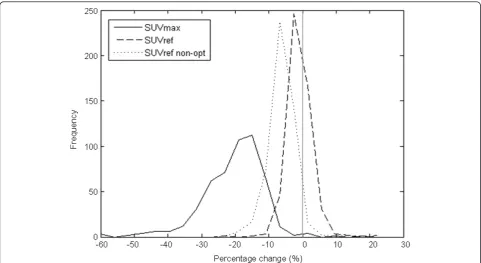
six possible pairings of the four reconstruction protocols used. For each pairing, the reconstruction with the
lar-gest SUVreffilter computed in the phantom study was
selected as protocola.
those derived from the68Ge phantom study described above. The same analysis was also repeated using the SUVpeakmeasure to compute ΔSUVpeak.
The sensitivity of the SUVrefmethodology to filter size was assessed by applying non-optimal SUVreffilters and
measuring the effect onΔSUVref. This assessment was
performed for the comparison of PSF with OSEM and for TOF1 with OSEM. The non-optimal filters for each pairwise comparison were selected by increasing the
FWHM of the mean SUVreffilter for the reconstruction
with the lowest RCs (i.e. OSEM) by twice the standard deviation (SD) of the mean filter FWHM for that recon-struction from the phantom study, and decreasing the FWHM of the optimal filter for the reconstruction with the highest RCs (i.e. PSF or TOF1) by the corresponding amount.
The effect of hotspot location on the performance of SUVref was assessed by separating the set of 500 clinical hotspots into two groups, lateral and medial. The threshold for this separation was arbitrarily selected as 75 mm from the centre of the transaxial field of view since this resulted in equal size groups. The motivation for this comparison was to evaluate any effect on SUVref performance of comparing PSF-based reconstructions with an improved resolution uniformity throughout the transaxial FOV, compared with a traditional OSEM reconstruction [10].
Finally, to investigate the impact of SUVrefon measur-ing response, a subset of 25 lung hotspots were extracted from the original 500 clinical hotspots. All 300 possible pairwise combinations of these hotspots were then used to simulate response studies, with one of each pair pro-viding the baseline measurement and the other the fol-low-up measurement. For each simulated response study, the percentage change was calculated using both SUVmax
and SUVref, as described above, for each of the four
reconstruction protocols, with the same reconstruction protocol used per simulated measurement of response. The mean absolute difference in calculated percentage change for each pair of hotspots across the four
recon-struction protocols was then compared for SUVmaxand
SUVref.
Results
Phantom data study
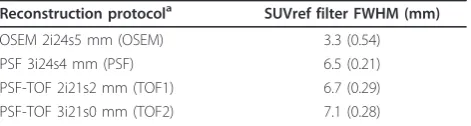
The SUVref filters computed for the four reconstruction protocols, in order to minimise the difference in RCs when compared to the reference values published by Boellaard et al. [4], are shown in Table 1. The data reconstructed with OSEM required the smallest addi-tional filter (3.3-mm FWHM), while the TOF2 data with the additional iteration required the largest (7.1-mm FWHM). This was as expected given the contrast to noise improvements observed in images reconstructed
with the PSF and PSF-TOF reconstruction algorithms [12].
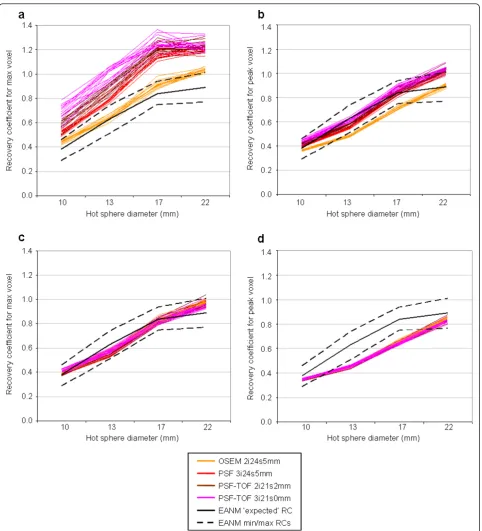
The effect of applying these SUVreffilters on the RCs measured for the phantom studies is shown in Figure 1. Figure 1a shows the RCs measured using the max voxel value in the original data. All reconstruction protocols with the exception of OSEM fall entirely outside the EANM specifications [4] (denoted by the dashed lines), and all but one of these OSEM reconstructions have at least one RC above the proposed maximum specifica-tion. Figure 1c shows the RCs measured following appli-cation of the SUVreffilter. With the exception of the 22-mm sphere in 2 of the 60 reconstructed repeats, all points lie within the bounds defined in the EANM spe-cification [4]. Although the EANM bounds are for the
maximum voxel value, the RCs for SUVpeak(Figure 1b)
and SUVref,peak(Figure 1d) are also shown. For SUVpeak, 55 of the 60 reconstruction repeats have at least one RC either above or below the EANM-specified bounds, with all repeats having at least one point outside the bounds for SUVref,peak. It is also worth noting that with SUVmax, all reconstructions produce RCs greater than 1 for at least the largest hot sphere. An RC greater than 1 is most likely due to the positive bias of selecting the max-imum voxel in noisy data [13], although could also result from imperfections in the scatter correction or cross-calibration of the scanner. This will be more apparent for reconstructions with better RC and higher noise; although improvements in RC beyond a certain point will have minimal impact for larger spheres. With the additional smoothing of SUVpeak, SUVrefand SUVref,
peak, far fewer RCs are greater than 1.
The variation within each reconstruction protocol and across all protocols is presented in Table 2. The mean RSD is significantly reduced for all intra-reconstruction comparisons simply as a result of applying a smoothing filter, as shown with both SUVrefand SUVpeak. However, a significantly larger reduction in mean RSD across all protocols was seen with SUVref(and SUVref,peak) when
compared to SUVmax(and SUVpeak). In fact, the mean
RSD across all protocols with SUVref (and SUVref,peak) was smaller than the intra-reconstruction mean RSD for all but the OSEM reconstructed data with SUVmax. This
Table 1 Mean SUVreffilters computed for the four
reconstruction protocols
Reconstruction protocola SUVref filter FWHM (mm)
OSEM 2i24s5 mm (OSEM) 3.3 (0.54)
PSF 3i24s4 mm (PSF) 6.5 (0.21)
PSF-TOF 2i21s2 mm (TOF1) 6.7 (0.29)
PSF-TOF 3i21s0 mm (TOF2) 7.1 (0.28)
Mean (with standard deviation in parenthesis).a
implies that with the application of an appropriate
SUV-ref filter, there is less variance in a set of data from a range of different reconstructions than within data reconstructed with the same protocol when using SUVmax.
Clinical data study
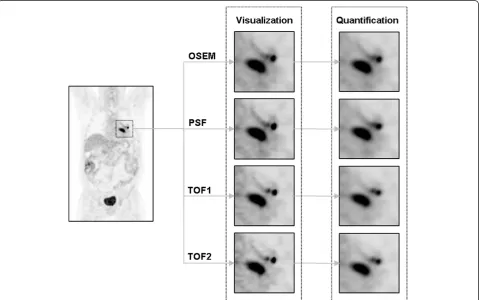
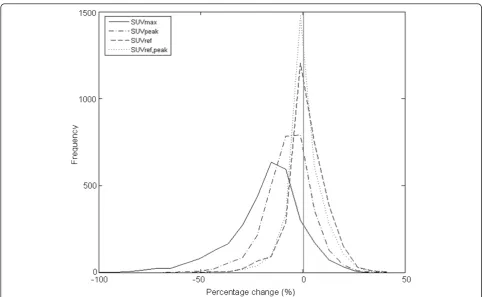
For the clinical data, the same four reconstruction proto-cols were used and the SUVreffilter sizes computed with the corresponding phantom studies applied (Figure 2). Figure 3 shows the distribution in percentage changes for
ΔSUVmax,ΔSUVref,ΔSUVpeakandΔSUVref,peak. Both bias and variance are reduced with SUVref, from -17.8% (17.4 SD) with SUVmaxto -1.98% (9.42 SD). SUVpeakhas an inter-mediate bias and variance of -7.19% (11.56 SD), with SUVref,peakhaving the smallest bias and variance of 0.84% (8.61 SD).
The reduction of bias with SUVref to close to zero
means there is no longer a higher maximum with one reconstruction versus another. The potential clinical impact of the reduction in bias and variance with SUVref can be evaluated by considering the use of a fixed threshold of percentage change in order to determine
disease progression or treatment response. Table 3
shows the percentage of hotspots having a ΔSUVmax,
ΔSUVref,ΔSUVpeak orΔSUVref,peak greater than either 10%, 20% or 30%. This percentage can be considered as the proportion of hotspots that would be incorrectly classi-fied as having a clinically relevant change despite the underlying sinogram data being identical, with any change being purely a result of differences in recon-struction protocol. In all cases, the percentage of hot-spots with a percentage change above the threshold is greatly reduced with SUVrefwith an intermediate
reduc-tion seen for SUVpeak and the greatest reduction with
Table 2 Mean RSD of the RCs for each reconstruction protocol and across all protocols
Reconstruction protocol
Mean RSD with SUVmax
(%)
Mean RSD with SUVpeak
(%)
Mean RSD with SUVref
(%)
Mean RSD with SUVref,peak
(%)
OSEM 2.81 1.59 2.28 1.46
PSF 3.25 1.80 2.00 1.49
TOF1 4.69 2.32 2.58 1.70
TOF2 5.70 2.51 2.68 1.72
All protocols 13.60 7.75 2.85 1.72
Mean RSD of the RCs for the 15 repeats per reconstruction protocol and across all reconstruction protocols for SUVmax, SUVrefand SUVpeak. Reduction in RSD with
both SUVrefand SUVpeakfor all intra-reconstruction protocol comparisons, in addition to across all protocols, was significant (P< 0.01 with paired two-tailed
Student’st-test).
SUVref,peak. For example, even with a conservative PER-CIST-recommended threshold of 30%, a clinically rele-vant change was incorrectly identified in nearly 20% of
hotspots when using SUVmax, compared to just 1% with
SUVref. For SUVpeak, nearly 4% of hotspots would be incorrectly classified as undergoing a clinically signifi-cant change.
The sensitivity of this reduction in bias and variance to filter size was investigated using non-optimal SUVreffilters for two reconstruction comparisons. For the first compari-son, PSF versus OSEM, the change in the distribution of ΔSUVreffor the non-optimal filters versus the optimal filters
is shown in Figure 4 and Table 4. The non-optimal filters used, 6.1 and 4.4-mm FWHM, respectively, were both clo-ser to one another by twice the respective SD from the
mean filters identified in the phantom study (6.5 and 3.3 mm, respectively). This is aimed at simulating a“worst case scenario”in the situation where the SUVreffilters would not have been estimated optimally. The reduction in bias and variance, along with the reduction in number of hotspots with a percentage change above the individual thresholds, is smaller when using the non-optimal filters;
however, when compared to SUVmax, the reduction even
with non-optimal filters is still significant.
The same behaviour can be seen with the second comparison, TOF1 versus OSEM, Figure 5and Table 5. Again, a smaller, but still significant, reduction in bias and variance, and number of hotspots with a percentage change above the individual thresholds, is observed when non-optimal filters are used.
Figure 3Distribution ofΔSUVmax,ΔSUVpeak,ΔSUVrefandΔSUVref. peakfor the clinical datasets.ΔSUVmax(solid line),ΔSUVpeak(dash-dot line), ΔSUVref(dashed line) andΔSUVref.peak(dotted line). The mean (and SD) for SUVmaxwas -17.8% (17.4), for SUVpeak-7.19% (11.56), for SUVref-1.98% (9.42) and for SUVref,peak-0.84% (8.61). The difference between each distribution is significant (P< 0.001 with paired two-tailed Student’sttest).
Table 3 Percentage of hotspots with aΔSUVmax,ΔSUVpeak,ΔSUVreforΔSUVref,peakgreater than specified difference
threshold
Difference threshold
Percentage with SUVmax
(%)
Percentage with SUVpeak
(%)
Percentage with SUVref
(%)
Percentage with SUVref,peak
(%)
10% 70.1 41.5 24.7 19.8
20% 37.6 12.3 5.7 3.7
30% 19.9 3.9 1.0 0.7
The effect of hotspot distance from centre of the transaxial field of view on ΔSUVrefis shown in Figure 5 and Table 6. No significant difference between lateral
and medial ΔSUVref or ΔSUVmax distributions was
observed (Figure 6). This is reflected in the number of hotspots with a percentage difference above the thresh-olds specified (Table 6).
Finally, the assessment of the impact of SUVref on
response assessment, when the same reconstruction proto-col is used for both the baseline and follow-up study, showed a significant reduction in the mean absolute differ-ence in percentage change, as measured across the four different reconstruction protocols, from 11.8% (8.7% SD) with SUVmaxto 6.8% (6.2% SD) with SUVref(P< 0.01 with the Wilcoxon Matched-Pairs Signed-Ranks Test).
Discussion
Variations in reconstruction protocol can have a major effect on quantifiable parameters such as contrast
recovery. For example, in the phantom experiments described above, the RC for the 10-mm hot sphere var-ies from 0.42 to 0.78 and from 1.01 to 1.33 for the 22-mm hot sphere. Following application of the appropriate SUVreffilters, this variation reduces to 0.38 to 0.43 for the 10-mm hot sphere and 0.93 to 1.04 for the 22-mm hot sphere. In fact, with SUVref the mean variation in RC across all reconstruction protocols studied is smaller than the mean variation in RC within a single recon-struction protocol. A reduction in RC variation was also
observed with the PERCIST measure SUVpeak; however,
the variation across all reconstruction protocols was sig-nificantly larger than for SUVref. The combination of SUVrefand SUVpeakin SUVref,peak reduces the variation across reconstruction protocols further still.
In addition to reducing the variation resulting from
differences in reconstruction protocol, SUVref can be
defined to produce RCs within the bounds specified by the recently published EANM specification [4]. Given all
Figure 4Distribution ofΔSUVmaxandΔSUVrefwith non-optimal filters for PSF and OSEM reconstruction protocols.ΔSUVmax(solid line) and ΔSUVref(dashed line). The mean (and SD) forΔSUVmaxwas -20.3% (9.1) and forΔSUVref-1.00% (3.54). Also shown with a dotted line is the
distribution ofΔSUVrefwith the application of suboptimal filters. The mean (and SD) for this non-optimalΔSUVrefis -6.25% (3.89). The difference between each distribution is significant (P< 0.001 with paired two-tailed Student’sttest).
Table 4 Effect of non-optimal filters onΔSUVmaxandΔSUVref, for PSF and OSEM reconstruction protocols
Difference threshold Percentage with SUVmax(%) Percentage with SUVref(%) Percentage with non-optimal SUVref(%)
10% 93.2 1.4 12.6
20% 44.6 0.6 0.8
30% 12.2 0.0 0.0
reconstructions evaluated with SUVmax produced RCs that were above the EANM-specified bounds, applica-tion of the SUVreffilter would ensure clinical sites using these reconstruction protocols produced quantifiably conforming values whilst allowing them to take advan-tage of improvements in image quality associated with advanced reconstruction protocols. With SUVpeak, more than 90% of reconstructions evaluated produced RCs outside EANM-specified bounds. Given the distribution of these outliers both above and below the specified bounds, significant widening of the bounds would be required to accommodate SUVpeak, and therefore reduce the benefit of the specification.
The potential clinical impact of the reductions in RC
variability with SUVref was presented in Table 3. For
example, if a percentage change in SUVmaxof greater
than 30% is selected as signifying a clinically relevant
change in the status of a lesion, either disease progression or treatment response, then for the combination of reconstruction protocols evaluated, a clinically relevant change would be incorrectly observed nearly 20% of the
time, compared to just 1% with SUVref, when in fact
there is no change in the underlying data. This reduction results from the reduction in bias and variation shown in Figure 2. In PERCIST, a threshold of 30% is used with SUVpeakto signify either metabolic disease progression or treatment response [1]. With the combination of recon-struction protocols evaluated in this study, a hotspot would be incorrectly classified nearly 4% of the time.
The use of such a conservative threshold (i.e. 30%) is a consequence of the intrinsic variability in repeat PET scans, biological variability and the need to account for inter-scanner variability and aims to reduce the number of incorrectly classified responders, albeit at the cost of
Figure 5Distribution ofΔSUVmaxandΔSUVrefwith non-optimal filters for TOF1 and OSEM reconstruction protocols.ΔSUVmax(solid line) andΔSUVref(dashed line). The mean (and SD) forΔSUVmaxwas -23.4% (17.2) and forΔSUVref1.23% (11.2). Also shown with a dotted line is the distribution ofΔSUVrefwith the application of suboptimal filters. The mean (and SD) for this non-optimalΔSUVrefis -5.69% (12.1). The difference between each distribution is significant (P< 0.001 with paired two-tailed Student’sttest).
Table 5 Effect of non-optimal filters onΔSUVmaxandΔSUVref, for TOF1 and OSEM reconstruction protocols
Difference threshold
Percentage with SUVmax(%) Percentage with SUVref(%) Percentage with non-optimal SUVref(%)
10% 78.4 34.4 38.0
20% 53.4 8.4 13.2
30% 32.0 1.4 3.4
sensitivity. The adoption of a methodology such as SUVref may enable the use of a less conservative thresh-old, by reducing the need to accommodate for inter-scanner variability, thus increasing sensitivity without increasing the number of incorrectly classified responders.
The combination of SUVref and SUVpeakin SUVref,peak results in a further reduction in the percentage of incor-rectly classified lesions (0.7%). This is due to the addi-tional smoothing inherent in the calculation of the peak value.
The sensitivity of the SUVrefmethodology to SUVref fil-ter size was investigated using non-optimal filfil-ters. In both reconstruction protocol comparisons (PSF versus OSEM and TOF1 versus OSEM), the application of non-optimal filters reduced the improvement in quantitative comparability provided by the optimal SUVreffilters as would be expected. Despite this, the improvement when
compared to SUVmaxwas still significant. Given the non-optimal filter, sizes were used each 2 SDs closer together than the optimal filter sizes, the chance of such subopti-mal filters being selected by chance is very ssubopti-mall, particu-larly if multiple phantom acquisitions are performed for filter selection (for instance, three repeats are recom-mended in the NEMA Standard [6]).
Considering the difference in resolution uniformity within the transaxial field of view with PSF-based recon-structions versus traditional OSEM, the effect of hotspot location was assessed. In the comparison of medial (< 75 mm from centre of transaxial FOV) versus lateral lesions (≥75 mm from centre of transaxial FOV), no sig-nificant difference in the distribution of percentage dif-ferences for either SUVmaxof SUVrefwas observed.
In addition to reducing the variation in quantification of uptake for individual hotspots across different recon-struction protocols, SUVrefalso significantly reduces the
Table 6 Effect of hotspot location onΔSUVmaxandΔSUVref
Difference threshold Percentage with SUVmax(%) Percentage with SUVref(%)
Medial Lateral Medial Lateral
10% 68.81 71.41 22.40 27.32
20% 37.91 37.69 4.28 7.51
30% 20.35 19.90 0.67 0.99
Percentage of medial and lateral hotspots with aΔSUVmaxorΔSUVrefgreater than the specified threshold for all six pairwise combinations of the four reconstruction protocols evaluated.
Figure 6Distribution ofΔSUVmaxandΔSUVreffor medial and lateral (solid and dashed lines, respectively) hotspots. The mean (and SD)
variation in assessments of change in uptake when both the baseline and follow-up scans are reconstructed using the same protocol. This in turn reduces the likelihood that the assessment of response for a given patient would differ between sites purely as a result of differ-ences in reconstruction protocol.
While this study has evaluated the ability of SUVrefto reduce reconstruction-dependent variation in SUV, simi-lar performance would be expected for scanner-depen-dent variation since this would also manifest mainly as a difference in RC.
It is also worth noting that an alternative solution could be to reconstruct the image with two protocols, one optimised for visual review and the other
conform-ing to the EANM guidelines. However, the SUVref
meth-odology has the advantage of avoiding the additional burden of reconstructing, storing and reviewing a sec-ond version of every data set.
Conclusion
SUVref significantly reduces reconstruction-dependent
variation in SUV measurements, while preserving the benefits of improved image quality through advances in reconstruction and scanner technology. This reduction in variation provides increased confidence in quantita-tive comparison of clinical images for monitoring treat-ment response or disease progression.
Acknowledgements
The authors would like to thank Vitaliy Rappoport for providing the phantom data, Richard Powers for providing the clinical data, and Mike Casey, Timor Kadir, Kevin Hakl and Bernard Bendriem for useful discussions.
Authors’contributions
MK and JD conceived and designed the study. MK carried out the experiments, analysis and drafted the manuscript. Both authors read and approved the final manuscript.
Competing interests
This research was funded by Siemens Healthcare of which both M. Kelly and J. Declerck are employees.
Received: 5 May 2011 Accepted: 18 August 2011 Published: 18 August 2011
References
1. Wahl RL, Jacene H, Kasamon Y, Lodge MA, From RECIST to PERCIST:
Evolving Considerations for PET Response Criteria in Solid Tumors.J Nucl Med2009,50:122S-150S.
2. Huang H:Anatomy of SUV.Nucl Med and Biol2000,27:643-646. 3. Jaskowiak CJ, Bianco JA, Perlman SB, Fine JP:Influence of Reconstruction
Iterations on 18 F-FDG PET/CT Standardized Uptake Values.J Nucl Med 2005,46:424-428.
4. Boellaard R, O’Doherty MJ, Weber WA, Mottaghy FM, Lonsdale MN, Stroobants SG, Oyen WJG, Kotzerke J, Hoekstra OS, Pruim J, Marsden PK, Tatsch K, Hoekstra CK, Visser EP, Arends B, Verzijlbergen FJ, Zijlstra JM, Comans EFI, Lammertsma AA, Paans AM, Willemsen AT, Beyer T, Bockisch A, Schaefer-Prokop C, Delbeke D, Baum RP, Chiti A, Krause BJ:FDG PET and PET/CT: EANM procedure guidelines for tumour PET imaging: version
1.0.Eur J Nucl Med Mol Imaging2010,37:181-200.
5. Boellaard R, Oyen WJG, Hoekstra CJ, Hoekstra OS, Visser EP, Willemsen AT, Arends B, Verzijlbergen FJ, Zijlstra J, Paans AM, Comans EF, Pruim J:The Netherlands protocol for standardisation and quantification of FDG whole body PET studies in multi-centre trials.Eur J Nucl Med Mol Imaging 2008,35:2320-2333.
6. National Electrical Manufacturers Association. NEMA Standards Publication NU 2-2007. Performance Measurements of Positron Emission Tomographs. NEMA2007.
7. Weber WA, Figlin R:Monitoring cancer treatment with PET/CT: Does it make a difference?J Nucl Med2007,48:36S-44S.
8. Joshi A, Koeppe RA, Fessler JA:Reducing between scanner differences in multi-centre PET studies.NeuroImage2009,49:154-159.
9. Kadrmas DJ, Casey ME, Conti M, Jakoby BW, Lois C, Townsend DW:Impact of Time-of-Flight on PET Tumor Detection.J Nucl Med2009,50:1315-1323. 10. Panin V, Kehren F, Michel C, Casey M:Fully 3-D PET Reconstruction with
system matrix derived from point source measurements.IEEE Trans Med
Imaging2007,25:907-921.
11. Young H, Baum R, Cremerius U, Herholz K, Hoekstra O, Lammertsma AA, Pruim J, Price P:Measurement of Clinical and Subclinical Tumour Response using [18F]-fluorodeoxyglucose and Positron Emission Tomography: Review and 1999 EORTC Recommendations.Eur J Cancer 1999,35:1773-1782.
12. Kadrmas DJ, Casey ME, Conti M:Impact of Time-of-Flight on PET Tumour Detection.J Nucl Med2009,50:1315-1323.
13. Boellaard R, Krak N, Hoekstra OS, Lammertsma AA:Effects of Noise, Image Resolution, and ROI Definition on the Accuracy of Standard Uptake Values: A Simulation Study.J Nucl Med2004,45:1519-1527.
doi:10.1186/2191-219X-1-16
Cite this article as:Kelly and Declerck:SUVref: reducing reconstruction-dependent variation in PET SUV.EJNMMI Research20111:16.
Submit your manuscript to a
journal and benefi t from:
7 Convenient online submission
7 Rigorous peer review
7 Immediate publication on acceptance
7 Open access: articles freely available online
7 High visibility within the fi eld
7 Retaining the copyright to your article