R E S E A R C H
Open Access
Strong convergence theorems and rate of
convergence of multi-step iterative methods for
continuous mappings on an arbitrary interval
Withun Phuengrattana
1,2and Suthep Suantai
1,2** Correspondence: [email protected]
1Department of Mathematics,
Faculty of Science, Chiang Mai University, Chiang Mai 50200, Thailand
Full list of author information is available at the end of the article
Abstract
In this article, by using the concept ofW-mapping introduced by Atsushiba and Takahashi andK-mapping introduced by Kangtunyakarn and Suantai, we defineW(T,
N)
-iteration and K(T,N)-iteration for finding a fixed point of continuous mappings on an arbitrary interval. Then, a necessary and sufficient condition for the strong
convergence of the proposed iterative methods for continuous mappings on an arbitrary interval is given. We also compare the rate of convergence of those iterations. It is proved that theW(T,N)-iteration andK(T,N)-iteration are equivalent and theK(T,N)-iteration converges faster than theW(T,N)-iteration. Moreover, we also present numerical examples for comparing the rate of convergence betweenW(T,N) -iteration andK(T,N)-iteration.
MSC: 26A18; 47H10; 54C05.
Keywords:fixed point, continuous mapping,W-mapping,K-mapping, rate of convergence
1 Introduction
There are several classical methods for approximation of solutions of nonlinear equa-tion of one variable
f(x) = 0 (1:1)
wheref: E® Eis a continuous function andE is a closed interval on the real line. Classical fixed point iteration method is one of the methods used for this problem. To use this method, we have to transform (1.1) to the following equation:
g(x) =x (1:2)
whereg:E® Eis a contraction. Then, Picard’s iteration can be applied for finding a solution of (1.2).
Question: If g: E ® E is continuous but not contraction, what iteration methods can be used for finding a solution of (1.2) (that is a fixed point ofg) and how about the rate of convergence of those methods.
There are many iterative methods for finding a fixed point ofg. For example, the Mann iteration(see [1]) is defined byx1 ÎEand
xn+1= (1−αn)xn+αng(xn) (1:3)
for all n≥1, where {αn}∞n=1is a sequence in [0,1]. TheIshikawa iteration(see [2]) is
defined byx1 ÎEand
yn= (1−βn)xn+βng(xn)
xn+1= (1−αn)xn+αng(yn) (1:4)
for alln ≥1, where {αn}∞n=1, {βn}∞n=1 are sequences in [0,1]. TheNoor iteration(see
[3]) is defined byx1Î Eand
⎧ ⎨ ⎩
zn= (1−γn)xn+γng(xn)
yn= (1−βn)xn+βng(zn)
xn+1= (1−αn)xn+αng(yn)
(1:5)
for all n ≥ 1, where {αn}∞n=1, {βn}∞n=1, and {γn}∞n=1 are sequences in [0,1]. Clearly
Mann and Ishikawa iterations are special cases of Noor iteration. The SP-iteration(see [4]) is defined byx1Î Eand
⎧ ⎨ ⎩
zn= (1−γn)xn+γng(xn)
yn= (1−βn)zn+βng(zn)
xn+1= (1−αn)yn+αng(yn)
(1:6)
for all n ≥ 1, where {αn}∞n=1, {βn}∞n=1, and {γn}∞n=1 are sequences in [0,1]. Clearly
Mann iteration is special cases of SP-iteration.
In 1976, Rhoades [5] proved the convergence of the Mann and Ishikawa iterations to a solution of (1.2) whenE = [0,1]. He also proved the Ishikawa iteration converges fas-ter than the Mann ifas-teration for the class of continuous and nondecreasing functions. Later in 1991, Borwein and Borwein [6] proved the convergence of the Mann iteration of continuous functions on a bounded closed interval. In 2006, Qing and Qihou [7] extended their results to an arbitrary interval and to the Ishikawa iteration and gave some control conditions for the convergence of Ishikawa iteration on an arbitrary interval. Recently, Phuengrattana and Suantai [4] obtained a similar result for the new iteration, called the iteration, and they proved the Mann, Ishikawa, Noor and SP-iterations are equivalent and the SP-iteration converges faster than the others for the class of continuous and nondecreasing functions.
In this article, we are interested to employ the concept of W-mappings andK -map-pings for approximation of a solution of (1.2) for a continuous function on an arbitrary interval and compare which one converges faster. The concept ofW-mapping was first introduced by Atsushiba and Takahashi [8]. They defined W-mapping as follows. LetC be a subset of a Banach spaceXandT:C®Cbe a mapping. A pointxÎCis afixed
point ofTifTx=x. The set of all fixed points ofTis denoted byF(T). Let {Ti}Ni=1 be a
finite family of mappings ofCinto itself. LetWn:C®Cbe a mapping defined by
Sn,0=I,
Sn,1=λn,1T1Sn,0+ (1−λn,1)I,
Sn,2=λn,2T2Sn,1+ (1−λn,2)I, ..
.
Sn,N−1=λn,N−1TN−1Sn,N−2+ (1−λn,N−1)I,
Wn=Sn,N =λn,NTNSn,N−1+ (1−λn,N)I,
where I is the identity mapping ofCand ln,iÎ [0,1] for all i = 1, 2,...,N. Such a
mapping Wnis called theW-mappinggenerated byT1,T2,...,Tnandln,1,ln,2,...,ln,N.
Many researchers have studied and applied this mapping for finding a common fixed point of nonexpansive mappings, for instance, see [8-23].
In 2009, Kangtunyakarn and Suantai [24] introduced a new concept of theK-mapping in a Banach space as follows. LetKn:C®Cbe a mapping defined by
Un,0=I,
Un,1=λn,1T1Un,0+ (1−λn,1)Un,0,
Un,2=λn,2T2Un,1+ (1−λn,2)Un,1, ..
.
Un,N−1=λn,N−1TN−1Un,N−2+ (1−λn,N−1)Un,N−2,
Kn=Un,N=λn,NTNUn,N−1+ (1−λn,N)Un,N−1,
(1:8)
where I is the identity mapping ofCand ln,iÎ [0,1] for all i = 1, 2,...,N. Such a
mapping Knis called the K-mapping generated byT1,T2,..., Tn andln,1, ln,2,..., ln,N.
They showed that if Cis a nonempty closed convex subset of a strictly convex Banach
space X and {Ti}Ni=1 is a finite family of nonexpansive mappings ofCinto itself, then
F(Kn) =Ni=1F(Ti) and they also introduced an iterative method by using the concept
of K-mapping for finding a common fixed point of a finite family of nonexpansive mappings and a solution of an equilibrium problem. Applications ofK-mappings for fixed point problems and equilibrium problems can be found in [23-26].
By using the concept of W-mappings andK-mappings, we introduce two new itera-tions for finding a fixed point of a mapping T :E ® E on an arbitrary intervalE as follows.
The W(T,N)-iterationis defined byu1 ÎEand
un+1=Wn(T,N)un∀n≥1, (1:9)
whereN≥1 andWn(T,N) is a mapping ofEinto itself generated by
Sn,0=I,
Sn,1=λn,1TSn,0+ (1−λn,1)I,
Sn,2=λn,2TSn,1+ (1−λn,2)I, ..
.
Sn,N−1=λn,N−1TSn,N−2+ (1−λn,N−1)I,
W(nT,N)=Sn,N=λn,NTSn,N−1+ (1−λn,N)I,
(1:10)
where Iis the identity mapping ofE andln,iÎ [0,1] for alli= 1, 2,...,N. We call a
mapping W(T,N)
n as theW-mapping generated by T and ln,1,ln,2,..., ln,N. Clearly W
(T,1)
-iteration is Mann iteration, W(T,2)-iteration is Ishikawa iteration andW(T,3) -itera-tion is Noor itera-itera-tion.
The K(T,N)-iterationis defined byx1Î Eand
whereN≥1 andKn(T,N) is a mapping ofEinto itself generated by
Un,0=I,
Un,1=λn,1TUn,0+ (1−λn,1)Un,0,
Un,2=λn,2TUn,1+ (1−λn,2)Un,1, ..
.
Un,N−1=λn,N−1TUn,N−2+ (1−λn,N−1)Un,N−2,
K(nT,N)=Un,N=λn,NTUn,N−1+ (1−λn,N)Un,N−1,
(1:12)
where Iis the identity mapping ofE andln,iÎ [0,1] for alli= 1, 2,...,N. We call a
mapping Kn(T,N) as theK-mapping generated by Tandln,1,ln,2, ...,ln,N. ClearlyK(T,1)
-iteration is Mann -iteration andK(T,3)-iteration is SP-iteration.
Obviously the mappings (1.10) and (1.12) are special cases of theW-mapping andK -mapping, respectively.
The purpose of this article is to give a necessary and sufficient condition for the strong convergence of the W(T,N)-iteration and K(T,N)-iteration of continuous mappings on an arbitrary interval. We also prove that the K(T,N)-iteration andW(T,N)-iteration are equivalent and the K(T,N)-iteration converges faster than theW(T,N)-iteration for the class of continuous and nondecreasing mappings. Moreover, we present numerical examples for the K(T,N)-iteration to compare with the W(T,N)-iteration. Our results extend and improve the corresponding results of Rhoades [5], Borwein and Borwein [6], Qing and Qihou [7], Phuengrattana and Suantai [4], and many others.
2 Convergence theorems
We first give a convergence theorem for theK(T,N)-iteration for continuous mappings on an arbitrary interval.
Theorem 2.1 Let E be a closed interval on the real line and T: E®E be a continu-ous mapping. For x1 Î E, let the K(T,N)-iteration {xn}∞n=1 defined by (1.11), where
{λn,i}∞n=1(i= 1, 2, ...,N)are sequences in[0,1]satisfying the following conditions:
(C1) ∞n=1λn,i<∞ for all i= 1, 2,...,N- 1;
(C2)limn®∞ln,N= 0and ∞
n=1λn,N =∞.
Then {xn}∞n=1 is bounded if and only if {xn}∞n=1 converges to a fixed point of T.
Proof. It is obvious that if {xn}∞n=1 converges to a fixed point of T, then it is
bounded. Now, assume that {xn}∞n=1 is bounded. We will show that {xn}∞n=1 converges
to a fixed point ofT. First, we show that {xn}∞n=1 is convergent. To show this, we
sup-pose not. Then there exist a, bÎℝ,a= lim infn®∞xn,b= lim supn®∞xnand a<b.
Next, we show that
ifm∈(a,b), thenTm=m. (2:1)
To show this, suppose that Tm ≠mfor some mÎ(a,b). Without loss of generality, we may assume that Tm- m> 0. By continuity of T, there existsδ Î(0,b - a) such that
By boundedness of {xn}∞n=1, we have {xn}∞n=1 belongs to a bounded closed interval.
Continuity ofT implies that {Txn}∞n=1 belongs to another bounded closed interval, so {Txn}∞n=1 is bounded. Since Un,1 xn = ln,1 Txn + (1- ln,1)xn, we get {Un,1xn}∞n=1 is
bounded, and thus {TUn,1xn}∞n=1 is bounded. Similarly, by using (1.11), we have {Un,ixn}∞n=1 and {TUn,ixn}∞n=1 are bounded for all i= 2, 3,..., N- 1. It follows by (1.11)
that Un,ixn-Un,i-1xn=ln,i(TUn,i-1xn-Un,i-1xn) for alli = 1,2,...,N. By condition (C1)
and (C2), we get limn®∞|Un,ixn-Un,i-1 xn|=0 for alli= 1, 2,...,N.
Since
|xn+1−xn|=Un,Nxn−Un,0xn
≤xn+1−Un,N−1xn+Un,N−1xn−Un,N−2xn+· · ·+Un,1xn−Un,0xn,
it implies that limn®∞|xn+1- xn| = 0. Thus, there existsM0such that
|xn+1−xn|< δ
N and Un,ixn−Un,i−1xn<
δ
N(i= 1, 2, ...,N−1), (2:3)
for alln >M0. Sinceb = lim supn®∞ xn>m, there existsk1 >M0such that xk1>m. Let k=k1, then xk>m. If xk≥m+Nδ, then by (2.3), we have xk+1>xk− Nδ ≥m, soxk
+1>m. If xk∈(m,m+Nδ), then by (2.3), we have
m− δ
Ni<Uk,ixk<m+
δ
N(i+ 1) for alli= 1, 2, ...,N−1.
So we have
|xk−m|< δand Uk,ixk−m< δfor alli= 1, 2, ...,N−1.
This implies by (2.2) that
Txk−xk>0 andTUk,ixk−Uk,ixk>0 for alli= 1, 2, ...,N−1. (2:4)
Using (1.11), we obtain
xk+1=λk,NTUk,N−1xk+ (1−λk,N)Uk,N−1xk =Uk,N−1xk+λk,N(TUk,N−1xk−Uk,N−1xk)
=Uk,N−2xk+λk,N−1(TUk,N−2xk−Uk,N−2xk) +λk,N(TUk,N−1xk−Uk,N−1xk) ..
.
=xk+
N
i=1
λk,i(TUk,i−1xk−Uk,i−1xk).
(2:5)
By (2.4), we havexk+1>xk. Thus,xk+1>m.
By using the above argument, we obtain xk+j>mfor allj≥2. Thus we getxn>mfor
all n>k. Soa= lim infn®∞xn≥m, which is a contradiction witha<m. Thus Tm=m.
Therefore, we obtain (2.1).
For the sequence {xn}∞n=1, we consider the following two cases:
Case 1: There exists xM¯ such that a<xM¯ <b. Then TxM¯ =xM¯ . By using (1.11), we
we obtain xM¯ =xM¯+1=xM¯+2= ..., so xn→xM¯ . This implies that xM¯ =a and xn ® a,
which contradicts with our assumption.
Case 2: For all n, xn ≤a or xn ≥b. Because b - a> 0 and limn®∞ |xn+1 - xn| = 0,
there exists M1 such that |xn+1−xn|< b−Na for all n>M1. It implies that eitherxn≤ a
for all n>M1orxn≥b for alln>M1. Ifxn≤aforn>M1, thenb= lim supn®∞xn≤a,
which is a contradiction with a<b. Ifxn≥b forn>M1, so we havea= lim infn®∞xn ≥b, which is a contradiction witha<b.
Hence, we have {xn}∞n=1 is convergent.
Finally, we show that {xn}∞n=1 converges to a fixed point ofT. Let limn®∞,xn=pand
suppose Tp ≠ p. Since {Un,ixn}∞n=1 is bounded for alli = 1, 2,..., N- 1, it implies by
(1.11), condition (C1) and (C2) that limn®∞ Un,ixn=pfor alli= 1, 2,...,N- 1. Lethk,i
=TUk,i-1xk-Uk,i-1xkfor alli= 1, 2,..., N. Continuity ofTimplies that limk®∞hk,i=Tp
- p≠0 for alli= 1, 2,...,N. Putw=Tp-p. Thenw≠0. By (2.5), we have
n−1
k=1
(xk+1−xk) = n−1
k=1
λk,1hk,1+λk,2hk,2+· · ·+λk,Nhk,N
.
This implies that
xn=x1+
n−1
k=1
λk,1hk,1+λk,2hk,2+· · ·+λk,Nhk,N
. (2:6)
By condition (C1), (C2), and limk®∞ hk,i=w ≠0 for all i = 1, 2,..., N, we get that ∞
k=1λk,ihk,i is convergent for all i= 1, 2,..., N- 1 and ∞k=1λk,Nhk,N is divergent. It
follows by (2.6) that {xn}∞n=1 is divergent, which is a contradiction. Hence, {xn}∞n=1
con-verges to a fixed point ofT.
We now obtain the convergence theorem of W(T,N)-iteration. The proof is omitted because it is similar as above theorem and Theorem 2.2 of [4].
Theorem 2.2 Let E be a closed interval on the real line and T: E®E be a continu-ous mapping. For x1 Î E, let the W(T,N)-iteration {xn}∞n=1 defined by (1.9), where
{λn,i}∞n=1(i= 1,2,...,N)are sequences in[0,1]satisfying the following conditions:
(C1)limn®∞ln,i= 0for all i= 1,2,...,N;
(C2) ∞n=1λn,N =∞.
Then {xn}∞n=1 is bounded if and only if {xn}∞n=1 converges to a fixed point of T.
The following results are obtained direclty from Theorem 2.1.
Corollary 2.3 ([4, Theorem 2.1])Let E be a closed interval on the real line and T: E ® E be a continuous mapping. For x1 Î E, let the SP-iteration {xn}∞n=1 defined by
(1.6),where {λn,1}∞n=1, {λn,2}∞n=1, and {λn,3}∞n=1 are sequences in [0,1]satisfying the
fol-lowing conditions:
(C1) ∞n=1λn,1<∞ and ∞n=1λn,2<∞;
(C2)limn®∞ln,3= 0and
∞
n=1λn,3=∞.
Then {xn}∞n=1 is bounded if and only if {xn}∞n=1 converges to a fixed point of T.
Corollary 2.4 ([7, Theorem 3]) Let E be a closed interval on the real line and T:E
(1.3), where {λn,1}∞n=1 is a sequence in [0,1] satisfying limn®∞, ln,1 = 0 and
∞
n=1λn,1=∞. Then {xn}∞n=1 is bounded if and only if {xn}∞n=1 converges to a fixed
point of T.
The following results are obtained directly from Theorem 2.2.
Corollary 2.5 ([4, Theorem 2.2])Let E be a closed interval on the real line and T: E ®E be a continuous mapping. For x1 Î E, let the Noor iteration {xn}∞n=1 defined by
(1.5), where {λn,1}∞n=1, {λn,2}∞n=1, {λn,3}∞n=1 are sequences in[0,1]satisfying the following
conditions:
(C1)limn®∞ln,1= 0, limn®∞ln,2= 0andlimn®∞ln,3= 0;
(C2) ∞n=1λn,3=∞.
Then {xn}∞n=1 is bounded if and only if {xn}∞n=1 converges to a fixed point of T.
Corollary 2.6 ([7]) Let E be a closed interval on the real line and T : E ®E be a continuous mapping. For x1 Î E, let the Ishikawa iteration {xn}∞n=1 defined by (1.4),
where {λn,1}∞n=1 are sequences in[0,1]satisfying the following conditions:
(C1)limn®∞ln,1= 0andlimn®∞ln,2= 0;
(C2) ∞n=1λn,2=∞.
Then {xn}∞n=1 is bounded if and only if {xn}∞n=1 converges to a fixed point of T.
3 Rate of convergence and numerical examples
There are many articles have been published on the iterative methods using for approximation of fixed points of nonlinear mappings, see for instance [1-7]. However, there are only a few articles concerning comparison of those iterative methods in order to establish which one converges faster. As far as we know, there are two ways for comparison of the rate of convergence. The first one was introduced by Berinde [27]. He used this idea to compare the rate of convergence of Picard and Mann itera-tions for a class of Zamfirescu operators in arbitrary Banach spaces. Popescu [28] also used this concept to compare the rate of convergence of Picard and Mann iterations for a class of quasi-contractive operators. It was shown in [29] that the Mann and Ishi-kawa iterations are equivalent for the class of Zamfirescu operators. In 2006, Babu and Prasad [30] showed that the Mann iteration converges faster than the Ishikawa itera-tion for this class of operators. Two years later, Qing and Rhoades [31] provided an example to show that the claim of Babu and Prasad [30] is false.
However, this concept is not suitable or cannot be applied to a class of continuous self-mappings defined on a closed interval. In order to compare the rate of conver-gence of continuous self-mappings defined on a closed interval, Rhoades [5] introduced the other concept which is slightly different from that of Berinde to compare iterative methods which one converges faster as follows.
Definition 3.1Let Ebe a closed interval on the real line andT :E®Ebe a contin-uous mapping. Suppose that {xn}∞n=1 and {un}∞n=1 are two iterations which converge to
In this section, we study the rate of convergence ofW(T,N)-iteration and K(T,N) -itera-tion for continuous and nondecreasing mappings on an arbitrary interval in the sense of Rhoades. The following lemmas are useful and crucial for our following results.
Lemma 3.2Let E be a closed interval on the real line and T: E®E be a continuous and nondecreasing mapping such that F(T) is nonempty and bounded with x1 > sup{p
Î E: p=Tp}.Let {xn}∞n=1 be defined by W(T,N)-iteration or K(T,N)-iteration. If Tx1>x1, then {xn}∞n=1 does not converge to a fixed point of T.
Proof. We prove only the case that {xn}∞n=1 is defined byK(T,N)-iteration because the
other case can be proved similarly.
Let Tx1 >x1. Sincex1 > sup{pÎ E :p=Tp} and by using (1.11) and mathematical induction, we can show that xn≥sup{pÎE: p=Tp} for alln≥1. It is clear thatTxn ≥xnfor all n≥1. Using (1.11), we have
Un,1xn=λn,1Txn+ (1−λn,1)xn≥xnfor alln≥1.
Since Tis nondecreasing, we haveTUn,1xn≥Txn≥xn. Using (1.11) again, we have
Un,2xn=λn,2TUn,1xn+ (1−λn,2)Un,1xn≥xnfor alln≥1.
This implies that TUn,2xn≥Txn ≥xn. By continuity in this way, we can show that
xn+1=Kn(T,N)xn=Un,Nxn≥xn for all n ≥ 1. Thus {xn}∞n=1 is nondecreasing. But x1 > sup{pÎE:p=Tp}, it implies that {xn}∞n=1 does not converges to a fixed point ofT.
By using the same argument of proof as in above lemma, we get the following result. Lemma 3.3Let E be a closed interval on the real line and T: E®E be a continuous and nondecreasing mapping such that F(T) is nonempty and bounded with x1 < inf{pÎ E : p=Tp}.Let {xn}∞n=1 be defined by W(T,N)-iteration or K(T,N)-iteration. If Tx1 <x1, then {xn}∞n=1 does not converge to a fixed point of T.
We now get the following theorem for compare rate of convergence between W(T,N) -iteration andK(T,N)-iteration.
Theorem 3.4 Let E be a closed interval on the real line and T: E®E be a continu-ous and nondecreasing mapping such that F(T) is nonempty and bounded. For u1=x1
Î E, let {un}∞n=1 and {xn}∞n=1 are the sequences defined by (1.9)and(1.11),respectively.
Let {λn,i}∞n=1be sequences in[0,1)for all i= 1,2,...,N.Then, the W(T,N)-iteration {un}∞n=1
converges to the fixed point p of T if and only if the K(T,N)-iteration {xn}∞n=1 converges to
p. Moreover, the K(T,N)-iteration converges faster than the W(T,N)-iteration. Proof. PutL= inf{pÎE:p=Tp} andU= sup{pÎE:p=Tp}.
(⇒) Suppose that theW(T,N)-iteration {un}∞n=1 converges to the fixed pointpofT.
We divide our proof into the following three cases:
Case 1:u1 =x1>U. By Lemma 3.2, we haveTu1<u1and Tx1<x1. We now show that xn≤unfor alln≥1. Assume thatxk ≤uk. Thus,Txk≤Tuk. Sincex1 >Uand by using (1.11) and mathematical induction, we can show that xn≥ Ufor alln ≥1. It is clear
that Txk≤ xk. This implies that Txk≤ Uk,1xk≤xk. SinceTis nondecreasing,TUk,1xk≤ Txk. Thus, we have
It follows thatUk,2xk≤xk. By (3.1) andT is nondecreasing, we haveTUk,2xk≤TUk,1 xk≤Uk,2xk. This implies that
TUk,2xk≤Uk,3xk≤Uk,2xk.
Thus, we haveUk,3xk≤xk. By continuity in this way, we can show that
Uk,ixk≤xkfor all i= 1, 2, ...,N.
Using (1.9) and (1.11), we get
Uk,1xk−Sk,1uk=λk,1(xk−uk) + (1−λk,1)(Txk−Tuk)≤0.
Since Tis nondecreasing, we haveTUk,1xk≤TSk,1uk. It follows that
Uk,2xk−Sk,2uk=λk,2
Uk,1xk−uk
+ (1−λk,2)(TUk,1xk−TSk,1uk)
≤λk,2(Uk,1xk−xk) + (1−λk,2)(TUk,1xk−TSk,1uk)
≤0.
That is Uk,2xk ≤Sk,2uk. Since T is nondecreasing, we haveTUk,2xk ≤ TSk,2uk. This
implies that
Uk,3xk−Sk,3uk=λk,3
Uk,2xk−uk
+ (1−λk,3)(TUk,2xk−TSk,2uk)
≤λk,3(Uk,2xk−xk) + (1−λk,3)(TUk,2xk−TSk,2uk)
≤0.
That isUk,3xk ≤Sk,3uk. By continuity in this way we can show thatUk,Nxk ≤Sk,Nuk.
Thus, xk+1≤ uk+1. Hence, by mathematical induction, we obtain xn≤un for alln≥ 1.
By xn≥Ufor alln≥1, we get 0≤xn-p≤un-p, so
xn−p≤un−p for alln≥1. (3:2)
Since limn®∞, un =p, it implies that limn®∞ xn= p. That is, the K(T,N)-iteration
{xn}∞n=1 converges to the same fixed pointp. Moreover, by (3.2), we see that theK(T,N)
-iteration {xn}∞n=1 converges faster than theW(T,N)-iteration {un}∞n=1.
Case 2: u1 =x1 <L. By Lemma 3.3, we haveTu1 >u1 and Tx1 >x1. By using (1.9), (1.11) and the same argument as in Case 1, we can show that xn≥unfor all n≥1. We
note that x1<Land by using (1.11) and mathematical induction, we can show thatxn≤ L for alln≥1. Thus, we have |xn- p|≤|un- p| for all n≥1. It follows that limn®∞
xn = p and the K(T,N)-iteration {xn}∞n=1 converges faster than the W(T,N)-iteration {un}∞n=1.
Case 3:L≤u1=x1 ≤U. Suppose thatTu1 ≠u1. Without loss of generality, we sup-pose Tu1 <u1. It follows by (1.9) that un≤ u1 for all n≥1. Since limn®∞ un =p, we
must getp<u1 =x1. By the same argument as in Case 1, we havep≤xn≤unfor alln ≥ 1. It follows that |xn- p|≤ |un-p| for alln≥1. Hence, limn®∞xn=pand the K(T, N)
-iteration {xn}∞n=1 converges faster than theW(T,N)-iteration {un}∞n=1.
(⇐) Suppose that theK(T,N)-iteration {xn}∞n=1 converges to the fixed pointpofT. Put
ln,i= 0 for alli= 1, 2,...,N- 1 andn≥1, we get the sequence {xn}∞n=1 generated by
that converges to p. We will show that W(T,N)-iteration {un}∞n=1 converges to p. We
shall prove only the case x1 =u1 >U, because other cases can be proved similarly as the first part. By Proposition 3.5 in [4], we getTx1 <x1 andTu1 <u1. Assume thatuk ≤ xk. ThusTuk ≤Txk. Since u1>Uand by using (1.9) and mathematical induction, we can show that un ≥Ufor all n≥ 1. It is clear thatTuk ≤uk. This implies thatTuk≤ Sk,1uk≤uk. SinceTis nondecreasing,TSk,1uk≤Tuk≤Sk,1uk. Thus,TSk,1uk≤uk≤ xk. It
follows that TSk,1uk≤ Sk,2uk ≤ uk. SinceT is nondecreasing, TSk,2uk≤ Tuk ≤ Sk,1uk.
Thus,TSk,2uk ≤ uk≤ xk. By continuity in this way, we haveTSk,iuk≤ xk for alli = 1,
2,..., N. By (1.9) and (3.3), we obtain
Sk,iuk−xk=λk,i(uk−xk) + (1−λk,i)(TSk,i−1uk−xk)≤0,
for all i= 2, 3,...,N- 1. SinceT is nondecreasing, we have
TSk,iuk≤Txkfor alli= 2, 3, ...,N−1.
It follows by (1.9) and (3.3) that
uk+1−xk+1=λk,N(uk−xk) + (1−λk,N)(TSk,N−1uk−Txk)≤0.
By mathematical induction, we haveun≤xnfor alln≥1. We note thatx1>Uand by using (3.3) and mathematical induction, we can show that xn≥Ufor all n≥ 1. Thus,
we have 0 ≤un- p≤xn- pfor alln ≥1. Since limn®∞xn=p, it follows that limn®∞ un=pThat is, theW(T,N)-iteration {un}∞n=1 converges to the same fixed pointp.
We also consider the speed of convergence of the K(T,N)-iteration which depends on the choice of control sequences {λn,i}∞n=1(i= 1,2,...,N) as the following theorem.
Theorem 3.5 Let E be a closed interval on the real line and T: E®E be a continu-ous and nondecreasing mapping such that F(T) is nonempty and bounded. Let {λn,i}∞n=1,
{λ∗
n,i}∞n=1 are the sequences in[0,1)such that λn,i≤λ∗n,i for all i= 1,2,..., N.Let {xn}∞n=1
be a sequence defined by x1ÎE and
xn+1=Kn(T,N)xn ∀n≥1, (3:4)
where K(T,N)
n is the K-mapping generated by T andln,1,ln,2,...,ln,N,and
x∗n∞n=1be a sequence defined by x∗1=x1∈E and
xn∗+1=K¯n(T,N)x∗n ∀n≥1, (3:5)
where K¯(T,N)
n is the K-mapping generated by T and λ∗n,1,λn∗,2, ...,λ∗n,N.
If {xn}∞n=1 converges to the fixed point p of T, then
x∗n∞n=1 converges to p. Moreover,
x∗n∞n=1 converges faster than {xn}∞n=1.
Proof. Put L = inf{p Î E : p= Tp} and U = sup{p Î E : p= Tp}. Suppose that
{xn}∞n=1 converges to a fixed pointpofT. We divide our proof into the following three
cases:
mathematical induction, we can show that x∗n≥U for all n ≥ 1. It is clear that Tx∗k≤x∗k. This implies that Tx∗k≤Uk,1x∗k ≤x∗k. Since T is nondecreasing,
TUk,1x∗k≤Tx∗k. Thus, we have
TUk,1x∗k≤Uk,2x∗k≤Uk,1x∗k.
It follows that TUk,2x∗k≤TUk,1x∗k≤Uk,2x∗k. This implies that
TUk,2x∗k≤Uk,3x∗k≤Uk,2x∗k.
By continuity in this way, we can show that
TUk,ix∗k ≤Uk,ix∗kfor alli= 0, 1, ...,N. (3:6)
Using (3.4), (3.5), and (3.6), we have
Uk,1x∗k−Uk,1xk=
Uk,0x∗k−Uk,0xk
+λ∗k,1TUk,0x∗k−Uk,0x∗k
+λk,1
Uk,0xk−TUk,0xk
≤Uk,0x∗k−Uk,0xk
+λ∗k,1TUk,0x∗k−Uk,0x∗k
+λ∗k,1Uk,0xk−TUk,0xk
= (1−λ∗k,1)Uk,0x∗k−Uk,0xk
+λ∗k,1TUk,0x∗k−TUk,0xk
≤0.
This implies TUk,1x∗k ≤TUk,1xk. It follows that
Uk,2x∗k−Uk,2xk=
Uk,1x∗k−Uk,1xk
+λ∗k,2TUk,1x∗k−Uk,1x∗k
+λk,2
Uk,1xk−TUk,1xk
≤Uk,1x∗k−Uk,1xk
+λ∗k,2TUk,1x∗k−Uk,1x∗k
+λ∗k,2Uk,1xk−TUk,1xk
= (1−λ∗k,2)Uk,1x∗k−Uk,1xk
+λ∗k,2TUk,1x∗k−TUk,1xk
≤0.
By continuity in this way, we can show that
¯
Kk(T,N)xk∗−K(kT,N)xk=Uk,Nx∗k−Uk,Nxk≤0.
That is, x∗k+1≤xk+1. By mathematical induction, we obtain x∗n≤xn for all n≥ 1.
Since x∗n≥U for alln≥1, we get 0≤x∗n−p≤xn−p, so x∗n−p≤xn−p for alln
≥1. It follows that limn→∞x∗n=p and
x∗n∞n=1 converges faster than{xn}∞n=1.
Case 2: x∗1=x1<L. By Lemma 3.3, we have Tx∗1>x∗1 andTx1 >x1. By using (3.4), (3.5) and the same argument as in Case 1, we can show that x∗n≥xn for alln≥1. We
note that x∗1<L and by using (3.5) and mathematical induction, we can show that x∗n≤L for all n ≥ 1. Thus, we have x∗n−p≤xn−p for all n≥ 1. It follows that
limn→∞x∗n=p and
x∗n∞n=1 converges faster than {xn}∞n=1.
Case 3: L≤x∗1=x1≤U. Suppose that Tx∗1=x∗1. Without loss of generality, we
sup-pose Tx∗1<x∗1. It follows by (3.5) thatxn+1≤xnfor alln≥1. Since limn®∞xn=p, we
must get p<x∗1=x1. By the same argument as in Case 1, we have p≤x∗n≤xn for all
n ≥ 1. It follows that x∗n−p≤xn−p for all n ≥ 1. Hence, limn→∞x∗n=p and
x∗n∞n=1 converges faster than{xn}∞n=1.
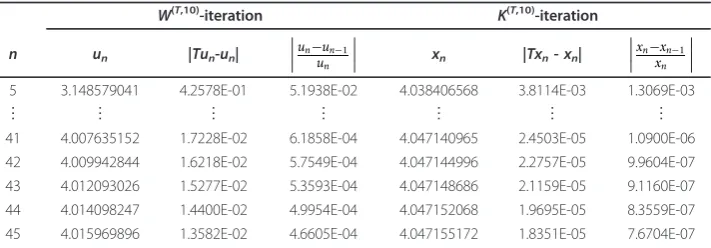
Example 3.6 Let T: [0,8]®[0,8]be defined by Tx=−sin(x−23) +x+12. Then T is a continuous and nondecreasing mapping. The comparison of the rate of convergence of the W(T,N)-iteration {un}∞n=1 and K(T,N)-iteration {xn}∞n=1 to a fixed point of T are given
in Table1,with the initial point u1 =x1 = 1when N= 10.
From Table 1, we see that theK(T,10)-iteration converges faster than theW(T,10) -itera-tion under the same control condi-itera-tions. We also observe that x45= 4.047155172 is an approximation of the fixed point of Twith accuracy at 6 significant digits.
Example 3.7Let T: [-7, 7]®[-7, 7] be defined by
Tx= ⎧ ⎪ ⎨ ⎪ ⎩
0.7x+e−0.8+ 0.8,if x∈[−7,−4)
e5x −2, if x∈[−4, 5) (x−5)2+e−2, if x∈[5, 7].
Then T is a continuous and nondecreasing mapping. The comparison of the rate of convergence of the W(T,N)-iteration {un}∞n=1 and K
(T,N)
-iteration {xn}∞n=1 to a fixed point
of T are given in Table 2,when N= 12.
In Example 3.7, the mapping Tis continuous on [-7,7] but it not differentiable atx= -4 andx= 5. In Table 2, we observe that the K(T,12)-iteration andW(T,12)-iteration with the initial point is x= 5 converge to a fixed pointp≈ -1.215863862 ofT. Moreover, the K(T,12)-iteration converges faster than theW(T,12)-iteration.
Table 1 Comparison of the rate of convergence between W(T,10)-iteration and theK(T,10)
-iteration for the mapping given in Example 3.6, for λn,i= n1.51+1(i= 1,2,...,9) and
λn,10= n0.51+1
W(T,10)-iteration K(T,10)-iteration
n un |Tun-un| un−uun−1
n
xn |Txn-xn| xn−xxn−1 n
5 3.148579041 4.2578E-01 5.1938E-02 4.038406568 3.8114E-03 1.3069E-03
⋮ ⋮ ⋮ ⋮ ⋮ ⋮ ⋮
41 4.007635152 1.7228E-02 6.1858E-04 4.047140965 2.4503E-05 1.0900E-06 42 4.009942844 1.6218E-02 5.7549E-04 4.047144996 2.2757E-05 9.9604E-07 43 4.012093026 1.5277E-02 5.3593E-04 4.047148686 2.1159E-05 9.1160E-07 44 4.014098247 1.4400E-02 4.9954E-04 4.047152068 1.9695E-05 8.3559E-07 45 4.015969896 1.3582E-02 4.6605E-04 4.047155172 1.8351E-05 7.6704E-07
Table 2 Comparison of the rate of convergence between theW(T,12)-iteration andK(T,12) -iteration for the mapping given in Example 3.7, for λn,i= n21+1(i= 1, 2,..., 11) and
λn,12= n0.51+1, with the initial pointu1=x1= 5
W(T,12)-iteration K(T,12)-iteration
n un |Tun-un| un−uun−1
n
xn |Txn-xn| xn−xxn−1 n
5 -0.343578991 7.2283E-01 8.7516E-01 -1.215808886 4.6467E-05 4.2767E-05
⋮ ⋮ ⋮ ⋮ ⋮ ⋮ ⋮
Open Problem: Is it possible to prove the convergence theorem of a finite family of continuous mappings on an arbitrary interval by using W-mappings andK-mappings and how about the rate of convergence of those methods?
Acknowledgements
The authors would like to thank the Centre of Excellence in Mathematics, the Commission on Higher Education for financial support. WP is supported by the Office of the Higher Education Commission and the Graduate School of Chiang Mai University, Thailand.
Author details
1Department of Mathematics, Faculty of Science, Chiang Mai University, Chiang Mai 50200, Thailand2Centre of
Excellence in Mathematics, CHE, Si Ayutthaya Road, Bangkok 10400, Thailand
Authors’contributions
All authors contributed equally and significantly in this research work. All authors read and approved the final manuscript.
Competing interests
The authors declare that they have no competing interests.
Received: 6 October 2011 Accepted: 31 January 2012 Published: 31 January 2012
References
1. Mann, WR: Mean value methods in iteration. Proc Amer Math Soc.4, 506–510 (1953). doi:10.1090/S0002-9939-1953-0054846-3
2. Ishikawa, S: Fixed points by a new iteration method. Proc Amer Math Soc.44, 147–150 (1974). doi:10.1090/S0002-9939-1974-0336469-5
3. Noor, MA: New approximation schemes for general variational inequalities. J Math Anal Appl.251, 217–229 (2000). doi:10.1006/jmaa.2000.7042
4. Phuengrattana, W, Suantai, S: On the rate of convergence of Mann, Ishikawa, Noor and SP-iterations for continuous functions on an arbitrary interval. J Comput Appl Math.235, 3006–3014 (2011). doi:10.1016/j.cam.2010.12.022 5. Rhoades, BE: Comments on two fixed point iteration methods. J Math Anal Appl.56, 741–750 (1976).
doi:10.1016/0022-247X(76)90038-X
6. Borwein, D, Borwein, J: Fixed point iterations for real functions. J Math Anal Appl.157, 112–126 (1991). doi:10.1016/ 0022-247X(91)90139-Q
7. Qing, Y, Qihou, L: The necessary and sufficient condition for the convergence of Ishikawa iteration on an arbitrary interval. J Math Anal Appl.323, 1383–1386 (2006). doi:10.1016/j.jmaa.2005.11.058
8. Atsushiba, S, Takahashi, W: Strong convergence theorems for a finite family of nonex-pansive mappings and applications, in: B.N. Prasad Birth Centenary Commemoration Volume. Indian J Math.41, 435–453 (1999)
9. Ceng, LC, Cubiotti, P, Yao, JC: Strong convergence theorems for finitely many nonexpansive mappings and applications. Nonlinear Anal.67, 1464–1473 (2007). doi:10.1016/j.na.2006.06.055
10. Cho, YJ, Kang, SM, Qin, X: Approximation of common fixed points of an infinite family of nonexpansive mappings in Banach spaces. Comput Math Appl.56, 2058–2064 (2008). doi:10.1016/j.camwa.2008.03.035
11. Cholamjiak, P, Suantai, S: A new hybrid algorithm for variational inclusions, generalized equilibrium problems and a finite family of quasi-nonexpansive mappings. Fixed Point Theory and Applications2009, 20 (2009). Article ID 350979 12. Colao, V, Marino, G, Xu, H-K: An iterative method for finding common solutions of equilibrium and fixed point
problems. J Math Anal Appl.344, 340–352 (2008). doi:10.1016/j.jmaa.2008.02.041
13. Kangtunyakarn, A, Suantai, S: Hybrid iterative scheme for generalized equilibrium problems and fixed point problems of finite family of nonexpansive mappings. Nonlinear Anal Hybrid Syst.3, 296–309 (2009). doi:10.1016/j.nahs.2009.01.012 14. Kimura, Y, Takahashi, W: Weak convergence to common fixed points of countable nonexpansive mappings and its
applications. J Korean Math Soc.38, 1275–1284 (2001)
15. Nakajo, K, Shimoji, K, Takahashi, W: Strong convergence to common fixed points of families of nonexpansive mappings in Banach spaces. J Nonlinear Convex Anal.8, 11–34 (2007)
16. Nakajo, K, Shimoji, K, Takahashi, W: On strong convergence by the hybrid method for families of mappings in Hilbert spaces. Nonlinear Anal.71, 112–119 (2009). doi:10.1016/j.na.2008.10.034
17. Qin, X, Cho, YJ, Kang, SM: Viscosity approximation methods for generalized equilibrium problems and fixed point problems with applications. Nonlinear Anal.72, 99–112 (2010). doi:10.1016/j.na.2009.06.042
18. Shimoji, K, Takahashi, W: Strong convergence to common fixed points of infinite nonexpansive mappings and applications. Taiwanese J Math.5, 387–404 (2001)
19. Singthong, U, Suantai, S: A new general iterative method for a finite family of nonexpansive mappings in Hilbert spaces. Fixed Point Theory and Appl2010, 12 (2010). Article ID 262691
20. Takahashi, W: Weak and strong convergence theorems for families of nonexpansive mappings and their applications. Ann Univ Mariae Curie-Sklodowska.51, 277–292 (1997)
21. Takahashi, W, Shimoji, K: Convergence theorems for nonexpansive mappings and feasibility problems. Math Comput Model.32, 1463–1471 (2000). doi:10.1016/S0895-7177(00)00218-1
22. Yao, Y: A general iterative method for a finite family of nonexpansive mappings. Nonlinear Anal.66, 2676–2687 (2007). doi:10.1016/j.na.2006.03.047
24. Kangtunyakarn, A, Suantai, S: A new mapping for finding common solutions of equilibrium problems and fixed point problems of finite family of nonexpansive mappings. Nonlinear Anal.71, 4448–4460 (2009). doi:10.1016/j.na.2009.03.003 25. Onjai-uea, N, Jaiboon, C, Kumam, P: A strong convergence theorem based on a relaxed extragradient method for
generalized equilibrium problems. Appl Math Sci.4, 691–708 (2010)
26. Peathanom, S, Phuengrattana, W: A hybrid method for generalized equilibrium, variational inequality and fixed point problems of finite family of nonexpansive mappings. Thai J Math.9, 95–119 (2011)
27. Berinde, V: Picard iteration converges faster than Mann iteration for a class of quasi-contractive operators. Fixed Point Theory Appl.2, 97–105 (2004)
28. Popescu, O: Picard iteration converges faster than Mann iteration for a class of quasi-contractive operators. Math Commun.12, 195–202 (2007)
29. Soltuz, SM: The equivalence of Picard, Mann and Ishikawa iterations dealing with quasi-contractive operators. Math Commun.10, 81–88 (2005)
30. Babu, GV, Prasad, KN: Mann iteration converges faster than Ishikawa iteration for the class of Zamfirescu operators. Fixed Point Theory and Appl2006, 6 (2006). Article ID49615
31. Qing, Y, Rhoades, BE: Comments on the Rate of Convergence between Mann and Ishikawa Iterations Applied to Zamfirescu Operators. Fixed Point Theory and Appl2008, 3 (2008). Article ID 387504
doi:10.1186/1687-1812-2012-9
Cite this article as:Phuengrattana and Suantai:Strong convergence theorems and rate of convergence of
multi-step iterative methods for continuous mappings on an arbitrary interval.Fixed Point Theory and Applications2012
2012:9.
Submit your manuscript to a
journal and benefi t from:
7Convenient online submission
7Rigorous peer review
7Immediate publication on acceptance
7Open access: articles freely available online
7High visibility within the fi eld
7Retaining the copyright to your article