Integrating Decompositional Event Structures into Storylines
William Croft, Pavl´ına Peˇskov´a, Michael Regan MSC 03 2130 Linguistics
1 University of New Mexico Albuquerque NM 87131-0001, USA
{wcroft,pavlinap,reganman}@unm.edu
Abstract
Storyline research links together events in stories and specifies shared participants in those stories. In these analyses, an atomic event is assumed to be a single clause headed by a single verb. However, many analyses of verbal semantics assume a decompositional analysis of events ex-pressed in single clauses. We present a formalization of a decompositional anal-ysis of events in which each participant in a clausal event has their own tempo-rally extended subevent, and the subevents are related through causal and other in-teractions. This decomposition allows us to represent storylines as an evolving set of interactions between participants over time.
1 Introduction
Stories are typically represented as a set of events and temporal relations among events (Caselli and Vossen, 2012). However, events are frequently given a decompositional analysis in linguistics, as surveyed in Levin and Rappaport Hovav (2005), and also in computational linguistics, for exam-ple Narayanan (1997). Many of the event de-compositions in linguistics do not explicitly rep-resent the temporal dimension, and distribute par-ticipants across different event components. Such representations do not lend themselves well to in-tegration with storyline analysis.
The event decomposition proposed in Croft
(2012) and applied to event annotation in Croft et al.(2016) is more suited to integration with sto-ryline analysis. Croft’s analysis of events explic-itly represents time as a geometric dimension, as part of the representation of aspect—the structure of events as they unfold in successive phases over
time. In addition to explicit representation of the temporal dimension, Croft introduces a second di-mension, qualitative states, to model change over the course of the event. These two dimensions allow one to represent directly the pre-state and post-state of events (Im and Pustejovsky, 2010;
Segers et al.,2015), as different states on the qual-itative dimension, and as different points of time in the temporal dimension.
Croft’s analysis also decomposes events into distinct subevents for each participant. The subevents represent directly the interactions of participants, instead of representing them indi-rectly and incompletely by semantic role labels. This decomposition allows for a smoother inte-gration of complex event structure with story net-works, albeit with a reinterpretation of the struc-ture of stories.
The decompositional model of events allows us to consider an alternative model of the structure of stories. In this model, stories are made up of participant histories, that is, the participant’s exis-tence through time. A participant history is in turn made up of subevents, namely the states and pro-cesses that the participant has or undergoes during each interval of time. The participant histories are related to each other through participant interac-tions, that is, subevent relations within events, at certain times. This alternative decomposition of stories is also suggested byvan Erp et al. (2014), who use a modified metro map visualization ( Sha-haf et al.,2012), with participants as “lines” and events as “stations”. This alternative model can be more fully realized using a decompositional anal-ysis of events in which each participant has its own subevent.
This alternative decomposition of stories is also more independent of the linguistic expression, in which events are realized as simple clauses with one or more argument phrases denoting
pants, and interclausal syntax expresses temporal and other relations between events. Thus, it rep-resents a story structure that must be derived in-directly from the linguistic expressions. In this paper we present a formalization of this alterna-tive decomposition of stories and events, and show how this formalization can be used to construct a visualization of stories as an evolving network of interactions among participants over time.
2 Event Decomposition and Annotation
2.1 Subevents and Aspect
In Croft’s decompositional analysis, each partici-pant has its own subevent. Each subevent consists of a sequence of temporal phases, representing how the subevents unfold over time. A subevent is made up of phases that are defined on two dimen-sions, time and a dimension of qualitative states that can be used to define different types of states and processes. That is, instead of representing the qualitative states and changes of an event as an atomic predicate, a predicate is analyzed as a path through a one-dimensional quality space over time. Obviously, a one-dimensional representa-tion of qualitative states/changes is a simplifica-tion, but it is an advance on analyses in which the qualitative event structure is left unanalyzed as the verbal “root” (Levin and Rappaport Hovav,2005). Subevents have an aspectual type. Semanticists have identified a number of different aspectual types, most of which can be analyzed as special cases of Vendler’s categories of states, achieve-ments, activities and accomplishments (Vendler,
1957;Croft et al.,2016). States lack change on the qualitative dimension. Some states are inherent properties of an individual (She is French), while others are reversible (The window is open) or ir-reversible (The window is broken), and still oth-ers exist only in a point of time (The sun is at its zenith).
Achievements represent a transition, construed as instantaneous, from one qualitative state to an-other. Directed achievements transition to a re-sult state (The window broke), while semelfac-tives (called cyclic achievements by Croft) tran-sition to the result state and back to the initial state (The light flashed). Accomplishments rep-resent a gradual change on a qualitative dimen-sion over time, attaining a natural endpoint. Incre-mental accomplishments represent a measurable, monotonic change (She ran into the gym), while
nonincremental accomplishments describe an ac-tivity that is not monotonic before achieving the result state (He repaired the computer). Activities represent change that does not have a natural end-point. Directed activities represent a monotonic change (The balloon rose), while the change de-scribed by undirected activities is nonmonotonic (The fans were dancing.).
We argue that there is another Vendler-like cat-egory: processes that stop, returning to the base state. These events, which we callendeavors, are temporally bounded, but not by reaching a natural endpoint. They may be directed or undirected. En-deavors are not lexicalized as such in English, but certain subevents in complex events are endeav-ors. In Russian, there are lexicalized endeavors (Forsyth,1970). Undirected endeavors are derived from undirected activities with the prefixpo-, as in On po-spal posle obeda‘He had a sleep after din-ner’. Directed endeavors are derived from directed activities with the prefixespri-, pod-, andnad-, as inOn pri-otkryl dver’‘He opened the door a little’. Participant subevents cause other participant subevents; this is the domain of force dynamics (Talmy,1988). Croft(2012) extends Talmy’s no-tion of force dynamics to cover a wide range of asymmetric relations between participants. The commonest noncausal interaction is a spatial re-lationship between two entities, the figure and the ground, followingTalmy(1983).
Many different event types are discussed in the linguistic semantic literature: caused motion, application, emission, change of state, and so on. Construction grammarians argue that these schematic event types represent the meanings of argument structure constructions (Goldberg,1995,
2006).
2.2 Force Dynamics and Types of Qualitative Change
Croft et al. (2016) propose an analysis of the semantic types of argument structure construc-tions in terms of force-dynamic relaconstruc-tions between participants, causal and noncausal, and the type of change that the theme participant undergoes. Among the most common types of force-dynamic relations are Force, the prototypical physical trans-mission of force relation; Constrain, Talmy’s “cau-sation of rest/stasis” (Talmy,1988); and Path, the spatial figure-ground relation.
changes, based in part on different types of in-cremental theme (Dowty,1991;Hay et al.,1999). The simplest change subevent of the affected en-tity is a change of state of the enen-tity, that is, a change in a scalar property of the entity as a whole (Hay et al.,1999).
Events involving change in a spatial figure-ground relation proceed in two different ways. Motion events of various kinds, such as The boy ran across the road, define a spatial path on the qualitative dimension that the figure traverses as a whole; for this reasonDowty(1991) calls the fig-ure a “holistic theme”.
Application, removal, combining and separat-ing events, such as The man picked pears from the tree, define a mereological change in the lo-cation of figure on the qualitative dimension; this is Dowty’s incremental theme proper. Covering and uncovering events, such asI buttered the toast with hazelnut butterandThey stripped the trees of bark, differ from application and removal events in that the incremental change is conceptualized as happening to the ground object (toast, trees) rather than the figure.
Croft et al. define another type of theme change, which they call Design for creation of an object with a certain identity, for events of creation (They built a shelter), formation (She carved a toy out of a stick) and replication (He scanned the article).
We identify another type of physical change not described byCroft et al.(2016): internal change of a single participant, such asThe flag fluttered. In-ternal events often also express a locative relation: The flag fluttered (over the fort). Finally, simple static location is included as an internal event type, albeit static:The flag is over the fort.
The relations between subevents and proper-ties of subevents summarized above cover a large range of the inventory of physical processes ex-pressed by simple verbs in English. There are of course many other events involving mental pro-cesses and other interactions between humans and other entities (perception, cognition, emotion, tention, attention, etc.), and many other events in-volving social interactions, which remain to be an-alyzed in this decompositional framework.
2.3 Annotation and Visualization of Aspect and Force Dynamics of Events
We proposed an annotation scheme for annotat-ing clauses with their aspectual type and
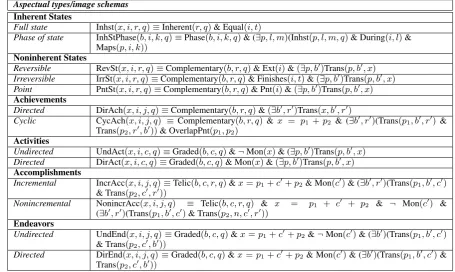
force-dynamic type of change, based on the verb, tense-aspect construction, and argument structure con-struction (Croft et al.,2016). We retain this aspect annotation, with the addition of directed and undi-rected endeavors. The full list of aspectual types is found in Table4in the Supplementary Material, which also includes their formalization (see sec-tion3). We are developing a revised annotation of aspectual types, a notoriously difficult area of lin-guistic semantics, that we believe will be simpler to use by annotators, yet still captures all of the distinctions in Table4.1
The force dynamic annotation scheme in Croft et al.(2016) annotates only the type of change un-dergone by the theme participant in the clausal event. The revision and extension of the annota-tion scheme described above is found in Table5
in the Supplementary Material. The theme change may be externally caused; annotation for external and internal cause can be found in Table6in the Supplementary Material.
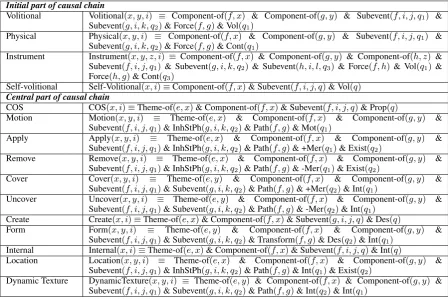
A complete annotation of the structure of a clausal event consists of three annotations: the aspectual type (ideally, the fine-grained classifi-cation in Table 4); and for the force dynamics, the external/internal cause (Table6) and the theme change type (Table5).
We applied this annotation scheme, with the modifications described in this section, to clauses in three Pear Stories (Chafe,1980). The Pear Sto-ries are a set of oral narratives produced by speak-ers after viewing a short film which was designed to analyze patterns of verbalization. Since there is no language in the film, the narratives mostly encode physical events of the type already ana-lyzed by Croft et al. We chose the Pear Stories since this allowed us to easily annotate most of the events in the narrative. We believe that the oral narratives share significant narrative structure with news stories. However, temporal ordering of events is much more regular in the Pear Stories.
Relations between clausal events in the Pear Stories were annotated using predicates from the temporal interval calculus (Allen,1984;Mani and Pustejovsky,2012). Temporal relations expressed by adverbial clauses and coordination are repre-sented adequately for our purposes by the tem-poral interval calculus predicates. The temtem-poral interval calculus predicates that expressed
inter-1The revised aspect annotation scheme, and annotation
Event FD 1 FD 2 Aspect TR
And he comes down, . . from the ladder, Self-volitional Motion Incremental Accomplishment AFT
[1.1] and he’s wearing an apron, Volitional Constrain Undirected Activity CONT
[image:4.595.76.522.62.105.2]And he dumps them [.45] into some baskets . . Volitional Apply Incremental Accomplishment AFT Table 1: Annotation of a passage from the Pear Stories
clausal relations occurring in the Pear Stories nar-ratives that were annotated are Before (BEF), Af-ter (AFT), Meets (MEET), Equal (EQ), Overlap (OVER), and Contains (CONT). Coreference rela-tions between participants across events were also annotated by using the same values for recurrent individuals in the constructional annotation (not shown in Table1).
Figure 1: Graphic representation of decomposi-tional event structure forAnd he dumps them into some baskets
A sample annotation is given in Table1. From this annotation, we construct predicate calcu-lus representations of the decompositional event structure based on the formalization in section
3. From the formal representation, we automati-cally generate a graphic representation of a clausal event. Figure 1shows the graphic representation of the third sentence in Table1. The graphic rep-resentation is a modified version of those found in
Croft(2012). In particular, we add structure to the qdimension (the vertical dimension) for each par-ticipant, as described in section3.
Adding the annotation of temporal relations be-tween clausal events allows us to generate a visu-alization of the fragment of the story in Table 1; see Figure4and the discussion in section4.
3 A Formalization of Event Structure Here we formalize the idea that stories are made up of participant histories that interact over time. This view of story structure informs the formaliza-tion of the individual events in a story that express the participant interactions. Since event structure is complex, almost all of our attention here will be focused on the event structure formalization. The formalization expands the annotation to formulas that allow for inference about events and their par-ticipants, and allow for visualizations of the struc-ture of events and the strucstruc-ture of stories.
3.1 Aspect and the Interval Calculus
Our formalization uses the interval calculus for both the temporal and qualitative dimensions (Allen, 1984;Mani and Pustejovsky, 2012), and the commonsense knowledge axioms of Gordon and Hobbs (2017).2 Since event decomposition
involves many composite entities, we use the nota-tional simplification ofx=a+bto describe a com-posite entityxwith exactlyaandbcomponent en-tities, that is, CompositeEntity(x) & Component-of(a, x) & Component-of(b, x) &a6=b& ((y6=a &y 6= b)⊃ ¬Component-of(y, x)); likewise for composite entities with more than two component entities. The notationx=aindicates equality, that is, there is exactly one component to the composite entity. However, we will use Equal(i, j) for inter-val equality followingAllen(1984).
We begin with the formal analysis of subevents and their participants. Each participant is identi-fied with its own subevent. A participant is mod-eled as a history, namely, the states and changes that a participant has, performs or undergoes over time. The identity of a participant as an individual is expressed by the unity of the participant history. A subevent is a component of a participant his-tory. The subevent consists of qualitative states and changes of the participant during a time inter-val of the participant history. We model the
quali-2We use the axioms that are presented at
[image:4.595.93.265.270.476.2]tative structure of a subevent by the qualitative di-mensionqorthogonal to the time dimensiont.
Different verbs or predicates define different relevant qualitative states for each participant subevent. Hence each subevent has a distinct set of qualitative states. One can consider each predi-cate’s set of qualitative states as an interval on the q dimension. Alternatively, each predicate can be thought of as representing a distinct qualitative di-mension (see section4). Where necessary, we will distinguish qualitative state dimensions for differ-ent predicates, for example for differdiffer-ent subevdiffer-ents of a multiparticipant event, asq1, q2. . .
FollowingAllen (1984), we represent “points” in time as very small intervals. Specifically, we define a “point” interval as an interval that does not contain a smaller interval, that is, Pnt(i) ≡
(¬∃j)During(j, i). Extended (Ext) intervals are not punctual. One reason for treating points as the smallest intervals is that an event that is con-strued as occurring in an “instant” (The bridge col-lapsed) may also be construed as occurring over an interval (The bridge is collapsing). We would represent these two construals as both occurring over intervals with different granularities (Hobbs,
1985a) such that for the coarser-grained temporal metric, there are no smaller intervals than the event interval, but for a finer-grained temporal metric, there are. (We have not yet modeled granularity shifts.)
3.2 The Structure of the Qualitative Dimension
We analyze the structure of the qualitative dimen-sion q for each subevent also using the interval calculus, which can be generalized beyond time (Mani and Pustejovsky, 2012; Hobbs and Pan,
2004). Verbs and other predicates impose more specific structure onq.
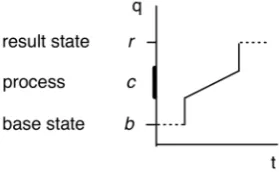
We distinguish four types of qualitative dimen-sions that capture the potential variation of qual-itative states defined by predicates over time. In-herent predicates cannot vary over time for a par-ticipant; for example one cannot start or stop be-ing French. Hence only one point is defined onq, which we labelr. Complementary predicates can vary between applying or not applying to a partic-ipant; for example a window can be either whole or broken. Only two points are defined on q, a “base state”bcalled a “rest state” inCroft(2012), and the “result state”, also labeledr. Graded
pred-icates vary dynamically in their states beyond the base stateb; for example, one can either dance or not dance, but dancing involves various changes on a dimension of bodily movements. Graded predicates involve the base state b and a contin-uous intervalcfor the process. Finally, telic pred-icates such as entering a room have a base state b (not being in the room), the central interval of dynamically varying statesc (the entering move-ment), and a result stater(being in the room).
The types of predicates are defined in Table 3
in the Supplementary Material. The structure of a telic predicate is illustrated in Figure2.
3.3 Phases and Subevents
A phase is defined as a function from an intervali ontto an intervaljon theqdimension (see Table
3). Phases can be distinguished by properties of the domain and/or range. A state is a phase whose range is a point (that is, the smallest interval) onq. A process is a phase whose domain and range are extended ontandq respectively. Processes may be monotonic (Mon(p)) or nonmonotonic.
A transition (Trans) is a phase derived from two phases that meet: it is made up of the finish “point” of the first phase and the start “point” of the sec-ond phase. This is our solution to the “divided in-stant” problem described byMani and Pustejovsky
(2012, pg. 60); our solution is similar to that of
Hobbs and Pan(2004) (however they distinguish instants from intervals). We divide the “instant” of transition of two phases that meet into the fin-ish point of the first phase and the start point of the second phase. The transition phase is a composite phase made up of those two point phases.
[image:5.595.345.485.637.723.2]In order to define transitions, we first define start and finish “points” of a temporal interval. We then define start and finish phases of a larger phase, namely the phases whose domains are the start and finish points of the larger phase. A transition phase
is then defined as a composite phase made up of the finish of the first phase and start of the sec-ond phase. A transition phase is not a point inter-val, but it is the smallest extended interval: that is, there is no interval between the finish point of the first phase and the start point of the second phase, since the two phases meet.
Finally, for convenience we define specific phases in terms of the interval on q that serves as their range; these are b0, c0 and r0 in Table 3 in the Supplementary Material. Because of the nature of b, c, r, it follows that State(b0, i, b, q), Process(c0, i, c, q)and State(r0, i, r, q).
A subevent has an aspectual type. Aspectual types are composite entities composed of one or more phases. The four types of states differ with respect to their domains (time intervals) on t, de-fined on the interval calculus. Unbounded events, that is noninherent states and activities, presup-pose that there was a transition from the base state to the asserted phase; the presupposed phase is represented by an existentially quantified predi-cate. Formalizations of all aspectual types can be found in Table4in the Supplementary Material.
3.4 Events as Force Dynamic Chains of Subevents
Events expressed by single clauses are informally analyzed as interactions between participants for multiparticipant events. For example, inThe rock broke the window, the rock acted on the win-dow. We analyze these force-dynamic relations as relations between subevents that are compo-nents of the participant’s history. In our exam-ple, the rock’s contact subevent caused the win-dow’s change of state subevent (the specific qual-itative state being contributed by the semantics of the verbbreak). The rock’s contact subevent is a component of the rock’s history, and likewise the window’s change of state event is a component of the window’s history.
The unity of an event expressed by a single clause (verb and argument structure construction) is defined by the fact that all subevents of an event are simultaneous, whatCroft(2012) calls the tem-poral unity of events; and by the presence of force dynamic relations between the subevents.
We model the type of incremental change that a participant undergoes, described in section 2, as a property of that participant’s subevent, or more precisely the qualitative dimension of that
subevent. The types of change described in sec-tion2are Property change (Prop), Motion (Mot), Mereological change (Mer), Design change (Des), and Internal change (Int). Mereological change falls into four subtypes. Apply represents incre-mental change of the spatial figure with respect to the ground object, for example paint being grad-ually applied to a wall. Apply and Remove are inverses, represented by +Mer and -Mer. Cover represents a construal by which the incremental change happens to the spatial ground, for exam-ple the wall being gradually covered by the paint. Cover and Uncover are also inverses.
We also provide an analysis of the qualities of subevents of the agent and instrument, not dis-cussed byCroft et al.(2016). Agents interact in physical processes using their body. Most of the time what the agent does is volitional, that is, a process involving mental as well as physical as-pects of a person. For now, we model volitionality as the type of action that an agent engages in, that is, the agent’s subevent has the property Vol. In-struments interact solely physically, of course, ul-timately through some sort of contact. We model the interaction of instruments by attributing the property Contact to the instrument’s subevent.
The aspectual annotation of the overall event describes the aspectual type of the theme partic-ipant. For this reason, the formalization of the as-pectual annotation of the overall event is distinct from the representation of the aspectual type of each subevent. The formalization of the force dy-namic annotation that includes the theme partici-pant specifies which participartici-pant is the theme. The combination of the aspectual annotation predi-cate and the force dynamic annotation predipredi-cate(s) specifies the aspectual type of the theme partic-ipant subevent. The physical force and mental “force” applied by an instrument is dynamic but nonmonotonic. The aspectual type of an agent or instrument subevent varies depending on the as-pectual type of the theme: an undirected activity if the overall event is unbounded, an undirected en-deavor if the event is bounded and durative, or a semelfactive if the event is punctual.
Aspectual Types/Image Schemasall below⊃AspTyp(x, i, j, q)
Inherent state Inhst(x, i, r, q)≡Inherent(r, q)& Equal(i, t)
Inherent state phase InhStPh(b, i, j, q)≡Phase(b, i, j, q)& (∃p, l, m)[Inhst(p, l, m, q)& During(i, l)& Maps(p, i, j)]
Incremental accomplishment IncrAcc(x, i, j, q)≡Telic(b, c, r, q)&x=p1+c0+p2& Mon(c0)& (∃b0, r0)[Trans(p
1, b0, c0)& Trans(p2, c0, r0)]
Undirected endeavor UndEnd(x, i, j, q)≡Graded(b, c, q)&x=p1+c0+p2&¬Mon(c0)& (∃b0)[Trans(p
1, b0, c0)& Trans(p2, c0, b0)]
Force Dynamic Image Schemas
Volitional Volitional(e, x, y, i)≡Component-of(f, x)& Component-of(g, y)& Subevent(f, i, j, q1)& Subevent(g, i, k, q2)& Force(f, g)& Vol(q1)
Apply Apply(e, x, y, i)≡Theme-of(e, x)& Component-of(g, y)& Component-of(h, z)& Subevent(g, i, j, q1)& InhStPh(h, i, k, q2)& Path(g, h)& +Mer(q1)& Exist(q2)
Aspectual Type of Theme Participant
Incremental Accomplishment IncrementalAccomplishment(e, i) ≡ Theme-of(x, e) & Component-of(g, x) & IncrAcc(g, i, j, q)
Predicate Calculus Representation of Example Sentence He dumped them into some
[image:7.595.79.516.58.281.2]baskets. DumpComponent-of(F armer, P ears, Baskets)(g, P ears) Component-of≡Component-of(h, Baskets)(f, F armer)& UndEnd&(f, i, j, q1) & IncrAcc(g, i, k, q2) & InhStPh(h, i, l, q3) & Vol(q1) & +Mer(q2) & Exist(q3) & Force(f, g)& Path(g, h)
[image:7.595.77.283.319.445.2]Table 2: Formalization of aspectual and force dynamic image schemas for example sentence.
Figure 3: Linking constructions to the semantic representation
3.5 Deriving the Graphic Representation of the Event Structure of a Sentence
To illustrate the formalization of the aspectual and force-dynamic decomposition of events, we briefly go through the derivation of the semantic representation of the sentence represented graph-ically in Figure1. The first step is extracting the argument structure construction and tense-aspect construction forms from the sentence (not mod-eled here). The associated meaning is represented by the aspectual and force dynamic annotations, with the arguments of the semantic annotations bound to the participants in the construction; see Figure3.
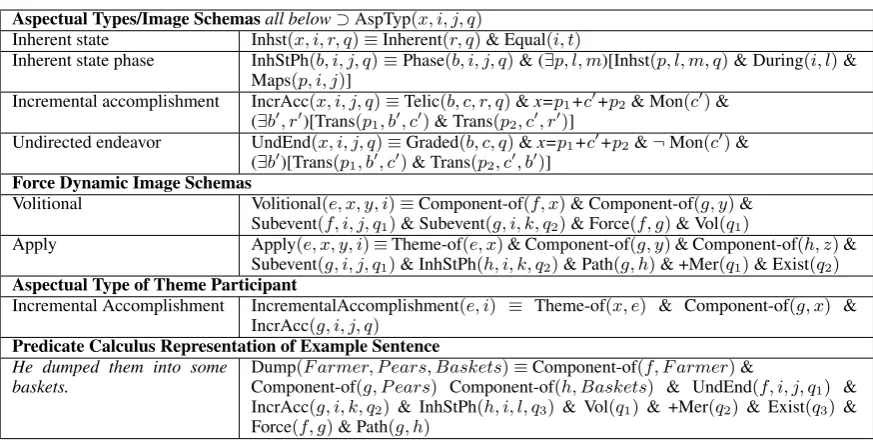
The force dynamic annotation, in two parts, can be expanded with the representations in Table2. A Volitional external cause involves the farmer’s vo-litional subevent in a force relation with the pears’ subevent. The pears’ subevent involves
mereolog-ically moving the pears with respect to the bas-kets’ subevent. The basbas-kets’ subevent is simply the phase of the inherent state of existing as an entity with which the pears enter a spatial relation-ship; this is represented by the inherent state phase formalization in Table2.
The incremental accomplishment aspectual type is associated with the theme argument, as noted above. The formalization of incremen-tal accomplishments in Table2 indicates that the q dimension of an incremental accomplishment defines base, center and result intervals. The subevent spans the transition from the base state to the central process and from the central process to the result state, that is, the subevent is bounded; it is also monotonic (see Figure1).
The agent subevent is specified as an undirected endeavor, since the overall event is temporally bounded. As such, theq dimension defines base and center intervals only. The subevent spans the transition from the base state to the central process and back to the base state.
4 Visualization
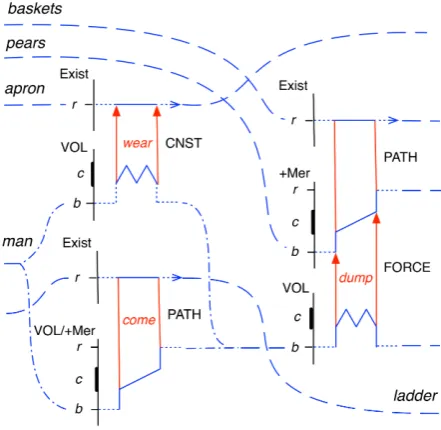
We are also developing a visualization to capture the evolving interactions of participants over time. The basic idea is a modified metro map (Shahaf et al.,2012), in which the lines represent partici-pant histories and the nodes represent interactions among participants, that is, clausal events. Fig-ure4presents a visualization of the events, partic-ipants and interactions in the passage in Table 1
above.
Clausal events are related to other clausal events through temporal relations and relations of shared participants, as in van Erp et al. (2014). As with other storyline visualizations, temporally se-quenced events—Before, After, and Meets in the interval logic—can be arranged horizontally, with sequenced events sharing participants aligned hor-izontally. Temporally overlapping events—Equal, Overlap, During and Contain—can be arranged vertically. Events whose temporal location is con-strained but not totally specified would be situated relative to those events to which they hold tempo-ral relations.
Of course, such metro maps get very tangled very quickly, since coherent narratives normally express many interwoven events with many dif-ferent combinations of many difdif-ferent partici-pants. Algorithms such as that ofLiu et al.(2013) will, we hope, generate visually presentable metro maps of more complex participant interactions over time.
The primary innovation in the visualization is that the interactions between participants in a sin-gle clausal event are made explicit, as in Croft
(2012) andCroft et al.(2016). That is, the nodes in the metro map visualization are elaborated as interactions between the participants. The roles of participants within a clausal event are kept sepa-rate because each participant has its own subevent. The qualitative states and changes of each partici-pant are also explicitly represented. The visualiza-tion therefore describes not only the interacvisualiza-tions that each participant engages in over the time of the story, but also exactly what they do or what happens to them.
Precise representation of participants and their states in events requires addressing certain issues. A group of participants may act as a unit in some events but separately in other events:
[image:8.595.308.529.64.279.2]41 [.6] they g [.25] gather all the pears
Figure 4: Event Decomposition and Interactions of Participants
42 and put them in the basket,
43 a–nd one of the guys, helps him
44 brush off the dust,
45 [.9] and another guy picks up the rock,
In this case, we must allow the history for the group of three boys to split in order to represent the interaction of individual boys from the group with other entities (the cyclist and the rock).
In other cases, the same participant is playing different roles in two different events at the same time:
140 then he . . takes a pear,
141 after carefully watching the man in the tree.
142 Who’s still picking.
The man in the tree is functioning as the target of the watching event in 141 at the same time that he is the agent of the picking event in 142.
different qualitative states of being watched and picking. Such virtual splits will be visualized in a distinct way from actual splits as found in passage 41-45 above. In Figure4, we represent the virtual split of the man by dot-dashed lines.
5 Conclusion and Future Prospects The participant-oriented description of storylines presented here allows for the representation of the qualitative state(s) that each participant is in at any temporal interval in the participant’s history, and hence the storyline.
At this point, we have not represented the qual-itative states of participants between events. How-ever, some general patterns can easily be imple-mented. The identification of the theme partic-ipant indicates which particpartic-ipant undergoes and change, and the resulting state for that participant, if there is one, can be assumed to hold, other things being equal. Even for the case of events without a result state for the participant, the event can be assumed to persist. The subevents of agent and instrument participants will end at the end of the event; they will return to the base state.
In some cases, grammatical elements provide information that allows one to infer qualitative states between events. For example, in line 142, Who’s still picking, the aspectual adverb still in-dicates that the picking activity described there is a continuation of the same picking activity re-ported earlier in the narrative. As we model ad-ditional tense-aspect constructions, including as-pectual adverbs, we will be able to represent the persistence or not of subevents past the reported event.
However, in many cases, the persistence (or lack thereof) of qualitative states can only be inferred using world knowledge. These inferences can be done using the formalization in section 3, com-bined with representations of relevant common-sense knowledge.
The representation we have developed applies only to events presented as having actually hap-pened in the narrative. Many events in narratives, including news stories, are unrealized in various ways at the point that they are introduced: they may represent planned events, desired events, or events reported with a degree of uncertainty. Even so, they can often be sequenced relative to realized events: planned events follow the current realized event, negated events are “simultaneous” with the
actual state of affairs (which is the opposite of the negated event in relevant respects), and so on.
We have not included unrealized events in our annotation and representation. We are developing a model of non-real events using mental spaces (Fauconnier, 1985, 1997) or worlds (McCawley,
1993) in which the non-real events hold in their own mental space/world, and can be related to real events in different ways. Mental spaces would be represented by using the Holds predicate (Allen,
1984; Hobbs, 1985b), with a world argument w added, relativized to an agent holding the belief or intending a plan etc.: Holds(e,a,w). The re-lationship between mental spaces and their basis in reality will be modeled followingClark(1996). Other predicates represent relations between men-tal spaces or between agents and their menmen-tal spaces, building on Fauconnier(1985,1997) and
McCawley(1993).
Acknowledgments
The research was supported in part by grant HDTRA1-15-1-0063 by the Defense Threat Re-duction Agency to the first author.
References
James Allen. 1984. Towards a general theory of action and time.Artificial Intelligence23:123–154. Tommaso Caselli and Piek Vossen. 2012. The
Story-line Annotation and Representation Scheme (StaR): a proposal. InProceedings of the 2nd Workshop on Computing News Storylines, Stroudsburg, Penn: As-sociation for Computational Linguistics, pages 67– 72.
Wallace Chafe, editor. 1980. The pear stories. New York: Ablex.
Herbert H. Clark. 1996. Using language. Cambridge: Cambridge University Press.
William Croft. 2012. Verbs: aspect and causal struc-ture. Oxford University Press.
William Croft, Pavl´ına Peˇskov´a, and Michael Regan. 2016. Annotation of causal and aspectual struc-ture of events in RED: a preliminary report. In 4th Events Workshop, 15th Annual Conference of the North American Chapter of the Association of Computational Linguistics: Human Language Tech-nologies (NAAACL-HLT 2016), Stroudsburg, Penn: Association for Computational Linguistics, pages 8– 17.
Gilles Fauconnier. 1985. Mental Spaces. Cambridge, Mass: MIT Press.
Gilles Fauconnier. 1997.Mappings in thought and lan-guage. Cambridge: Cambridge University Press. James Forsyth. 1970. A grammar of aspect: usage
and meaning in the Russian verb. Cambridge: Cam-bridge University Press.
Adele E. Goldberg. 1995. Constructions: A Con-struction Grammar Approach to Argument Struc-ture. Chicago: University of Chicago Pres.
Adele E. Goldberg. 2006. Constructions at Work: The Nature of Generalization in Language. Oxford: Ox-ford University Press.
Andrew S. Gordon and Jerry R. Hobbs. 2017. A Formal Theory of Commonsense Psychology: How People Think People Think. Cambridge University Press, to appear.
Jennifer Hay, Christopher Kennedy, and Beth Levin. 1999. Scalar structure underlies telicity in “de-gree achievements”. In Tanya Matthews and Devon Strolovitch, editors, Proceedings of SALT, Ithaca: Cornell University Press, volume 9, pages 127–144. Jerry R. Hobbs. 1985a. Granularity. InProceedings of the Ninth International Joint Conference on Arti-ficial Intelligence, Volume 1, San Francisco, Calif.: Morgan Kaugmann, pages 432–435.
Jerry R. Hobbs. 1985b. Ontological promiscuity. In Proceedings of the 12th Annual Meeting of the Asso-ciation for Computational Linguistics, Stroudsburg, Penn: Association for Computational Linguistics. Jerry R. Hobbs. 2005. Toward a useful concept of
causality for lexical semantics. Journal of Seman-tics22:181–209.
Jerry R. Hobbs and Feng Pan. 2004. An ontology of time for the semantic web. ACM Transactions on Asian Language Information Processing 3(1):66– 85.
Syeohun Im and James Pustejovsky. 2010. Anno-tating lexically entailed subevents for textual in-ference tasks. In Proceedings of the 23rd In-ternational Florida Artificial Intelligence Research Society Conference (FLAIRS-23), Daytona Beach, Florida, pages 204–209.
Beth Levin and Malka Rappaport Hovav. 2005. Argu-ment realization. Cambridge: Cambridge Univer-sity Press.
Shixia Liu, Yingcai Wu, Enxun Wei, Mengchen Liu, and Yang Liu. 2013. Storyflow: tracking the evolu-tion of stories. IEEE Transactions on Visualization and Computer Graphics19(12):2436–2445. Inderjeet Mani and James Pustejovsky. 2012.
Inter-preting motion: grounded representations for spa-tial language. Oxford: Oxford University Press.
James D. McCawley. 1993. Everything that linguists have always wanted to know about logic (but were ashamed to ask). Chicago: University of Chicago Press, 2 edition.
Srini Narayanan. 1997. Knowledge-based action rep-resentations for metaphor and aspect (KARMA). Ph.D. thesis, Department of Computer Science, Uni-versity of California at Berkeley.
Roxane Segers, Piet Vossen, Marco Rospocher, Lu-ciano Serafini, Egoitz Laparra, and German Rigau. 2015. ESO: a frame-based ontology for events and implied situations. InProceedings of the MAPLEX-2015 Workshop.
Dafna Shahaf, Carlos Guestrin, and Eric Horvitz. 2012. Trains of thought: generating information maps. In Proceedings of the 21st International Conference on World Wide Web, New York: Association of Com-puting Machinery, pages 899–908.
Leonard Talmy. 1983. How language structures space. In Herbert L. Pick (Jr.) and Linda P. Acredolo, edi-tors,Spatial orientation: theory, research and appli-cation, New York: Plenum Press, pages 225–282. Leonard Talmy. 1988. Force dynamics in language and
cognition. Cognitive Science2:49–100.
Marieke van Erp, Gleb Satyukov, Piek Vossen, and Marit Nijssen. 2014. Discovering and visualiz-ing stories in the news. In Proceedings of the 9th Language Resources and Evaluation Conference (LREC2014), European Language Resources Asso-ciation, pages 3277–3282.
A Supplementary Material: Annotation and Formalization of Aspect and Force Dynamic Structure of Events
Structure ofq: Phases:
Inherent(r, q)≡Pnt(r)& Equal(r, q) Phase(p, i, j, q)≡Function(p, i, j)& Interval-on(i, t)& Interval-on(j, q)
Complementary(b, r, q)≡q=b+r& Pnt(b)&
Pnt(r)& Meets(b, r) b
0: Phase(b0, i, b, q) & (Complementary(b, r, q) ∨ Graded(b, c, q) ∨
Telic(b, c, r, q)) Graded(b, c, q)≡q=b+c& Pnt(b)& Ext(c)&
Meets(b, c) c
0: Phase(c0, i, c, q)& (Graded(b, c, q)∨Telic(b, c, r, q))
Telic(b, c, r, q)≡q=b+c+r& Pnt(b)& Ext(c)
& Pnt(r)& Meets(b, c)& Meets(b, r) r
0: Phase(r0, i, r, q) & (Inherent(r, q) ∨ Complementary(b, r, q) ∨
Telic(b, c, r, q))
Transitions:
Start point: Spt(x, i)≡Starts(x, i)& Pnt(x) Finish point: Fpt(x, i)≡Finishes(x, i)& Pnt(x) Start phase: Sph(s, p)≡Phase(s, i, j, q)&
[image:11.595.71.540.107.257.2]Phase(p, k, l, q)& Spt(i, k)& Maps(p, i, j) Finish phase& Maps(p, i, j): Fph(f, p)≡Phase(f, i, j, q)& Phase(p, k, l, q)& Fpt(i, k) Transition phase: Trans(p, p1, p2)≡Phase(p, i, j, q)& Phase(p1, k, l, q) & Phase(p2, m, n, q) & Meets(k, m)& Fph(f, p1)& Sph(s, p2)&p=f+s
Table 3: Structure ofqdimensions and types of phases. These axioms and definitions underlie the phasal geometrical model of aspect.
Aspectual types/image schemas Inherent States
Full state Inhst(x, i, r, q)≡Inherent(r, q)& Equal(i, t)
Phase of state InhStPhase(b, i, k, q)≡Phase(b, i, k, q)& (∃p, l, m)(Inhst(p, l, m, q)& During(i, l)& Maps(p, i, k))
Noninherent States
Reversible RevSt(x, i, r, q)≡Complementary(b, r, q)& Ext(i)&(∃p, b0)Trans(p, b0, x)
Irreversible IrrSt(x, i, r, q)≡Complementary(b, r, q)& Finishes(i, t)&(∃p, b0)Trans(p, b0, x)
Point PntSt(x, i, r, q)≡Complementary(b, r, q)& Pnt(i)&(∃p, b0)Trans(p, b0, x)
Achievements
Directed DirAch(x, i, j, q)≡Complementary(b, r, q)&(∃b0, r0)Trans(x, b0, r0)
Cyclic CycAch(x, i, j, q) ≡ Complementary(b, r, q) & x = p1 +p2 & (∃b0, r0)(Trans(p1, b0, r0) & Trans(p2, r0, b0))& OverlapPnt(p1, p2)
Activities
Undirected UndAct(x, i, c, q)≡Graded(b, c, q)&¬Mon(x)& (∃p, b0)Trans(p, b0, x)
Directed DirAct(x, i, c, q)≡Graded(b, c, q)& Mon(x)&(∃p, b0)Trans(p, b0, x)
Accomplishments
Incremental IncrAcc(x, i, j, q)≡Telic(b, c, r, q)&x=p1+c0+p2& Mon(c0)& (∃b0, r0)(Trans(p1, b0, c0) & Trans(p2, c0, r0))
Nonincremental NonincrAcc(x, i, j, q) ≡ Telic(b, c, r, q) & x = p1 + c0 + p2 & ¬ Mon(c0) & (∃b0, r0)(Trans(p
1, b0, c0)& Trans(p2, n, c0, r0))
Endeavors
Undirected UndEnd(x, i, j, q)≡Graded(b, c, q)&x=p1+c0+p2&¬Mon(c0)& (∃b0)(Trans(p1, b0, c0) & Trans(p2, c0, b0))
Directed DirEnd(x, i, j, q)≡Graded(b, c, q)&x=p1+c0+p2& Mon(c0)& (∃b0)(Trans(p1, b0, c0)& Trans(p2, c0, b0))
[image:11.595.67.523.318.590.2]Direct Inverse
Force (contact, force exertion) Resist (maintain)
Theme Direct Reverse
Property Change of State
Path Motion (directed motion, manner of motion)
Mereological Apply (Cover (application, combining)covering, filling) Remove (Uncover (removal, separation)uncovering, emptying)
Design CreateForm
[image:12.595.74.524.75.192.2]Existence InternalLocation Dynamic Texture
Table 5: Force-dynamic image schemas for annotation: theme change type. The terms in the second and third columns make up the annotation.
External Cause Example
Autonomous no external cause Paint spilled onto the floor.
Self-Volitional no external cause; theme argument brings about
action volitionality Wanda ran out of the room.
Physical external physical cause The baseball shattered the window.
Volitional external volitional cause; no distinct instrument I painted the wall.
[image:12.595.82.515.260.338.2]Instrumental external volitional cause with distinct instrument I painted the wall with a roller.
Table 6: External/Internal cause. The terms in the first column make up the annotation.
Initial part of causal chain
Volitional Volitional(x, y, i) ≡ Component-of(f, x) & Component-of(g, y) & Subevent(f, i, j, q1) & Subevent(g, i, k, q2)& Force(f, g)& Vol(q1)
Physical Physical(x, y, i) ≡ Component-of(f, x) & Component-of(g, y) & Subevent(f, i, j, q1) & Subevent(g, i, k, q2)& Force(f, g)& Cont(q1)
Instrument Instrument(x, y, z, i) ≡ Component-of(f, x) & Component-of(g, y) & Component-of(h, z) & Subevent(f, i, j, q1) & Subevent(g, i, k, q2)& Subevent(h, i, l, q3) & Force(f, h)& Vol(q1) & Force(h, g)& Cont(q3)
Self-volitional Self-Volitional(x, i)≡Component-of(f, x)& Subevent(f, i, j, q)& Vol(q) Central part of causal chain
COS COS(x, i)≡Theme-of(e, x)& Component-of(f, x)& Subevent(f, i, j, q)& Prop(q)
Motion Motion(x, y, i) ≡ Theme-of(e, x) & Component-of(f, x) & Component-of(g, y) & Subevent(f, i, j, q1)& InhStPh(g, i, k, q2)& Path(f, g)& Mot(q1)
Apply Apply(x, y, i) ≡ Theme-of(e, x) & Component-of(f, x) & Component-of(g, y) & Subevent(f, i, j, q1)& InhStPh(g, i, k, q2)& Path(f, g)& +Mer(q1)& Exist(q2)
Remove Remove(x, y, i) ≡ Theme-of(e, x) & Component-of(f, x) & Component-of(g, y) & Subevent(f, i, j, q1)& InhStPh(g, i, k, q2)& Path(f, g)& -Mer(q1)& Exist(q2)
Cover Cover(x, y, i) ≡ Theme-of(e, y) & Component-of(f, x) & Component-of(g, y) & Subevent(f, i, j, q1)& Subevent(g, i, k, q2)& Path(f, g)& +Mer(q2)& Int(q1)
Uncover Uncover(x, y, i) ≡ Theme-of(e, y) & Component-of(f, x) & Component-of(g, y) & Subevent(f, i, j, q1)& Subevent(g, i, k, q2)& Path(f, g)& -Mer(q2)& Int(q1)
Create Create(x, i)≡Theme-of(e, x)& Component-of(f, x)& Subevent(g, i, j, q)& Des(q)
Form Form(x, y, i) ≡ Theme-of(e, y) & Component-of(f, x) & Component-of(g, y) & Subevent(f, i, j, q1)& Subevent(g, i, k, q2)& Transform(f, g)& Des(q2)& Int(q1)
Internal Internal(x, i)≡Theme-of(e, x)& Component-of(f, x)& Subevent(f, i, j, q)& Int(q)
Location Location(x, y, i) ≡ Theme-of(e, x) & Component-of(f, x) & Component-of(g, y) & Subevent(f, i, j, q1)& InhStPh(g, i, k, q2)& Path(f, g)& Int(q1)& Exist(q2)
Dynamic Texture DynamicTexture(x, y, i) ≡ Theme-of(e, y) & Component-of(f, x) & Component-of(g, y) & Subevent(f, i, j, q1)& Subevent(g, i, k, q2)& Path(f, g)& Int(q2)& Int(q1)
[image:12.595.73.522.391.690.2]