platelet-rich plasma to treat an elite athlete with
patellar tendinopathy – a case report
Tracy L. Rowan,
BSc, BPHE, CSCS, DC*Jillian L. Drouin,
BSc, CSCS, DC* Sports Sciences Resident, Canadian Memorial Chiropractic College, 6100 Leslie Street, Toronto, Canada
Address Correspondence to: Dr. Tracy L. Rowan, 6100 Leslie Street, Toronto, Ontario M2H 3J1. Phone: 416-482-2340. Fax: 416-646-1115. Email: [email protected]
Disclaimer: Written consent was received from the patient for publication of this case report. No funding was received for this report. The author has no commercial associations that might pose a conflict of interest in connection with the submitted article.
©JCCA 2013
Objectif : la tendinopathie rotulienne affecte une
proportion considérable des athlètes dont les activités consistent à sauter ou à donner des coups de pied. Les injections de plasma riche en plaquettes (PRP) peuvent être un traitement prometteur lorsqu’utilisées avec les traitements traditionnels courants.
Caractéristiques cliniques : la tendinopathie rotulienne résulte souvent d’une surcharge répétitive ou excessive sur le tendon rotulien. La modification des activités, la cryothérapie, les exercices excentriques, la thérapie par ondes de choc et le PRP ont été indiqués comme des options de traitement au cours des différentes étapes de cette affection.
Intervention et résultat : une femme âgée de 23 ans, une athlète d’élite en athlétisme, a été traitée pour une tendinopathie rotulienne au moyen d’une combinaison d’interventions thérapeutiques traditionnelles ainsi qu’une injection de PRP. Cette athlète a regagné son niveau de compétitivité d’avant blessure six mois après l’injection.
Conclusion : les documents scientifiques récents sur le PRP semblent être prometteurs pour la tendinopathie rotulienne, mais il est difficile de savoir quels patients
Objective: Patellar tendinopathy affects a substantial proportion of athletes involved in jumping or kicking activities. Platelet rich plasma (PRP) injections may be a promising treatment used in conjunction with common traditional therapies.
Clinical Features: Patellar tendinopathy is often the result of repetitive or excessive overload on the patellar tendon. Activity modification, cryotherapy, eccentric exercises, shockwave therapy, and PRP have been indicated as treatment options during various stages of this condition.
Intervention and Outcome: A 23 year old female, elite track and field athlete was managed for patellar tendinopathy with a combination of traditional therapeutic interventions as well as a PRP injection. This athlete returned to pre-injury level of competition six months post-injection.
A multidisciplinary approach including the use of platelet-rich plasma to treat an elite athlete with patellar tendinopathy
Introduction
Patellar tendinopathy is a sudden or repetitive injury re-sulting in pain and loss of tensile strength of the patellar tendon. It is common among athletes involved in jumping or kicking activities, such as basketball, soccer, jumping events, and volleyball.1 The pain is localized to the
in-ferior pole of the patella and initially presents as post-exertional knee pain and stiffness while stairs, running, squatting, and kneeling often aggravate the knee pain. Patellar tendinopathy is a result of excessive or repeti-tive overloading of the patellar tendon that exceeds the reparative capacity of the tendon and has a characteristic increase in signal intensity on magnetic resonance im-aging (MRI).2 Rees et al. recommend the use of the term
tendinopathy as a generic descriptor of this condition and reserve the use of the terms “tendinosis” and “tendinitis” only after histopathologic evaluation of inflammation.3
Evidence from animal models of induced tendinopathy reveal that inflammation is only a component of the most acute tendon-loading protocols and commonly has no role in the progression or propagation of the disease process.3
Furthermore, histopathological studies of surgical speci-mens in patients diagnosed with tendinopathy demon-strate collagen disorganization, hypercellularity, fibrosis, nerve and vessel ingrowth and consistently exhibit absent or minimal inflammation.4,5 However, inflammation often
plays an important role during the early reactive phase of the condition.6 Repetitive strain on the tendon can
re-sult in the production of inflammatory molecules by the tenocytes as well as microruptures of collagen fibrils.5
Distinguishing between the acute inflammatory phase of the condition versus chronic degenerative tendon changes is crucial for proper management. A variety of treatment options are used for the treatment of patellar
tendinop-athy, however, there is currently no optimal management strategy that has emerged from the literature and treat-ment selection often depends on the phase of the con-dition. Common treatment modalities include rest, ice, manual therapy, non-steroidal anti-inflammatory drugs (NSAIDs), instrument-assisted soft-tissue mobilization, eccentric exercise, shockwave therapy as well as a newer treatment option, platelet-rich plasma (PRP) injections. PRP has gained popularity over the past few decades for the treatment of various common musculoskeletal complaints. Numerous elite athletes have elected PRP treatments with the hopes of accelerating the rate of heal-ing and a faster return to sport. PRP was first employed in 1987 during open-heart surgery to avoid excessive transfusion of homologous blood products and over the past 10 years it has become widespread throughout vari-ous medical fields including; dentistry, maxillofacial surgery, neurosurgery, and orthopedics.7–10 Preparation
of PRP involves centrifugation of autologous blood and extraction of the plasma portion once minimum concen-tration of 1,000,000 platelets per microliter in 5 milliliters of plasma is achieved.11 This equates to a three to five
fold increase in platelet concentration compared to whole blood.11 The PRP is then injected into the affected area
with the goal of enhancing the body’s natural healing abilities. Platelets are typically involved during the early inflammatory phase of healing and contain numerous pro-teins, cytokines, growth factors (GFs), and other bioactive substances.11,12 Growth factors and chemokines have been
shown to promote angiogenesis, cell migration, prolif-eration and differentiation as well as protein deposition which all have a role in restoring normal tissue structure and function.7 The high concentration of platelet-derived
GFs delivered to the site of tissue injury is believed to be
pourraient en bénéficier le plus, et si le stade de l’affection a un impact sur le résultat clinique.
(JCCA 2013;57(4):301-309)
m o t s c l é s : plasma riche en plaquettes, fibrine riche
en plaquettes, sang autologue, tendinopathie rotulienne, tendinose rotulienne, tendinite rotulienne
whether the stage of the disorder has an impact on the clinical outcome.
(JCCA 2013;57(4):301-309)
k e y w o r d s: platelet-rich plasma, platelet-rich
the primary contributor to the therapeutic effects of PRP. As with any form of injection, adverse events from PRP may include infection, scar tissue formation, calcification at the injection site and neurovascular injury.13,14 Although
no long term clinical studies exist for the use of PRP for musculoskeletal conditions, a significant number of pa-tients have been treated worldwide and Wang-Saegusa et al. reported that no adverse effects were observed when PRP was utilized in more than 800 patients.15 Despite the
widespread use of PRP, there are few controlled, clinical trials that have been published to date on its effectiveness.
Case Presentation
The patient was a 23 year old Canadian National track and field team athlete with a 6 year history of chronic undiag-nosed bilateral knee pain who injured her left knee while performing one-step high jump take-off drills over four successive 33 inch hurdles. On beginning her third set, she felt a sudden sharp pain in the anterior knee on take-off and was unable to continue with training. On presenta-tion to a sport-specialist physician the following day, she described a dull pain in the anterior knee with walking
which was rated as 7 out of 10 on a visual analogue scale (VAS). The patient had severe pain with palpation of the patellar tendon, moderate pain at the inferior patellar pole with resisted knee extension and pain at 30 degrees of knee flexion with a double leg squat. A magnetic reson-ance image (MRI) was ordered and originally read by the sport-specialist physician as patellar tendinosis. The pa-tient began treatment with low-level laser therapy (12 J, pre-set muscle/joint category) and eccentric decline-board squats (2x10 daily) with a chiropractor on advice from the sport-specialist physician. Two weeks later, a second opin-ion of the MRI from a DACBR (Diplomate, American Chiropractic Board of Radiology) chiropractor revealed patellar tendinitis with a 5mm transverse defect in the left lateral tendon at the base of the patella (Figure 1) which was agreed upon by the sport-specialist physician to be the more accurate diagnosis. At this point, the chiroprac-tic plan of management was altered to address the more accurate diagnosis by eliminating the eccentric squats and increasing modalities to decrease the inflammation. The chiropractor also re-assessed the patient for biomechan-ical causes of the tendinopathy and found hypomobility Figure 1
A multidisciplinary approach including the use of platelet-rich plasma to treat an elite athlete with patellar tendinopathy
of the right sacroiliac (SI) joint, extremely limited dor-siflexion at the left ankle mortise joint and hypomobilty of the left subtalar joint, along with hypertonic bilateral iliopsoas, left hamstring, gastrocnemius and soleus mus-cles. The patient was co-treated by the chiropractor and a registered massage therapist with low-level laser therapy, soft tissue therapy consisting of muscle release therapy and trigger point therapy to the musculature of the hip, thigh and lower leg, spinal manipulative therapy to the right SI joint, extremity manipulative therapy to the left ankle mortise and subtalar joint, and active daily quadri-ceps stretching for four weeks. She was also instructed to lessen the degree of impact and volume of her training in preparation for a major international event taking place in four weeks. Following the competition and after one month of complete rest, the patient had no pain on walk-ing and only minimal pain on palpation of the patellar tendon. She returned to training with aqua jogging and rehabilitation with eccentric squats for four weeks. The patient gradually returned to the track by initiating jog-ging, sprinting, and then jumping over a two month per-iod. During this time the patient was symptom-free.
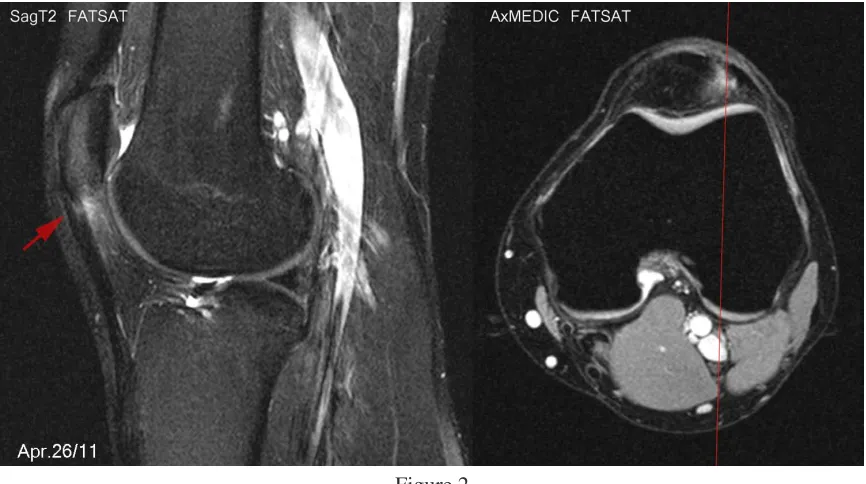
After two months of pain-free jumping in training ses-sions, the patient entered a minor competition and felt a sharp pain in her left anterior knee during warm-up for the high jump. A second MRI was ordered by the sport-specialist physician and revealed an increase in size of the patellar tendon defect to 8mm (Figure 2). The pa-tient began extracorporeal shockwave therapy (2000 hits, 2.2 bars, 10Hz) to the left patellar tendon in addition to the previously mentioned plan of management with the chiropractor which was also advised by the sport-spe-cialized physician. After 1 session per week for 4 weeks, the patient continued to train and her knee pain was self-managed during competitions by using non-steroidal an-ti-inflammatory drugs (NSAIDs), topical analgesics, kin-esiotape (Y band around patella), and using cryotherapy and topical anti-inflammatories post-competition on the advice of the sport-specialized physician. When the pain persisted one month following the shockwave therapy, the patient was prescribed topical nitrogen patches to apply directly to the injury site, followed by oral COX-2 inhibitors and topical diclofenac sodium solution by the sport-specialist physician to be used in conjunction with Figure 2
the previously described chiropractic plan of manage-ment.
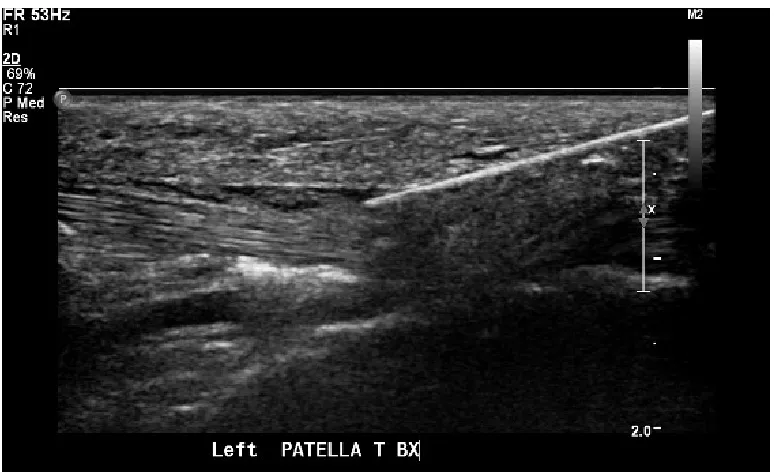
After five months (of which the final two consisted of complete rest and discontinuation of all anti-inflamma-tories) there was no evidence on diagnostic ultrasound of healing at the location of defect in the tendon and no improvement of the patient’s symptoms. At this point, the patient underwent a single injection of PRP with a fat graft (injection of 3 cc of adipose followed by 2 cc of PRP with buffy coat) guided by ultrasound (Figure 3). The injection was completed by a second sport-specialist physician with extensive experience in the procedure. Following the in-jection, the patient was non-weight bearing for two weeks and 50% weight-bearing for an additional week. She was also instructed to refrain from taking or using any anti-inflammatory medication or topical for at least one week. This was followed by four weeks of rehabilitation exer-cises (eccentric decline-board squats, 3x10 daily) and no other activity, followed by three weeks of rehabilitation and aqua jogging. Two months post-injection, a diagnos-tic ultrasound confirmed complete resolution of the de-fect and the patient was symptom-free. She performed a
gradual return to training over the following two months and returned to full competition level six months post-injection.
Discussion
The addition of PRP to the management of this case of patellar tendinopathy highlights the potential for PRP to be used as an adjunctive therapy aimed toward accelerat-ing the rate of healaccelerat-ing and return to sport. Activity modi-fication to reduce the overload on the patellar tendon is often the first step when treating an individual with pa-tellar tendinopathy. Cryotherapy is also commonly used to reduce the inflammation during the acute phase of the condition and may help to reduce pain during the later phases of healing. Instrument-assisted soft-tissue mobil-ization (IASTM) has also been discussed as a beneficial treatment for chronic tendinopathy with proposed bene-fits of creating controlled microtrauma with capillary hemorrhage inducing a localized inflammatory reaction to stimulate the body’s natural healing cascade and rep-arative system.16 Graston technique, a form of IASTM,
was designed to “detect and release scar tissue, adhesions Figure 3
A multidisciplinary approach including the use of platelet-rich plasma to treat an elite athlete with patellar tendinopathy
and fascial restrictions”.17 Currently there is a paucity of
literature, limited to case reports/series, evaluating the ef-fects of IASTM on pain or function for patellar or other tendon pathologies and therefore was not included in the treatment plan for this case. However, it is important to note that a lack of evidence does not imply the treatment is ineffective, it only indicates that more research is needed for this form of therapy. The use of NSAIDs for chronic tendinopathies has been a topic of debate considering that recent discoveries have shown that inflammation is often not part of the pathology of the chronic form of this con-dition.18 A 2002 study found that anti-inflammatories did
not provide long-term benefit when used for chronic ten-dinopathies.19 Furthermore, no strong evidence supports
the use of injection of anesthetic or corticosteroids into or around the patellar tendon during rehabilitation.14,20 A
sys-tematic review by van Ark et al. in 2011 found that steroid treatment is only effective in the short term and that any observed effects deteriorated in the long term.14
Further-more, it has been shown that steroid injection in tendons leads to impaired synthesis of collagen and increased risk of tendon atrophy.13,21
Eccentric exercise (EE) training has become increas-ingly popular as a treatment for tendinopathy since it was first presented in 1984 by Curwin and Stanish and it is now one of the most well studied interventions for this condition.22 Despite this, there is still a paucity of
evi-dence supporting the effectiveness of EE training in the treatment of tendinopathy and controversy over the ap-propriate protocol as well as when this form of therapy should be introduced. A review by Woodley et al. deter-mined that due to a dearth of high-quality studies dem-onstrating clinically significant results, solid conclusions on the effectiveness of EE training could not be drawn.23
This review noted that there were limited levels of evi-dence to propose that EE training demonstrated a positive effect on pain, function, and patient satisfaction compared to various other treatment interventions.23 In contrast, a
study comparing the effects of corticosteroid injection, eccentric decline squat training, and heavy slow resist-ance training found that subjects with chronic tendinop-athy who performed long-term (6 month follow-up) ec-centric and heavy resistance training maintained clinical improvements and patient satisfaction while these param-eters declined with corticosteroid injections.21 In 2007,
Visnes and Bahr found that while most studies suggest EE
training may have a positive effect, the ability to propose a specific protocol in the treatment of chronic patellar ten-dinopathy is limited.24 However, based on the few studies
reviewed, Visnes and Bahr made the recommendations that EE training should be performed with some level of discomfort, on a decline board, and during a period of athlete withdrawal from sport.24 More recently, Saithna
et al. critiqued the conclusion that athletes should be re-moved from their sport during EE training, demonstrating the lack of high-quality evidence to support this action and citing the negative psychological and physiological effects this could have on an athlete, such as low self-esteem and depression.22
Extracorporeal shockwave therapy (ESWT) has been shown to be a safe and favorable treatment for chronic patellar tendinopathy that elicits a positive effect on pain and function.25 Numerous studies have described
prom-ising results of ESWT with success rates ranging from 73.5% to 87.5% in athletes with patellar tendinopathy.26 A
recent randomized clinical trial (RCT) assessed the effects of ESWT for symptomatic chronic patellar tendinopathy in jumping athletes who continued to participate in their respective sport throughout treatment.25 Using the
Victor-ian Institute of Sport Assessment Patellar Tendinopathy Questionnaire (VISA-P) at 1, 12, and 22 weeks follow-ing the final treatment, the authors concluded that there was no improvement in the course of the condition when athletes continued to train and compete during ESWT treatment.27 Peers et al. studied patients with chronic
pa-tellar tendinopathy resistant to conservative treatment and compared the outcome of 13 knees treated surgically and 15 knees treated with ESWT.28 They observed that
ESWT had equivocal functional outcomes to surgery in this cross-sectional analysis.28 In patients with patellar
tendinopathy secondary to patellar tendon harvesting for ACL reconstruction, Wang et al. compared 30 knees treat-ed with ESWT and 24 knees treattreat-ed conservatively over a 2 to 3 year follow-up period.26 The ESWT group showed
significantly greater patient satisfaction, increases in the patellar tendon vascularity, and a trend towards reduction in tendon thickness on ultrasound compared to the con-servative treatment group.26 Although ESWT appears to
currently a paucity of evidence to recommend the use of ESWT during the acute phase of tendinopathy.25
A systematic review in 2011 by van Ark et al. high-lighted three studies that investigated the effects of PRP injections for the treatment of patellar tendinopathy.14
Al-though all of these studies concluded that PRP injection appears to be a promising treatment option, the quality of the studies were low and all had numerous, significant lim-itations. The first study looking at PRP for chronic patellar tendinopathy was by Volpi et al. in 2007.29 This was a
pro-spective cohort study of eight subjects receiving a single injection of PRP coupled with individualized rehabilita-tion protocols. After 120 days post-injecrehabilita-tion, seven of the eight subjects had significant improvements in their pain scores and MRI images demonstrated a noticeable reduc-tion in the irregularity of the patellar tendon compared to pre-injection images for 80% of the subjects.29 Kon et al.
(2009) conducted a prospective study of 20 subjects with chronic patellar tendinopathy treated with PRP and fol-lowed for a minimum of six months.30 Approximately 6.8
million platelets were injected into the tendon every 15 days for a total of three injections. Non-steroidal medica-tions were allowed and stretching exercises and mild ac-tivities were only allowed after the second injection. The results showed statistically significant improvements in all pain and function outcome measures however there was no control group to compare the results and the sample size was small.30 Finally, Filardo et al. (2009) performed
a similar study with 31 subjects who received three injec-tions of PRP spaced 15 days apart.31 This study did have
a control group that only received physical therapy and the results of this study found no statistical differences in terms of pain, time-to-recovery or patient satisfaction but did find statistically significant greater improvements in sport activity level in the PRP group.31 A fourth study,
published after the systematic review, was a prospective cohort study with 36 subjects receiving a single injec-tion of PRP.32 The study found statistically and
clinic-ally meaningful improvements in pain and function com-pared to pre-injection status and also noted that subjects who had not previously been treated with ethoxysclerol, corticosteroid, and/or surgical treatment had the largest improvements and therefore largest healing potential.32
The strongest quality study to date on PRP for patellar tendinopathy was done recently by Vetrano et al. (2013).33
This was a randomized controlled trial with 46
consecu-tive athletes with jumper’s knee treated with either two autologous ultrasound-guided PRP injections over two weeks or three sessions of focused extracorporeal shock wave therapy at 48 to 72 hour intervals.33 Each athlete
was also given a standardized stretching and strength-ening protocol one week after the final treatment to be conducted for two weeks followed by water activities if there was only mild pain. This study reported clinically and statistically significant improvement of symptoms in both groups at 2, 6 and 12 month follow-up and no dif-ference between groups in the VISA-P, VAS and modified Blazina scale scores at 2 month follow-up. However, the PRP group showed statistically significant improvement over the ESWT group in VISA-P and VAS scores at 6 and 12 month follow-up and in the modified Blazina scale at 12 month follow-up.33 Finally, and of particular interest
to sports therapists, a case series by van Ark et al. (2013) outlined an exercise-based physical therapy program for patients treated with PRP injection.34 The study is an
ex-cellent initial resource for practicing clinicians and fur-ther controlled trials would be beneficial to compare this program to other commonly utilized protocols. Although the results of these studies appear promising, the lack of high-quality randomized controlled trials, poor standard-ization, and differing protocols of PRP preparation and administration make it difficult to determine whether its utility in athletes for acute or chronic injuries is benefi-cial.
Despite the specific treatments utilized, the progno-sis for patellar tendinopathy is good with the majority of individuals improving via activity modification and conservative care. However, it also has the potential to be a debilitating condition that may significantly affect an individual’s quality of life and sports performance. In a cross sectional study of 100 athletes with patellar ten-dinopathy, 33% were unable to return to sport for more than six months and 18% were unable to participate in their sport for greater than 12 months.18,35
Conclusions
ther-A multidisciplinary approach including the use of platelet-rich plasma to treat an elite athlete with patellar tendinopathy
apies and at what stage of the injury that these therapies should be implemented. This case study highlights the importance of recognizing the pathological stage of pa-tellar tendinopathy and applying sound knowledge of the histological components involved to determine which intervention may be most beneficial. Furthermore, it em-phasizes the possible benefits of adding PRP injections as a complimentary therapy along with manual therapy, pain-relieving modalities, shockwave therapy, and ec-centric exercises. This case report was of a high level athlete treated more aggressively to allow for earlier return to competition and may not be the ideal course of treatment for the general population. Considering the limited value of a single case report with the absence of a control group, further research is warranted to more con-clusively determine the best course of therapy for patel-lar tendinopathy.
References
1. Tiemessen I, Kuijer P, Hulshof C, Frings-Dresen M. Risk factors for developing jumper’s knee in sport and occupation: a review. BMC Res Notes. 2009;2:127. 2. Kannus P. Etiology and pathophysiology of chronic tendon
disorders in sports. Scandinavian J Med & Science in Sports. 1997;2:78–85.
3. Rees JD, Maffulli N, Cook J. Management of
tendinopathy. American J Sports Med. 2009;37(9):1855– 1867.
4. Khan K, Cook J, Bonar F, Harcourt P, Astrom M. Histopathology of common tendinopathies. Update and implications for clinical management. Sports Med. 1999;27(6):393–408.
5. Lavagnino M, Arnoczky S, Elvin N, Dodds J. Patellar tendon strain is increased at the site of the Jumper’s Knee lesion during knee flexion and tendon loading: results and cadaveric testing of a computational model. Am J Sports Med. 2008;36(11):2110–2118.
6. Cook JL, Purdam CR. Is tendon pathology a continuum? A pathology model to explain the clinical presentation of load-induced tendinopathy. Br J Sports Med. 2009;43(6):409–16.
7. Alsousou J, Ali A, Willett K, Harrison P. The role of platelet-rich plasma in tissue regeneration. Platelets. 2012;44(December 2011):1–10.
8. Cole BJ, Seroyer ST, Filardo G, Bajaj S, Fortier LA. Platelet-rich plasma: where are we now and where are we going? Sports Health: A Multidisciplinary Approach. 2010;2(3):203–210.
9. Andia I, Sánchez M, Maffulli N. Basic science: molecular and biological aspects of platelet-rich plasma therapies. Operative Techniques in Orthopaedics. 2012;22(1):3–9.
10. Sampson S, Gerhardt M, Mandelbaum B. Platelet rich plasma injection grafts for musculoskeletal injuries: a review. Current reviews in musculoskeletal medicine. 2008;1(3-4):165–74.
11. Foster TE, Puskas BL, Mandelbaum BR, Gerhardt MB, Rodeo S a. Platelet-rich plasma: from basic science to clinical applications. Am J Sports Medicine. 2009;37(11):2259–72.
12. De Mos M, Van der Windt AE, Jahr H, et al. Can platelet-rich plasma enhance tendon repair? A cell culture study. Am J Sports Medicine. 2008;36(6):1171–8.
13. Coombes BK, Bisset L, Vicenzino B. Efficacy and safety of corticosteroid injections and other injections for management of tendinopathy: a systematic review of randomised controlled trials. Lancet. 2010;376(9754):1751–67.
14. Van Ark M, Zwerver J, Van den Akker-Scheek I. Injection treatments for patellar tendinopathy. Br J Sports Medicine. 2011;45(13):1068–76.
15. Engebretsen L, Steffen K, Alsousou J, et al. IOC consensus paper on the use of platelet-rich plasma in sports medicine. Br J Sports Medicine. 2010;44(15):1072–81.
16. Gross M. Chronic tendinitis: pathomechanics of injury factors affecting the healing response and treatment. J Orthop Sports Phys Ther. 1992;16(6):248–261. 17. Black DW. Treatment of knee arthrofibrosis and
quadriceps insufficiency after patellar tendon repair: a case report including the use of the Graston technique. International J Therapeutic Massage and Bodywork. 2010;3(2):14–21.
18. Gosens T, Peerbooms JC, Van Laar W, Den Oudsten BL. Ongoing positive effect of platelet-rich plasma versus corticosteroid injection in lateral epicondylitis: a double-blind randomized controlled trial with 2-year follow-up. Am J Sports Medicine. 2011;39(6):1200–8.
19. Khan K, Cook J, Kannus P, Maffulli N, Bonar S. Time to abandon the “tendinitis” myth. Br Med J. 2002;324(7338):626–627.
20. Fredberg U, Bolvig L, Pfeiffer-Jensen M, Clemmensen D, Jakobsen B, Stengaard-Pedersen K. Ultrasonography as a tool for diagnosis, guidance of local steroid injection and, together with pressure algometry, monitoring of the treatment of athletes with chronic jumper’s knee and Achilles tendinitis: a randomized, double-blind, placebo-controlled . Scan J Rheumatol. 2004;33(2):94–101. 21. Kongsgaard M, Kovanen V, Aagaard P. Corticosteroid
injections, eccentric decline squat training and heavy slow resistance training in patellar tendinopathy. Scan J Med Sci Sports. 2009;19:790–802.
tendinopathy: effectiveness of eccentric exercise. Br J Sports Med. 2007;41:188–199.
24. Visnes H, Bahr R. The evolution of eccentric training as treatment for patellar tendinopathy (jumper’s knee): a critical review of exercise programmes. Br J Sports Med. 2007;41:217–223.
25. Van Leeuwen M, Zwerver J, Van den Akker-Scheek I. Extracorporeal shockwave therapy for patellar
tendinopathy: a review of the literature. Br J Sports Med. 2009;43(3):163–168.
26. Wang C, Ko J, Chan Y, LH W, Hsu S. Extracorporeal shockwave for chronic patellar tendinopathy. Am J Sports Med. 2007;35(6):972–978.
27. Zwerver J, Dekker F, Pepping G. Patient guided Piezo-electric Extracorporeal Shockwave Therapy as treatment for chronic severe patellar tendinopathy: a pilot study. J Back Musculoskeletal Rehab. 2010;23(3):111–115. 28. Peers K, Lysens R, Brys P, Bellemans J. Cross-sectional
outcome analysis of athletes with chronic patellar tendinopathy treated surgically and by extracorporeal shock wave therapy. Clin J Sport Med. 2003;13(2):79–83. 29. Volpi P, Marinoni L, Bait C. Treatment of chonic patellar
tendinosis with buffered platelet rich plasma: a preliminary study. Med Sport. 2007;60:595–603.
30. Kon E, Filardo G, Delcogliano M, et al. Platelet-rich
plasma: new clinical application: a pilot study for treatment of jumper’s knee. Injury. 2009;40(6):598–603. 31. Filardo G, Kon E, Della Villa S, Vincentelli F, Fornasari
PM, Marcacci M. Use of platelet-rich plasma for the treatment of refractory jumper’s knee. International Orthopaedics. 2010;34(6):909–15.
32. Gosens T, Den Oudsten B, Fievez E, Van ‘t Spikjker P, Fievex A. Pain and activity levels before and after platelet-rich plasma injection treatment of patellar tendinopathy: a prospective cohort study and the influence of previous treatments. International Orthopaedics. 2012;36:1941– 1946.
33. Vetrano M, Castorina A, Vulpiani MC, Baldini R, Pavan A, Ferretti A. Platelet-rish plasma versus focused schock waves in the treatment of jumper’s knee in athletes. Am J Sports Med. 2013;41(4):795-803.
34. Van Ark M, Van den Akker-Scheek I, Meijer LTB, Zwerver J. An exercise-based physical therapy program for patients with patellar tendinopathy after platelet-rich plasma injection. Physical Therapy in Sport. 2013;14(2):124–30. 35. Cook J, Khan K, Harcourt P, Grant M, Young D, Bonar