The Thirty-Third AAAI Conference on Artificial Intelligence (AAAI-19)
Dynamic Explainable Recommendation Based on Neural Attentive Models
Xu Chen
TNList, School of SoftwareTsinghua University [email protected]
Yongfeng Zhang
Department of Computer ScienceRutgers University [email protected]
Zheng Qin
∗ School of Software Tsinghua University [email protected]Abstract
Providing explanations in a recommender system is getting more and more attention in both industry and research com-munities. Most existing explainable recommender models re-gard user preferences as invariant to generate static explana-tions. However, in real scenarios, a user’s preference is al-ways dynamic, and she may be interested in different product features at different states. The mismatching between the ex-planation and user preference may degrade costumers’ satis-faction, confidence and trust for the recommender system. With the desire to fill up this gap, in this paper, we build a novelDynamicExplainableRecommender (calledDER) for more accurate user modeling and explanations. In specific, we design a time-aware gated recurrent unit (GRU) to model user dynamic preferences, and profile an item by its review information based on sentence-level convolutional neural net-work (CNN). By attentively learning the important review in-formation according to the user current state, we are not only able to improve the recommendation performance, but also can provide explanations tailored for the users’ current pref-erences. We conduct extensive experiments to demonstrate the superiority of our model for improving recommendation performance. And to evaluate the explainability of our model, we first present examples to provide intuitive analysis on the highlighted review information, and then crowd-sourcing based evaluations are conducted to quantitatively verify our model’s superiority.
Introduction
Explainable recommendation has attracted increasing atten-tion in both industry and academic communities, because it can not only enhance customers’ satisfaction, confidence and trust for the recommender system, but also can help them to make better and faster choices (Zhang and Chen 2018). With the desire to make a recommender system more interpretable, user reviews–which contain rich user preference–have been widely leveraged as an important re-source to provide recommendation explanations, for exam-ple, EFM (Zhang et al. 2014) explained a recommendation by filling user cared features learned from the review in-formation into pre-defined templates. LRPPM (Chen et al. 2016b) and MTER (Wang et al. 2018) extended EFM for
∗
Corresponding author
Copyright c⃝2019, Association for the Advancement of Artificial Intelligence (www.aaai.org). All rights reserved.
more accurate user-item-feature explanations based on ten-sor factorization techniques. NARRE (Chen et al. 2018a) leveraged attention mechanism to extract valuable item re-views to explain the rating prediction process.
Despite effectiveness, these explainable recommender models still suffer from some inherent limitations. To begin with, most of them represent a user as a static latent vec-tor, thus, they fail to capture user dynamic preference in the context of explainable recommendation, which may weaken the recommendation performance according to many previ-ous studies (Tang and Wang 2018; Hidasi et al. 2016). More importantly, the explanations provided by these models are usually invariant, which is less effective in satisfying users’ actually dynamic preference in real scenarios. For example, a user may care more about the socks’ breathability in the beginning, and after a period of time, she may become more interested in the warmth because the weather started getting cold. The mismatching between the explanation and user preference may degrade costumers’ satisfaction, confidence and trust for the recommender system.
In a summary, in this paper, we propose to model user dy-namic preference in the context of explainable recommen-dation, and accordingly provide adaptive explanations tai-lored for different user states. To achieve this goal, we de-sign a novel dynamic explainable recommender model by integrating gated recurrent unit (GRU) with attention mech-anism. The carefully designed time-aware gated recurrent unit (GRU) is good at modeling user dynamic preference, while the attention mechanism facilitates explainable rec-ommendation. By combining them, we hope to take advan-tages of the benefits from both components. We conduct ex-tensive experiments to demonstrate the effectiveness of our model for the recommendation task of rating prediction. And also, we evaluate our model’s explainability from both qual-itative and quantqual-itative perspectives.
Preliminaries
In this section, we first conduct primary analysis based on a real-world dataset to verify our assumption that: users’ cared item aspects are always changeable in real scenarios. Then we formally define the task of explainable recommendation with user dynamic preferences.
Data Analysis
We base our analysis on the Amazon dataset1, which is
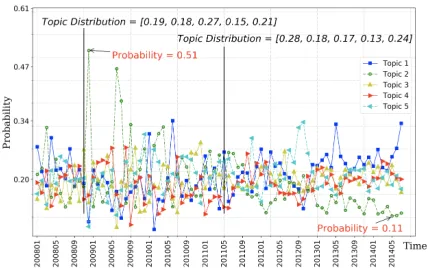
col-lected from www.amazon.com. To alleviate the influence of product diversity, we focus our analysis in the same category (we specified it as Musical Instruments). Intu-itively, people usually talk about their cared product aspects in the review information (McAuley and Leskovec 2013; Zhang et al. 2014). To verify the dynamic properties of user preferences, we merge all the user reviews posted in the same month into a document, and further leverage Latent Dirichlet Allocation (LDA) (Blei, Ng, and Jordan 2003) to project each document into a topical distribution vector that reflects its relevance to different learned topics. The changes of the topic distribution in each month are presented in Fig-ure 1, we can see: (1) On the whole, users’ attention for dif-ferent topics is dynamic. For example, in November 2008, users discussed more on the third topic (with the proba-bility of 0.27), while in May 2011, the first topic became the most cared aspect (with the probability of 0.28). (2) For each topic, its received attention varies as the time changes. For example, the second topic (denoted in green circle) ob-tained the most attention in December 2008 (with the prob-ability of 0.51), following which its attractiveness gradually decreased, and reached the lowest point in May 2014 (with the probability of 0.11).
These results manifest that users’ cared product features are always changeable, which motivates us to provide adap-tive explanations to satisfy user dynamic preferences.
Problem Definition
Suppose we have a user setU = {u1, u2, ..., u|U |}and an
item set I = {i1, i2, ..., i|I|}. For each user, we
chrono-logically organize his/her historical behaviors as a sequence
1
http://jmcauley.ucsd.edu/data/amazon/links.html
Figure 1: The dynamic nature of the user review topic dis-tribution across different months. The number of topics in LDA is set as 5.
of quadruples Ou = {(vu
s, rus,wsu, tus)} lu
s=1, where tu1 6 tu
2 6 . . . 6 tulu,v
u
s is an item in I, and thesth element
(vu
s, rus,wsu, tus)means that useruinteracted with itemvus
at timetu
s by rating rsu and reviewwsu. Given all the user
behaviors in the training set O = {Ou|u ∈ U }, our task
of explainable recommendation with user dynamic prefer-ence is to learn a predictive functionf, such that for a user-item pair(u, vu
lu+1)in the testing set, it can predict the rat-ing rluu+1 that reflects the user’s likeness towards the item attu
lu+1. And further, its internal parameters or intermediate outputs should provide explanations for the final predicted rating according to the user’s preference attu
lu+1.
DER: Dynamic Explainable Recommender
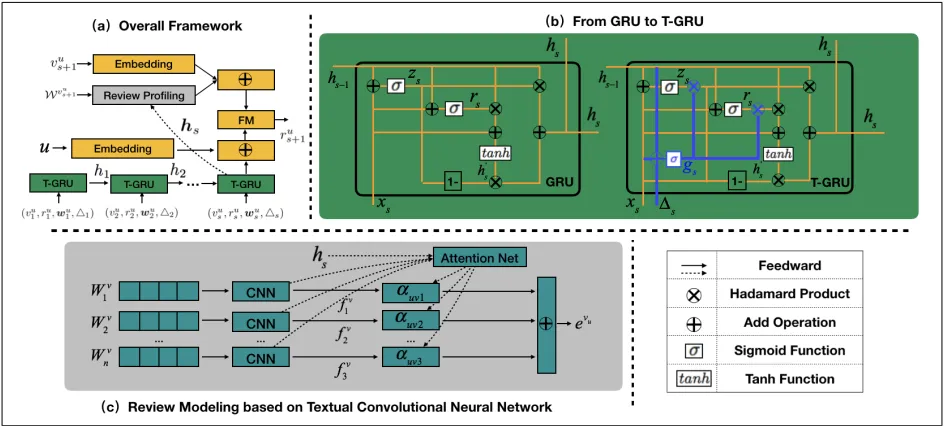
The principle of our framework can be seen in Figure 2. User dynamic preference is modeled by a novel time-aware GRU architecture. By aggregating user historical behaviors, the output from the last GRU step encodes the user’s current preference. The target item is profiled based on all its re-ceived user reviews, where each sentence is projected into a latent vector by a convolutional neural network (CNN). According to the user current preference, different sentence vectors are attentively merged into a unified embedding, which is then leveraged to derive the final rating. Once our model learned, the attention weights encode the importances of different review sentences, which can help us to explain the rating prediction process. In the following, we describe different components in our framework more in depth.User Profiling based on Time-aware Gated
Recurrent Unit
Gated recurrent unit (GRU) (Cho et al. 2014) is a powerful and efficient tool to model sequential features. The compu-tational rule (see Figure 2(b)) of a traditional GRU at each time step can be concluded as:
zs=σ(Wz[xs,hs−1]) (1)
rs=σ(Wr[xs,hs−1]) (2)
h′s=Tanh(Wh[xs,rs⊙hs−1]) (3)
Figure 2: (a) The overall framework. (b) The comparison between traditional GRU and our designed T-GRU. The blue bold lines highlight the augmented operations. (c) The attention mechanism of merging different review sentences for the target item.
wherezsis the update gate andrsis the reset gate, each of
which is obtained by applying a sigmoid functionσ(·)to the concatenated input.h′s is the current memory content and
hsis the output hidden state.⊙is Hadamard (element-wise)
product and[·,·]is concatenate operation. Tanh(·)is hyper-bolic tangent activation function andWz,Wr,Wh are
pa-rameters to be learned. Basically, in the process of sequence modeling, by multiplying withhs−1, the reset gaters
de-termines what to remove from the previous steps,e.g., ifrs
is close to0, GRU will wash out the past information and focus only on the current inputxs. At the same time, the
update gatezs determines what to collect from the current
memory contenth′sand what from the previous stepshs−1.
For example, ifzsis close to1, then1−zswill be near0.
GRU will keep a majority of the previous informationhs−1,
and ignore big portion of the current contenth′s.
GRU has been demonstrated to be effective in many neural language processing (NLP) tasks (Cho et al. 2014; Zhou et al. 2017; Noh, Hongsuck Seo, and Han 2016). In our problem, we can straightforwardly regard a user be-havior as a word, and the whole bebe-havior sequence as a sentence. However, an important difference between user behavior modeling (UBM) and neural language processing (NLP) is that: the time interval information between two successive steps, which is meaningless in NLP, is an impor-tant signal in UBM. Intuitively, a user tend to have similar preferences within a short time, while large time gap may decrease the influence of the former action. To seamlessly embed this insight into our model, we redesign the architec-ture of GRU. To begin with, we introduce a new time gate
gs, which is jointly determined by the current inputxs, the
previous informationhs−1and the time interval△s, that is: gs=σ(Wg[xs,hs−1] +λ△s)2, where,△s=ts+1−tsis
2
For simplicity, the label for discriminating different users’ se-quential behaviors is omitted
the time interval between stepsands+ 1,λ>0(meaning each element in λis larger than 0) is a pre-defined hyper-parameter.Wg is a weighting matrix to be learned.
Obvi-ously, each element ingsis monotonically increasing at△s,
which means larger time interval leads to largergs, and vice
versa.
On one hand, we hope a small time interval will not change user preference much, it means if△sis small, user
preference atts+1should be similar to the one atts, which
is profiled byxs. On the other hand, we hope long time
in-terval will have the user return to previous long-term prefer-ence, it means ifts+1is much larger thants, the influence of
the current behaviorxsshould be little. The user preference
tend to be consistent with the historical behaviors embedded inhs−1. Based on these analysis, the time gategsis infused
into equation (3) as:
h′s=Tanh(Wh[xs,gs⊙rs⊙hs−1]) (5)
where if the time interval△sis small (meaning smallgs),
the influence of the historical informationhs−1will be
low-ered by multiplyinggs, and the current inputxs will take
the leading role, and vice versa. Similarly, we revise equa-tion (4) as:
hs=gs⊙zs⊙hs−1+ (1−gs⊙zs)⊙h′s (6)
where the user preference atts+1(i.e.,hs) will keep a
major-ity of the long-term preference encoded inhs−1, if the next
action happens after a large time interval△s(corresponding
to largegs), and vice versa. The overall architecture of the
modified GRU can be seen in Figure 2(b), we call it T-GRU for short.
For comprehensive user profiling, in our model, xs not
only includes the interacted item ID, but also contains the corresponding rating and review information, that is:
xs= [EVvus,ERr u s,W
u
where,vsuandrus are one-hot representations for the
inter-acted item and its received rating, respectively.EV andER
are weighting matrices that projectvu
s andrsu into
embed-ding vectors.Wu
s is the representation of the review fromu
tovu
s, which simply averages the pre-trained embeddings of
the words inwus 3.
Item Profiling based on Textual Convolutional
Neural Network
People usually talk about different product features in their reviews. Comparing with item ID, such information can pro-vide more explicit and comprehensive signals for collab-orative modeling. Similar to many previous work (Zheng, Noroozi, and Yu 2017; Chen et al. 2018a), the review in-formation in our model is processed based on the convo-lutional neural network (CNN) (Krizhevsky, Sutskever, and Hinton 2012). However, instead of taking each user review as a whole, we process it on the sentence-level to allow more flexible explanations.
Formally, suppose there are n sentences in all the re-views of an item defined by:W ={W1,W2, ...,Wn}4. Let ck = {ck1,c2k, ...,ckT}be the word embedding list of Wk,
whereck
i ∈ Rd is the pre-trained word embedding for the ith word in Wk. Suppose there arem filters in our CNN architecture, each of which is associated with a parameter
Kj ∈Rd×t, wheretis the window size (typically set as 2-5). The filter processes t-length windows of d-dimensional vectors to produce local features, and the output from thelth window of thejth filter is:
olkj=ReLU(ckl:(l+t−1)∗Kj+bj)
l∈ {1,2, ..., T −t+ 1} (8)
whereckl:(l+t−1)={ckl,ckl+1, ...,ckl+t−1}is thelth window to be processed.bjis the bias, ReLU(x) = max{0, x}is the active function (Nair and Hinton 2010), and∗is the Frobe-nius inner product operation. Given the output from thejth filter, max-pooling operation is conducted to select the most salient feature, i.e., the one with the highest value, that is:
fkj = max{o1kj, okj2 , ..., oTkj−t+1}. At last, the final embed-ding for thekth sentenceWkis:fk = [fk1, fk2, ...fkm].
Explainable Rating prediction
Previous methods (Chen et al. 2018a; Seo et al. 2017; Wu et al. 2017) usually interpret a recommendation in user-independent manners. However, in real scenarios, people usually have different personalities and may care about dif-ferent aspects even for the same item. This intuition moti-vates us to explain the recommendations in a personalized manner.
Based on the above sections, suppose a useru’s dynamic preference at tu
s+1 is encoded in hus ∈ Rh, and the
dif-ferent review sentences of an item v are represented as
3
It should be noted that more advanced methods, such as the hierarchical model (Cheng and Lapata 2016), can also be leveraged to deriveWu
s, which are left for future exploration.
4
For simplicity, the label for discriminating different items is omitted
f1v,f2v, ...,fnv. For personalized explanation, we profile the
item properties reflected in review information by merging sentence embeddings under “user-aware” attention weights as:evu =∑n
k=1αuvk·fkv, whereαuvkis derived from an
attention net as:
auvk=W2ReLU(W1((Whhsu)⊙(Wffkv)) +b1) +b2
αuvk= exp(auvk/τ)
∑h
k′=1exp(auvk′/τ)
(9) whereWh, Wf are weighting parameters that projecthus
andfv
k into the same space, [W1,W2,b1,b2] are
param-eters of the attention net, τ is the pre-defined temperature parameter. Once the model learned,αuvk, which has taken user dynamic preference into consideration, can be used to explain the rating prediction process by highlighting differ-ent sdiffer-entence importances.
For more robust user and item profiling, we further intro-duce auxiliary embeddingseu∈
RKandev∈RKto derive the final rating fromutov, that is:
ˆ
ruv=FM([(eu+Hhhus), (e
v+H
eevu)]) (10)
whereHh ∈ RK×h,He ∈ RK×m are weighting param-eters, [·,·] is the concatenate operation, and FM(·) is the factorization machine layer, which is effective in capturing nested variable interactions between the heterogeneous in-formation learned from user reviews (e.g.hu
s andevu) and
the other ones (e.g. eu andev) (Zheng, Noroozi, and Yu 2017). At last, our final objective function to be minimize is:
L= ∑
(u,v)∈R
(ruv−rˆuv)2+γ ∑
θ∈Θ
||θ||22 (11)
whereRis the set of user-item pairs in the training set.ruv
is the real rating from user uto itemv.Θis the set of pa-rameters to be regularized. In this equation, the first term is used to minimize the distance between the predicted and the real ratings, while the second term aims to regularize the parameters to avoid over fitting.
Experiments
In this section, we evaluate our model by comparing it with several state-of-the-art models. We begin by introducing the experimental setup, and then report and analyze the experi-mental results.
Experiment Setup
Datasets We use two publicly available datasets from dif-ferent domains to evaluate our models, that is:
•Amazon5: This dataset contains user rating and review
in-formation for different products on www.amazon.com. Ac-cording to the product category, the raw data is divided into 24 subsets. To cover different data characters, we select three categories in our experiments, that is,Musical Instru-ments,AutomotiveandToy. In specific,Toyis a larger and sparser dataset, whileMusical InstrumentsandAutomotive are smaller, but denser.
5
Table 1: Statistics of the datasets.Musical Instrumentsis ab-breviated as Music.
Datasets #User #Item #Interaction Density Music 1429 900 10245 0.797% Automotive 2928 1835 20441 0.380% Toy 19412 11924 167472 0.072% Yelp 34547 47010 1523939 0.094%
•Yelp6: This is a large-scale dataset including users’ rating
and review behaviors for different restaurants. Because the raw data is very large, we pre-process it by removing the users and items with less than 20 ratings. The statistics of these datasets can be seen in Table 1.
Evaluation method and baselines Root Mean Square Er-ror (RMSE) is leveraged in our experiments to evaluate dif-ferent models. Suppose the predicted and real ratings from
utovareruvˆ andruv, respectively. The RMSE score is cal-culated by:
RMSE=
√
1
|T |
∑
(u,v)∈T
(ruv−ruvˆ )2, (12)
whereT is the set of user-item pairs in the testing set, and lower RMSE score means better performance. In our exper-iments, the following representative models are selected as the baselines:
• PMF: This is a traditional matrix factorization method (Mnih and Salakhutdinov 2008), and the model parameters are learned by stochastic gradient decent (SGD).
• GRU4Rec:This is a well known sequential recommender model (Hidasi et al. 2016), where each previously inter-acted item is accordingly fed into each time step.
• Time-LSTM This is a time-aware sequential recom-mender method, where the time interval information (Zhu et al. 2017) is incorporated in the modeling process.
• Time-LSTM++:This method is an advanced version of Time-LSTM, where the input of each step not only con-tains item ID, but also includes review and rating infor-mation as in equation 7 for more comprehensive user pro-filing.
• NARRE: This is a state-of-the-art explainable recom-mendation method (Chen et al. 2018a), which has been verified to outperform many promising algorithms includ-ing NMF, SVD++, HFT and DeepCoNN on Amazon and Yelp datasets. We implemented it based on the authors’ public code7.
Implementation details For each user behavior sequence, the last and second last interactions are used for testing and validation, while the other interactions are left for train-ing. In our model, the batch size as well as the learn-ing rate are determined in the range of{50,100,150}and
6
https://www.kaggle.com/yelp-dataset/yelp-dataset/data 7
https://github.com/THUIR/NARRE
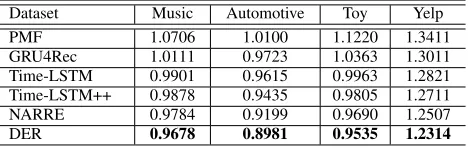
Table 2: The results of comparing our model with the base-lines in terms of RMSE.
Dataset Music Automotive Toy Yelp PMF 1.0706 1.0100 1.1220 1.3411 GRU4Rec 1.0111 0.9723 1.0363 1.3011 Time-LSTM 0.9901 0.9615 0.9963 1.2821 Time-LSTM++ 0.9878 0.9435 0.9805 1.2711 NARRE 0.9784 0.9199 0.9690 1.2507
DER 0.9678 0.8981 0.9535 1.2314
{0.001,0.01,0.1,1}, respectively. The user/item embedding sizeKis tuned in the range of{8,16,32,64,128}, and we will discuss its influence on the model performance in the following sections. For the user review information, we first pre-process it based on the Stanford Core NLP tool8, and then the word embeddings are pre-trained based on the Skip-gram model9. The baselines designed for Top-N recommen-dation are revised to optimize the RMSE score.
Evaluation on Rating Prediction
Overall performance From the results shown in Table 2, we can see: the simple PMF method performed worst be-cause it fails to capture the sequential properties for user behavior modeling, and also cannot borrow the power of review information to enhance the user/item represen-tations. Time-LSTM and Time-LSTM++ performed bet-ter than GRU4Rec, which is consistent with the previous study (Zhu et al. 2017), and verifies the effectiveness of time interval information for user dynamic preference modeling. NARRE outperformed Time-LSTM++, and the reason can be that, for a target item, NARRE utilizes all its review infor-mation to provide informative signals to assist the rating pre-diction process, and the attention mechanism further make it powerful to discriminatively enhance the impact of the valu-able review information, while reducing the noise influence. Encouragingly, DER consistently performed better than the best baseline NARRE on all the datasets. Comparing with NARRE, which represents each user as a static embedding, the carefully designed T-GRU architecture enables us to ac-curately model user dynamic preference, which facilitates more adaptive and reasonable user profiling, and eventually leads to improved rating prediction.
Influence of the embedding size K. In this section, we investigate how the embedding size influences our model’s performance, and due to the space limitation, unless speci-fied, we only report the results on the Automotive dataset. We observe the performance changes by tuning the embed-ding size K in the range of{8,16,32,64,128}. From the result presented in Figure 3, we can see: our model achieved the best performances when the embedding size was relative small (i.e.,K = 8) , while largerK didn’t help to further improve the results. This observation actually agrees with many previous studies (Li et al. 2016; Zhang et al. 2017;
8
https://stanfordnlp.github.io/CoreNLP/ 9
Figure 3: Influence of the embedding sizeKfor our model’s final performance
Chen et al. 2016a), and the reason can be that: in our dataset, a small number of parameters are enough for capturing user different behavior patterns, using redundant dimensions will increase the model complexity and over fit the training set, which may degrade our model’s generalization capability on the testing set.
Evaluation on Recommendation Explainability
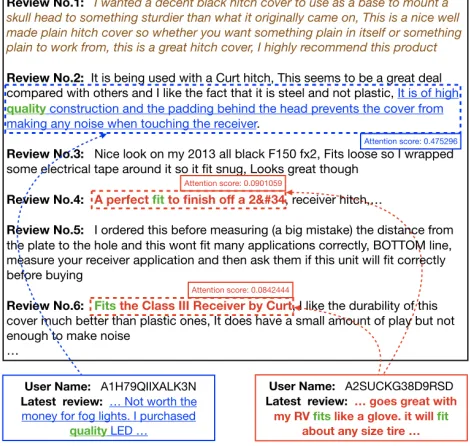
As described by the previous work (Chen et al. 2018a), the review information of a target item can provide users with detailed information and suggestions to make informed de-cisions. By presenting valuable review sentences for the rec-ommended items, the transparency and explainability of the recommender system can be improved. In this section, we evaluate our highlighted review information from both qual-itative and quantqual-itative perspectives based on the Automo-tive dataset.Qualitative evaluation To provide intuitive analysis about our model’s explainability, we present an example in Fig-ure 4. In specific, we compare the highlighted review infor-mation of a target item by NARRE and our model for dif-ferent users. To evaluate our model’s capability on dynamic modeling, we also list the latest reviews from these users for reference.
We can see: NARRE highlighted the same review for different users due to its user-independent attention mech-anism, while our model can highlight personalized review information, which is more practical and reasonable in real scenarios. With the help of sentence-level attention mech-anism, our model can flexibly extract useful information across different reviews to form the final explanations. For example, for the user ’A2SUCKG38D9RSD’, our model highlighted the sentences, which are both about the aspect of “fit”, from the 4th and 6th reviews. At last, the review infor-mation highlighted by our model can effectively track user recent preference, for example, user ’A1H79QIIXALK3N’ recently expressed some opinions about the “quality” aspect, which is also highlighted by our model for the current rec-ommendation. However, NARRE didn’t exhibit such capa-bility. This observation, to some extent, verifies our model’s superiority for learning user dynamic preference in the con-text of explainable recommendation.
Figure 4: The example of an item’s highlighted reviews for two different users. The most important review learned by NARRE is labeled by italic, and the sentences selected by our model are presented in underlined and bold fonts for dif-ferent users, respectively. The latest reviews from these two users are listed below for reference, and the green words in-dicate similar preferences.
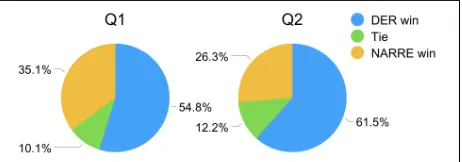
Quantitative evaluation To quantitatively evaluate our model’s explainability, we conduct crowd-sourcing evalua-tion by comparing our model with NARRE. In our model, we highlight two most valuable sentences according to the learned attention weights (i.e.αuvk), while in NARRE, we
predict the most important review for the target item. For each user-item pair, the workers are provided with two in-formation sources: (1) The user’s real review for the current item, and (2) All the reviews recently posted by the user. Based on these information, the workers are asked to select one from three options (i.e., A:DER, B:NARRE, C:Tie) to answer the following questions:
• Q1:Which model can highlight more accurate informa-tion as compared with user real reviews?
• Q2:For each user, which model can highlight textual in-formation that is more consistent with her recent reviews?
Figure 5: Results of the quantitative evaluation on the rec-ommendation explanations.
information highlighted by our model can be much more ef-fective in tracking user recent preference, which verifies the effectiveness of our designed dynamic architecture.
Related Work
Explainable Recommendation
Explainable recommendation is becoming more and more popular in both research and industry communities (Zhang and Chen 2018), and many promising models have been proposed in the recent years. More specifically, early meth-ods (Zhang et al. 2014; Chen et al. 2016b) mainly based themselves on the combination between matrix factorization (MF) and sentiment analysis (SA). In a nutshell, they first extracted featuopinion-sentiment triplets from the user re-view information, are then infused them into MF for col-lective user preference modeling. At last, the explanations were provided by filling the predicted user cared features into pre-defined templates. Despite effectiveness, the final results of these models may be limited by the accuracy of the review preprocessing tools, and it may also be less efficient in practice due to the complex process for extracting feature-opinion-sentiment triplets. Recently, with the ever prosper-ing of deep learnprosper-ing technology, many algorithms (Seo et al. 2017; Chen et al. 2018a; Tay, Tuan, and Hui 2018) were de-signed to explain a recommendation based on the attention mechanism. Basically, in these models, the raw user review information related to a user (or an item) was merged into a document, and by attentively discovering valuable infor-mation in the document, the explanations were provided by highlighting the words with the highest attention weights. In particularly, D-Attn (Seo et al. 2017) and NARRE (Chen et al. 2018a) automatically learned the importances of different review sentences under the supervision of user-item rating information. For providing tailored explanations for differ-ent target items, MPCN (Tay, Tuan, and Hui 2018) lever-aged ”co-attention” mechanism to capture the correlations between the users and the items. In addition to user-review explanations, Ai et al (Ai et al. 2018) conducted explainable recommendation by reasoning over knowledge graph em-beddings, where explanation paths between user and item were constructed to generate knowledge-enhanced explana-tions.
Although these models have achieved promising results, they failed to model user dynamic preference, and the pro-vided explanations were usually static at different times, which may weaken the persuasiveness of the explanations as mentioned before.
Recommendation based on User Dynamic
Preference
Recently, many models have been designed to incorpo-rate temporal information into recommender system to cap-ture user dynamic preference. In specific, early methods care more about transition properties between two suc-cessive behaviors. For instance, the factorized personal-ized Markov chains (FPMC) (Rendle, Freudenthaler, and Schmidt-Thieme 2010) combined matrix factorization with one-order Markov chain to capture the influence of the last behavior towards the next one. The hierarchical representa-tion model (HRM) (Wang et al. 2015) generalized FPMC into a representation learning framework, and significantly improved the recommendation performance. The major lim-itation of these methods lies in the ignoring of long-term preference dependency. To solve this problem, many mod-els were proposed to capture user multi-step behaviors based on the recurrent neural network (RNN) (Yu et al. 2016; Hidasi et al. 2016; Tan, Xu, and Liu 2016; Donkers, Loepp, and Ziegler 2017; Liu et al. 2016; Song, Elkahky, and He 2016), the convolutional neural network (CNN) (Tang and Wang 2018) or the memory network (Chen et al. 2018b). Ba-sically, these methods attempt to transfer the power of deep learning in sequence modeling to the field of recommender system, while an important information–the time interval between two adjacent behaviors–has been totally ignored. Recently, Zhu et al (Zhu et al. 2017) designed a model called Time-LSTM to demonstrated the importance of time interval information for user dynamic preference modeling. Differ-ent from this method, our model is built upon a more sim-ply and lightweight architecture–GRU, which can be more effective for practical recommender systems. More impor-tantly, our model is able to incorporate side information (i.e., user reviews) for explainable recommendations.
Conclusion
In this paper, we propose to model user dynamic prefer-ence in the context of explainable recommendation. Based on our designed model, we can improve the performance of user-item rating prediction as compare with several state-of-the-art methods, and more importantly, we can provide adaptive recommendation explanations according to the user dynamic preference. We conduct extensive experiments to demonstrate the superiority of our model.
References
Ai, Q.; Azizi, V.; Chen, X.; and Zhang, Y. 2018. Learning heterogeneous knowledge base embeddings for explainable recommendation. Algorithms.
Blei, D. M.; Ng, A. Y.; and Jordan, M. I. 2003. Latent dirichlet allocation. Journal of machine Learning research. Chen, C.; Li, D.; Lv, Q.; Yan, J.; Chu, S. M.; and Shang, L. 2016a. Mpma: Mixture probabilistic matrix approximation for collaborative filtering. InIJCAI.
Chen, X.; Qin, Z.; Zhang, Y.; and Xu, T. 2016b. Learning to rank features for recommendation over multiple categories. InSIGIR.
Chen, C.; Zhang, M.; Liu, Y.; and Ma, S. 2018a. Neural attentional rating regression with review-level explanations. InWWW.
Chen, X.; Xu, H.; Zhang, Y.; Tang, J.; Cao, Y.; Qin, Z.; and Zha, H. 2018b. Sequential recommendation with user mem-ory networks. InWSDM.
Cheng, J., and Lapata, M. 2016. Neural summarization by extracting sentences and words. InACL.
Cho, K.; Van Merri¨enboer, B.; Gulcehre, C.; Bahdanau, D.; Bougares, F.; Schwenk, H.; and Bengio, Y. 2014. Learning phrase representations using rnn encoder-decoder for statis-tical machine translation.arXiv preprint arXiv:1406.1078. Donkers, T.; Loepp, B.; and Ziegler, J. 2017. Sequential user-based recurrent neural network recommendations. In Recsys.
Hidasi, B.; Karatzoglou, A.; Baltrunas, L.; and Tikk, D. 2016. Session-based recommendations with recurrent neural networks. ICLR.
Krizhevsky, A.; Sutskever, I.; and Hinton, G. E. 2012. Imagenet classification with deep convolutional neural net-works. InNIPS.
Li, D.; Chen, C.; Lv, Q.; Yan, J.; Shang, L.; and Chu, S. 2016. Low-rank matrix approximation with stability. In ICML.
Liu, Q.; Wu, S.; Wang, D.; Li, Z.; and Wang, L. 2016. Context-aware sequential recommendation. InICDM. McAuley, J., and Leskovec, J. 2013. Hidden factors and hidden topics: understanding rating dimensions with review text. InRecsys.
Mnih, A., and Salakhutdinov, R. R. 2008. Probabilistic ma-trix factorization. InNIPS.
Nair, V., and Hinton, G. E. 2010. Rectified linear units improve restricted boltzmann machines. InICML.
Noh, H.; Hongsuck Seo, P.; and Han, B. 2016. Image ques-tion answering using convoluques-tional neural network with dy-namic parameter prediction. InCVPR.
Rendle, S.; Freudenthaler, C.; and Schmidt-Thieme, L. 2010. Factorizing personalized markov chains for next-basket recommendation. InWWW.
Seo, S.; Huang, J.; Yang, H.; and Liu, Y. 2017. Interpretable convolutional neural networks with dual local and global at-tention for review rating prediction. InRecsys.
Song, Y.; Elkahky, A. M.; and He, X. 2016. Multi-rate deep learning for temporal recommendation. InSIGIR.
Tan, Y. K.; Xu, X.; and Liu, Y. 2016. Improved recur-rent neural networks for session-based recommendations. In Proceedings of the 1st Workshop on DLRS.
Tang, J., and Wang, K. 2018. Personalized top-n sequential recommendation via convolutional sequence embedding. In WSDM.
Tay, Y.; Tuan, L. A.; and Hui, S. C. 2018. Multi-pointer co-attention networks for recommendation. arXiv preprint arXiv:1801.09251.
Wang, P.; Guo, J.; Lan, Y.; Xu, J.; Wan, S.; and Cheng, X. 2015. Learning hierarchical representation model for nextbasket recommendation. InSIGIR.
Wang, N.; Wang, H.; Jia, Y.; and Yin, Y. 2018. Explainable recommendation via multi-task learning in opinionated text data.SIGIR.
Wu, L.; Quan, C.; Li, C.; Wang, Q.; and Zheng, B. 2017. A context-aware user-item representation learning for item recommendation. arXiv preprint arXiv:1712.02342. Yan, J.; Liu, X.; Shi, L.; Li, C.; and Zha, H. 2018. Improving maximum likelihood estimation of temporal point process via discriminative and adversarial learning. InIJCAI. Yu, F.; Liu, Q.; Wu, S.; Wang, L.; and Tan, T. 2016. A dynamic recurrent model for next basket recommendation. InSIGIR.
Zhang, Y., and Chen, X. 2018. Explainable recommen-dation: A survey and new perspectives. arXiv preprint arXiv:1804.11192.
Zhang, Y.; Lai, G.; Zhang, M.; Zhang, Y.; Liu, Y.; and Ma, S. 2014. Explicit factor models for explainable recommen-dation based on phrase-level sentiment analysis. InSIGIR. Zhang, Y.; Ai, Q.; Chen, X.; and Croft, W. 2017. Joint representation learning for top-n recommendation with het-erogeneous information sources.CIKM.
Zheng, L.; Noroozi, V.; and Yu, P. S. 2017. Joint deep mod-eling of users and items using reviews for recommendation. InWSDM.
Zhou, H.; Huang, M.; Zhang, T.; Zhu, X.; and Liu, B. 2017. Emotional chatting machine: emotional conversation gen-eration with internal and external memory. arXiv preprint arXiv:1704.01074.