ISSN: 2334-2986 (Print), 2334-2994 (Online) Copyright © The Author(s). All Rights Reserved. Published by American Research Institute for Policy Development DOI: 10.15640/jea.v3n1a17 URL: http://dx.doi.org/10.15640/jea.v3n1a17
Structural Steel at the Beginning of the Last Century and Today
Dušan Rodziňák
1, Jozef Čerňan
2& Rudolf Zahradníček
3Abstract
The article deals with the assessment of material characteristics of the two types of steels. One was produced some 100 years ago and used in the construction of barracks in the former so-called„ Saffron garden “site in Kosice. In connection with the reconstruction there arose the need to review the eligibility of steel for further use in the new project. Within the framework of reconstruction a new steel produced in the current circumstances was used. Conducted analysis at booth steel specimens reveals extensive difference especially in steel microsture homogeneity, considerably incluencing their mechanical properties. These results will help by reconstructional Works especially for engineers responsible for architecture and for Structural engineers, because public safety is the most important issue.
Keywords: low carbon construction steel, strength and plastic properties of the steel
Introduction
In connection with the conversion of many older buildings in the new architectural plan, there often arises the need to revalue the furtherworthines of the materials from which it has been built. This applies mainly to metallic materials in cases when an increase in load or change its nature is expected. Likewise, the possible long-term effects of the atmosphere (humidity) resulting in corrosion damage are monitored. This was the case of the reconstruction of the former headquarter building of the military warehouses of Cpt. Jaroš barracks, in the object called the „Saffron garden“ in the Skladná street, Košice. This building was built in 1915 - 1920. In the building steel beams I 30, I 40 as well as buckling steel columns were used, which were riveted from isosceles L profiles with dimensions of 80, 120 and 200 mm. The steel was most likely produced and supplied by the VítkoviceSteelworks Ostrava,which in the former Austro - Hungarian Empire were the only ones having such technology for rolling steel rods (Purš, J. a kol.,1989). Steel production in the mentioned steelworks ran in Siemens-Martin furnaces by alkaline way. This fact was deduced from the analysis made on this type of steel used. These facts were supported by the statement of Associate Prof. M.
Pivovarči, PhD., Senior metallurgist and longtime employee ofthe Šverma Steelworks in Podbrezová. As a young
engineer, just after studying in Ostrava,he started to workright in Vitkovice, so he was familiar with the above issue and its history. As it was a building whose age was around a hundred years,it was necessary to determine whether the steel material used in its construction will comply with requirements imposed, particularly in terms of increased load. After reconstruction the building will be raised by 2 floors. To assess the properties of the used steel analyzes were made, which will be described hereinafter. Ultimately, the obtained results will be confronted with the currently existing structural steels used for the same applications. The published results are expected to be a good guide for architects, respectively structural engineers when solving similar problems.
1
Professor Emmeritus, Technical University of Košice, Faculty of Aeronautics, Department of aviation technical studies, Rampová 7, Košice. E-mail: [email protected]
2
PhD Student, Technical University of Košice, Faculty of Aeronautics, Department of aviation technical studies, Rampová 7, Košice. E-mail:[email protected]
3
The Results of the Investigation
For the analysis of the steel used for the construction, samples from the beams and columns were taken. As chemical analysis has shown, the material used in the construction, irrespective of its size, has been made from one type of steel. Result of analysis (carried out in an accredited laboratory of U.S. Steel Košice- Labortest s.r.o) is given in Tab. 1. Initial testing of „Saffron“ steel has shown, that this steel roughly corresponds to construction steel of class 10 namely STN 10 370. Considering the fact that these steels are waived and today steels of class 11 are used, we have chosen as comparison material structural steel type STN 11 375 (S 235). The analysis of this material was also carried out in the same accredited laboratory and is also presented in Table 1.
Table 1: Chemical Composition of Investigated Steels
Elements1 C Mn Si P S Al Cu Ni Cr Ti V
„Saffron“ 0.076/0.15 0.63 0.93 0.039 0.007 0.009 0.10 0.02 0.01 0.007 0.015 11 375 0.107 0.52 0.15 0.009 0.023 0.002 0.20 0.08 0.05 0.001 0.001
1elements are given in %
Chemical analysis shows that it is a low-carbon steel with a carbon content of about 0.15%, which on the
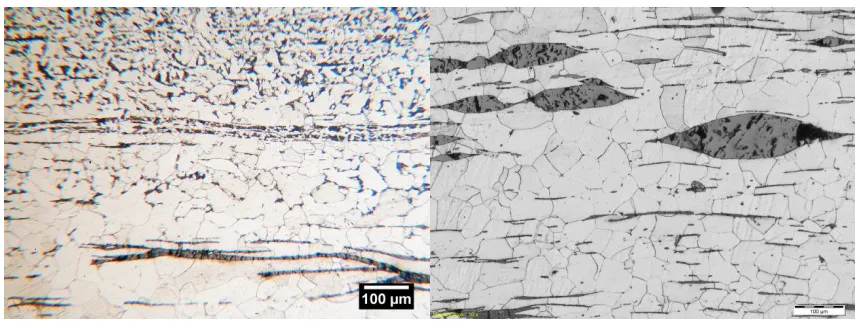
surface is decarburized to the level of 0.076%. As this decarburization is to a depth of orders tenths of mm, it has no significant effect on the strength properties of the steel as a whole. As already indicated in the introduction, it is a steel produced by alkaline technology, as evidenced by low level of phosphorus and sulphur. The manganese content is given by the fact that in this process the deoxidation of steel is carried out not with aluminum (see its very low content), but by manganese alone, i.e. by reaction of Mn + FeO = MnO + Fe. This will be confirmed in the next parts, too. Metallographic structure analysis by optical microscopy showed that the steel is in accordance with carbon content showing an irregular ferrite-pearlite structure heavily contaminated by dirt/inclusions - Figure 1-2. Ferritic grain sizes ranged from 40 to 120 microns, which is the result of slow cooling after rolling.
Figure 1: a - Irregular Row Ferritic - Pearlitic Structure, b - Details of Inclusions
Heavy soiling structure corresponds to the time period and technologies then available. Their chemical analysis ( using scanning electron microscope with EDX analyzer ) showed that the predominant part has a character of oxides - Fig.2,3. Figure 2 shows the surface area where the inclusions were analyzed. The place signed by number 2 points onan area ( the relevant box ) where besides iron no additional element is present. Spectra 3 and 7 show also manganese and oxygen in addition to iron. This suggests the presence of oxides FeO and MnO, respectively the presence of complex oxides (Fe, Mn)O. Static tension tests performed on flat samples of prescribed dimensions showed the following, values prescribed by the standard (average of 4 samples) - Table 2. As the results show, this steel made produced some 100 yearsago, and in terms of its strength and plasticity can be compared with structural steel of class STN 10 370, which has Re, min = 235 MPa and Rm = 360-440 MPa. That steel in class 10 is no longer
Figure 2: Identification of Selected Inclusions Figure 3: EDX Analysis of Selected Inclusions
Table 2: Mechanical Properties of Investigated Steels
In cases where there is no a sufficient amount of material to make samples for the static test strength in pull, it is possible to make use of conversion tables to calculate the strength values of hardness. These can be measured at small samples, which can be cut out from the structures easily and almost without substantially affecting it. The values obtained in this way were then confronted with the results, which were measured on samples used for strength tests. In our case, the measurements of hardness were performed according to the methodology of Vickers and Brinell as well. The average results of these measurements are also shown in Table 2. From conversion tables, one can find out that the hardness of 131 HV10 corresponds to strength of about 385 MPa and the hardness of 105 HB corresponds to strength of about 335 MPa. Apart from that, we have also measured the impact strength at temperatures of – 20 °C, 0 °C and + 20 °C. To the tests we produced samples with a thickness of 5 mm and the depth of the notch at 2 mm both in the direction of hot rolled steel beams and in the transverse direction. As comparison material, hot rolled steel 11 375 (S 235) in strips measuring 60x5 mm was used. The results of measurement by KCV2 Charpy hammer (300 J) are shown in Table 3. The measured values for the work required to puncture notched samples are shown in Table 3. This value was then converted to KCV by dividing it per unit area of 1 cm2 and is listed as the second value. From the result of the „Saffron“ steel, it is evident that values of impact
toughness corresponds both to the strength and the plastic properties of the steel. In the transverse direction, the values are half, what exactly follows from the high content of inclusions/impurities in the steel. Another good thing about steel is the fact that the temperature effect in our conditions (up to – 20 °C) is negligible, since the values of impact strength have not been changed by its effect. This also applies to the values in the transverse direction.
Table 3: Results of Impact Thougness
Material KCV2 - (J)
200C 00C -20 0C
Steel “Saffron”
Longitudinal 24/60 26/65 21/52.5
Transversal 12/30 11/27.5 11/27.5
Steel 11 375
Longitudinal 86/215 87/217.5 85/212.5
Transversal 70/175 61/152.5 55/137.5
Observation of fracture surfaces of samples following both the static strength test and that of impact toughness showed the following. Fractographic manifestation of steel fracture with sufficient plasticity (expressed by the elongation A10 value) is seen as a transcrystalline ductile fracture of a typical pit morphology – Fig. 4a. Due to high
contamination of the steel, the pits are inversely lar and the whole fracture exhibits irregular plasticity. This fracture character essentially remained unchanged, nor even at dynamic tests by 0°C. The values of toughness fit to it.
Material Re (MPA) Rm (MPA) A10 (%) Z (%) HV 10 HB
„Saffron“ 242 345 26 44 120 105
At temperatures of -20 °C, however, in the all two materials found fragments of brittle fracture occure. By the „Saffron“ material, in the direction of rolling, there are only rare fragments, which result from the presence of hard and brittle inclusions. In the transverse direction, their incidence is dominant and the entire appearance of fracture surface is virtually fissile by nature Fig. 5a. By contrast, material 11375 shows a fracture of mixed nature, but the mode of ductile fracture is dominant - 5b.
Figure 4: Transcrystalline Ductile Fracture Morphology – a) 11375, b) Saffron
Figure 5. a) Brittle Cleavage (Saffron“),b)Mixed Brittle and Ductile Fracture (11375) at -20 °C
Another area of the "Saffron" material was concerned with the investigation and finding corrosion damages on I40 beams, which were placed on the ground floor in the floor (above the cellars). Strong corrosion was observed on it, while the corrosion residues easily peeled off. Their appearance and dimensions (especially thickness) are documented in Fig. 6. The corrosion was manifested by the emergence of compact porous residues, reaching a thickness of about 5-6 mm. This kind of electro - chemical corrosion with oxygen depolarization occurs in humid environments even at low temperatures.It can be stated that its impact has resulted in the loss of thickness of the material thereby influencing the beam bearing capacity. Values of wall thickness for the I 40 beam are according to standards 14.4 mm. The measured value was only 13.1 mm. That means, there occured a loss of thickness of about 1.3 mm. From experience in this field (corrosion) is known that 1 mm of material turns into a 3.5 to 7 mm thick layer of corrosion products, which depends on the nature and type of corrosion incurred residues. In our case, corrosive residues were caused by thenature of iron hydroxide - Fe(OH)3, because it is electrochemical corrosion in an aqueous
The beams in the upper floors, no corrosion was observed, since there were no conditions for this type of corrosion. However, by calculation it has been found out that the loss of carrier cross-section due to corrosion increases the tension value from 6,06.10-4 MPa to 6,56.10-4 MPa at a unit load, which results in capacity reduction
from circa 38 to 36 tones ( i.e. about 5.3 % ). The 100-year old steel was confronted with the l STN 11375 steel as its probable replacement to be made currently by comparing their relevant properties. Chemical analysis of the 11375 steel is listed in Table 1. The comparison of the two steels shows that there is no fundamental difference between them. Only the silicon content of the " Saffron " steel is almost triple, with respect to the basic method. Its content that exceeds 0.5 %, allows us to exaggerate when defining it as a silicon alloy steel. As for the mechanical properties - see table 2, the present steel shows higher values both in terms of strength and plastic properties. Strength properties are higher: Rm/Re is about 30/48 % and plastic properties A10/Z of the 38/34 %. The hardness measurement
showed the following values, see Tab. 2. The Vickers hardness HV10 136 represent the tables value of 435 MPa strength and the Brinell hardness of 120 corresponds to 385 MPa.
Figure 6: The appearance of corrosion products Figure 7: Ferite – pearlite structure Steel 11375
Metallographic structure analysisbased on optical microscopy showed that the steel in accordance with
the regular carbon ferrite-pearlite structure is of a small grain structure showing very low pollution - Figure 7. Grain
measurements showed that its value is at about 15 micron, corresponding to the grain size No. 9 (Kříž, R., Vávra,
P.,1993). This basically fine structure is developed as a consequence of faster cooling on open air under the conditions given (only 5 mm wall thickness). High mechanical properties as well as good plasticity in parallel with the purity of steel yield ultimately in high levels of toughness. Even though such construction steel is not used in structures resisting dynamic stresses, it is possible to work with this value as a backup for unexpected events.
Conclusion
The present material shows the technological progress that metallurgy has made over the last 100 years. At the same time in can serve as a guide to architects /civil engineers as a when dealing with similar cases. Yet, it is possible to state that the steel produced in the past fulfills the conditions established for them, especially when structural engineers in their calculations for simple structures adhere only the value of the yield stress. Though in extreme and minimal values, the norms are satisfied even by century-old steels, too.
Acknowledgements
Authors would like to take this opportunity to thank prof. Ing. Jaroslav Briančin, CSc of the Institute of
Geotechnics of the Slovak Academy of Sciences for helping with realization of material analysis.
References
Purš,J. a kol.(1989). Dějiny hutníctví železa v Československu (History of steel metallurgy in Czechoslovakia), Praha. Kříž, R., Vávra, P.(1993): Strojírenská příručka (EngineeringGuide), 3. issue, Praha: SCIENTIA, spol. s r.o.
Comparison ofsteels signingaccording to STN(CSN) andto the current standardsENorENISO, available on the Internet(18. 11. 2014): http://www.tazvolen.sk/download/software_na_stiahnutie/nove-stare-oznacenie-oceli.pdf SelectedarticlesandtablesofSTNEN 1993-1-1, available on the Internet (18. 11. 2014):