*Corresponding author:Sankara Pitchaiah Podila ISSN: 0976-3031
Case Report
ONEIROPHOBIA AND GENDER- A CASE STUDY
Sankara Pitchaiah Podila
Department of Geology, Acharya Nagarjuna University, Andhra Pradesh, India
DOI: http://dx.doi.org/10.24327/ijrsr.2019.1001.3093
ARTICLE INFO ABSTRACT
Oneirophobia is a fear of nightmares. The present study was carried out to know the degree of Oneirophobia among 8th to 10th Government high school students. The response was taken from 2743 students (Male: 1589 Female: 1154). The study found that 25.29% of male students expressed the phobia and it is 23.65% in the case of females. Comparatively, high percentage of male students has Oneirophobia than female. Some of the useful treatment methods are Homeopathy, Exposure based therapy, Cognitive therapy and Relaxation techniques.
INTRODUCTION
Nightmares are currently defined in both the Diagnostic and Statistical Manual of Psychiatric Disorders, Fourth Edition, Text Revision (DSM-IV-TR) and the International Classification of Sleep Disorders, Second Edition (ICSD-2). Differences between the dreams of men and women have been a topic of interest. Dreaming is what occurs when the mature brain is adequately activated, disconnected from external stimuli and without self-reflection. Once instigated, dreaming actively draws on memory schemas, general knowledge and episodic information to produce simulations of the world (Domhoff, 2003) (Foulkes, 1985).
The present study was carried out to know the degree of Oneirophobia among male and female students of 8th to 10th class students.
Symptoms
Anxiety, neuroticism, and global symptom reporting, schizophrenia -spectrum symptoms, heightened risk for suicide; dissociative phenomena; health behavioral problems and sleep disturbances are some of the symptoms associated with the nightmares. Nightmares accompany several chronic health problems, including migraine, bronchitis/asthma, chronic obstructive airways disorder, cardiac disease, and substance abuse (Nielsen and Levin, 2009).
Causes
Freud (1900) considered dreams to be the royal road to the unconscious as it is in dreams that the ego's defenses are lowered so that some of the repressed material comes through to awareness, albeit in distorted form. Dreams perform important functions for the unconscious mind and serve as valuable clues to how the unconscious mind operates. Freud distinguished between the manifest content of a dream (what the dreamer remembers) and the latent content, the symbolic meaning of the dream (i.e., the underlying wish). The manifest content is often based on the events of the day.
The process whereby the underlying wish is translated into the manifest content is called dreamwork. The purpose of dreamwork is to transform the forbidden wish into a non-threatening form, thus reducing anxiety and allowing us to continue sleeping. Dream work involves the process of condensation, displacement, and secondary elaboration (https://www. simplypsychology.org). A broad range of traumatic events may trigger nightmares: combat exposure, motor vehicle accidents, natural disasters, crime victimization, and rape (Nielsen and Levin, 2009).
Nir and Tononi, 2010 showed that the human brain, disconnected from the environment, can generate an entire world of conscious experiences by itself. Content analysis and developmental studies have promoted understanding of dream phenomenology. In parallel, brain lesion studies, functional
International Journal of
Recent Scientific
Research
International Journal of Recent Scientific Research
Vol. 10, Issue, 01(F), pp. 30626-30631, January, 2019
Copyright © Sankara Pitchaiah Podila, 2019, this is an open-access article distributed under the terms of the Creative Commons Attribution License, which permits unrestricted use, distribution and reproduction in any medium, provided the original work is properly cited.
DOI: 10.24327/IJRSR CODEN: IJRSFP (USA)
Article History:
Received 13th October, 2018 Received in revised form 11th November, 2018
Accepted 8th December, 2018 Published online 28th January, 2019
Key Words:
imaging and neurophysiology have advanced current knowledge of the neural basis of dreaming. The neurophysiology of REM sleep, and in particular recent insights into its regional activity patterns, offers a useful starting point for relating dream phenomenology to underlying brain activity. Viewing dreams as a powerful form of imagination can help explain many of their unique
features, such as sudden transitions, uncertainty about people and places, poor subsequent recall and disconnection from the environment, and offers testable predictions for future studies.
Based on recent research in cognitive neuroscience, sleep physiology, fear conditioning. and emotional-memory regulation. Levin and Nielsen, (2009) proposed (L multilevel l1eurocognitive model that unites waking and sleeping as a conceptual framework for understanding a wide spectrum of disturbed dreaming. They propose that normal dreaming serves a fear-extinction function and that nightmares reflect failures in emotion regulation. Further, they had
suggested that the nightmares occur as a result of two processes that we term affect load-a consequence of (laity variations in emotional pressures-and affect distress-a disposition to experience events with high level of negative emotional reactivity.
Cohen and Zadra (2015) investigated laypeople’s causal beliefs about their worst nightmare experience and examined whether these beliefs varied as a function of participants’ gender, age of nightmare occurrence, and recurrence of the nightmare itself. The results showed that: 1) The three most frequently reported explanations for people’s worst nightmare were difficult interpersonal relationships, attributions of unknown or nonexistent causality, and mediums of entertainment; 2) Women were more likely than men to attribute their worst nightmare to factors related to interpersonal relationships 3) Some attributions varied depending on whether the worst nightmare had occurred during childhood, adolescence, or adulthood; and 4) Worst nightmares that were recurrent in nature were more likely to be attributed to phobias and negative emotions than non-recurrent worst nightmares. Interestingly, many of the lay beliefs endorsed in the present study were in line with empirical and theoretical studies on the aetiology of nightmares.
METHODOLOGY
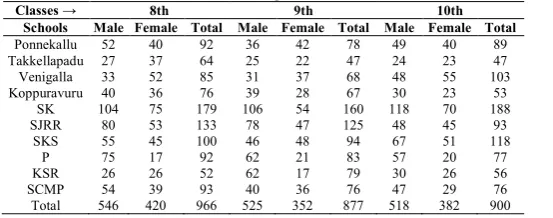
A total of 2743 students, studying 8th to 10th in Government high schools was participated, out of them 1589 are male and 1154 were female. The details are shown in Tables 1 and 2. Students were assembled in a classroom of the respective schools and asked them to give their response to a single question-“Do you have a fear of dreams ?” The purpose of the study and the details regarding the phobia were explained in their mother tongue. The data were analyzed using statistical analysis. Percent variation was observed and presented under results and discussion.
Table 1 School Wise, Class Wise and Gender Wise Student’s Strength
Classes → 8th 9th 10th
Schools Male Female Total Male Female Total Male Female Total
Ponnekallu 52 40 92 36 42 78 49 40 89
Takkellapadu 27 37 64 25 22 47 24 23 47
Venigalla 33 52 85 31 37 68 48 55 103
Koppuravuru 40 36 76 39 28 67 30 23 53
SK 104 75 179 106 54 160 118 70 188
SJRR 80 53 133 78 47 125 48 45 93
SKS 55 45 100 46 48 94 67 51 118
P 75 17 92 62 21 83 57 20 77
KSR 26 26 52 62 17 79 30 26 56
SCMP 54 39 93 40 36 76 47 29 76
Total 546 420 966 525 352 877 518 382 900
Table 2 School Wise and Gender Wise Student, with Oneirophobia
Classes → 8th 9th 10th
Schools Male Female Male Female Male Female
Ponnekallu 8 5 12 12 20 18 Takkellapadu 12 5 3 6 4 5
Venigalla 12 14 9 17 10 10 Koppuravuru 21 10 10 3 4 1
SK 23 21 27 13 31 22 SJRR 14 14 9 10 11 12 SKS 11 10 7 10 21 6
P 30 6 24 6 17 2 KSR 6 7 12 4 3 6 SCMP 14 10 6 0 11 8 Total 151 102 119 81 132 90
RESULTS AND DISCUSSION
A percent variation of the male and female students, those suffering from Oneirophobia was shown in table 3 and figures 1 and 2.
Male
8th class
Highest percent of P school students (32.61) were marked the Oneirophobia (Figure 1A), followed by Koppuravuru (27.63%), Takkellapadu (18.75%). The lowest percent was noticed with Ponnekallu (8.70%).
Figure 1A-8th Male Students with Oneirophobia
9th Class
28.92% of P school students had expressed the Oneirophobia (Figure 1B), followed by SK school students (16.88%) and Ponnekallu (15.38%). Comparatively, the problem is low in Takkellapadu (6.38%).
Table 3 Percentage of Male and Female Students with Oneirophobia
Classes → 8th 9th 10th
Schools Male Female Male Female Male Female
Ponnekallu 8.70 5.43 15.38 15.38 22.47 20.22 Takkellapadu 18.75 7.81 6.38 12.77 8.51 10.64 Venigalla 14.12 16.47 13.24 25.00 9.71 9.71 Koppuravuru 27.63 13.16 14.93 4.48 7.55 1.89 SK 12.85 11.73 16.88 8.13 16.49 11.70 SJRR 10.53 10.53 7.20 8.00 11.83 12.90 SKS 11.00 10.00 7.45 10.64 17.80 5.08 P 32.61 6.52 28.92 7.23 22.08 2.60 KSR 11.54 13.46 15.19 5.06 5.36 10.71 SCMP 15.05 10.75 7.89 0.00 14.47 10.53
0.00 5.00 10.00 15.00 20.00 25.00 30.00 35.00
%
Figure 1B-9th Male Students with Oneirophobia
10th Class
Highest percent of Ponnekallu students (22.47) were marked the Oneirophobia (Figure 1C), followed by P (22.08%) and SKS (17.80%). The problem was low in KSR (5.36%).
Figure 1C 10th Male Students with Oneirophobia
Female
8th Class
16.47% of Venigalla students were pointed Oneirophobia (Figure 2A), followed by KSR (13.46%) and Koppuravuru (13.16%). The lowest percent was observed with Ponnekallu (5.43%).
Figure 2 A-8th Female Students with Oneirophobia
9th Class
Highest percent of Venigalla (25.00) school students had Oneirophobia (Figure 2B), followed by Ponnekallu (15.38%) and Takkellapadu (12.77%). No student was opted the phobia from SCMP.
Figure 2B- 9th Female Students with Oneirophobia
10th Class
20.22% of Ponnekallu students were suffering from Oneirophobia (Figure 2C), followed by SJRR (12.90%) and SK (11.70%). The lowest percent was noticed with Koppuravuru school students (1.89).
Figure 2C 10th Female Students with Oneirophobia
Comparative study
Male (8th to 10th)
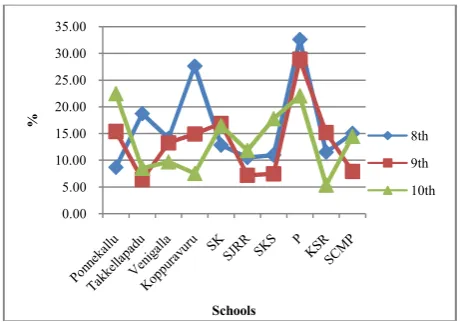
Comparison of Oneirophobia among 8th to 10th class male students was shown in table 3 and figure 3). Among the male students, high percent of P, 8th students (32.61%) had Oneirophobia followed by P (28.92%) of 9th students, and Koppuravuru (27.63%) of 8th students. The lowest percent was observed with KSR, 10th class students (5.36%).
Figure 3 8th to 10th class male students with Oneirophobia
Female (8th to 10th)
0.00 5.00 10.00 15.00 20.00 25.00 30.00 35.00
%
Schools
0.00 5.00 10.00 15.00 20.00 25.00
%
Schools
0.00 2.00 4.00 6.00 8.00 10.00 12.00 14.00 16.00 18.00
%
Schools
0.00 5.00 10.00 15.00 20.00 25.00 30.00
%
Schools
0.00 5.00 10.00 15.00 20.00 25.00
%
Schools
0.00 5.00 10.00 15.00 20.00 25.00 30.00 35.00
%
Schools
8th
9th
In the case of female students, high percent of Venigalla students (25.00) had an Oneirophobia (Table 3 and Figure 4), followed by Ponnekallu (20.22%), Venigalla (16.47%). The lowest percent was observed with Koppuravuru 10th class students (1.89%).
Figure 4 8th to 10th class Female students with Oneirophobia
Comparison of Oneirophobia betweenMale and Female
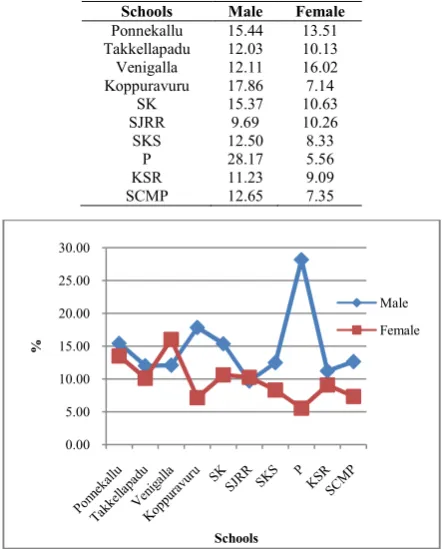
Comparison of Oneirophobia among 8th to 10th class male and female students was shown in table 4 and figure 5). Highest percent of P (28.17) male had expressed Oneirophobia, followed by Koppuravuru (17.86%) and Ponnekallu (15.44%). The lowest percent was observed with SJRR (9.69%). In the case of female students, highest percent of Venigalla (16.02) had chosen, followed by Ponnekallu (13.51%) and SK (10.63%). The lowest percentage was observed with P (5.56%). in the form of increased hostility, aggression and anxiety.
Table 4 Comparison of Oneirophobia between Male and Female Students (%)
Schools Male Female
Ponnekallu 15.44 13.51 Takkellapadu 12.03 10.13 Venigalla 12.11 16.02 Koppuravuru 17.86 7.14
SK 15.37 10.63 SJRR 9.69 10.26 SKS 12.50 8.33
P 28.17 5.56 KSR 11.23 9.09 SCMP 12.65 7.35
Figure 5 Oneirophobia among 8th to 10th class male and female students
Handlin and Levin (1995) studied on Dreams of Traditional and Nontraditional Women. The results found that the
traditional women appear to be less distressed than the other groups of women on most dream measures such as hostility, aggression, negative emotion, and positive dream outcome. Perhaps the nontraditional women in the present study who are making unconventional choices are consolidating a new sense of self. As a result, their dreams may reflect this difficult psychological work
Schredl et al., (2004) investigated with the stability of the rank order of the dream themes and of gender differences in the content of dreams. They opined that the question of the meaning of these themes or the relationship between typical dream contents and waking life experiences, however, has not yet been answered and is open to future research.
Domohoff (2005) reported gender similarities and differences in dream content. He focused mainly on the dreams of American men and women because very little is known about gender patterns in other societies. The results showed that the only meant to provide a normative basis for comparisons with dream journals from individual men and women, or with dream reports from men and women in other cultures. At the most general level, the findings are supportive of the idea that there is a "continuity" between the content of dreams and waking life because they are in many ways what we might expect based on what is known about the autobiographical memories, interests, and living situations of men and women in waking life.
Schredl and Reinhard (2008) had reported gender differences in dream recall. They suggest that the smaller gender difference in childhood might indicate that there is a gender-specific ‘dream socialization’. Patrick (2011) reported men and women dream differently. Women tend to recall their dreams more often than men and women tend to report more frequent and more intense nightmares than men. Men dream more often about other men rather than women, whereas women dream equally often about men and women. Schredl (2014) explained the gender difference in nightmare frequency. This study indicated that women tend to report nightmares more frequently than men. The study hypothesize that gender-specific socialization processes play an important role in explaining the gender differences in nightmare frequency in adolescents and young to middle-aged adults.
The present study found that Oneirophobia is slightly high in male students than female.
Treatment Methods
People who have frequent nightmares may fear falling asleep and being plunged into their worst dreams. Some nightmares are repeated every night. People who are awakened by their nightmares cannot get back to sleep, which creates artificial insomnia". Through visualization techniques, patients learn to change the scenario of one or more of their dreams and repeat the new scenario using a mental imagery technique (https://www.science daily.com)
Marcovici (2010) focused on three gender differences in dreaming, namely, dream recall frequency, sex of dream character and dream aggression. Research also finds differences in dream work therapy with men and women, with women reporting greater gains from dream work than men (Hill et al., 2003; Kolchakian & Hill, 2002; Rochlen, 2004). Lower Dream Recall Frequency (DRF) in males can be
0.00 5.00 10.00 15.00 20.00 25.00 30.00
%
Schools
8th
9th
10th
0.00 5.00 10.00 15.00 20.00 25.00 30.00
%
Schools
Male
addressed in therapy by assessing DRF in clients and teaching recall techniques to clients who have trouble remembering dreams. While an attempt has been made to provide some gender-specific tools for working with male clients given the research on “typical” male dreams, it should be emphasized that, above all, the needs of the individual client—male or female-should be assessed and addressed before assuming gender-specific strategies should be employed.
Nadorff et al., (2014) studied in relation between generalized anxiety disorder (GAD) and frequency of bad dreams in older adults. Patients with GAD had significantly more bad dreams than those without, and bad dream frequency was significantly associated with depression, anxiety, worry, and poor quality of life. Data from this study suggest that practitioners should consider assessing for nightmares and bad dreams in older adults with GAD. Nightmares or bad dreams also may serve as a marker for GAD, suggesting that providers should evaluate worry and anxiety if an older adult reports having either of these symptoms. Further, our findings also suggest that treatment targeting anxiety may be associated with a reduction of disturbing dreams. Thus, anxiety may also represent a potential treatment target for reducing bad dreams and nightmares.
There are certain therapies by which this phobia is treatable. The main treatment of choice for specific phobias is Cognitive-behavioral (CBT). Behavioral techniques by which survivor is exposed to feared situations (gradually or rapidly) are frequently used. In addition, the patient is taught ways of stopping the panic reaction and regaining emotional control (Abbas and Kiran, 2015).
Some of the useful methods
Exposure-based therapy-(Singh and Singh, 2016)
Cognitive therapy (CT) - (Specific phobia. http://www. med.upenn.edu).
Progressive desensitization (Specific phobia. http://www. med.upenn.edu).
Relaxation-(Specific phobia. http://www. med.upenn.edu).
Hypnosis (hypnotherapy)- (Natural treatment for phobia and anxiety. http://www.phobicss-ociety.org)
Homeopathy- (http:// www.phobicssociety .org).
Herbal remedies- (Natural treatment for phobia and anxiety. http:// www.phobicssociety.org).
CONCLUSION
Dreams represent the fulfillment of unconscious wishes related to egoistic (often infantile sexual) impulses (Freud, 1900). The present study made a comparison of Oneirophobia among 8th to 10th male and female students. Out of the total 1589 male students 402 students have Oneirophobia. Similarly, in the case of female students, 273 students out of 1154 expressed the phobia. Highest percent of P school male students (28.17) and Venigalla female students (16.02) had the phobia. Nightmares are not a disease, but can be a problem for the individual. Parents shall take care to rectify the phobia in children using appropriate treatment methods.
Acknowledgement
Authors are thankful to Rotary club – Adharsh, Guntur Commissioner, GMC and the Authorities of Acharya Nagarjuna University for the financial assistance.
References
1. Abbas Syeda Sarah and Kiran Sehrish (2015), People with Fear of Height; Oneirophobia, World Journal of Pharmaceutical And Medical Research, 1(1), 52-5. 2. Cohen Ariela & Zadra Antonio (2015) An analysis of
laypeople’s beliefs regarding the origins of their worst nightmare, International Journal of Dream Research Volume 8, No. 2. Pp. 120-128.
3. Domhoff, G. W. (2005). The Dreams of Men and Women: Patterns of Gender Similarity and Difference. Retrieved February 6, 2019 from the World Wide
Web: http://dreamresearch.net/Library/domhoff_2005c.h tml
4. Domhoff, G.W. (2003) The Scientific Study of Dreams: Neural Networks, Cognitive Development, and Content Analysis, American, Psychological Association
5. Foulkes, D. (1985) Dreaming: A Cognitive-Psychological Analysis, Lawrence Erlbaum Associates 6. Freud, S. (1900) The Interpretation of Dreams, The
Modern Library
7. Handlin D and Levin Ross (1995) Dreams of Traditional and Nontraditional Women: Are Dream Aggression and Hostility Related to Higher Levels of Waking Well-Being?, Sex Roles, Vol. 33, Nos. 7/8.
8. Hill, C. E., Rochlen, A. B., Zack, J. S., McCready, T., & Dematatis, A. (2003). Working with dreams using the Hill Cognitive-Experiential Model: A comparison of computer-assisted, therapist empathy, and therapist empathy _ input conditions. Journal of Counseling Psychology, 50, 211–220.
9. Kolchakian, M. R., & Hill, C. E. (2002). Dreaming interpretation with heterosexual dating couples. Dreaming, 12, 1–16.
10. Marcovici A. M (2010) Gender Differences in Dreams: Applications to Dream Work With Male Clients, Dreaming, American Psychological Association, Vol. 20, No. 3, 199–210.
11. Nadorff Michael R., Ben Porter , Howard M. Rhoades , Anthony J. Greisinger , Mark E. Kunik & Melinda A. Stanley (2014) Bad Dream Frequency in Older Adults With Generalized Anxiety Disorder: Prevalence, Correlates, and Effect of Cognitive Behavioral Treatment for Anxiety, Behavioral Sleep Medicine, 12:1, 28-40, DOI: 10.1080/15402002.2012.755125. 12. Natural treatment for phobia and anxiety. Available at
http:// www.phobicssociety .org.uk/natural treatment for phobia and anxiety/ Accessed on 24 December 2015.onal Journal of Basic & C.
13. Nielsen T and Levin R (2009) Dreams, Dreaming Theories and Correlates of Nightmares, Encyclopedia of Neuroscience, vol. 3, pp. 663-669.
15. Patrick McNamara (2011) The Dreams of Men and Women, https://www. psychologytoday.com/us/ blog/dream-catcher/201109/the-dreams-men-and-women
16. Rochlen, A. B. (2004). Using dreams to work with male clients. In C. E. Hill (Ed.), Dream work in therapy: Facilitating exploration, insight, and action (pp. 187– 201). Washington, DC: American Psychological Association.
17. Schredl M (2014) Explaining the Gender Difference in Nightmare Frequency, The American Journal of Psychology, Vol. 127, No. 2, pp. 205-213.
18. Schredl M, Ciric P, Gotz S, Wittmann L., (2004) Typical Dreams: Stability and Gender Differences, The Journal of Psychology, 138(6), 485–494.
19. Schredl Michael and Reinhard I R I S (2008) Gender differences in dream recall: a meta-analysis, J.Sleep.Res., 17,125-131.
20. Singh Jarnail, Singh Janardhan (2016) Treatment options for the specific phobias Int J Basic Clin Pharmacol, ;5(3):593-598.
21. Specific phobia. Available at http://www. med.upenn.edu/csta /phoias_treatment. html. Accessed on 26 December 2015.
22. https://www.simplypsychology.org/Sigmund-Freud.html 23. https://www.sciencedaily.com/releases/2014/01/140128
094143.htm
How to cite this article:
Sankara Pitchaiah Podila. 2019, Oneirophobia and Gender- A Case Study. Int J Recent Sci Res. 10(01), pp.30626-30631. DOI: http://dx.doi.org/10.24327/ijrsr.2019.1001.3093