Please cite this article as: A. Ahmadi Yazdi , M. Honarvar,A Two Stage Stochastic Programming Model of the Price Decision Problem in the Dual-channel Closed-loop Supply Chain, International Journal of Engineering (IJE), TRANSACTIONS B: Applications Vol. 28, No. 5, (May 2015) 738-745
International Journal of Engineering
J o u r n a l H o m e p a g e : w w w . i j e . i rA Two Stage Stochastic Programming Model of the Price Decision Problem in the
Dual-channel Closed-loop Supply Chain
A. Ahmadi Yazdi , M. Honarvar*
Department of Industrial Engineering, Yazd University, Yazd, Iran
P A P E R I N F O
Paper history:
Received 27 November 2014
Received in revised form 19 January 2015 Accepted 13 March 2015
Keywords:
Logistic Network Reverse Logistics Ntegrated Logistics Pricing Policy Multi-channel Sale
A B S T R A C T
In this paper, we propose a new model for designing integrated forward/reverse logistics based on pricing policy in direct and indirect sales channel. The proposed model includes producers, disposal center, distributers and final customers. We assumed that the location of final customers is fixed. First, a deterministic mixed integer linear programming model is developed for integrated logistics network design. Then, the stochastic counterpart of the proposed mixed integer linear programming model is developed by using scenario-based stochastic approach. We use the value of the stochastic solution (VSS) as a measure to evaluate the accuracy of stochastic programming approach. VSS value showed that using stochastic approach for solving the proposed model is sufficient. Moreover, we could obtain optimal values of sale prices in direct and indirect sale channel and service level by considering forward and reverse flow together.
doi: 10.5829/idosi.ije.2015.28.05b.12
1. INTRODUCTION1
Logistic network design problem that takes into account the facility locations and the shipment of product flows have been an area of increasing attention during the last decade in both practice and academia [1]. While the traditional supply chain network design, namely forward logistic, considers the direct flow from producer to the customer in logistic networks, Nowadays, the emphasis on environmental, economic, legislative reasons and potentials of value recovery from the used products have caused many industries to focus on reverse logistic and recovery activities [2-8]. Reverse logistics (RL) is the process of planning, implementing, and controlling the cost effective flow of raw materials, in-process inventory, finished goods, and related information from the point of consumption to the point of origin in order to reuse of products and raw materials or dispose them [9]. The literature of represented models concerning the logistics network design problem dividing into forward logistics network, reverse logistics
1*Corresponding Author’s Email: [email protected] (M. Honarvar)
network, and finally integrated forward/reverse logistics network [1]. A comprehensive review of reverse and integrated logistics can be found in (Fleischmann [2]; Pokharel and Mutha [6]; Govindan [8]). In this paper, we survey specific network design problems for reverse and integrated logistics network design problems. Some authors like Üster et al. [10], Amiri [11], Patia et al. [12], and Aras et al. [13] are those ones, who carried out investigations about the integrated logistics. Keyvanshokooh [1] presented a mixed-integer linear programming to consider dynamic pricing approach for used products, forward/reverse logistics network configuration and inventory. Kamali et al. [14] proposed a single product, multi-echelon, multi-period closed loop supply chain for high-tech products (which have continuous price decrease). Four heuristics-based methods including genetic algorithm (GA), particle swarm optimization (PSO), differential evolution (DE), and artificial bee colony (ABC) are proposed for solving their model. Sahraeian et al. [15] introduced a supply chain network design problem which contains environmental concerns in arcs and nodes of network and there are some routes such as road, rail and etc. in each pair of nodes. Demand uncertainty and uncertainty
in the quality of returned products is an important factor to be considered in designing supply chain networks. Some researchers consider the uncertainty in reverse logistics. Pishvaee et al. [5] proposed an integrated logistic model. They presented a single-period and single-product Mixed Integer Linear Programming (MILP) for integration of their logistic model. Then, they developed the model using scenario-based stochastic approach. Their model was aimed at minimization of total costs. Pishvaee et al. [16] proposed a robust optimization model to design a closed-loop supply chain network. With presentation of single-product and single-period model, Pishvaee and Torabi [17] proposed a bi-objective possibilistic mixed integer-programming model. They considered two groups of customers: the recycled material customer and the product customers. To solve the presented possibilistic optimization model, an interactive fuzzy solution approach is used. Pishvaee et al. [18] suggests a dual-objective credibility-based fuzzy mathematical programming model to design a green logistic network under uncertainty conditions. Their model is aimed at minimization of environmental effects and total cost for creating network synchronously. Vahdani et al. [19] proposed a bi-objective model to design a reliable network of hybrid reliable facilities in logistic network under uncertainty conditions. They solved the model by combining queuing theory, fuzzy possibilistic programming and fuzzy multi-objective programming. Optimal decisions on price play a critical role in revenue management of supply chain.
Cattani et al. [20] and Tsay and Agrawal [21] presented comprehensive reviews on multi-channel models. Balasubramanian [22] considered competition in the multiple-channel environment from a strategic viewpoint. Tsay and Agrawal [23] considered the channel conflicts in dual channel supply chain. Chiang et al. [24] studied a price-setting game between a manufacturer and its independent retailer in a dual channel based on the consumer choice model. Mirzahosseinian et al. [25] presented a dual channel inventory model based on queuing theory in a manufacturer-retailer supply chain, consisting of a traditional retail. They used simulated annealing to find a solution for inventory level in each echelon. The service level is rate of increase needed for the distributor to exert in order to raise the profit, demand, and customer’s satisfaction. Defining the service level depends on type of production process and method of sale. Service level has significant effects on demand, profit, and pricing strategy. Ahmadvanda et al. [26] investigates the impact of provided service by the retailers and manufacturers on customers’ demand and members’ profit in a supply chain. In addition, in the most studied related to multi sales channel, the prices in each channel are determined without considering the
production and transportation constraints. The main advantage of our model could be summarized as follows: 1) Designing a dual sales channel supply chain considering important constraints like production and transportation constraints, 2) the concept of dual sales channel is considered in integrated supply chain, beside the prices defined in each channel, 3) the service level of retailers is determined by optimization of model.
The proposed model may be widely employed in some industries such as manufacturing of electronic devices and personal computers (PCs), etc., in which there are both indirect and direct selling channels. Several famous companies like Dell, Sony and Apple have use multi sale channels. Therefore, this model may be a useful tool for such companies. An alternative way to incorporate more information about the demand uncertainty into the model is by formulating a stochastic linear program. To the best of our knowledge from a review of the literature, there is no existing joint pricing network design decision model in dual channel integrated supply chain based uponstochastic programming and scenario generation method. In the rest of this paper, in section 2 we develop our stochastic model. The index VSS is calculated for proposed stochastic model in section 3. Finally, concluding remarks are presented in section 4.
2. MODEL DEVELOPMENT
Forward flow
Revers flow arising from customer Revers flow arising from distributer
Direct flow
Production/recovery cenetr Hybrid collection-distribution cenetr
Customer Reverse flow arising from
direct flow
Disposal Center
Figure 1. Proposed integrated logistic network
The defective or breakdown products received by customers in direct channel are also returned to collection-distributer centers as returned products in retail channel.
In the presented model, the subject of pricing is addressed within the close-loop integrated logistic network. The concept of pricing has been independently studied by various authors but it has been so far less proposed in the integrated logistic network and its relevant mathematical optimal model. The proposed model will be able to determine producer’s pricing policy in both retail and direct channels. The producers must set a direct channel price
p
mand sell the product directly through the direct channel and the retailer competes against the direct channel by offering a mix of added servicess
and retail pricep
r to customers. We consider a centralized dual-channel supply chain in which an integrated manufacturer controls all three decisions: the traditional retail price, the direct sale price, and the service level in retail channel. Some parameters in logistics network design such as demand of customers, transportation costs and resource capacities are quite uncertain [27]. To handle this uncertainty and have a robust logistics network, we develop a stochastic integrated supply chain by incorporating demand uncertainty.In the conducted studies regarding the pricing such as Chiang et al. [24] and Bin et al. [28], demand function is indicated by a linear function of base demand (dmk,drK), direct and indirect sale prices (pr,pm) and service level (
ss
), as follows:1 2 *
k K r m k
Dr
=dr
-br p bm p
+ +y
m ss
+x
(1)1 2 *
k k m r k
Dm =dm -bm p +br p -yr ss+x¢ (2)
where, the coefficients
br
1 andbm
1 are the coefficients of the price elasticity in the retail channel and direct channel demand functions, respectively. The cross-price sensitivitiesbr
2 andbm
2 reflect the degree to which the goods are sold via two channels are substitutes, andm
y
andy
r
are the service sensitivity of the demand in the direct channel. If the service levelss
increases by one unit,y
m
units of demand (customers) will be lost from the direct channel, of whichy
r
units of demand will transfer to the retail channel. The total demand of the two channels should be downward sloping in the retailer’s price, direct sale price and upward sloping in the service level. Thus, we have<
2 1
bm br , br bm2< 1 and ym<yr.
x
k andx
k¢
are random variable with PDF (probability density function) f(.) and CDF (cumulative distribution function) F(.), that does not depend on the price and service level and shift the demand randomly about the mean. The related works that considered linear-additive functional demand form include (Chen &Simchi-Levi [29]; Dana & Petruzzi [30]; Federgruen & Heching [31]).are made at the second stage. The decisions at second stage include rate of supply by retailers, supply through direct channel and rates of the returned products. We employ the scenario-tree method to solve the stochastic model. For this purpose, suppose the given stochastic vector ξ=( ,..., , ,..., )x1 x xK 1¢ xK¢ with certain number
scenarios ξs =( ,..., ,x1s x xs 1¢s K ,..., )x¢
s
K and probability
s
J
whiles 1 S= ¼ . With respect to the above-said definitions, the given indices, parameters, and the variables at first and second stage are defined according to the scenario as follows:
Sets
I Set of potential production/recovery center locations
i IÎ
J Set of hybrid distribution-collection center locations j JÎ
K Set of fixed locations of customer zones k KÎ
M Set of potential disposal center locations m MÎ
Parameters
f
The Cost of providing a unit of service level1
br
The coefficient of price elasticity in retail channel2
br
The coefficient of cross-price sensitivities in retail channel1
bm
The coefficient of price elasticity in direct channel2
bm
The coefficient of cross-price sensitivities in direct channelr
y
The coefficient of service elasticity in retail channelm
y The coefficient of service elasticity in e-tail channel
k
dm Base level of direct channel demand for customer k
K
dr
Base level of retail channel demand for customer kk
r
Rate of return of used products from retail channel customer k'
k
r
Rate of return of used products from direct channel customer kj
g
Rate of return of products by distributer j to producersl
Average disposal fraction in direct and indirect channelsl¢ Average disposal fraction for returned products by distributors
i
f
Fixed cost of opening production/recovery center ij
g
Fixed cost of opening hybrid distribution-collection center jm
h
Fixed cost of opening disposal center mij
c
Shipping cost per unit of products from production/recovery center i to hybrid distribution-collection center jik
ff Shipping cost per unit of products from production/recovery center i to direct channel customer
k
jk
a
Shipping cost per unit of products from hybrid distribution-collection center j to retail channel customer kkj
b
Shipping cost per unit of products from customer kto hybrid distribution-collection center j
ji
e
Shipping cost per unit of products from hybrid distribution-collection center j to production/recovery center ijm
p
Shipping cost per unit of products from hybrid distribution-collection center j to disposal center mi
r
Manufacturing cost per unit of product at production/recovery center ii
q
Recovery cost per unit of product at production/recovery center ij
n
Processing cost per unit of product at hybrid distribution-collection center jm
h
Disposal cost per unit of product at disposal centerm
i
t
Penalty cost per unit of non-utilized capacity at production/recovery center ij
b Penalty cost per unit of non-utilized capacity at hybrid distribution-collection center j
m
a
Penalty cost per unit of non-utilized capacity at disposal center mi
cw
Capacity of production/recovery center ij
cy
Capacity of handling products in forward flow at hybrid distribution-collection center jm
cz
Capacity of handling products at disposal center mj
cyr
Capacity of handling products in reverse flow at hybrid distribution-collection center ji
cwr
Capacity of recovery for production/recovery center imservice
Upper limit of service level in retail channel.The first stage variables are Xij,Nji,pm,
, , , r i j m
p W Y Z and the second stage variables are as
s ik
O Quantity of products in direct channel shipped from
production/recovery center i to customer zone k under scenario s
s jk
U Quantity of products shipped from hybrid
distribution-collection center j to customer zone k under scenario s
s kj
Q
Quantity of returned products shipped from customer zone k to hybrid distribution-collection centerj under scenario s
s ji
V Quantity of returned products shipped from hybrid distribution-collection center j to production/recovery center i under scenario s
s jm
T Quantity of irreparable products shipped from hybrid distribution-collection center j to disposal center
m under scenario s
s kj
M
Quantity of returned products from direct channel customer zone k to hybrid distribution-collection centerj under scenario s
The formulation of proposed stochastic model is as follows;
( ( )
s s s s
m ik d jk i i j j
k i s j k s i j
s s
m m ik ik i ij ij
m i k s i j
MaxZ p O p U f W g Y
h Z ff O c X
v
J J
J r
= + - -
-- - +
-ååå ååå å å
å ååå å åå
( ) ( )( )
s s s s s
j jk jk j kj kj kj
j k s k j s
a U b Q M
J n + - J n + +
-å -å -å å å å
( )( )
( ) ( )
s s
i ji ji ji j i s
s s s s
m jm jm m m m jm
j m s m s j
e V N
T Z cz T
J q
J h p a J
+ +
-+ -
-åå å
åå å
å å
å
( ( ) ( ( ))
( ) ( ( )) ) *
s s s s
i i i ij ik i i ji ji
i j k s j s j
s s s s
j j j jk j i kj kj
j k k s k s
Wcw X O Wcwr V N
Ycy X Ycyr Q M ss
t J J
b J J f
é ù
- ê - + + - + ú
-ë û
é - + - + ù
-ê ú
ë û
å å åå åå å
å å åå åå
(3)
s.t.
1 2
( k) ,
s s
jk k r m
j
U £ dr -br p+bm p +yr ss´ +x " Îk K s SÎ
å
(4) ' 1 2 ( * ) ,£ - + - + " Î Î
å
s sik k m r k
i
O dm bm p br p yr ss x k K s S
(5)
,
s s
kj k jk
j j
Q =r U " Îk K s SÎ
å
å
(6) ' , s skj k ik
j i
M =r O " Îk K s SÎ
å
å
(7)(1 ) s ,
j ij jk
i k
X U j J s S g
-
å
³å
" Î Î (8)(1 )( ) 0 ,
s s s
ji kj kj
i k k
V - -l Q + M = " Îj J s SÎ
å å å (9)
( ) ( ) 0 ,
s s s
jm kj kj j ij
m k k i
T -l Q + M -g l¢ X = " Îj J s SÎ
å å å å (10)
(1 )
ji j ij
i i
N =g -l¢ X " Îj J
å
å
(11)m i
p ³r " Îi I (12)
d j
p ³v " Îj J (13)
,
s ij ik i i
j k
X + O £cw W " Îi I sÎS
å
å
(14)ij j j i
X £cy Y " Îj J
å
(15),
s s
kj kj j j
k k
Q + M £cyr Y " Îj J sÎS
å
å
(16),
s
ji ji i i
j j
V + N £cwr W " Îi I sÎS
å
å
(17),
s
jm m m
j
T £cz Z " Îm M sÎS
å
(18)ss Mservice£ (19)
}
{
, , 0,1 , ,
i j m
W Y Z Î " Î " Î " Îi I j J m M
, s, s, s, s, , s, s, , , 0
ij jk kj ji jm ji kj ik d m
X U Q V T N M O p p ss³
, , , ,
i I j J k K m M s S
" Î Î Î Î Î
) 20 (
Objective function is profit maximization including total revenue and costs from two channels. Constraints (4) and (5) guarantee that the sent products to the customer may meet the demand wholly or partially. The constraints (6) and (7) define respectively the collection of returned products in direct and indirect channel. The constraint (8) is the balancing constraint at production/recovery and hybrid distribution collection centers in forward flow.
The constraint (9) insures that, the flow of repairable products existing from hybrid distribution/collection centers is equal to the flow entering to production/recovery centers. The constraint (10) indicates quantity of the transferred products to disposal centers. The constraint (11) shows the amount of products, which are returned by distributor to the producer. The constraints (12) and (13) denote the sale prices should be greater than process costs at production and distribution/collection centers.
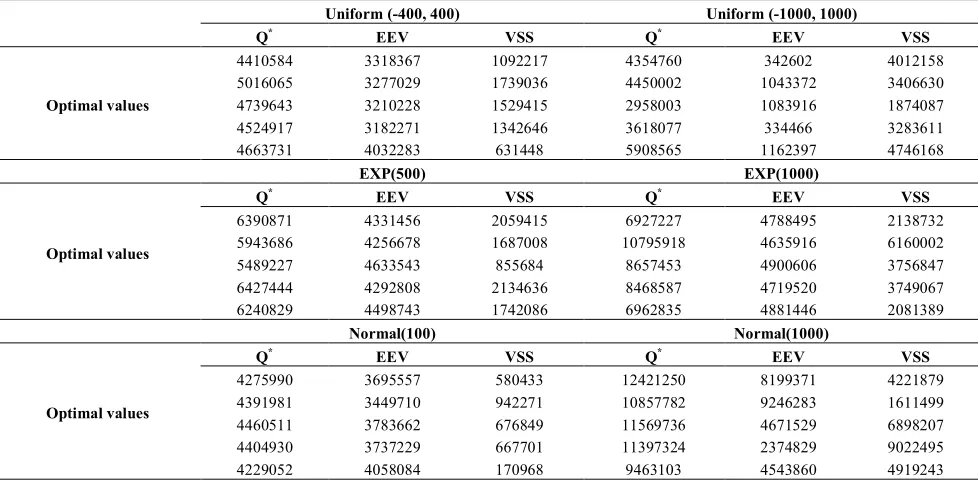
TABLE 1. Computational results for VSS and the stochastic programming solutions with respect to different probability distributions
Uniform (-400, 400) Uniform (-1000, 1000)
Q* EEV VSS Q* EEV VSS
Optimal values
4410584 3318367 1092217 4354760 342602 4012158
5016065 3277029 1739036 4450002 1043372 3406630
4739643 3210228 1529415 2958003 1083916 1874087
4524917 3182271 1342646 3618077 334466 3283611
4663731 4032283 631448 5908565 1162397 4746168
EXP(500) EXP(1000)
Optimal values
Q* EEV VSS Q* EEV VSS
6390871 4331456 2059415 6927227 4788495 2138732
5943686 4256678 1687008 10795918 4635916 6160002
5489227 4633543 855684 8657453 4900606 3756847
6427444 4292808 2134636 8468587 4719520 3749067
6240829 4498743 1742086 6962835 4881446 2081389
Normal(100) Normal(1000)
Optimal values
Q* EEV VSS Q* EEV VSS
4275990 3695557 580433 12421250 8199371 4221879
4391981 3449710 942271 10857782 9246283 1611499
4460511 3783662 676849 11569736 4671529 6898207
4404930 3737229 667701 11397324 2374829 9022495
4229052 4058084 170968 9463103 4543860 4919243
3. VALUE OF STOCHASTIC PROGRAMMING
Stochastic programs are computationally expensive and difficult to solve. Therefore, for real-world problems, simpler models have been considered. For example, some researchers have solved the deterministic program by replacing all random variables with their expected values. The Value of the Stochastic Solution (VSS) has been used as measure of the accuracy in these studies. The concept of VSS can be used to determine whether putting extra effort into modeling and solving stochastic programming can be beneficial. Let Z( )x be the optimal decision of the first stage in deterministic problem where all random variables are replaced by their expected values. The VSS is then defined as
*
VSS Q= -EEV, withEEV E Q Z= x( ( ( ), ))x x . EEV is expected result of using EV (expected value program) solution. If this difference is large enough, it indicates that using the stochastic programming approach is beneficial. In this section, we compute this measure and study the effect of the distribution function type and variance of stochastic factor ξ in demand function, on VSS. For this purpose, sensitivity analysis has been carried out for different probabilistic functions as follows: In Table 1, it can be seen that as the mean value and variance of distributions increase, the VSS also increases. In Table 1, VSS value in mode (Uniform [-1000, 1000]) is greater than mode (Uniform [-400, 400]) in all cases.The VSS values for distributions with greater mean and variance are higher than the VSS
values for distributions with lower mean value and variance at all modes.
4. CONCLUSION
In this paper, we proposed a new mixed integer linear programming model for designing integrated forward/reverse logistics based on pricing policy in direct and indirect sales channel. We could calculate the optimal sale prices in direct and indirect sales channels using our model. The stochastic counterpart of the proposed MILP model was also developed by using scenario-based stochastic approach, considering uncertain demand with specific probability distribution. Value of stochastic solution (VSS) was calculated to evaluate the accuracy of stochastic programming approach. By considering different probability distribution for uncertain demands, the results showed that the VSS values for distribution with greater mean and variance are higher than the VSS values for distributions with lower mean value and variance at all cases.
5. REFERENCES
2. Fleischmann, M., Bloemhof-Ruwaard, J.M., Dekker, R., Van der Laan, E., Van Nunen, J.A. and Van Wassenhove, L.N., "Quantitative models for reverse logistics: A review", European Journal of Operational Research, Vol. 103, No. 1, (1997), 1-17.
3. Srivastava, S.K., "Network design for reverse logistics", Omega, Vol. 36, No. 4, (2008), 535-548.
4. Du, F. and Evans, G.W., "A bi-objective reverse logistics network analysis for post-sale service", Computers & Operations Research, Vol. 35, No. 8, (2008), 2617-2634. 5. Pishvaee, M.S., Jolai, F. and Razmi, J., "A stochastic
optimization model for integrated forward/reverse logistics network design", Journal of Manufacturing Systems, Vol. 28, No. 4, (2009), 107-114.
6. Pokharel, S. and Mutha, A., "Perspectives in reverse logistics: A review", Resources, Conservation and Recycling, Vol. 53, No. 4, (2009), 175-182.
7. Georgiadis, P., "An integrated system dynamics model for strategic capacity planning in closed-loop recycling networks: A dynamic analysis for the paper industry", Simulation Modelling Practice and Theory, Vol. 32, (2013), 116-137.
8. Govindan, K., Soleimani, H. and Kannan, D., "Reverse logistics and closed-loop supply chain: A comprehensive review to explore the future", European Journal of Operational Research, Vol. 240, No. 3, (2015), 603-626.
9. Lambert, S., Riopel, D. and Abdul-Kader, W., "A reverse logistics decisions conceptual framework", Computers & Industrial Engineering, Vol. 61, No. 3, (2011), 561-581. 10. Uster, H., Easwaran, G., Akçali, E. and Cetinkaya, S., "Benders
decomposition with alternative multiple cuts for a multi‐product closed‐loop supply chain network design model", Naval Research Logistics (NRL), Vol. 54, No. 8, (2007), 890-907. 11. Amiri, A., "Designing a distribution network in a supply chain
system: Formulation and efficient solution procedure",
European Journal of Operational Research, Vol. 171, No. 2, (2006), 567-576.
12. Pati, R.K., Vrat, P. and Kumar, P., "A goal programming model for paper recycling system", Omega, Vol. 36, No. 3, (2008), 405-417.
13. Aras, N., Aksen, D. and Tanugur, A.G., "Locating collection centers for incentive-dependent returns under a pick-up policy with capacitated vehicles", European Journal of Operational Research, Vol. 191, No. 3, (2008), 1223-1240.
14. Kamali, H., Sadegheih, A., Vahdat-Zad, M. and Khademi-Zare, H., "Deterministic and metaheuristic solutions for closed-loop supply chains with continuous price decrease", International Journal of Engineering, Vol. 27, No. 12, (2014), 1897-1906. 15. Sahraeian, R., Bashiri, M. and Moghadam, A.T., "Capacitated
multimodal structure of a green supply chain network considering multiple objectives", International Journal of Engineering-Transactions C: Aspects, Vol. 26, No. 9, (2013), 963-974.
16. Pishvaee, M.S., Rabbani, M. and Torabi, S.A., "A robust optimization approach to closed-loop supply chain network design under uncertainty", Applied Mathematical Modelling, Vol. 35, No. 2, (2011), 637-649.
17. Pishvaee, M. and Torabi, S., "A possibilistic programming approach for closed-loop supply chain network design under uncertainty", Fuzzy Sets and Systems, Vol. 161, No. 20, (2010), 2668-2683.
18. Pishvaee, M., Torabi, S. and Razmi, J., "Credibility-based fuzzy mathematical programming model for green logistics design under uncertainty", Computers & Industrial Engineering, Vol. 62, No. 2, (2012), 624-632.
19. Vahdani, B., Tavakkoli-Moghaddam, R. and Jolai, F., "Reliable design of a logistics network under uncertainty: A fuzzy possibilistic-queuing model", Applied Mathematical Modelling, Vol. 37, No. 5, (2013), 3254-3268.
20. Cattani, K.D., Gilland, W.G. and Swaminathan, J.M., Coordinating traditional and internet supply chains, in Handbook of quantitative supply chain analysis,(2004), Springer, 643-677.
21. Tsay, A.A. and Agrawal, N., Modeling conflict and coordination in multi-channel distribution systems: A review, in Handbook of quantitative supply chain analysis,(2004), Springer, 557-606. 22. Balasubramanian, S., "Mail versus mall: A strategic analysis of
competition between direct marketers and conventional retailers", Marketing Science, Vol. 17, No. 3, (1998), 181-195. 23. Tsay, A.A. and Agrawal, N., "Channel conflict and coordination
in the e‐commerce age", Production and Operations Management, Vol. 13, No. 1, (2004), 93-110.
24. Chiang, W.-y.K., Chhajed, D. and Hess, J.D., "Direct marketing, indirect profits: A strategic analysis of dual-channel supply-chain design", Management Science, Vol. 49, No. 1, (2003), 1-20.
25. Mirzahosseinian, H., Makui, A., Teimoury, E., Ranjbar-Bourani, M. and Amoozad-Khalili, H., "Impact of transportation system on total cost in a two-echelon dual channel supply chain",
International Journal of Engineering, Transactions B: Applications, Vol. 24, (2011), 27-36.
26. Ahmadvand, A., Asadi, H. and Jamshidi, R., "Impact of service on customers' demand and members' profit in supply chain",
International Journal of Engineering, Vol. 25, No. 3, (2012), 213-222.
27. Yang, G. and Liu, Y., "Designing fuzzy supply chain network problem by mean-risk optimization method", Journal of Intelligent Manufacturing, (2013), 1-12.
28. Dan, B., Xu, G. and Liu, C., "Pricing policies in a dual-channel supply chain with retail services", International Journal of Production Economics, Vol. 139, No. 1, (2012), 312-320. 29. Chen, X. and Simchi-Levi, D., "Coordinating inventory control
and pricing strategies with random demand and fixed ordering cost: The finite horizon case", Operations Research, Vol. 52, No. 6, (2004), 887-896.
30. Dana Jr, J.D. and Petruzzi, N.C., "Note: The newsvendor model with endogenous demand", Management Science, Vol. 47, No. 11, (2001), 1488-1497.
A Two Stage Stochastic Programming Model of the Price Decision Problem in the
Dual-channel Closed-loop Supply Chain
A. Ahmadi Yazdi , M. Honarvar
Department of Industrial Engineering, Yazd University, Yazd, Iran
P A P E R I N F O
Paper history:
Received 27 November 2014
Received in revised form 19 January 2015 Accepted 13 March 2015
Keywords:
Logistic Network Reverse Logistics Ntegrated Logistics Pricing Policy Multi-channel Sale
هﺪﯿﮑﭼ
ﻪﻟﺎﻘﻣﻦﯾارد
,
وﺮﺸﯿﭘﻪﭼرﺎﭙﮑﯾﮏﯿﺘﺴﺠﻟياﺮﺑﺪﯾﺪﺟلﺪﻣﮏﯾ /
شوﺮﻓلﺎﻧﺎﮐرديراﺬﮔﺖﻤﯿﻗﺖﺳﺎﯿﺳسﺎﺳاﺮﺑسﻮﮑﻌﻣ
ﺖﺳاهﺪﺷدﺎﻬﻨﺸﯿﭘﻢﯿﻘﺘﺴﻣﺮﯿﻏوﻢﯿﻘﺘﺴﻣ .
هﺪﻨﻨﮐﺪﯿﻟﻮﺗﻞﻣﺎﺷيدﺎﻬﻨﺸﯿﭘلﺪﻣ
,
ﻦﻓدﺰﮐاﺮﻣ
,
ﯽﻣﯽﯾﺎﻬﻧيﺮﺘﺸﻣوهﺪﻨﻨﮐﻊﯾزﻮﺗ
-ﺪﺷﺎﺑ . ﮐضﺮﻓﺎﻣ يﺮﺘﺸﻣ نﺎﮑﻣﻪﮐﻢﯾدﺮ ﺖﺳاﺖﺑﺎﺛﯽﯾﺎﻬﻧيﺎﻫ
. اﺪﺘﺑارد
,
ﺢﯿﺤﺻدﺪﻋﻂﻠﺘﺨﻣﯽﻄﺧيﺰﯾرﻪﻣﺎﻧﺮﺑلﺪﻣﮏﯾ
ﯽﻣ هدادﻪﻌﺳﻮﺗﻪﭼرﺎﭙﮑﯾﮏﯿﺘﺴﺠﻟﻪﮑﺒﺷ ﯽﺣاﺮﻃياﺮﺑﯽﻌﻄﻗ دﻮﺷ
. ﺢﯿﺤﺻدﺪﻋ ﯽﻄﺧلﺪﻣيﺎﺘﻤﻫﯽﻟﺎﻤﺘﺣالﺪﻣ ﺲﭙﺳ
ﯽﻣهدادﻪﻌﺳﻮﺗيزﺎﺳﻮﯾرﺎﻨﺳدﺮﮑﯾورزاهدﺎﻔﺘﺳاﺎﺑيدﺎﻬﻨﺸﯿﭘﻂﻠﺘﺨﻣ دﻮﺷ
. ﺧﺎﺷزاﺎﻣ ﮏﯾناﻮﻨﻋﻪﺑﯽﻟﺎﻤﺘﺣاﻞﺣشزراﺺ
هزاﺪﻧارﺎﯿﻌﻣ ﻪﻣﺎﻧﺮﺑ دﺮﮑﯾورﺖﻗدياﺮﺑ يﺮﯿﮔ ﯽﻣهدﺎﻔﺘﺳاﯽﻟﺎﻤﺘﺣايﺰﯾر
ﻢﯿﻨﮐ . راﺪﻘﻣ
VSS
دﺮﮑﯾورزاهدﺎﻔﺘﺳاﻪﮐدادنﺎﺸﻧ
ﯽﻣﺐﺳﺎﻨﻣيدﺎﻬﻨﺸﯿﭘلﺪﻣﻞﺣياﺮﺑﯽﻟﺎﻤﺘﺣا ﺪﺷﺎﺑ
. ﻦﯾاﺮﺑهوﻼﻋ
,
وﻢﯿﻘﺘﺴﻣلﺎﻧﺎﮐردشوﺮﻓﺖﻤﯿﻗﻪﻨﯿﻬﺑﺮﯾدﺎﻘﻣﻢﯿﺘﺴﻧاﻮﺗﺎﻣ
ﺮﯿﻏ ﻢﯾروﺎﯿﺑﺖﺳدﻪﺑسﻮﮑﻌﻣوﻢﯿﻘﺘﺴﻣنﺎﯾﺮﺟماﻮﺗﻦﺘﻓﺮﮔﺮﻈﻧردﺎﺑارﺖﻣﺪﺧﺢﻄﺳوشوﺮﻓﻢﯿﻘﺘﺴﻣ .