P R O T O C O L
Open Access
Non-Interventional Factors Influencing
Velopharyngeal Function For Speech In
Initial Cleft Palate Repair: A Systematic
Review Protocol
David Sainsbury
1*, Caroline Williams
1, Catherine de Blacam
2, Joanne Mullen
1, Ambika Chadha
3, Yvonne Wren
4,5,
Peter Hodgkinson
1and Cleft Multidisciplinary Collaborative
Abstract
Background:This systematic review aims to inform the development of a screening tool which pre-operatively
predicts which children are likely to develop velopharyngeal insufficiency, one of the causes of poor speech outcomes, following cleft palate repair. This would be highly beneficial as it would inform pre-operative counselling of parents, allow targeted speech and language therapy, and enable meaningful comparison of outcomes between surgeons, techniques, and institutions. Currently, it is unclear which factors influence speech outcomes. A systematic review investigating the non-interventional factors which potentially influence speech outcomes following cleft palate repair is warranted. This may be illuminating in itself or provide foundations for future studies.
Methods:A systematic review will be carried out according to Cochrane methodology and reported according to
PRISMA guidelines (PLoS Med 6: e1000097, 2009). Systematic review software will be used to facilitate three-stage screening by two independent reviewers experienced in cleft lip and palate. Thereafter, data extraction and GRADE assessment will be performed in duplicate by five independent reviewers experienced in cleft lip and palate. Studies reporting the proportion of patients who were recommended or underwent secondary speech surgery for velopharyngeal insufficiency following primary surgery for cleft palate will be included.
The study findings will be tabulated and summarised. The primary outcome measure will be further speech surgery (either recommended or performed). The secondary outcome measure will be perceptual speech assessment for the presence of velopharyngeal insufficiency. A meta-analysis is planned. However, if this is not possible, due to the anticipated marked heterogeneity of study characteristics, pre-operative assessment, and the recorded outcome measures, a narrative synthesis will be undertaken.
Discussion:This systematic review may provide sufficient data to inform the development of a screening tool to predict the risk of velopharyngeal insufficiency prior to cleft palate repair. However, it is anticipated that these findings will provide the foundation for future studies in this area.
Systematic review registration:Registered on 19 December 2016 with PROSPEROCRD42017051624
Keywords:Cleft palate, Palatoplasty, Speech, Velopharyngeal insufficiency, Hypernasality, Velopharyngeal incompetence, Velopharyngeal dysfunction, Poor speech, Fistula, Speech surgery
© The Author(s). 2019Open AccessThis article is distributed under the terms of the Creative Commons Attribution 4.0 International License (http://creativecommons.org/licenses/by/4.0/), which permits unrestricted use, distribution, and reproduction in any medium, provided you give appropriate credit to the original author(s) and the source, provide a link to the Creative Commons license, and indicate if changes were made. The Creative Commons Public Domain Dedication waiver (http://creativecommons.org/publicdomain/zero/1.0/) applies to the data made available in this article, unless otherwise stated.
* Correspondence:[email protected]
1Newcastle upon Tyne Hospitals NHS Foundation Trust, Newcastle upon
Tyne, UK
Background
Cleft palate is one of the commonest congenital cranio-facial conditions, affecting 1 in 2000 live births [2]. The aims of cleft palate repair are the anatomical reconstruc-tion of an intact palate and a funcreconstruc-tional velopharyngeal mechanism to allow for normal speech development and feeding. In addition to poor speech, other complications following cleft palate repair include fistula, bleeding, and iatrogenic impact on mid-facial growth [12]. Conse-quently, outcomes following cleft palate repair may be assessed in terms of palatal fistula (an abnormal commu-nication between the oral and nasal layers of the palate), the incidence of velopharyngeal insufficiency (the inabil-ity to make a functional seal between the nose and mouth resulting in characteristic, hypernasal cleft type speech with air audibly leaking down the nose), cleft speech characteristics (which measures articulation) and facial growth analysis.
Reported rates of velopharyngeal insufficiency range from 0 to 66% [17]. Possible factors responsible for this disparity include the broad clinical phenotype of orofa-cial clefting, the range of classification systems used in assessing cleft severity, the inclusion of multiple sur-geons, techniques, or institutions within the same stud-ies, and the inherent limitations of retrospective data collection in many studies [8].
It would be highly beneficial if it were possible to pre-operatively determine which children were likely to develop velopharyngeal insufficiency (leading to poor speech outcomes) following their cleft palate repair. Firstly, this would facilitate pre-operative counselling of parents before a palate repair. The families are informed pre-operatively about the risk factors and likelihood of success or the potential need for secondary surgery or further intervention. Secondly, it would allow extra, tar-geted care to be given to these children in the form of speech and language therapy. Thirdly, it would enable meaningful, standardised comparison of cleft repair techniques, surgeons, and cleft centres undertaking pal-atal surgery to improve national and international standards.
It is likely that a diverse range of factors influence the success of a cleft palate repair with respect to speech and other outcomes. Male sex, greater cleft width, and shorter palate length have been shown to be independ-ent predictors of velopharyngeal insufficiency [8,11,13]. Combined cleft lip and palate was associated with wider mean cleft palate width and a higher incidence of shorter palates than in isolated cleft palate [8]. Velophar-yngeal insufficiency was more frequent in cases of com-bined cleft lip and palate than in cleft palate alone [8]. However, this was a single institution and single surgeon study and, other than gender and presence of lip in-volvement, was based on factors which could only be
accurately established at the time of surgery (i.e. were based on the anatomy of the cleft palate). A systematic review has not been undertaken looking at the non-interventional factors or exposures which influence out-comes following cleft palate repair. Interventions include any surgery, any medications including antibiotics, non-surgical devices such as naso-alveolar moulding or arm splints, speech, and language therapy input.
Aim
The question this systematic review is aiming to answer is what non-interventional factors influence poor velo-pharyngeal function for speech (as indicated by the pro-portion of patients being recommended or undergoing re-operation or speech surgery) following initial cleft palate repair?
Methods/design
A systematic review will be carried out according to Cochrane methodology and reported according to PRISMA guidelines [9]. This was registered on 19 December 2016 with PROSPERO CRD42017051624. Systematic review software (Distiller SR, Evidence Partners, Ottawa, ON) will be used to facilitate three-stage screening by two independ-ent reviewers experienced in cleft lip and palate. Data extraction will be performed in duplicate by independent reviewers experienced in cleft lip and palate. Studies that report the proportion of patients who were recommended or underwent secondary speech surgery for velopharyngeal insufficiency following primary surgery for cleft palate will be included. The study findings will be tabulated and summarised. The primary outcome measure will be further speech surgery (either recommended or underwent). The secondary outcome measure will be perceptual speech assessment for the presence of velopharyngeal insufficiency. Any protocol deviations which occur during the review will be reported and the reasons behind it in the section“ Differ-ences between Protocol and Review” of the systematic review.
Eligibility criteria
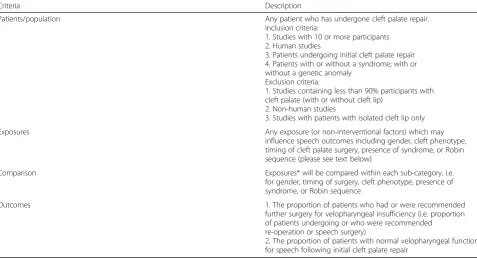
The objectives for this systematic review are defined using a PECO framework (Table1) [10].
Participants/population
There will be no exclusion based on the year of publica-tion, and databases will be searched from inception (Table1).
Exposure(s)
Any surgical intervention and schedule will be included in the review.
1. Non-cleft related pre-operative factors a. Gender
b. Ethnicity c. Premature birth
d. Age at time of soft palate repair e. Age at time of hard palate repair f. Syndromal presence/genetic anomaly g. Birth weight
h. Weight at palate repair i. Head circumference j. Robin sequence k. Deprivation index l. Socio-economic status m. Hearing problems n. Developmental delay o. Previous general anaesthetics
p. Significant associated comorbidities (e.g. cardiac, respiratory and airway issues, feeding issues) 2. Cleft-related pre-operative factors
a. Cleft type
i. Bilateral cleft lip-cleft palate ii. Unilateral cleft lip-cleft palate iii. Cleft palate only
iv. Cleft of the soft palate v. Sub-mucous cleft palate b. Unilateral or bilateral c. Lip involvement d. Alveolar involvement e. Hard palate involvement
Comparator(s)/control
Exposures will be compared within each sub-category, i.e. gender, timing of surgery, cleft phenotype, presence of syndrome, or Robin sequence. In this systematic re-view, we are interested in non-interventional factors or exposures which influence speech outcomes following cleft palate repair. For example, if the exposure is one gender, then the comparator is the other gender; if the exposure is timing of surgery less than N months, the comparator is timing of surgery more thanNmonths; if the exposure is the presence of a syndrome, comparator is no syndrome, etc.
Context
Reported rates of velopharyngeal insufficiency vary widely following initial cleft palate surgery. For example, published rates of VPI range from 0 to 66% (Smith and Losee 2014). Whilst certain factors have been implicated (e.g. male sex, bilateral cleft lip and palate, cleft width), the reason for this variation is unclear. The factors of interest have been included as there is some low quality or equivocal evidence that they may be associated with poor speech outcomes. For example, socio-economic deprivation has been suggested by some to be associated with poor speech outcomes [16] but not by others [4]. Consequently, the reason for including many of the factors of interest is that there is some evidence they im-pact speech outcomes following cleft palate repair, such as cleft type or age at surgery, or realistically could do Table 1.PECO table
Criteria Description
Patients/population Any patient who has undergone cleft palate repair.
Inclusion criteria:
1. Studies with 10 or more participants 2. Human studies
3. Patients undergoing initial cleft palate repair 4. Patients with or without a syndrome; with or without a genetic anomaly
Exclusion criteria:
1. Studies containing less than 90% participants with cleft palate (with or without cleft lip)
2. Non-human studies
3. Studies with patients with isolated cleft lip only
Exposures Any exposure (or non-interventional factors) which may
influence speech outcomes including gender, cleft phenotype, timing of cleft palate surgery, presence of syndrome, or Robin sequence (please see text below)
Comparison Exposures* will be compared within each sub-category, i.e.
for gender, timing of surgery, cleft phenotype, presence of syndrome, or Robin sequence
Outcomes 1. The proportion of patients who had or were recommended
further surgery for velopharyngeal insufficiency (i.e. proportion of patients undergoing or who were recommended re-operation or speech surgery)
2. The proportion of patients with normal velopharyngeal function for speech following initial cleft palate repair
so, such as Robin sequence or previous general anaes-thesia) [15,18].
Outcome(s)
The principal interest of this review is the need for fur-ther surgery with the aim to improve speech following initial cleft palate repair.
Whilst theoretically the incidence of velopharyngeal in-sufficiency might be considered the best primary outcome measure there is wide variability in type, use, and interpret-ation of perceptual speech assessment tools. Consequently, there is heterogeneity across the literature with respect to recorded speech parameters. It is therefore unlikely that it will be realistically possible to pool or compare these. Therefore, the rate of secondary speech surgery (including cleft palate re-repair, pharyngoplasty, pharyngeal wall aug-mentation, or palate lengthening procedures such as buc-cinator myomucosal flaps) will be used as an indicator for poor speech outcomes. This must be interpreted with a degree of caution as there will be some children with poor speech outcomes who do not proceed to further speech surgery. Additionally, the threshold for secondary speech surgery is likely to vary between centres, clinicians, families, and patients.
Primary outcomes
The primary outcome will be the proportion of patients who had or were recommended further surgery for velopharyngeal insufficiency (i.e. proportion of patients undergoing or who were recommended re-operation or speech surgery). This includes patients undergoing cleft palate re-repair (include palate muscle re-positioning, secondary intravelar veloplasty, and Furlow’s double-opposing z-plasty), pharyngoplasty (pharyngeal flaps, sphincter pharyngoplasty), pharyngeal wall augmenta-tion (with cartilage, fat or silicone), or palate lengthen-ing procedures such as buccinator myomucosal flaps.
Secondary outcomes
The secondary outcome measure is the proportion of patients with normal velopharyngeal function for speech following initial cleft palate repair. This includes mea-sures such as resonance and nasal emission. It is antici-pated that it may be challenging to pool such variables as the recorded speech parameters have wide heterogen-eity in terms of recording the perceptual speech assess-ment. There will also be a variation between cleft teams and clinicians as to the definition of“normal”speech.
Effect measures will be recorded using perceptual assessment scales. The definition of improvement will depend on which perceptual assessment scale each study has used. VPI assessment is assessor-dependent, using tools such as the Great Ormond Street Speech Assessment Tool [14]. Objective tools to assess VPI
such as nasometry are generally only used for research purposes. Any speech assessment will be included in the review to capture all relevant papers. However, studies will be excluded if the reported speech out-comes do not relate to velopharyngeal insufficiency. Studies reporting only psychosocial outcomes will be excluded.
To facilitate comparison between studies, we will record resonance outcomes for each study under five categor-ies—normal, mild hypernasality, moderate hypernasality, severe hypernasality, or hyponasality. If it is not possible to determine the degree of hypernasality, it will be re-corded as“hypernasality of unknown severity”. Nasal air-flow errors (emission and turbulence) will be recorded as normal, mild, moderate, or severe. If the authors have not stratified this then this will be recorded as ‘presence of nasal emission’,‘presence of nasal turbulence’,‘no airflow errors’, or‘not reported’.
Follow-up length
To be included in the review, studies must report the proportion of patients who were recommended or underwent secondary speech surgery for velopharyngeal insufficiency at five years of age or older. This length of time is necessary to allow time for the child’s speech and language skills to develop as part of a typical trajectory in English speaking children [5].
Information sources
A comprehensive electronic database search from incep-tion until present date will be performed using the following:
1. MEDLINE (OVID interface, 1948 onwards) 2. EMBASE (OVID interface, 1980 onwards) 3. AMED
4. PsycINFO
5. CINAHL—Cumulative Index to Nursing and Allied Health Literature
6. Health Technology Assessment Database 7. SpeechBITE
8. Cochrane Central Register of Controlled Trials (CENTRAL)
9. Cochrane Database of Systematic Reviews 10. Scopus
Search strategy
Literature search strategies will be developed using med-ical subject headings (MeSH) and text words related to cleft palate. The literature search will include articles written in all languages but will be limited to human subjects. To ensure literature saturation, we will scan the reference lists of included studies or relevant review articles identified through the initial search.
Publications of potential relevance to our study will be identified by using both exploded MeSH headings and text words. The search strategy has been peer-reviewed by two independent librarians, and the final search will be performed by one of these librarians (JM).
cleft*, OR palat* AND repair*, OR palatoplast*, OR reconstruct*, OR surg*, OR operat*, OR reconstruct*, OR pharyngoplast*, OR pharyngeal flap, OR palatal surg*, OR furlow, OR honig, OR hynes, OR orticochea, OR sanvenero-roselli, OR jackson OR,
skoog OR, (fat ADJ inject*)
OR (cartilage ADJ graft*) OR (fat ADJ graft*) OR buccinators ADJ flaps, OR
pharyngeal ADJ wall ADJ augmentation sommerlad repair* OR
intravelar veloplast*, OR von langenbeck*, AND
speech ADJ outcome*, OR velopharyngeal function*,
velopharyngeal ADJ (insufficiency OR dysfunction OR incompeten*), OR
resonance, OR hypernasal*, OR passive ADJ CSCs, OR
nasal ADJ (emission OR turbulence OR regurgitation), OR
airflow ADJ errors, OR speech, OR
nasalance, OR cleft ADJ speech, OR
poor ADJ speech
We will not include literature reviews, case reports, case series with less than 10 participants, review arti-cles, commentaries, letters, editorials and dissertation abstracts, and conference proceedings. We consider these forms of publication to deliver insufficient infor-mation and to present a higher risk of reporting error, as compared with peer-reviewed articles. A pre-liminary review has been conducted which suggests that there is an extensive evidence base to draw from within the peer-reviewed literature. Therefore, it was felt unnecessary to extend this to encompass the grey literature.
Study records
Selection process and study design
Studies will be screened for inclusion using the above inclusion criteria (Table1). The following types of study will be included:
1. Studies reporting the proportion of patients who were recommended or underwent re-operation or speech secondary surgery for VPI at 5 years of age or older.
2. Studies reporting the proportion of patients with normal velopharyngeal function for speech following initial cleft palate repair.
3. Randomised controlled trials (RCTs), cluster RCTs, non-randomised controlled clinical trials, longitudinal studies with and without controls, cross-sectional investigations with and without controls, and retrospective studies with prospective data collection with and without controls, case series with 10 or more participants.
The following types of study will be excluded:
1. Literature reviews (previous reviews will be identified to establish their findings and therefore, provide a background to previous research). 2. Case reports, case series with less than 10
participants, review articles, commentaries, letters, editorials, and dissertation abstracts.
patterns which might be based on the different study designs.
Screening
The search results will be uploaded to DistillerSR (Evidence Partners, Ottawa, ON) and de-duplicated. Thereafter, a three-stage screening process will be used. During the first stage, based upon titles, two independent reviewers will ex-clude articles that are evidently not pertinent to the review. In the second stage, two reviewers will read and review all abstracts yielded by the search against inclusion criteria. The co-investigators will retrieve the full text of all articles that appear to meet the inclusion criteria or in any case where there is uncertainty about eligibility. At the third stage, the full-text papers will be reviewed in duplicate. The reasons for excluding papers will be recorded. Discrepancies in study selection will be dealt with by discussion, with unresolved conflicts solved by third-party arbitration. Uncertainties re-garding eligibility for inclusion will be clarified by contacting study authors when necessary. To avoid overlapping patient populations, data on authorship, recruitment years, data source, and geographic location will be compared at the data extraction stage. If a patient population is found to overlap, the article with the most comprehensive data will be in-cluded. Review authors will not be blinded to the journal titles or to the study authors or institutions. A pilot of the data extraction form will be performed.
Data collection process
Data extraction and analysis
Five independent reviewers will perform data extraction in duplicate. EndNote X7 (Thompson Reuters, Philadelphia, PA) bibliographic software program will be used to manage citations. Screening and data extraction will be completed using DistillerSR (Evidence Partners, Ottawa, ON) online systematic review software.
The following variables will be recorded from each article:
Study characteristics
Author(s)
Year of publication
Dates of study period
Funding source
Country of origin
Type of study design
Population characteristics
Procedure
Number of patients
Gender of patients
Ethnicity
Adoption
Prior surgery
Tonsillectomy
Adenoidectomy
Previous general anaesthetic
Mean birth weight
Weight at palate repair
Premature birth
Feeding history
Breast-fed
Bottle-fed
Supplemental feeding, e.g. nasogastric tube
Maternal smoking
Consanguinity
Family history of palatal anomaly
Syndrome diagnosis/genetic anomaly/Robin sequence
Significant associated comorbidity
Hemi-facial microsomia
Neurofibromatosis
Moebius syndrome
Microtia
Airway issues or obstructive sleep apnoea
Head circumference
Deprivation index
Socio-economic status
Hearing problems
Including otitis media with effusions, grommet insertions, use of a hearing aid
Developmental delay
Cleft type
LAHSHAL or LASHAL code
Veau (I, II, III, IV)
Bilateral cleft lip-cleft palate
Unilateral cleft lip-cleft palate
Cleft palate only
Complete cleft of secondary palate
Incomplete cleft palate with hard palate involvement
Complete cleft of soft palate with no hard palate involvement
Incomplete cleft of soft palate
Sub-mucous cleft palate
Unilateral or bilateral
Lip involvement
Alveolar involvement
Hard palate involvement
Timing of palate repair
Mean age at soft palate repair
Mean age at hard palate repair
Details of the initial surgical procedure(s)
Mission surgery
Surgeon’s experience
Method of speech assessment
Speech assessment carried out by a speech and language therapist
Blinded perceptual speech assessment
Speech assessment by more than one therapist
Follow-up
Mean length of follow-up until speech assessment
Mean length of follow-up at the last speech assessment
Speech assessment
Method of speech assessment: speech assessment carried out by a speech and language therapist, use of a validated perceptual speech assessment tool, blinded perceptual speech assessment, and speech assessment by more than one therapist
Resonance postoperatively
Normal resonance postoperatively
Normal nasal emission postoperatively
Nasal emission postoperatively
Hyponasal postoperatively
Post-operative course
Complications
Requirement for secondary speech surgery
Mean length of time until secondary speech surgery
Type of further surgery
Posterior pharyngeal wall augmentation (including fat injection, calcium hydroxyapatite injection)
Palate re-repair (including Furlow’s
palatoplasty, pushback, intravelar veloplasty)
Pharyngeal flap
Sphincter pharynoplasty
Buccinator myomucosal flaps
During data extraction, other variables of interest may be recognised. These will then be added to the dataset and the protocol amended accordingly. The method-ology used for the recording of outcomes will also be noted and will include the following variables: speech assessment carried out by a speech and language therap-ist, use of a validated perceptual speech assessment tool, blinded perceptual speech assessment, speech assess-ment by more than one therapist.
Percentages of patients achieving normal resonance and nasal emission postoperatively will be extracted as standalone variables in the first instance and will be then included with the improved resonance and nasal emis-sion variables.
Risk of bias and quality assessment in individual studies
Both bias and quality will be assessed in duplicate. Studies with significant results are more likely to be published than studies without significant results (i.e. publication bias). The ROBINS-E tool will be used for assessing risk of bias in observational studies [1]. The methodologic quality
of each study will be appraised using modified criteria based on the Cochrane Collaboration’s tool for assessing risk of bias in therapeutic studies [7]. The following domains will be assessed: selection bias (randomisation of patients to a given treatment), detection bias (blinded as-sessment of outcomes), outcome asas-sessment (recording of key outcomes—in this case, normalised resonance), and attrition bias (inclusion of all patients who received the treatment in question). Quality will be assessed using the Oxford Centre for Evidence-based Medicine 2011 level of evidence guidelines (OCEBM Levels of Evidence Working Group, 2011). GRADE assessment will be performed in duplicate to assess the certainty of the body of evi-dence [6].
Data Synthesis
Systematic reviews performed in this area [3] have identi-fied significant diversity of methodology and reporting of results. Consequently, it is anticipated that there will be substantial heterogeneity and that a formal meta-analysis will not be feasible. It is expected that a systematic narrative synthesis will be provided with the information presented in the text and tables to summarise and explain the charac-teristics and findings of the included studies. The narrative synthesis will explore the relationship and findings both within and between the included studies, in line with the guidance from the Centre for Reviews and Dissemination. For each study, the number of patients who achieved each of the outcomes of interest will be recorded. Individual per-centages will be calculated using the number of patients in each study as denominator. We will contact the authors of the trials and studies to resolve any missing data.
Discussion
Abbreviations
CSCs:Cleft speech characteristics; VPI : Velopharyngeal insufficiency
Acknowledgements
The authors are extremely grateful to Rachel Playforth (Assistant Librarian, Royal Sussex County Hospital) for her help with the search strategy and reviewing the protocol and to Claire Leng and Helen Charlton (Senior Library Assistants, Newcastle upon Tyne Hospitals Foundation Trust) for their help in retrieving articles. The authors are grateful to the Cleft and Craniofacial Conditions Clinical Studies Group and the Cleft and Craniofacial Conditions Early Career Researcher Group for supporting the activities of the Cleft Multidisciplinary Collaborative. Evidence synthesis support was provided by Bronia Arnott, Suzanne McDonald, and Fiona Beyer (Newcastle University).
Authors’contributions
DS contributed to the protocol, supervised the database search, downloaded the references to reference manager and Distiller SR, screened (first, second, and third stages), retrieved the full-text papers, assessed the quality, and extracted and analysed the data. AC checked the protocol, retrieved the full-text papers, extracted the data, and assessed the quality. CdeB checked the protocol, retrieved the full-text papers, extracted the data, and assessed the quality. JM checked the search strategy, undertook searches, and retrieved full-text papers. CW checked the protocol screening (first, second, and third stages), retrieved full-text papers, extracted the data, and assessed the quality. YW is a senior author, checked the protocol, extracted the data, assessed the quality, and is a guarantor of review. PH is a senior author, checked protocol, and is a guarantor of review. All authors read and approved the final manuscript.
Funding
The authors are extremely grateful to the Newcastle Upon Tyne NHS Foundation Trust for use of the EndNote License and to the charitable fund of the Newcastle Cleft Lip and Palate Team for purchasing the licenses for Distiller SR (Evidence Partners, Ottawa, ON). These funders were not involved in developing the protocol.
Availability of data and materials
The datasets used and/or analysed during the current study are available from the corresponding author on reasonable request.
Ethics approval and consent to participate
Not applicable.
Consent for publication
Not applicable.
Competing interests
The authors declare that they have no competing interests.
Author details 1
Newcastle upon Tyne Hospitals NHS Foundation Trust, Newcastle upon Tyne, UK.2Royal College of Surgeons in Ireland, Dublin, Ireland.3Guys’and
St. Thomas’NHS Foundation Trust, London, UK.4Bristol Dental School, University of Bristol, Bristol, UK.5Bristol Speech and Language Therapy
Research Unit, North Bristol NHS Trust, Bristol, UK.
Received: 3 December 2018 Accepted: 15 August 2019
References
1. Bero L, Chartres N, Diong J, Fabbri A, Ghersi D, Lam J, et al. The risk of bias in observational studies of exposures (ROBINS-E) tool: concerns arising from application to observational studies of exposures. Systematic Reviews. 2018;7(1):242.
2. Biavati MJ, Rocha-Worley G. Palatopharyngeal incompetence. E-Medicine from WebMD. 2006. http://emedicine.medscape.com/article/994975-overview#showall. Accessed 22 Aug 2018.
3. de Blacam C, Smith S, Orr D. Surgery for velopharyngeal dysfunction: a systematic review of interventions and outcomes. Cleft Palate Craniofac J. 2018;55(3):405–22.
4. Choa RM, Slator R, Jeremy A, Robinson S, Franklin D, Roberts A, et al. Identifying the effect of cleft type, deprivation and ethnicity on speech and dental outcomes in UK cleft patients: a multi-centred study. Journal of Plastic, Reconstructive & Aesthetic Surgery : JPRAS. 2014;67(12):1637–43. 5. Dodd B, Holm A, Hua Z, Crosbie S. Phonological development: a normative
study of British English-speaking children. Clin Linguist Phon. 2003;17:617–43. 6. Guyatt GH, Oxman AD, Vist GE, Kunz R, Falck-Ytter Y, Alonso-Coello P, et al. GRADE: an emerging consensus on rating quality of evidence and strength of recommendations. BMJ. 2008;336:924.
7. Higgins A, Altman D, Sterne J. Assessing risk of bias in included studies. In: Higgins J, Green S, eds. Cochrane Handbook for Systematic Reviews of Interventions, Version 5.1.0 [updated March 2011]. The Cochrane Collaboration, 2011. Available at:www.handbook.cochrane.org. 8. Mahoney MH, Swan MC, Fisher DM. Prospective analysis of presurgical
risk factors for outcomes in primary palatoplasty. Plast Recon Surg. 2013;132(1):165–71.
9. Moher D, Liberati A, Tetzlaff J, Altman DG, The PRISMA Group. Preferred Reporting Items for Systematic Reviews and Meta-Analyses: The PRISMA Statement. PLoS Med. 2009;6(7):e1000097.
10. Morgan RL, Whaley P, Thayer K, Schünemann HJ. Identifying the PECO: a framework for formulating good questions to explore the association of environmental and other exposures with health outcomes. Environ Int. 2018;121(Pt 1):1027–31.
11. Parwaz MA, Sharma RK, Parashar A, Nanda V, Biswas G, Makkar S.Width of cleft palate and postoperative palatal fistula--do they correlate? J Plast Reconstr Aesthet Surg. 2009;62(12):1559–63.
12. Pigott RW. Objectives for cleft palate repair. Ann Plast Surg. 1987;19(3):247–59. 13. Randall P, LaRossa D, McWilliams BJ, Cohen M, Solot C, Jawad AF. Palatal
length in cleft palate as a predictor of speech outcome. Plast Reconstr Surg 2000;106(6):1254-9; discussion 1260–1.
14. Sell D, Harding A, Grunwell P. GOS.SP,ASS.'98: an assessment for speech disorders associated with cleft palate and/or velopharyngeal dysfunction (revised). Int J Lang Commun Disord. 1999;34:17–33.
15. Sitzman TJ, Hossain M, Carle AC, Heaton PC, Britto MT. Variation among cleft centres in the use of secondary surgery for children with cleft palate: a retrospective cohort study. BMJ Paediatr Open. 2017;1(1):e000063–8. 16. Smillie I, Yong K, Harris K, Wynne DM, Russell CJ. Socioeconomic influence
on orofacial cleft patient care. Scott Med J. 2015;60(2):70–4.
17. Smith DM, Losee JE. Cleft palate repair. Clin Plast Surg. 2014;41:189–210. 18. Stein MJ, Zhang Z, Fell M, Mercer N, Malic C. Determining postoperative
outcomes after cleft palate repair: A systematic review and meta-analysis. J Plast Reconstr Aesthet Surg. 2019;72(1):85–91.
Publisher’s Note