I
I
I
N
N
N
T
T
T
E
E
E
R
R
R
N
N
N
A
A
A
T
T
T
I
I
I
O
O
O
N
N
N
A
A
A
L
L
L
J
J
J
O
O
O
U
U
U
R
R
R
N
N
N
A
A
A
L
L
L
O
O
O
F
F
F
R
R
R
E
E
E
S
S
S
E
E
E
A
A
A
R
R
R
C
C
C
H
H
H
I
I
I
N
N
N
C
C
C
O
O
O
M
M
M
M
M
M
E
E
E
R
R
R
C
C
C
E
E
E
,
,
,
I
I
I
T
T
T
A
A
A
N
N
N
D
D
D
M
M
M
A
A
A
N
N
N
A
A
A
G
G
G
E
E
E
M
M
M
E
E
E
N
N
N
T
T
T
A Monthly Double-Blind Peer Reviewed Refereed Open Access International e-Journal - Included in the International Serial Directories
C
C
C
CONTENTS
ONTENTS
ONTENTS
ONTENTS
Sr.
No.
TITLE & NAME OF THE AUTHOR (S)
Page No.
1
.
FORCASTING OF FINANCIAL MARKETS - APPLICATION OF FUZZY ASSOCIATION RULESBHAGIRATHI NAYAK, DR. C. NAHAK & DR. ARUN KR. MISRA
1
2
.
PERCEIVED QUALITY OF SERVICES RENDERED BY UNIVERSITY LIBRARY: A CASE STUDY OF PANJAB UNIVERSITY MAIN LIBRARY, CHANDIGARH, INDIADR. TESFATSION SAHLU DESTA
9
3
.
DYNAMIC COMPENSATION SYSTEM FOR PAKISTANRABIA MUSHTAQ
20
4
.
DESIGN AND IMPLEMENTATION OF EXAMPLE BASED ENGLISH-HINDI MACHINE TRANSLATION SYSTEMVIVEK DUBEY & DR. H. R. SHARMA
26
5
.
INDIAN TELECOMMUNICATION SECTOR: A PARADIGM SHIFTDR. HARSH DWIVEDI & KAVYA SAINI
29
6
.
A STUDY ON CONSTRUCTION OF EQUITY PORTFOLIO (OIL, IT, STEEL AND BANKING STOCKS) WITH REFERENCE TO THE SHARPE INDEX MODELP.VARADHARAJAN & DR. P VIKKRAMAN
38
7
.
A STUDY ON ECONOMIC EMPOWERMENT OF WOMEN THROUGH SELF HELP GROUPS IN MAHABUBNAGAR DISTRICT OF ANDHRA PRADESHM V S MAHENDRA, S ANANDA REDDY & M S BHAT
44
8
.
A STUDY ON THE RELATIONSHIP BETWEEN GOLD, SILVER AND NIFTYR.KARTHIKEYAN & DR. M. G. SARAVANARAJ
50
9
.
TV VIEWING PRACTICES OF INDIAN CHILDRENDR. PAVLEEN KAUR & DR. RAGHBIR SINGH
66
10
.
TOURISM POTENTIAL IN VELLORE REGION - AN EMPIRICAL STUDYDR. D. ASHOK
71
11
.
A STUDY ON STEPS TAKEN TO INPROVE CREDIT AND SAVINGS IN RURAL INDIADR. P. UMA RANI
73
12
.
HEALTHCARE SERVICES IN INDIA: A STRATEGIC PERSPECTIVEDR. PRESHTH BHARDWAJ & DR. JAYRAJ D. JADEJA
78
13
.
INCREASING WOMEN EMPLOYMENT IN IT INDUSTRY: AN ANALYSIS OF REASONSS. ANNAPOORNA & S. T. BAGALKOTI
87
14
.
IMPACT OF ORGANIZATIONAL CLIMATE, ROLE AMBIGUITY AND ROLE CONFLICT ON ORGANIZATIONAL COMMITMENT AMONG THE FACULTY IN ENGINEERING COLLEGESDR. T. G. VIJAYA & R. HEMAMALINI
90
15
.
PERFORMANCE APPRAISAL SYSTEM IN INCOME TAX DEPARTMENT: A CASE STUDYDR. TEJ SINGH & DR. RAJIV RATAN
95
16
.
ROBUST AWARENESS ON INDIAN INSURANCE INDUSTRY IN TIER THREE CITIESDR. T.V. MALICK, DR. V. SELVAM & N. ABDUL NAZAR
101
17
.
AWARENESS AND PERCEPTIONS OF E-BANKING CUSTOMERS IN CHHATTISGARH (INDIA)A. K. CHANDRA & D. K. GANGESHWAR
105
18
.
COMPARATIVE STUDY OF PARAMETRIC AND NON-PERAMETRIC VALUE AT RISK (VaR) METHODSVIKRANT VIKRAM SINGH, ANOOP MOHANTY & SUMIT GOYAL
109
19
.
A STUDY TO DETERMINE THE EFFECTIVENESS OF THE TRAINING PROGRAMMES AT ONE OF THE NAVRATNA COMPANY IN ELECTRONIC INDUSTRYDR. R. PADMAJA
118
20
.
IMPLEMENTATION OF CRM WITH INFORMATION TECHNOLOGY IN HIGHER EDUCATIONDR. NARINDER TANWAR
125
21
.
PERFORMANCE ANALYSIS OF SOFTWARE INDUSTRIES THROUGH VALUE ADDED APPROACH - AN EMPIRICAL STUDY ON INFOSYS LTD.DR. R. KRISHNAKUMAR
129
22
.
TECHNOLOGICAL SERVICES IN RURAL BANKING: A STUDY WITH REFERENCE TO BANK BRANCHES IN TIRUNELVELI DISTRICTD. DEVANDHIRAN & SREEHARI .R
133
23
.
VICKS VAPORUB - MOTHER’S TOUCH THERAPY: A CASE STUDYRAJNI KAMBOJ
141
24
.
THE RELATIONSHIP BETWEEN LOCUS OF CONTROL AND ROLE STRESS AMONG ENGINEERS AND PERSONNELR. SUBASREE
144
25
.
THE LEGAL LACUNAS OF AN INDIAN CORPORATION’S CRIMINAL LIABILITYDR. SHRUTI BEDI
149
VOLUME NO. 1 (2011), ISSUE NO. 5 (OCTOBER) ISSN2231-5756
CHIEF PATRON
CHIEF PATRON
CHIEF PATRON
CHIEF PATRON
PROF. K. K. AGGARWAL
Chancellor, Lingaya’s University, Delhi
Founder Vice-Chancellor, Guru Gobind Singh Indraprastha University, Delhi
Ex. Pro Vice-Chancellor, Guru Jambheshwar University, Hisar
PATRON
PATRON
PATRON
PATRON
SH. RAM BHAJAN AGGARWAL
Ex. State Minister for Home & Tourism, Government of Haryana
Vice-President, Dadri Education Society, Charkhi Dadri
President, Chinar Syntex Ltd. (Textile Mills), Bhiwani
CO
CO
CO
CO----ORDINATOR
ORDINATOR
ORDINATOR
ORDINATOR
AMITA
Faculty, E.C.C., Safidon, Jind
ADVISORS
ADVISORS
ADVISORS
ADVISORS
PROF. M. S. SENAM RAJU
Director A. C. D., School of Management Studies, I.G.N.O.U., New Delhi
PROF. M. N. SHARMA
Chairman, M.B.A., Haryana College of Technology & Management, Kaithal
PROF. S. L. MAHANDRU
Principal (Retd.), Maharaja Agrasen College, Jagadhri
EDITOR
EDITOR
EDITOR
EDITOR
PROF. R. K. SHARMA
Dean (Academics), Tecnia Institute of Advanced Studies, Delhi
CO
CO
CO
CO----EDITOR
EDITOR
EDITOR
EDITOR
DR. BHAVET
Faculty, M. M. Institute of Management, Maharishi Markandeshwar University, Mullana, Ambala, Haryana
EDITORIAL ADVISORY BOARD
EDITORIAL ADVISORY BOARD
EDITORIAL ADVISORY BOARD
EDITORIAL ADVISORY BOARD
DR. AMBIKA ZUTSHI
Faculty, School of Management & Marketing, Deakin University, Australia
DR. VIVEK NATRAJAN
Faculty, Lomar University, U.S.A.
DR. RAJESH MODI
Faculty, Yanbu Industrial College, Kingdom of Saudi Arabia
PROF. SANJIV MITTAL
University School of Management Studies, Guru Gobind Singh I. P. University, Delhi
PROF. ANIL K. SAINI
Chairperson (CRC), Guru Gobind Singh I. P. University, Delhi
DR. KULBHUSHAN CHANDEL
Reader, Himachal Pradesh University, Shimla
DR. SAMBHAVNA
Faculty, I.I.T.M., Delhi
DR. MOHENDER KUMAR GUPTA
Associate Professor, P. J. L. N. Government College, Faridabad
DR. SHIVAKUMAR DEENE
Asst. Professor, Government F. G. College Chitguppa, Bidar, Karnataka
MOHITA
Faculty, Yamuna Institute of Engineering & Technology, Village Gadholi, P. O. Gadhola, Yamunanagar
ASSOCIATE EDITORS
ASSOCIATE EDITORS
ASSOCIATE EDITORS
ASSOCIATE EDITORS
PROF. NAWAB ALI KHAN
Department of Commerce, Aligarh Muslim University, Aligarh, U.P.
PROF. ABHAY BANSAL
Head, Department of Information Technology, Amity School of Engineering & Technology, Amity University, Noida
PROF. A. SURYANARAYANA
Department of Business Management, Osmania University, Hyderabad
DR. ASHOK KUMAR
Head, Department of Electronics, D. A. V. College (Lahore), Ambala City
DR. JATINDERKUMAR R. SAINI
Head, Department of Computer Science, S. P. College of Engineering, Visnagar, Mehsana, Gujrat
DR. V. SELVAM
Divisional Leader – Commerce SSL, VIT University, Vellore
DR. PARDEEP AHLAWAT
Reader, Institute of Management Studies & Research, Maharshi Dayanand University, Rohtak
S. TABASSUM SULTANA
Asst. Professor, Department of Business Management, Matrusri Institute of P.G. Studies, Hyderabad
TECHNICAL ADVISOR
TECHNICAL ADVISOR
TECHNICAL ADVISOR
TECHNICAL ADVISOR
AMITA
Faculty, E.C.C., Safidon, Jind
MOHITA
Faculty, Yamuna Institute of Engineering & Technology, Village Gadholi, P. O. Gadhola, Yamunanagar
FINANCIAL ADVISORS
FINANCIAL ADVISORS
FINANCIAL ADVISORS
FINANCIAL ADVISORS
DICKIN GOYAL
Advocate & Tax Adviser, Panchkula
NEENA
Investment Consultant, Chambaghat, Solan, Himachal Pradesh
LEGAL ADVISORS
LEGAL ADVISORS
LEGAL ADVISORS
LEGAL ADVISORS
JITENDER S. CHAHAL
Advocate, Punjab & Haryana High Court, Chandigarh U.T.
CHANDER BHUSHAN SHARMA
Advocate & Consultant, District Courts, Yamunanagar at Jagadhri
SUPERINTENDEN
SUPERINTENDEN
SUPERINTENDEN
SUPERINTENDENT
T
T
T
VOLUME NO. 1 (2011), ISSUE NO. 5 (OCTOBER) ISSN2231-5756
CALL FOR MANUSCRIPTS
CALL FOR MANUSCRIPTS
CALL FOR MANUSCRIPTS
CALL FOR MANUSCRIPTS
We
invite unpublished novel, original, empirical and high quality research work pertaining to recent developments & practices in
the area of Computer, Business, Finance, Marketing, Human Resource Management, General Management, Banking, Insurance,
Corporate Governance and emerging paradigms in allied subjects like Accounting Education; Accounting Information Systems;
Accounting Theory & Practice; Auditing; Behavioral Accounting; Behavioral Economics; Corporate Finance; Cost Accounting;
Econometrics; Economic Development; Economic History; Financial Institutions & Markets; Financial Services; Fiscal Policy;
Government & Non Profit Accounting; Industrial Organization; International Economics & Trade; International Finance; Macro
Economics; Micro Economics; Monetary Policy; Portfolio & Security Analysis; Public Policy Economics; Real Estate; Regional
Economics; Tax Accounting; Advertising & Promotion Management; Business Education; Business Information Systems (MIS);
Business Law, Public Responsibility & Ethics; Communication; Direct Marketing; E-Commerce; Global Business; Health Care
Administration; Labor Relations & Human Resource Management; Marketing Research; Marketing Theory & Applications;
Non-Profit Organizations; Office Administration/Management; Operations Research/Statistics; Organizational Behavior & Theory;
Organizational Development; Production/Operations; Public Administration; Purchasing/Materials Management; Retailing;
Sales/Selling; Services; Small Business Entrepreneurship; Strategic Management Policy; Technology/Innovation; Tourism,
Hospitality & Leisure; Transportation/Physical Distribution; Algorithms; Artificial Intelligence; Compilers & Translation; Computer
Aided Design (CAD); Computer Aided Manufacturing; Computer Graphics; Computer Organization & Architecture; Database
Structures & Systems; Digital Logic; Discrete Structures; Internet; Management Information Systems; Modeling & Simulation;
Multimedia; Neural Systems/Neural Networks; Numerical Analysis/Scientific Computing; Object Oriented Programming;
Operating Systems; Programming Languages; Robotics; Symbolic & Formal Logic; Web Design. The above mentioned tracks are
only indicative, and not exhaustive.
Anybody can submit the soft copy of his/her manuscript
anytime
in M.S. Word format after preparing the same as per our
submission guidelines duly available on our website under the heading guidelines for submission, at the email addresses,
[email protected]
or
.
GUIDELINES FOR SUBMISSION OF MANUSCRIPT
GUIDELINES FOR SUBMISSION OF MANUSCRIPT
GUIDELINES FOR SUBMISSION OF MANUSCRIPT
GUIDELINES FOR SUBMISSION OF MANUSCRIPT
1. COVERING LETTER FOR SUBMISSION:
DATED: _____________
THE EDITOR
IJRCM
Subject:
SUBMISSION OF MANUSCRIPT IN THE AREA OF .
(e.g. Computer/IT/Finance/Marketing/HRM/General Management/other, please specify)
.
DEAR SIR/MADAM
Please find my submission of manuscript titled ‘___________________________________________’ for possible publication in your journal.
I hereby affirm that the contents of this manuscript are original. Furthermore it has neither been published elsewhere in any language fully or partly, nor is it under review for publication anywhere.
I affirm that all author (s) have seen and agreed to the submitted version of the manuscript and their inclusion of name (s) as co-author (s).
Also, if our/my manuscript is accepted, I/We agree to comply with the formalities as given on the website of journal & you are free to publish our contribution to any of your journals.
NAME OF CORRESPONDING AUTHOR:
Designation:
Residential address with Pin Code:
Mobile Number (s):
Landline Number (s):
E-mail Address:
Alternate E-mail Address:
2. INTRODUCTION: Manuscript must be in British English prepared on a standard A4 size paper setting. It must be prepared on a single space and single column with 1” margin set for top, bottom, left and right. It should be typed in 8 point Calibri Font with page numbers at the bottom and centre of the every page.
3. MANUSCRIPT TITLE: The title of the paper should be in a 12 point Calibri Font. It should be bold typed, centered and fully capitalised.
4. AUTHOR NAME(S) & AFFILIATIONS: The author (s) full name, designation, affiliation (s), address, mobile/landline numbers, and email/alternate email address should be in italic & 11-point Calibri Font. It must be centered underneath the title.
5. ABSTRACT: Abstract should be in fully italicized text, not exceeding 250 words. The abstract must be informative and explain the background, aims, methods, results & conclusion in a single para.
6. KEYWORDS: Abstract must be followed by list of keywords, subject to the maximum of five. These should be arranged in alphabetic order separated by commas and full stops at the end.
7. HEADINGS: All the headings should be in a 10 point Calibri Font. These must be bold-faced, aligned left and fully capitalised. Leave a blank line before each heading.
8. SUB-HEADINGS: All the sub-headings should be in a 8 point Calibri Font. These must be bold-faced, aligned left and fully capitalised.
9. MAIN TEXT: The main text should be in a 8 point Calibri Font, single spaced and justified.
10. FIGURES &TABLES: These should be simple, centered, separately numbered & self explained, and titles must be above the tables/figures. Sources of data should be mentioned below the table/figure. It should be ensured that the tables/figures are referred to from the main text.
11. EQUATIONS: These should be consecutively numbered in parentheses, horizontally centered with equation number placed at the right.
12. REFERENCES: The list of all references should be alphabetically arranged. It must be single spaced, and at the end of the manuscript. The author (s)
should mention only the actually utilised references in the preparation of manuscript and they are supposed to follow Harvard Style of Referencing.
The author (s) are supposed to follow the references as per following:
•
All works cited in the text (including sources for tables and figures) should be listed alphabetically.•
Use (ed.) for one editor, and (ed.s) for multiple editors.•
When listing two or more works by one author, use --- (20xx), such as after Kohl (1997), use --- (2001), etc, in chronologically ascending order.•
Indicate (opening and closing) page numbers for articles in journals and for chapters in books.•
The title of books and journals should be in italics. Double quotation marks are used for titles of journal articles, book chapters, dissertations, reports,working papers, unpublished material, etc.
•
For titles in a language other than English, provide an English translation in parentheses.•
The location of endnotes within the text should be indicated by superscript numbers.PLEASE USE THE FOLLOWING FOR STYLE AND PUNCTUATION IN REFERENCES:
BOOKS
•
Bowersox, Donald J., Closs, David J., (1996), "Logistical Management." Tata McGraw, Hill, New Delhi.•
Hunker, H.L. and A.J. Wright (1963), "Factors of Industrial Location in Ohio," Ohio State University.CONTRIBUTIONS TO BOOKS
•
Sharma T., Kwatra, G. (2008) Effectiveness of Social Advertising: A Study of Selected Campaigns, Corporate Social Responsibility, Edited by DavidCrowther & Nicholas Capaldi, Ashgate Research Companion to Corporate Social Responsibility, Chapter 15, pp 287-303.
JOURNAL AND OTHER ARTICLES
•
Schemenner, R.W., Huber, J.C. and Cook, R.L. (1987), "Geographic Differences and the Location of New Manufacturing Facilities," Journal of UrbanEconomics, Vol. 21, No. 1, pp. 83-104.
CONFERENCE PAPERS
•
Garg Sambhav (2011): "Business Ethics" Paper presented at the Annual International Conference for the All India Management Association, NewDelhi, India, 19–22 June.
UNPUBLISHED DISSERTATIONS AND THESES
•
Kumar S. (2011): "Customer Value: A Comparative Study of Rural and Urban Customers," Thesis, Kurukshetra University, Kurukshetra.ONLINE RESOURCES
•
Always indicate the date that the source was accessed, as online resources are frequently updated or removed.WEBSITE
VOLUME NO. 1 (2011), ISSUE NO. 5 (OCTOBER) ISSN2231-5756
DESIGN AND IMPLEMENTATION OF EXAMPLE BASED ENGLISH-HINDI MACHINE TRANSLATION SYSTEM
VIVEK DUBEY
ASSOCIATE PROFESSOR
COMPUTER SCIENCE & ENGINEERING DEPARTMENT
SHRI SHANKARACHARYA COLLEGE OF ENGINEERING & TECHNOLOGY
BHILAI
DR. H. R. SHARMA
PRINCIPAL AND HEAD
COMPUTER SCIENCE & ENGINEERING DEPARTMENT
CHHATRAPATI SHIVAJI INSTITUTE OF TECHNOLOGY
DURG
ABSTRACT
A Machine Translation (MT) is the fast automatic translating tool that a sentence of source language has been translated to sentence of target language with same meaning and similar construction. Normally, in every MT system there are preprocessing phase, core MT phase and post-processing phase. In the preprocessing phase, source sentence has been normalized, parsed and chunked into noun chunks and verb chunks. Using example based in core MT phase, tagged chunked source language has been matched, selected and extracted best generalized target example. In these phase grammar of source language has also been analyzed and grammar of target language using source language grammar has been extracted. In post-processing phase, chunked machine translated target sentences has been adapted using target language grammar and arranged according to target language structure. An Example-Based MT system has been designed and developed for English-Hindi language pair. Experimental results of proposed system have also been compared with popular MT such as Google MTS, TSS MTS and Anusaarka MTS and observed its quality is better than other available MT systems. In this paper, a road-map of implementation of English-Hindi Example-Based MTS has been described.
KEYWORDS
Sentence Segmentation, Chunking Sentence, Best Example Extractor, Retrieving Target Language, Adapting Target Language.
INTRODUCTION
ow a day, Machine Translation (MT) is growing to use in online chatting, email, translating e-books etc. MT is a system used to translate sentences written in one language to other language automatically (Jurafsky D. et al., 2009; Gupta D. 2005) for example Google Translate, SYSTRAN, Anusaarka, etc.
MT systems are usually implemented using either rule based (RBMT) (Jurafsky D. et. al., 2009), statistical method based (SBMT) (Jurafsky D. et al., 2009; Ney et al., 2000; Knight, 1997; Brown et al., 1990), example based (EBMT) (Gupta D. 2005; Nagao M. 1981; Sadler V. 1989; Sato and Nagao 1990; Sumita E. and Iida H., 1991; Kitano H. 1993; Furuse et al. 1994; Watanabe H. and Maruyama H. , 1994; Cranias et al. 1994; Jones 1996; Veale T. and Way A., 1997; Carl, M. 1999, Andriamanakasina T. et al. 1999, Brown, 2000) or hybrid based (HBMT) approach.
EBMT is popular (Nirenburg S. C. et al., 1994) and advantageous (Gupta D., 2001) than other MT approaches with respect to accuracy, flexibility and portability. Since EBMT uses examples, translator’s skill has been involved and also examples have been updated and changed according to source language (SL) - target language (TL).
Normally in every approaches of MT, there are three phases: pre-processing, core-processing and post-processing. In pre-processing, input sentences are normalizing, tagging and chunking. Usually chunking is helpful in MT in cases compound and complex sentences. In core-processing, chunks are translated using example based (Bojar O. et al., 2010; Chunyu K. et al., 2002; Mostafa A. et al., 1995; Grishman et al., 1992. The order of subject (S), object (O) and verb (V) of SL is different than the TL. In post-processing, translated chunks are merged in order of target language.
An proposed Example-Based MT system has been designed and developed for English-Hindi language pair. In this paper, core module of MT system has been described. Next sections brief the organization of core machine translation system, explore implementation & result and last section concludes the paper.
ORGANIZATION OF EXAMPLE BASED MACHINE TRANSLATION SYSTEM
In general, an example is a pair of text in English-Hindi language that is a translation of each other Eiichiro S. et al. (1991). Examples are in the form of chunks (Klein E., 2004) as sentences or phrases or words. There are basically three steps as shown in figure 1: Intra-Language Matching Chunks & Extraction of SL Grammar (Nirenburg S. C. et al., 1994), Mapping Inter-Language Chunks & Mapping SL-TL (Grammar Elita N. et al., 2005) and Rule-Driven Adaptation of TL (Takao D. et al., 2003; Guvenir H.A. et al.,1998; Nirenburg S.C.,1995).
Initially, intra-language matching chunks unit finds suitable matches for input tagged chunks using SL corpus and also fixes shortest best match of SL and simultaneously extraction of SL grammar unit extracts grammar of input tagged chunks called as source language grammar (SLG). Secondly, mapping inter-language chunks unit maps SL corpus to parallel aligned TL corpus and finds TL and simultaneously mapping SL-TL grammar maps SLG to TL grammar (TLG) and finds TLG. Lastly, rule-driven adaptation unit adapts TL using TLG (Takao D. et al., 2003).
FIGURE 1: ORGANIZATION OF CORE MACHINE TRANSLATION
IMPLEMENTATION AND RESULT
INTRA-LANGUAGE MATCHING CHUNKS UNIT: In this unit, there are two inputs: Tagged Chunks and English-Hindi parallel aligned corpus. There is an output as list of similar examples. There are three process steps: select examples, sort selected examples based on searched factor and extract best example. Similarly in this unit, grammar of input has also been extracted. The intra-language matching process has been illustrated in table 1-2 for input “I am going to school” and Retrieval of SL Grammar of Chunks has been illustrated in table 3
TABLE 1: ILLUSTRATION OF INTRA-LANGUAGE MATCHING PROCESS
SN / Wt Retrieved Example Base
s5/26 Ram and Rajesh are going to school
s1/18 I am a Student - - -
s3/17 She is going to college - -
s4/16 I used to go to school -
s2/7 He loves his school - - -
TABLE 2: INPUT-SL EXAMPLE MAPPED TABLE
Input (Word) W1(I) W2(am) W3(going) W4(to) W5(school)
SL (Sentence Number) S1 S1 S5 S5 S5
SL (Word Number) 1 2 5 6 7
TABLE 3: ILLUSTRATION OF RETRIEVAL OF SL GRAMMAR OF CHUNKS
Chunks SL Grammar
NX He/PRP He
VX He/PRP is/VBZ He_VBZ
NX a/DT student/NN DT_NN
VX He/PRP has/VBZ been/VBN working/VBG He_has_been_VBG
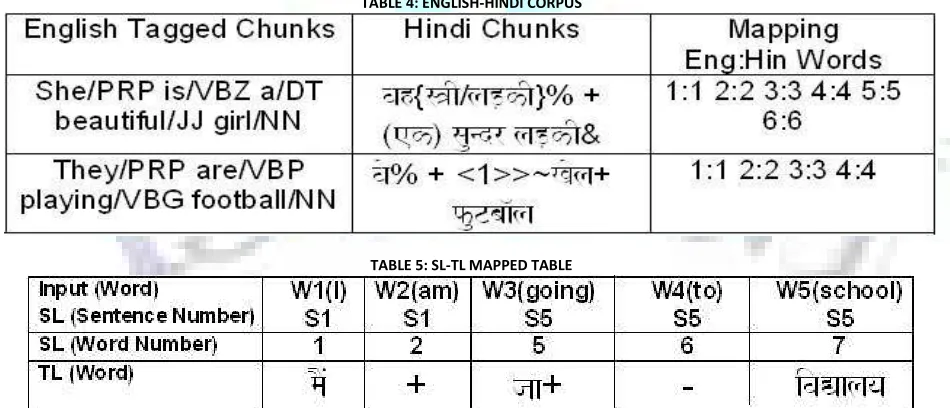
MAPPING INTER-LANGUAGE CHUNKS UNIT: There are two inputs in this unit: Best Example and English-Hindi corpus. There is an output as chunked TL. Similarly in this unit, grammar of TL has also been extracted using SLG. The organization of English-Hindi Corpus has been shown in table 4 and SL-TL mapping process has been illustrated in table 5.
TABLE 4: ENGLISH-HINDI CORPUS
TABLE 5: SL-TL MAPPED TABLE
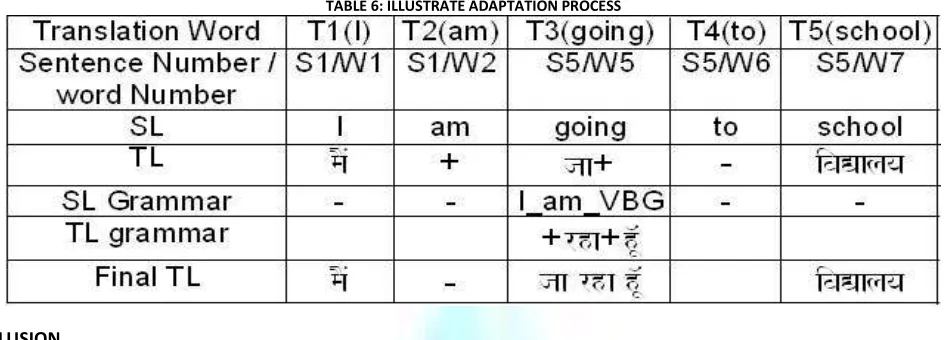
RULE-DRIVEN ADAPTATION UNIT: In the last process rule-driven adaptation, there are two inputs: Target chunk and TLG. There is an output as adapted target chunk. The adaptation process has been illustrated in table 6.
Output of Parsing Model (Tagged Chunks (SL)) (English)
Adapt Extracted TL using TLG
Input to Post Processing Model (Adapted TL (Hindi))
Mapping Inter-Language Chunks
Mapping SLG-TLG & Extracting TLG
Extracting SLG
English-Hindi Parallel Phrases / Sentences / Words / Syllables
Based Corpus
SLG-TLG Dictionary Intra-Language Matching
VOLUME NO. 1 (2011), ISSUE NO. 5 (OCTOBER) ISSN2231-5756
TABLE 6: ILLUSTRATE ADAPTATION PROCESS
CONCLUSION
In this paper, general and adaptable core processing phase of EBMT has been explained step-by-step using examples and experimentally explored units: Intra-language matching chunks unit, Mapping inter-Intra-language chunks unit and Rule-driven adaptation unit. However prototype is Intra-languages independent. It can be used for any pair of languages. Also prototype has been tested over 500 unknown sentences.
REFERENCES
Andriamanakasina, T., Araki, K., Tochinai, T. (1999), “Example-based Machine Translation of Part-of-Speech Tagged sentences by recursive Division”, Proceedings of MT SUMMIT VII, Singapore.
Bojar O., Straňák P., Zeman D. (2010), "Data Issues in English-to-Hindi Machine Translation", Proceedings of the Seventh conference on International Language Resources and Evaluation (LREC'10).
Brown, R. D. (2000), “Automated generalization of translation examples”, Proceedings of the Eighteenth International Conference on Computational Linguistics, pp. 125-131.
Brown, P. F., Cocke J., Pietra, S. A. D., Pietra, V. J. D., Jelinek, F., Lefferty, J. D., Mercer, R. L., Roossin P. S. (1990), “A Statistical Approach to Machine Translation”, Computational Linguistics, 16, pp. 79-85.
Carl M. (1999), “Inducing Translation Templates for Example-Based Machine Translation”, Proc. of MT-Summit VII.
Chunyu, K., Haihua, P., Jonathan J. W. (2002), “Example-Based Machine Translation: A New Paradigm”, In S.W. Chan (ed.), Translation and Information Technology, pp.57-78.
Cranias, L., Papageorgion, H. and Piperidis, S. (1994), “A Matching Technique in Example-Based Machine Translation”, Institute for Language and Speech Processing, Greece. Paper Presented to Computation and Language.
Eiichiro S., Hitoshi I. (1991), “Experiments and Prospects of Example-Based Machine Translation”, Proc. of ACL-91, pp. 185-192.
Furuse, O., Sumita, E., Iida, H. (1994), “Transfer-Driven Machine Translation Utilizing Empirical Knowledge”, Translations of IPSJ, Vol. 35, No. 3, pp. 414-425 Grishman, R., Kosaka, M. (1992), “Combining Ration list and Empiricist Approaches to MT”, Proceedings of TMI-92, Monntreal, pp. 263-274.
Gupta, D. (2005),“Contributions to English to Hindi Machine Translation using Example-Based Approach”, Ph.D. Thesis, Dept. of Mathematics, IIT Delhi.
Gupta, D., Chatterjee, N. (2001), “A Systematic Adaptation Scheme for English-Hindi Example-Based Machine Translation”, Proc. STRANS-2001, IIT Kanpur, pp 132-140.
Guvenir, H. A., Cicekli, (1998), “Learning Translation Templates from Examples”, Elsevier Science Ltd. Jones, D. (1996), “Analogical Natural language Processing”, UCL Press. London, pp. 155.
Jurafsky D., Chang, Pi-Chuan, Christopher, D. (2009), “Manning: Disambiguating DE for Chinese-English Machine Translation”, Proceedings of the Fourth Workshop on Statistical Machine Translation, Athens, Greece, 30–31 March 2009, pp. 215-223.
Kitano H. (1993), “A Comprehensive and Practical Model of Memory-based machine Translation”, Proc. of IJCAI-93. pp. 1276-1282.
Klein, E. (2004), “Introduction to Computational Linguistics Chunking and Partial Parsing”, ICL Week 5, Lecture 2, 21st October.
Knight, K. (1997), “Automating Knowledge Acquisition for Machine Translation”, AI Magazine, 18/4.
Mostafa, A., Muhammed, A., Husni, A. (1995), "English To Arabic Machine Translation: A Critical Review and Suggestions For Development", The Fourth Saudi Engineering Conference, Nov. I995, Volume III.
Nagao, M. A. Elithorn and R. Banerji (1981), “A framework of a Mechanical Translation between Japanese and English by Analogy Principle, in Artificial and Human Intelligence”, 9eds.) North-Holland, pp. 173-180.
Ney, H., Och, F.J., Vogel, S. (2000), “Statistical Translation of Spoken Dialogues in the Vermobil System”, MSC2000, pp. 69-74.
Nirenburg, S., Beale, S. Domashnev, C. (1994), “A Full-Text Experiment in Example-Based Machine Translation”, Int'l Conf. on New Methods in Language Processing, pp. 78-87, Manchester.
Nirenburg, S.C. (1995), “The PANGLOSS Mark III Machine Translation System”, (Tech. Rep. No. CMU-CMT-95-145), Pittsburgh: Carnegie Mellon University. Sadler, V. (1989), “Working with Analogical semantics”, Foris Publications, pp. 256.
Sato, S., Nagao, M. (1990), “Towards Memory-Based Translation”, In the proceedings of the International Conference on Computational Linguistics, COLONG-90, Helsinki, Finland, August 1990.
Sumita, E. and Iida, H. (1991), “Experiments and Prospects of Example-Based Machine Translation”, Proceedings of the 29th Annual Meeting of the Association for Computational Linguistics, Berkeley, California, USA, pp. 85-192.
Takao, D., Eiichiro, S., Hirofumi, Y. (2003), “Adaptation Using Out-of-Domain Corpus within EBMT”, HLT-NAACL 2003.
Veale, T., Way, A. (1997), “Gaijin: A template-driven bootstrapping approach to Example-Based Machine Translation”, International Conference, Recent Advances in Natural Language Processing, Tzigov Chark, Bulgaria, pp. 239-244.
REQUEST FOR FEEDBACK
Dear Readers
At the very outset, International Journal of Research in Commerce, IT and Management (IJRCM)
acknowledges & appreciates your efforts in showing interest in our present issue under your kind perusal.
I would like to request you to supply your critical comments and suggestions about the material published
in this issue as well as on the journal as a whole, on our E-mails i.e.
or
for further improvements in the interest of research.
If you have any queries please feel free to contact us on our E-mail
.
I am sure that your feedback and deliberations would make future issues better – a result of our joint
effort.
Looking forward an appropriate consideration.
With sincere regards
Thanking you profoundly
Academically yours
Sd/-