Open Access
Methodology
Boolean network simulations for life scientists
István Albert*
1, Juilee Thakar
2, Song Li
3, Ranran Zhang
4and Réka Albert
1,2,3Address: 1Huck Institutes for the Life Sciences, Pennsylvania State University, University Park, Pennsylvania, USA, 2Physics Department,
Pennsylvania State University, University Park, Pennsylvania, USA, 3Biology Department, Pennsylvania State University, University Park,
Pennsylvania, USA and 4College of Medicine, Hershey, Pennsylvania, USA
Email: István Albert* - [email protected]; Juilee Thakar - [email protected]; Song Li - [email protected]; Ranran Zhang - [email protected]; Réka Albert - [email protected]
* Corresponding author
Abstract
Modern life sciences research increasingly relies on computational solutions, from large scale data analyses to theoretical modeling. Within the theoretical models Boolean networks occupy an increasing role as they are eminently suited at mapping biological observations and hypotheses into a mathematical formalism. The conceptual underpinnings of Boolean modeling are very accessible even without a background in quantitative sciences, yet it allows life scientists to describe and explore a wide range of surprisingly complex phenomena. In this paper we provide a clear overview of the concepts used in Boolean simulations, present a software library that can perform these simulations based on simple text inputs and give three case studies. The large scale simulations in these case studies demonstrate the Boolean paradigms and their applicability as well as the advanced features and complex use cases that our software package allows. Our software is distributed via a liberal Open Source license and is freely accessible from http:// booleannet.googlecode.com
Introduction
At the most general level systems biology approaches con-sist of two steps. The first is building a model of the biolog-ical system of interest, a representation that incorporates existing knowledge and experimental observations. This model then can be subjected to various conditions and may be allowed to evolve in time, a step typically referred to as simulation. These simulations then can be used to generate qualitative or quantitative predictions on the overall behavior of the system.
Mathematical models of biological systems range from continuous to discrete (based on the representation of the status of the system's components) and from determinis-tic to stochasdeterminis-tic (based on their incorporation of random-ness and noise) [1-4]. The simplest models assume that
each element of the system has a binary (Boolean) state, and are therefore discrete, deterministic and parameter-free. However, several extensions of the Boolean mode-ling formalism also allow for iterative parameterization and the incorporation of continuous and stochastic ele-ments [5-7]. The most important barrier precluding a more general use of Boolean models consists of the diffi-culties of the computational implementation of a given model. This implementation needs to perform in a con-sistent, correct and extensible manner to allow for the integration of all empirical knowledge as well as the unfet-tered exploration of the dynamical behaviors allowed by the model. There are very few tools that focus on qualita-tive modeling, for example the Genetic Network Analyzer [8] supports qualitative predictions via a piece-wise linear model and provides advanced visualization capabilities. Published: 14 November 2008
Source Code for Biology and Medicine 2008, 3:16 doi:10.1186/1751-0473-3-16
Received: 24 September 2008 Accepted: 14 November 2008
This article is available from: http://www.scfbm.org/content/3/1/16
© 2008 Albert et al; licensee BioMed Central Ltd.
There are several software packages that focus on quanti-tative modeling via differential equations [9-11], and dis-crete modeling [7,12] but these tools are less suited for exploratory analyses of biological systems in which the majority of kinetic parameters are unknown.
In this paper we present a software toolbox (from now on referred to as BooleanNet) that greatly facilitates the implementation and study of Boolean dynamic models of biological systems. It is a tool that can simulate a Boolean model based on a very simple text based input describing the interactions and regulatory relationships in the sys-tem. The main distinguishing feature of our software com-pared to previous efforts is that we aim to provide support for modeling the dynamic behavior of well defined bio-logical sub-systems, rather than focusing on a larger scale network inference, analysis or modeling based on high throughput data. Once the rules are expressed the soft-ware can employ several simulation strategies: synchro-nous iterations, stochastic updates or hybrid modeling via a system of piecewise linear differential equations. More importantly our system allows the integration of non-boolean mechanisms into the simulation thus expanding its applicability to a wider domain. Every aspect of the simulation process may be customized: node states may be overridden at different stages of the operation, updat-ing rules may be altered, and differential equations may be augmented or replaced. We place particular focus on the documentation and demonstrate use cases from sim-ple usage samsim-ples to advanced and realistic examsim-ples. A series of 6 tutorials guide users through various aspects of the simulations. Our code, written in the Python pro-gramming language, is available as a software library and is distributed via a liberal Open Source license, freely accessible through the Google project hosting service at http://booleannet.googlecode.com
Boolean network models
A Boolean network model is a directed graph (network) whose nodes represent the elements of a system, edges represent regulatory relationships between elements, and every node is characterized by a True (1) or False (0) state [12-14]. Thus a network with N nodes will have 2N possi-ble states. As time passes the state of each node is deter-mined by the states of its neighbors (nodes that point to it), through a rule called a transfer function. In the sim-plest case the transfer function can be represented as a statement acting on the inputs via a logical function using the logical operators NOT, AND, OR; this statement also returns a True/False state. Depending on the output of the transfer function, the state of the node either stays the same or changes. A change in the state of a given node generally triggers changes in the state of nodes regulated by it (the nodes it points to). This way the state of the net-work goes through a dynamic trajectory.
This type of Boolean representation is very common in biology, although hardly if ever is named as so. For exam-ple in the case of a gene regulatory network scientists rou-tinely describe genes and pathways as being activated or repressed (On/Off), the analysis of gene expression levels leads to a classification of genes as being differentially expressed or not, during an infection a pathogen is either cleared or it persists. This classification is a very natural desire to order and categorize observed phenomena, and intuitively estimate the outcome of regulatory mecha-nisms. However, the complexity of biological networks makes even the enumeration of network components and interactions a daunting task, and human intuition must be complemented by formal modeling. Boolean models and their extensions (collectively called qualitative mod-els) have the common feature of very closely reflecting the topology of the regulatory network (i.e. the upstream/ downstream regulatory relationships invoked in verbal pathway descriptions). In addition they readily incorpo-rate inhibitory relationships (through the NOT operator) and combinatorial regulation of a target node by several regulators, whether these regulators act independently (represented by the OR operator) or they are condition-ally dependent (represented by the AND operator). Differ-ent types of qualitative models offer a range of choices for representing the passing of time, from regular time steps to sampling over relative timescales and to explicit incor-poration of known decay times.
or we may find nodes whose effect matters very little, either because of the redundancy of the pathway topology or because their effect is being cancelled out. Our software implements a steady state and cycle detection routine that can be used to quickly determine their length and first occurrence.
The synchronous model cannot properly account for the different time scales over which various events take place in the biological system. Most often these time scales are not known, nonetheless imposing the equality of all time scales, as the synchronous model does, introduces an arti-ficial constraint. We can extend the base model to account for timescales by allowing the node updates to affect the state instantaneously while performing the updates in a random order within each iteration [5,2]. This extension introduces stochasticity into the evolution of the system and allows it to sample all timescales. In this mode of operation (named asynchronous update in BooleanNet) the study of the network most often consists of perform-ing a large number of replicate simulations that start from the same initial condition, then tallying the attractors reachable from this initial condition (there can be several due to the stochasticity of the asynchronous update) and the states of the nodes at different time steps. This model can be further expanded by introducing rank ordered updates, essentially grouping nodes into separate ranks based on information regarding the relative duration of their synthesis or decay. The update orders in each rank group are randomized but are executed before the rules contained in a higher rank group. This mode is also sup-ported by our software, where the ranks are numbers affixed to each rule, and rules sharing a certain number are considered a rank group.
The piece-wise linear formalism allows us to build special-ized Boolean rules that can represent each individual node in even greater detail [16]. This model associates two variables to each node: a continuous variable akin to a concentration, and a discrete variable akin to the activity of the node. The change in the continuous variable corre-sponding to a given node is determined by a differential equation that combines a synthesis term given by a Boolean function of the activities of the nodes regulating the node and a free (uncatalized) degradation term. The discrete and continuous variables are connected via two parameters: a decay rate for the continuous variable and a threshold that determines the minimum concentration for which the discrete variable is True. Thus a Boolean rule of the form A = B AND C will be replaced by a differential equation of the form:
Above an inequality will numerically evaluate to 1 if the statement is True and 0 otherwise. Here the Boolean (first) term corresponds to the regulated synthesis of A while the decay (second) term corresponds to its free (unregulated) dissociation. When the Boolean term is True the equation is
of the form , leading to an
asymptotic increase to 1/delayA, or maintenance of an ini-tial concentration equal to this value. When the Boolean term is False the equation is of the form
, leading to an exponential
decrease to zero, or maintenance of an initial concentra-tion equal to zero. The limiting values 0 and 1/delayA of the continuous variable represent, respectively, the absence of species A and maximal concentration of spe-cies A, and correspond to the discrete values False (0) and True (1). Note that the steady states of a Boolean model are the same, regardless of the mechanism of update, and coincide with the steady state of the Boolean variables of the corresponding piecewise linear model.
Case studies
Below we present a number of realistic scenarios that apply the BooleanNet library to several different problem domains. The rule sets, data and the code that produce the plots are part of the software package and can be found in the 'examples' directory. The case studies are based on published models; our main goal for presenting these is to demonstrate the modeling aspect of the approaches, to illustrate and explain customizations and adaptations that are often necessary to capture the biological phenom-ena of interest. Biological modeling is rarely "pure" in the sense of being able to fully and rigorously adhere to the mathematical formalisms. There are always elements, actors and processes do not completely fit the model, and need to be altered to accommodate some observed behav-iors or limits. We believe that our software allows for an unprecedented customization, where all aspects of the simulation process can be interacted with, nodes, rules and states can be observed and modified in every single timestep. The rules, simulation and visualization code for each of the examples below can be found in the main source code distribution. Each of the three projects below have been published as separate article [18-20] that should be consulted for a more in depth description on the details of the biological systems and of the dynamic models. On our website we also distribute a series of accessible tutorials that gradually introduce the concepts used in the simulations.
d conc A
dt =
(
(concB>thresholdB)and conc( C>thresholdC))
−decayA××concAd conc A
dt = −1 decayA×concA
d conc A
Case study 1: Modeling abscisic acid (ABA) – induced stomatal closure in plants
Plants take up carbon dioxide for photosynthesis through microscopic pores called stomata. The size of the pores is determined by the two cells (called guard cells) that flank the stomata, and the shape of the guard cells is in turn determined by their water content and turgor pressure. Plants also lose water by transpiration through the pores, thus they need to regulate the size of the stomata to bal-ance carbon gain with water loss. During drought condi-tions plants synthesize a hormone called abscisic acid (ABA). ABA acts as a signal to a complex signal transduc-tion pathway leading to the closure of the stomata. Fol-lowing an extensive curation of the experimental literature, in [17] we have synthesized a network for ABA-induced closure that includes 43 nodes and 69 regulatory edges (see website or source distribution for the rules). The nodes of the network include proteins, ion channels and secondary messengers, as well as more abstract con-cepts such as membrane depolarization and stomatal clo-sure. The state of 38 of the 43 nodes is regulated by other nodes in the network and in [17] we expressed this
regu-lation as Boolean rules. Here we use these rules to com-pare the asynchronous and piece-wise linear frameworks of BooleanNet in exploring the dynamics of the system.
We performed an asynchronous Boolean simulation using 300 random initial states, with ABA on for all 10 steps of the simulation. In the piecewise linear mode we set the decay rates of all nodes equal to 1 and each thresh-old θ equal to 0.5, and we performed 300 simulations with random initial states. For both modes, we tested the wild type as well as a number of important knockouts and plotted the average state of the node "Closure" as a func-tion of time steps. Specifically, in the asynchronous Boolean simulation we plot the percentage of simulations that have Closure = 1, while in the piecewise linear simu-lation we plot the mean and mean ± standard deviation of the continuous variable corresponding to closure. In the wild type (WT) simulation, all nodes are updated as spec-ified by the Boolean rules. We also performed knockout simulations of sphingosine one-phosphate (S1P), phos-phatidic acid (PA), cytosolic pH (pHc) and abscisic acid insensitive (ABI1), setting the corresponding node's state
Abscisic Acid signaling simulations: a) Effect of mutations on closure in asynchronous Boolean simulation of ABA induced clo-sure
Figure 1
to False (0). We found that for WT simulations, the two model variants give the same closure response (ABA Fig-ure 1a/b, blue curves). In addition, the two simulations produced qualitatively similar results for knockouts. We also observed that the variation of the closure response was smaller in WT than in the mutants, whereas the mutants showed similar, higher than WT variations. These results suggest that knockouts not only affect the mean closure responses but also their variation [17].
Case study 2: T-cell large granular lymphocyte leukemia simulation
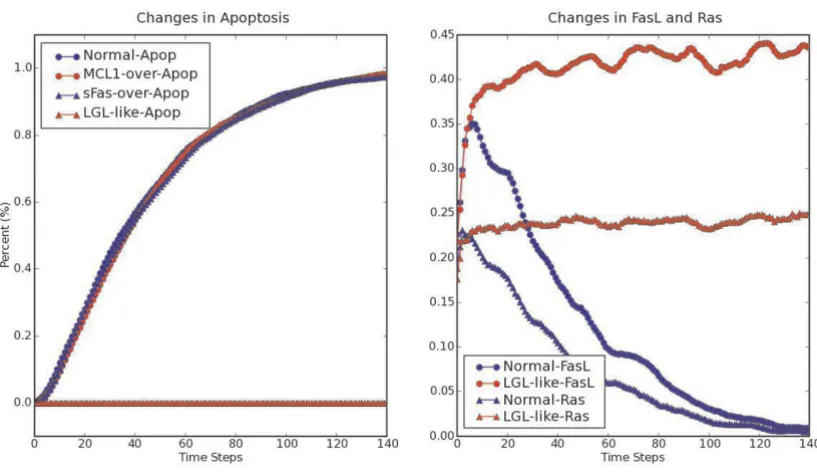
T-cell large granular lymphocyte leukemia (T-LGL) is char-acterized by the abnormal clonal expansion of antigen-primed mature cytotoxic T lymphocytes (CTLs) poten-tially driven by chronic virus infection [18]. Different from normal CTLs which are eliminated through activa-tion induced cell death (AICD) after antigen encounter [19], leukemic LGL cells persist in the peripheral blood and remain long-term competent [18]. Fas-induced apop-tosis is crucial for normal AICD [19]. Despite the high-level expression of both Fas receptor and Fas ligand (FasL), leukemic T-LGL cells are resistant to Fas-induced apoptosis [20]. Leukemic T-LGL cells express high-level of soluble Fas (sFas) which serves as decoy Fas receptor to inhibit normal Fas-induced apoptosis. In addition, it has been shown that the pro-survival MAPK pathway [21,22] and JAK-STAT pathway [23] are constitutively active in leukemic T-LGL, and anti-apoptotic BCL2 (B-cell leuke-mia/lymphoma 2) family member MCL1 (myeloid cell leukemia sequence 1) is overexpressed [23]. In order to examine the effect of these known deregulations on nor-mal AICD process, in [24] we constructed the AICD net-work representing the main events occurring during normal CTL activation and AICD process from literature. Proteins, mRNAs and small molecules (such as lipids) are represented as nodes in the network. "Apoptosis" is also included as a node to summarize the biological effect. We used "Stimuli" as a general node indicating antigen stim-ulation. Interactions or regulations between nodes were represented by edges, starting from the upstream regula-tors and ending at the downstream targets. Here we con-sider a simplified version of the network and the corresponding Boolean rules in a simulation using the asynchronous mode of BooleanNet (see website for the rules). Except nodes known to have basal level activities, most of the nodes in the network were initiated in the state of 0 to reproduce a resting-T-cell-like state. We then explored the dynamics under chronic antigen stimulation via constantly setting node "Stimuli" at the state 1. This condition induces the depletion of reactive CTL through AICD, as illustrated by the asymptotic increase to 1 of the apoptosis percentage in the output "Normal-Apop" of Fig-ure 2a. Overexpression of MCL1 or sFas alone by con-stantly setting the node "MCL1" or "sFas" in the state 1
does not prevent the onset of apoptosis. However, simul-taneous overexpression of MCL1 and sFas completely inhibits the apoptosis onset. At the same time, Figure 2b shows that the oeverexpression of MCL1 and sFas induces the constitutive activity of Ras (a key component of the MAPK pathway [21]) as well as the constitutive expression of FasL, reproducing an LGL-like state This example illus-trates that complex biological behaviors such as apoptosis can be successfully modeled using a simple Boolean model (see [24] for further results).
Case study 3: Modeling the mammalian immune response to B. bronchiseptica infection
The dynamic interplay between a pathogen (e.g. virus or bacterium) and its host's defenses decides whether the pathogen will be cleared or will establish a niche in the host. The gram-negative bacterium Bordetella bronchisep-tica persists within its mammalian hosts by interfering with the hosts' immune responses [25]. In [26] we synthe-sized a network of interactions among the immune effec-tors of a mammalian host and the virulence faceffec-tors of B. bronchiseptica from the experimental literature. The net-work contains 34 nodes (see website for rules) that repre-sent immune cell types, signaling molecules (cytokines), antibodies and bacterial factors such as antigens. The reg-ulatory edges of the network represent immune processes such as antigen presentation, activation of immune cells as well as the modulation of immune components by bac-teria. Based on our best interpretation of the experimental literature we formulated a piece-wise linear model and we used BooleanNet to simulate the interplay between host immune components and bacterial factors.
The piece-wise formulation was replaced by specific ordi-nary differential equation for the nodes 'bacteria' and 'phagocytosis' to incorporate known details of dynamic behavior. We implemented spatial separation of certain cells and cytokines by defining distinct and linked com-partments. Intercompartmental transport of cells was given by Hill type functions, e.g.
where DC represents the concentration of dendritic cells and subscripts 1 and 2 indicate the concentrations in dif-ferent compartments. Since cytokines flow to various places through lymph and blood their inter-compartmen-tal dynamics were given by the random variables rc and r
so that a fraction rc - r <f <rc + r of the total concentration of the cytokine is present in the compartment in which the cytokine is produced and a fraction 1- f is transported to the other compartment. We changed the fraction f after a
d DC dt
DC n DC n H n
DC
DC
2 1
1
2 =
variable expiration time several times during the simula-tion.
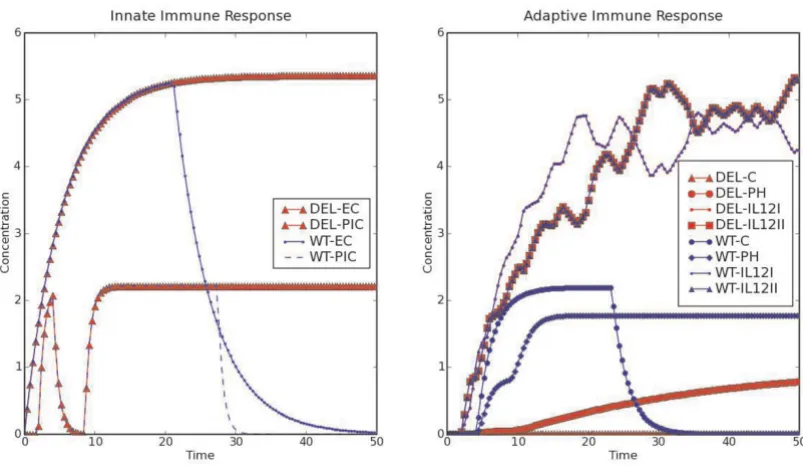
Figure 3 shows the time course of components of the innate and adaptive immune response generated by BooleanNet. These results reproduce the outcome of a custom computer code written specifically for simulating host-pathogen interactions (unpublished data). Addition-ally the software runtime is shorter and it offers a general-ized framework which can be used to simulate different systems. BooleanNet also provides extra features includ-ing a user friendly way to search in the parameter space and to import parameter files.
We also simulated previously known network perturba-tions e.g. B cell, T cell deletion and the infecperturba-tions by Type III secretion system (TTSS) defective Bordetella strain. The model could reproduce the persistence of bacteria in the absence of B cells (see Figure 3, DEL) and T cells [27,28].
It can also simulate the earlier clearance of bacteria in
ΔbscN mutant (TTSS defective strain) infection [29].
Conclusion
The success of qualitative models in describing specific cellular systems and processes such as flower develop-ment [30,31], the yeast cell cycle [32], and Drosophila embryonic development [33-35] indicates that the topol-ogy of regulatory networks has a significant role in restrict-ing their dynamical behavior. Our software allows straightforward implementation of qualitative models for systems where the network topology or pathway is at least partially known.
Authors' contributions
IA programmed the software and wrote the paper. SL formed case study 1. RZ performed case study 2. JT per-formed case study 3. RA directed research and wrote the paper.
Representative outputs of simulating the long-term survival of leukemic T-LGL cells Figure 2
Competing interests
The author(s) declare that they have no competing inter-ests
Acknowledgements
This work was partially supported by NSF grants MCB-0618402 and CCF-0643529 (CAREER), NIH grants 1R55AI065507 – 01A2 and 1 R01 GM083113-01 and USDA grant 2006-35100-17254.
References
1. Fall CP, Marland ES, Wagner JM, Tyson JJ: Computational Cell Biology
New York: Springer; 2002.
2. Voit EO: Computational Analysis of Biochemical Systems Cambridge: Cambridge University Press; 2000.
3. de Jong H: Modeling and simulation of genetic regulatory sys-tems: a literature review. J Comput Biol 2002, 9:67-103. 4. Alon U: An Introduction to Systems Biology: Design Principles of Biological
Circuits 2006.
5. Chaves M, Albert R, Sontag ED: Robustness and fragility of Boolean models for genetic regulatory networks. J Theor Biol
2005, 235:431-449.
6. Chaves M, Sontag ED, Albert R: Methods of robustness analysis for Boolean models of gene control networks. Syst Biol (Steve-nage) 2006, 153:154-167.
7. Shmulevich I, Dougherty ER, Kim S, Zhang W: Probabilistic Boolean Networks: a rule-based uncertainty model for gene regulatory networks. Bioinformatics 2002, 18:261-274.
8. de Jong H, Geiselmann J, Hernandez C, Page M: Genetic Network Analyzer: qualitative simulation of genetic regulatory net-works. Bioinformatics 2003, 19:336-344.
9. Mendes P: GEPASI: a software package for modelling the dynamics, steady states and control of biochemical and other systems. Comput Appl Biosci 1993, 9:563-571.
10. Loew LM, Schaff JC: The Virtual Cell: a software environment for computational cell biology. Trends Biotechnol 2001,
19:401-406.
11. Olivier BG, Rohwer JM, Hofmeyr JH: Modelling cellular systems with PySCeS. Bioinformatics 2005, 21:560-561.
12. Kauffman SA: Metabolic stability and epigenesis in randomly constructed genetic nets. J Theor Biol 1969, 22:437-467. 13. Thomas R: Boolean formalization of genetic control circuits.
J Theor Biol 1973, 42:563-585.
14. Glass L, Kauffman SA: The logical analysis of continuous, non-linear biochemical control networks. J Theor Biol 1973,
39:103-129.
15. Kauffman SA: The origins of order: self organization and selection in evolu-tion New York: Oxford University Press; 1993.
16. Glass L: Classification of biological networks by their qualita-tive dynamics. J Theor Biol 1975, 54:85-107.
17. Li S, Assmann SM, Albert R: Predicting essential components of signal transduction networks: a dynamic model of guard cell abscisic acid signaling. PLoS Biol 2006, 4:e312.
18. Sokol L, Loughran TP Jr: Large Granular Lymphocyte Leuke-mia. Oncologist 2006, 11:263-273.
19. Klebanoff CA, Gattinoni L, Restifo NP: CD8+ T-cell memory in tumor immunology and immunotherapy. Immunological Reviews 2006, 211:214-224.
The time course of (a) innate and (b) adaptive immune response to B Figure 3
Publish with BioMed Central and every scientist can read your work free of charge "BioMed Central will be the most significant development for disseminating the results of biomedical researc h in our lifetime."
Sir Paul Nurse, Cancer Research UK
Your research papers will be:
available free of charge to the entire biomedical community
peer reviewed and published immediately upon acceptance
cited in PubMed and archived on PubMed Central
yours — you keep the copyright
Submit your manuscript here:
http://www.biomedcentral.com/info/publishing_adv.asp
BioMedcentral 20. Lamy T, Liu JH, Landowski TH, Dalton WS, Loughran TP Jr:
Dysreg-ulation of CD95/CD95 Ligand-Apoptotic Pathway in CD3+ Large Granular Lymphocyte Leukemia. Blood 1998,
92:4771-4777.
21. Epling-Burnette PK, Bai F, Wei S, Chaurasia P, Painter JS, Olashaw N, Hamilton A, Sebti S, Djeu JY, Loughran TP Jr: ERK couples chronic survival of NK cells to constitutively activated Ras in lympho-proliferative disease of granular lymphocytes (LDGL). Onco-gene 2004, 23:9220-9229.
22. Schade AE, Powers JJ, Wlodarski MW, Maciejewski JP: Phosphati-dylinositol-3-phosphate kinase pathway activation protects leukemic large granular lymphocytes from undergoing homeostatic apoptosis. Blood 2006, 107:4834-4840.
23. Epling-Burnette PK, Liu JH, Catlett-Falcone R, Turkson J, Oshiro M, Kothapalli R, Li Y, Wang J-M, Yang-Yen H-F, Karras J, Jove R, Lough-ran TP Jr: Inhibition of STAT3 signaling leads to apoptosis of leukemic large granular lymphocytes and decreased Mcl-1 expression. J Clin Invest 2001, 107:351-362.
24. Zhang R, Shah MV, Yang J, Nyland SB, Liu X, Yun JK, Albert R, Lough-ran TP Jr: Network model of survival signaling in large granu-lar lymphocyte leukemia. Proc Natl Acad Sci USA 2008,
105:16308-16313.
25. Mills KH: Regulatory T cells: friend or foe in immunity to infection? Nat Rev Immunol 2004, 4:841-855.
26. Thakar J, Pilione M, Kirimanjeswara G, Harvill ET, Albert R: Mode-ling systems-level regulation of host immune responses. PLoS Comput Biol 2007, 3:e109.
27. Kirimanjeswara GS, Mann PB, Harvill ET: Role of antibodies in immunity to Bordetella infections. Infect Immun 2003,
71:1719-1724.
28. Harvill ET, Cotter PA, Miller JF: Pregenomic comparative analy-sis between bordetella bronchiseptica RB50 and Bordetella pertussis tohama I in murine models of respiratory tract infection. Infect Immun 1999, 67:6109-6118.
29. Pilione MR, Harvill ET: The Bordetella bronchiseptica type III secretion system inhibits gamma interferon production that is required for efficient antibody-mediated bacterial clear-ance. Infect Immun 2006, 74:1043-1049.
30. Mendoza L, Thieffry D, Alvarez-Buylla ER: Genetic control of flower morphogenesis in Arabidopsis thaliana: a logical anal-ysis. Bioinformatics 1999, 15:593-606.
31. Espinosa-Soto C, Padilla-Longoria P, Alvarez-Buylla ER: A gene reg-ulatory network model for cell-fate determination during Arabidopsis thaliana flower development that is robust and recovers experimental gene expression profiles. Plant Cell
2004, 16:2923-2939.
32. Li F, Long T, Lu Y, Ouyang Q, Tang C: The yeast cell-cycle net-work is robustly designed. Proc Natl Acad Sci USA 2004,
101:4781-4786.
33. Sanchez L, Thieffry D: A logical analysis of the Drosophila gap-gene system. J Theor Biol 2001, 211:115-141.
34. Sanchez L, Thieffry D: Segmenting the fly embryo: a logical analysis of the pair-rule cross-regulatory module. J Theor Biol
2003, 224:517-537.