R E S E A R C H A R T I C L E
Open Access
Nursing intervention versus usual care to
improve delirium among home-dwelling
older adults receiving homecare
after hospitalization: feasibility and
acceptability of a Randomized Controlled Trail
Henk Verloo
1*, Céline Goulet
2, Diane Morin
3,4and Armin von Gunten
5Abstract
Background:Delirium is an acute cognitive impairment among older hospitalized patients. It can persist until discharge and for months after that. Despite proof that evidence-based nursing interventions are effective in preventing delirium in acute hospitals, interventions among home-dwelling older patients is lacking. The aim was to assess feasibility and acceptability of a nursing intervention designed to detect and reduce delirium in older adults after discharge from hospital.
Methods: Randomized clinical pilot trial with a before/after design was used. One hundred and three older adults were recruited in a home healthcare service in French-speaking Switzerland and randomized into an
experimental group (EG, n= 51) and a control group (CG, n= 52). The CG received usual homecare. The EG
received usual homecare plus five additional nursing interventions at 48 and 72 h and at 7, 14 and 21 days after discharge. These interventions were tailored for detecting and reducing delirium and were conducted by a geriatric clinical nurse (GCN). All patients were monitored at the start of the study (M1) and throughout the
month for symptoms of delirium (M2). This was documented in patients’ records after usual homecare using
the Confusion Assessment Method (CAM). At one month (M2), symptoms of delirium were measured using the CAM, cognitive status was measured using the Mini-Mental State Examination (MMSE), and functional status was measured using Katz and Lawton Index of activities of daily living (ADL/IADL). At the end of the study, participants in the EG and homecare nurses were interviewed about the acceptability of the nursing interventions and the study itself.
Results: Feasibility and acceptability indicators reported excellent results. Recruitment, retention, randomization, and other procedures were efficient, although some potentially issues were identified. Participants and nurses considered organizational procedures, data collection, intervention content, the dose-effect of the interventions, and methodology all to be feasible. Duration, patient adherence and fidelity were judged acceptable. Nurses, participants and informal caregivers were satisfied with the relevance and safety of the interventions.
Conclusions:Nursing interventions to detect/improve delirium at home are feasible and acceptable. These results confirm that developing a large-scale randomized controlled trial would be appropriate.
Trial regestration:ISRCTN registry no: 16103589 - 19 February 2016
Keywords:Acceptability, Delirium, Feasibility, Intervention, Home-dwelling older adults, Prevention
* Correspondence:[email protected]
1University of Applied Nursing Sciences, La Source, 30, Avenue Vinet, CH-1004 Lausanne, Switzerland
Full list of author information is available at the end of the article
Background
Delirium is a clinical syndrome characterized by a men-tal disorder involving acute onset and disturbances to consciousness, orientation, memory, thought, percep-tion, and behavior that tend to fluctuate during the course of the day [1]. The syndrome’s etiology is often multifactorial, with high occurrence rates—ranging up to 83 %—among hospitalized older patients [1, 2]. One third of these confused older patients still have unre-solved delirium symptoms when they return home [3].
The prevalence of delirium among home-dwelling older adults is estimated to lie between 0.50 % and 34 %, but well-documented population-based data is still lacking [3, 4]. Delirium can be a reversible syn-drome if detected early and, in many cases, prompt detection of risk factors have been helpful in success-fully avoiding it [5]. Delirium is considered to be a reversible condition if detected early, and literature indicates that prompt detection of delirium risk fac-tors can avoid its occurrence in many cases [5]. Un-detected and untreated delirium can have serious consequences for older adults such as cognitive and physical decline, re-hospitalization, institutionalization or premature mortality [6, 7]. A preventive approach to delirium, including the detection of risk factors by community health nurses, may contribute to signifi-cantly maintain or restore health among vulnerable older adults [8]. Delirium detection and intervention strategies are frequently applied to hospitalized older patients [1]. However, strategies targeting delirium in home-dwelling older adults (and their informal care-givers) are largely unexplored [9, 10]. Previous studies have suggested that multicomponent interventions for preventing delirium are related to better patient out-comes [11]. Although poorly documented to date, it is nevertheless reasonable to suggest that rapid detec-tion and preventive interventions by community health nurses might significantly contribute to main-taining or restoring the health of vulnerable older adults at a high risk of developing delirium [8]. In-deed, to the best of our knowledge, patient-centered research based on homecare nursing interventions de-signed to detect and improve delirium in home-dwelling older patients after hospital discharge is inexistent [12].
This pilot trial aimed to assess the feasibility and ac-ceptability of a new nursing evidence-based intervention developed to detect and improve delirium among home-dwelling older adults, including their informal caregivers. The research questions were: 1) Are the methods for assessing symptoms/signs of delirium and the overall study procedure feasible for use with home-dwelling older adults? 2) Are the interventions and study proce-dures acceptable for discharged, home-dwelling older adults, their informal caregivers, and homecare nurses?
Methods
Study design
A pilot randomized controlled trial was designed and conducted to assess how hospital-discharged home-dwelling older adults, their informal caregivers, and their homecare nurses rated the feasibility and acceptability of an innovative nursing intervention and the study proce-dures themselves.
Intervention development
The present study’s nursing intervention was developed based on: a) the United Kingdom’s Medical Research Council guidelines [13]; b) the theoretical framework of stressor prevention strategies in the Neuman Nursing Model [14]; c) the intervention mapping approach devel-oped by Bartholomew et al. [15]; and d) guidelines from several professional organizations and recently published geriatric-friendly hospital programs [13, 15–24].
Participants in the control group (CG) received the usual comprehensive care provided by homecare nurses in French-speaking Switzerland. The precise nature of that care depended on the patient’s clinical status, the presence of informal caregivers, and the range of skills of the nursing staff at the homecare center.
In addition to the usual care dispensed by homecare nurses, participants in the experimental group (EG) underwent five patient-centered nursing interventions provided by a gerontology clinical nurse (GCN) during five home visits. Interventions were separated into seven domains: assessment, detection, monitoring, support, direct care, health promotion, and education. These do-mains contained 15 nursing-specific protocols, covering 70 nursing activities (Table 1) previously judged to be acceptable for patients by a panel of community nursing experts. Furthermore, the nursing intervention had previously been adapted and standardized following pre-testing with five discharged, home-dwelling older patients. A user’s guide was developed in order to structure and standardize the intervention. This work, prior to the pilot study, allowed the researchers to se-lect the most appropriate, patient-centered domains, protocols, and activities for older adults according to their clinical needs, including in presence of delirium symptoms and risk factors. This type of approach is often referred to as a tailored approach because it makes the link between standardized guidelines and patient-centered care [16].
Patient-centered nursing intervention
pressure, heart rate, self-evaluation of pain, oxygen sat-uration, and body temperature). In the presence of symptoms/signs of delirium on the first visit or of wors-ening patient conditions on subsequent visits, the GCN informed and reassured the older adult and his informal caregiver. The GCNs used an empathic approach to edu-cating them about the symptoms/signs of delirium, pass-ing on educational material, and to advispass-ing them, when judged necessary, to contact their family physician. This first intervention was made within two days of partici-pants giving their consent.
In the second phase, during subsequent visits, GCN pro-vided tailored interventions and nursing activities—based on detection, care needs, health education and health pro-motion—according to the presence of delirium or potential
delirium risk factors (Table 1). These interventions— num-bers two to five—were conducted at 3, 7, 14, and 21 days after their consent. These intervals were chosen based on the average duration of episodes of delirium; these usually vary between three to seven days [1]. Table 1 presents the patient-centered nursing intervention strategy.
Sample and setting
This pilot study was conducted from February to No-vember 2012 in collaboration with a home healthcare unit in French-speaking Switzerland. Older patients with a medical prescription for homecare were eligible to par-ticipate if they: i) were aged 65 years old or over; ii) had been recently discharged from hospital; and iii) were capable of understanding and answering questions in Table 1Intervention to detect and prevent delirium among discharged home-dwelling older adults after hospitalization or acute illness
Phase Timing (Estimated duration) Domain Description of activity
Phase I ASSESSMENT OF CLINICAL STATE AND DELIRIUM RISK FACTORS
Start of the intervention (15 mins) Assessment •Symptoms/signs of delirium
•ADL/IADL performance
•Biological parameters
•Comprehension among informal caregivers Detection •Prodromal symptoms
•New delirium risk factors Phase II PATIENT-CENTERED INTERVENTION
Subsequent to assessment of clinical state and delirium risk factors (30 to 40 mins)
Monitoring •Cognitive impairment
•Sensorial impairment
•Constipation/diarrhea
•Obesity/sarcopenia
•Infection
•Polymedication
•Sleep-wake cycle
•Mobility impairment, fall risk
•Pain
•Debilitating comorbidities Care •Verify support for ADL/IADL
•Verify nursing care activities such as catheter care, wound-dressing, medication preparation
•Verify effectiveness of pain management
•Verify care needed by informal caregivers Support •Physical
•Cognitive
•Psychological and emotional
•Spiritual
•Organized support for informal caregivers Education •Delirium
•Healthy aging
•Prevention of skin, urinary, and pulmonary infections
•Fall prevention
•Adherence to medication therapy
•Prevention of excessive alcohol consumption and use of over the counter medication
•Therapeutic education on healthy aging to informal caregivers RECOMMENDATIONS
End of intervention(5 mins) Individualized healthy aging strategies
•Preventing physical discomfort
•Mobility, nutrition, and hydration strategies
French. They were excluded if they: i) received out-patient treatment in a hospital on a regular basis; ii) already had a medical prescription for a single intervention of home-care; and iii) lived outside the study’s geographical limits. The participants were enrolled and assessed within 48 h of hospital discharge with the aim of rapidly detecting the symptoms/signs of delirium or delirium risk factors.
Sample size and randomization
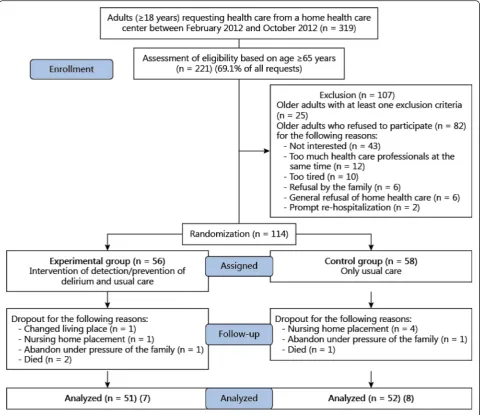
One hundred and fourteen participants were recruited to the study and assigned to groups using computerized block randomization (4 participants per block) using opaque sealed envelopes. They were allocated to either the EG (n= 56) or the CG (n= 58). Totals of 51 EG par-ticipants and 52 CG parpar-ticipants completed the study. Every participant, the principal investigator (PI), and the GCNs who carried out the interventions were aware of the group allocations because nursing interventions needed to be prepared and adapted to the patients. As a pilot study, it was not necessary to calculate sample sizes [25], however, this study managed to recruit a sample al-most equal in size to the few other existing studies on delirium prevention in hospital settings [26, 27].
Instruments and procedures
The PI and GCNs collected data on the socio-demographic characteristics, symptoms/signs of delirium (CAM), delirium risk factors, cognition (MMSE), physical status (ADL/IADL), comorbidities (Cumulative Illness Rating Scale for Geriatrics, CIRS-G), and medication use of both groups. These data were collected through ques-tionnaires, patient records, and face-to-face interviews. Inter-rater reliability between the PI and the GCNs was excellent with regards to the assessment of the CAM and ADL/IADL (with Cohen’s Kappa coefficients of 0.79 and 0.85, respectively), and the results of the MMSE and CIRS-G (with intraclass correlations of 0.92 and 0.83, re-spectively) [28]. The PI and GCNs also collected data on the duration of the baseline assessment (mins/assess-ment), the number of interventions (1–5), the duration of these interventions (mins/intervention), the duration of the assessments of symptoms/signs of delirium using the CAM in patient records, and using measurement instru-ments (mins/assessment) at study entry (M1) and after one month (M2). Besides duration, data related to inter-ventional and methodological feasibility and acceptability were also collected throughout the study; these came from the personal notes written by the PI and the CGNs, as well as the comments from participants and informal care-givers; these were analyzed subsequently [29, 30].
More specifically, acceptability data were collected about recruitment, the participant retention rate, and the number and timing of nursing interventions. Add-itionally, the GCNs assessed their own adherence to
the number of patient-centered nursing interventions and their completion rate for the full set of interven-tions. At the end of the study (M2), older adults and their informal caregivers from the EG answered open-ended questions on the acceptability and safety of nursing activities. With regards to feasibility and ac-ceptability, each intervention was examined using the number of procedures carried out as well as the bar-riers and facilitators to of the procedures in data col-lection and the organization of the strategy (Table 2).
Data analysis
Comparisons within and between groups were per-formed, and the most appropriate statistical tests were selected according to the type of variables. Statistical analyses were performed using the IBM-Statistical Package for Social Sciences (IBM-SPSS®), version 21 [31]. A statistical significance threshold value was established at
p= 0.05, and all tests were two-tailed. Qualitative data were summarized using content analysis [32, 33]. In order to assess the number of symptoms/signs of delirium using the CAM, as documented in patient records after the provision of usual care by community health nurses, well-established analytical approaches were used [34, 35].
Results
Socio-demographic profiles
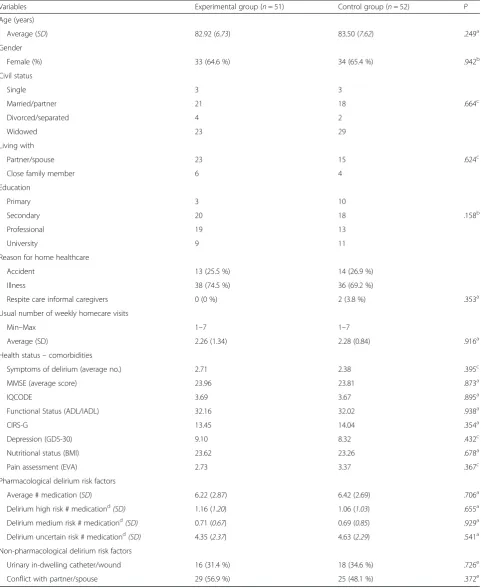
The two groups did not differ significantly with regards to socio-demographic characteristics, health status, or risk factors of delirium. The majority of participants were widowed older women (>82 years old), living alone, and with a lower or vocational level of education. Loss of independence after an acute illness was the most common reason for being prescribed homecare services. The health status of participants, as measured using the MMSE, CAM and Geriatric Depression scale (GDS),
Table 2Evaluation of feasibility and suitability among home-dwelling older adults and their informal caregivers
Feasibility -Recruitment -Retention rate
-Adherence to the interventions -Duration of the interventions
-Suitability and safety of the interventions -Difficulties and constraints during interventions
Suitability -Duration of measurement
-Adequacy of the recruitment strategy -Adequacy of the randomization process -Adequacy of the data collection process
oAccessibility of data in a home healthcare setting
oData collection from participants and their informal caregivers
showed important rates of comorbidities, with high average numbers of symptoms and signs of cognitive impairment, delirium, and depression; daily polymedi-cation often included more than six drugs. No signifi-cant difference was observed between the mean number of usual care interventions provided by com-munity healthcare nurses in the EG and the CG. More than half of the participants indicated being stressed by situations involving personal conflict (Table 3). Further-more, participants did not differ significantly from those who refused to participate.
Acceptability of the intervention
Recruitment
During the recruitment period, 319 medical prescrip-tions and discharge reports requesting homecare for older adults were reviewed in order to determine their eligibility. Of 196 older adults eligible for the study, 58 % (113/196) agreed to participate. Of the 82 refusals, 25 participants were not interested in the study, 12 declared receiving too many interventions as it was, 10 declared themselves to be too tired to participate, six refused home healthcare, two were immediately re-hospitalized, and one was immediately admitted to a nursing home. Furthermore, six family members opposed the participa-tion of their relative.
Retention rate
The study’s 91 % (103/113) participant retention rate was judged very high. Retention rates between the EG and the CG were very similar (91 % or 51/56, and 90 % or 52/58, respectively). Four participants in the EG aban-doned the study because one died, one changed geo-graphical location, one was institutionalized, and one gave no reason. Six participants in the CG abandoned the study because four were institutionalized, one died, and one left the study.
Adherence to the intervention program
A total of 244 patient-centered nursing interventions were carried out for the 51 EG participants. Forty-four participants received all five nursing interventions, three received only four, and four received only three (Fig. 1). Family members were present during 104 interventions.
Intervention duration
The duration of interventions varied between 5 and 180 mins; average duration was 59.8 mins. Details of the mini-mum, maximini-mum, and average duration of interventions
one to five are detailed in Table 4. Intervention one took an average of 12 mins more than intervention five. Using a posthoc Bonferroni correction of the p-valueat 0.013, only the shorter minimum durations of interventions two and three showed a significant difference when compared to the average duration of intervention one (Table 4).
Acceptability of the nursing interventions at home
The participants and their informal caregivers stated that all the interventions provided during the homecare visits (n= 244) had improved their quality of life and de-creased the discomforts of their ill-health. All the partic-ipants collaborated actively during the interventions and expressed their satisfaction directly to the homecare nurses. Participants with a high-school level education or higher were particularly interested in health education and health promotion information concerning delirium risk factors.
The qualitative data was collected among 44 out of 51 (79 %) of the EG participants during the last nurs-ing intervention. Open-ended questions were used in a semi-structured interview (before T1). These inter-views were recorded and summarized using content analysis [32, 36]. They stated that the interventions they had experienced had been both efficient and patient-centered. Favorable progress in the health sta-tus of the three participants who had undergone an elective hip replacement meant that homecare visits stopped after intervention three, and a further four participants stopped after intervention four. Two sup-plementary explanations were necessary to clarify non-pharmacological risk factors of delirium and to ensure that patients adhered more closely to the pre-scribed medication doses. During the final interven-tion, seven participants stated that the number, content, duration, and intensity of the interventions provided had been well adapted to their health status.
Acceptability and safety of interventions
Homecare nurses mentioned the positive feedback that they had received from EG participants; these indicated that nursing interventions had caused no safety issues, whether physical (falls) or psycho- logical (increased anxiety). Nurses’ observations also highlighted the in-appropriate accommodation conditions endured by some of the participants suffering from mobility and sensorial impairment. Neither the M1 and M2 assess-ments nor the EG interventions were in any way consid-ered to be disruptions to the homecare nurses’ usual activities or to the homecare setting.
Table 3Basic assessment of participants’socio-demographic characteristics, health status, and delirium risk factors
Variables Experimental group (n= 51) Control group (n= 52) P
Age (years)
Average (SD) 82.92 (6.73) 83.50 (7.62) .249a
Gender
Female (%) 33 (64.6 %) 34 (65.4 %) .942b
Civil status
Single 3 3
Married/partner 21 18 .664c
Divorced/separated 4 2
Widowed 23 29
Living with
Partner/spouse 23 15 .624c
Close family member 6 4
Education
Primary 3 10
Secondary 20 18 .158b
Professional 19 13
University 9 11
Reason for home healthcare
Accident 13 (25.5 %) 14 (26.9 %)
Illness 38 (74.5 %) 36 (69.2 %)
Respite care informal caregivers 0 (0 %) 2 (3.8 %) .353a
Usual number of weekly homecare visits
Min–Max 1–7 1–7
Average (SD) 2.26 (1.34) 2.28 (0.84) .916a
Health status–comorbidities
Symptoms of delirium (average no.) 2.71 2.38 .395c
MMSE (average score) 23.96 23.81 .873a
IQCODE 3.69 3.67 .895a
Functional Status (ADL/IADL) 32.16 32.02 .938a
CIRS-G 13.45 14.04 .354a
Depression (GDS-30) 9.10 8.32 .432c
Nutritional status (BMI) 23.62 23.26 .678a
Pain assessment (EVA) 2.73 3.37 .367c
Pharmacological delirium risk factors
Average # medication (SD) 6.22 (2.87) 6.42 (2.69) .706a
Delirium high risk # medicationd(SD) 1.16 (1.20) 1.06 (1.03) .655a
Delirium medium risk # medicationd(SD) 0.71 (0.67) 0.69 (0.85) .929a
Delirium uncertain risk # medicationd(SD) 4.35 (2.37) 4.63 (2.29) .541a
Non-pharmacological delirium risk factors
Urinary in-dwelling catheter/wound 16 (31.4 %) 18 (34.6 %) .726e
Conflict with partner/spouse 29 (56.9 %) 25 (48.1 %) .372e
Note.a
Studentttest;b
Fisher Exact Test;c
Mann-WhitneyUtest;d
following the American Geriatrics Society 2012 Beers Criteria Update Expert Panel, (Resnick & Pascala, 2012);e
The study recorded a number of complications to carrying out interventions: seven participants had diffi-culties reading and writing in French; 12 participants had a sensorial impairment and were unable to answer simple questions, which required rapid adaptations to
the interventions. Less than 50 % of the informal care-givers were present during the consent procedure (n= 48), and even fewer were present during the interventions (n= 23), due to work commitments. In 13 % of inter-ventions, existing or latent personal conflicts between participants and their caregiver or partner reduced the applicability of certain intervention components.
Feasibility of interventions and the study as a whole
Duration of measurement and organization
The time needed to fill in the forms on health status and delirium risk factors at M1 varied between 30 and 210 mins (M = 75 mins). At M2, the time required fell to between 23 and 150 mins (M = 39 mins). The significant difference found between the time needed at M1 and
Fig. 1Recruitment of the participants
Table 4Duration of patient-centered nursing interventions
Intervention Durationa 95 % CIb p-value
Mina Maxa M (SD)a ILa,c ULa,d
Intervention 1 10 120 66.4 (25.7) 57.6 72.3
-Intervention 2 10 120 61.4 (24.6) 55.3 70.1 0.004*
Intervention 3 5 180 59.1 (31.6) 50.9 69.8 0.002*
Intervention 4 5 120 55.5 (23.8) 49.4 64.0 0.013
Intervention 5 5 150 54.0 (27.3) 45.7 62.3 0.027
Note:a
in mins;b
Confidence Interval;c
Inferior level;d
M2 (95 % CI [28.58, 43.07]) might be explained by the time needed to explain to participants and their care-givers how to fill in the questionnaires. The time needed to fill in the CAM form using clinical observations from patient records was also assessed. The time required to complete a CAM form (1,300 CAM forms from 103 pa-tient records) varied from 15–35 mins, depending on the number of usual care interventions (minimum 1 to maximum 7 weekly homecare events) carried out during the study period.
During the study period, the PI was present eight hours a day, five days a week. This enabled the PI to regularly re-cruitment participants, develop good communication with the homecare nurses, and avoid overlapping appointments between home visits to the CG and EG.
Adequacy of the recruitment strategy
Immediately after the prescription of nursing care in a homecare setting, eligible patients were contacted for a prompt appointment to explain the pilot study and the anticipated demands of participation, and to sign an informed consent form. Informal caregivers were also invited to be present. Both patients and in-formal caregivers were given 48 h to give consent. The recruitment period was spread over six months. Overall, 319 homecare prescriptions were reviewed, and 69 % were deemed eligible (221/319). Non-eligibility was mostly related to the prescription of a single homecare intervention, to the fact that patients were also receiving outpatient treatment in the hospital, or to the fact that they lived outside the study’s catchment area.
Adequacy of the randomization process
Computerized block randomization using opaque sealed envelopes containing the group assignments was adequate for allocating comparable participants to the EG and CG (Table 3). This approach allowed the timing of the five nursing interventions in the EG to be coordinated and contributed to the feasibility of the intervention strategy. Four participants randomized to the CG asked to have their assignment changed to the EG, but no changes in the groups were permitted.
Adequacy of data collection
◦Accessibility to homecare data
Data on health behavior, health status, current medical treatments, the frequency of planned care, hospitaliza-tions, institutionalization, and deaths were available through patients’ homecare records. The transcripts of the observational notes taken by the homecare nurses,
and kept in patients’records, revealed that they were in-complete in 77 % of cases, suggesting that several symp-toms/signs of delirium remained undetected.
◦Data collection from participants and their informal
caregivers
In three instances at the time of intervention, partici-pants were under the influence of alcohol and had diffi-culty filling in their questionnaires. Nine participants refused to draw a figure or write a sentence during the administration of the MMSE. Fifteen participants had no support from an informal caregiver so the Informant Questionnaire on Cognitive Decline in the Elderly (IQCODE) could not be completed. Difficulties in obtaining reliable answers on the GDS were also ob-served in participants who scored less than 15 points on the MMSE, and four of these were unable to even understand the instructions needed to fill in the GDS and the MMSE. Two interventions overlapped with usual care activities and six patients were absent for their M2 assessment.
Adherence to the study and the intervention
procedures
A well-organized timetable facilitated adherence to the study’s methodology. For example, eight participants presenting with important cognitive impairment needed the date of their M2 assessment adjusted, and the pres-ence of their informal caregivers was requested. Despite the stress endured by some participants and their infor-mal caregivers when it came to filling in the MMSE, the GDS and the IQCODE, the home health nurses men-tioned that all the participants and their informal care-givers appreciated the follow-up contact at M1 and M2 and the time and interest taken to assess how they were experiencing life at those moments.
A strict schedule and attentive follow-up prevented absences and overlaps with private or regular care ap-pointments. It was necessary to establish a maximum duration (2 h and 30 mins) for interventions with partic-ipants suffering from loneliness or social isolation so that homecare nurses did not overstay.
Adequacy of intervention content
promotion support provided by the GCNs during their interventions corresponded to the emotional, psycho-logical, and physical needs expressed by almost all the participants and their caregivers. Repeated explanations and reminders helped to ensure better adherence to pre-scribed doses of medication and to substantially reduce pharmacological risk factors for delirium.
Adequacy of number and spacing of interventions
(nurse-dose)
One hundred and six (43 %) interventions were made in the morning (8 h00 to 12 h00), and 138 (57 %) in the afternoon (13 h00 to 19 h00). No problems were ob-served during these interventions with regards to the in-tensity of the health promotion or health education activities or with regards to physical fatigue/exhaustion. Twenty-five percent of participants judged interventions one and two to be too close together, however.
Facilitators and barriers to adherence to
methodology
Some of the patients’ socio-demographic character-istics facilitated adherence to the intervention meth-odology. Nine participants principally communicated with their CGN in their Italian mother tongue, which was considered to be a factor facilitating adherence. Also, participants with higher levels of education were interested in the health education and health promotion aspects of interventions, particularly infor-mation related to the pharmacological risk factors of delirium.
One barrier to patient-centered nursing interventions with participants with impaired mobility was cluttered living spaces, including rugs rather than fitted carpets and inaccessible elevators. Also, participants with ad-vanced cognitive and hearing impairments, or with multiple symptoms/signs of delirium required the pres-ence of an informal caregiver or family member in order to receive individually adapted interventions. Three intoxicated participants significantly reduced the value of interventions on two visits.
Discussion
Numerous conclusions can be drawn from this pilot study. We can confirm that the Neuman Systems Model is an appropriate framework to underpin pre-vention as a nursing interpre-vention. This theoretical framework allows a clear and reliable identification of delirium risk factors and its early and efficient detec-tion. It also fosters the development of a nursing pre-vention strategy at home [14].
Further, this study directly targeted home-dwelling older adults presenting symptoms of delirium or delir-ium risk factors. The content and intensity of the five additional patient-centered nursing interventions were adapted to the severity of the patients’ cognitive and functional decline and aimed to prevent risk factors for delirium. Six domains of activity were implemented dur-ing each intervention, startdur-ing with the assessment and detection of the symptoms of delirium and new risk fac-tors, and the measurement of biological parameters. The favorable evolution of the cognitive and functional status of the EG participants demonstrated the adequacy, clical appropriateness and relevance of the sequence of in-terventions. This study was well accepted by the participants, their informal caregivers, and the nurses in-volved. Thus, we believe that the components of this pilot study should be considered as implementable in any future experimental randomized clinical trials [37].
The difference in duration between intervention one and the other four was mainly due to the time spent reinforcing the nurse-patient relationship, and build-ing confidence and empathy with participants and their informal caregivers. Time was also required to answer questions about how the four following inter-ventions at home would be organized. Time also helped nurses to detect loneliness and social isolation, both of which are considered important risk factors for delirium [38]. Extra time spent during interven-tion one probably contributed to motivating partici-pants to actively apply nursing recommendations, thus resulting in high levels of adherence.
The successful recruitment of participants to the study and their rapid acceptance of it can be related to several elements. Firstly, the PI spent considerable time informing homecare nurses about the usefulness and relevance of a pilot study. This resulted in a clear commitment from them to encourage homecare pa-tients to participate. This shows that homecare or community health nurses can play a key role in re-search by spreading information and encouraging eli-gible patients to participate in experimental studies [37]. Other factors facilitating the study’s organization and important to successful recruitment were the sin-gle center setting, the lack of concomitantly ongoing clinical studies, and a small catchment area including a high demographic density of patients.
Although recruitment was considered successful, ana-lyzing the reasons for refusals to participate might con-tribute to optimizing future recruitment strategies in similar studies. Indeed, half of the discharged older adults eligible refused to participate, stating, for example, that participation would mean too many forms of care at the same time, or that they were too tired. The literature shows that these types of reasons have proven to be barriers to consent in other studies [46, 47]. Other reasons for refusing to participate were fears about institutionalization or the risk of losing one’s driver’s license [48]. Finally, families who refused to support the participation of an aged relative may have feared a loss of family privacy, the disclosure of family conflicts, or other personal problems.
This present study had some limitations with regards to the feasibility and acceptability of the interventions and the study as a whole. The most significant limitation in this study concerns the onset and the delay between the discharge of the older adult and the first assessment of de-lirium with the CAM within the 2 days after having been discharged home. Delirium could have been missed with dramatic consequences such as readmission to the hos-pital or early and avoidable mortality [49]. An important concern in this study was the trustworthiness of the col-lected qualitative data among cognitive impaired older adults [37]. The facts that newly discharged older adults are exhausted, and community health nurses are over-worked or face serious time constraints, meant that a more structured interview and better-organized data registration were not feasible. Another limitation to this study is the limited feedback and collaboration from infor-mal caregivers during intervention visits. However, we es-timate it unlikely that these shortcomings can take much away from the acceptability of this innovative approach
Conclusions
This pilot study demonstrated the beneficial effects of the patient-centered nursing interventions aiming to
improve delirium at home [3]. The Neuman Systems Model theoretical framework revealed itself to be appro-priate for conducting nursing intervention studies of de-lirium at home [50]. Participants, informal caregivers, and homecare nurses expressed their satisfaction throughout the different stages of the intervention strat-egy and the study as a whole; they also considered the interventions to be acceptable, and their number and spacing appeared to be feasible. These results are prom-ising; they challenge researchers to develop similar pro-jects with the ultimate aim of allowing older adults to remain at home longer in optimal conditions of physical and mental health.
Ethics approval and consent to participate
The regional Research Ethics Committee of the Canton of Valais approved the study protocol (CCVEM 030/11). After presenting and explaining the study to potential participants, they were required to sign informed con-sent forms; if they scored below 15 points on the MMSE, then their informal caregivers were asked to sign instead.
Abbreviations
ADL/IADL:Katz and Lawton Index of activities of daily living; CAM: confusion assessment method; CG: control group; CIRS-G: cumulative illness rating scale for geriatrics; EG: experimental group; GCN: geriatric clinical nurse; GDS: geriatric depression scale; IQCODE: informant questionnaire on cognitive decline in the elderly; M1: start of the study; M2: study after 1 month; MMSE: mini-mental state examination; PI: principal investigator.
Competing interests
The authors declare that they have no competing interests. Financial competing interests: none.
Non-financial competing interests: none.
Authors’contributions
HV developed the study concept, the study design, collected, analyzed and interpreted the data and drafted the manuscript. CG participated in the study concept, contributed in the data interpretation and in the drafting of the manuscript. AvG contributed in the study concept, the data analysis and in the drafting of the manuscript. DM participated in the study design and in the drafting of the manuscript. All authors contributed toward data analysis, drafting and revising the paper, approved the final version and agree to be accountable for all aspects of the work.
Acknowledgments
We thank the patients and their families for their participation. This study would not have been possible without the input of Ms Ariane Kapps (a Master of Science student who helped with intervention development), as well as the work of all the participating nurses from the Home Healthcare Service of Valais. The authors also thank Ms. Sylvana Gerber for her contribution towards successful data collection. This study was funded in part by the Leenaards Foundation, Swiss Alzheimer Association, Public Health Service of the State of Valais, and the University of Applied Sciences of Nursing La Source, Lausanne, Switzerland. The sponsors played no role in the design and conduct of the study, data collection, management, analysis, or interpretation of the data, nor in the preparation, review, or approval of the manuscript.
Author details
1
Lausanne University Hospital, 10, Rte de la Corniche, CH-1010 Lausanne, Switzerland.4Faculty of Nursing Science, Université Laval, Québec, Canada. 5Department of Psychiatry, Service Universitaire de Psychiatrie de l’Age Avancé (SUPAA), Lausanne University Hospital, CH-1008 Prilly, Switzerland.
Received: 13 July 2015 Accepted: 8 March 2016
References
1. Inouye SK, Westendorp RG, Saczynski JS. Delirium in elderly people. Lancet. 2014;383(9920):911–22.
2. Saczynski JS, Marcantonio ER, Quach L, Fong TG, Gross A, Inouye SK, Jones RN. Cognitive Trajectories after Postoperative Delirium. N Engl J Med. 2012; 367(1):30–9.
3. de Lange E, Verhaak PFM, van der Meer K. Prevalence, presentation and prognosis of delirium in older people in the population, at home and in long term care: a review. Int J Geriatr Psychiatry. 2013;28(2):127–34. 4. Hasegawa N, Hashimoto M, Yuuki S, Honda K, Yatabe Y, Araki K, Ikeda M.
Prevalence of delirium among outpatients with dementia. Int Psychogeriatr. 2013;25(11):1877–83.
5. Siddiqi N, Holt R, Britton AM, Holmes J. Interventions for preventing delirium in hospitalized patients. Cochrane Database Syst Rev 2009, 4:10. 1002/14651858.CD14005563.pub14651852.
6. Fong TG, Tulebaev SR, Inouye SK. Delirium in elderly adults: diagnosis, prevention and treatment. Nat Rev Neurol. 2009;5(4):210–20.
7. Han JH, Shintani A, Eden S, Morandi A, Solberg LM, Schnelle J, Ely W. Delirium in the emergency department: an independent predictor of death within 6 months. Ann Emerg Med. 2010;56:244–52.
8. Fick DM, Hodo DM, Lawrence F, Inouye SK. Recognizing delirium superimposed on dementia: assessing nurses' knowledge using case vignettes. J Gerontol Nurs. 2007;33(2):40–7.
9. Verloo H, Goulet C, Morin D, von Gunten A. Delirium among Home-Dwelling Elderly after a recent hospitalization: An urgent need for effective nursing interventions. Dement Geriatr Cogn Disord Extra. 2012;2:187–9.
10. Anderson CP, Ngo LH, Marcantonio ER. Complications in postacute care are associated with persistent delirium. J Am Geriatr Soc. 2012;60(6):1122–7. 11. Huang L, Inouye SK, Fong TG, Rudolph JL, Marcantonio ER. Review of
Systems for Delirium: A Framework to Advance Understanding and Recognition. J Am Geriatr Soc. 2011;59:S54.
12. Bond SM. Delirium at home: strategies for home health clinicians. Alzheimer’s Care Today. 2009;10(2):99–107.
13. Medical Research Council. Developing and Evaluating Complex Interventions: New Guidance. London: Medical Research Council; 2008. 14. Neuman B, Fawcett J. The Neuman Systems Model. 5th ed. Pearson
Education: New-York; 2011.
15. Bartholomew LK, Parcel GS, Kok G, Gottlieb NH, Fernandez ME. Planning Health promotion programs: an intervention mapping approach. 3rd ed. San Francisco, US: Jossey-Bass; 2011.
16. Sidani S, Braden CJ. Design, Evaluation, and Translation of Nursing interventions. Oxford, UK: Wiley-Blackwell; 2011.
17. van Meijel B, Gamel C, van Swieten-Duijfjes B, Grypdonck MH. The development of evidence-based nursing interventions: methodological considerations. J Adv Nurs. 2004;48(1):84–92.
18. Hshieh TT, Chen P, Dowal S, Inouye SK. Knowledge-To-Action for Delirium Prevention: Diffusion of the Hospital Elder Life Program (HELP). J Am Geriatr Soc. 2012;60:S114.
19. Inouye SK, Bogardus ST, Baker DI, Leo-Summers L, Cooney LM. The Hospital Elder Life Program: A model of care to prevent cognitive and functional decline in older hospitalized patients. J Am Geriatr Soc. 2000; 48(12):1697–706.
20. Margitic SE, Inouye SK, Thomas JL, Cassel CK, Regenstreif DI, Kowal J. Hospital Outcomes Project for the Elderly (HOPE): rationale and design for a prospective pooled analysis. J Am Geriatr Soc. 1993;41(3):258–67. 21. Foreman MD, Mion LC, Tryostad L, Fletcher K. Standard of practice
protocol: acute confusion/delirium. NICHE Faculty. Geriatr Nurs. 1999; 20(3):147–52.
22. Counsell SR, Holder CM, Liebenauer LL, Palmer RM, Fortinsky RH, Kresevic DM, Quinn LM, Allen KR, Covinsky KE, Landefeld CS. Effects of a multicomponent intervention on functional outcomes and process of care in hospitalized older patients: a randomized controlled trial of
Acute Care for Elders (ACE) in a community hospital. J Am Geriatr Soc. 2000;48(12):1572–81.
23. National Institute for Health and Care Excellence. Delirium : diagnosis, prevention and management. In: Clinical Guideline 103. Londres: National Institute for Health and Clinical Excellence; 2010.
24. Registered Nurses' Association of Ontario - L'Association des infirmières et infirmiers autorisés de l'Ontario. Screening for delirium, dementia and depression in older adults. Toronto, Canada: Registered Nurses Association of Ontario; 2003.
25. Thabane L, Ma J, Chu R, Cheng J, Ismaila A, Rios LR, Goldsmith CH. A tutorial on pilot studies: the what, why and how. BMC Med Res Methodol. 2010;10:1.
26. Milisen K, Foreman MD, Abraham IL, De Geest S, Godderis J, Vandermeulen E, Fischler B, Delooz HH, Spiessens B, Broos PL. A nurse-led interdisciplinary intervention program for delirium in elderly hip-fracture patients. J Am Geriatr Soc. 2001;49(5):523–32.
27. Inouye SK, Bogardus ST, Charpentier PA, Leo-Summers L, Acampora D, Holford TR, Cooney LW. A multicomponent intervention to prevent delirium in hospitalized older patients. New Engl J Med. 1999;340(9):669–76. 28. Hair JKJ, Black WC, Babin BJ, Anderson RE. Multivariate data analysis: a
global perspective. 7th ed. New Jersey, US: Pearson Education Inc; 2010. 29. Feeley N, Cossette S, Côté J, Héon M, Stremler R, Martorella G, Purden M. The
Importance of Piloting an RCT Intervention. Can J Nurs Res. 2009;41(2):84–99. 30. Conn VS, Algase DL, Rawl SM, Zerwic JJ, Wyman JF. Publishing Pilot
Intervention Work. West J Nurs Res. 2010;32(8):994–1010. 31. IBM-SPSS. Statistical Package for Social Sciences. Somer, NY: IBM
Corporation; 2011.
32. Burla L, Knierim B, Barth J, Liewald C, Duetz M, Abel A. From Text to Codings: Intercoder Reliability Assessment in Qualitative Content Analysis. Nurs Res. 2008;57(2):113–7.
33. Waltz CF, Strickland OL, Lenz ER. Measurement in Nursing and Health research. 4th ed. New York, US: Springer Publishing Company; 2010. 34. Steis M, Fick DM. Delirium superimposed on dementia: accuracy of nurse
documentation. J Gerontol Nurs. 2012;38(1):32–42.
35. Voyer P, Cole MG, McCusker J, St-Jacques S, Laplante J. Accuracy of nurse documentation of delirium symptoms in medical charts. Int J Nurs Pract. 2008;14(2):165–77.
36. Ritchie L, Lewis J, McNaughton Nicholls C, Ormston R. Qualitative Research Practice: a guide for social science students and researchers. 12th ed. Washington DC: Sage; 2014.
37. Cherubi A, Bernabei R, Ferrucci L, Marchionni N, Studenski S, Vellas B. Clinical Trials in Older Adults. 1st ed. New York: John Wiley Blackwell; 2015. 38. Bilotta C, Case A, Nicolini P, Mauri S, Castelli M, Vergani C. Social vulnerability,
mental health and correlates of frailty in older outpatients living alone in the community in Italy. Aging Ment Health. 2010;14(8):1024–36.
39. Duncan V. Barriers to Frontline Surgical Nurse Detection of Delirium in the Hospitalized Older Adult. Canada: University of Victoria; 2012.
40. Yang Y-H. Comprehension and Knowledge about Delirium in Nurses Working at Long-Term Care Hospitals or General Hospitals. J Korean Acad Soc Nurs Educ. 2010;16(2):312–20.
41. Heidrich DE. Delirium: an under-recognized problem. Clin J Oncol Nurs. 2007;11(6):805–7.
42. Hare M, Wynaden D, McGowan S, Landsborough I, Speed G. A questionnaire to determine nurses' knowledge of delirium and its risk factors. Contemp Nurse. 2008;29(1):23–31.
43. Malenfant P, Voyer P. Detecting delirium in older adults living at home. J Community Health Nurs. 2012;29(2):121–30.
44. Morandi A, Solberg LM, Habermann R, Cleeton P, Peterson E, Ely EW, Schnelle J. Documentation and management of words associated with delirium among elderly patients in postacute care: a pilot investigation. J Am Med Dir Assoc. 2009;10(5):330–4.
45. Milisen K, Foreman MD, Wouters B, Driesen R, Godderis J, et al. Documentation of Delirium in elderly partients with hip fracture. Journal of Gerontological Nursing. 2002;28(11):23–9.
46. Voyer P, Lauzon S, Collin J, Cousins SO. Research method issue: recruiting and retaining subjects in a research study. Nurse Res. 2008;15(3):12–25. 47. Mody L, Miller DK, McGloin JM, Freeman M, Marcantonio ER, Magaziner J,
Studenski S. Recruitment and retention of older adults in aging research. J Am Geriatr Soc. 2008;56(12):2340–8.
49. Eeles EMP, Hubbard RE, White SV, O'Mahony MS, Savva GM, Bayer AJ. Hospital use, institutionalisation and mortality associated with delirium. Age Ageing. 2010;39(4):470–5.
50. Fawcett J, Gigliotti E. Using conceptual models of nursing to guide nursing research: the case of the Neuman systems model. Nurs Sci Q. 2001;14(4): 339–45.
• We accept pre-submission inquiries
• Our selector tool helps you to find the most relevant journal
• We provide round the clock customer support
• Convenient online submission
• Thorough peer review
• Inclusion in PubMed and all major indexing services
• Maximum visibility for your research
Submit your manuscript at www.biomedcentral.com/submit