R E S E A R C H A R T I C L E
Open Access
Insufficient uptake of systematic search
methods in oncological clinical practice
guideline: a systematic review
Chiara Trevisiol
1†, Michela Cinquini
2†, Aline S. C. Fabricio
3, Massimo Gion
3*and Anne W. S. Rutjes
4,5Abstract
Background:The use of systematic review methods are widely recognized to be essential in the development of
recommendations in clinical practice guidelines to prove their trustworthiness. The objective of this study was to assess the use of systematic search methods by authors of guidelines published in the oncology field.
Methods:We analyzed 590 guidance documents identified in PubMed, NGC, GIN and web sites for guidelines in
2009–2015 in oncology. The main outcome measure used was incidence of guidance documents supported by a systematic search of the literature. In addition to descriptive analyses, logistic regression was used to evaluate if adequate search methods were explained by guideline characteristics.
Results:Of 590 guidance documents included in the study, 305 (51.7%) declared the use of systematic search methods but only 168 (28.5%) applied methods meeting minimum standards for quality and provided sufficient details to allow classification. 164 (27.8%) guidance documents did not report any use of literature evaluation. Guidance documents produced by a Government Agency in North America (OR 2.16, 95% CI 1.16–4.17) and those with a focused scope (OR 2.35, 95% CI 0.97–5.56) were positively associated with the use of systematic search methods. We found no association between the year of publication and use of systematic search methods. Conclusions:A relatively small number of guidance documents was informed by scientific evidence identified through adequate systematic search methods. We observed substantial room for improvement of applied methods and reporting, especially in documents with a broad focus, or those produced by professional societies or
independent expert panels in other continents than North America.
Keywords:Guideline, Systematic review, Reporting quality, Oncology, Reproducibility of result
Background
Clinical practice guidelines (CPGs) are defined by Institute of Medicine (IOM) as statements that include recommen-dation intended to optimize patient care. They are in-formed by a systematic review of evidence and assessment of the benefit and harms of alternative care options [1]. This definition emphasizes the fact that clinical recom-mendations need to be based on the best available evi-dence evaluated through a systematic review of the medical literature.
According to the Cochrane collaboration handbook“A systematic review attempts to collate all empirical evi-dence that fits pre-specified eligibility criteria in order to answer a specific research question. It uses explicit, sys-tematic methods that are selected with a view to minimiz-ing bias, thus providminimiz-ing more reliable findminimiz-ings from which conclusions can be drawn and decisions made.”[2–4].
Similarly, the IOM and the Guidelines International Network (GIN) recommend that guideline developers use systematic review methods to identify and evaluate evidence related to the guideline topic [1, 5]. Selective assessment and unstructured appraisal of the literature may lead to recommendations that promote suboptimal or even harmful care [6]. Therefore, clinicians should consider whether recommendations in a guideline are
© The Author(s). 2019Open AccessThis article is distributed under the terms of the Creative Commons Attribution 4.0 International License (http://creativecommons.org/licenses/by/4.0/), which permits unrestricted use, distribution, and reproduction in any medium, provided you give appropriate credit to the original author(s) and the source, provide a link to the Creative Commons license, and indicate if changes were made. The Creative Commons Public Domain Dedication waiver (http://creativecommons.org/publicdomain/zero/1.0/) applies to the data made available in this article, unless otherwise stated.
* Correspondence:[email protected]
†Chiara Trevisiol and Michela Cinquini contributed equally to this work.
3Regional Center for Biomarkers, Department of Clinical Pathology, Azienda
relevant to their practice only after having verified that the guideline has been prepared according to proper methodological requirements.
A well-defined, transparent and reproducible search strategy along with grey literature searches and selection criteria to include evidence should be the starting point to achieve evidence-based CPGs [7].
The quality of practice guidelines has already been a source of concern in the past. In a previous overview Grilli and colleagues found that 87% of 431 analyzed guidelines did not report any information on the system-atic search, although the proportion of guidelines report-ing some form of search increased over time (2% in 1988–91 to 18% in 1996–98) [8].
The landscape for CPGs has significantly changed in the last two decades since the National Guideline Clearinghouse [9] was launched, the GIN Inter-national Guidelines Network [10] was established, and the Appraisal of Guidelines for Research and Evaluation (AGREE) consortium [11] and the Grad-ing of Recommendations Assessment, Development and Evaluation (GRADE) working group [12] started their activities. GRADE methodology has impacted on CPGs definition and grading the quality of evi-dence, while quality and reporting for CPGs are widely evaluated by AGREE II tool. Nonewithstand-ing, we assisted to a world-wide proliferation of CPGs produced with different methods, and pub-lished in different reporting modalities by different panels.
Considering that systematic review of published evi-dence is an essential component in the methodo-logical process of CPGs production, understanding how search strategies are used by Guideline Develop-ment Panels (GDPs) is important. Recently, three arti-cles on reporting CPGs were published, but none of them assessed whether GDPs provided sufficient de-tails to conclude that systematic searches were indeed performed [7, 13, 14].
In fact, from a methodological point of view a guide-line is classified as Clinical Practice Guideguide-line when it provides sufficient details to demonstrate that a system-atic search and other systemsystem-atic review steps were per-formed. In absence of any description of the search, or if the described strategy did not meet a set of minimum criteria, the document would be best referred to as
“guidance document”[15].
The objective of this study, that is collateral to a na-tional project aiming at synthesizing recommendations on traditional circulating tumor markers in solid tumors [16–18], was to assess the use of systematic search methods in CPGs in oncological field as a test context framework, and to determine which context variables were associated with adequate use.
Methods Search strategy
A systematic literature search for existing guidelines in oncology published in English or Italian was undertaken using PubMed, National Guideline Clearinghouse, GIN Library databases and websites of 11 organizations and 61 Italian scientific societies producing CPGs. The search strategy was built with keywords related to cancer and guidelines. Full details are described in Add-itional file 1. Selection was independently performed by 3 examiners on the basis of the titles and abstracts of the identified records. A record was default included when at least 2 out of 3 examiners opted for inclusion. When only one examiner opted for inclusion, disagree-ment was resolved by discussion.
Full-text reports were retrieved for the potentially eli-gible documents. Every reasonable effort was made to lo-cate related reports to included guidance documents online, that could provide additional information regard-ing the methodology used to generate the CPG recommendations.
Selection criteria
Any document containing information and recommen-dations pertaining to diagnosis, work-up, management, treatment or follow-up of tumors on adult population was included. Moreover, documents had to meet all of the following eligibility criteria to be included:
contain recommendations intended to optimize patient care and assist physicians, other practitioners and patients, to make decisions about appropriate health care for specific clinical circumstances;
be produced under the auspices of, or endorsed by, government agencies or health care organizations, medical specialty associations or relevant
professional societies;
be produced, reviewed, reassessed for validity or updated between 2009 and 2015;
being accessible in the public domain.
The following documents were excluded from the analysis:
guidelines concerning malignancies in which traditional circulating tumor markers are not considered (e.g. brain tumors, soft tissue tumors, musculoskeletal tumors, non-melanoma skin can-cers, hematological malignancies, hereditary/familial cancers);
guidelines concerning malignancies in which traditional circulating tumor markers have no role in risk assessment or in the management
palliative care; documents focused on specific subgroups of patients, such as pregnant women, children, adolescents, homeless people);
health technology assessment reports, systematic review and network meta-analyses;
narrative reviews and comments or editorials accompanying the guidelines;
guidelines developed and issued by an individual(s) not officially sponsored or supported by one of the organization types cited above.
Some reports were identified as multiple reports be-longing to an unique guidance document if they were ei-ther ordered by the same organization/producer or produced during the same consensus meeting or if they were explicitly cited in the main guidance document. In these cases all the identified multiple reports were in-cluded to allow for a full appreciation of the guideline but they count as one document in our logistic analyses.
When the same guideline developer or GDP published guidance documents in different formats (summarized, abridged, or full version), or published in different jour-nals or websites, we included the most recent un-abridged version as main report.
Data extraction
For each included guidance document, we collected the following characteristics.
year of publication;
scope of guidelines: broad (Multi-aspect, e.g. from diagnosis to metastatic disease management) or focused (centered on a specific clinical question or topic);
type of organization/producer classified as
Professional/Specialist Society, Government Agency, Independent Expert Panel, Other (Not-for-profit Organization, For-profit Organization, International Agency-i.e. WHO, Academic Institution);
continent (considering the“seven-continent model”) classified as North America (United States, Canada), South America, Europe, Asia, Oceania, Africa, International (GDP members or producers from two or more continents);
cancer type.
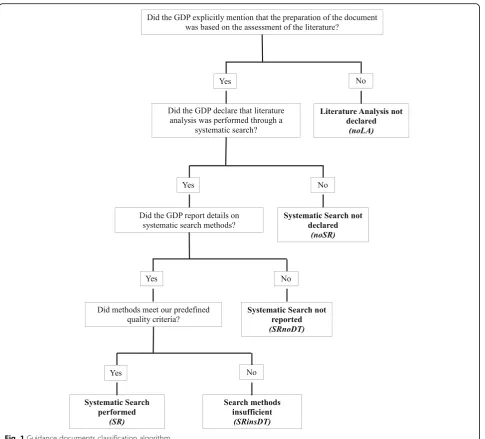
Detailed information on degree of traceability of pub-lished evidence in the produced recommendations was collected following this pattern (Fig.1):
Was the production of recommendations based on any literature analysis?
If yes, did the GDP declare a systematic search of literature?A very inclusive approach was used, for
example, it was considered sufficient that the general review process was described as
“comprehensive”or“extensive”, or that a database search was done.
If yes, did the GDP report details on the systematic review methods (i.e.biomedical database and/or web site search, keywords)?
A systematic search strategy was considered sufficient and appropriate when all of the following three criteria were met:
explicit reporting of the use of at least one biomedical database (e.g. MEDLINE);
use of at least one additional source to retrieve citations, such as another biomedical database, screening of reference lists of included reports, personal communication with investigators or organizations;
explicit description of the search terms used in bibliographic search(es).
When above criteria were met, the guidance document was classified as being informed by a systematic search method (SR). These criteria were inspired by the de-scriptions of Oxman and Guyatt in 1988 [19,20]. A very similar approach was used by NICE in 2004 [21].
Two reviewers (CT, MC) have independently evaluated the guidance documents classifying them as documents:
without explicit description of the use of literature analysis (noLA);
with literature analysis but without reference to the use of systematic search methods (noSR);
described to be based on one or more systematic reviews, not providing details to demonstrate it (SRnoDT);
described to be based on one or more systematic reviews, with a search strategy not meeting our quality criteria (SRinsDT);
described to be based on one or more systematic reviews, with a search strategy meeting our quality criteria (SR).
Any disagreement on the classification process was re-solved by discussion or involvement of a third examiner (AR) until consensus was reached.
Data analysis
The association between several guideline characteris-tics and the type of literature evaluation was examined by univariate regression model analysis in two models.
Model 1 included the whole sample of guidelines, in order to compare documents declaring the use of sys-tematic search methods (SR; SRinsDT; SRnoDT) with documents without declaration of systematic review or a literature analysis (noSR and noLA). Model 2 was re-stricted to documents declaring the use of systematic search methods. In this model, we evaluated the associ-ation between guideline characteristics and the use of adequate search methods. The dependent variable in these logistic regression analyses was dichotomized in sufficient and appropriate (SR, as defined above) vs. less rigorous systematic search strategy (SRinsDT & SRnoDT). We presented the results ofModel 2into two
separate analyses, (SR vs SRinsDT) and (SR vs SRnoDT), respectively.
Documents produced from and published by the same organization, were included as a clustering variable in the regression analyses to obtain robust variances.
The independent variables evaluated in both models concerned:
a. year of publication as continuous variable; b. type of organization/producer as categorical
variable, definingGovernment Agencyas the contrast;
c. scope as categorical variable, definingBroadas the contrast;
d. continent as categorical variable, defining
Using a cut-off p-value of 0.05, we included candidate variables in a multivariable model to assess the predic-tors of the use of well conducted/reported systematic search methods.
Results are reported as odds ratios (ORs) with 95% CIs. Analyses were performed using SAS (Statistical Analysis System, SAS Institute Inc., Cary, NC, USA, Ver-sion 9.2) software. All tests were two-sided andP< 0.05 was used to determine statistical significance.
The study involved no human participants and re-quired no ethical approval.
Results
Selection of guidelines
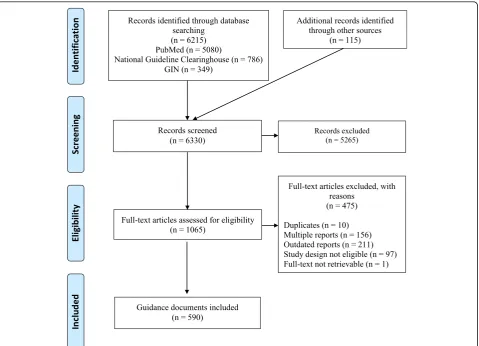
Overall, of 6330 titles and abstract retrieved from the da-tabases and websites searches, 1065 reports were identi-fied as potentially eligible. Four hundred seventy-five were excluded after screening of the full-text. A final set of 590 guidance documents was identified. Full list is re-ported in Additional file 2. Figure 2 shows a modified PRISMA flow diagram [22].
Guideline characteristics
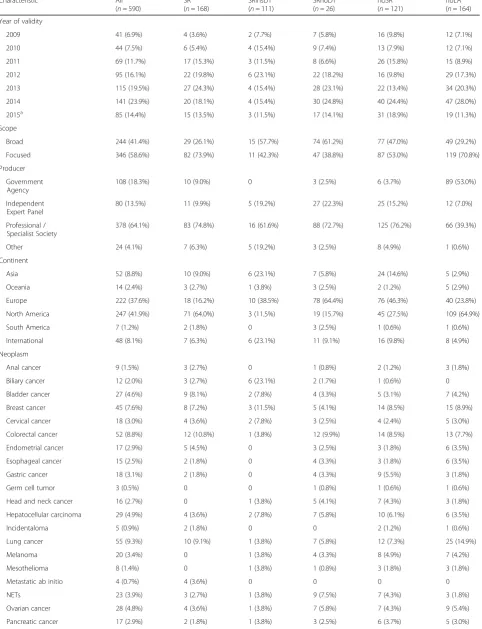
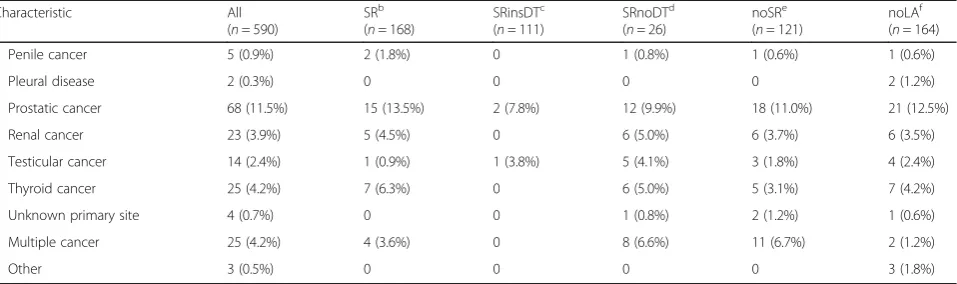
Table 1 shows the characteristics of the included guid-ance documents. Overall, the number of guidelines in-creased during the years and their scope was focused in 346/590 (58.6%). Most of the documents were developed by Professional or Specialist Societies (378/590, 64.1%), followed by Government Agencies (108/590, 18.3%) and by Independent Expert Panels (80/590, 13.6%). They were published predominantly in North America (247/ 590, 41.9%) and Europe (222/590, 37.6%). No document published in Africa was identified. Guidelines were re-lated to all tumor types, with the number of identified documents ranging from 2 documents for pleural neo-plasm to 68 documents for prostatic cancer.
One hundred sixty four (27.8%) documents did not de-clare any literature analysis, while 72.2% (n= 426) based the production of recommendations on literature evalu-ation. Of these 121 (28.4%) did not report a systematic literature review.
In 305 guidelines the GDP declared to have performed a systematic search of the literature. In this subgroup, 168/305 (55.1%) met our quality standards, 111/305
Table 1Characteristics of 590 guidance documents by type of search methods
Characteristic All
(n= 590)
SRb (n= 168)
SRinsDTc (n= 111)
SRnoDTd (n= 26)
noSRe (n= 121)
noLAf (n= 164)
Year of validity
2009 41 (6.9%) 4 (3.6%) 2 (7.7%) 7 (5.8%) 16 (9.8%) 12 (7.1%)
2010 44 (7.5%) 6 (5.4%) 4 (15.4%) 9 (7.4%) 13 (7.9%) 12 (7.1%)
2011 69 (11.7%) 17 (15.3%) 3 (11.5%) 8 (6.6%) 26 (15.8%) 15 (8.9%)
2012 95 (16.1%) 22 (19.8%) 6 (23.1%) 22 (18.2%) 16 (9.8%) 29 (17.3%)
2013 115 (19.5%) 27 (24.3%) 4 (15.4%) 28 (23.1%) 22 (13.4%) 34 (20.3%)
2014 141 (23.9%) 20 (18.1%) 4 (15.4%) 30 (24.8%) 40 (24.4%) 47 (28.0%)
2015a 85 (14.4%) 15 (13.5%) 3 (11.5%) 17 (14.1%) 31 (18.9%) 19 (11.3%)
Scope
Broad 244 (41.4%) 29 (26.1%) 15 (57.7%) 74 (61.2%) 77 (47.0%) 49 (29.2%)
Focused 346 (58.6%) 82 (73.9%) 11 (42.3%) 47 (38.8%) 87 (53.0%) 119 (70.8%)
Producer
Government Agency
108 (18.3%) 10 (9.0%) 0 3 (2.5%) 6 (3.7%) 89 (53.0%)
Independent Expert Panel
80 (13.5%) 11 (9.9%) 5 (19.2%) 27 (22.3%) 25 (15.2%) 12 (7.0%)
Professional / Specialist Society
378 (64.1%) 83 (74.8%) 16 (61.6%) 88 (72.7%) 125 (76.2%) 66 (39.3%)
Other 24 (4.1%) 7 (6.3%) 5 (19.2%) 3 (2.5%) 8 (4.9%) 1 (0.6%)
Continent
Asia 52 (8.8%) 10 (9.0%) 6 (23.1%) 7 (5.8%) 24 (14.6%) 5 (2.9%)
Oceania 14 (2.4%) 3 (2.7%) 1 (3.8%) 3 (2.5%) 2 (1.2%) 5 (2.9%)
Europe 222 (37.6%) 18 (16.2%) 10 (38.5%) 78 (64.4%) 76 (46.3%) 40 (23.8%)
North America 247 (41.9%) 71 (64.0%) 3 (11.5%) 19 (15.7%) 45 (27.5%) 109 (64.9%)
South America 7 (1.2%) 2 (1.8%) 0 3 (2.5%) 1 (0.6%) 1 (0.6%)
International 48 (8.1%) 7 (6.3%) 6 (23.1%) 11 (9.1%) 16 (9.8%) 8 (4.9%)
Neoplasm
Anal cancer 9 (1.5%) 3 (2.7%) 0 1 (0.8%) 2 (1.2%) 3 (1.8%)
Biliary cancer 12 (2.0%) 3 (2.7%) 6 (23.1%) 2 (1.7%) 1 (0.6%) 0
Bladder cancer 27 (4.6%) 9 (8.1%) 2 (7.8%) 4 (3.3%) 5 (3.1%) 7 (4.2%)
Breast cancer 45 (7.6%) 8 (7.2%) 3 (11.5%) 5 (4.1%) 14 (8.5%) 15 (8.9%)
Cervical cancer 18 (3.0%) 4 (3.6%) 2 (7.8%) 3 (2.5%) 4 (2.4%) 5 (3.0%)
Colorectal cancer 52 (8.8%) 12 (10.8%) 1 (3.8%) 12 (9.9%) 14 (8.5%) 13 (7.7%)
Endometrial cancer 17 (2.9%) 5 (4.5%) 0 3 (2.5%) 3 (1.8%) 6 (3.5%)
Esophageal cancer 15 (2.5%) 2 (1.8%) 0 4 (3.3%) 3 (1.8%) 6 (3.5%)
Gastric cancer 18 (3.1%) 2 (1.8%) 0 4 (3.3%) 9 (5.5%) 3 (1.8%)
Germ cell tumor 3 (0.5%) 0 0 1 (0.8%) 1 (0.6%) 1 (0.6%)
Head and neck cancer 16 (2.7%) 0 1 (3.8%) 5 (4.1%) 7 (4.3%) 3 (1.8%)
Hepatocellular carcinoma 29 (4.9%) 4 (3.6%) 2 (7.8%) 7 (5.8%) 10 (6.1%) 6 (3.5%)
Incidentaloma 5 (0.9%) 2 (1.8%) 0 0 2 (1.2%) 1 (0.6%)
Lung cancer 55 (9.3%) 10 (9.1%) 1 (3.8%) 7 (5.8%) 12 (7.3%) 25 (14.9%)
Melanoma 20 (3.4%) 0 1 (3.8%) 4 (3.3%) 8 (4.9%) 7 (4.2%)
Mesothelioma 8 (1.4%) 0 1 (3.8%) 1 (0.8%) 3 (1.8%) 3 (1.8%)
Metastatic ab initio 4 (0.7%) 4 (3.6%) 0 0 0 0
NETs 23 (3.9%) 3 (2.7%) 1 (3.8%) 9 (7.5%) 7 (4.3%) 3 (1.8%)
Ovarian cancer 28 (4.8%) 4 (3.6%) 1 (3.8%) 7 (5.8%) 7 (4.3%) 9 (5.4%)
(36.4%) did not (i.e. only one or two quality standards criteria out of three were met) and 26/305 (8.5%) did not provide any detail on the search methods used.
Among the 111 guidance documents performing a sys-tematic search not meeting our quality standards, 12/ 111 (10.8%) reported the biomedical database search only, 36/111 (32.4%) reported details on biomedical database search and other sources, while 60/111 (54.1%) reported details on biomedical database search and words. Two guidance documents reported only the key-words and 1 reported keykey-words and other sources but not the biomedical database searched.
Regression analyses
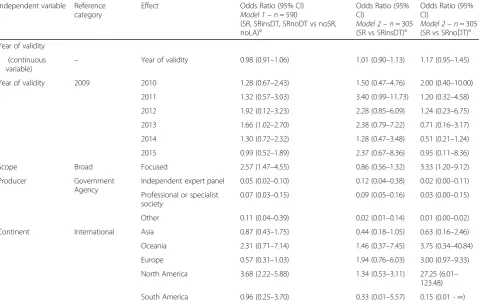
Results are reported in Table2
Model 1
The univariate models including all 590 guidance docu-ments. Despite the increased number of guidelines pro-duced over the years, the ratio between documents declaring and those not declaring the use of systematic search methods remained unchanged (OR 0.98, 95% CI 0.91–1.06). No trend was detected over the year (p for trend = 0.732).
The probability of declaring a systematic search method was strongly influenced by the scope of the guidance document. Documents with a focused scope were more likely to report the use of systematic search methods (OR 2.57, 95% CI 1.47–4.55).
Taking government agencies as a reference, all docu-ments developed by other guideline producers were less likely to declare the use a systematic search. Guidance documents produced by an independent expert panel have the highest probability of not declaring any system-atic search (OR 0.05, 95% CI 0.02–0.10).
The only continent associated with a significant higher uptake of systematic search methods was North America
with an OR of 3.68 (95% CI 2.22–5.88). This result was confirmed when considering USA and Canada as dis-tinct nationalities (data not shown).
Model 2
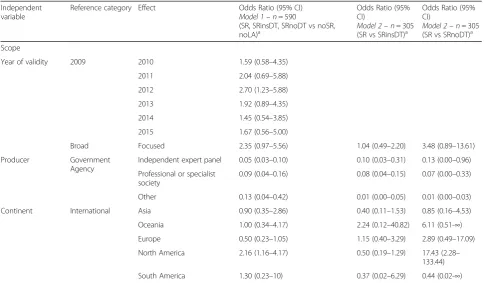
The univariate models included guidance documents ex-plicitly mentioning the use of systematic searches (n= 305). Guidelines having a focused scope and being pro-duced in North America more often met our quality cri-teria for adequate search methods (OR 3.33; 95% CI 1.20–9.12 and OR 27.25; 95% CI 6.01–123.48 respect-ively). When we used documents meeting some but not all of our quality criteria as comparator, the evidence was less conclusive (OR 0.86; 95% CI 0.56–1.32 and OR 1.34; 95% CI 0.53–3.11 respectively). Producers other than government agency were less likely to meet all or part of our quality criteria for adequate search strategies. Table 3presents results from the multivariable regres-sion analyses, confirming those from univariate models. A systematic search was more likely to be declared if documents were produced in North America, by a gov-ernment agency and with a focused scope. In model 2,
using documents not explaining search methods as com-parator, the multivariate analysis showed that documents produced in North America, by a Government agency, with a focused scope were more likely to use sufficient methods. Using documents meeting some but not all of the quality criteria as comparator, we found no
statisti-cally significant associations, except for
non-governmental bodies that remain associated with lower probabilities of using sufficient search methods.
Discussion
In the present study we analyzed guidance documents published over a 5 year period in oncology to evaluate the use of systematic searches, the adequateness of these Table 1Characteristics of 590 guidance documents by type of search methods(Continued)
Characteristic All
(n= 590)
SRb (n= 168)
SRinsDTc (n= 111)
SRnoDTd (n= 26)
noSRe (n= 121)
noLAf (n= 164)
Penile cancer 5 (0.9%) 2 (1.8%) 0 1 (0.8%) 1 (0.6%) 1 (0.6%)
Pleural disease 2 (0.3%) 0 0 0 0 2 (1.2%)
Prostatic cancer 68 (11.5%) 15 (13.5%) 2 (7.8%) 12 (9.9%) 18 (11.0%) 21 (12.5%)
Renal cancer 23 (3.9%) 5 (4.5%) 0 6 (5.0%) 6 (3.7%) 6 (3.5%)
Testicular cancer 14 (2.4%) 1 (0.9%) 1 (3.8%) 5 (4.1%) 3 (1.8%) 4 (2.4%)
Thyroid cancer 25 (4.2%) 7 (6.3%) 0 6 (5.0%) 5 (3.1%) 7 (4.2%)
Unknown primary site 4 (0.7%) 0 0 1 (0.8%) 2 (1.2%) 1 (0.6%)
Multiple cancer 25 (4.2%) 4 (3.6%) 0 8 (6.6%) 11 (6.7%) 2 (1.2%)
Other 3 (0.5%) 0 0 0 0 3 (1.8%)
aFrom January, 1st to July, 15th
bSR = systematic search methods meeting our quality criteria;cSRinsDT = described systematic search methods did not meet our quality criteria; d
searches and the context variables that may be associ-ated with adequate use.
We found that, although a majority of guidance docu-ments is informed by literature analyses, only a minority met pre-defined criteria for systematic search methods. Still about a quarter of guidance documents did not per-form a literature analysis at all to produce recommenda-tions. Moreover, we found no evidence that the use of systematic search methods or its adequateness improved over time since 2009 to 2015. Guidance documents with a focused scope produced by governmental bodies, espe-cially in North America were most likely to use sufficient search methods.
The formation of a guideline panel with strong clinical and methodological background is paramount for devel-oping and using guidelines. Any guideline being consid-ered for guiding clinical practice, endorsement or adaptation should be informed by appropriate and up-to-date systematic reviews of the literature. The adequateness of a search strategy is determined by several factors and in this study, we only stipulated three minimum criteria that a search strategy should meet: searching at least one bib-liographic database, searching at least one additional source and reporting keywords. We found that the vast majority (7 out of 10) of guidance documents did not
meet this limited set of quality criteria. Within the set de-claring the use of systematic search methods, still 4 out of 10 did not meet our criteria so that we observed room for improvement in both the use and reporting of adequate search strategies.
Our regression analyses showed strong positive associ-ations between declared use of systematic search methods and guideline production by government agen-cies and in North America. These results are possibly due to involvement and funding from public institutions and perhaps the strong uptake of evidence based methods in this area. On the other hand, the positive as-sociations found between declared use of systematic search methods and guideline production in North America seems not due to the fact that both the USA and Canada are high income countries. In fact, guidance documents from two other continents (Europe and Oceania) are all produced in high income countries and 551 out of 590 examined guidance documents are pro-duced by high income countries. Despite the availability of guidance tools for guidelines development and assess-ment (GRADE, AGREE, GIN and IOM standards) being progressively disseminated in the past decade, we did not detect an improved uptake of literature analyses or
systematic search methods in the past 5 year.
Table 2Results of the univariate logistic regression analyses
Independent variable Reference category
Effect Odds Ratio (95% CI)
Model 1–n= 590
(SR, SRinsDT, SRnoDT vs noSR, noLA)a
Odds Ratio (95% CI)
Model 2–n= 305 (SR vs SRinsDT)a
Odds Ratio (95% CI)
Model 2–n= 305 (SR vs SRnoDT)a
Year of validity
(continuous variable)
– Year of validity 0.98 (0.91–1.06) 1.01 (0.90–1.13) 1.17 (0.95–1.45)
Year of validity 2009 2010 1.28 (0.67–2.43) 1.50 (0.47–4.76) 2.00 (0.40–10.00)
2011 1.32 (0.57–3.03) 3.40 (0.99–11.73) 1.20 (0.32–4.58)
2012 1.92 (0.12–3.23) 2.28 (0.85–6.09) 1.24 (0.23–6.75)
2013 1.66 (1.02–2.70) 2.38 (0.79–7.22) 0.71 (0.16–3.17)
2014 1.30 (0.72–2.32) 1.28 (0.47–3.48) 0.51 (0.21–1.24)
2015 0.99 (0.52–1.89) 2.37 (0.67–8.36) 0.95 (0.11–8.36)
Scope Broad Focused 2.57 (1.47–4.55) 0.86 (0.56–1.32) 3.33 (1.20–9.12)
Producer Government
Agency
Independent expert panel 0.05 (0.02–0.10) 0.12 (0.04–0.38) 0.02 (0.00–0.11)
Professional or specialist society
0.07 (0.03–0.15) 0.09 (0.05–0.16) 0.03 (0.00–0.15)
Other 0.11 (0.04–0.39) 0.02 (0.01–0.14) 0.01 (0.00–0.02)
Continent International Asia 0.87 (0.43–1.75) 0.44 (0.18–1.05) 0.63 (0.16–2.46)
Oceania 2.31 (0.71–7.14) 1.46 (0.37–7.45) 3.75 (0.34–40.84)
Europe 0.57 (0.31–1.03) 1.94 (0.76–6.03) 3.00 (0.97–9.33)
North America 3.68 (2.22–5.88) 1.34 (0.53–3.11) 27.25 (6.01– 123.48)
South America 0.96 (0.25–3.70) 0.33 (0.01–5.57) 0.15 (0.01 -∞)
ORs larger than 1 refer to increased use of systematic search methods in model 1 and increased use of search methods meeting our quality criteria in model 2
a
Notwithstanding the evidence, the scientific community progressively assumes systematic searches to be “ obvi-ously done”in comprehensive guidance documents that were produced over the past years. The more recent reporting tools for practice guidelines in health care can be taken as an example [7, 13]. The RIGHT Working Group developed a checklist that includes 22 items sidered essential for proper reporting of CPGs; as con-cerns evidence, the items 11a and 11b query how systematic reviews were done, not if they were done. One could reason that a document omitting descriptions of a systematic review process is a guidance document rather than a CPG, but still our findings are alarming. Guidance documents not meeting basic search require-ments are used to drive appropriate clinical decisions and second, in spite of intentions and advice of GDPs, guidance documents are more and more commonly used as formal documents in specific fields such as health pol-icies and legal litigations, without adequate implementa-tion processes in clinical practice.
Every GDP can choose a reporting format based on their specific audience [13]. Taking lung cancer as an example, the National Institute for Health and Care Excellence reported all clinical questions in a unique document [23]. Conversely, the Cancer Care Ontario [24] produced separate guidelines for every clinical condition (diagnosis, initial work-up, therapy monitoring, etc)
whereas the American College of Chest Physicians pub-lished different reports in an unique journal supplemen-tary number [25]. It was therefore challenging to classify multiple reports in order to fit with the clinical questions fixed in the present study for individual malignancies and for specific clinical conditions (diagnosis, initial work-up, therapy monitoring, etc). The adoption of different classi-fications of multiple reports leads to different counts of examined documents.
Strengths and limitations of this study
A strength of the present study was the use of a dupli-cate and independent processes throughout the project as well as the use of systematic and transparent method in searching, screening and collecting data. Moreover, we reported on a representative sample of guidance doc-uments in oncology, without restricting to the type of clinical questions addressed.
Our study also presents some limitations. Regarding applicability, although oncology is a crucial health sector, it remains to be investigated if our results can be trans-ferred to other healthcare areas. In addition, as the ma-jority of the identified guidelines were developed in Europe and North America, both high-income countries, our sample may not be representative to middle or low income countries. Our selection may be biased by the English / Italian language limit that was imposed in the Table 3Results of the multivariable regression analyses
Independent variable
Reference category Effect Odds Ratio (95% CI) Model 1–n= 590
(SR, SRinsDT, SRnoDT vs noSR, noLA)a
Odds Ratio (95% CI)
Model 2–n= 305 (SR vs SRinsDT)a
Odds Ratio (95% CI)
Model 2–n= 305 (SR vs SRnoDT)a
Scope
Year of validity 2009 2010 1.59 (0.58–4.35)
2011 2.04 (0.69–5.88)
2012 2.70 (1.23–5.88)
2013 1.92 (0.89–4.35)
2014 1.45 (0.54–3.85)
2015 1.67 (0.56–5.00)
Broad Focused 2.35 (0.97–5.56) 1.04 (0.49–2.20) 3.48 (0.89–13.61)
Producer Government
Agency
Independent expert panel 0.05 (0.03–0.10) 0.10 (0.03–0.31) 0.13 (0.00–0.96)
Professional or specialist society
0.09 (0.04–0.16) 0.08 (0.04–0.15) 0.07 (0.00–0.33)
Other 0.13 (0.04–0.42) 0.01 (0.00–0.05) 0.01 (0.00–0.03)
Continent International Asia 0.90 (0.35–2.86) 0.40 (0.11–1.53) 0.85 (0.16–4.53)
Oceania 1.00 (0.34–4.17) 2.24 (0.12–40.82) 6.11 (0.51-∞)
Europe 0.50 (0.23–1.05) 1.15 (0.40–3.29) 2.89 (0.49–17.09)
North America 2.16 (1.16–4.17) 0.50 (0.19–1.29) 17.43 (2.28– 133.44)
South America 1.30 (0.23–10) 0.37 (0.02–6.29) 0.44 (0.02-∞)
ORs larger than 1 refer to increased use of systematic search methods in model 1 and increased use of search methods meeting our quality criteria in model 2
a
selection and by the type of bibliographic databases searched. We however reason that it is unlikely that our findings would be more favorable if our search methods would have been broader. To clarify, Italian national guidelines were included in the present study because it was branded from a national project in Italy aiming at extensively evaluating and synthesizing recommenda-tions on tumor markers [16–18]. However, the number of Italian guidelines identified pose a small percentage of both the European and the total guidelines evaluated (n= 24/222, 11%; n= 24/590, 4%, respectively). Poor reporting of search strategies may have led to misclassifi-cations. This type of bias occurs in any methodological assessment of any type of research, but we attempted to avoid misclassifications as much as possible by actively searching for multiple reports to identified guidance documents that might contain additional information on search methods. Lastly, although a relatively large set of documents was identified, the number of documents de-claring the use of systematic search methods was rather small. Consequently, the evaluation of adequateness of applied methods resulted in typically wide confidence in-tervals around the summary estimates so that the magni-tude of associations are uncertain.
In context with previous studies and policy implications In the present study we confirm and expand similar find-ings from other studies in more restricted areas. Grilli et al. reported in 2000 that the majority of documents published as CPGs do not provide evidence of the use of systematic review methods [8]. In 2008, Somerfield showed that few professional organizations rely on sys-tematic reviews as the basis for oncology guidelines [26]. Reames et al., who evaluated oncology guidelines for can-cer type with high mortality, noted a poor compliance with IOM standard’s systematic review criteria [27].
Findings of the present study indicate two issues to be considered in future guideline preparation: the first issue concerns the policy of guideline development, which is best improved at an organizational level and at the level of steering groups which have roles and responsibilities in managing guideline production; the second is focusing on improving methodology and/or reporting, which is best addressed in the GDPs which include both clinical experts and methodologists.
Conclusion
In this systematic review of guidance documents in the field of oncology, we found that there still is substantial room for improvement of the uptake of adequate system-atic search methods in the development of guidelines. Only a relatively small proportion of guidance documents was informed by scientific evidence identified through adequate systematic search methods. Best strategies to
obtain improvement will vary across settings and conti-nents but may involve educational interventions to sensitize CPGs producers to improve quality of methods and reporting but also governmental interventions to promote adequate methods with a call to scientific organi-zations to reduce the number of documents that are based on expert opinions without systematically evaluating the scientific literature.
Additional files
Additional file 1:Full details of the search strategies. Systematic search strategy for identification of clinical practice guidelines; list of professional health organizations and government agencies searched for guidance documents; list of scientific Italian health societies or associations searched for guidance documents. (DOCX 25 kb)
Additional file 2:Guidance documents list. List and classification of all the included Guidance Documents. (XLSX 83 kb)
Abbreviations
CPGs:Clinical practice guidelines; GDPs: Guideline Development Panels; GIN: Guidelines International Network; IOM: Institute of Medicine; noLA: no reference to any type of literature analysis; noSR: literature analysis described, but not as systematic; ORs: odds ratios; SR: systematic search methods meeting our quality criteria; SRinsDT: described systematic search methods did not meet our quality criteria; SRnoDT: use of systematic search described, but no details provided
Acknowledgements Not applicable.
Authors’contributions
CT and MG were responsible for the conception and design of the study. AWSR suggested the review methods and definitions. MG, CT, MC and AWSR planned data collection. CT and MC extracted and double-checked the data under supervision of AWSR. MC planned and did the statistical analyses. All authors contributed to the data interpretation. CT, MC, MG e ASCF drafted the first version of the manuscript. All authors revised the manuscript for im-portant intellectual content and approved the final version.
Funding
This study was partially funded by Regione Veneto (IT), through the
‘Programma Regionale per i Biomarcatori Diagnostici, Prognostici e Predittivi’ assigned to Azienda ULSS3 Serenissima, and Istituto Oncologico Veneto (IT). The funders had no role in study design, data collection and analysis, decision to publish, or preparation of the manuscript.
Availability of data and materials
The datasets used and analyzed during the current study are available from the corresponding author.
Ethics approval and consent to participate Not applicable.
Consent for publication Not applicable.
Competing interests
The authors declare that they have no competing interests.
Author details
1Veneto Institute of Oncology IOV–IRCCS, Padua, Italy.2Unit of Systematic Reviews Methodology and Guidelines Production, Department of Oncology, Mario Negri Institute for Pharmacological Research IRCCS, Milan, Italy. 3Regional Center for Biomarkers, Department of Clinical Pathology, Azienda
Switzerland.5Institute of Primary Health Care (BIHAM), University of Bern, Hochschulstrasse 4, 3012 Bern, Switzerland.
Received: 26 November 2018 Accepted: 8 August 2019
References
1. Graham R, Mancher M, Miller Wolman D, et al. Clinical practice guidelines we can trust. Washington: National Academies Press; 2011.
2. JPT H, Green S, editors. Cochrane Handbook for Systematic Reviews of Interventions: The Cochrane Collaboration; 2011. Available fromhttp:// handbook.cochrane.org. Accessed 23 Nov 2018. (Version 5.1.0) [updated March 2011]
3. Antman EM, Lau J, Kupelnick B, et al. A comparison of results of meta-analyses of randomized control trials and recommendations of clinical experts. Treatments for myocardial infarction. JAMA. 1992;268:240–8. 4. Oxman AD, Guyatt GH. The science of reviewing research. Ann N Y Acad
Sci. 1993;703:125–33 discussion 33-4.
5. Qaseem A, Forland F, Macbeth F, Ollenschläger G, Phillips S, van der Wees P, et al. Guidelines international network: toward international standards for clinical practice guidelines. Ann Intern Med. 2012;156:525–31.https://doi. org/10.7326/0003-4819-156-7-201204030-00009.
6. Woolf SH, Grol R, Hutchinson A, Eccles M, Grimshaw J. Clinical guidelines: potential benefits, limitations, and harms of clinical guidelines. BMJ. 1999;318:527–30.
7. Brouwers MC, Kerkvliet K, Spithoff K. The AGREE reporting checklist: a tool to improve reporting of clinical practice guidelines. BMJ. 2016;352:i1152.
https://doi.org/10.1136/bmj.i1152.
8. Grilli R, Magrini N, Penna A, Mura G, Liberati A. Practice guidelines developed by specialty societies: the need for a critical appraisal. Lancet. 2000;355:103–6.https://doi.org/10.1016/s0140-6736(99)02171-6.
9. The National Guideline Clearinghouse.https://www.ahrq.gov/gam/index. html. Accessed 15 July 2018.
10. The GIN International Guidelines Network.http://www.g-i-n.net/. Accessed 23 November 2018.
11. The Appraisal of Guidelines for Research and Evaluation (AGREE) consortium
https://www.agreetrust.org. Accessed 23 November 2018. 12. The Grading of Recommendations Assessment, Development and
Evaluation (GRADE) working group.http://www.gradeworkinggroup.org/. Accessed 23 November 2018.
13. Chen Y, Yang K, Marušic A, Qaseem A, Meerpohl JJ, Flottorp S, et al. A reporting tool for practice guidelines in health care: the RIGHT statement. Ann Intern Med. 2017;166:128–32.https://doi.org/10.7326/m16-1565. 14. Vernooij RW, Alonso-Coello P, Brouwers M, Martínez García L, Panel CU.
Reporting items for updated clinical guidelines: checklist for the reporting of updated guidelines (CheckUp). PLoS Med. 2017;14:e1002207.https://doi. org/10.1371/journal.pmed.1002207.
15. National Guideline Clearinghouse (NGC) Inclusion Criteria .https://www.ahrq. gov/gam/summaries/inclusion-criteria/index.html. Accessed 30 April 2019. 16. Gion M, Trevisiol C, Rutjes AW, Rainato G, Fabricio AS. Circulating tumor markers: a guide to their appropriate clinical use comparative summary of recommendations from clinical practice guidelines (PART 1). Int J Biol Markers. 2016;31:e332–e67.https://doi.org/10.5301/jbm.5000251. 17. Gion M, Trevisiol C, Rutjes AW, Rainato G, Fabricio AS. Circulating tumor
markers: a guide to their appropriate clinical use comparative summary of recommendations from clinical practice guidelines (PART 2). Int J Biol Markers. 2017;32:e1–e52.https://doi.org/10.5301/ijbm.5000259. 18. Gion M, Trevisiol C, Rutjes AW, Rainato G, Fabricio AS. Circulating tumor
markers: a guide to their appropriate clinical use comparative summary of recommendations from clinical practice guidelines (PART 3). Int J Biol Markers. 2017;32:e147–e81.https://doi.org/10.5301/ijbm.5000272. 19. Oxman AD, Guyatt GH. Guidelines for reading literature reviews. Can Med
Assoc J. 1988;138:697–703.
20. Jadad AR, Enkin MW. From individual trials to groups of trials: reviews, meta-analyses, and guidelines. In: Jadad AR, Enkin MW, editors. Randomized controlled trials: questions, answers and musings. London: BMJ Books; 2007. 21. National Collaborating Centre for Mental Health. Eating Disorders. Core
interventions in the treatment and Management of Anorexia Nervosa, bulimia nervosa and related eating disorders. (NICE clinical guidelines 9). Leicester: British Psychological Society; 2004. Available fromhttps://www. ncbi.nlm.nih.gov/books/NBK49325/. Accessed 10 May 2019
22. Liberati A, Altman DG, Tetzlaff J, Mulrow C, Gøtzsche PC, Ioannidis JP, et al. The PRISMA statement for reporting systematic reviews and meta-analyses of studies that evaluate healthcare interventions: explanation and elaboration. BMJ. 2009;339:b2700.https://doi.org/10.1136/bmj.b2700. 23. National Institute for Health and Clinical Excellence. The diagnosis and
treatment of lung cancer (update). (Clinical guideline 121). London: National Institute for Health and Care Excellence; 2011. Available fromhttp://www. nice.org.uk/guidance/ng122. Accessed 23 November 2018
24. Cancer Care Ontario Guidelines and Advices. Lung Cancer.https://www. cancercareontario.ca/en/guidelines-advice/types-of-cancer/lung. Accessed 23 November 2018.
25. American College of Chest Physicians, editor. Diagnosis and management of lung cancer, 3rd ed: American College of Chest Physicians evidence-based clinical practice guidelines. Chest. 2013;143(Suppl 5):1–50, e1-e512.
https://doi.org/10.1378/chest.
26. Somerfield MR, Einhaus K, Hagerty KL, Brouwers MC, Seidenfeld J, Lyman GH, et al. American Society of Clinical Oncology clinical practice guidelines: opportunities and challenges. J Clin Oncol. 2008;26:4022–6.https://doi.org/1 0.1200/jco.2008.17.7139.
27. Reames BN, Krell RW, Ponto SN, Wong SL. Critical evaluation of oncology clinical practice guidelines. J Clin Oncol. 2013;31:2563–8.https://doi.org/1 0.1200/jco.2012.46.8371.
Publisher’s Note