R E S E A R C H
Open Access
A synthesis of implementation science
frameworks and application to global
health gaps
Pablo Villalobos Dintrans
1,2*, Thomas J. Bossert
1, Jim Sherry
3and Margaret E. Kruk
1Abstract
Background:Implementation science has been growing as discipline in the past decades, producing an increasing number of models in the area. On the other hand, most frameworks are intended to guide the implementation of programs, focusing on identifying elements and stages that increase their success. This article aims to structure this discussion, proposing a simplified tool that synthesizes common elements of other frameworks, and highlight the usefulness to use implementation science not only in identifying successful implementation strategies but as a tool to assess gaps in global health initiatives.
Methods:The study was carried out through a combined methodology that included an initial search of implementation science frameworks, experts’ opinions, and the use of references in frameworks to elaborate a list of articles to be reviewed. A total of 52 articles were analyzed, identifying their definitions of implementation science and the elements of different frameworks.
Results:The analysis of articles allowed identifying the main goals and definitions of implementation science. In a second stage, frameworks were classified into“time-based”,“component-based”and“mixed”, and common elements of each type of model were used to propose a synthetic framework with six elements: Diagnosis, Intervention provider/ system, Intervention, Recipient, Environment, and Evaluation. Finally, this simplified framework was used to identify gaps in global health was using The Lancet Global Health Series. Potential areas of intervention arise for five different global health issues: malaria, non-communicable diseases, maternal and child health, HIV/AIDS, and
tuberculosis. Prioritization strategies differ for the different health issues, and the proposed framework can help identify and classify all these different proposals.
Conclusions:There is a huge variety of definitions and models in implementation science. The analysis showed the usefulness of applying an implementation science approach to identify and prioritize gaps in implementation strategies in global health.
Keywords:Implementation science frameworks, Global health gaps
Introduction
During the past decades, implementation science (IS) has been recognized as increasingly important. Practi-tioners and scholars have realized the difference between efficacy (outcome of an intervention under ideal condi-tions) and effectiveness (outcome of an intervention
under normal conditions) when translating evidence-based research into practice in the real world [1–4].
The growing importance of the field has resulted in a huge increase of research in the area; a search for
“implementation science” in PubMed shows that the
number of articles on the topic has increased from 141 in 2000 to more than 2500 in 2015; since 2004, at least ten journals have devoted special issues to the topic [5].
The proliferation of studies has assisted scholars and practitioners by providing more guidance on concept
and design [5], but the proliferation of definition,
© The Author(s). 2019Open AccessThis article is distributed under the terms of the Creative Commons Attribution 4.0 International License (http://creativecommons.org/licenses/by/4.0/), which permits unrestricted use, distribution, and reproduction in any medium, provided you give appropriate credit to the original author(s) and the source, provide a link to the Creative Commons license, and indicate if changes were made. The Creative Commons Public Domain Dedication waiver (http://creativecommons.org/publicdomain/zero/1.0/) applies to the data made available in this article, unless otherwise stated. * Correspondence:[email protected]
1Harvard T H Chan School of Public Health, Boston, USA 2Universidad de Santiago, Santiago, Chile
models, and methods has created new complexities for users [6–8]. It is challenging to reconcile several of the popular frameworks, which approach implementation
science from diverse perspectives. [9]. The breadth of
the field can be a barrier to use of implementation sci-ence, particularly for practitioners and policy makers
approaching the area for the first time. [5, 10–14] As a
result there have been several efforts to compile and
standardize terms and definitions [7, 15–18] as well as
to identify and classify the plethora of frameworks and models that have been proposed [5–7,19–25].
From an academic perspective, the diversification of the conceptual underpinnings in the field may hinder ro-bust interdisciplinary dialogue and increases the risk of
“interdisciplinary amateurism”, i.e. an exchange of ideas
without grasping their full implications [26].
Finally, implementation science frameworks and
models have been presented as useful in recognizing ele-ments for successful implementation, but could also be valuable in identifying current gaps in implementation strategies as well as helpful for prioritizing areas for action.
The aim of this paper is to compile and classify key implementation science frameworks in health care and synthesize their key features. We apply the synthesis of frameworks to identify core challenges in the implemen-tation of priority programs in global health.
Methods
Search and analysis strategies
We set out to identify the main definitions and aims of implementation science and commonly used frameworks and models. The search process was performed in three stages. First, we began by reviewing existing frameworks on implementation science. In the first stage, we used a targeted review, searching in PubMed for papers in English published in peer-reviewed journals between
2000 and 2016. The terms used in the search were:“
im-plementation science”, “implementation research”,
“framework”, and“systematic review”. As highlighted by
other authors [5, 22], the diversity of terms, definitions, and disciplines contributing to implementation science make it difficult to locate every publication in the field and carry out a traditional systematic review. The selec-tion of articles was focused on publicaselec-tions containing models and frameworks for implementation science based on systematic reviews, exclusively. The initial search resulted in seven systematic review articles, which were examined in depth. A second set of ten papers was included based on suggestions from experts in the field; all the suggested articles not considered initially (al-though some were not systematic reviews) were included in the list of articles to be analyzed. Finally, the list was completed using the references in all articles included in
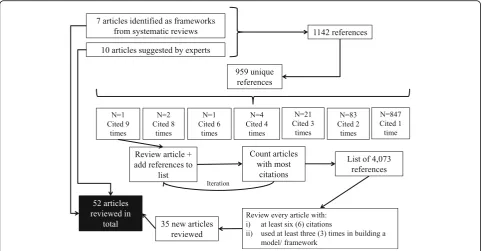
the first two stages (snowball sampling). From the ori-ginal list of references, the articles with more citations were identified, analyzed and their bibliography included in the list of references. From these references, new arti-cles were selected and their references added to the list. After several iterations, 4073 references were identified; out of these the articles included in the final selection were those with six citations or more, as well as models explicitly used in building a new framework or model (with three citations or more). The selection process used to select articles in the review is shown in Fig.1:
Even though there is an important overlap between both groups, the strategy allowed identifying articles that were relevant for the implementation science literature, even though they contained no formal model, and top reference models that were not among the top cited
articles (see Additional file1). The total number of
ar-ticles reviewed was 52, comprising scientific arar-ticles and books presenting frameworks, meta-frameworks, theories, classifications, and concepts and definitions [2, 5–9, 13–25, 27–59].
All the articles were examined to identify the presence of a framework/ model of implementation science. Each paper was reviewed, extracting information on:
1. Definitions and goals of implementation science 2. Methods (whether it was based on a systematic
search or not)
3. Elements of the framework 4. Focus of the framework 5. Context of implementation
A first by-product of the search and review is dis-played in Additional file 1. It exhibits the list of articles included in the review, showing the most cited refer-ences as well as the most used frameworks. The table allows shows relevant references that can serve as a starting point for a practitioner or decision maker inter-esting in understand and use implementation science, identifying articles containing frameworks, classifications and those based on systematic searches.
Results
Definitions and aims of implementation science
We reviewed the frequency of words and phrases used in the definitions and stated goals of implementation
sci-ence. Table 1 shows the main concepts used to define
implementation science; 86 different definitions were ex-tracted and synthesized using the structure shown in the table.
of transferring evidence-based knowledge into practice, in a scientific way.
As shown in Table1, the different definitions were
an-alyzed to identify the components of a definition -action, starting point and destination, and expected result- and the concepts and terms utilized for each component. This information was then used to build what can be
seen as a generic definition of implementation science.
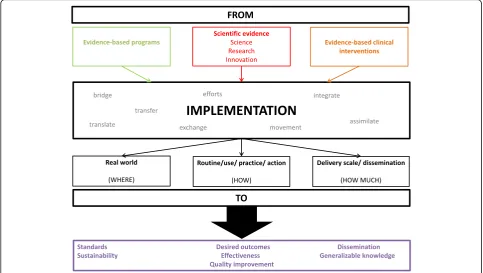
Figure2 presents a visual representation of the goals of
implementation science synthesized from the reviewed literature. It is important, however, to recognize that the use of different terms is not whimsical: different defini-tions emphasize different dimensions of implementation science. For example, even though all the definitions Fig. 1Flowchart of the search and selection process. Source: Authors elaboration.
Table 1Words used in different definitions of“implementation science”
From Goal
Action/ tool Starting point Destination Action/ tool Result
Translating/ transferring/ transporting/ exchanging (9)
Intervention/ program (20)
Practice/ routine practice (29) Improve/ change (12)
Quality of health-care (11)
Reducing/ closing gap (8) Research (11) Use/ utilization/ routine use (14) Meet/ achieve (3) Intervention/ implementation (4)
Promoting uptake (8) Knowledge (10) Real-world/ reality/ context/ settings (9)
Deliver (2) Health-care (3)
Getting/ bringing/ delivering (6) Evidence (9) Innovation/ program/ policy (4) Identify/ clarify (2)
Outcomes/ health outcomes (2)
Understanding (4) Practice (8) Knowledge (3) Other (5) Other (6)
Implementing (4) Innovation (5) Other (10)
Putting (4) Science/ findings (4)
Bridging/ nexus (5) Other (8)
Integrating (3)
Promoting/ encouraging (3)
Process (3)
Other (10)
follow the proposed scheme (from knowledge to prac-tice) they differ on the starting point (basic science, in-novations) and the outcome (applied in the real world, routine, scaling-up). As shown below, it starts from already known evidence about what works and tries to fill the gap between this knowledge and its application to a particular setting, reducing the gap between theory and practice. The final objective of this process is quality improvement and moving from efficacy-proven interven-tions to effective intervention in the real world.
We then developed a classification of the conceptual models used in implementation science. The first step in the process was to identify differences and common ele-ments among existing models and grouped them into different groups, similarly to other studies that also
clas-sify models and frameworks [7]. Using the focus on the
implementation process, the frameworks were divided into two broad categories: time-based and
component-based, resembling Nilsen’s classification between
“Process (how-to) model”and “Determinant framework”
[19]. The list of papers reviewed and their categories can
be found in the Additional file2.
The set of papers used includes several systematic re-views as well as non-systematic ones, mostly based on previous studies (empirical and non-empirical) written in English and including one or more framework in implementation science or implementation processes, covering a period of more than 45 years. Since the search
was restricted to PubMed, most of the frameworks are built within the scope of health care innovations, but some claim to be generalizable to other areas outside
health care [16, 28, 33] or constructed to analyze
par-ticular diseases or populations [7,17,18,28,55].
Time-based models define the elements as a sequence of stages to be followed in order to have an adequate process of implementation, while component-based models focus on the presence of certain features that should be taken into account and planned for a success-ful implementation. There is an overlap between both types of frameworks, but also idiosyncratic parts that are missed from one and other. As noted before, given its
complexity and specificity, implementation science
frameworks and models tend to be incomplete [6].
Every framework was labeled using these two broad categories; in this process, it became clear that some frameworks included both approaches, allowing for a
third category of “mixed frameworks”, in which
ele-ments of component-based and time-based are
present. Once the groups were defined, the common
components of each category were identified
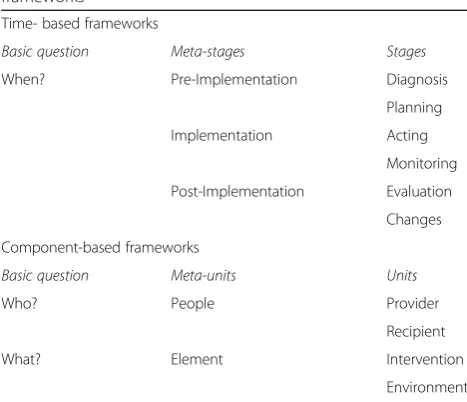
(Table 2).
Time-based models highlight the when. Three
meta-stages were identified from the different
frame-works: pre-implementation, implementation, and
post-implementation. The meta-stage of
diagnosis and planning. Some elements (stages)
in-cluded in these phases are “set-up”, “research/ gather
evidence”, “creating structures”, “develop a concrete
proposal/ plan”, etc. The implementation meta-stage
can be divided into the stages of acting and
monitor-ing. Examples included in the original frameworks
for these categories are “do”, “program installation”,
“carry out plan and evaluate progress”, or “go full
scale”. Finally, the post-implementation includes the
process of evaluation and making changes. Several
frameworks include in this meta-stage actions as
“evaluate”, “test scale-up”, or “improve future
applications”.
Component-based models focus on two different
questions: who and what. These questions give rise to
two different meta-units: people and elements. When focusing on people, different frameworks highlight the
importance of considering characteristics of both,
pro-viders and recipients. Features related to the former are “inner-setting”, “organization”, “facilitation”, or
“factors and support systems”. From the recipients’
point of view, several models emphasize the
import-ance of elements such as “outer-setting”, “patient”,
“community level factors”, “adoption/ assimilation”, or
“participant’s responsiveness”. The meta-unit of
ele-ments is separated between eleele-ments present in the intervention itself, as well as elements to consider
re-lated to the environment. The frameworks studied
identify “intervention/ innovation characteristics”,
“program”, or “adherence/ intervention complexity” as
components related to the intervention itself. Other
components such as “outer-setting”, “structural
fac-tors”, “context”, or “external environment” can be
de-fined as related to the environment.
A synthesis of frameworks for implementation science We synthesized the key features of existing frameworks.
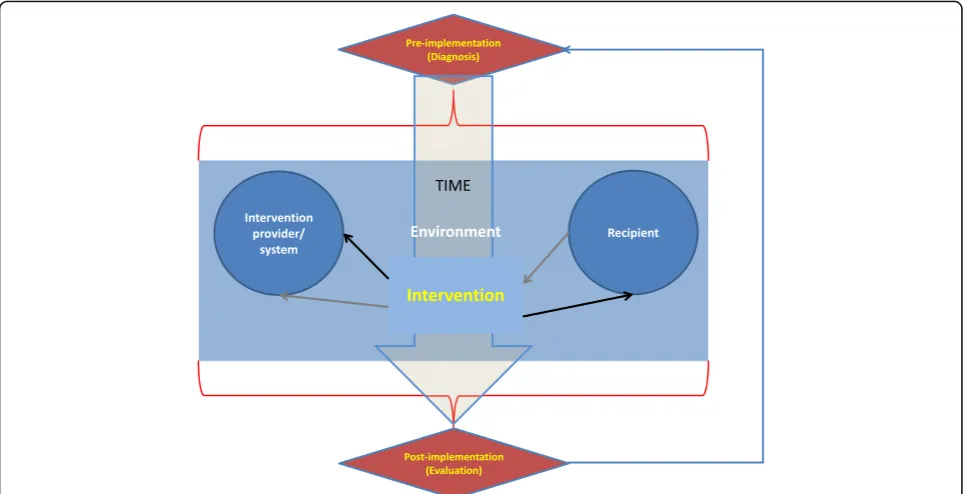
As shown in Fig.3, the resulting framework contains six
elements and synthesizes the frameworks previously pre-sented: Pre-implementation (diagnosis), Intervention provider/ system, Intervention, Recipient, Environment, and Post-implementation (evaluation).
To address the apparent lack of dialogue between the two types of models, the three meta-stages of the time-based models were preserved, including all the parts identified as relevant in component-based models. Essentially, all the components of these models are referred to the implementation meta-stage. The
frame-work’s synthesis adds a temporal dimension to the
com-ponent-based models, as well as important new elements to be considered in the diagnosis and evaluation stages (environmental factors). Alternatively, the synthesis can be interpreted as an extension to time-based models, en-hancing the importance of the implementation stage by defining concrete components to be assessed when implementing an intervention.
Figure 3 should be interpreted as a synthesis of both
kinds of models: it not only adds elements of both types of frameworks, but also delineates their interaction. The time component is illustrated vertically in the figure.
The process starts with thePre-implementation
(Diagno-sis) phase, which explicitly takes into account every
element of the implementation process: the initial as-sessment and the planning of the implementation should consider characteristics of providers and recipients, as well as environmental factors to design an effective
intervention. Similarly, the Post-implementation
(Evalu-ation) process also needs to consider all these factors when assessing performance and proposing changes. The use of implementation elements as input for the pre and post-implementation stages is illustrated by the red curly brackets in the figure.
The central box describes the Implementation stage,
including: i) Intervention provider/system, i.e. the agent
or system in charge of executing the intervention; ii)
Re-cipient, i.e. the agent who is intended to be changed by the intervention; iii) theInterventionitself and; iv) Envir-onment, i.e. all the external factors that affects the result of the intervention during the implementation stage. Providers, recipients and interventions are considered as independent components and illustrated in individual boxes, while environmental factors can affect any of these elements during the implementation process and, therefore are unbounded in this central box. Even though they are considered independent elements, pro-viders, recipients and intervention relate to each other during this stage. The black arrows show the direction
in which the provider affects the recipient through the
intervention; on the other hand, the gray arrows denote Table 2Classification of implementation science conceptual
frameworks
Time- based frameworks
Basic question Meta-stages Stages
When? Pre-Implementation Diagnosis
Planning
Implementation Acting
Monitoring
Post-Implementation Evaluation
Changes
Component-based frameworks
Basic question Meta-units Units
Who? People Provider
Recipient
What? Element Intervention
the fact that the intervention and its results can affect providers (and consequently may lead them to change the activity) during the implementation process, a feed-back usually related to the results of monitoring.
The three time-stages are connected in a sequential way, starting from the diagnosis and ending with the evaluation. However, an arrow connects the evaluation with the diagnosis, adding a cyclical component to the temporal dimension. Since both process (diagnosis and evaluation) are based in the assessment of the same ele-ments (those included in the implementation phase) a
natural process of feedback arise from the evaluation’s
results which can be considered a new diagnosis in the process of changing the intervention.
Finally, original frameworks were“translated” into the
new proposed framework: all the elements originally listed in each framework were reclassified into the six proposed categories, in order to ensure the completeness of the new model.
Application of the synthesis to implementation of priority global health programs
Finally, the pertinence of the proposed synthesis was tested using several priority global health issues. It is de-signed to be, at the same time, sufficiently comprehen-sive so as to identify gaps and key elements needed when implementing programs, and simple enough to serve as guide for practitioners.
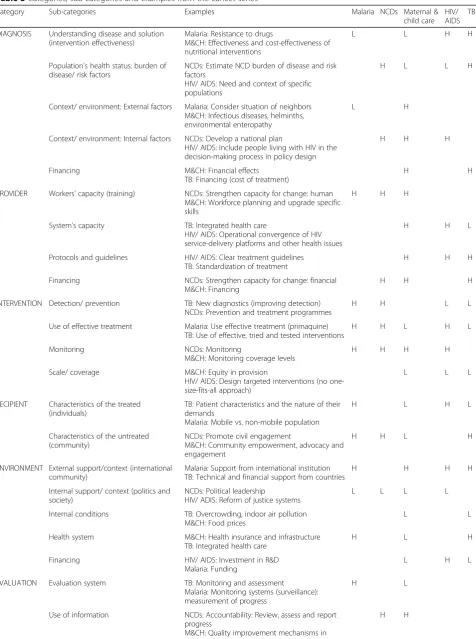
Five global health issues were identified and assessed using the synthesis of frameworks to organize and iden-tify gaps and key elements of the implementation process. Malaria, maternal and child health (M&CH), non-communicable diseases (NCDs), HIV/ AIDS and tu-berculosis (TB) were selected as current relevant global health issues.
Strategies to cope with these problems were collected using articles published in The Lancet Global Health Series. The use of Lancet series serves as an example to illustrate the utility of the synthesis for analyzing topics related to the Millennium Development Goals (MDGs) as well as new health conditions.
Several papers were selected through critical review process, using as criterion whether they identified gaps or contained proposal to deal with unfinished problems
re-lated to these global health issues [60–72]. All articles
were reviewed to identify concrete strategies proposed to deal with the selected health conditions. These strategies were classified into the six categories described above: Diagnosis, Provider, Intervention, Recipient, Environment, and Evaluation. In a second stage, these strategies were regrouped and used to establish 23 sub-categories within the original classifications, and each one of the strategies identified was classified into a sub-category (Table3).
strategies or gaps mentioned by the articles in each health issue: H (high) for subcategories with a number of strategies above the median, L (low) for subcategories with a number of strategies below the median, and blank for subcategories with no strategies proposed. First, from an implementation science perspective, it is important to highlight that every subcategory is relevant for imple-menting strategies for change: blank boxes represent areas that were not prioritized in the reviewed articles but need to be pondered when designing, implementing and evaluating global health interventions. Boxes with a large number of strategies (H) identify areas considered as key in the reviewed articles, either because of its high impact in producing changes or because they are cur-rently ignored. Finally, boxes with a low number of strat-egies (L) are areas that need to be addressed, but where the gaps are smaller. Both, H and blank boxes can be interpreted as areas in which gaps -from an implementa-tion science approach- still persist, because either they have been explicitly identified as relevant in dealing with the global health problems selected or because have been ignored in the analysis.
The results presented (including the construction of sub-categories) should be considered as an example of applying the synthesis to a particular set of infor-mation. Consequently, even though the synthesis can be generalized to other contexts, the results derived from its application to the Lancet paper may not. The example intends to show how the structure
pre-sented in Fig. 2 is useful to capture implementation
strategies in different settings and to organize imple-mentation priorities.
Discussion
The aim of this paper is to provide a starting point for practitioners and decision makers to the field of implementation science, by compiling and classifying articles and concepts, synthesizing the existing imple-mentation science frameworks in health care into a simplified scheme, and illustrating its use to identify current challenges in the implementation of priority programs in global health. The initial motivation be-hind it was to review the existence of several frame-works in the field that identify several success and failure factors, and to describe detailed implementa-tion strategies. This informaimplementa-tion generates a trade-off, particularly for practitioners: on the one hand, more information and tools are available but, on the other hand, it generates confusion, hindering the selection of a model for implementing interventions in the practice.
We constructed a synthesis of frameworks used in im-plementation science to reduce the complexity in the field and offer guidance to policy makers and practi-tioners. The synthesis takes into account components of
different types of models, capturing the wide variety of approaches emerging in the field. With this in mind, the proposed framework is not intended to replace other (more detailed) models but to help practitioners and de-cision makers to select the proper model, by providing a panoramic view of different types of models and their el-ements. Its flexibility permits the revision of particular categories, adding new subcategories or going deep into existing ones, depending on the focus of the interven-tion; other frameworks can be used to complement the analysis if the intervention requires a particular focus,
e.g. address a specific disease [55], a dealing with
envir-onmental factors [47] or aligning interventions with
recipients [31,57].
The approach has several limitations. First, we used a review that was, at least initially, focused on IS frameworks: it is possible that there are other (for ex-ample disease-specific) frameworks that may not have surfaced in our review. However, we were interested in broad, foundational frameworks. Additionally, the strategy of complementing the initial search with
ex-perts’ suggestions and the use of snowball sampling
to include extra articles in the review help dealing with this issue. Second, the search strategy was a tar-geted and not a systematic review. This decision was based on the difficulty of performing a traditional systematic review in the field, as identified by the pre-vious literature. However, the used search strategy allowed to identify a literature beyond IS frameworks and to build a broader network of IS-related works that enriched the analysis. Third, there is an
unavoid-able trade-off between specificity and simplicity.
Simplicity is relevant for practitioners, but having a framework that can be applied to solve a particular problem too. The proposed summary seeks simplicity by merging information from several models, mixing time-based and component-based frameworks, into a single structure with six elements. In this sense, the synthesis should be considered as an initial step for implementing innovations and understanding imple-mentation gaps. Fourth, the application of the frame-work using the Lancet series produces ad-hoc results that are not necessarily applicable to other context.
Different results –including the definition of
sub-cat-egories and identification of gaps- would have arisen by using different sources of data. Nevertheless, the utilization of the Lancet series must be seen as an example to illustrate one way in which IS and the proposed framework can be used to identify priority areas for intervention in global health.
Conclusions
Table 3Categories, sub-categories and examples from the Lancet series
Category Sub-categories Examples Malaria NCDs Maternal &
child care HIV/ AIDS
TB
DIAGNOSIS Understanding disease and solution (intervention effectiveness)
Malaria: Resistance to drugs
M&CH: Effectiveness and cost-effectiveness of nutritional interventions
L L H H
Population's health status: burden of disease/ risk factors
NCDs: Estimate NCD burden of disease and risk factors
HIV/ AIDS: Need and context of specific populations
H L L H
Context/ environment: External factors Malaria: Consider situation of neighbors M&CH: Infectious diseases, helminths, environmental enteropathy
L H
Context/ environment: Internal factors NCDs: Develop a national plan
HIV/ AIDS: Include people living with HIV in the decision-making process in policy design
H H H
Financing M&CH: Financial effects TB: Financing (cost of treatment)
H H
PROVIDER Workers' capacity (training) NCDs: Strengthen capacity for change: human M&CH: Workforce planning and upgrade specific skills
H H H
System's capacity TB: Integrated health care
HIV/ AIDS: Operational convergence of HIV service-delivery platforms and other health issues
H H L
Protocols and guidelines HIV/ AIDS: Clear treatment guidelines TB: Standardization of treatment
H H H
Financing NCDs: Strengthen capacity for change: financial M&CH: Financing
H H H
INTERVENTION Detection/ prevention TB: New diagnostics (improving detection) NCDs: Prevention and treatment programmes
H H L L
Use of effective treatment Malaria: Use effective treatment (primaquine) TB: Use of effective, tried and tested interventions
H H L H L
Monitoring NCDs: Monitoring
M&CH: Monitoring coverage levels
H H H H
Scale/ coverage M&CH: Equity in provision
HIV/ AIDS: Design targeted interventions (no one-size-fits-all approach)
L L L
RECIPIENT Characteristics of the treated (individuals)
TB: Patient characteristics and the nature of their demands
Malaria: Mobile vs. non-mobile population
H L H L
Characteristics of the untreated (community)
NCDs: Promote civil engagement
M&CH: Community empowerment, advocacy and engagement
H H L H
ENVIRONMENT External support/context (international community)
Malaria: Support from international institution TB: Technical and financial support from countries
H H H H
Internal support/ context (politics and society)
NCDs: Political leadership
HIV/ ADIS: Reform of justice systems
L L L L
Internal conditions TB: Overcrowding, indoor air pollution M&CH: Food prices
L L
Health system M&CH: Health insurance and infrastructure TB: Integrated health care
H L H
Financing HIV/ AIDS: Investment in R&D Malaria: Funding
L H L
EVALUATION Evaluation system TB: Monitoring and assessment
Malaria: Monitoring systems (surveillance): measurement of progress
H L
Use of information NCDs: Accountability: Review, assess and report progress
M&CH: Quality improvement mechanisms in
order to develop a tool to identify core challenges in the implementation of priority programs in global health. The analysis reveals the presence of several models and frameworks in implementation science, including differ-ent definitions and approaches.
The process of compelling, classifying and comparing different frameworks uncovered the huge diversity of models but also highlighted common elements that can be condensed in a general simplified tool. The analysis also showed the usefulness of applying an implementa-tion science approach to identify and prioritize gaps in implementation strategies in global health.
We hope this synthesis can be a useful tool for policy makers, particularly in identifying the relevant elements and phases in an implementation process, and as an in-strument to prioritize areas for action. The synthesis can only be improved by using and adapting it to different settings and implementation challenges. We encourage policy makers to use and test the proposed synthesis in designing, implementing and evaluating implementation initiatives in applied health care programs.
Additional files
Additional file 1:List of articles reviewed (DOCX 88 kb)
Additional file 2:List of frameworks reviewed (DOCX 113 kb)
Abbreviations
HIV/AIDS:Human Immunodeficiency Virus/ Acquired Immunodeficiency Syndrome; IS: Implementation Science; M&CH: Maternal and Child Health; MDGs: Millennium Development Goals; NCDs: Non-Communicable Diseases; TB: Tuberculosis
Acknowledgements Not applicable.
Authors’contributions
MEK devised the project and conceived the idea. MEK and PVD performed the search and generated the list of articles. PVD performed data extraction, analysis and wrote the first draft. All other authors contributed to successive drafts. All authors read and approved the final manuscript.
Funding Not applicable.
Availability of data and materials
The datasets used and/or analyzed during the current study are available from the corresponding Availability of data and author on reasonable request.
Ethics approval and consent to participate Not applicable.
Consent for publication Not applicable.
Competing interests
The authors declare that they have no competing interests.
Author details
1Harvard T H Chan School of Public Health, Boston, USA.2Universidad de Santiago, Santiago, Chile.3University Research Co., LLC, Chevy Chase, USA.
Received: 4 April 2019 Accepted: 1 August 2019
References
1. Roberts ET, Matthews DD. HIV and chemoprophylaxis, the importance of considering social structures alongside biomedical and behavioral intervention. Soc Sci Med. 2012;75:1555–61.
2. Damschroder LJ, Hagedorn HJ. A guiding framework and approach for implementation research in substance use disorders treatment. Psychol Addict Behav. 2011;25(2):194–205.
3. Steckler A, McLeroy KR. The Importance of External Validity. Am J Public Health. 2008;98(1):9–10.
4. Victora CG, Habitch JP, Bryce J. Evidence-based public health: moving beyond randomized trials. Am J Public Health. 2004;94(3):400–5. 5. Tabak RG, Khoong EC, Chambers DA, Brownson RC. Bridging research and
practice: models for dissemination and implementation research. Am J Prev Med. 2012;43:337–50.
6. Moullin JC, Sabater-Hernández D, Fernandez-Llimos F, Benrimoj SI. A systematic review of implementation frameworks of innovations in healthcare and resulting generic implementation framework. Health Res Policy Syst. 2015;13:16.
7. Greenhalgh T, Robert G, Macfarlane F, Bate P, Kyriakidou O. Diffusion of innovations in service organizations: systematic review and
recommendations. Milkbank Quarterly. 2004;82(4):581–629.
8. Eccles MP, Mittman BS. Welcome to Implementation Science. Implement Sci. 2006;1:1.
9. Michie S, Johnston M, Abraham C, Lawton R, Parker D, Walker A. Making psychological theory useful for implementing evidence based practice: a consensus approach. Qual Saf Health Care. 2005;14:26–33.
10. Colquhoun H, Leeman J, Michie S, Lokker C, Bragge P, Hempel S, McKibbon KA, Peters G-JY, Stevens KR, Wilson MG, Grimshaw J. Towards a common terminology: a simplified framework of interventions to promote and integrate evidence into health practices, systems, and policies. Implement Sci. 2014;9:51.
11. Kruk ME. More Health for the Money - Toward a More Rigorous Implementation Science. Sci Transl Med. 2014;6(245):245ed17.
12. Davies P, Walker AE, Grimshaw JM. A systematic review of the use of theory in the design of guideline dissemination and implementation strategies and interpretation of the results of rigorous evaluations. Implement Sci. 2010;5:14.
13. Feldstein AC, Glasgow RE. A practical, robust implementation and sustainability model (PRISM) for integrating research findings into practice. Jt Comm J Qual Patient Saf. 2008;34(4):228–43.
14. Fixsen DL, Naoom SF, Blasé KA, Friedman RM, Wallace F. Implementation Research: A Synthesis of the Literature. Tampa, FL: University of South Florida, Louis de la Parte Florida Mental Health
Table 3Categories, sub-categories and examples from the Lancet series(Continued)
Category Sub-categories Examples Malaria NCDs Maternal &
child care HIV/ AIDS
TB
health facilities
Data availability M&CH: Quantity and quality of monitoring data H
Total number of strategies proposed in the series 18 11 87 25 41
Institute, The National Implementation Research Network (FMHI Publication #231); 2005.
15. Spiegelman D. Evaluating public health interventions: examples, definitions, and a personal note. Am J Public Health. 2016;106(1):70–3.
16. Odeny TA, Padian N, Doherty MC, Baral S, Beyrer C, Ford N, Geng EH. Definitions of implementation science in HIV/AIDS. Lancet. 2015;2(5):e178–80. 17. Durlak JA, DuPre EP. Implementation matters: a review of research on
the influence of implementation on program outcomes and the factors affecting implementation. Am J Community Psychol. 2008;41: 327–50.
18. Rabin BA, Brownson RC, Haire-Joshu D, Kreuter MW, Weaver NL. A glossary for dissemination and implementation research in health. J Public Health Management Practice. 2008;14(2):117–23.
19. Nilsen P. Making sense of implementation theories, models and frameworks. Implement Sci. 2015;10:53.
20. Chaudoir SR, Dugan AG, Barr CHI. Measuring factors affecting implementation of health innovations: a systematic review of structural, organizational, provider, patient, and innovation level measures. Implement Sci. 2013;8:22.
21. Damschroder LJ, Aron DC, Keith RE, Kirsh SR, Alexander JA, Lowery JC. Fostering implementation of health services research findings into practice: a consolidated framework for advancing implementation science. Implement Sci. 2009;4:50.
22. Rogers EM. Diffusion of innovations. New York: Free Press; 2003. 23. Grol R, Bosch MC, Hulscher ME, Eccles MP, Wensing M. Planning and
studying improvement in patient care: the use of theoretical perspectives. Milbank Q. 2007;85:93–138.
24. May C. Towards a general theory of implementation. Implement Sci. 2013;8:18.
25. Fisher ES, Shortell SM, Savitz LA. Implementation science: a potential catalyst for delivery system reform. JAMA. 2016;315(4):339–40.
26. Pauwles L. Taking the visual turn in research and scholarly communication. Vis Sociol. 2000;15:7–14.
27. Ajzen I. The theory of planned behavior. Organ Behav Hum Decis Process. 1991;50:179–211.
28. Barker PM, Reid A, Schall MW. A framework for scaling up health interventions: lessons from large-scale improvement initiatives in Africa. Implement Sci. 2016;11:12.
29. Bero LA, Grilli R, Grimshaw RM, Harvey E, Oxman AD, Thomson MA. Closing the gap between research and practice: an overview of systematic reviews of interventions to promote implementation of research findings by health care professionals. BMJ. 1998;317:465–8.
30. Cane J, O’Connor D, Michie S. Validation of the theoretical domains framework for use in behaviour change and implementation research. Implement Sci. 2012;7:37.
31. Carroll C, Patterson M, Wood S, Booth A, Rick J, Balain S. A conceptual framework for implementation fidelity. Implement Sci. 2007;2:40. 32. Craig P, Dieppe P, Macintyre S, Michie S, Nazareth I, Petticrew M.
Developing and evaluating complex interventions: the new Medical Research Council guidance. BMJ. 2008;337:a1655.
33. Eccles MP, Armstrong D, Baker R, Cleary K, Davies H, Davies S, Glasziou P, Ilott I, Kinmonth A-L, Leng G, Logan S, Marteau T, Michie S, Rogers H, Rycroft-Malone J, Sibbald B. An implementation research agenda. Implement Sci. 2009;4:18.
34. Ferlie EW, Shortell SM. Improving the quality of health care in the United Kingdom and the United States: a framework for change. Milkbank Quarterly. 2001;79(2):281–315.
35. French SD, Green SE, O’Connor DA, McKenzie JE, Francis JJ, Michie S, Buchbinder R, Schattner P, Spike N, Grimshaw JM. Developing theory-informed behaviour change interventions to implement evidence into practice: a systematic approach using the theoretical domains framework. Implement Sci. 2012;7:38.
36. Glasgow RE, Vogt TM, Boles SM. Evaluating the public health impact of health promotion interventions: the RE-AIM framework. Am J Public Health. 1999;89:1322–7.
37. Glisson C, Schoenwald SK. The ARC organizational and community intervention strategy for implementing evidence-based children’s mental health treatments. Ment Health Serv Res. 2005;7(4):243–59.
38. Green LW, Kreuter MW. Health program planning: an educational and ecological approach. New York: McGraw-Hill; 2005.
39. Grimshaw JM, Thomas R, MacLennan G, Fraser C, Ramsay C, Vale L, Whitty P, Eccles M, Matowe L, Shirran L, Wensing M, Dijkstra R, Donaldson C. Effectiveness and efficiency of guideline dissemination and implementation strategies. Health Technol Assess. 2004;8(6):iii–v 1-72.
40. Grol R, Jones R. Twenty years of implementation research. Fam Pract. 2000; 17:S32–5.
41. Kilbourne AM, Neuman MS, Pincus HA, Bauer MS, Stall R. Implementing evidence-based interventions in health care: applications of the replicating effective programs framework. Implement Sci. 2007;2:42.
42. Kitson A, Harvey G, McCormack B. Enabling the implementation of evidence based practice: a conceptual framework. Quality in Health Care. 1998;7:149–58.
43. Kitson A, Rycroft-Malone J, Harvey G, McCormack B, Seers K, Titchen A. Evaluating the successful implementation of evidence into practice using the PARiHS framework: theoretical and practical challenges. Implement Sci. 2008;3(1):1. 44. Klein KJ, Sorra JS. The challenge of innovation implementation. Acad Manag
Rev. 1996;21(4):1055–80.
45. Madon T, Hofman KJ, Kupfer L, Glass RI. Public health. Implementation science. Science. 2007;318(5857):1728–9.
46. McCormack B, McCarthy G, Wright J, Slater P, Coffey A. Development and testing of the context assessment index (CAI). Worldviews Evid-Based Nurs. 2009;6(1):27–35.
47. McCormack B, Kitson A, Harvey G, Rycroft-Malone J, Titchen A, Seers K. Getting evidence into practice: the meaning of `context. J Adv Nurs. 2002; 38(1):94–104.
48. Meyers DC, Durlak JA, Wandersman A. The quality implementation framework: a synthesis of critical steps in the implementation process. Am J Community Psychol. 2012;50:462–80.
49. Oxman AD, Thomson MA, Davis DA, et al. No magic bullets: a systematic review of 102 trials of interventions to improve professional practice. CMAJ. 1995;153:1423.
50. Rycroft-Malone J. The PARIHS framework—a framework for guiding the implementation of evidence-based practice. J Nurs Care Qual. 2004;19(4): 297–304.
51. Rycroft-Malone J, Kitson A, Harvey G, McCormack B, Seers K, Titchen A, Estabrooks C. Ingredients for change: revisiting a conceptual framework. Qual Saf Health Care. 2002;11:174–80.
52. Schein EH. Organizational culture and leadership. San Francisco, CA: Jossey-Bass; 2010.
53. Senge P. The fifth discipline: the art and practice of the learning organization. New York: Doubleday Currency; 1990.
54. Simpson DD. A conceptual framework for transferring research to practice. J Subst Abus Treat. 2002;22:171–82.
55. Sivaram S, Sanchez MA, Rimer BK, Samet JM, Glasgow RE. Implementation science in Cancer prevention and control: a framework for research and programs in low- and middle-income countries. Cancer Epidemiol Biomark Prev. 2014;23(11):2273–84.
56. Stetler CB, Legro MW, Wallace CM, Bowman C, Guihan M, Hagedorn H, Kimmel B, Sharp ND, Smith JL. The role of formative evaluation in implementation research and the QUERI experience. J Gen Intern Med. 2006;21:S1–8.
57. Stetler CB, McQueen L, Demakis J, Mittman B. An organizational framework and strategic implementation for system-level change to enhance research-based practice: QUERI series. Implement Sci. 2008;2:30.
58. Stetler CB, Damschroder LJ, Helfrich CD, Hagedorn HJ. A guide for applying a revised version of the PARIHS framework for implementation. Implement Sci. 2011;6:99.
59. Taylor MJ, McNicholas C, Nicolay C, Darzi A, Bell D, Reed JE. Systematic review of the application of the plan–do–study–act method to improve quality in healthcare. BMJ Qual Saf. 2014;23:290–8.
60. Victora CG, Requejo JH, Barros AJD, Berman P, Bhutta Z, Boerma T, Chopra M, de Francisco A, Daelmans B, Hazel E, Lawn J, Maliqi B, Newby H, Bryce J. Countdown to 2015: a decade of tracking progress for maternal, newborn, and child survival. Lancet. 2016;387(10032):2049–59.
61. Piot P, Karim SSA, Hecht R, Legido-Quigley H, Buse K, Stover J, Resch S, Ryckman T, Møgedal S, Dybul M, Goosby E, Watts C, Kilonzo N, McManus J, Sidibé M. Defeating AIDS—advancing global health. Lancet. 2015;386:171–218.
63. Keshavjee S, Dowdy D, Swaminathan S. Stopping the body count: a comprehensive approach to move towards zero tuberculosis deaths. Lancet. 2015;386(10010):e46–7.
64. Furin J, Akugizibwe P, Ditiu L, Gray G, Palmero D, Zaidi S. No one with HIV should die from tuberculosis. Lancet. 2015;386(10010):e48–50.
65. Dickson KE, Simen-Kapeu A, Kinney MV, Huicho L, Vesel L, Lackritz E, de Graft JJ, von Xylander S, Rafi N, Sylla M, Mwansambo C, Daelmans B, Lawn JE. Every newborn: health-systems bottlenecks and strategies to accelerate scale-up in countries. Lancet. 2014;384:438–54.
66. Bonita R, Magnusson R, Bovet P, Zhao D, Malta DC, Geneau R, Suh I, Thankappan KR, McKee M, Hospedales J, de Courten M, Capewell S, Beaglehole R. Country actions to meet UN commitments on non-communicable diseases: a stepwise approach. Lancet. 2013;381:575–84. 67. Ruel MT, Alderman H. Nutrition-sensitive interventions and programmes:
how can they help to accelerate progress in improving maternal and child nutrition? Lancet. 2013;382:536–51.
68. Moonen B, Cohen JM, Snow RW, Slutsker L, Drakeley C, Smith DL, Abeyasinghe RR, Rodriguez MH, Maharaj R, Tanner M, Targett G. Operational strategies to achieve and maintain malaria elimination. Lancet. 2010;367: 1592–603.
69. Beyrer C, Malinowska-Sempruch K, Kamarulzaman A, Kazatchkine M, Sidibe M, Strathdee SA. Time to act: a call for comprehensive responses to HIV in people who use drugs. Lancet. 2010;367:551–63.
70. Morris SS, Cogill B, Uauy R. Effective international action against undernutrition: why has it proven so difficult and what can be done to accelerate progress? Lancet. 2008;371:608–21.
71. Bhutta ZA, Ahmed T, Black RE, Cousens S, Dewey K, Giugliani E, Haider BA, Kirkwood B, Morris SS, Sachdev HP, Shekar M. What works? Interventions for maternal and child undernutrition and survival. Lancet. 2008;371:417–40. 72. Bryce J, Coitinho D, Darnton-Hill I, Pelletier D, Pinstrup-Andersen P.