R E S E A R C H
Open Access
Evaluating influence of the genotypes in the
follicle-stimulating hormone receptor (FSHR)
Ser680Asn (rs6166) polymorphism on poor
and hyper-responders to ovarian stimulation:
a meta-analysis
Noel Pabalan
1,2,3, Camila Martins Trevisan
4, Carla Peluso
4, Hamdi Jarjanazi
5, Denise Maria Christofolini
4,
Caio Parente Barbosa
4and Bianca Bianco
4*Abstract
Background/aims:Reported associations of controlled ovarian hyperstimulation response (COH) with genotypes of the Ser680Asn (N680S) polymorphism in the follicle stimulating hormone receptor (FSHR) gene have conflicting results.
Methods:PubMed and Embase databases were searched for studies that investigated the N680S polymorphism in the FSHR gene in COH. Parameters used to examine ovarian response were poor and hyper-responses to COH. Using the meta-analytic approach, we estimated ovarian response risk (odds ratio [OR] with 95% confidence intervals) according to genotype.
Results:Our findings showed that SS genotype carriers were most likely to be poor responders (OR 1.61, p = 0.08) compared to the NN and NS genotypes which showed no associations (OR 0.93-0.95, p = 0.75-0.78). Heterogeneity of these pooled ORs warranted examining its sources. We detected outlying studies in each of the three N680S genotypes. Omitting these outliers erased the heterogeneity of the recalculated pooled outcomes. It also materially altered the SS effects where carriers became slightly unlikely to be poor responders (OR 0.90, p = 0.52). The S allele carrier effect was modulated for poor responders (OR 1.24, p = 0.39) in the Non-Hispanic Caucasian (NHC) subgroup. The likelihood of the S allele carriers (OR 1.47, p = 0.02) and the unlikelihood of the N allele carriers (OR 0.64, p = 0.007) were significant in our hyper-response findings. Confined to NHC retained significance of the S allele effects (OR 1.57, p = 0.01) but not among the N allele carriers (OR 0.68, p = 0.18).
Conclusions:In summary, this is a meta-analytical confirmation of the FSHR SS genotype role in COH response. Hyper-responder analysis strengths lie on the non-heterogeneity and robustness of its results. Non-robustness and heterogeneity of the poor-responder results compose its limitations. Thus, poor response findings probably require caution as to the interpretation as a susceptibility marker for ovarian response.
Keywords:Follicle-stimulating hormone receptor, FSHR, Polymorphisms, Ovarian response, Meta-analysis
* Correspondence:[email protected]
4Human Reproduction and Genetics Center, Department of Collective Health -Faculdade de Medicina do ABC, Av. Pr?ncipe de Gales, 821, Santo Andr?/SP, S?o Paulo Zip Code 09060-650, Brazil
Full list of author information is available at the end of the article
? 2014 Pabalan et al.; licensee BioMed Central. This is an Open Access article distributed under the terms of the Creative Commons Attribution License (http://creativecommons.org/licenses/by/4.0), which permits unrestricted use, distribution, and reproduction in any medium, provided the original work is properly credited. The Creative Commons Public Domain Dedication waiver (http://creativecommons.org/publicdomain/zero/1.0/) applies to the data made available in this article, unless otherwise stated.
Background
In vitrofertilization (IVF) is a multi-step process involving collection of oocyte-containing follicles after controlled ovarian hyperstimulation (COH) with rFSH (recombinant Follicle-stimulation hormone). Further steps involve oocyte fertilization, embryo development, embryo transfer to the uterus, and implantation. All these steps are critical for successful IVF [1]. An initial critical step of this complex procedure is the COH, aiming to safely obtain an adequate number of high-quality oocytes, so as to allow selection of the most viable embryo for transfer [1,2]. However, women submitted to this procedure yield different numbers of oocytes. Poor responders provide no more than 4-5 oocytes. Those with 6-15 oocytes are normal responders and those with >15 oocytes are hyper-responders [3,4]. Poor responses result in retrieved oocytes reduced number and hyper-response may lead to ovarian hyperstimulation syndrome (OHSS). Poor response may warrant repeated stimulation cycles to obtain appropriate number of oocytes. In contrast, good response is modulated to avoid hyperstimulation [5]. Thus, the patients advanced identification will elicit these responses in order to standard treatment, which would be clinically beneficial. Several factors have been proposed to predict ovarian response. These are: age [6], hormonal status [7], cigarette smoking [8] and ovarian reserve [6,9]. Apart from these proposed predictors, polymorphisms in various genes, such as estrogen receptor alpha (ESR1), cytochrome P450 19A (CYP19A) and follicle-stimulating hormone (FSH) have been investigated as markers to predict ovarian re-sponse [1,10-13]. FSH has been implicated in follicular growth and maturation, granulosa cell proliferation and in estradiol/aromatase synthesis [14]. FSH effects are mediated by FSH receptor (FSHR), a G-protein-coupled receptor expressed in granulosa cells [15] which medi-ates FSH signal transduction through adenylate cyclase activation and elevation of intracellular cAMP [16]. The
FSHR gene is located on chromosome 2p21 spanning a region of 54 kb [17] and contains one large exon, which encodes the transmembrane and intracellular domains; and nine smaller exons, which encode the extracellular do-main [15]. Two non-synonymous SNPs have been identi-fied in the coding region of exon 10 of the FSH receptor gene (http://www.ncbi.nlm.nih.gov/snp/?term=FSHR; Gen-eID: 2492; Locus tag: HGNC: 3969). The first (rs6165) is found within the extracellular domain (codon 307) in which A is substituted by G, changing codon 307 from threonine (ACT) to alanine (GCT). The second (rs6166) lies within the intracellular domain (codon 680), in which G is replaced by A. This leads to an amino acid change at position 680 from serine (AGT) to asparagine (AAT) [18]. These two SNPs are related to ovarian re-sponse and affect gene function by changing the e
gene product properties and consequently modifying response to FSH [19]. These polymorphisms are in linkage disequilibrium (LD), resulting in the most frequent al-lelic combination of T307-N680 and A307-S680 [20,21]. Many previous studies including a recent meta-analysis [22] focused on the N680S polymorphism. Clinical studies have demonstrated that the N680S polymorphism deter-mines ovarian response to FSH stimulation in patients undergoing IVF treatment [11,22,23].
Given the conflicting outcomes in the human repro-duction investigations of the variants in the FSHR gene [17,24], we performed a meta-analysis to evaluate the role of the N680S FSHR polymorphism in ovarian response. Here, we compared the association of inac-tivating FSHR genotypes in (i) poor and (ii) hyper-responding women with normal ovarian response.
Materials and methods Selection of studies
Using the terms,?FSHR?,?follicle stimulating hormone? ,
?polymorphism? and ?ovarian stimulation?, we searched MEDLINE using PubMed and Embase for associated studies as of September 12, 2014. References cited in the retrieved articles were also screened manually to identify additional eligible studies. Inclusion criteria included: (1) case? control study design evaluating the association between FSHR polymorphisms and ovarian response, (2) sufficient genotype frequency data presented to calcu-late the odds ratios (ORs) and 95% confidence intervals (CIs). (3) Control frequencies (normal/good responders) must be in Hardy-Weinberg Equilibrium (HWE).
Data extraction
Two investigators, independently, extracted data and reached consensus on all the items. The following information was obtained from each publication: first author?s name, published year, country of origin, dom-inant ancestry of the study populations, study design, context of the study, type of ovarian response, use of the HWE, addressed LD, FSHR polymorphism studied, sample source, genotyping approach, matching infor-mation and genotype data. We extracted data that belonged to our investigation of ovarian response using these parameters: (i) number of poor and (ii) hyper-responders as well as (iii) normal (good/control) re-sponders. We also calculated frequencies of the variant allele, deviations of the normal responders from the HWE. (iv) Rates of pregnancy.
Quality assessment of the studies
We used the Clark-Baudouin Score (CBS) to evaluate the methodological quality of the included studies [25]. This scale emphasizes statistics (i.e. p values, power and corrections for multiplicity) and includes genotyping
Pabalanet al. Journal of Ovarian Research2014,7:122 Page 2 of 11
methods as well as HWE. These, among others, were addressed in several of the included papers. Thus, we felt this to be the most appropriate in assessing the methodological included studies quality. The CBS scores reach from 0 (worst) to 9 (best) for cohort studies and 0 (worst) to 10 (best) for case-control studies. The score follows as: case-control studies: (quality is low for <5 and high for ≥5); cohort studies: (quality is low for <4 and high for≥4).
Meta-analysis
Due to the FSHR polymorphisms (T307A and N680S) were found to be in complete LD [20,21], we only inves-tigated the N680S polymorphism. Influence of FSHR N680S polymorphism was estimated using the following parameters: we examined (i) poor ovarian response, (ii) hyper-response compared to the (iii) normal or good responders using the homozygote variant and wild-type alleles as well as the heterozygote genowild-type. We also examined (iv) pregnancy rates. These associations were expressed as OR, 95% CI.
Raw data for genotype frequencies, without adjustment, were used for calculating OR study-specific estimates. The pooled estimates significance was determined by the Z-test. Pooled estimates were obtained using either the fixed [26] (in the absence of heterogeneity) or random [27] (in its presence) effects models. Heterogeneity between studies was estimated using the χ2-based Q test [28]. Recognizing the low power of this test [29], significance threshold was set at p = 0.10. We also quantified heterogeneity with the I2 statistic which measures the degree of inconsistency among studies [30]. Significance was set at a p-value of ≤0.05 throughout, except in heterogeneity estimation. Pooled estimates were submitted to sensitivity analysis which involved omitting one study at a time and recalculating the pooled estimates, to test the summary effect robustness. Subgroup analysis based on ethnicity was performed on those comprising of three or more subgroups. Data were analyzed using Review Manager 5.3 (Copenhagen: Nordic Cochrane Centre, Cochrane Collaboration, 2014) and SigmaStat 2.3 (Systat Software, San Jose, CA). Most comparisons in our meta-analysis had less than 10 studies, and be-cause of the low sensitivity of the qualitative and quanti-tative tests [31], we did not investigate publication bias. However, the overall analysis of poor responders had 11 studies; for those, we used Begg?s test to evaluate whether the magnitude of the observed association was related to the variance of each study [32].
Results Included studies
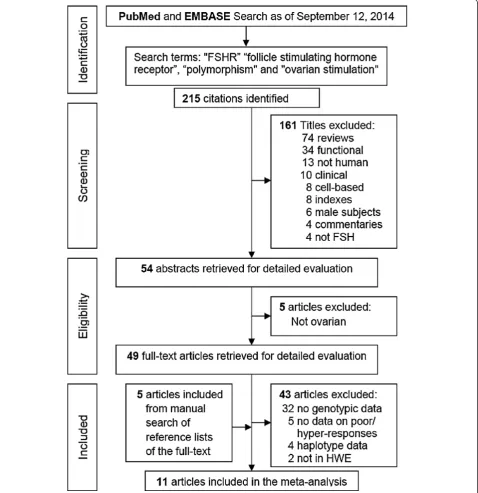
Figure 1 outlines our study selection process in a flow-chart following PRISMA (Preferred Reporting Items for
Systematic Reviews and Meta-Analyses) guidelines [33]. We identified a total of 215 citations during the initial search, from which 161 were omitted because they were not conforming our inclusion criteria. We retrieved the remaining 54 abstracts which after review, five articles were excluded. Full-texts of the remaining 49 were obtained and read including the reference lists. From these lists, we found five articles with potential inclu-sion in the meta-analysis. From the 54 full-text articles, 43 were removed, including two studies [3,34] which control frequencies deviated from the HWE. Under these circumstances, the total number of articles included in the meta-analysis was 11 [1,4,13,35-42]. This number was increased to 13 studies, due to the provision of the independent data added from Boudjenah et al [1] and Livshyts et al [39].
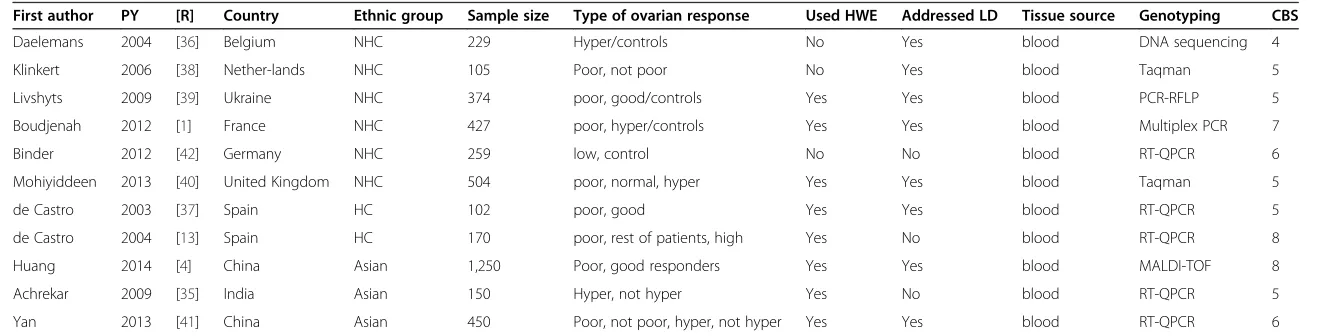
The epidemiological features and clinical characteris-tics of these studies are outlined in Table 1. The publi-cation years of the included studies ranged from 2003 to 2014. Six studies [1,36,38-40,42] had subjects that were of non-Hispanic Caucasian (NHC) descendant, two [13,37] were Hispanic Caucasian (HC) and three were Asian [4,35,41]. Eight of each 11 articles (72.7%) addressed HWE and LD, respectively. Based on the CBS scores, methodological quality of the included papers was high (mean and standard deviation of 5.82 ? 1.3).
Additional file 1: Table S1 shows the 11 studies from nine articles [1,4,13,35,37-42] summarizing the genotype frequencies of the poor responders compared to normal/ good responders. Additional file 2: Table S2 displays the six studies from five articles [1,13,35,36,40] summarizing genotype frequencies of the hyper-responders compared to normal responders.
Overall and subgroup analysis
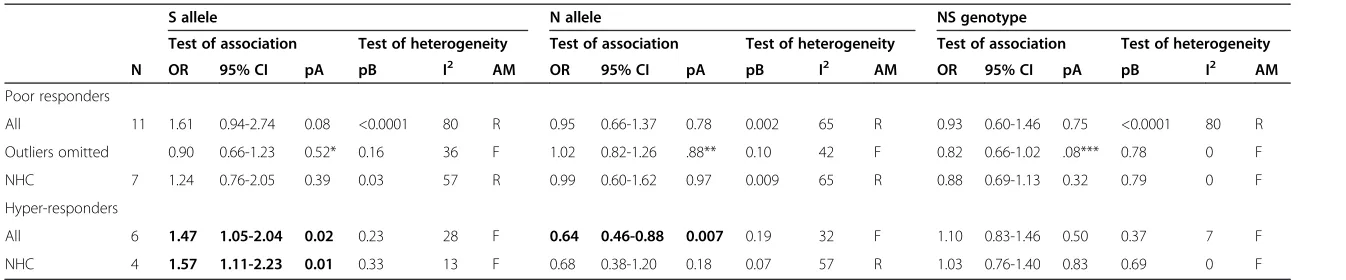
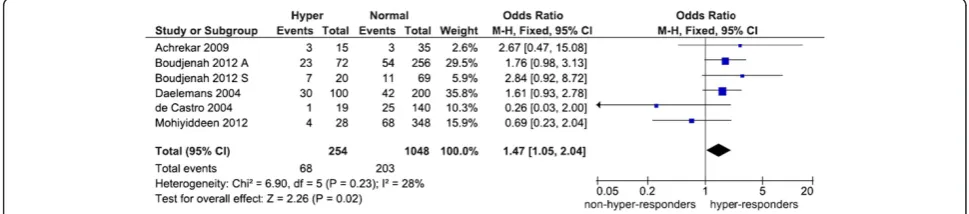
We found no evidence of publication bias in the overall analysis of poor responders (p = 0.39-0.94). Table 2 and Figures 2 and 3 show an overall favoring of the SS geno-type among the ovarian response groups, significant for hyper-responders (OR 1.47, p = 0.02) but not for poor responders (OR 1.61, p = 0.08). Confined to NHC modu-lated the poor responder effects (OR 1.24, p = 0.39) but not the hyper-responder effects (OR 1.57, p = 0.01). The N allele carriers unlikelihood of being ovarian responders was exemplified among hyper-responders with an overall significance (OR 0.64, p = 0.007). Of the studies listed in Table 1, six reported pregnancy rates [3,34,36,38,40,43], half of these had controls that deviated from the HWE [3,34,36]. All pregnancy rates pooled effects indicated absence of associations (data not shown).
Outlier analysis
We sought outlier studies as sources of the heterogeneity observed in the overall poor responder pooled effects
Pabalanet al. Journal of Ovarian Research2014,7:122 Page 3 of 11
(Figure 2). The Galbraith plots in Figure 4 show the outliers, four studies from three articles [4,39,41] in the S allele, three studies [37,39,41] in the N allele and one study [4] in the NS genotype. Table 2 shows the re-sults of removing these outliers followed by re-analysis which erased heterogeneity (p values for heterogeneity from < 0.0001 to = 0.78) in all three genotypes and al-tered the SS genotype effect (OR 0.90, p = 0.52).
Sensitivity analysis
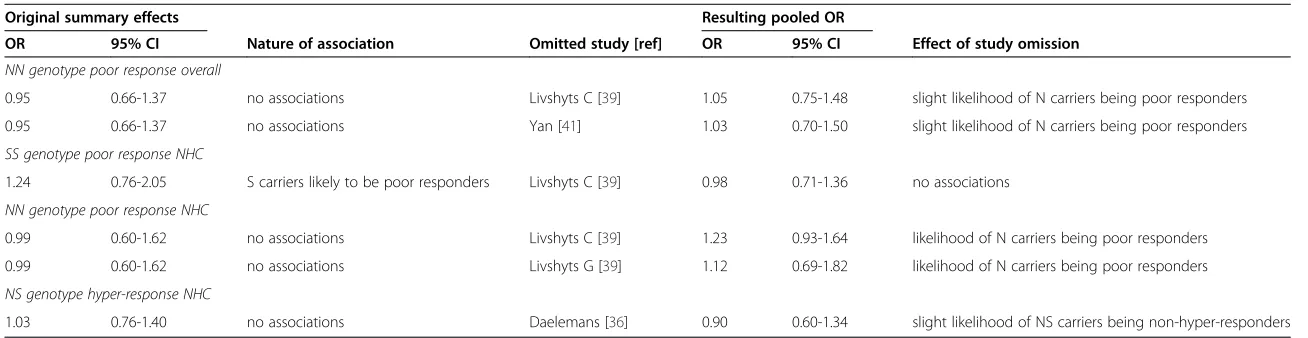
Table 3 summarizes the changes in association resulting from sensitivity treatment. These changes have affected the poor responder group more than the hyper-responders. Generally, finding of no associations have been altered to the likelihood of N allele carriers to be poor responders with omission of three studies from two articles [39,41]. This pattern was also observed in hyper-responders where
Figure 1Flowchart of literature search and study selection.
Pabalanet al. Journal of Ovarian Research2014,7:122 Page 4 of 11
Table 1 Included articles characteristics that examined the FSHR N680S polymorphism association with ovarian response
First author PY [R] Country Ethnic group Sample size Type of ovarian response Used HWE Addressed LD Tissue source Genotyping CBS
Daelemans 2004 [36] Belgium NHC 229 Hyper/controls No Yes blood DNA sequencing 4
Klinkert 2006 [38] Nether-lands NHC 105 Poor, not poor No Yes blood Taqman 5
Livshyts 2009 [39] Ukraine NHC 374 poor, good/controls Yes Yes blood PCR-RFLP 5
Boudjenah 2012 [1] France NHC 427 poor, hyper/controls Yes Yes blood Multiplex PCR 7
Binder 2012 [42] Germany NHC 259 low, control No No blood RT-QPCR 6
Mohiyiddeen 2013 [40] United Kingdom NHC 504 poor, normal, hyper Yes Yes blood Taqman 5
de Castro 2003 [37] Spain HC 102 poor, good Yes Yes blood RT-QPCR 5
de Castro 2004 [13] Spain HC 170 poor, rest of patients, high Yes No blood RT-QPCR 8
Huang 2014 [4] China Asian 1,250 Poor, good responders Yes Yes blood MALDI-TOF 8
Achrekar 2009 [35] India Asian 150 Hyper, not hyper Yes No blood RT-QPCR 5
Yan 2013 [41] China Asian 450 Poor, not poor, hyper, not hyper Yes Yes blood RT-QPCR 6
PY: Publication Year; [R]: Reference; NHC: Non-Hispanic Caucasian; HC: Hispanic Caucasian; HWE: Hardy-Weinberg Equilibrium; LD: Linkage Disequilibrium PCR: Polymerase Chain Reaction; RFLP: Restriction Fragment Length Polymorphism; RT-QPCR: Real-Time Quality Polymerase Chain Reaction; MALDI-TOF: Matrix Assisted Laser Desorption Ionization-Time-of-Flight; CBS: Clark-Baudouin Score: assessment of methodological quality of the included studies.
Pabalan
et
al.
Journal
of
Ovarian
Research
2014,
7
:122
Page
5
o
f
1
1
http://ww
w.ovarianre
search.com/c
ontent/7/
Table 2 Summary of the FSHR N680S polymorphism with poor and hyper-responders
S allele N allele NS genotype
Test of association Test of heterogeneity Test of association Test of heterogeneity Test of association Test of heterogeneity
N OR 95% CI pA pB I2 AM OR 95% CI pA pB I2 AM OR 95% CI pA pB I2 AM
Poor responders
All 11 1.61 0.94-2.74 0.08 <0.0001 80 R 0.95 0.66-1.37 0.78 0.002 65 R 0.93 0.60-1.46 0.75 <0.0001 80 R
Outliers omitted ? 0.90 0.66-1.23 0.52* 0.16 36 F 1.02 0.82-1.26 .88** 0.10 42 F 0.82 0.66-1.02 .08*** 0.78 0 F
NHC 7 1.24 0.76-2.05 0.39 0.03 57 R 0.99 0.60-1.62 0.97 0.009 65 R 0.88 0.69-1.13 0.32 0.79 0 F
Hyper-responders
All 6 1.47 1.05-2.04 0.02 0.23 28 F 0.64 0.46-0.88 0.007 0.19 32 F 1.10 0.83-1.46 0.50 0.37 7 F
NHC 4 1.57 1.11-2.23 0.01 0.33 13 F 0.68 0.38-1.20 0.18 0.07 57 R 1.03 0.76-1.40 0.83 0.69 0 F
NHC: Non-Hispanic Caucasian; N: number of studies; OR: odds ratio; CI: confidence interval; pA: p value for association with significance set at <0.05; pB: p value for heterogeneity with significance set at <0.10; I2 values as measure of heterogeneity are considered low (<44%), moderate (45-74%) or high (>75%); values inboldindicate significant associations; *N = 7; **N = 8; ***N = 10; AM: Analysis Model; R: Random-effects;
F: Fixed-effects.
Pabalan
et
al.
Journal
of
Ovarian
Research
2014,
7
:122
Page
6
o
f
1
1
http://ww
w.ovarianre
search.com/c
ontent/7/
no associations were changed to likelihood of NS carriers to be non-hyper-responders with omission of Daelemans et al [36].
Discussion
With a sample size of 4,020 for the N680S FSHR poly-morphism, our meta-analysis has shown that the FSHR gene genotype is important in determining ovarian re-sponse. The N680S polymorphism has been shown to be associated with poor and hyper ovarian responses to stimulation. From the three genotypes, the most and least likely to be poor and hyper-responders to ovarian stimulation are SS and NS carriers, respectively. SS genotype carriers favoring seem to merit higher confi-dence in the hyper-responder findings than those in poor responders for two reasons: (i) hyper-responder findings were generally not heterogeneous which the poor responder results were. (ii) Sensitivity treatment showed that poor responder effects were not as robust as those of the hyper-responders. To our knowledge, this is the first meta-analysis to address poor and hyper-responses as indicators of ovarian response. A recent
meta-analysis [22] examined the number of retrieved oocytes and basal FSH levels based on eight studies, but not the parameters we used here, except pregnancy rates in which our findings did not materially differ.
The study-specific findings showed that women homo-zygous for the FSHR S680 variant were less likely to be low responders and more likely to be high responders [1]. In a Chinese study of infertile women, the polymor-phisms T307A and N680S were associated with ovarian response to FSH, with the SS genotype having higher rates of poor response, but not with OHSS [41]. A retrospective study in IVF patients has shown an asso-ciation between the presence of the S variant and poor responses to gonadotropin stimulation, suggesting that the S680 allele was associated with a diminished sensi-tivity to FSH [37]. The implication of S680 allele as a potential marker for predicting poor ovarian response has been countered with reports suggesting no N680S association with ovarian response [44]. It has been sug-gested that the subjects with the NS genotype are more associated with good response to FSH stimulation, whereas the subjects with SS and NN genotypes have a
Figure 3Forest plot of the S680 influence variant on hyper ovarian response.Black diamond denotes the pooled OR. Blue squares indicate the OR in each study, with square sizes directly proportional to the weight contribution (%) of the study. Horizontal lines represent 95% confidence intervals. Note: In Boudjenah et al. [1], the suffixes A and S indicate overall population and homogeneous subgroup, respectively; . M-H: Mantel-Haenszel; CI: confidence interval; df: degree of freedom.
Figure 2Forest plot of the S680 influence variant on poor ovarian response.Black diamond denotes the pooled OR. Blue squares indicate the OR in each study, with square sizes directly proportional to the weight contribution (%) of the study. Horizontal lines represent 95% confidence intervals. Note: In Boudjenah et al. [1], the suffixes A and S indicate overall population and homogeneous subgroup, respectively; In Livshyts 2009, the suffixes C and G indicate control women under 35 years old and over 35 years old, respectively. M-H: Mantel-Haenszel; CI: confidence interval; df: degree of freedom.
Pabalanet al. Journal of Ovarian Research2014,7:122 Page 7 of 11
tendency to resist FSH stimulation and thus require more exogenous FSH for ovarian stimulation [45]. All these show a lack of consistency in these association studies outcomes. Here, then, enters the utility of our meta-analysis.
The observation that the allelic FSH receptor variants are FSH sensitivity determinants has lead to the hypoth-esis that certain genetic changes may fine tune the hor-monal regulation of ovarian physiology, and these can be attractive markers for various clinical applications in-cluding optimization of the exogenous FSH dose in ART (Assisted Reproduction Technique) programs [20,46].
Approximately 20% of women undergoing ovarian stimu-lation in an IVF program respond poorly to gonadotropin treatment [47]. Such patients show low concentrations of serum estradiol, fewer mature oocytes and reduced pregnancy rates. The basis for low response to gona-dotropin is not well understood. Diminished ovarian
reserve and increased maternal age may be associated with poor ovarian response [6]. Several parameters such as poor perifollicular flow [48], presence of ovarian autoanti-bodies [49] and day 3 serum FSH concentrations [50,51] have been proposed as ovarian response predictors, but have not been proven. In some poor responders, increasing the FSH dose may not help in achieving an increase in serum estradiol concentrations [52].
Level of FSHR expression also impacts greatly on the extent of FSH action. FSHR plays a fundamental role in determining the physiologic FSH responsiveness in the ovary. Studies suggest that reduced expression affects FSHR function thereby affecting folliculogenesis [53]. The FSHR reduced expression on granulosa cells has been shown to be associated with poor ovarian response [54]. The expression of FSH receptor and its ability to respond to the exogenous FSH seems to be a gona-dotropin determinant treatment. Thus, altered FSH receptor expression and function seems to be a factor and may account for poor ovarian response. Recently it has been demonstrated that lower expression of the FSH receptor may account for poor ovarian response to gonadotropin stimulation, suggesting a critical role of FSH receptor in the ovarian response [54].
Interpreting these meta-analysis results would warrant awareness of its strengths and limitations. Strengths in-clude: (i) all tissue sources were blood; (ii) most of the studies addressed the HWE and LD issues; (iii) consistency in identifying the SS genotype as most likely to be associated with ovarian response. (iv) Since we did not include studies which controls deviated from the HWE, we managed to minimize methodological weak-ness, such as biased selection of subjects, genotyping er-rors and population stratification [55].
On the other hand, there are a number of limitations in our study: (i) we did not address age as covariate of poor and hyper-response given the insufficiency of primary data from the included studies. (ii) genotyping approaches were not uniform, although half of the studies used real-time PCR (Polymerase Chain Reaction).
It is possible that the N680S polymorphism does not play any direct functional role in the development of OHSS, but it is in LD with other polymorphisms. It is also likely that variants in other than FSHR are relevant to ovarian response [56]. Variants in genes relevant to biochemical pathways involved in steroids production and folliculogenesis have been studied, but replication of these relationships has been lacking [13,57,58]. Gen-ome wide association studies may be promising as did a recent one that found significant correlation with ovarian response [59]. It is conceivable that ovarian response related to any one locus will be small due to gene-gene as well as gene-environment interactions are likely to operate.
1 2 3 4 5 6
-4 -2 0 2 4 6
Hua
LivC LivG
Yan
S allele
1 2 3 4 5 6
Log OR / SE
-4 -2 0 2 4 6
dC3
LivC Yan N allele
1 /SE
1 2 3 4 5 6
-4 -2 0 2 4
6 NS genotype Hua
Figure 4Galbraith plot analysis to detect sources of
heterogeneity.LivC: Livshyts C; LivG: Livshyts G; dC3: de Castro et al.
[37]; Hua: Huang; Note: In Livshyts, the suffixes C and G indicate control women less than 35 years old and over 35 years old, respectively.
Pabalanet al. Journal of Ovarian Research2014,7:122 Page 8 of 11
Table 3 Summary of sensitivity analysis findings
Original summary effects Resulting pooled OR
OR 95% CI Nature of association Omitted study [ref] OR 95% CI Effect of study omission
NN genotype poor response overall
0.95 0.66-1.37 no associations Livshyts C [39] 1.05 0.75-1.48 slight likelihood of N carriers being poor responders
0.95 0.66-1.37 no associations Yan [41] 1.03 0.70-1.50 slight likelihood of N carriers being poor responders
SS genotype poor response NHC
1.24 0.76-2.05 S carriers likely to be poor responders Livshyts C [39] 0.98 0.71-1.36 no associations
NN genotype poor response NHC
0.99 0.60-1.62 no associations Livshyts C [39] 1.23 0.93-1.64 likelihood of N carriers being poor responders
0.99 0.60-1.62 no associations Livshyts G [39] 1.12 0.69-1.82 likelihood of N carriers being poor responders
NS genotype hyper-response NHC
1.03 0.76-1.40 no associations Daelemans [36] 0.90 0.60-1.34 slight likelihood of NS carriers being non-hyper-responders
OR: Odds ratio; CI: Confidence Interval; Note: In Livshyts 2009, the suffixes C and G indicate control women less than 35 years old and over 35 years old, respectively.
Pabalan
et
al.
Journal
of
Ovarian
Research
2014,
7
:122
Page
9
o
f
1
1
http://ww
w.ovarianre
search.com/c
ontent/7/
Conclusion
Genotyping the FSHR N680S together with some add-itional markers may provide a means of identifying a group of poor responders before infertility treatment is initiated. Meanwhile, further studies regarding other SNPs (or haplotypes) in the FSHR gene may help better understand the role of FSHR gene and ovarian re-sponse. Since potential biases and confounders could not be ruled out completely in this meta-analysis, additional large case-control studies or later update meta-analysis may be warranted to validate or modify our findings. It would help that well-designed studies based on sample sizes commensurate with detection of small genotypic risks should allow more definitive con-clusions about the association of FSHR polymorphisms and ovarian response.
Additional files
Additional file 1: Table S1.Genotype frequencies of poor responders compared to normal/good responders. In Livshyts 2009, the suffixes C and G indicate control women under 35 years old and over 35 years old, respectively. In Boudjenah et al. [1], the suffixes A and S indicate overall population and homogeneous subgroup, respectively. NHC: Non-Hispanic Caucasian; HC: Hispanic Caucasian; maf: minor allele frequency; HWE: Hardy-Weinberg Equilibrium.
Additional file 2: Table S2.Genotype frequencies of hyper-responders compared to normal responders. In Boudjenah et al. [1], the suffixes A and S indicate overall population and homogeneous subgroup, respectively; NHC: Non-Hispanic Caucasian; HC: Hispanic Caucasian; maf: minor allele frequency; HWE: Hardy-Weinberg Equilibrium.
Competing interests
The authors declare that they have no competing interests.
Authors? contributions
NP and BB conceived study design. NP, CMT, CP and HJ performed the data collection and analyzed data. NP, DMC, CPB and BB interpreted the data. All authors were involved in literature search, writing the paper and had final approval of the submitted and published versions.
Acknowledgements
This work was supported by FAPESP research grants #2014/06177-2.
Author details
1Center for Research and Development, Angeles University Foundation, Angeles City 2009, Philippines.2Graduate School, Cebu Doctors?University, Mandaue City 6014, Philippines.3Research and Extensions Office, Saint Louis University, BaguioCity 2006, Philippines.4Human Reproduction and Genetics Center, Department of Collective Health - Faculdade de Medicina do ABC, Av. Pr?ncipe de Gales, 821, Santo Andr?/SP,
S?o Paulo Zip Code 09060-650, Brazil. 5Environmental Monitoring and Reporting Branch, Ontario Ministry of the Environment, 125 Resources Road, Etobicoke, ON M9P 3V6, Canada.
Received: 6 October 2014 Accepted: 11 December 2014
References
1. Boudjenah R, Molina-Gomes D, Torre A, Bergere M, Bailly M, Boitrelle F, Taieb S, Wainer R, Benahmed M, de Mazancourt P, Selva J, Vialard F:Genetic polymorphisms influence the ovarian response to rfsh stimulation in pa-tients undergoing in vitro fertilization programs with icsi.PLoS One2012, 7:e38700.
2. Mohiyiddeen L, Nardo LG:Single-nucleotide polymorphisms in the fsh receptor gene and ovarian performance: Future role in ivf.Human Fertil
(Cambridge England)2010,13:72?78.
3. Sheikhha MH, Eftekhar M, Kalantar SM:Investigating the association between polymorphism of follicle-stimulating hormone receptor gene and ovarian response in controlled ovarian hyperstimulation.J Human
Reprod Sci2011,4:86?90.
4. Huang X, Li L, Hong L, Zhou W, Shi H, Zhang H, Zhang Z, Sun X, Du J: The ser680asn polymorphism in the follicle-stimulating hormone receptor gene is associated with the ovarian response in controlled ovarian hyperstimulation.Clin Endocrinol (Oxf)2014, doi: 10.1111/cen.12573. [Epub ahead of print]
5. Lledo B, Guerrero J, Turienzo A, Ortiz JA, Morales R, Ten J, Llacer J, Bernabeu R: Effect of follicle-stimulating hormone receptor n680s polymorphism on the efficacy of follicle-stimulating hormone stimulation on donor ovarian response.Pharmacogenet Genomics2013,23:262?268.
6. Kligman I, Rosenwaks Z:Differentiating clinical profiles: Predicting good responders, poor responders, and hyperresponders.Fertil Steril2001, 76:1185?1190.
7. Haller K, Salumets A, Uibo R:Anti-fsh antibodies associate with poor outcome of ovarian stimulation in ivf.Reprod Biomed Online2008, 16:350?355.
8. Freour T, Masson D, Mirallie S, Jean M, Bach K, Dejoie T, Barriere P: Active smoking compromises ivf outcome and affects ovarian reserve.
Reprod Biomed Online2008,16:96?102.
9. Coccia ME, Rizzello F:Ovarian reserve.Ann N Y Acad Sci2008,1127:27?30. 10. Altmae S, Haller K, Peters M, Hovatta O, Stavreus-Evers A, Karro H, Metspalu A, Salumets A:Allelic estrogen receptor 1 (esr1) gene variants predict the outcome of ovarian stimulation in in vitro fertilization.Mol Hum Reprod 2007,13:521?526.
11. Altmae S, Hovatta O, Stavreus-Evers A, Salumets A:Genetic predictors of controlled ovarian hyperstimulation: Where do we stand today?
Hum Reprod Update2011,17:813?828.
12. Moron FJ, Ruiz A:Pharmacogenetics of controlled ovarian hyperstimulation: Time to corroborate the clinical utility of fsh receptor genetic markers.
Pharmacogenomics2010,11:1613? 1618.
13. de Castro F, Moron FJ, Montoro L, Galan JJ, Hernandez DP, Padilla ES, Ramirez-Lorca R, Real LM, Ruiz A:Human controlled ovarian hyperstimulation outcome is a polygenic trait.Pharmacogenetics2004,14:285?293.
14. Gharib SD, Wierman ME, Shupnik MA, Chin WW:Molecular biology of the pituitary gonadotropins.Endocr Rev1990,11:177? 199.
15. Simoni M, Gromoll J, Nieschlag E:The follicle-stimulating hormone receptor: Biochemistry, molecular biology, physiology, and pathophysiology.
Endocr Rev1997,18:739?773.
16. Segaloff DL, Ascoli M:The lutropin/choriogonadotropin receptor? 4 years later.Endocr Rev1993,14:324? 347.
17. Gromoll J, Simoni M:Follicle-stimulating-hormone receptor and twinning.
Lancet2001,357:230. author reply 231-232.
18. Aittomaki K, Lucena JL, Pakarinen P, Sistonen P, Tapanainen J, Gromoll J, Kaskikari R, Sankila EM, Lehvaslaiho H, Engel AR, Nieschlag E, Huhtaniemi I, de la Chapelle A:Mutation in the follicle-stimulating hormone receptor gene causes hereditary hypergonadotropic ovarian failure.Cell1995, 82:959?968.
19. Simoni M, Tempfer CB, Destenaves B, Fauser BC:Functional genetic polymorphisms and female reproductive disorders: Part i: Polycystic ovary syndrome and ovarian response.Hum Reprod Update2008,14:459?484. 20. Perez Mayorga M, Gromoll J, Behre HM, Gassner C, Nieschlag E, Simoni M:
Ovarian response to follicle-stimulating hormone (fsh) stimulation depends on the fsh receptor genotype.J Clin Endocrinol Metab2000, 85:3365?3369.
21. Simoni M, Nieschlag E, Gromoll J:Isoforms and single nucleotide polymorphisms of the fsh receptor gene: Implications for human reproduction.Hum Reprod Update2002,8:413?421.
22. Yao Y, Ma CH, Tang HL, Hu YF:Influence of follicle-stimulating hormone receptor (fshr) ser680asn polymorphism on ovarian function and in-vitro fertilization outcome: A meta-analysis.Mol Genet Metab2011, 103:388? 393.
23. Laan M, Grigorova M, Huhtaniemi IT:Pharmacogenetics of follicle-stimulating hormone action.Current Opin Endocrinol Diabetes Obesity2012,19:220?227. 24. Kene PS, Nalavadi VC, Dighe RR, Iyer KS, Mahale SD:Identification of the structural and functional determinants of the extracellular domain of the
Pabalanet al. Journal of Ovarian Research2014,7:122 Page 10 of 11
human follicle stimulating hormone receptor.J Endocrinol2004, 182:501? 508.
25. Clark MF, Baudouin SV:A systematic review of the quality of genetic association studies in human sepsis.Intensive Care Med2006,32:1706?1712. 26. Mantel N, Haenszel W:Statistical aspects of the analysis of data from
retrospective studies of disease.J Natl Cancer Inst1959,22:719?748. 27. DerSimonian R, Laird N:Meta-analysis in clinical trials.Control Clin Trials
1986,7:177?188.
28. Lau J, Ioannidis JP, Schmid CH:Quantitative synthesis in systematic reviews.
Ann Intern Med1997,127:820?826.
29. Higgins JP, Thompson SG, Deeks JJ, Altman DG:Measuring inconsistency in meta-analyses.BMJ Clin Res2003,327:557?560.
30. Higgins JP, Thompson SG:Quantifying heterogeneity in a meta-analysis.
Stat Med2002,21:1539?1558.
31. Ioannidis JP, Trikalinos TA:The appropriateness of asymmetry tests for publication bias in meta-analyses: A large survey.Cmaj2007, 176:1091?1096.
32. Begg CB, Mazumdar M:Operating characteristics of a rank correlation test for publication bias.Biometrics1994,50:1088? 1101.
33. Moher D, Liberati A, Tetzlaff J, Altman DG:Preferred reporting items for systematic reviews and meta-analyses: The prisma statement.PLoS Med 2009,6:e1000097.
34. Loutradis D, Patsoula E, Minas V, Koussidis GA, Antsaklis A, Michalas S, Makrigiannakis A:Fsh receptor gene polymorphisms have a role for different ovarian response to stimulation in patients entering ivf/icsi-et programs.J Assist Reprod Genet2006,23:177?184.
35. Achrekar SK, Modi DN, Desai SK, Mangoli VS, Mangoli RV, Mahale SD: Follicle-stimulating hormone receptor polymorphism (thr307ala) is associated with variable ovarian response and ovarian hyperstimulation syndrome in indian women.Fertil Steril2009,91:432? 439.
36. Daelemans C, Smits G, de Maertelaer V, Costagliola S, Englert Y, Vassart G, Delbaere A:Prediction of severity of symptoms in iatrogenic ovarian hyperstimulation syndrome by follicle-stimulating hormone receptor ser680asn polymorphism.J Clin Endocrinol Metab2004,89:6310?6315. 37. de Castro F, Ruiz R, Montoro L, Perez-Hernandez D, Sanchez-Casas Padilla E,
Real LM, Ruiz A:Role of follicle-stimulating hormone receptor ser680asn polymorphism in the efficacy of follicle-stimulating hormone.Fertil Steril 2003,80:571? 576.
38. Klinkert ER, te Velde ER, Weima S, van Zandvoort PM, Hanssen RG, Nilsson PR, de Jong FH, Looman CW, Broekmans FJ:Fsh receptor genotype is associated with pregnancy but not with ovarian response in ivf.Reprod Biomed Online 2006,13:687? 695.
39. Livshyts G, Podlesnaja S, Kravchenko S, Sudoma I, Livshits L:A distribution of two snps in exon 10 of the fshr gene among the women with a diminished ovarian reserve in ukraine.J Assist Reprod Genet2009,26:29?34. 40. Mohiyiddeen L, Newman WG, Cerra C, McBurney H, Mulugeta B, Roberts SA,
Nardo LG:A common asn680ser polymorphism in the follicle-stimulating hormone receptor gene is not associated with ovarian response to gonadotropin stimulation in patients undergoing in vitro fertilization.
Fertil Steril2013,99:149?155.
41. Yan Y, Gong Z, Zhang L, Li Y, Li X, Zhu L, Sun L:Association of follicle-stimulating hormone receptor polymorphisms with ovarian response in chinese women: A prospective clinical study.PLoS One2013, 8:e78138.
42. Binder H, Strick R, Zaherdoust O, Dittrich R, Hamori M, Beckmann MW, Oppelt PG:Assessment of fshr variants and antimullerian hormone in infertility patients with a reduced ovarian response to gonadotropin stimulation.Fertil Steril2012,97:1169? 1175. e1161.
43. Jun JK, Yoon JS, Ku SY, Choi YM, Hwang KR, Park SY, Lee GH, Lee WD, Kim SH, Kim JG, Moon SY:Follicle-stimulating hormone receptor gene polymorphism and ovarian responses to controlled ovarian hyperstimulation for ivf-et.J Hum Genet2006,51:665?670.
44. La Marca A, Sighinolfi G, Argento C, Grisendi V, Casarini L, Volpe A, Simoni M:Polymorphisms in gonadotropin and gonadotropin receptor genes as markers of ovarian reserve and response in in vitro fertilization.Fertil
Steril2013,99:970?978. e971.
45. Loutradis D, Theofanakis C, Anagnostou E, Mavrogianni D, Partsinevelos GA: Genetic profile of snp(s) and ovulation induction.Curr Pharm Biotechnol 2012,13:417? 425.
46. Behre HM, Greb RR, Mempel A, Sonntag B, Kiesel L, Kaltwasser P, Seliger E, Ropke F, Gromoll J, Nieschlag E, Simoni M:Significance of a common
single nucleotide polymorphism in exon 10 of the follicle-stimulating hormone (fsh) receptor gene for the ovarian response to fsh: A pharmacogenetic approach to controlled ovarian hyperstimulation.
Pharmacogenet Genomics2005,15:451?456.
47. Keay SD, Liversedge NH, Mathur RS, Jenkins JM:Assisted conception following poor ovarian response to gonadotrophin stimulation.
Br J Obstet Gynaecol1997,104:521? 527.
48. Battaglia C, Genazzani AD, Regnani G, Primavera MR, Petraglia F, Volpe A: Perifollicular doppler flow and follicular fluid vascular endothelial growth factor concentrations in poor responders.Fertil Steril2000,74:809? 812. 49. Luborsky JL, Thiruppathi P, Rivnay B, Roussev R, Coulam C, Radwanska E:
Evidence for different aetiologies of low estradiol response to fsh: Age-related accelerated luteinization of follicles or presence of ovarian autoantibodies.Human Reprod (Oxford England)2002,17:2641?2649. 50. Balasch J, Creus M, Fabregues F, Carmona F, Casamitjana R, Ascaso C,
Vanrell JA:Inhibin, follicle-stimulating hormone, and age as predictors of ovarian response in in vitro fertilization cycles stimulated with gonadotropin-releasing hormone agonist-gonadotropin treatment.
Am J Obstet Gynecol1996,175:1226?1230.
51. Barnhart K, Osheroff J:Follicle stimulating hormone as a predictor of fertility.Current Opin Obstetrics Gynecol1998,10:227? 232.
52. Land JA, Yarmolinskaya MI, Dumoulin JC, Evers JL:High-dose human menopausal gonadotropin stimulation in poor responders does not improve in vitro fertilization outcome.Fertil Steril1996,65:961?965. 53. Oktay K, Briggs D, Gosden RG:Ontogeny of follicle-stimulating hormone
receptor gene expression in isolated human ovarian follicles.
J Clin Endocrinol Metab1997,82:3748?3751.
54. Cai J, Lou HY, Dong MY, Lu XE, Zhu YM, Gao HJ, Huang HF:Poor ovarian response to gonadotropin stimulation is associated with low expression of follicle-stimulating hormone receptor in granulosa cells.Fertil Steril 2007,87:1350?1356.
55. Thakkinstian A, McElduff P, D'Este C, Duffy D, Attia J:A method for meta-analysis of molecular association studies.Stat Med2005, 24:1291?1306.
56. Loutradis D, Vlismas A, Drakakis P, Antsaklis A:Pharmacogenetics in ovarian stimulation?current concepts.Ann N Y Acad Sci2008,1127:10? 19. 57. Kevenaar ME, Themmen AP, Laven JS, Sonntag B, Fong SL, Uitterlinden AG,
De Jong FH, Pols HA, Simoni M, Visser JA:Anti-mullerian hormone and anti-mullerian hormone type ii receptor polymorphisms are associated with follicular phase estradiol levels in normo-ovulatory women.Human
Reprod (Oxford England)2007,22:1547? 1554.
58. Moron FJ, de Castro F, Royo JL, Montoro L, Mira E, Saez ME, Real LM, Gonzalez A, Manes S, Ruiz A:Bone morphogenetic protein 15 (bmp15) alleles predict over-response to recombinant follicle stimulation hormone and iatrogenic ovarian hyperstimulation syndrome (ohss).Pharmacogenet
Genomics2006,16:485?495.
59. van Disseldorp J, Franke L, Eijkemans R, Broekmans F, Macklon N, Wijmenga C, Fauser B:Genome-wide analysis shows no genomic predictors of ovarian response to stimulation by exogenous fsh for ivf.Reprod Biomed Online2011, 22:382?388.
doi:10.1186/s13048-014-0122-2
Cite this article as:Pabalanet al.:Evaluating influence of the genotypes
in the follicle-stimulating hormone receptor (FSHR) Ser680Asn (rs6166) polymorphism on poor and hyper-responders to ovarian stimulation:
a meta-analysis.Journal of Ovarian Research20147:122.
Pabalanet al. Journal of Ovarian Research2014,7:122 Page 11 of 11
![Figure 4 Galbraith plot analysis to detect sources ofheterogeneity.[37]; Hua: Huang; Note: In Livshyts, the suffixes C and G indicate control LivC: Livshyts C; LivG: Livshyts G; dC3: de Castro et al.women less than 35 years old and over 35 years old, respectively.](https://thumb-us.123doks.com/thumbv2/123dok_us/9504823.1933437/8.595.57.292.89.457/galbraith-analysis-ofheterogeneity-livshyts-suffixes-livshyts-livshyts-respectively.webp)