RESEARCH ARTICLE
Effect of attention-deficit–
hyperactivity-disorder training program on the
knowledge and attitudes of primary school
teachers in Kaduna, North West Nigeria
Dupe Lasisi
1*, Cornelius Ani
2, Victor Lasebikan
3, Lateef Sheikh
1and Olayinka Omigbodun
3,4Abstract
Background: There are indications that teachers have limited knowledge about attention deficit hyperactivity disor-der (ADHD), despite its high prevalence in childhood and its long-term effects on students such as academic undisor-dera- undera-chievement, reduced self-esteem, and social and behavioural difficulties. This study is therefore aimed at assessing the effect of an ADHD training program on the knowledge of ADHD among primary school teachers in Kaduna, Nigeria and their attitudes towards pupils with ADHD.
Methods: This was a randomized controlled trial involving 84 primary school teachers in the intervention group and 75 teachers in the control group. Participants in the intervention group received an initial 3-h training with a one-and-a-half hour booster session 2 weeks later using the World Health Organisation MhGAP-IG module on behavioural disorders focusing on ADHD. Outcome measures were knowledge of ADHD, attitude towards ADHD, and knowledge of behavioural intervention.
Results: Controlling for baseline scores, the intervention group had significantly higher post intervention scores on knowledge of ADHD, lower scores on attitude towards ADHD (i.e. less negative attitudes), and higher scores on knowledge of behavioural intervention compared with the control group respectively. The intervention showed moderate to large effect sizes. The booster training was associated with a further statistically significant increase in knowledge of ADHD only.
Conclusions: The training program significantly improved the knowledge and attitudes of the teachers in the intervention group towards ADHD. Considerations should be given to incorporating ADHD training programs into teacher-training curricula in Nigeria, with regular reinforcement through in-service training.
Keywords: ADHD, Training, Teachers, Kaduna, Nigeria
© The Author(s) 2017. This article is distributed under the terms of the Creative Commons Attribution 4.0 International License (http://creativecommons.org/licenses/by/4.0/), which permits unrestricted use, distribution, and reproduction in any medium, provided you give appropriate credit to the original author(s) and the source, provide a link to the Creative Commons license, and indicate if changes were made. The Creative Commons Public Domain Dedication waiver (http://creativecommons.org/ publicdomain/zero/1.0/) applies to the data made available in this article, unless otherwise stated.
Background
Attention deficit hyperactivity disorder (ADHD) is one of the common childhood neuro-developmental disor-ders which is often associated with disturbed classroom behaviour [1] and one of the most frequent reasons for referral to school psychologists [2]. The inattention, impulsivity and hyperactivity which are the symptoms
of ADHD are usually evident in the classroom, placing teachers in a unique position to identify and refer such students for further assessment [3]. Despite this, stud-ies have found that teachers have limited and inaccurate knowledge about ADHD and often provide inappropriate information about the condition to parents [4].
Findings from previous studies in Nigeria and other developing countries [5–10] indicate that teachers have limited knowledge of ADHD. For example, Jimoh [11] studied 250 teachers from 10 public and 10 private schools in Lagos, Nigeria and reported deficiencies in
Open Access
*Correspondence: [email protected]
1 Federal Neuropsychiatric Hospital, Barnawa, Kaduna, Nigeria
their knowledge as well as negative attitudes towards pupils with ADHD. Similarly, Adeosun et al. [10] reported negative attitudes towards pupils with ADHD among 144 primary school teachers in Lagos. Not only in Nigeria and other developing countries such as Trinidad and Tobago [12] but even in developed countries such as the UK [13], teachers’ attitudes towards ADHD and the role of pharmacological treatment remains unfavora-ble. The role of teachers becomes even more important in developing countries because parents may not have access to other supports and information sources to help them support their children with ADHD.
As children spend the majority of their time in schools [14] and interact with teachers in a variety of ways on a daily basis [15], practitioners rely on teachers to pro-vide information to assist in establishing the diagnosis of ADHD. Carey [16] found that more than half of the 401 paediatricians studied relied solely on information from school reports to diagnose ADHD.
Furthermore, teachers are essential in the implementa-tion, support and evaluation of recommended treatment plan for children with ADHD [17]. Also, teachers make recommendations, appropriate or inappropriate, about ADHD to the parents, who tend to follow such recom-mendations [16, 23]. In turn, parents frequently turn to teachers for information about ADHD [19]. Di Battista and Sheperd [20] found that teachers provided incorrect and unsuitable advice to parents of children with ADHD which many of them followed. Thus, the knowledge that teachers have about ADHD affects their behaviour and attitudes towards affected children. For example, a lit-erature review of North-American studies by Sherman et al. [21] suggests that teacher factors such as their view on treatment options, and types of strategies used in the classroom can have huge influence on the educational outcome of children with ADHD. Also teachers with lim-ited knowledge of ADHD may fail to identify children with symptoms who may otherwise benefit from assess-ment and treatassess-ment [17]. Negative teachers’ attitude may result in demotivation and self-deprecation by students affected by ADHD [22]. A recent cross-national com-parisons of teachers’ knowledge and misconceptions of ADHD involving nine countries including South Africa [23] emphasised the importance of greater teachers’ knowledge of ADHD in many aspects including in pro-moting help-seeking. Therefore, in view of the impor-tance of improving teacher’s knowledge and attitude towards ADHD, the current study was designed to assess the effect of an ADHD training program on the knowl-edge and attitudes of primary school teachers in Kaduna, Nigeria. To our knowledge, this is the first study to spe-cifically evaluate the effect of training teachers on ADHD in Nigeria.
Methods
This was a randomized controlled trial with intervention and waitlist control groups. The target group was teach-ers in public and private primary schools in Kaduna, North West Nigeria. Kaduna is one of the most cosmo-politan cities in Nigeria with sizeable proportions of every major ethnic group.
Nigerian public schools are government-run schools predominantly attended by students from families with lower income [24] and face challenges of operational quality, absence of required facilities, lack of parental commitment to school activities and high rate of bully-ing [24]. In contrast, private schools in Nigeria are owned by individuals, attended by families with higher income and foster a greater sense of community and are more responsive to parents and students [24].
At the time of the study, the population of teachers in government and private primary schools in Kaduna metropolis was 36,492 and 19,283 respectively in the pri-vate schools [25].
Sample size determination
The sample size for the study was calculated using the formula for comparing two means [26]:
where n = the sample for each of the intervention and
control groups, F = 7.85 is a factor which is based on
power of 80 and 0.05% level of significance [20], σ = the
standard deviation for the outcome measure, d = the
dif-ference we hypothesise will be found between the treat-ment and control groups. We are assuming that the training will result in the treatment group having a half standard deviation (0.5) better knowledge of the inter-vention content than the control group hence; the sample size will be
Thus, a sample of 63 teachers in each of the interven-tion and control groups was identified as adequate to identify a post intervention difference of half a standard deviation in teachers’ knowledge based on 80% power and 0.05% level of significance.
In order to compensate for possible non-response, the final target sample size was increased to 70 teachers in each group. However, due to an agreement with head-masters to select only one of two teachers from each class (so as not to leave any class unattended during the train-ing) the teachers that eventually participated were 84 in
n=2F(σ/d)2
n=2F(σ/d)2,
n=2×7.85(1/0.5)2,
the intervention group and 75 in the control group. The teachers selected in this procedure exceeded the sample size but all were accommodated in the training to avoid leaving some disappointed.
Sampling and study procedure
The teachers in the intervention group were selected from primary schools in a local government area differ-ent from that of the control group in order to avoid con-tamination. The 23 local government areas in Kaduna metropolis were listed in alphabetical order, and two local government areas (Kaduna South and Chikun) were randomly selected. The inclusion of all the 23 local government areas, with half of the regions being in the intervention group and the other half being in the con-trol group, would have been ideal but this was logistically difficult within the resources available for this study. Chi-kun was randomly assigned to control group and Kaduna South to intervention group by balloting. Next, schools in the two local government areas were stratified into pub-lic schools and private schools. The schools in each group were listed in alphabetical order and assigned numbers. This was then followed by selection of schools from each group using table of random numbers. Headmasters of the intervention schools were asked to identify teachers in the schools who would like to be trained on ADHD.
In order to have at least one teacher to manage each classroom during the training, the headmaster used bal-loting to select one teacher if both teachers in the same classroom indicated interest in participating in the train-ing. The teachers selected in this procedure exceeded the sample size but were accommodated in the train-ing to avoid leavtrain-ing some disappointed. Similarly, the head teachers of the control group schools also selected teachers who indicated interest in ADHD training in the future. Similar balloting technique was used to select eligible teachers until the sample size was reached. For logistical reasons, teachers were trained in their own schools using either a big classroom or the library. A total of seven schools participated in the study: four schools in the control group and three schools in the interven-tion group. There were two public and one private school in the intervention group and two public and two pri-vate schools in the control group. The number of pripri-vate and public schools selected was based on probability-proportional-to size (PPS) calculation using the teacher population as the basis. The training lasted for 3 h with a break of 10 min after each hour. The materials were rein-forced with a second booster session of one-and-a-half hours 2 weeks later. The intervention and control groups completed the outcome measures at baseline and 1 week after the first 3-h training for the intervention group. The
measures were repeated for the intervention group alone 1 week after the booster session.
Measures
A sociodemographic questionnaire obtained informa-tion about the teachers’ characteristics such as age, gen-der, previous training on ADHD, teaching experience and qualifications.
The 27-item section B of the Self-report ADHD ques-tionnaire (SRAQ) [27] was used to assess teachers’ knowledge of symptoms, diagnosis, treatment, nature, causes, and outcome of ADHD. Each item is answered as “True,” “False,” or “Don’t Know”. The SRAQ was derived from Knowledge of Attention Deficit Disorders Scale (KADDS) [28] and has acceptable internal reliability (α = 0.78 for the knowledge scale). The correct answers were summed into a knowledge score where higher scores indicate better knowledge of ADHD (range 0–27).
The ADHD Attitude Scale (section D) of the SRAQ [4] was used to assess teachers’ beliefs and attitudes about ADHD. It has 30-items scored on a 5-point Likert-type scale (1 = strongly disagree to 5 = strongly agree). Some items in the scale measured cognitive attitude (e.g.
“ADHD is an excuse for children to misbehave”), others
measured affective attitude (e.g. “I would feel frustrated
having to teach a child with ADHD”), and some items
tapped into behavioural component of attitude (e.g.
“Children with ADHD should not be taught in the
regu-lar school system like ours”). The answers were summed
to create an ADHD Attitude Scale where higher scores indicate more negative attitude (range 30–150, α = 0.79).
The knowledge of Behavioural Interventions Question-naire (KBIQ) was used to assess the teachers’ knowledge of common classroom strategies for ADHD. The KBIQ was a 12-item instrument designed by the second author for the purpose of this study. Face validity for the KBIQ was established through peer review. Piloting among 15 teachers in a school not involved in the study confirmed clarity. Examples of items in the scale include:
“The position where a child with ADHD sits in the classroom does not really affect their behaviour or learning as long as they feel comfortable”. “Children with ADHD may need extra breaks if a classroom activity requires lengthy periods of sitting”. “Punish-ing children with ADHD for bad behaviour is more effective in changing their behaviour than reward-ing them for good behaviour”. “Frequent praise for a child with ADHD is not good for them as they become “big-headed” and start behaving badly”.
answers were summed to create a KBIQ score where higher scores indicate better knowledge of behavioural interventions (range 0–12). The KBIQ showed good internal consistency (α = 0.82).
The intervention
The intervention was taken from the World Health Organisation’s Mental Health Gap Action Programme Intervention Guide (MhGAP-IG) [29] which was devel-oped to support the delivery of mental health interven-tions in non-specialist settings. The behavioural disorders module of the MhGAP covers ADHD. We used the con-tent for the training of primary school teachers regard-ing ADHD. The module covers the symptoms of ADHD, associated impairment, other conditions that need to be excluded, and the treatment options including behav-ioural interventions and medication. The participants were also trained on classroom management strategies for children with ADHD. The training was delivered by the first author using PowerPoint presentations, clinical vignettes, role plays, small group discussions and videos. The intervention was offered to the waitlist control group when it became evident that it was helpful for the inter-vention group. We confirmed that the control group did not receive any similar intervention before the last out-come measures were collected.
Data analysis
The data was analysed with SPSS version 16. Chi-square test and independent sample t test were used to assess differences between the intervention and control groups. Analysis of co-variance (ANCOVA) was performed on the three outcome measures to determine the effect of the intervention. The post intervention scores were used as the dependent variables while the fixed fac-tor was the treatment group. Pre-intervention scores were entered as covariates and controlled for. Age was also controlled for in the ANCOVA for knowledge of ADHD because age correlated significantly with this outcome variable with older teachers having less knowl-edge (r = −0.2, p = 0.05). Similarly, gender was entered as an additional fixed factor in the ANCOVA for Attitude towards ADHD because males had significantly more negative attitudes than females {(M = 97.81 SD = 9.74) vs (M = 92.67 SD = 9.07), t = 2.13, p = 0.03}. Cohen d effect sizes were calculated with 0.20–0.49, 0.50–0.79 and 0.8 or higher representing small, medium and large effect sizes respectively [30] . For the intervention group alone, paired sample t tests were used to compare the first post intervention scores on outcome measures and the post booster-session scores. Effect sizes were also calculated as above.
Results
A total of 159 primary school teachers from four public and three private schools participated in this study (84 in the intervention group and 75 controls). There were two public and one private schools in the intervention group and two public and two private schools in the control group. The number of private and public schools selected was based on PPS calculation using the teacher popula-tion as the basis. In the intervenpopula-tion group, 84 teachers completed the baseline measures and attended the first training session, 76 teachers completed the first post intervention measures 1 week later. Seventy-six teach-ers attended the booster session but 75 completed the post booster measures 1 week after. In the control group, 75 teachers filled the baseline measures while 71 teach-ers were available for the follow up measures which took place the same week as for the intervention group.
Socio‑demographic characteristics of participants
The mean age of the teachers was 42.46 ± 8.03 years
and with an average of 14.30 years (SD = 8.13 years) of
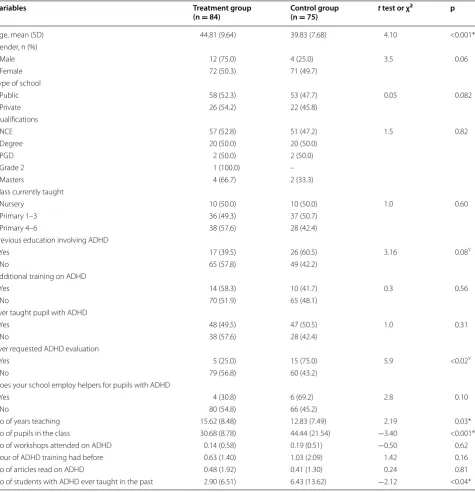
teaching experience. Table 1 shows that teachers in the two groups were not statistically different in gender, type of school, qualifications, classes currently taught, hav-ing additional trainhav-ing on ADHD, ever teachhav-ing pupils with ADHD, number of ADHD workshops previously attended, number of ADHD articles read, whether previ-ous education involved training on ADHD and whether their schools employed people specifically to help pupils with ADHD. However, teachers in the intervention group were significantly older, had more years of teaching expe-rience, and smaller classes, while the teachers in the con-trol group were more likely to have ever requested for ADHD evaluation for their pupils as well as taught more children with ADHD.
Effectiveness of the intervention
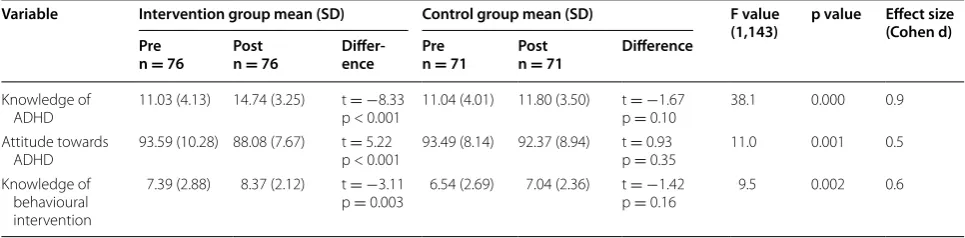
At baseline, the scores on knowledge and attitude towards ADHD were not significantly different between the groups but the intervention group scored signifi-cantly higher on knowledge of behavioural intervention (Table 2). However, post-intervention, the interven-tion group scored significantly higher on Knowledge of ADHD (t = 5.270, df = 145, p = 0.0001), knowledge
of behavioural interventions for ADHD (t = 3.594,
df = 145, p = 0.005), and significantly less on
nega-tive attitude towards ADHD (t = −2.838, df = 145,
p = 0.0001). As shown in Table 2, ANCOVA showed
scored significantly higher on knowledge of ADHD {F (1,143) = 38.1, p = 0.000}. The intervention explained
21% of the variance in the post intervention knowl-edge of ADHD scores with a large effect size of 0.9. Similarly, the training programme showed a statisti-cally significant effect on attitude towards ADHD scores
{F (1,143) = 11.0, p = 0.001} and explained 7.1% of the
variance with a moderate Cohen’s effect size (d) of 0.5. Finally, a statistically significant treatment effect on knowledge of behavioural intervention {F (1,143) = 9.5,
p = 0.002} was observed with a moderate Cohen’s effect
size (d) of 0.6.
Table 1 Socio-demographic characteristics, teaching history, and past experience of ADHD between the treatment and control groups
Y Yates correction
* Significant at p < 0.05
Variables Treatment group
(n = 84) Control group(n = 75) t test or χ
2 p
Age, mean (SD) 44.81 (9.64) 39.83 (7.68) 4.10 <0.001*
Gender, n (%)
Male 12 (75.0) 4 (25.0) 3.5 0.06
Female 72 (50.3) 71 (49.7)
Type of school
Public 58 (52.3) 53 (47.7) 0.05 0.082
Private 26 (54.2) 22 (45.8)
Qualifications
NCE 57 (52.8) 51 (47.2) 1.5 0.82
Degree 20 (50.0) 20 (50.0)
PGD 2 (50.0) 2 (50.0)
Grade 2 1 (100.0) –
Masters 4 (66.7) 2 (33.3)
Class currently taught
Nursery 10 (50.0) 10 (50.0) 1.0 0.60
Primary 1–3 36 (49.3) 37 (50.7)
Primary 4–6 38 (57.6) 28 (42.4)
Previous education involving ADHD
Yes 17 (39.5) 26 (60.5) 3.16 0.08Y
No 65 (57.8) 49 (42.2)
Additional training on ADHD
Yes 14 (58.3) 10 (41.7) 0.3 0.56
No 70 (51.9) 65 (48.1)
Ever taught pupil with ADHD
Yes 48 (49.5) 47 (50.5) 1.0 0.31
No 38 (57.6) 28 (42.4)
Ever requested ADHD evaluation
Yes 5 (25.0) 15 (75.0) 5.9 <0.02Y
No 79 (56.8) 60 (43.2)
Does your school employ helpers for pupils with ADHD
Yes 4 (30.8) 6 (69.2) 2.8 0.10
No 80 (54.8) 66 (45.2)
No of years teaching 15.62 (8.48) 12.83 (7.49) 2.19 0.03*
No of pupils in the class 30.68 (8.78) 44.44 (21.54) −3.40 <0.001*
No of workshops attended on ADHD 0.14 (0.58) 0.19 (0.51) −0.50 0.62
Hour of ADHD training had before 0.63 (1.40) 1.03 (2.09) 1.42 0.16
No of articles read on ADHD 0.48 (1.92) 0.41 (1.30) 0.24 0.81
Impact of booster session
Table 3 shows paired t tests which indicate that the sec-ond booster training was associated with a statistically significant further increase in knowledge of ADHD but no further increase in knowledge of behavioural inter-vention or a further reduction in negative attitude towards ADHD.
Discussion
This is a randomized controlled trial of the effect of ADHD training on the knowledge and attitude of primary school teachers in Kaduna, North West Nigeria towards this condition. Teachers in the intervention group were trained using a standard ADHD training program for 3 h in the first session and one-and-a-half hours in the second booster session 2 weeks later. Compared with the control group, the ADHD training program demon-strated a statistically significant increase in knowledge of ADHD and its behavioural management, and improved attitude towards affected children.
The need for this type of study in Nigeria is evidenced by extant literature indicating low levels of knowledge of ADHD and negative attitude towards affected children by Nigerian teachers. Further support for the need for this intervention comes from the current study which showed the teachers had limited exposure to ADHD training. For example, only a third of the teachers reported that their previous training included ADHD. Also less than a fifth of the participants had had additional training on ADHD in spite of an average of 14 years of teaching experience.
These observations become more pertinent when it is considered that the 5% prevalence of ADHD means that every classroom is likely to have one or more children with the condition [18, 31].
The improvement in knowledge of ADHD, attitude towards affected children, and knowledge of ADHD-related behavioural management following the interven-tion in this study is similar to findings from previous studies using a variety of training methods and platforms such as provision of written materials [9], one point training [32], short-term intervention (1 week) [33], as well as internet based training. These have all shown rap-idly improved knowledge about ADHD, with benefits lasting for up to 6 months [34, 35].
The study by Sarraf et al. [9] is particularly relevant to areas with very limited resources. They conducted a two-method training on ADHD among 67 primary school teachers in Iran. The first method involved a 2-day work-shop while the second method was a nonattendance edu-cation group. The latter group was given ADHD related booklets to study with the precise educational content similar to that of the workshop group. Post-test ques-tionnaires were given to the workshop group after the 2 days of training. The nonattendance group who had studied the related booklets was assessed after 10 days. They found that both the nonattendance education method and workshop method were effective in promot-ing teachers’ knowledge of ADHD. However, the work-shop education was more effective in changing attitude and improving knowledge of behaviour management Table 2 Comparisons between intervention group and control group on outcome measures (knowledge of ADHD, atti-tude to ADHD, and knowledge of behavioural intervention)
Variable Intervention group mean (SD) Control group mean (SD) F value
(1,143) p value Effect size (Cohen d) Pre
n = 76 Postn = 76 Differ‑ence Pren = 71 Postn = 71 Difference
Knowledge of
ADHD 11.03 (4.13) 14.74 (3.25) t p < 0.001=−8.33 11.04 (4.01) 11.80 (3.50) p t ==− 0.101.67 38.1 0.000 0.9 Attitude towards
ADHD 93.59 (10.28) 88.08 (7.67) t p < 0.001= 5.22 93.49 (8.14) 92.37 (8.94) p t == 0.93 0.35 11.0 0.001 0.5 Knowledge of
behavioural intervention
7.39 (2.88) 8.37 (2.12) t =−3.11
p = 0.003 6.54 (2.69) 7.04 (2.36) t p ==− 0.161.42 9.5 0.002 0.6
Table 3 Intervention group only: within group differences in post intervention and post booster scores on outcome measures (knowledge of ADHD, attitude to ADHD, and knowledge of behavioural intervention)
*Significant at p < 0.05
Continuous variables Post‑intervention
n = 75 Post‑boostern = 75 t df p
Knowledge of ADHD score 14.83 (±3.18) 15.48 (±3.53) −2.12 74 0.04*
Attitude to ADHD score 88.13 (±7.71) 86.92 (±8.95) 1.22 74 0.23
of students with ADHD. This study suggests that where resources are insufficient to support face to face train-ing, providing teachers with written information about ADHD could in the least improve their knowledge of the condition.
Limitations of the study
Due to time and resource constraints, the duration of the intervention was short comprising of a 3-h session followed 2 weeks later by a one-and-a-half hour booster training. Also, the participants were randomised at school level rather than as individuals. The latter would have been ideal but would have been impractical within the resources available for the study. Masking was not feasible which means that socially desirable responding could have contributed to the better outcomes among the intervention group. The study used a waitlist control group (rather than an active control group) and treat-ment trials using waitlist controls tend to show better outcomes. The inclusion of all the 23 local government areas in the study area, with half of the regions being in the intervention group and the other half being in the control group, would have been ideal but this was logis-tically difficult within the resources available for this study. The administrative structure of the schools made it pragmatic for headmasters to be involved in identify-ing participants. However, this may have introduced bias compared with if teachers were recruited directly. Finally, the long term impact of the training is uncertain as we only have short term outcomes.
Conclusion
ADHD is a prevalent neuro-developmental disorder affect-ing 3–7% of school-aged children. This suggests that every classroom of 25 children would have at least one child with ADHD. However, findings from previous studies indicate that teachers have low knowledge of ADHD as well as neg-ative attitude towards affected children. This study showed that one session of ADHD training using a standard readily available training package can improve teacher’s knowledge and attitude towards ADHD. Thus considera-tion should be given to the integraconsidera-tion of ADHD training programs into teacher training programs and inclusion of ADHD in the continuing professional development train-ing of already qualified teachers in Nigeria.
Abbreviations
ADHD: attention deficit hyperactivity disorder; mhGAP-IG: Mental Health Gap Action Programme—Intervention Guide; SD: standard deviation; SRAQ: self report ADHD questionnaire; KADDS: Knowledge of Attention Deficit Disorders Scale; KBIQ: Knowledge of Behavioural Intervention Questionnaire; WHO: World Health Organisation; ANCOVA: analysis of covariance.
Authors’ contributions
All authors participated in the research, were involved in the drafting of the manuscript, have given their approval for the publication of the work and have agreed to be accountable for all aspects of the work. All authors read and approved the final manuscript.
Author details
1 Federal Neuropsychiatric Hospital, Barnawa, Kaduna, Nigeria. 2 Academic
Unit of Child and Adolescent Psychiatry, Imperial College London, London, UK. 3 Department of Psychiatry, University of Ibadan and University College
Hospital, Ibadan, Nigeria. 4 Centre for Child and Adolescent Mental Health,
University of Ibadan, College of Medicine, University College Hospital, Ibadan, Nigeria.
Acknowledgements
The study was conducted as part of a graduate programme at the centre for child and adolescent mental health, University of Ibadan, Nigeria. The Centre (and this publication) is supported by the John D. and Catherine T. MacArthur Foundation (Grant Number: 10-95902-000-INP).
Competing interests
The authors declare that they have no competing interests.
Availability of data and materials
The datasets generated and analysed during this current study is available on request from the corresponding author.
Consent for publication
All authors have given their approval for the publication of the work. This manuscript does not contain details, images or videos relating to individual participants.
Ethics approval and consent to participate
Ethical approval was obtained from the Research and Ethics Committee of the Federal Neuro-Psychiatric Hospital, Kaduna. Permission was obtained from the Kaduna State Universal Basic Education Board and the head teachers of the participating schools. Written informed consent to participate was also obtained from the participating teachers.
Funding
This publication is supported by the John D. and Catherine T. MacArthur Foundation (Grant Number: 10-95902-000-INP).
Received: 10 August 2016 Accepted: 2 March 2017
References
1. McCarthy S, Wilton L, Murray ML, Hodgkins P, Wong ICK. The epidemiol-ogy of pharmacologically treated attention deficit hyperactivity disorder (ADHD) in children, adolescents and adults in UK primary care. BMC Pediatr. 2012;12(78):1–11.
2. Polanczyk G, Rohde LA. Epidemiology of attention-deficit/hyperactivity disorder across the lifespan. Curr Opin Psychiatry. 2007;20:386–92. 3. Raman N, Van Rensburg ABRJ. Clinical and psycho-social profile of
child and adolescent mental health care users and services at an urban child mental health clinic in South Africa: original. Afr J Psychiatry. 2013;28(108):356–63.
4. Kos JM, Richdale AL, Jackson MS. Knowledge about attention-deficit/ hyperactivity disorder: a comparison of in-service and preservice teach-ers. Psychol Sch. 2004;41(5):517–26.
5. Guerra FR, Brown MS. Teacher knowledge of attention deficit hyperactiv-ity disorder among middle school students in South Texas. RMLE Online. 2012;36(3):1–7.
• We accept pre-submission inquiries
• Our selector tool helps you to find the most relevant journal
• We provide round the clock customer support
• Convenient online submission
• Thorough peer review
• Inclusion in PubMed and all major indexing services
• Maximum visibility for your research
Submit your manuscript at www.biomedcentral.com/submit
Submit your next manuscript to BioMed Central
and we will help you at every step:
7. Bradshaw L, Kamal M. Teacher knowledge, training and acceptance of students with ADHD in their classrooms: Qatar case study. Near Middle East J Res Educ. 2013;5:1–11.
8. Dilaimi A. New Zealand primary school teachers’ knowledge and perceptions of attention-deficit/hyperactivity disorder (ADHD). A thesis presented in partial fulfilment of the requirements for the degree of Mas-ter in Educational Psychology at Massey University, Albany, New Zealand 2013; p. 1–217.
9. Sarraf N, Karahmadi M, Marasy MR, Azhar SM. A comparative study of the effectiveness of nonattendance and workshop education of primary school teachers on their knowledge, attitude and function towards ADHD students in Isfahan in 2010. J Res Med Sci. 2011;16(9):1196–201. 10. Adeosun I, Ogun O, Fatiregun O, Adeyemo S. Attitude of Nigerian primary
school teachers to children with attention deficit hyperactivity disorders. Eur Psychiatry. 2013;28(1):1.
11. Jimoh M. Knowledge and attitude towards attention deficit hyperactivity disorder among primary school teachers in Lagos state, Nigeria. Adv Life Sci Technol. 2014;23:7–15.
12. Youssef MK, Hutchinson G, Youssef FF. Knowledge of and attitudes toward ADHD among teachers: insights from a Caribbean Nation. SAGE Open. 2015;5(1):1–8.
13. Moldavsky M, Sayal K. Knowledge and attitudes about attention-deficit/ hyperactivity disorder (ADHD) and its treatment: the views of children, adolescents, parents, teachers and healthcare professionals. Curr Psychia-try Rep. 2013;15(8):377.
14. Kleynhans SE. Primary school teachers knowledge and misperceptions of attention deficit/hyperactivity disorder (ADHD) (Master’s thesis, University of Stellenbosch, Stellenbosch, South Africa). 2005. http://hdl.handle. net/10019.1/1612. Accessed 26 Feb 2016.
15. Pelham WE, Gnagy EM, Greenslade KE, Milichi R. Teachers’ rating of DSM-III-R symptoms for the disruptive behaviour disorders. J Am Acad Child Adolesc Psychiatry. 1992;31(2):210–8.
16. Carey W. Problems diagnosing attention and activity. Paediatrics. 1999;103(3):664–7.
17. Ohan JL, Cormier N, Hepp SL, Visser TAV, Strain MC. Does knowledge about attention deficit/hyperactivity disorder impact teachers’ reported behaviors and perceptions? Sch Psychol Q. 2008;23:436–49.
18. Kos J, Richdale A, Hay D. Children with attention deficit hyperactivity disorder and their teachers: a review of the literature. Int J Disabil Dev Educ. 2006;53(2):147–60.
19. Bussing R, Schoenberg NE, Perwien AR. Knowledge and information about ADHD: evidence of cultural differences among African-American and white parents. Soc Sci Med. 1998;46(7):919–28.
20. Di Battista D, Sheperd ML. Primary school teachers’ beliefs and advice to parents concerning sugar consumption and activity in children. Psychol Rep. 1993;72(1):47–55.
21. Sherman J, Rasmussen C, Baydala L. The impact of teacher factors on achievement and behavioural outcomes of children with attention deficit/hyperactivity disorder (ADHD): a review of the literature. Educ Res. 2008;50(4):347–60.
22. Kendall L. “The teacher said I’m thick!” Experiences of children with atten-tion deficit hyperactivity disorder within a school setting. Support Learn. 2016;31:122–37.
23. Sciutto MJ, Terjesen MD, Kučerová A, Michalová Z, Schmiedeler S, Antonopoulou K, Shaker NZ, Lee JY, Alkahtani K, Drake B, Rossouw J. Cross-national comparisons of teachers’ knowledge and misconceptions of ADHD. Int Perspect Psychol Res Pract Consult. 2016;5(1):34–50. 24. Inuwa AM, Mohammad-Yusof N. Teachers challenges in Nigerian Public
secondary schools climate: implications on students dropouts. Sci J Sociol Anthropol. 2012;2012:125–32.
25. Ministry of Education KS. Kaduna: Kaduna State School Census Report; 2010.
26. Wade A. Statistics and research methodology. London: Inst Child Heal; 1997.
27. Kos J. Primary school teachers’ knowledge, attitudes and behaviours toward children with attention-deficit/hyperactivity disorder. Melbourne: RMIT University; 2004.
28. Sciutto MJ, Terjesen MD, Frank AS. Teachers’ knowledge and mis-perceptions of attention-deficit/hyperactivity disorder. Psychol Sch. 2000;37(2):115–22.
29. World Health Organisation (WHO). mhGAP Intervention Guide for mental, neurological and substance use disorders in non-specialized health set-tings. 1st ed. In: Mental Health Gap Action Programme. vol. 1.0, Geneva: WHO; 2010. p. 1–121.
30. Cohen J (1988) Statistical power analysis for the behavioural sciences, 2nd edn. Hillsdale, NJ: Erlbaum.
31. Fabiano G, Pelham W. Improving the effectiveness of behavioural class-room interventions for attention-deficit/hyperactivity disorder: a case study. J Emot Behav Disord. 2003;11(2):122–8.
32. Murray EK. “Don’t give up on them”: managing attention deficit hyperac-tivity disorder in schools—what teachers and parents believe and know. Murdoch: Murdoch University; 2009.
33. Syed EU. Increase in teachers’ knowledge about ADHD after a week-long training program. A pilot study. J Att. 2010;13(4):420–3.
34. Aguiar AP, Kieling RR, Costa AC, Chardosim N, Dorneles BV, Almeida MR, et al. Increasing teachers’ knowledge about ADHD and learning disorders: an investigation on the role of a psychoeducational intervention. J Atten Disord. 2014;18:691–8.