R E S E A R C H A R T I C L E
Open Access
Primary care physicians
’
own exercise habits
influence exercise counseling for patients with
chronic kidney disease: a cross-sectional study
Yoshiyuki Morishita
1*, Akihiko Numata
1, Atushi Miki
1, Mari Okada
1, Kenichi Ishibashi
2, Fumi Takemoto
1,
Yasuhiro Ando
1, Shigeaki Muto
1, Daisuke Nagata
1and Eiji Kusano
3Abstract
Background:The appropriate exercise counseling for chronic kidney disease (CKD) patients is crucial to improve their prognosis. There have been few studies about exercise counseling by primary care physicians for CKD patients. We investigated primary care physicians’exercise counseling practices for CKD patients, and the association of these physicians’own exercise habits with exercise counseling.
Methods:The population of this cross-sectional study was 3310 medical doctors who graduated from Jichi Medical University from 1978 to 2012. The study instrument was a self-administered questionnaire that was mailed in August 2012 to investigate their age class, specialty, workplace, exercise habits, and practices of exercise counseling for CKD.
Results:581 (64.8%) medical doctors practiced the management of CKD among a total of 933 responses. These 581 medical doctors were defined as CKD primary care physicians and their answers were analyzed. CKD primary care physicians’own exercise habits (frequencies and intensities) were as follows: frequencies: daily, 71 (12.1%);≥2–3 times/ week, 154 (26.5%);≥1 time/week, 146 (25.1%); and≤1 time/month, 176 (30.2%); intensities: high (≥6 Mets), 175 (30.1%); moderate (4–6 Mets), 132 (22.7%); mild (3–4 Mets), 188 (32.3%); very mild (<3 Mets), 47 (8.1%); and none, 37 (6.4%). The CKD primary care physicians’exercise recommendation levels for CKD patients were as follows: high, 31 (5.3%); moderate, 176 (29.7%); low, 256 (44.0%); and none, 92 (15.8%). The CKD primary care physicians’exercise
recommendations for CKD patients were significantly related to their own exercise frequency (p < 0.001), but they were not related to their age, specialty, workplace, or exercise intensity.
Conclusions:CKD primary care physicians’exercise recommendation level for CKD patients was limited. In addition, CKD primary care physicians’own exercise habits influenced the exercise counseling for CKD patients. The establishment of guidelines for exercise by CKD patients and their dissemination among primary care physicians are needed.
(University Hospital Medical Information Network Clinical Trial Registry. number, UMIN000011803. Registration date, Sep/19/2013)
Background
Chronic kidney disease (CKD) patients show gradual de-cline in maximal exercise capacity in accordance with the progression of their CKD stage [1,2]. Actually, CKD stage 3–5 patients have been reported to show lower peak oxy-gen consumption, averaging 50-80% compared with healthy subjects [3,4]. This decreased exercise capacity decreases
quality of life and enhances sarcopenia, which can be de-fined as the age-related (1% per year after the age of 25) loss of muscle [5,6]. Several studies reported that sarcopenia progressed much more intensively in CKD patients in asso-ciation with several factors often observed in CKD, such as nutritional deficiencies, acidosis, and vitamin D deficiency [7,8]. Sarcopenia is an independent predictor of low phys-ical performance activities and fractures [9]. Recently, accu-mulated evidence has demonstrated that all CKD patients, irrespective of CKD stage and treatment modality, can im-prove their physical functioning and reduce the risk of * Correspondence:[email protected]
1
Division of Nephrology, Department of Medicine, Jichi Medical University, 3311-1, Yakushiji, Shimotsuke-city, Tochigi 329-0498, Japan
Full list of author information is available at the end of the article
sarcopenia by exercise training [10,11]. Previous studies have reported beneficial effects of resistance exercise train-ing on muscle mass and contractile function in CKD patients [12-15]. In addition, several studies also have re-ported the beneficial effects of exercise on potential medi-ators of cardiovascular disease in CKD [12,16]. Since the prevalence of CKD has been increasing globally [17,18] and it has become a common disease globally, like cardio-vascular diseases and metabolic syndrome, appropriate ex-ercise counseling by primary care physicians as well as nephrologists for CKD patients is crucial to improve their prognosis. However, physicians reported limited medical school and residency training education about the benefi-cial effects of exercise, as well as inadequate guidelines for writing exercise prescriptions or referrals as barriers to ex-ercise counseling [19,20]. Several studies reported that physicians who exercise are more likely to counsel their patients to do so as well [21,22]. However, there have been few studies about exercise counseling by primary care physicians for CKD patients. Therefore, in the present study, we investigated primary care physicians’ exercise counseling practices for CKD patients. Furthermore, we also investigated the associations of primary care physi-cians’ own exercise habits with their exercise counseling, as well as major barriers for exercise counseling for CKD patients.
Methods
This study was conducted in accordance with the Dec-laration of Helsinki and was approved by the ethics com-mittee of Jichi Medical University. Since this study was analysis of anonymous self-administered questionnaire, responses were considered as consents for this study. This study was registered at University Hospital Medical Information Network Clinical Trial Registry (UMIN-CTR). The identification number is UMIN000011803.
Subjects
The population of this cross-sectional study was 3310 medical doctors who graduated from Jichi Medical Uni-versity from 1978 to 2012. The medical doctors who graduate from this medical university have a 5–7-year term of duty to work in a rural area of Japan as primary care physicians. In addition, almost all medical doctors (> 80%) continue to work as primary care physicians after this term of duty.
Study instrument
The study instrument was a self-administered question-naire. This was designed to obtain detailed information about primary care physicians’characteristics, including their age class, specialty, workplace, personal exercise habits, and management of CKD (exercise counseling practice, medical prescription pattern). The results of
their medical prescription pattern will be analyzed and reported elsewhere. This study focused on the primary care physicians’ exercise counseling practices for CKD patients, and the association of primary care physicians’ own exercise habits with their exercise counseling for CKD. The questions that were used for analysis in the present study were as follows:
Characteristics
1. Age (24–30, 30–40, 40–50, 50–60,≥60 years)
2. Specialty (internal medicine, surgery, general medicine, pediatrics, others)
3. Workplace: (university hospital, polyclinic hospital, hospital, clinic, others)
Personal exercise habits
1. Exercise frequency (daily,≥2–3 times/week,≥1
time/week ,≤1 time/month)
2. Exercise intensity (high [≥6 Mets], eg, swimming,
jogging, soccer, cycling; moderate [4–6 Mets], eg, quick walking, golf; mild [3–4 Mets], eg, walking, cleaning; very mild [<3 Mets], eg, stretching, cooking; none; others)
Exercise recommendation for CKD
1. Management of CKD patients (yes, no) 2. Diseases for which you recommend exercise
[multiple selection] (diabetes mellitus,
hyperlipidemia, apoplexia, heart failure, arterial hypertension, others)
3. General exercise recommendations for CKD patients (high, moderate, low, others)
The next two questions were for those who chose high or moderate for the question above about general exer-cise recommendations for CKD patients.
1. Recommended exercise frequency for CKD patients
(daily,≥2–3 times/week,≥1 time/week,≤1 time/
month)
2. Recommended exercise intensity for CKD patients
(high [≥6 Mets], eg, swimming, jogging, soccer,
cycling; moderate [4–6 Mets], eg, quick walking, golf; mild [3–4 Mets],eg, walking, cleaning, very mild [<3 Mets],eg, stretching, cooking; others
The next question was for those who chose low or no for the above question about general exercise recom-mendations for CKD patients.
inadequate knowledge on the effects of exercise, concern that exercise may impair renal function and cause complications, inadequate knowledge to prescribe exercise for CKD patients, inadequate time, others)
Statistical analysis
The associations between primary care physicians’own ex-ercise habits (frequency and intensity) and their age class, specialty, and workplace were analyzed by multiple linear regression analysis to determine the independent variables. Values of p < 0.01 were considered to be significant.
Results
The survey was mailed to 3310 medical doctors, with sponses being received from 933 in total (28.2%). 37 re-sponses were excluded from this study due to their inadequacy. Among the remaining 896, 581 (64.8%) med-ical doctors managed CKD patients. In this study, these 581 medical doctors were defined as CKD primary care physi-cians and their answers to the self-administered question-naire were analyzed.
The characteristics and exercise habits of CKD primary care physicians
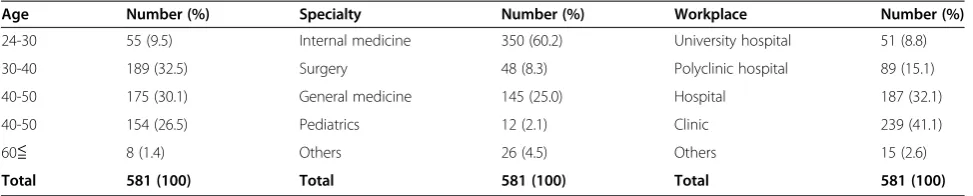
The characteristics of CKD primary care physicians’ age class, specialty, workplace and their exercise habits are shown in Table 1 and Table 2. Multivariable linear regres-sion analysis showed that the CKD primary care physi-cians’exercise frequency was significantly associated with
their age class (p < 0.01), but was not associated with their specialty or workplace (Table 3). Those in the older age classes were more likely to have a high exercise frequency. The CKD primary care physicians’ exercise intensity was not significantly associated with their age class, their spe-cialty and workplace (Table 3).
CKD primary care physicians’exercise counseling
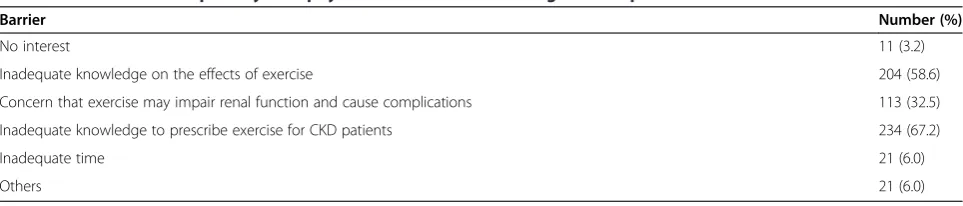
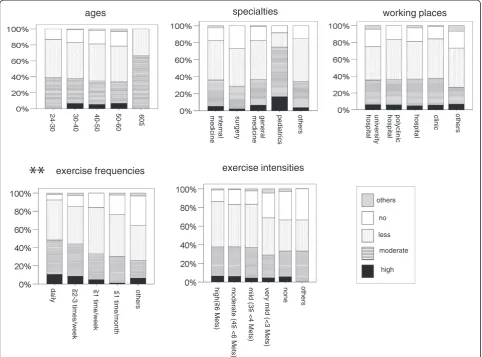
The diseases for which CKD primary care physicians recommend exercise were as follows: diabetes mellitus, 562 (96.7%); hyperlipidemia, 509 (87.6%); apoplexia, 250 (43.0%); heart failure, 129 (22.2%); arterial hypertension, 408 (70.2%); and others, 61 (10.5%). Table 4 shows CKD primary care physicians’ exercise counseling for CKD patients. Among CKD primary care physicians who had low and no exercise recommendations, the barriers to exercise counseling for CKD patients are shown in Table 5. Multivariable linear regression analysis showed that the CKD primary care physicians’ exercise recom-mendations (general) for CKD patients were significantly associated with their own exercise frequency (p < 0.001), but they were not associated with their age, specialty, workplace, or their own exercise intensity (Table 6, Figure 1). The CKD primary care physicians who had a high exercise frequency were more likely to recommend exercise at a high frequency for CKD patients than those who had a lower exercise frequency (Figure 1). Further-more, multivariable linear regression analysis showed among the CKD primary care physicians who had high and moderate exercise recommendations for CKD patients, Table 1 The characteristic of CKD primary care physicians
Age Number (%) Specialty Number (%) Workplace Number (%)
24-30 55 (9.5) Internal medicine 350 (60.2) University hospital 51 (8.8)
30-40 189 (32.5) Surgery 48 (8.3) Polyclinic hospital 89 (15.1)
40-50 175 (30.1) General medicine 145 (25.0) Hospital 187 (32.1)
40-50 154 (26.5) Pediatrics 12 (2.1) Clinic 239 (41.1)
60≦ 8 (1.4) Others 26 (4.5) Others 15 (2.6)
Total 581 (100) Total 581 (100) Total 581 (100)
Abbreviations:CKDchronic kidney disease.
Table 2 CKD primary care physicians’exercise habits
Frequency Number (%) Intensity Number (%)
Daily 71 (12.2) High (≥6 Mets) 175 (30.1)
≥2–3 times/week 154 (26.5) Moderate (4–6 Mets) 132 (22.7) ≥1 time/week 146 (25.1) Mild (3–4 Mets) 188 (32.2) ≤1 time/month 176 (30.3) Very mild (<3 Mets) 47 (8.1)
Others 32 (5.5) None 37 (6.4)
N/A 2 (0.3) Others 3 (0.5)
Total 581 (100) Total 203 (100)
Abbreviations:CKDchronic kidney disease,N/Anot available.
Table 3 Multivariate linear regression analyses of the association of age, specialty and workplace and exercise habits (frequency and intensity) in CKD primary care physician
Exercise frequency Exercise intensity
(Model R2= 0.139) (Model R2= 0.139)
χ2 p χ2 p
Age (years old) 38.224 *0.001 37.462 0.010
Specialty 28.470 0.028 25.553 0.181
Workplace 18.623 0.289 21.999 0.341
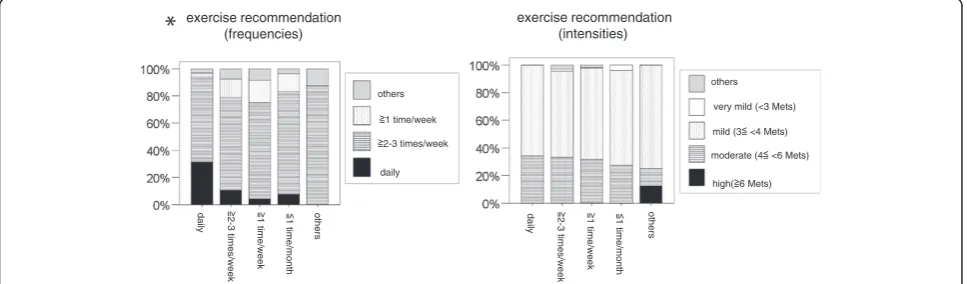
exercise recommendations frequency was associated with their own exercise frequency (p < 0.01) but not ex-ercise intensity (Table 7, Figure 2). They were not also associated with their age class, specialty or workplace (Table 7). The CKD primary care physicians who had a high exercise frequency were more likely to recommend exercise at a high frequency for CKD patients (Figure 2). Their exercise recommendations intensity for CKD pa-tients was not associated with their age class, specialty, or workplace, or with their own exercise frequency and intensity (Table 6).
Discussion
The results in the present study show that primary care physicians’exercise recommendation levels for CKD pa-tients were limited because their rate of positive exercise recommendations (high recommendation: 5.4% + moder-ate recommendation: 30.9%) was < 40% and their rmoder-ate of negative exercise recommendations was > 50% (low rec-ommendation: 44.1% + no recrec-ommendation: 15.8%) for such patients. In addition, the CKD primary care
phy-sicians’ exercise recommendation (general) for CKD
patients was significantly associated with their own exer-cise frequencies, but not with their age, specialty, work-place or their own exercise intensity. Furthermore, in the CKD primary care physicians who had positive exer-cise recommendations (high and moderate) for CKD pa-tients, their exercise frequency recommendations for CKD patients were significantly associated with their own exercise frequency; however, they were not associated with
their age class, specialty, or workplace, or with their own exercise intensity, and their exercise intensity recommen-dations for CKD patients were not associated with their age class, specialty, or workplace, or with their own exer-cise frequency and intensity.
There have been few studies about exercise counseling by primary care physicians for CKD patients. To the best of our knowledge, this is the first study to report on such exercise counseling. Several studies reported that physicians who have substantial exercise habits are more likely to counsel their patients to exercise [21,22]. In the present study, we also found associations of the CKD primary care physicians’ exercise frequency recommen-dations with their own exercise frequency.
Recently, several studies have demonstrated that all CKD patients, irrespective of their CKD stage, treatment modality, age, and functional impairment, can benefit from exercise [10-15]. Exercise including resistance exer-cise training can improve their physical capacity and reduce the risk of sarcopenia [10-15]. In addition, al-though the direct cardiovascular outcome in CKD pa-tients due to exercise has not been reported, several studies have reported the beneficial effects of exercise on potential mediators of cardiovascular disease such as ar-terial stiffness, C-reactive protein, and interleukin 6 [12,16]. In terms of renal function, although there have been no large studies that clearly showed the effects of exercise on renal function, several studies have shown that exercise decreased proteinuria and glomerular scler-osis in an animal model with CKD [23,24]. The European Table 4 CKD primary care physicians’exercise counseling for CKD patient
General Number (%) Frequency Number (%) Intensity Number (%)
High 31 (5.3) daily 22 (10.8) High (≥6 Mets) 1 (0.5)
Moderate 172 (29.6) ≥2–3 times/week 143 (70.4) Moderate (4–6 Mets) 61 (30.5)
Low 256 (44.1) ≥1 time/week 25 (12.3) Mild (3–4 Mets) 132 (66.0)
No 92 (15.8) ≤1 time/month 0 (0) Very mild (<3 Mets) 3 (1.5)
Others 10 (1.7) Others 13 (6.4) None 3 (1.5)
N/A 20 (3.4) Others 3 (1.5)
N/A 3 (1.5)
Total 581 (100) Total 203 (100) Total 203 (100)
Abbreviations:CKDchronic kidney disease,N/Anot available.
Table 5 Barriers for CKD primary care physicians’exercise counseling for CKD patient
Barrier Number (%)
No interest 11 (3.2)
Inadequate knowledge on the effects of exercise 204 (58.6)
Concern that exercise may impair renal function and cause complications 113 (32.5)
Inadequate knowledge to prescribe exercise for CKD patients 234 (67.2)
Inadequate time 21 (6.0)
Others 21 (6.0)
Association of Rehabilitation in Chronic Kidney Disease recommends maintaining CKD patients on a fairly in-tense level of exercise [25]. The National Kidney Foun-dation Kidney Disease Outcome Quality Initiative (K/ DOQI) clinical practice guidelines recommend that
physical functioning assessment and encouragement to participate in physical activity should be part of the rou-tine care plan for dialysis patients [26]. However, these recommendations do not seem to have been widely adopted and have been insufficiently referred to CKD primary care physicians because positive exercise rec-ommendations by CKD primary care physicians in the present study were limited at <40% (high recommenda-tion: 5.4% + moderate recommendarecommenda-tion: 30.9%), and the rate of negative exercise recommendation was > 50% (low recommendation: 44.1% + no recommendation: 15.8%) for CKD patients; however, they highly recom-mended exercise for patients with metabolic syndrome, such as diabetic mellitus (97.0%), hyperlipidemia (87.9%), and hypertension (70.8%). In addition, in the CKD primary care physicians who had negative exercise recommenda-tions for CKD patients, the main reasons why these physi-cians did not recommend exercise for CKD patients in the present study were inadequate knowledge on the effects of exercise (59.3%) and inadequate knowledge to prescribe Table 6 Multivariate linear regression analyses of the
association of age, specialty and workplace and exercise habits of CKD primary care physician and their exercise counseling (general) for CKD patient
Exercise recommendation general
(Model R2= 0.333) χ2
p
Age (years old) 20.616 0.194
Specialty 19.744 0.232
Workplace 11.937 0.748
Exercise frequency 38.548 ** < 0.001
Exercise intensity 13.055 0.875
Abbreviation:CKDchronic kidney disease, **p < 0.001.
ages specialties working places
inter
n
al
medic
ine
surgery medi general
ci
ne
pedi
atrics
others univ
er
s
ity
hos
p
ital
hospi
tal
p
ol
ycl
in
ic
hospi
tal
c
linic others
exercise frequencies exercise intensities
dai
ly 2-3 ti
mes
/week
1 ti
me/week
1 ti
me/month
others high(
6 Mets)
m
oderate (
4
<
6 M
ets)
mi
ld (3
<4
Mets)
very m
ild
(<
3
M
e
ts)
none others
high moderate less no others
30-40
50-60
60
40
-5
0
24-3
0
exercise (68.7%). Each CKD patient has a different type of disease, such as cardiovascular disease, heart disease, and metabolic syndrome. These complicated conditions may contribute to difficulty in establishing clear exercise guide-lines for CKD patients. Clyne reported that physicians should preferably prescribe exercise training and nephrol-ogists or physiolnephrol-ogists should design a program and evalu-ate its progress for CKD patients [25]. The cooperative planning and management of exercise for CKD patients may be useful to encourage exercise and improve their prognosis. In the management of CKD patients, appropri-ate pharmacological medication in CKD also very impo-tent. We investigated and reported medication-prescribing patterns of the primary care physicians in CKD. In that analysis, there were certain associations between the pre-scribing patterns of the CKD primary care physicians for CKD and their specialty and workplace (in press); how-ever, there was no association between their prescribing patterns for CKD and their exercise habits (unpublished data).
There are several limitations in this study. First, this was cross-sectional study, which limits the generalizability of the results. Seconds, since the study instrument was a
mailed administered questionnaire, there may be self-selection bias, and it may also contribute to low response rate (28.2%) to questionnaire. Second, the primary care physicians in this study may not be a representative popu-lation of all primary care physicians because all medical doctors in this study graduated from one medical sity; however, majority of graduates of this medical univer-sity work as primary care physicians. Third, the results were from a self-administered questionnaire and were not objectively evaluated in terms of primary care physicians’ personal exercise habits and exercise recommendations for CKD patients. These confounding factors in cross-sectional study might affect the results. Further studies will thus need to investigate more accurately the exercise prescription patterns for CKD patients and the exercise habits of primary care physicians using instruments such as exercise recording devices for both primary care physi-cians and CKD patients.
Conclusion
CKD primary care physicians’exercise recommendation level for CKD patients was limited. In addition, CKD primary care physicians’ own exercise habits influenced Table 7 Multivariate linear regression analyses of the association of age, specialty and workplace and exercise habits of CKD primary care physician who had who had high and moderate exercise recommendations for CKD patients and their exercise counseling (frequency and intensity) for CKD patient
Exercise recommendation frequency Exercise recommendation intensity
(Model R2= 0.333) (Model R2= 0.333)
χ2 p
χ2 p
Age (years old) 9.137 0.691 16.973 0.387
Specialty 19.619 0.075 17.649 0.345
Workplace 19.378 0.080 12.986 0.674
Exercise frequency 28.728 *0.004 16.693 0.406
Exercise intensity 17.719 0.278 26.126 0.162
Abbreviation:CKDchronic kidney disease; *, p < 0.01.
exercise recommendation (frequencies)
daily 2
-3 ti
mes/week
1 ti
me/week
1 ti
me/month
others daily 2
-3 ti
mes/week
1 ti
me/week
1 ti
me/month
others
exercise recommendation (intensities)
daily 2-3 times/week 1 time/week others
high( 6 Mets) mild (3 <4 Mets) very mild (<3 Mets) others
moderate (4 <6 Mets)
the exercise counseling for CKD patients. The establish-ment of guidelines for exercise by CKD patients and their dissemination among primary care physicians are needed.
Competing interests
The authors declare no competing interests.
Authors’contributions
YM participated in the design of the study and coordination, and performed the statistical analysis and drafted the manuscript. AN participated in its design. AM participated in its design and helped to carry out the statistical analysis. MO participated in its design and helped to carry out the statistical analysis. KI participated in its design. FT participated in its design. YA participated in its design. SM participated in its design. DN conceived of the study and participated in its design and coordination. EK conceived of the study and participated in its design and coordination. All authors have read and approve the final manuscript.
Acknowledgments
The authors thank Minami Watanabe, Yuko Suda, Yukari Hoshino, and Aiko Oashi for their excellent assistance. The authors have no funding for this study.
Author details
1Division of Nephrology, Department of Medicine, Jichi Medical University,
3311-1, Yakushiji, Shimotsuke-city, Tochigi 329-0498, Japan.2Department of Medical Physiology, Meiji Pharmaceutical University, Kiyose, Japan. 3
Department of Internal medicine, Ustunomiya Social Insurance Hospital, Ustunomiya, Japan.
Received: 25 October 2013 Accepted: 12 March 2014 Published: 19 March 2014
References
1. Clyne N, Jogestrand T, Lins LE, Pehrsson SK:Progressive decline in renal function induces a gradual decrease in total hemoglobin and exercise capacity.Nephron1994,67:322–326.
2. Boyce ML, Robergs RA, Avasthi PS, Roldan C, Foster A, Montner P, Stark D, Nelson C:Exercise training by individuals with predialysis renal failure: cardiorespiratory endurance, hypertension, and renal function.
Am J Kidney Dis1997,30:180–192.
3. Leikis MJ, McKenna MJ, Petersen AC, Kent AB, Murphy KT, Leppik JA, Gong X, McMahon LP:Exercise performance falls over time in patients with chronic kidney disease despite maintenance of hemoglobin concentration.Clin J Am Soc Nephrol2006,1:488–495.
4. Eidemak I, Haaber AB, Feldt-Rasmussen B, Kanstrup IL, Strandgaard S:
Exercise training and the progression of chronic renal failure.Nephron 1997,75:36–40.
5. Cheema B, Abas H, Smith B, O’Sullivan AJ, Chan M, Patwardhan A, Kelly J, Gillin A, Pang G, Lloyd B, Berger K, Baune BT, Singh MF:Investigation of skeletal muscle quantity and quality in end-stage renal disease.
Nephrology (Carlton)2010,15:454–463.
6. Goodpaster BH, Park SW, Harris TB, Kritchevsky SB, Nevitt M, Schwartz AV, Simonsick EM, Tylavsky FA, Visser M, Newman AB:The loss of skeletal muscle strength, mass, and quality in older adults: the health, aging and body composition study.J Gerontol A Biol Sci Med Sci2006,61:1059–1064. 7. Bonanni A, Mannucci I, Verzola D, Sofia A, Saffioti S, Gianetta E, Garibotto G:
Protein-energy wasting and mortality in chronic kidney disease.Int J Environ Res Public Health2011,8:1631–1654.
8. Remuzzi A:Vitamin D, insulin resistance, and renal disease.Kidney Int 2007,71:96–98.
9. Lang T, Streeper T, Cawthon P, Baldwin K, Taaffe DR, Harris TB:Sarcopenia: etiology, clinical consequences, intervention, and assessment.Osteoporos Int2010,21:543–559.
10. Storer TW, Casaburi R, Sawelson S, Kopple JD:Endurance exercise training during haemodialysis improves strength, power, fatigability and physical performance in maintenance haemodialysis patients.Nephrol Dial Transplant2005,20:1429–1437.
11. Heiwe S, Tollback A, Clyne N:Twelve weeks of exercise training increases muscle function and walking capacity in elderly predialysis patients and healthy subjects.Nephron2001,88:48–56.
12. Castaneda C, Gordon PL, Uhlin KL, Levey AS, Kehayias JJ, Dwyer JT, Fielding RA, Roubenoff R, Singh MF:Resistance training to counteract the catabolism of a low-protein diet in patients with chronic renal insufficiency. A randomized, controlled trial.Ann Intern Med2001,135:965–976. 13. Castaneda C, Gordon PL, Parker RC, Uhlin KL, Roubenoff R, Levey AS:
Resistance training to reduce the malnutrition-inflammation complex syndrome of chronic kidney disease.Am J Kidney Dis2004,43:607–616. 14. Chen JL, Godfrey S, Ng TT, Moorthi R, Liangos O, Ruthazer R, Jaber BL, Levey
AS, Castaneda-Sceppa C:Effect of intra-dialytic, low-intensity strength training on functional capacity in adult haemodialysis patients: a randomized pilot trial.Nephrol Dial Transplant2010,25:1936–1943. 15. Cheema B, Abas H, Smith B, O’Sullivan A, Chan M, Patwardhan A, Kelly J,
Gillin A, Pang G, Lloyd B, Fiatarone Singh M:Randomized controlled trial of intradialytic resistance training to target muscle wasting in ESRD: the Progressive Exercise for Anabolism in Kidney disease (PEAK) study.
Am J Kidney Dis2007,50:574–584.
16. Mustata S, Groeneveld S, Davidson W, Ford G, Kiland K, Manns B:Effects of exercise training on physical impairment, arterial stiffness and health-related quality of life in patients with chronic kidney disease: a pilot study.Int Urol Nephrol2011,43:1133–1141.
17. Jha V, Garcia-Garcia G, Iseki K, Li Z, Naicker S, Plattner B, Saran R, Wang AY, Yang CW:Chronic kidney disease: global dimension and perspectives.
Lancet2013,382:260–272.
18. Coresh J, Byrd-Holt D, Astor BC, Briggs JP, Eggers PW, Lacher DA, Hostetter TH:Chronic kidney disease awareness, prevalence, and trends among U.S. adults, 1999 to 2000.J Am Soc Nephrol2005,16:180–188. 19. Williford HN, Barfield BR, Lazenby RB, Olson MS:A survey of physicians’
attitudes and practices related to exercise promotion.Prev Med1992,
21:630–636.
20. Clever LH, Arsham GM:Physicians’own health–some advice for the advisors.West J Med1984,141:846–854.
21. Abramson S, Stein J, Schaufele M, Frates E, Rogan S:Personal exercise habits and counseling practices of primary care physicians: a national survey.Clin J Sport Med2000,10:40–48.
22. Wells KB, Ware JE Jr, Lewis CE:Physicians’practices in counseling patients about health habits.Med Care1984,22:240–246.
23. Kohzuki M, Kamimoto M, Wu XM, Xu HL, Kawamura T, Mori N, Nagasaka M, Kurosawa H, Minami N, Kanazawa M, Saito T, Yoshida K:Renal protective effects of chronic exercise and antihypertensive therapy in hypertensive rats with chronic renal failure.J Hypertens2001,19:1877–1882.
24. Heifets M, Davis TA, Tegtmeyer E, Klahr S:Exercise training ameliorates progressive renal disease in rats with subtotal nephrectomy.Kidney Int 1987,32:815–820.
25. Clyne N:Exercise training in chronic kidney disease.US Nephrology2011,
5:3.
26. K/DOQI Workgroup:K/DOQI clinical practice guidelines for cardiovascular disease in dialysis patients.Am J Kidney Dis2005,45:S1–S153.
doi:10.1186/1471-2369-15-48
Cite this article as:Morishitaet al.:Primary care physicians’own exercise habits influence exercise counseling for patients with chronic kidney disease: a cross-sectional study.BMC Nephrology201415:48.
Submit your next manuscript to BioMed Central and take full advantage of:
• Convenient online submission
• Thorough peer review
• No space constraints or color figure charges
• Immediate publication on acceptance
• Inclusion in PubMed, CAS, Scopus and Google Scholar
• Research which is freely available for redistribution