Taxonomic note of Parnassia (Celastraceae) in China... 43
Taxonomic note of
Parnassia
(Celastraceae) in China:
a reassessment of Subsect.
Xiphosandra
Huiying Yu1, Feiyi Guo1, Yumin Shu2, Zhixiang Zhang1,3
1 Laboratory of Systematic Evolution and Biogeography of Woody Plants, College of Nature Conservation, Bei-jing Forestry University, BeiBei-jing 100083, China 2 Institute of Plant Adaptation and Utilization in Southwest Mountain, College of Life Science, China West Normal University, Nanchong, Sichuan 637002, China 3 Mu-seum of Beijing Forestry University, Beijing 100083, China
Corresponding author:Zhixiang Zhang ([email protected])
Academic editor:M. P. Simmons | Received 15 October 2018 | Accepted 26 November 2018 | Published 20 December 2018
Citation: Yu H, Guo F, Shu Y, Zhang Z (2018) Taxonomic note of Parnassia (Celastraceae) in China: a reassessment of Subsect. Xiphosandra. PhytoKeys 114: 43–54. https://doi.org/10.3897/phytokeys.114.30551
Abstract
P. brevistyla, P. delavayi and P. leptophylla. belong to Celastraceae, Parnassia L., Sect. Nectarotrilobos Drude, Subsect. Xiphosandra (Franch.) Ku. Due to lack of material, the reliability of their taxonomic characteris-tics remained unknown and all three species have been retained. Following extensive field investigations, population sampling and examination of specimens, we determined that the previously used character-istics to distinguish these three species, i.e. the shape of basal leaves and the depth of staminode lobes, vary continuously within populations and should not be used to distinguish separate species. Therefore, P. brevistyla and P. leptophylla are hereby designated as synonyms of P. delavayi.
Keywords
Subsect. Xiphosandra, Celastraceae, new synonym, taxonomy
Introduction
Parnassia L. (Linnaeus 1753) is a genus that is predominantly distributed in the arctic and temperate zones of the Northern Hemisphere; it is most speciose in China and the Himalayas (Simmons 2004). All species of Parnassia are perennial herbs, glabrous;
PhytoKeys 114: 43–54 (2018) doi: 10.3897/phytokeys.114.30551 http://phytokeys.pensoft.net
Copyright Huiying Yu et al. This is an open access article distributed under the terms of the Creative Commons Attribution License (CC BY 4.0), which permits unrestricted use, distribution, and reproduction in any medium, provided the original author and source are credited.
RESEARCH ARTICLE
Launched to accelerate biodiversity research
flowers solitary, borne on unbranched scape, actinomorphic, hermaphrodite; stami-nodes 5, inserted opposite to petals, terete and entire or flat and divided into lobes or filiform rays. The genus was traditionally placed in the family Saxifragaceae (Hook-er and Thompson 1858, Engl(Hook-er 1930, Cronquist 1981, Ku 1995, Ku and Hultgård 2001); however, it was recently transferred to Celastraceae (APG IV 2016, Ball 2016) based on molecular evidence (Soltis et al. 1997, Soltis et al. 2000, Zhang and Simmons 2006, APG IV 2016). The latest updated checklist of the genus recognised 61 species, 2 subspecies, 11 varieties and 1 forma (Shu et al. 2017).
Subsect. Xiphosandra (Franch.) Ku (1987) has been recognised as consisting of those species in which the stamen connectives apically project as lanceolate append-ages (Fig. 1g). It includes three species: P. brevistyla, P. delavayi and P. leptophylla. Based on unique morphological characteristics (i.e. the stamen connectives apically project as lanceolate appendages), the three species were placed in Sect. Xiphosandra Franch. (Franchet 1897) with the support of Wu et al. (2003). Alternatively, most researchers placed them into Subsect. Xiphosandra of Sect. Nectarotrilobos Drude (Ku 1987, Wu 2005) or directly into Sect. Nectarotrilobos due to their flat and 3-lobed staminodes (Nekrassova 1927, Engler 1930, Handel-Mazzetti 1941).
Parnassia delavayi Franch. was published based on three collections (Delavay 217,
Delavay s.n. and Delavay Parnassia n. 2) (Franchet 1896). Then, Parnassia delavayi
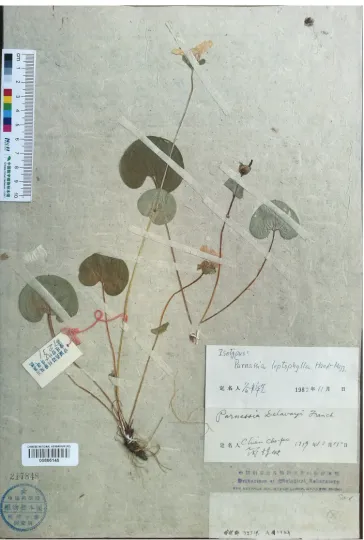
Franch. var. brevistyla Brieger was proposed in 1922 based on specimens collected from Tibet, China, 3750 m and Schenhsi, China, 2600 m, s.n. (Brieger 1922). Handel-Mazzetti (1931) promoted Parnassia delavayi var. brevistyla into the new species Par-nassia brevistyla (Brieg.) Hand.-Mazz. Handel-Mazzetti (1941) published 10 new taxa, including Parnassia leptophylla Hand.-Mazz., on the basis of a specimen collected from Baoxing, Sichuan, China—KL Chu 3231. Since the authors did not specify the holo-type of Parnassia delavayi or P. leptophylla in their publications, P00709352 (Fig. 2) was designated as the lectotype of P. delavayi and PE00866146 (Fig. 3) was designated as the lectotype of P. leptophylla by Shu et al. (2017). However, according to the infor-mation provided by the original description of P. brevistyla, these types of P. brevistyla
were not found after reviewing the specimens and high-resolution images of specimens in major herbaria, which was also mentioned by Stafleu and Mennega (1995).
Based on the descriptions of P. brevistyla, P. delavayi and P. leptophylla, the differ-ences amongst them mainly consist of two characteristics: the shape of leaf blades and the depth of staminode lobes (Ku 1995, Table 1). With regard to the shape of blades:
P. brevistyla has ovate-cordate basal leaves, while the other two species have reniform
Table 1. Morphological characters of the specimens amongst Parnassia brevistyla, P. delavayi and P. leptophylla.
P. brevistyla P. delavayi P. leptophylla Leaves Ovate-cordate Reniform, occasionally
suborbicular Reniform, occasionally suborbicular Staminodes Shallowly 3-lobed,the length of
Taxonomic note of Parnassia (Celastraceae) in China... 45
Figure 1.Parnassia delavayi: habitat (a), individual (b), flower (c), fruits (d, e), staminodes (f) and stamens (g). Scale bar: 1 mm.
or occasionally suborbicular basal leaves. With regard to the depth of staminode lobes:
P. brevistyla staminodes are shallowly 3-lobed and the length of lobes is 1/6 or less of staminodes’ length; P. delavayi staminodes are shallowly 3-lobed or to half their length;
P. leptophylla staminodes are 3-lobed for ca. 3/4 of their length.
Taxonomic note of Parnassia (Celastraceae) in China... 47
ulations, even sometimes within individuals. Therefore, the aim of this study was to clarify the classification relationship amongst P. brevistyla, P. delavayi and P. leptophylla
by re-evaluating their morphological characteristics, particularly the shape of blades and the depth of staminode lobes.
Material and methods
Specimens from BJFC, CDBI, IMC, KUN, QFNU, P, PE, SM, SZ and WCNU
(Suppl. material 1) were examined during this study. High-resolution photographs were also captured. The measurements provided herein were mostly obtained from dried herbarium specimens. Since the shape of both the leaf base and the apex are basi-cally identical, the leaf shape is defined by the aspect ratio of leaves in this study. The primary examined populations were in Chongqing, Gansu, Guizhou, Hebei, Henan, Hubei, Hunan, Shanxi, Sichuan, Tibet and Yunnan. These populations include the type localities of P. brevistyla, P. delavayi and P. leptophylla (Taibai, Shanxi; Baoxing, Sichuan; Heqing, Dali). To ensure the data are fully comprehensive, we have recorded all measurable traits, such as sepals and petals, in each population.
An Olympus SZX16 dissecting microscope was used for observations and an Olympus DP72 cooled digital colour camera was used to photograph leaves and sta-minodes. TpsDig software: Version 2.17 (http://life.bio.sunysb.edu/ee/rohlf/software. html) was used to measure the lengths and widths of leaves, thus improving the ac-curacy of experimental results.
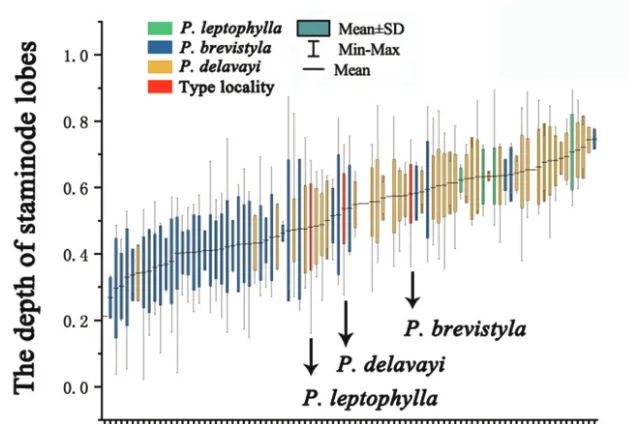
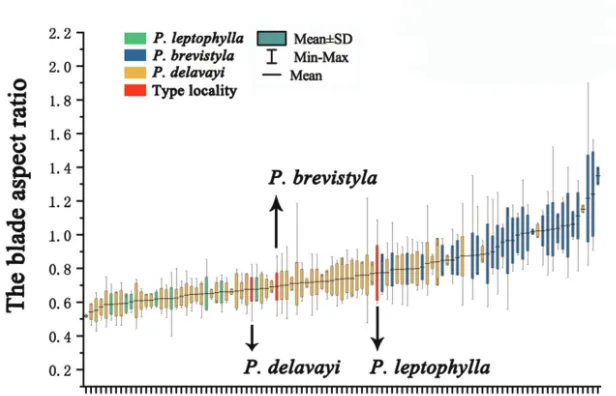
Overlapping or non-overlapping standard deviations can be used to determine if there is continuous or discontinuous variation of a quantitative trait between two or more groups, thus providing evidence for species differentiation or merging. This ap-proach was applied to the aspect ratio of leaves (the width of leaves / the length of leaves) and the depth of staminode lobes (the length of central lobes / the length of staminodes) (Fig. 4). A total of 100 populations from 11 provinces were studied. To ensure the uni-versality and comprehensive nature of the data, we measured all available individuals.
Taxonomic note of Parnassia (Celastraceae) in China... 49
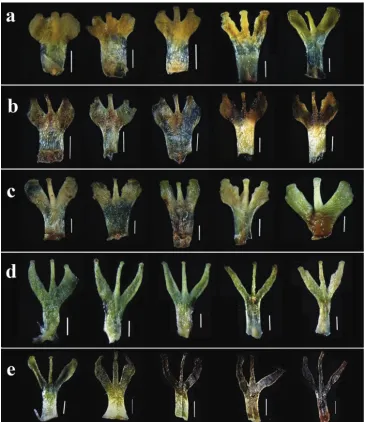
Figure 5. Variation of staminodes: a, b represent variation of the depth of staminode lobes in population of Kangding, Sichuan c represents variation of the depth of staminode lobes in population of Baoxing, Sichuan (the type locality of Parnassia leptophylla) d represents variation of the depth of staminode lobes in population of Cangshan, Dali (the type locality of P. delavayi) e represents variation of the depth of staminode lobes in population of Mabian, Sichuan. Scale bar: 1 mm.
Results
Figure 6. The standard deviation analysis of the depth of staminode lobes.
P. brevistyla, P. delavayi and P. leptophylla. As shown in Fig. 6, the variation of the depth of staminodes in the specimens collected from Baoji County, Heqing County and Baoxing County, where the types of P. brevistyla, P. delavayi and P. leptophylla
were collected, is within the variation range of the population of P. brevistyla. There is also significant overlap of the depth of staminode lobes amongst the three species. Thus, P. brevistyla, P. delavayi and P. leptophylla show no differences in the depth of staminode lobes.
The shape of basal leaves has also been considered to be a distinguishing charac-teristic in previous treatments (Ku 1987, 1995). However, we found that the shape of basal leaves varies greatly within populations. Based on field experience, we found that their leaf shape varies dramatically, not only amongst different regions, but also in the same population. Shapes range from reniform, broadly cordate, to cordate and ovate-cordate. As shown in Fig. 7, the variation of the blade aspect ratio in the specimens col-lected from type localities of P. brevistyla, P. delavayi and P. leptophylla is within the vari-ation range of P. brevistyla populations. Furthermore, a significant overlap was found for the blade aspect ratio amongst these three species with respect to the observed ranges as well as the standard deviations (Fig. 7). Based on this continuous variation, it is difficult to find a dividing line to distinguish different leaf shapes.
In summary, P. brevistyla, P. delavayi and P. leptophylla show no differences in the shape of blades and the depth of staminode lobes. Thus, we treated P. brevistyla and
Taxonomic note of Parnassia (Celastraceae) in China... 51
Figure 7. The standard deviation analysis of the blade aspect ratio.
Discussion
Hong (2016) proposed a new operational species concept called the morphological-biological species concept which emphasises that two or more qualitative traits or sta-tistically discontinuous quantitative characters should exist between two species (Liu 2016). We applied this species concept in this study.
Taxonomically delimited species can be regarded as an assemblage of populations or individuals that have common morphological features and show distinct morpho-logical discontinuity with other such assemblages in a number of characteristics (Singh 2004). That is, individuals of a given species show continuous variation in some char-acteristics. However, due to limitations of herbarium material, researchers can only ob-serve a certain state of an individual within a population, rather than its variation with-in populations. Therefore, field with-investigation and random samplwith-ing withwith-in populations are important components of taxonomic studies (Xu et al. 2017). In this study, through both random sampling and statistical analysis within populations, the variability of morphological characteristics used in previous taxonomic treatments were analysed and reconsidered to avoid taxonomic artifacts that may be caused by undersampling.
Furthermore, the distributions of these three species are continuous and overlap. There-fore, since these three species lack clear morphologic distinction and overlap in their dis-tribution range, we hereby reduce P. brevistyla and P. leptophylla to synonyms of P. delavayi.
Taxonomic treatment
Parnassia delavayi Franchet, 1896: 267
Fig. 2
=Parnassia brevistyla (Brieg.) Hand.-Mazz., 1931: 434. Syn. nov.
≡Parnassia delavayi Franch. var. brevistyla Brieger, 1922: 400. Syn. nov. Type: China. Tibet, ‘Beju-Batang, Nadelwalder bei Chieda am Anstieg zum Passe Mala’, 3500 m alt. (syntypes: not located); China. Schenhsi, Qingling, Taibaishan, Tempels Wan-schuen-gou, 2600 m alt., s.n. 2720 (syntypes: not located).
=Parnassia leptophylla Hand.-Mazz., 1941: 120. Syn. nov. (Fig. 3) Type: China. Sichuan, Baoxing, KL Chu 3231 (lectotype designated by Shu et al. 2017: PE00866146!; isolectotypes: IBSC0145403!, PE00865960!, SZ00179815!). Fig. 3.
Type. CHINA. Yunnan, Eryuan (Lan-kong), Hee Chanmen, 2800 m alt., 16
Au-gust 1883, Delavay 217 (lectotype designated by Shu et al. 2017: P05556394!; isolec-totypes: P00709355!, P00709356!, P05556395!, P06392624!); CHINA. Yunnan, Eryuan, Lanho, Yanginchan, 7 August 1883, Delavay 130 (syntypes: P00709357!, P00709358!, P06392623!)
Description. Stems 1–5, 10–40 cm, with 1 cauline leaf proximally or near
mid-dle. Basal leaves 3–7(10); petiole 2–16 cm; blade reniform, cordate or ovate-cordate, 1–4 × 1–4.5 cm, base deeply cordate to subcordate, apex rounded, apiculate. Flower 2–4.5 cm in diam.; hypanthium turbinate or campanulate. Sepals oblong, ovate to obovate, 4–13 × 2–8 mm, margin entire, apex rounded-obtuse. Petals white, some-times green at base, obovate or oblong-obovate, 8–25 × 5–12 mm, base attenuate, margin erose in proximal 1/3, apex rounded or acute. Anthers ellipsoid, connective projected at apex into a lanceolate appendage, to 5 mm; filaments ca. 5.5 mm; stami-nodes 3–6 mm, shallowly 3-lobed or to half their length, rarely lateral ones 2-lobu-late, lateral lobes usually wider than central one. Ovary superior, subglobose; stigma 3-lobed. Capsule obovoid with 3 thickened, longitudinal angles. Seeds brown, glossy, oblong. 2n = 14.
Acknowledgements
Taxonomic note of Parnassia (Celastraceae) in China... 53
specimens. This work was supported by the National Natural Science Foundation of China (grant no. 31110103911 & J1310002) and the Science & Technology Basic Work (grant no. 2017FY100100).
References
APG IV (2016) An update of the Angiosperm Phylogeny Group classification for the orders and families of flowering plants: APG IV. Botanical Journal of the Linnean Society 181(1): 1–20. https://doi.org/10.1111/boj.12385
Ball PW (2016) Parnassia. In: Ma JS, Ball PW, Levin GA (Eds) Flora of North America, vol. 12. Oxford University Press, New York & Oxford, 113–117.
Brieger FG (1922) Aufzählung der von Dr. Limprichet in Ostasien gesammelten Pflanzen. Repertorium Specierum Novarum Regni Vegetabilis. Beihefte 12: 400–402. https://biodi-versitylibrary.org/page/33525913
Cronquist A (1981) The integrated system of classification of flowering plants. Columbia Uni-versity Press, New York, 1–1262.
Engler A (1930) Saxifragaceae. In: Engler A, Prantl K (Eds) Die Natürlichen Pflanzenfamillien 18a. W Englmann, Leipzig, 178–182.
Franchet AR (1896) Saxifragaceae, Crassulaceae, et Combretaceae novae. Journal de Botanique (Morot) 10(16): 260–282. https://biodiversitylibrary.org/page/8855851
Franchet AR (1897) Synopsis Parnassiarum florae Asiae orientalis. Bulletin de la Société Bota-nique de France 44: 244–263. http://www.biodiversitylibrary.org/item/8666. https://doi. org/10.1080/00378941.1897.10830772
Handel-Mazzetti H (1931) Saxifragacea, Parnassia. Symbolae Sinicae 7(2): 432–435. https:// doi.org/10.5962/bhl.title.878
Handel-Mazzetti H (1941) Kleine Beitrage zur Kenntnis der Flora von China. Oesterreichische Botanische Zeitschrift 90(2): 118–126. https://doi.org/10.1007/BF01257742
Hong DY (2016) Biodiversity pursuits need a scientific and operative species concept. Shengwu Duoyangxing 24(9): 979–999. https://doi.org/10.17520/biods.2016203
Hooker JD, Thompson T (1858) Præcursores ad floram Indicam. Journal of the Proceedings of the Linnean Society. Botany 2: 54–103. http://biodiversitylibrary.org/page/167541 Ku TC (1987) A revison of the genus Parnassia (Saxifragaceae) in China. Bulletin of Botanical
Research 7(1): 1–57.
Ku TC (1995) Parnassia. In: Lu LT, Huang SM (Eds) Flora Reipublicae Popularis Sinicae, vol. 35. Science Press, Beijing, 1–66.
Ku TC, Hultgård UM (2001) Parnassia. In: Wu ZY, Raven PH (Eds) Flora of China, vol. 8. Missouri Botanical Garden Press, St. Louis and Science Press, Beijing, 95–118.
Linnaeus C (1753) Species plantarum, vol. 1. Laurentius Salvius, Stockholm, 560.
Liu BB (2016) A taxanomic revision of Pourthiaea Decne. (Rosaceae). PhD Thesis, University of China, Chinese Academy of Science.
Shu YM, Yu HY, Mu XY, Zhang ZX (2017) Checklist and typification of Parnassia (Celas-traceae). Phytotaxa 309(1): 1–22. https://doi.org/10.11646/phytotaxa.309.1.1
Simmons MP (2004) Parnassiaceae. In: Kubitzki K (Ed.) The families and genera of vascular plants. Springer Verlag, Berlin, 291–296. https://doi.org/10.1007/978-3-662-07257-8_33 Singh G (2004) Hierarchical classification. In: Singh G (Ed.) Plant Systematics: An Integrated
Approach. Science Publishers, Plymouth, 120–128.
Soltis DE, Soltis PS, Nickrent DL, Johnson LA, Hahn WJ, Hoot SB, Sweere JA, Kuzoff RK, Kron KA, Chase MW, Swensen SM, Zimmer EA, Chaw SM, Gillespie LJ, Kress WJ, Sytsma KJ (1997) Angiosperm phylogeny inferred from 18 S ribosomal DNA sequences. Annals of the Missouri Botanical Garden 84(1): 1–49. https://doi.org/10.2307/2399952 Soltis DE, Soltis PS, Chase MW, Mort ME, Albach DC, Zanis M, Saolainen V, Hahn WJ, Hoot
SB, Fay MF, Axtell M, Swensen SM, Nixon KC, Farris JS (2000) Angiosperm phylogeny in-ferred from a combined data set of 18S rDNA, rbcL, and atpB sequences. Botanical Journal of the Linnean Society 133(4): 381–461. https://doi.org/10.1111/j.1095-8339.2000.tb01588.x Stafleu FA, Mennega EA (1995) Taxonomic Literature: A Selective Guide to Botanical Publica-tions and CollecPublica-tions with Dates, Commentaries and Types, supplement III: Br-Ca. Koeltz Scientific Books, Koenigstein, 73–74. https://doi.org/10.5962/bhl.title.48631
Wu D (2005) Phylogeny and Biogeography of the genus Parnassia. Kunming Istitute of Botany, Chinese Academy of Sciences.
Wu ZY, Lu AM, Tang YC, Chen ZD, Li DZ (2003) The families and genera of angiosperms in China a comprehensive analysis. Science Press, Beijing, 649–654.
Xu SJ, Shang C, Zhang ZX, Zhao LC (2017) The identity of Homalium breviracemosum (Sali-caceae). Phytotaxa 326(1): 63–70. https://doi.org/10.11646/phytotaxa.326.1.5
Zhang LB, Simmons MP (2006) Phylogeny and delimitation of the Celastrales inferred from nuclear and plastid genes. Systematic Botany 31(1): 122–137. https://doi. org/10.1600/036364406775971778
Supplementary material 1
A list of herbarium specimens examined
Authors: Huiying Yu, Feiyi Guo, Yumin Shu, Zhixiang Zhang Data type: species data
Copyright notice: This dataset is made available under the Open Database License (http://opendatacommons.org/licenses/odbl/1.0/). The Open Database License (ODbL) is a license agreement intended to allow users to freely share, modify, and use this Dataset while maintaining this same freedom for others, provided that the original source and author(s) are credited.