Available Online at www.ijpret.com
159
INTERNATIONAL JOURNAL OF PURE AND
APPLIED RESEARCH IN ENGINEERING AND
TECHNOLOGY
A PATH FOR HORIZING YOUR INNOVATIVE WORK
PREDICTION OF HUMAN PERSONALITY BY HANDWRITING ANALYSIS
BASED ON SEGMENTATION METHOD USING SUPPORT VECTOR MACHINE
ANIKE A. RAUT1, ANKUR M. BOBADE2
1. Department of Electronics & Telecommunication, IBSS COE Amravati, Maharashtra, India. 2. Department of Electronics & Telecommunication, IBSS COE Amravati, Maharashtra, India.
Accepted Date: 27/02/2014 ; Published Date: 01/05/2014
\
Abstract:Earlier personality of person is predicted by spending lot of time with the person.
As we know spending time with person is very difficult task. Referring to this problem, in the present study a method has been proposed for the behavioral prediction of a person through automated handwriting analysis. Handwriting analysis is a method to predict personality of a Person .This is done by Image Processing in MATLAB. In order to predict the personality we are going to take the writing sample and from it we are going to extract different features i.e. slant of letters and words, pen pressure, spacing between letter, spacing between word, size of letters, baseline Segmentation method is used to extract the feature of handwriting which are given to the SVM which shows the behavior of the writer sample. This gives optimum accuracy with the use of Redial Kernel function.
Keywords: Support Vector Machines (SVMs), Image processing, Segmentation, MATLAB, personal trait, Psychology.
Corresponding Author:ANIKE A. RAUT
Access Online On:
www.ijpret.com
How to Cite This Article:
Anike Raut, IJPRET, 2014; Volume 2 (9): 159-166
Available Online at www.ijpret.com
160
INTRODUCTION
Handwriting analysis is also known as graphology which is a method of identifying the traits related to an individual Handwriting is a skill that varies person to person. It can reveal traits such as emotional and mental instability, which can further lead an individual to engage in deviant behavior [4]. It helps in understanding personality traits through the strokes and patterns revealed by handwriting. Handwriting is often referred to as indication of personality trait represented by neurological patterns in the brain [2]. Handwriting is brain writing, representing the mental status of the person [1]. Handwriting reveals the true personality including emotional outlay, fears, honesty, defenses and many other individual personality traits [2]. Handwriting was developed a long time ago as a means to expand human facilitate communication.
Available Online at www.ijpret.com
161
g, q, y, z, etc.), word spacing, line spacing, page margins, middle zone or case (as in a, o, c, s, e, etc.), arcade, garland, angle, thread. All features are extracted automatically from the digital image of handwriting. These samples are then input to the support vector machine for classification. The algorithm proposed is simple and easy to implement and use. MATLAB is the tool used for the same [1].
Literature summary and related work:-
Throughout history, scientists, philosophers, artists and others have been interested in the relationship between the handwriting and the writer. This interest appeared as early as 1622. Efforts at handwriting analysis began in 1872, with the work of the French abbe, Hypolite Michon, who gave graphology its name. Michon and his compatriot, Jules Crepieux-Jamin developed the school of isolated signs. The foundation of Support Vector Machines (SVM) has been developed by Vapnik and has gained popularity due to its many attractive, analytic and computational features. But he has used less features to predict personality or behavior because of these results is very poor. Barrick and Mount summarized the role of personality at work in seven divergent research streams to demonstrate that personality matter because it predicts and explains behavior at work. [5]
Shitala Prasad, set. All used six features to predict the behavior of person, i.e. size of letters, slant of letters and words, baseline, pen pressure, spacing between letters and spacing between words. With these features they did not get the accurate result because of that they are unable to predict the personality of person. Accuracy of result is optimum. [1]
Vikram Kamath, et. all proposed a new method to predict personality using Automated Handwriting Analysis System. They have used eight features to detect the personality i.e. Size, Baseline, Pressure, Slant, Breaks, Word spacing, Margins, Speed. With these features they did not get the accurate result because of that they are unable to predict the personality of person. Accuracy of result is not optimum as required. [2]
Improved working:-
Available Online at www.ijpret.com
162
o, c, s, e, etc), arcade, garland, angle, thread, wavy line (written by authors who are mentally mature and are skilful), and many others. An automated method is used to predict the personality of an individual by his/her handwriting sample using SVM machine learning algorithm. The various parameters are calculated by simple use of trigonometry and thresholding techniques. All these features are given to SVM to get more accurate and correct result. This gives optimum accuracy with the use of Kernel function i.e. (RBF).
2. METHODOLOGY:
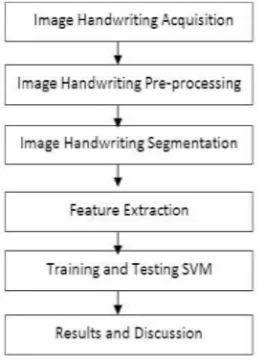
The level of accuracy of handwriting analysis in the result is totally depending on the knowledge and experience of the graphologist. Handwriting analyst called graphologist analyzes. To predict personality and behavior of person, the handwriting on a piece of paper written by the individual is taken and it is analyzed by graphologist which is very time taking. [1] Hence Support Vector Machine is used to predict personality and behavior of person, which is not a time consuming method. SVM has three main steps: pre-processing, feature extraction, and classification. Following figure-1 shows different step to be followed while detecting the personality and behavior of an individual.
Figure 1. Block Flow Diagram of system.
2.1. Image Handwriting Acquisition:-
Available Online at www.ijpret.com
163
2.2. Pre-Processing of Image
Handwriting:- As we know pre-processing means smoothing the image and smoothing means removing the noise i.e. dots and other parameter from the captured image. Thus we have to apply image pre-processing to the image for which personality detection has to be done. [1-2]
2.3. Segmentation of Image Handwriting:-
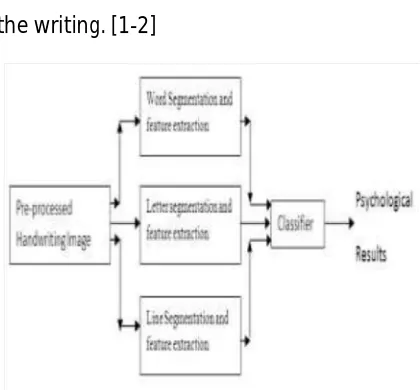
Once the given image of the handwriting sample is preprocessed segmentation is done. Segmentation means to break the image in to number of parts. Digitally collected image handwriting is segmented in to three parts i.e. line segmentation, word segmentation, letter segmentation.
2.3.1. Segmentation of Line:-
To find baseline features line segmentation is used which predict the writer’s emotional stability and dispositions in the baseline of
the writing. [1-2]
Figure 2. Segmentation and feature extraction.
2.3.2. Segmentation of Letter:-
In letter segmentation each letter is segmented from the word to detect the future parameter. Figure 3, shows the letter segmentation which is future used to calculate various slants in letters indicating the openness of sentiment and consequently of the intelligence. [1-3]
Available Online at www.ijpret.com
164
Word in the digitally collected handwriting image is segmented to calculate different features related to the human personality.
2.4. Feature Detection
Once the given image of the handwriting sample is preprocessed, eight characteristic traits of handwriting are determined. Features detection is a reduction of high dimension data input.
2.4.1. Pen Pressure:- Mental and physical stress on writer mind can be identified by the pen pressure. If the pen pressure is more, then he is showing his mental stress otherwise he talking normal with no mental stress. To determine the pen pressure some threshold value must be set (〖th〗_o). If the pen pressure is more than the threshold, then he has some mental stress otherwise it is normal.[1-2]
2.4.2 Baseline: - The baseline is an imaginary line on which the bottom of the middle zone letters aligns. In this, line spacing is also considered which shows emotional stability. [1]
2.4.3. Size of the Letters:- Size of the letter is judged by the vertical height. The size of handwriting is judged by a benchmark of 3mm as normal writing and full height of 9mm. If we found the bold letters, author wants to notice me. The letters are divided into three zones: lower case or zone (e.g. g, y), upper case or zone (e.g., I, t), middle case or zone (e.g. a, c, e). [1-2-4]
2.4.4. Spacing between Letters:- It indicates the openness of sentiment and consequently of the openness of intelligence. [1-2]
2.4.7 Margins:- The margins are obtained by the space between the starting point of the sentence and the edge of the paper or the last point of the sentence and the edge of the paper. [2]
2.4.8 Speed of the writing: - It is how fast the writer has written the handwriting sample. If the writing speed is fast then author is smart an uncommunicative otherwise he is lazy, clumsy, and dishonest. [2] Each steps or process explained above, gives some numerical value, which is -1, 0, or +1 depending on the threshold and the value obtained. Combining all these numerical value together in an SVM format and forwarded to the SVM classifier to classify the result and predict the author’s personality
Available Online at www.ijpret.com
165
2.4.6. Slant of Words and Letters:- The emotional interactions of the author are indicated by Slant in handwriting. The slant is obtained by joining the highest and lowest point surrounding a given point in the letter, and can be determine by following equation. [1-2-5]
3. CLASSIFICATION:-
To predict the personality of human being we are going to use a classifier named as SVM (support vector machine). As compare to neural network SVM is more accurate and time efficient. For the prediction of personality we have to train the classifier. SVM can be used to classify the data of unknown data class into the correct data categories. Suppose that we are given a training data set
{xi, yi}, i = 1. . .n; xi ε Rd; yi ε Rd - - 1
Where xi is a vector of input variables and yi represents the corresponding scalar output (target) value. Now based on the training data, the goal of SVM is to develop a function f(x) that can predict output based on the training data.
The classification can be performed in following three steps:
1. First, the input features are formulated as input vectors in some feature space.
2. Map these feature vectors to the higher dimension feature space using RBF kernel function.
3. Then a division global hyper plane is computed to separate the feature space optimally to the classes of the training vector samples. [1]
4. RESULTS:-
In this paper each 100 writers where asked to write the test documents and were saved in digital form and we extract different features. Thus we observed that if the data base is more to train the machine, the result we obtained is more accurate as that of the graphologist analyzes. When we used linear, polynomial kernel function with SVM then it gives a poor accuracy. Hence it’s better to use radial basis function (RBF) which will gives accuracy near about 90% with more training data based.
Available Online at www.ijpret.com
166
In this paper, we have specified a method which is going to predict the personality of human being. We have taken digitally. After taking the a handwriting sample image we have extracted different features such as size of the letters, pen pressure, baseline, letter spacing and word spacing and the most important slant of the letter and word in a document. Also we have calculated some parameters by using some simple trigonometry and thresholding techniques. All these features are given to SVM which predict the personality of the individual writer. SVM with use of RBF kernel function gives optimum accuracy.
6. REFERENCES:-
1. Shitala Prasad, Vivek Kumar Singh, Akshay Sapre, “Handwriting Analysis based on Segmentation Method for Prediction of Human Personality using Support Vector Machine” International Journal of Computer Applications (0975 – 8887) Volume 8– No.12, October 2010.
2. Vikram Kamath, Nikhil Ramaswamy, P. Navin Karanth, Vijay Desai and S. M. Kulkarni “Development of an Automated Handwriting Analysis System” VOL. 6, NO. 9, September 2011 ISSN 1819-6608 ARPN Journal of Engineering and Applied Sciences.
3. Luzheng Bi, Omer Tsimhoni, and Yili Liu, “Using the Support Vector Regression Approach To Model Human Performance” VOL. 41, NO. 3, MAY 2011.
4. Janet Fisher, Anish Maredia, Anita Nixon, Nerissa Williams, and Jonathan Leet, “Identifying Personality Traits and Especially Traits Resulting in Violent Behavior through Automatic Handwriting Analysis” May 4th, 2012.