Effects of Three Type Exercise Training Programs on FBS and HbA1C
of Elderly Men with Type 2 Diabetes
Hojjatollah Siavoshy1, Ali Heidarianpour1*
Introduction
ype 2 diabetes mellitus (T2DM) is a serious chronic illness related to hyperglycemia, overweight and metabolic syndrome (1-3). The prevalence of T2DM increases continuously. The sedentary lifestyle and overweight are identified as key risk factors of T2DM (4). The American
Diabetes Association (ADA) recommends that adults with T2DM accumulate at least 150 minutes of moderate intensity endurance training and 3 sessions of resistance training per week (5,6).
The effect of exercise training program was identified in T2DM treatment (1,7,8). Regular
T
1. Department of Exercise Physiology, Sport Science Faculty, Bu-Ali Sina University, Hamadan, Iran
*Correspondence:
Ali Heidarianpour, Department of Exercise Physiology, Sport Science Faculty, Bu-Ali Sina University, Hamadan, Iran.
Tel:(98) 813 138 1421
Email:[email protected]
Received: 23 July 2017
Accepted: 08 September 2017
Published in October 2017
Abstract
Objective: Type 2 diabetes(T2DM) patients can benefit from
exercise training programs but there are many barriers to do exercise .The aim of this study was to investigate effects of 10 weeks aerobic, resistance and combined strength and aerobic exercise program on fasting blood sugar (FBS) and glycated hemoglobin (HbA1c) of T2DM male patients.
Materials and Methods: A quasi experimental study on 52
T2DM male patients was done. They were divided into four groups: aerobic training group (ATG; n=13), resistance training group (RTG; n=13), combined strength and aerobic training group (SAG; n=13), and control group (CG; n=10). There were three types of training program: aerobic, with intensity of 55-85% of the heart rate maximum (HRmax) 3 times /week, and resistance, with intensity of 50-75% one-repetition maximum 3 times week. Anthropometric measurements, HbA1c and FBS were measured at the beginning and after 10 weeks.
Results: The mean (± standard deviation) age of participants was 53.24 (±1.05) years old. FBS decreased significantly in all studied groups (P-value<0.05); and HbA1c decreased significantly in RTG
and SAG groups (P-value<0.05), but, there were no significant
differences in HbA1c between groups.
Conclusion: The result of the present study indicated that three type exercise training programs cause improving the metabolic factors related to diabetes in T2DM male patients. However, each type of training also provides unique benefits.
Keywords: Type 2 diabetes mellitus, Glycated hemoglobin,
Fasting blood sugar, Resistance training, Aerobic training
physical activity is established as a prophylactic and curative treatment for chronic illnesses. The metabolic effects on glucose consumption and the structural remodeling of skeletal muscle are the major reasons of the glucose homeostasis improvement even in persons with insulin resistance illnesses (9,10). There are two Types of exercise training program: aerobic and resistance exercise. Aerobic exercise, generally defined as endurance exercising involving several muscle groups that aims to betterment cardiorespiratory performance, includes activities such as running, swimming or biking (11). Resistance or strength training forces contraction of defined muscle groups against a defined elastic or hydraulic resistance (11). Aerobic exercise training has been advocated as the most suitable form of exercise mode (1,12,13) with many positive metabolic effects, such as reduced fasting blood sugar (FBS) levels and decreased body fat, but also undetected hypoglycemic episodes during and after exercise training. In comparison, only limited information on the effect of resistance exercise training on T2D is available (1,14-17). Glycosylated hemoglobin (HbA1c) measurement is the standard test for glycemic control in diabetic patients. As HbA1c reflects the mean of all blood glucose values for a period of three months and HbA1c is negatively influenced by hypoglycemic episodes, and does not give good information about post exercise training program blood glucose (1).
Nevertheless, there are no adequate information about exercise training programs aimed to improve FBS and HbA1c. Tokmakidis et al (9), examine the effects of a combined resistance and endurance exercise training program on glucose control and insulin action in T2DM women. The results indicated that a combined exercise training program of resistance and endurance exercise training could induce positive adaptations on glucose control, insulin action, muscular strength and exercise training tolerance in patients with T2DM.
There are many barriers to do exercise training program of T2DM patients were observed. One of the most significant barriers is sedentary lifestyles related with a lack of motivation and difficulty in maintaining a planned exercise training protocol for adequate periods of time. On the other hand, participation in organized exercise training is limited in patients with T2DM by environmental factors, including gym and exercise training accessibility, lack of expert coaches. These factors are often related with other familiar barriers, beliefs regarding restrictive medical conditions linked to the specific patients regarding decreased physical and behavioral skills.
According to these theoretical considerations, the aim of this study was to investigate effects of 10 weeks aerobic, resistance and combined strength and aerobic exercise program on FBS and HbA1c of T2DM male patients.
Materials and Methods
This is a quasi-experimental study. We carried out sampling by convenience method in the diabetes center of Hamadan. The patients signed an informed consent form.
The research included 42 elderly men with T2DM who were selected for the exercise training by a physician. The exclusion criteria were: smoking, history of coronary artery diseases, hepatic or kidney diseases or proteinuria, gout or hyperuricemia or uncontrolled hypertension, diabetic retinopathy or neuropathy. Also, patients were excluded if they had participated in a regular exercise training program six months before study. All participants were asked to answer the 7 items Physical Activity Readiness questionnaire. The participants were divided into four groups by simple randomization, according to the accessibility of the program. They were divided as control group (CG – n=13); aerobic training group (ATG – n=13); resistance training group (RTG – n=13); and combined strength and aerobic training group (SAG; n=13). Six participants in the RTG and SAG groups were unavailable for
reassessment hence they were excluded in the analysis (Table 1).
The exercise training program consisted of ten weeks, three times per week for the ATG and RTG groups and intermittent a sessions for the SAG group, following the recommendations proposed by the American College of Sports Medicine (ACSM) (18). Each session lasted approximately 90 minutes, consisting of a 10-15 minute warm-up preceding the exercise training program and 10-15 minute stretching at the end of the session.
The aerobic training program was performed on a Grass field, with heart rate intensity corresponding to 55-85% of the heart rate maximum (controlled by a Beurer PM-100 frequency counter) during 60 minutes. The maximum heart rate was obtained through a maximal exercise test specific for this population, conducted prior of the training period beginning (19).
Resistance training was composed of six exercises and consisted of 3 sets of 12 maximum repetitions (12 MR) for each exercise at an intensity of 50-75% 1RM, with 3 minute interval between sets and exercises. The resistance training performed in 3 sessions a week for 10 weeks at a fitness center. The 10 weeks program was selected as it fits in summer holidays and therefore could be timetabled around the weekly schedule of participants. The resistance training program was designed according to the ACSM recommendations (20). The subjects performed six type of exercises using weight machines (optimal press BH fitness, china); three for the upper limbs (lat pull-down, chest press machine, seated row) and three for the lower limbs (leg press machine, knee extension, leg curl). These exercises were chosen because they would strengthen the major multi-joint muscles of the upper and lower limbs. The exercises were conducted on pin-loaded weight machines as they were considered safer for beginner subjects than free weights as there was less chance of a weight being dropped on a body part and
causing injury. Subjects performed up to 3 sets of 12 repetitions of each exercise. There was three minutes rest between each set for recovery, and the resistance was increased when 3 sets of 12 repetitions of an exercise could be completed (20).
The SAG group participated in a session of aerobic exercise and a session resistance intermittently and The CG group subjects continued with their usual activities, which may have included leisure and sporting activities but did not include a regular exercise training programs.
Before and after the trial was completed, these subjects were invited to complete the same program. Following a 12 hours overnight fasting, blood was collected for analysis of HbA1c, and FBS. Blood samples were obtained 48 h after the last training session. Plasma glucose was measured at the same time of collection using the enzymatic method of glucose oxidase (Auto Analyzer, Bio Tecnicon BT3000). HbA1c was measured with technique colorimeter.
Data analysis
Intention to treat analysis was performed and outcomes were analyzed using analysis of variance (ANOVA) with the baseline measure of each variable. When significant differences were revealed, the Tukey post hoc test was applied. The comparison of variables before and after the exercise training program, the paired t- test was performed. Statistical significance was assumed for P-values <0.05. The data were treated in the Statistical Package for the Social Sciences (SPSS), version 18.
Results
The 42 subjects were divided into four groups: 13 in the ATG, 10 in the RTG, 10 in SAG, and 13 in the CG. The groups ATG, RTG, SAG, and CG were homogeneous regarding age, height, body weight, body mass index (BMI), and history of diabetes (Table 1).
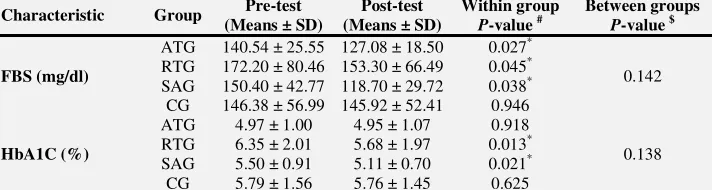
Table 2 displays the mean ± Standard Deviation (SD) of physiological measures for all groups at baseline and post-intervention as well as the differences between, and within, the groups post-intervention. All experimental groups experienced a significant reduces in FBS and the control group does not display significant decreases in this value. Participants in the RTG and SAG groups also experienced a significant decrease in HbA1c post-intervention. There was not a significant decrease in HbA1c in the ATG and CG groups (Table 2).
Discussion
The purpose of this research was to establish the effects of 10 weeks aerobic, resistance and combined strength and aerobic exercise program on FBS and HbA1c of T2DM male patients.
The findings of the present study demonstrated that this exercise training programs improved FBS in all groups significantly.
Results revealed that HbA1c was maintained in the ATG and CG groups although significant reduces in these measures were
evident in the RTG and SAG groups. This suggests that the intervention may have an impact on FBS and HbA1c maintenance by limiting their increase during the intervention period as observed within the control group. Although previous investigations involving individuals with T2DM have noted significant decrease in HbA1c through an aerobic intervention (9,24), both of these researches were of a longer period. According to the short period of this study (10 weeks), our results are expected.
FBS and HbA1c further reduced after 10 weeks of training in RTG and SAG groups, but HbA1c in ATG not significant. Furthermore, significant improvements in long-term glycemic control, as determined by decreased HbA1c, were related with strength and combined training, whereas the effects of aerobic training were not significant. There are some data in patient with T2DM to suggest that HbA1c is an important but not the only variable important in diabetes patients.
Two researches by Castaneda and Dunstan and colleagues support the benefits of resistance training program on glycemic control (14,15).
Table 1. Descriptive characteristics of participants (Mean ± SD).
Values ATG (N=13) RTG (N=10)* SAG (N=10)* CG (N=13) Age (year) 54.31 ± 2.20 52.20 ± 4.87 54.50 ± 2.81 52.00 ± 2.92
HD (year) 5.77 ± 1.49 10.65 ± 2.13 6.95 ± 1.83 9.61 ± 1.35
Height (cm) 169.23 ± 1.32 166.40 ± 2.76 164.85 ± 1.27 168.69 ± 1.85
Body mass (kg) 82.97 ± 2.76 80.95 ± 4.35 81.68 ± 3.97 80.38 ± 2.95
BMI (kg/m2) 29.10 ± 1.20 29.48 ± 1.90 30.02 ± 1.31 28.32 ± 1.09
* Six participants in the RTG and SAG groups were unavailable for reassessment therefore this participant was excluded in the analysis
Abbreviations: ATG=Aerobic Training Group, RTG=Resistance Training Group, SAG=Combined Strength and Aerobic Training Group, CG=Control Group, HD=History of diabetes, BMI=Body mass index
Table 2. Characteristics of physiological variables: all groups at baseline and post intervention.
Characteristic Group Pre-test (Means ± SD)
Post-test (Means ± SD)
Within group
P-value # Between groups
P-value $
FBS (mg/dl)
ATG 140.54 ± 25.55 127.08 ± 18.50 0.027*
0.142 RTG 172.20 ± 80.46 153.30 ± 66.49 0.045*
SAG 150.40 ± 42.77 118.70 ± 29.72 0.038*
CG 146.38 ± 56.99 145.92 ± 52.41 0.946
HbA1C (%)
ATG 4.97 ± 1.00 4.95 ± 1.07 0.918
0.138 RTG 6.35 ± 2.01 5.68 ± 1.97 0.013*
SAG 5.50 ± 0.91 5.11 ± 0.70 0.021* CG 5.79 ± 1.56 5.76 ± 1.45 0.625
# Paired samples t-test was used to establish differences between pre and post-intervention measures for each group (Pre-test and Post-test).
$ ANOVA was used to test differences between the groups at post-intervention.
* Significant difference between the values obtained for the before-exercise and after-exercise conditions (P < 0.05).
Both exercise training programs had positive effects on FBS. We indicated that resistance and combined training was associated with a significant improvement in HbA1c. These results are notable considering the relatively short period of the exercise training program. Several studies finding showed that resistance exercise training was feasible and safe for of T2DM male patients. Resistance exercise training is a kind of exercise that people might start if they attended a community gym. The model developed and implemented in this research has the potential to become part of the ongoing clinical experience and start of community based exercise training program. It could also provide ongoing opportunities for patient with T2DM who require a high level of exercise training programs.
Of the previous several researches published, some of them included only resistance or aerobic training programs (13-15), and the other were only combined resistance and aerobic exercise training programs on patient with T2DM (1,9,24). An important aspect of the resistance exercise training program was that it took place in an inclusive setting (a private fitness center). This is noteworthy as elderly men with T2DM often have restricted opportunities to participate in exercise training programs taking place in an integrated specific setting.
Other factors in the design of the intervention that could be considered are the period and
frequency of the exercise training program. Given its relatively short period, it is possible that a larger effect might be obtained from continuing the exercise training program for longer. A research on patient with T2DM reported programs with longer period and frequency are more beneficial (9,24). Increasing the exercise training program frequency to four times a week might change the outcome.
A limitation of this research was lack of follow up. Further studies are needed to determine the long term sustainability of the program given the level of support that patient with T2DM need to begin to exercise training program. An additional outstanding issue that should also be addressed in future researches whether exercise program alone can change physical activity levels.
Conclusions
In conclusion, resistance and aerobic training performed in a special fitness center is a feasible and safe exercise option for individual with T2DM that can lead to improvements of FBS and HbA1c levels. This trial provided important data that justify a future randomized trial to ascertain whether aerobic or resistance training carries over into an improved FBS and HbA1c levels for patients with T2DM.
References
1. Cauza E, Hanusch-Enserer U, Strasser B, Kostner K, Dunky A, Haber P. Strength and endurance training lead to different post exercise glucose profiles in diabetic participants using a continuous subcutaneous glucose monitoring system. European Journal of Clinical Investigation. 2005;35(2):745-51.
2. DeFronzo RA, Simonson D, Ferrannini E. Hepatic and peripheral insulin resistance. A common feature of type 2 (non-insulin-dependent) and type 1 (insulin dependent) diabetes mellitus. Diabetologia. 1982; 23:313-9.
3. Unger RH, Grundy S. Hyperglycemia as an inducer as well as a consequence of impaired islet cell function and insulin resistance. Implications for the
management of diabetes. Diabetologia. 1985;28:119-21.
4. Bordenave S, Metz L, Flavier S, Lambert K, Ghanassia E, Dupuy AM, et al. Training-induced improvement in lipid oxidation in type 2 diabetes mellitus is related to alterations in muscle mitochondrial activity Effect of endurance training in type 2 diabetes. Diabetes & metabolism. 2008;34(2):162-8.
5. Pariser G, DeMeuro MA, Gillette P. Outcomes of an Education and Exercise Program for Adults with Type 2 Diabetes, and Comorbidities that Limit their Mobility: A Preliminary Project Report. Cardiopulmonary Physical Therapy Journal. 2010;21(2):5-12.
6. Sigal R, Kenny G, Wasserman D, Castaneda-Sceppa C, White R. Physical activity/exercise and type 2 diabetes: A consensus statement from the American Diabetes Association. Diabetes Care. 2006;29:1433-8.
7. American Diabetes Association. Clinical practice recommendations 1998. Diabetes Care. 1999;22:49-53.
8. Young JC. Exercise prescription for individuals with metabolic disorders: Practical considerations. Sports Med. 1995;19:43-54.
9. Tokmakidis SP, Zois CE, Volakis KA, Touvra KA. The effect of a combined strength and aerobic exercise program on glucose control and insulin action in women with type 2 diabetes. Eur J Appl Physiol. 2004;92:437-42.
10. Toma´ s E, Zorzano A, Ruderman NB. Exercise effects on muscle insulin signaling and action. Exercise and insulin signaling: a historical perspective. J Appl Physiol. 2002;93:765-72. 11. Roden M. Exercise in type 2 diabetes: to resist or to
endure? Diabetologia. 2012;55:1235-9.
12. Devlin JT, Horton ES. Effects of a prior high-intensity exercise on glucose metabolism in normal and insulin resistant men. Diabetes. 1985;34:973-9. 13. Fritz T, Rosenquist U. Walking for exercise –
immediate effect on blood glucose levels in type 2 diabetes. Scand J Prim Health Care. 2001;19:31-3. 14. Castaneda C, Layne JE, Munoz-Orians L, Gordon
PL, Walsmith J, Foldvari M et al. A randomized controlled trial of resistance exercise training to improve glycemic control in older adults with type 2 diabetes. Diabetes Care. 2002;25:2335-41. 15. Dunstan DW, Daly RM, Owen N, Jolley D, De
Courten M, Shaw J et al. High-intensity resistance training improves glycemic control in older patients with type 2 diabetes. Diabetes Care. 2002;25:1729-36.
16. Dunstan DW, Puddey IB, Beilin LJ, Burke V, Morton AR, Stanton KG. Effects of a short-term circuit weight training programme on glycaemic control in NIDDM. Diabetes Res Clin Pract. 1998;40:53-61.
17. Erikson J, Taimela S, Eriksson K, Parviaianen S, Peltonen J, Kujala U. Resistance training in the treatment of non-insulin-dependent diabetes mellitus. Int J Sports Med. 1997;18:242-6.
18. Haskell WL, Lee IM, Pate RP, Powell KE, Blair SN, Franklin BA et al. Physical activity and public health: updated recommendation for adults from the American College of Sports Medicine and the American Heart Association. Circulation. 2007;116:1081-93.
19. Ebbeling CB, Ward A, Puleo EM, Widrick J, Rippe JM. Development of a single-stage submaximal treadmill walking test. Med Sci Sports Exerc .1991; 23(8):966-73.
20. American College of Sports Medicine. Progression models in resistance training for healthy adults. Medicine & Science in Sports & Exercise. 2009;41:687-708.
21. Park I, Schutz RW. An introduction to latent growth models: analysis of repeated measures physical performance data. Res Q Exerc Sport. 2005;76(2):176-92.
22. Cohen J: A power primer. Psychol Bull. 1992;112(1):155-9.
23. Cohen J, Statistical Power Analysis for Behavioral Sciences. 2thed. New York, Academic Press 1977;19-20.
24. Van Dijk JW, Manders RJF, Tummers K, Bonomi AG, Stehouwer CDA, Hartgens F,et al. Both resistance- and endurance-type exercise reduce the prevalence of hyperglycaemia in individuals with impaired glucose tolerance and in insulin-treated and non-insulin-treated type 2 diabetic patients. Diabetologia. 2012;55:1273-82.