Suryakumar B et al, International Journal of Computer Science and Mobile Applications, Vol.5 Issue. 9, September- 2017, pg. 1-9 ISSN: 2321-8363
Impact Factor: 4.123
A MULTI CONTEXT EMBEDDING MODEL
BASED ON CONVOLUTIONAL NEURAL
NETWORK FOR TRAJECTORY DATA MINING
Suryakumar B
1, Dr. E.Ramadevi
21
Ph.D Research Scholar Department of Computer Science, NGM College, Pollachi, India [email protected]
2
Associate Professor of Department of Computer Science, NGM College, Pollachi, India, [email protected]
Abstract
Nowadays there have been many technologies which provide positioning services eg., smart phone sensors, location estimation of 802.11, ultrasonic systems and so on. As a consequence, it is becoming easier to generate a large scale trajectory data of tracking traces of moving objects. The explosion of location-based social networks such as facebook, watsapp and etc provides number of ways for tracing human mobility including user generated geo-tagged contents, check-in-services and mobile applications. However, the issues in many applications are analyzing and mining trajectory data due to complex characteristics reflected in human mobility which is affected by multiple contextual information. Hence, this paper is focused on the challenges obtained in mining human trajectory data. In this paper, multi-context trajectory embedding model (MC-TEM) is proposed which is developed in advanced deep neural network called as Convolutional Neural Network (CNN). It characterizes the several types of contexts for different applications. The CNN is used in the contextual feature learning process. This CNN based MC-TEM model reduce the computation time of feature learning and also this method needs fewer parameters to tune. This method is applied for location recommendation and social link prediction. The proposed method is tested in three real time dataset to prove the effectiveness of the proposed method in terms of precision, recall and F-measure metrics.
Keywords: Trajectory data mining, location recommendation, link prediction, multi-context trajectory embedding model, Convolutional Neural Network.
1. Introduction
Internet enabled mobile devices are primary sources for obtaining the huge volumes of trajectory data which captures the movements of different types of different types of objects such as people, vehicles, animals and vessels (Tanuja & Govindarajulu, 2016). The increasing pervasiveness of location acquisition technologies has enabled collection of very large trajectory datasets for different types of moving objects. The determination of useful patterns from the movement behavior of moving objects are very valuable and forms a trajectory knowledgebase and much useful to variety of real time applications. Ubiquitous amounts of trajectory data sets are being generated continuously with the rapid development of location acquisition technologies. Trajectories of moving objects are useful in finding knowledge such as moving patterns, moving group patterns, finding location of a specific object or service etc.
Suryakumar B et al, International Journal of Computer Science and Mobile Applications, Vol.5 Issue. 9, September- 2017, pg. 1-9 ISSN: 2321-8363
Impact Factor: 4.123
generation process of trajectory data. But, due to the deep learning method in MC-TEM computation time was high and many parameters were required to tune.
In order to overcome these problems, in the parameter learning of MC-TEM Convolutional Neural Network (CNN) is developed in this paper. The multiple kinds of information of contextual information of trajectory data are characterized by using MC-TEM model. This model maximizes the average log probability for each location with the consideration of user-level, trajectory-level, location-level and temporal contexts contextual features. Then finally the gradients are computed y using CNN method and based on the gradients the embedding vectors are updated. This model is used in location recommendation and link prediction effectively.
2. Literature Survey
A flexible trajectory modelling called as evolving density trajectory model was proposed (Jeung et al., 2014) for mining trajectory data. It represented trajectory as time dependent Gaussian distributions. In each such distribution the mean denotes an actual location and the standard deviation denotes the degree of uncertainty range. The main advantage of this model was it effectively captures the dynamicity of location uncertainty without any unrealistic assumptions. It managing evolving uncertainty in trajectory data with the consideration of model inferred actual positions, non deterministic uncertainty ranges and time varying uncertainty by using three evolving density estimators. However, this model doesn’t effectively mine the trajectory data.
A friendship network structure was developed (Eagle et al., 2006) using mobile phone data. The observational data from mobile phones with standard self-report survey data were compared. The various behaviours were identified in the mobile phones data that were characteristic of friendship. Also, the relationship between behavioural data and individual satisfaction were studied. The developed friendship network structure is used for precise measurement of large scale human behavior based on communication data and contextual proximity. It identified characteristic behavioural signatures of relationships. However, serious privacy issues were raised due to the collection of data. A method of Latent Semantic Information mining was proposed (Liao et al., 2015) for trajectory data. The main aim of this method was to solve problem of finding potential patterns in trajectory data and structuring the spatio-temporal data. Initially, a vector space model was proposed to structure the trajectory data and then the singular value decomposition had been employed for construction of latent semantic subspace from the trajectory data matrix. Finally, the latent semantic information from the subspace was extracted.
The human mobility, social ties and link prediction methods was investigated (Wang et al., 2011). In this work, they follow the trajectories and communication patterns by using Call Detail Record (CDR) data from an anonymous country for measuring any pair of users. The user mobility was identified by introducing a series of co-location measures quantifying the similarity between their movement routines. The users were connected to the social network by adopting various well-established measures of network proximity based on common neighbors or structure of paths connecting the users in who-calls-whom network. The powerful interaction between users was achieved by using number of calls between the users as a measure of strength of their tie. The further improvement was required for link prediction by mixing mobility and network measures.
Novel direct and latent models were proposed (Sharma et al., 2017) for prediction of links in the social networks. A multilevel deep belief network learning based model was introduced for link prediction and user’s preferences which helps to achieve high accuracy. In this model, newly signed users in online social network who are created no social links or who are created very few social links are considered. Usually user performs two types of behavior on most online social network platforms where they created social links and consumes products. A non directed social network graph, the users on the given graph were determined to which new users will connect and will prefer the consumption of products. The Deep Belief Network (DBN) was used to address the link prediction in online social network platforms. In DBN link prediction method, a linear output unit layer was added for class labels. The further improvement is need for link prediction in online social networks.
Suryakumar B et al, International Journal of Computer Science and Mobile Applications, Vol.5 Issue. 9, September- 2017, pg. 1-9 ISSN: 2321-8363
Impact Factor: 4.123
recommendation probabilities of the nodes. A list of recommendation was recommended to users after ordering the nodes according to the estimated probabilities. However, the complexity of this algorithm depends on the iteration count which changes according to the graph size.
A novel approach was proposed (Li et al., 2017) for link prediction in social networks. In this approach utility analysis was introduced which develop the link prediction method. The link prediction problem was formulated as machine learning process with latent variables. It divided the link formation process into individual meeting process and decision making process. Concurrently, Expectation Maximization method was adopted and further developed for estimation of parameters embedded in the individual meeting process and decision making process. This method was more satisfying and more robust for link prediction in social networks. But this method face the problem of estimation of parameters through a series of networks based on multi stage observation of dynamic networks. A participatory cultural mapping was developed (Yang et al., 2016) based on collective behaviour data in location based social networks. The participatory sensed user behavioural data from location based social networks were collected. A progressive home location identification method was developed to filter out ineligible users. The cultural features from daily activity, mobility and linguistic perspectives were extracted. The cultural clustering method was proposed to discover the cultural clusters. Then, the cultural clusters were visualized on the world map. However, the issues were addressed which are caused by unique cultural features extracted from user behavioural data.
Collaborative location recommendation system was proposed (Tuan et al., 2017) with dynamic time periods. This system is called as Location-based Collaborative Filtering recommendation system with Dynamic Time Periods (LCFDTP) to recommend timely and suitable points of interests (POIs) to mobile users. This system speed up the computation of similarity based POI freshness. It also enables mobile users to promptly obtain recommended items closely matching their current space time conditions through choosing different strategies in dissimilar situations. Thus, this system is highly suitable for meeting user’s instant recommendation demand inherent in mobile environments.
3. Proposed Methodology
In this section, the proposed multi-context trajectory embedding model (MC-TEM) with parameter learning based on convolutional neural network (CNN) is described in detail. Here, the trajectory data mining is carried out by using MC-TEM model which is developed in the distributed learning framework. It is developed based on advanced deep learning model such as CNN for contextual feature learning process. This CNN based model reduced the computation time and also it required only fewer parameters to tune. For parameter learning in MC-TEM model, CNN is developed.
3.1 Multi-Context Trajectory Embedding Model
MC-TEM provides a general and flexible manner to characterize the multiple kinds of contextual information for trajectory data. The main objective function of MC-TEM model is to maximize the average log probability for each location. Consider a trajectory sequence 〈 〉 〈 〉 〈 〉 the objective function given its corresponding contextual information:
∑ ( )
(1)
A check-in record is modelled as a quadruple 〈 〉 when a user x checks in a location Loc with a category label Cat at the time stamp t. In the above equation 1, denotes the real valued feature vector consisting of all contextual information for the target location . Trajectory data is a complex and related to multiple types of information. So, in this paper propose to use distributed representation for trajectory modelling.
Suryakumar B et al, International Journal of Computer Science and Mobile Applications, Vol.5 Issue. 9, September- 2017, pg. 1-9 ISSN: 2321-8363
Impact Factor: 4.123
denoted by an L-dimensional embedding vector . A softmax multi class classifier is applied to create a check-in location conditioned on its contextual information.
( ( )) ( ̅̅̅̅̅ ) ∑ ( ̅̅̅̅̅
)
(2)
In equation 2, ̅̅̅̅̅ refers the averaged vector representation of the embedding vectors corresponding to all relevant contexts in for is given as follows:
̅̅̅̅̅
∑ ( )
∑ ( ) (3)
The advantage of MC-TEM is that, the varying window length does not affect the computational cost. But it needs to pay slightly more costs to equation 3. So it is useful to help control model complexity when using a long window or incorporating multiple kinds of contextual information.
The contextual feature are modelled based on the adaptation of three level hierarchy which organize the contextual features in a top down way i.e, user level, trajectory level and location level. One more feature is also considered named as temporal contexts. For a given target location , construct a contextual feature vector . By instantiating the context feature vector , the following objective function is defined on the entire data collection:
∑ ∑ ( ) (4)
In the above equation 4, X represents the set of users, denotes the set of trajectories generated by users x and is the length f trajectory y. is the user level context, is the trajectory level context,
is the location level context and is the temporal context. The contextual embedding vector of a target location is derived as:
̅̅̅̅̅ ,∑ ( ) ( )- (5) In the above equation 5, and are correspond to the contextual embedding vector. With ̅̅̅̅̅ , it is plug it into equation 2 to compute the generative probability of .
3.2 Parameter Learning
The parameters to learn in MC-TEM are the embedding vectors for various context features and the output embedding vectors for target locations . For parameter learning, MC-TEM needs to maximize the log probability. The hierarchical softmax technique is employed to optimize the objective function. The hierarchical softmax uses a binary tree representation for every location as its leaves, and each node is explicitly associated with embedding vector for calculating the relative probability to take the branch. The hierarchical softmax defines ( ) is given as follows:
( ) ∏ (* ( ̅̅̅̅̅ )+ * ( ̅̅̅̅̅ )+ ) ( ) (6)
In the above equation 6, denotes when the path of takes the left branch at the n-th level and
. All parameters are trained by using the Stochastic Gradient Descent (SGD) method. After computing the hierarchical softmax by using above equation 6, the error gradient is calculated by using CNN method and those gradients are used to update the parameters in this model.
The gradient for is computed as follows:
Suryakumar B et al, International Journal of Computer Science and Mobile Applications, Vol.5 Issue. 9, September- 2017, pg. 1-9 ISSN: 2321-8363
Impact Factor: 4.123
where
. The above equation gives the error gradient value for .
With this derivative, an embedding vector in the context of location is updated by using following equation:
∑ ̅̅̅̅̅
(8)
The learning algorithm is summarized using the hierarchical softmax for the proposed MC-TEM-CNN. This algorithm iterates through all the trajectories and updates the embedding vectors until the procedure converges. In each iterations, given a current location in the trajectory, this algorithm first get its embedding vectors and calculates its context embedding vector. Based on the derivation above, the binary tree in hierarchical sampling is updated followed by the embedding vectors.The hierarchical softmax for learning the parameters of MC-TEM-CNN
Input: Y, K, V, N //V represents the vector size Output:
Initialize the parameters randomly Shuffle the dataset
repeat
for i=1 to N do
Sample a check-in record 〈 〉 from Y; Initialize
Calculate ̅̅̅̅̅ using equation 3 for n=2 to L(Loc) do
̅̅̅̅̅
( )
Update ̅̅̅̅̅ end
for each embedding vector do
Update
end end
Until convergence
Thus the above algorithm summarizes the leaning algorithm using hierarchical softmax which is used for location recommendation and link prediction.
4. Result and Discussion
In this section, the experimental results are conducted in three public geo-social networking datasets are and Gowalla. All the datasets consists of check-in records in the form of (User ID, Location ID, Location Category, Timestamp, City). The has 4163 users, 483814 check-ins, 32512 links and 121142 locations. The has 266909 users, 33278 check-ins and 3680126 locations. The Gowalla has 216734 users, 12846151 check-ins, 736778 links and 1421262 locations. The performance of the proposed MC-TEM-CNN model is analyzed in terms of precision, recall and F-measure.
4.1 Precision
Precision value is evaluated based on set of all gold user pairs with real friend links and number of all user pairs identified by a candidate method as friends . It is represented as
Suryakumar B et al, International Journal of Computer Science and Mobile Applications, Vol.5 Issue. 9, September- 2017, pg. 1-9 ISSN: 2321-8363
Impact Factor: 4.123
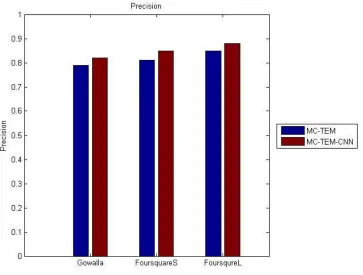
Figure 1: Comparison of Precision
Figure 1, shows the comparison of precision between existing multi-context trajectory embedding model (MC-TEM) and proposed MC-TEM with Convolutional Neural Network (CNN) (MC-TEM-CNN). X axis represents the datasets and Y axis represents the precision value. From the figure 1, it is proved that the proposed MC-TEM method has high precision than the MC-TEM.
4.2 Recall
Recall value is computed based on and . It is mathematically represented as
Suryakumar B et al, International Journal of Computer Science and Mobile Applications, Vol.5 Issue. 9, September- 2017, pg. 1-9 ISSN: 2321-8363
Impact Factor: 4.123
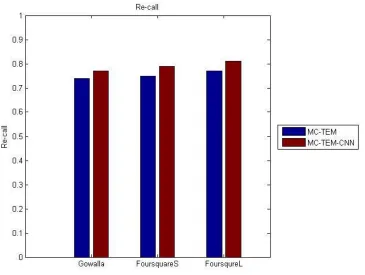
Figure 2. Comparison of Recall
Figure 2, shows the comparison of recall between existing multi-context trajectory embedding model (MC-TEM) and proposed MC-TEM with Convolutional Neural Network (CNN) (MC-TEM-CNN). X axis represents the datasets and Y axis represents the recall value. From the figure 2, it is proved that the proposed MC-TEM method has high recall than the MC-TEM.
4.3 F-measure
F-measure is calculated by using following equation.
Suryakumar B et al, International Journal of Computer Science and Mobile Applications, Vol.5 Issue. 9, September- 2017, pg. 1-9 ISSN: 2321-8363
Impact Factor: 4.123
Figure 3. Comparison of F-measure
Figure 3, shows the comparison of F-measure between existing multi-context trajectory embedding model (MC-TEM) and proposed MC-TEM with Convolutional Neural Network (CNN) (MC-TEM-CNN). X axis represents the datasets and Y axis represents the F-measure value. From the figure 3, it is proved that the proposed MC-TEM method has high F-measure than the MC-TEM.
5. Conclusion
In this paper, the trajectory data mining is carried out by using proposed CNN model. The MC-TEM-CNN explored contexts in a systematic way which includes the user level, trajectory level, location level and temporal contexts contextual features. This is effectively characterizing various kinds of contexts for different applications using trajectory data. In the same embedding space all the contextual information are signified. For feature learning process, CNN is introduced in MC-TEM which reduce the computation and it needs only few parameters to tune. The experimental results show that the proposed method is high effectively in terms of precision, recall and F-measure than the other methods.
References
[1] Tanuja, V., & Govindarajulu, P., 2016, A Survey on Trajectory Data Mining. International Journal of Computer Science and Security (IJCSS), vol. 10, no. 5, 195.
Suryakumar B et al, International Journal of Computer Science and Mobile Applications, Vol.5 Issue. 9, September- 2017, pg. 1-9 ISSN: 2321-8363
Impact Factor: 4.123
[3] Jeung, H., Lu, H., Sathe, S., & Yiu, M. L., 2014, Managing evolving uncertainty in trajectory databases. IEEE Transactions on Knowledge and Data Engineering, vol. 26, no.7, pp. 1692-1705.
[4] Eagle, N., Pentland, A., & Lazer, D., 2006, Inferring social network structure using mobile phone data. Proc. of National Academy of Sciences.
[5] Liao, L. C., Jiang, X. H., Zou, F. M., Tsai, P. W., & Deng, Y. L., 2015, A method of latent semantic information mining for trajectory data. In Intelligent Information Hiding and Multimedia Signal Processing (IIH-MSP), 2015 International Conference on IEEE, pp. 353-353.
[6] Wang, D., Pedreschi, D., Song, C., Giannotti, F., & Barabasi, A. L., 2011, August, Human mobility, social ties, and link prediction. In Proceedings of the 17th ACM SIGKDD international conference on Knowledge discovery and data mining ACM, pp. 1100-1108.
[7] Sharma, P., Rathore, S., & Park, J. H., 2017, Multilevel learning based modeling for link prediction and users’ consumption preference in Online Social Networks. Future Generation Computer Systems.
[8] Bagci, H., & Karagoz, P., 2016, Context-aware location recommendation by using a random walk-based approach.
Knowledge and Information Systems, vol. 47, no. 2, pp. 241-260.
[9] Li, Y., Luo, P., Fan, Z. P., Chen, K., & Liu, J., 2017, A utility-based link prediction method in social networks.
European Journal of Operational Research, vol. 260, no. 2, pp. 693-705.
[10] Yang, D., Zhang, D., & Qu, B., 2016, Participatory Cultural Mapping Based on Collective Behavior Data in Location-Based Social Networks. ACM Transactions on Intelligent Systems and Technology (TIST), vol. 7, no. 3, 30.
[11] Tuan, C. C., Hung, C. F., & Wu, Z. H., 2017, Collaborative location recommendations with dynamic time periods.
Pervasive and Mobile Computing, vol. 35, pp. 1-14.
[12] http://andrew.gibiansky.com/blog/machine-learning/convolutional-neural-networks/
Authors Biography
B.Suryakumar received M.Sc and MCA degrees in Computer Science from Annamalai University, Tamilnadu. Currently he is doing PhD in Computer Science at Bharathiar University, Coimbatore. His research interest lies in the area of Data Mining, Networking and Data security.