In memory of Alexey Chervonenkis
V
-Matrix Method of Solving Statistical Inference Problems
Vladimir Vapnik [email protected]
Columbia University New York, NY 10027, USA Facebook AI Research New York, NY 10017, USA
Rauf Izmailov [email protected]
Applied Communication Sciences Basking Ridge, NJ 07920-2021, USA
Editors:Alex Gammerman and Vladimir Vovk
Abstract
This paper presents direct settings and rigorous solutions of the main Statistical Inference problems. It shows that rigorous solutions require solving multidimensional Fredholm in-tegral equations of the first kind in the situation where not only the right-hand side of the equation is an approximation, but the operator in the equation is also defined ap-proximately. Using Stefanuyk-Vapnik theory for solving such ill-posed operator equations, constructive methods of empirical inference are introduced. These methods are based on a new concept calledV-matrix. This matrix captures geometric properties of the observation data that are ignored by classical statistical methods.
Keywords: conditional probability, regression, density ratio, ill-posed problem, mutual information, reproducing kernel Hilbert space·function estimation, interpolation function, support vector machines, data adaptation, data balancing, conditional density
1. Basic Concepts of Classical Statistics
In the next several sections, we describe main concepts of Statistics. We first outline these concepts for the one-dimensional case and then generalize them for the multidimensional case.
1.1 Cumulative Distribution Function
The basic concept ofTheoretical StatisticsandProbability Theoryis the so-calledCumulative Distribution Function(CDF)
F(x) =P{X ≤x}.
1.2 General Problems of Probability Theory and Statistics
The general problem of Probability Theory can be defined as follows:
Given a cumulative distribution function F(x), describe outcomes of random experi-ments for a given theoretical model.
The general problem of Statistics can be defined as follows:
Given iid observations of outcomes of the same random experiments, estimate the statistical model that defines these observations.
In Section 2, we discuss several main problems of Statistics. Next, we consider the basic one: estimation of CDF.
1.3 Empirical Cumulative Distribution Functions
In order to estimate CDF, one introduces the so-calledEmpirical Cumulative Distribution function(ECDF) constructed for iid observations obtained according to F(x):
X1, ..., X`.
The ECDF function has the form
F`(x) =
1 `
` X i=1
θ(x−Xi),
whereθ(x−Xi) is the step-function
θ(x−Xi) =
1, ifx≥Xi,
0, ifx < Xi.
Classical statistical theory is based on convergence of ECDF converges to CDF when the number `of observations increases.
1.4 The Glivenko-Cantelli Theorem and Kolmogorov Type Bounds
In 1933, the following theorem was proven (Glivenko-Cantelli theorem).
Theorem. Empirical cumulative distribution functions converge uniformly to the true cumulative distribution function:
lim
`→∞P{supx |F(x)−F`(x)| ≥ε}= 0, ∀ε >0.
In 1933, Kolmogorov derived asymptotical exact rate of convergence of ECDF to CDF for continuous functionsF(x):
lim
`→∞P{
√
`sup
x
|F(x)−F`(x)| ≥ε}= 2
∞
X k=1
Later, Dvoretzky, Kiefer, Wolfowitz, and Massart showed the existence of exponential type of bounds for any`:
P{sup
x
|F(x)−F`(x)| ≥ε} ≤2 exp{−2ε2`}. (2)
Bound (2) is defined by the first term of the right-hand side of Kolmogorov asymptotic equality (1).
Glivenko-Cantelli theorem and bounds (1), (2) can be considered as a foundation of statistical science since they claim that:
1. It is possible to estimate the true statistical distribution from iid data.
2. The ECDF strongly converges to the true CDF, and this convergence is fast.
1.5 Generalization to Multidimensional Case
Let us generalize the main concepts described above to the multidimensional case. We start with CDF.
Joint cumulative distribution function. For the multivariate random variable x = (x1, ..., xd), the joint cumulative distribution function F(x), x ∈ Rd is defined by the function
F(x) =P{X1≤x1, ..., Xd≤xd}. (3) As in the one-dimensional case, the main problem of Statistics is as follows: estimate CDF, as defined in (3), based on random multivariate iid observations
X1, ..., X`, Xi ∈Rd, i= 1, . . . , `..
In order to solve this problem, one uses the same idea of empirical distribution function
F`(x) =
1 `
` X i=1
θ(x−Xi),
wherex= (x1, ..., xd)∈Rd, Xi = (Xi1, ..., Xid)∈Rd and
θ(x−Xi) = d Y k=1
θ(xk−Xik).
Note that
F(x) =Euθ(x−u) = Z
θ(x−u)dF(u),
and the generalized (for the multidimensional case) Glivenko-Cantelli theorem has the form
lim
`→∞P
( sup
x
Euθ(x−u)−
1 `
` X i=1
θ(x−Xi)
≥ε )
= 0.
x, u ∈ Rd, and x is a vector of parameters). Since VC dimension of this set of functions is equal1 to one, according to the VC theory (Vapnik and Chervonenkis, 1974), (Vapnik, 1995), (Vapnik, 1998), the corresponding rate of convergence is bounded as follows:
P (
sup
x
Euθ(x−u)−
1 `
` X
i=1
θ(x−Xi)
≥ε )
≤exp
−
ε2−ln`
`
`
. (4)
According to this bound, for sufficiently large values of`, the convergence of ECDF to the actual CDF does not depend on the dimensionality of the space. This fact has important consequences for Applied Statistics.
2. Main Problems of Statistical Inference
The main target of statistical inference theory is estimation (from the data) of specific models of random events, namely:
1. conditional probability function;
2. conditional density function;
3. regression function;
4. density ratio function.
2.1 Conditional Density, Conditional Probability, Regression, and Density Ratio Functions
LetF(x) be a cumulative distribution function of random variable x. We call non-negative functionp(x) the probability density function if
Z x
−∞
p(x∗)dx∗ =F(x).
Similarly, letF(x, y) be the joint probability distribution function of variablesx andy. We call non-negativep(x, y) the joint probability density function of two variables x and y if
Z y
−∞
Z x
−∞
p(x∗, y∗)dx∗dy∗ =F(x, y).
1. Let p(x, y) and p(x) be probability density functions for pairs (x, y) and vectors x. Suppose that p(x)>0. The function
p(y|x) = p(x, y) p(x)
is called theConditional Density Function. It defines, for any fixedx=x0, the probability density function p(y|x = x0) of random value y ∈ R1. The estimation of the conditional density function from data
(y1, X1), ...,(y`, X`) (5)
is the most difficult problem in our list of statistical inference problems.
2. Along with estimation of the conditional density function, the important problem is to estimate the so-called Conditional Probability Function. Let variable y be discrete, say, y∈ {0,1}. The function defined by the ratio
p(y= 1|x) = p(x, y= 1)
p(x) , p(x)>0
is calledConditional Probability Function. For any given vectorx=x0, this function defines the probability that y is equal to one; correspondingly, p(y = 0|x=x0) = 1−p(y = 1|x= x0). The problem is to estimate the conditional probability function, given data (5) where y∈ {0,1}.
3. As mentioned above, estimation of the conditional density function is a difficult prob-lem; a much easier problem is the problem of estimating the so-calledRegression Function (conditional expectation of the variabley):
r(x) = Z
yp(y|x)dy,
which defines expected valuey∈R1 for a given vectorx.
4. In this paper, we also consider a problem, which is important for applications: estimating the ratio of two probability densities (Sugiyama et al., 2012). Letpnum(x) and pden(x) > 0 be two different density functions (subscripts num and den correspond to numerator and denominator of the density ratio). Our goal is to estimate the function
R(x) = pnum(x) pden(x) given iid data
X1, ..., X`den,
distributed according topden(x), and iid data X10, ..., X`0num, distributed according topnum(x).
In the next sections, we introduce direct settings for these four statistical inference problems.
2.2 Direct Constructive Setting for Conditional Density Estimation By definition, conditional densityp(y|x) is the ratio of two densities
p(y|x) = p(x, y)
p(x) , p(x)>0 (6)
or, equivalently,
This expression leads to the following equivalent one:
Z Z
θ(y−y0)θ(x−x0)f(x0, y0)dF(x0)dy0=F(x, y), (7)
where f(x, y) = p(y|x), function F(x) is the cumulative distribution function of x and F(x, y) is the joint cumulative distribution function of x and y.
Therefore, our setting of the condition density estimation problem is as follows:
Find the solution of integral equation (7) in the set of nonnegative functionsf(x, y) = p(y|x) when the cumulative probability distribution functions F(x, y) and F(x) are unknown but iid data
(y1, X1), ...,(y`, X`)
are given.
In order to solve this problem, we use empirical estimates
F`(x, y) =
1 `
` X i=1
θ(y−yi)θ(x−Xi), (8)
F`(x) =
1 `
` X i=1
θ(x−Xi) (9)
of the unknown cumulative distribution functions F(x, y) and F(x). Therefore, we have to solve an integral equation where not only its right-hand side is defined approximately (F`(x, y) instead of F(x, y)), but also the data-based approximation
A`f(x, y) = Z Z
θ(y−y0)θ(x−x0)f(x0, y0)dy0dF`(x0)
is used instead of the exact integral operator
Af(x, y) = Z Z
θ(y−y0)θ(x−x0)f(x0, y0)dy0dF(u0).
Taking into account (9), our goal is thus to find the solution of approximately defined equation
` X i=1
θ(x−Xi) Z y
−∞
f(Xi, y0)dy0 ≈
1 `
` X i=1
θ(y−yi)θ(x−Xi). (10)
Taking into account definition (6), we have
Z ∞
−∞
p(y|x)dy= 1, ∀x∈ X.
Therefore, the solution of equation (10) has to satisfy the constraint f(x, y) ≥ 0 and the constraint
Z ∞
−∞
f(y0, x)dy0= 1, ∀x∈ X.
2.3 Direct Constructive Setting for Conditional Probability Estimation
The problem of estimation of the conditional probability function can be considered analo-gously to the conditional density estimation problem. The conditional probability is defined as
p(y= 1|x) = p(x, y= 1)
p(x) , p(x)>0 (11)
or, equivalently,
p(y = 1|x)p(x) =p(x, y= 1). We can rewrite it as
Z
θ(x−x0)f(x0)dF(x0) =F(x, y= 1), (12)
wheref(x) =p(y= 1|x) and F(x, y= 1) =P{X ≤x, y= 1}.
Therefore, the problem of estimating the conditional probability is formulated as follows. In the set of bounded functions 0 ≤ f(x) ≤ 1, find the solution of equation (12) if cumulative distribution functions F(x) and F(x, y= 1)are unknown but iid data
(y1, X1), ...,(y`, X`), y∈ {0,1}, x∈ X,
generated according to F(x, y), are given.
As before, instead of unknown cumulative distribution functions we use their empirical approximations
F`(x) =
1 `
` X
i=1
θ(x−Xi), (13)
F`(x, y= 1) =p`F`(x|y= 1) =
1 `
` X
i=1
yiθ(x−Xi), (14)
where p` is the ratio of the number of examples with y = 1 to the total number ` of the
observations.
Therefore, one has to solve integral equation (12) with approximately defined right-hand side (13) and approximately defined operator (14):
A`f(x) =
1 `
` X i=1
θ(x−Xi)f(Xi).
Since the probability takes values between 0 and 1, our solution has to satisfy the bounds
0≤f(x)≤1, ∀x∈ X.
Also, definition (11) implies that
Z
f(x)dF(x) =p(y= 1),
2.4 Direct Constructive Setting for Regression Estimation By definition, regression is the conditional mathematical expectation
r(x) = Z
yp(y|x)dy= Z
yp(x, y) p(x) dy.
This can be rewritten in the form
r(x)p(x) = Z
yp(x, y)dy. (15)
From (15), one obtains the equivalent equation
Z
θ(x−x0)r(x0)dF(x0) = Z
θ(x−x0) Z
ydF(x0, y0). (16)
Therefore, the direct constructive setting of regression estimation problem is as follows: In a given set of functions r(x), find the solution of integral equation (16) if cumulative probability distribution functionsF(x, y) and F(x) are unknown but iid data (5) are given. As before, instead of these functions, we use their empirical estimates. That is, we construct the approximation
A`r(x) =
1 `
` X
i=1
θ(x−Xi)r(Xi)
instead of the actual operator in (16), and the approximation of the right-hand side
F`(x) =
1 `
` X j=1
yjθ(x−Xj)
instead of the actual right-hand side in (16), based on the observation data
(y1, X1), ...,(y`, X`), y∈R1, x∈ X. (17) 2.5 Direct Constructive Setting of Density Ratio Estimation Problem
LetFnum(x) andFden(x) be two different cumulative distribution functions defined onX ⊂ Rd and let p
num(x) and pden(x) be the corresponding density functions. Suppose that pden(x)>0, x∈ X. Consider the ratio of two densities:
R(x) = pnum(x) pden(x) .
The problem is to estimate the ratio R(x) when densities are unknown, but iid data
X1, ..., X`den ∼Fden(x), (18)
generated according toFden(x), and iid data
generated according toFnum(x), are given.
As before, we introduce the constructive setting of this problem: solve the integral equation
Z
θ(x−u)R(u)dFden(u) =Fnum(x)
when cumulative distribution functionsFden(x) andFnum(x) are unknown, but data (18) and (19) are given. As before, we approximate the unknown cumulative distribution functions Fnum(x) and Fden(x) using empirical distribution functions
F`num(x) =
1 `num
`num
X j=1
θ(x−Xj0)
forFnum(x), and
F`den(x) =
1 `den
`den
X j=1
θ(x−Xj)
forFden(x).
Since R(x)≥0 and limx→∞Fnum(x) = 1, our solution has to satisfy the constraints R(x)≥0, ∀x∈ X,
Z
R(x)dFden(x) = 1.
Therefore, all main empirical inference problems can be represented via (multidimen-sional) Fredholm integral equation of the first kind with approximately defined elements. Although approximations converge to the true functions, these problems are computation-ally difficult due to their ill-posed nature. Thus they require rigorous solutions.2
In Section 5, we consider methods for solving ill-posed operator equations, which we apply in Section 6 to our problems of inference. Before that, however, we present a general form for all statistical inference problems in the next subsections.
2.6 General Form of Statistical Inference Problems Consider the multidimensional Fredholm integral equation
Z
θ(z−z0)f(z0)dFA(z0) =FB(z),
where the kernel of operator equation is defined by the step functionθ(z−z0), the cumulative distribution functions FA(z) and FB(z) are unknown but the corresponding iid data
Z1, ..., Z`A ∼FA(z)
Z1, ..., Z`B ∼FB(z)
are given. In the different inference problems, the elements f(z), FA(z), FB(z) of the
equa-tion have different meanings (Table 1):
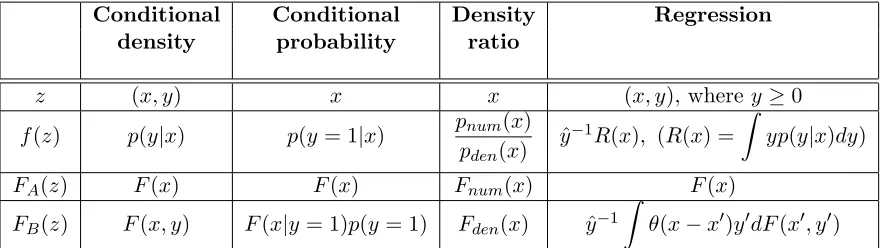
Conditional Conditional Density Regression density probability ratio
z (x, y) x x (x, y), where y≥0
f(z) p(y|x) p(y= 1|x) pnum(x) pden(x)
ˆ
y−1R(x), (R(x) = Z
yp(y|x)dy)
FA(z) F(x) F(x) Fnum(x) F(x)
FB(z) F(x, y) F(x|y= 1)p(y= 1) Fden(x) yˆ−1 Z
θ(x−x0)y0dF(x0, y0)
Table 1: Vector z, solutionf(z), and functions FA(z), FB(z) for different statistical
infer-ence problems.
1. In the problem of conditional density estimation, vectorzis the pair (x, y), the solution f(z) is p(y|x), the cumulative distribution functionFA(z) isF(x) and the cumulative
distribution functionFB(z) is F(x, y).
2. In the problem of conditional probability p(y = 1|x) estimation, vector z is x, the solution f(z) is p(y = 1|x), the cumulative distribution function FA(z) is F(x), the
cumulative distribution function FB(z) is F(x|y= 1)p(y = 1), where p(y = 1) is the
probability of class y= 1.
3. In the problem of density ratio estimation, the vector z is x, the solution f(z) is pnum(x)/pden(x), the cumulative function FA(z) is Fnum(x), the cumulative function FB(z) isFden(x).
4. In the problem of regression R(x) = R yp(y|x)dy estimation, the vector z is (x, y), where y ≥ 0, the solution f(z) is ˆy−1R(x), (R(x) = R yp(y|x)dy), the cumulative functionFA(z) is F(x), the cumulative function FB(z) is ˆy−1
R
θ(x0−x0)y0dF(x0, y0).
Since statistical inference problems have the same kernel of the integral equations (i.e., the step-function) and the same right-hand side (i.e., the cumulative distribution func-tion), it allows us to introduce (in Section 5) a common standard method (called V-matrix method) for solving all inference problems.
3. Solution of Ill-Posed Operator Equations
In this section, we consider ill-posed operator equations and their solutions.
3.1 Fredholm Integral Equations of the First Kind
In this section, we consider the linear operator equations
whereA maps elements of the metric spacef ∈ M ⊂E1 into elements of the metric space F ∈ N ⊂E2. Letf be a continuous one-to-one operator and f(M) =N. Let the solution of such operator equation exist and be unique. Then
M=A−1N.
The crucial question is whether this inverse operator A−1 is continuous. If it is, then close functions in N correspond to close functions in M. That is, ”small” changes in the right-hand side of (20) cause ”small” changes of its solution. In this case, we call the operatorA−1 stable(Tikhonov and Arsenin, 1977).
If, however, the inverse operator is discontinuous, then ”small” changes in the right-hand side of (20) can cause significant changes of the solution. In this case, we call the operator A−1 unstable.
Solution of equation (20) is called well-posedif this solution
1. exists;
2. is unique;
3. is stable.
Otherwise we call the solution ill-posed.
We are interested in the situation when the solution of operator equation exists, andis unique. In this case, the effectiveness of solution of equation (20) is defined by thestability of the operator A−1. If the operator is unstable, then, generally speaking, the numerical solution of equation is impossible.
Here we consider linear integral operator
Af(x) = Z b
a
K(x, u)f(u)du
defined by the kernel K(t, u), which is continuous almost everywhere on a ≤ t ≤b, c ≤
x ≤ d. This kernel maps the set of functions {f(t)}, continuous on [a, b], unto the set of functions {F(x)}, also continuous on [c, d]. The corresponding Fredholm equation of the first kind
Z b a
K(x, u)f(u)du=F(x)
requires finding the solutionf(u) given the right-hand sideF(x).
In this paper, we consider integral equation defined by the so-called convolution kernel
K(x, u) =K(x−u).
Moreover, we consider the specific convolution kernel of the form
K(x−u) =θ(x−u).
First, we show that the solution of equation
Z 1 0
θ(x−u)f(u)du=x (21)
is indeed ill-posed3. It is easy to check that f(x) = 1
is the solution of this equation. Indeed,
Z 1 0
θ(x−u)du= Z x
0
du=x. (22)
It is also easy to check that the function
f∗(x) = 1 + cosnx (23)
is a solution of the equation
Z 1 0
θ(x−u)f∗(u)du=x+ sinnx
n . (24)
That is, whennincreases, the right-hand sides of equations (22) and (24) are getting close to each other, but their solutions (21) and (23) are not.
The problem is how one can solve an ill-posed equation when its right-hand side is defined imprecisely.
3.2 Methods of Solving Ill-Posed Problems
In this subsection, we consider methods for solving ill-posed operator equations.
3.2.1 Inverse Operator Lemma
The following classical inverse operator lemma (Tikhonov and Arsenin, 1977) is the key enabler for solving ill-posed problems.
Lemma. If A is a continuous one-to-one operator defined on a compact set M∗ ⊂ M, then the inverse operator A−1 is continuous on the set N∗ =AM∗.
Therefore, the conditions of existence and uniqueness of the solution of an operator equation imply that the problem is well-posed on the compact M∗. The third condition (stability of the solution) is automatically satisfied. This lemma is the basis for all con-structive ideas of solving ill-posed problems. We now consider one of them.
3.2.2 Regularization Method
Suppose that we have to solve the operator equation
Af =F (25)
defined by continuous one-to-one operator AmappingMintoN, and assume the solution of (25) exists. Also suppose that, instead of the right-hand side F(x), we are given its approximationFδ(x), where
ρE2(F(x), Fδ(x))≤δ.
Our goal is to find the solution of equation
Af =Fδ
when δ→0.
Consider a lower semi-continuous functional W(f) (called theregularizer) that has the following three properties:
1. the solution of the operator equation (25) belongs to the domain D(W) of the func-tionalW(f);
2. functional W(f) is non-negative values in its domain;
3. all sets
Mc={f :W(f)≤c}
are compact for any c≥0.
The idea of regularization is to find a solution for (25) as an element minimizing the so-called regularized functional
Rγ( ˆf , Fδ) =ρ2E2(Af , Fˆ δ) +γδW( ˆf), fˆ∈D(W) (26)
withregularization parameter γδ >0.
The following theorem holds true (Tikhonov and Arsenin, 1977).
Theorem 1 Let E1 and E2 be metric spaces, and suppose for F ∈ N there exists a solution of (25) that belongs toMc. Suppose that, instead of the exact right-hand side F in
(25), its approximations4 Fδ ∈E2 in (26) are given such thatρE2(F, Fδ)≤δ. Consider the
sequence of parametersγ such that
γ(δ)−→0 for δ −→0,
lim
δ−→0 δ2
γ(δ) ≤r <∞. (27)
Then the sequence of solutionsfδγ(δ) minimizing the functionalsRγ(δ)(f, Fδ) onD(W)
con-verges to the exact solution f (in the metric of space E1) asδ −→0.
In a Hilbert space, the functional W(f) may be chosen as ||f||2 for a linear operatorA. Although the setsMcare (only) weakly compact in this case, regularized solutions converge
to the desired one. Such a choice of regularized functional is convenient since its domain D(W) is the whole spaceE1. In this case, however, the conditions on the parametersγ are more restrictive than in the case of Theorem 1: namely, γ should converge to zero slower thanδ2.
Thus the following theorem holds true (Tikhonov and Arsenin, 1977).
Theorem 2Let E1 be a Hilbert space andW(f) =||f||2. Then forγ(δ) satisfying (27) with r= 0, the regularized element fδγ(δ) converges to the exact solution f in metric E1 as δ→0.
4. Stochastic Ill-Posed Problems
In this section, we consider the problem of solving the operator equation
Af =F, (28)
where not only its right-hand side is defined approximately (F`(x) instead of F(x)), but
the operatorAf is also defined approximately. Such problem are called stochastic ill-posed problems.
In the next subsections, we describe the conditions under which it is possible to solve equation (28), where both the right-hand side and the operator are defined approximately. We first discuss the general theory for solving stochastic ill-posed problems and then con-sider specific operators describing particular problems, i.e., empirical inference problems described in Sections 2.3, 2.4, and 2.5. For all these problems, the operator has the form
A`f = Z
θ(x−u)f(u)dF`(u).
We show that rigorous solutions of stochastic ill-posed problem with this operator leverage the so-called V-matrix, which captures some geometric properties of the data; we also describe specific algorithms for solution of our empirical inference problems.
4.1 Regularization of Stochastic Ill-Posed Problems Consider the problem of solving the operator equation
Af =F
under the condition where (random) approximations are given not only for the function on the right-hand side of the equation but for the operator as well (the stochastic ill-posed problem).
We assume that, instead of the true operator A, we are given a sequence of random continuous operators A`, ` = 1,2, ... that converges in probability to the operator A (the
definition of closeness between two operators will be defined later).
First, we discuss general conditions under which the solution of stochastic ill-posed problem is possible; after that, we consider specific operator equations corresponding to each empirical inference problem.
As before, we consider the problem of solving the operator equation by the regularization method, i.e., by minimizing the functional
R∗γ`(f, F`, A`) =ρ2E2(A`f, F`) +γ`W(f). (29)
For this functional, there exists a minimum (perhaps, not unique). We define the closeness of operator Aand operator A` as the distance
||A`−A||= sup f∈D
||A`f−Af||E2
W1/2(f) .
Theorem. For any ε > 0 and any constants C1, C2 > 0 there exists a value γ0 > 0 such that for any γ`≤γ0 the inequality
P{ρE1(f`, f)> ε} ≤P{ρE2(F`, F)> C1 √
γ`}+P{||A`−A||> C2
√
γ`} (30)
holds true.
Corollary. As follows from this theorem, if the approximationsF`(x) of the right-hand
side of the operator equation converge to the true function F(x) in E2 with the rate of convergencer(`), and the approximations A` converge to the true operatorAin the metric
inE1 defined in (30) with the rate of convergencerA(`), then there exists such a function r0(`) = max{r(`), rA(`)}; lim
`→∞r0(`) = 0,
that the sequence of solutions to the equation converges in probability to the true one if
lim
`→∞
r0(`)
√
γ`
= 0, lim
`→∞γ`= 0.
4.2 Solution of Empirical Inference Problems
In this section, we consider solutions of the integral equation
Af =F,
where operatorA has the form
Af = Z
θ(x−u)f(u)dF1(u),
and the right-hand side of the equation is F2(x). That is, our goal is to solve the integral equation
Z
θ(x−u)f(u)dF1(x) =F2(x).
We consider the case whereF1(x) andF2(x) are two different cumulative distribution func-tions. (This integral equation also includes, as a special case, the problem of regression estimation, where F2(x) =
R
ydP(x, y) for non-negative y). This equation defines the main empirical inference problem described in Section 2. The problem of density ratio estimation requires solving this equation when both functions F1(x) and F2(x) are unknown but the iid data
X11, ..., X`11 ∼F1 (31)
X11, ..., X`12 ∼F2 (32)
are available. In order to solve this equation, we use empirical approximations instead of actual distribution functions, thus obtaining
A`1f =
Z
F`k(x) =
1 `k
`k
X i=1
θ(x−Xik), k= 1,2,
where F`1(u) are and F`2(x) are the empirical distribution functions obtained from data
(31) and (32), respectively.
One can show (see (Vapnik, 1998), Section 7.7) that, for sufficiently large`, the inequality
||A`−A||= sup f
||A`f −Af||E2
W1/2(f) ≤ ||F`−F||E2
holds true for the smooth solutionf(x) of our equations.
From this inequality, bounds (4), and the Theorem of Section 4.1, it follows that the regularized solutions of our operator equations converge to the actual function
ρE1(f`, f)→`→∞ 0
with probability one.
Therefore, to solve our inference problems, we minimize the functional
Rγ(f, F`, A`1) =ρ
2
E2(A`1f, F`2) +γ`W(f). (34)
In order to do this well and find the unique solution of this problem, we have to define three elements of (34):
1. The distanceρE2(F1, F2) between functionsF1(x) andF2(x) in E2.
2. The regularization functionalW(f) in the space of functionsf ∈E1. 3. The rule for selecting the regularization constant γ`.
In the next sections, we consider the first two elements.
5. Solving Statistical Inference Problems with V-matrix
Consider the explicit form of the functional for solving our inference problems. In order to do this, we specify expressions for the squared distance and regularization functional in expression (34).
5.1 The V-matrix
In this subsection, we consider the key element of our approach, theV-matrix.
5.1.1 Definition of Distance
Let our distance inE2 be defined by theL2 metric ρ2E2(F1(x), F2(x)) =
Z
(F1(x)−F2(x))2σ(x)dµ(x),
µ(x). For example, if our equation is defined in the box domain [0,1]d, we can use uniform measure in this domain and σ(x) = 1.
Below we define the measure µ(x) as
dµ(x) =
d Y k=1
dF`(xk), (35)
where eachF`(xk) is the marginal empirical cumulative distribution function of the
coordi-natexk estimated from data.
We also choose functionσ(x) in the form
σ(x) =
n Y k=1
σk(xk). (36)
In this paper, we consider several weight functions σ(xk):
1. The function
σ(xk) = 1.
2. For the problem of conditional probability estimation, we consider the function
σ(xk) = 1
F`(xk|y= 1)(1−F`(xk|y= 1)) +
, (37)
whereε >0 is a small constant.
3. For the problem of regression estimation, we consider the case where y ≥ 0 and, instead ofF`(xk|y = 1) in (37), the monotonic function
F`(xk) =
1 `yˆav
` X
i=1
yiθ(xk−Xik)
is used, where ˆyav is the average value of y in the training data. This function has
properties of ECDF.
4. For the problem of density ratio estimation, we consider an estimate of function Fnum(x) instead of the estimate of function F(x|y= 1) in (37).
Remark. In order to explain choice (37) for function σ(x), consider the problem of one-dimensional conditional probability estimation. Letf0(x) be the true conditional prob-ability. Consider the function ˆf0(x) =p1f0(x). Then the solution of integral equation
Z
θ(x−u) ˆf(u)dF(u) =F(x|y= 1)
defines the conditional probability ˆf0(x) =p1f0(x). Consider two functions: the estimate of the right-hand side of equation F`(x|y= 1) and the actual right-hand side
F0(x|y= 1) = Z x
−∞
The deviation
∆ =F0(x|y= 1)−F`(x|y= 1)
between these two functions has different values of variance for different x. The variance is small (equal to zero) at the end points of an interval and is large somewhere inside it. To obtain the uniform relative deviation of approximation from the actual function over the whole interval, we adjust the distance in any point of interval proportionally to the inverse of variance. Since for any fixedx the variance is
Var(x) =F(x|y= 1)(1−F(x|y= 1)), (38)
we normalize the squared deviation ∆2 by (38). The expression (37) realizes this idea.
5.1.2 Definition of Distance for Conditional Probability Estimation Problem
Consider the problem of conditional probability estimation.
For this problem, the squared distance between approximations of the right-hand side and the left-hand side of equation
F`(x, y= 1) =p`F`(x|y= 1) =
1 `
` X
i=1
yiθ(x−Xi)
can be written as follows:
ρ2(A`f, F`) = Z Z
θ(x−u)f(u)dF`(u)− Z
yiθ(x−u)dF`(u) 2
σ(x)dµ(x),
where yi ∈ {0,1} and F`(x) is the empirical distribution function estimated from training
vectors Xi. Therefore, we obtain the expression
ρ2(A`f, F`) =
1 `2
` X i,j=1
f(Xi)f(Xj) Z
θ(x−Xi)θ(x−Xj)σ(x)dµ(x)−
2 `2
` X i,j=1
f(Xi)yj Z
θ(x−Xi)θ(x−Xj)σ(x)dµ(x)+
1 `2
` X i,j=1
yiyj Z
θ(x−Xi)θ(x−Xj)σ(x)dµ(x),
(39)
where the last term does not depend on functionf(x).
Since bothσ(x) andµ(x) are products of one-dimensional functions, each integral in (39) has the form
Vi,j = Z
θ(x−Xi)θ(x−Xj)σ(x)dµ(x) = d Y k=1
Z
θ(xk−Xik)θ(xk−Xjk)σk(xk)dµ(xk). (40)
This (`×`)-dimensional matrix of elements Vi,j we callV-matrix of the sampleX1, ..., X`,
whereXi= (Xi1, . . . Xid), ∀i= 1, . . . , `.
Case 1. Data belongs to the upper-bounded support (−∞, B]d for some B and σ(x) = 1 on this support. Then the elements Vi,j of V-matrix have the form
Vi,j = d Y k=1
(B−max{Xik, Xjk}).
Case 2. Case whereσ(xk) = 1 and µdefined as (35). Then the elementsVi,j ofV-matrix have
the form
Vi,j = d Y k=1
ν(Xk>max{Xik, Xjk}).
where ν(Xk > max{Xik, Xjk}) is the frequency of Xk from the given data with the values larger than max{Xk
i, Xjk}.
Case 3. Case whereσ(x) is defined as (36), (37) andµ(x) as (35). In this case, the values Vi,j
also can be easily computed numerically (since both functions are piecewise constant, the integration (40) is reduced to a summation of constants).
To rewrite the expression for the distance in a compact form, we introduce the ` -dimensional vector Φ
Φ = (f(X1), ..., f(X`))T.
Then, taking into account (39), we rewrite the first summand of functional (34) as
ρ2(A`f, F`) =
1 `2 Φ
TVΦ−2ΦTV Y +YTV Y
, (41)
whereY denotes the`-dimensional vector (y1, ..., y`)T,yi∈ {0,1}.
5.1.3 Distance for Regression Estimation Problem
Repeating the same derivation for regression estimation problem, we obtain the same ex-pression for the distance
ρ2(A`f, F`) =
1 `2 Φ
TVΦ−2ΦTV Y +YTV Y ,
where coordinates of vector Y are values y ∈ R1 given in examples (17) for regression estimation problem.
5.1.4 Distance for Density Ratio Estimation Problem
In the problem of density ratio estimation, we have to solve the integral equation
Z
θ(x−u)R(u)dFden(u) =Fnum(x),
and iid data
X10, ..., X`0num ∼Fnum(x) are available.
Using the empirical estimates
F`num(x) =
1 `num
`num
X j=1
θ(x−Xj0)
and
F`den(x) =
1 `den
`den
X i=1
θ(x−Xi)
instead of unknown cumulative distribution Fnum(x) and Fden(x) and repeating the same distance computations as in the problems of conditional probability estimation and regres-sion estimation, we obtain
ρ2 =
Z Z
θ(x−u)R(u)dF`den(u)−F`num(x)
2
σ(x)dµ(x) =
1 `2den
`den
X i,j=1
R(Xi)R(Xj) Z
θ(x−Xj)θ(x−Xj)σ(x)dµ(x)−
2 `num`den
`num X i=1 `den X j=1
R(Xi)R(Xj0) Z
θ(x−Xi)θ(x−Xj0)σ(x)dµ(x)+
1 `2 num `num X i,j=1 Z
θ(x−Xj0)θ(x−Xj0)σ(x)dµ(x) = 1 `2
num `num
X i,j=1
Vi,j∗∗+
1 `2den
`den
X i,j=1
R(Xi)R(Xj)Vi,j−
2 `num`den
`den X i=1 `num X j=1
R(Xi)R(Xj0)Vi,j∗,
where the valuesVi,j, Vi,j∗, Vi,j∗∗ are calculated as
Vi,j = Z
θ(x−Xi)θ(x−Xj)σ(x)dµ(x), i, j= 1, ..., `den, Vi,j∗ =
Z
θ(x−Xi)θ(x−Xj0)σ(x)dµ(x), i= 1, ..., `num, j = 1, ..., `den, Vi,j∗∗=
Z
θ(x−Xi0)θ(x−Xj0)σ(x)dµ(x), i, j = 1, ..., `num.
We denote by V, V∗, and V∗∗ (respectively, (`den × `den)-dimensional, (`den ×`num )-dimensional, and (`num×`num)-dimensional) the matrices of corresponding elements Vi,j, Vi,j∗, andVi,j∗∗. We also denote by 1`num the`num-dimensional vector of ones, and by R– the
`den-dimensional column vector of R(Xi), i= 1, . . . , `den.
Using these notations, we can rewrite the distance as follows:
ρ2= 1 `2
den
RTV R−2
`den `num
RTV∗1`num+
`den `num
2
1T`numV∗∗1`num
5.2 The Regularization Functionals in RKHS
For each of our inference problems, we now look for its solution in Reproducing Kernel Hilbert Space (RKHS).
5.2.1 Reproducing Kernel Hilbert Space
According to Mercer theorem, any positive semi-definite kernel has a representation
K(x, z) =
∞
X k=1
λkφk(x)φk(z), x, z∈ X,
where{φk(x)} is a system of orthonormal functions andλk ≥0 ∀k.
Consider the set of functions
f(x;a) =
∞
X k=1
akφk(x). (42)
We say that set of functions (42) belongs to RKHS of kernel K(x, z) if we can define the inner product (f1, f2) in this space such that
(f1(x), K(x, y)) =f1(y). (43) It is easy to check that the inner product
(f(x, a), f(x, b)) =
∞
X k=1
akbk λk
,
where ak and bk are the coefficients of expansion of functions f(x, a), and f(x, b), satisfies
the reproducing property (43). In particular, the equality
(K(x1, z), K(x2, z)) =K(x1, x2) (44) holds true for the kernel K(x, x∗) that defines RKHS.
The remarkable property of RKHS is the so-called Representer Theorem (Kimeldorf and Wahba, 1971), (Kimeldorf and Wahba, 1970), (Sch¨olkopf et al., 2001), which states that any functionf(x) from RKHS that minimizes functional (34) can be represented as
f(x) =
` X i=1
ciK(Xi, x),
whereci, i= 1, ..., `are parameters and Xi, i= 1, ..., ` are vectors of observations.
5.2.2 Explicit Form of Regularization Functional.
In all our Statistical Inference problems, we are looking for solutions in RKHS, where we use the squared norm as the regularization functional:
That is, we are looking for solution in the form
f(x) =
` X i=1
αiK(Xi, x), (46)
where Xi are elements of the observation. Using property (44), we define the functional
(45) as
W(f) =
` X i,j=1
αiαjK(xi, xj).
In order to use the matrix form of (34), we introduce the following notations:
1. K is the (`×`)-dimensional matrix of elements K(Xi, Xj), i, j= 1, ..., `.
2. K(x) is the `-dimensional vector of functionsK(Xi, x), i= 1, ..., `.
3. A is the`-dimensional vector A= (α1, ..., α`)T of elements αi, i= 1, ..., `.
In these notations, the regularization functional has the form
W(f) =ATKA, (47)
and its solution has the form
f(x) =ATK(x). (48)
6. Solution of Statistical Inference Problems
In this section, we formulate our statistical inference problems as optimization problems.
6.1 Estimation of Conditional Probability Function
Here we present an explicit form of the optimization problem for estimating conditional probability function.
We are looking for the solution in form (48), where we have to find vector A. In order to find it, we have to minimize the objective function
T(A) =ATKV KA−2ATKV Y +γATKA, (49)
where Y is a binary vector (with coordinates y ∈ {0,1}) defined by the observations. The first two terms of the objective function come from distance (41), the last term is regulariza-tion funcregulariza-tional (47). (The third term from (49) was omitted in the target funcregulariza-tional since it does not depend on the unknown function.) Since the conditional probability has values between 0 and 1, we have to minimize this objective function subject to the constraint
0≤ATK(x)≤1, ∀x∈X. (50)
We also know that Z
wherep0 is the probability of classy = 1.
Minimization of (49) subject to constraints (50), (51) is a difficult optimization problem. To simplify this problem, we minimize the functional subject to the constraints
0≤ATK(Xi)≤1, i= 1, ..., `, (52)
defined only at the vectorsXi of observations5.
Also, we can approximate equality (51) using training data
1 `
` X
i=1
ATK(Xi) =p`, (53)
where p` is the frequency of class y = 1 estimated from data. Using matrix notation, the
constraints (52) and (53) can be rewritten as follows:
0` ≤KA≤1`, (54)
1 `A
TK1
` =p`. (55)
where K is the matrix of elements K(Xi, Xj), i, j = 1, ..., ` and 0`, 1` are `-dimensional
vectors of zeros and ones, respectively.
Therefore, we are looking for the solution in form (48), where parameters of vector A minimize functional (49) subject to constraints (54) and (55). This is a quadratic optimiza-tion problem with one linear equality constraint and 2`generallinear inequality constraints. In Section 6.4, we simplify this optimization problem by reducing it to a quadratic optimization problem with one linear equality constraint and several boxconstraints.
6.2 Estimation of Regression Function
Similarly, we can formulate the problem of regression function estimation, which has the form (48). To find the vector A, we minimize the functional
T(A) =ATKV KA−2ATKV Y +γATKA, (56)
whereY is a real-valued vector (with coordinatesyi ∈R1 of observations (5)).
Suppose that we have the following knowledge about the regression function:
1. Regressiony=f(x) =ATK(x) takes values inside an interval [a, b]:
a≤ATK(x)≤b, ∀x∈ X. (57)
2. We know the expectation of the values of the regression function:
Z
ATK(x)dF(x) =c. (58)
5. One can find the solution in closed formA= (V K+γI)−1V Y if constraints (52), (53) are ignored; here
Then we can solve the following problem: minimize functional (56) subject to constraints (57), (58).
Usually we do not have knowledge (57), (58), but we can approximate it from the training data. Specifically, we can approximateaby the smallest value a` ofyi, whilebcan
be approximated by the largest valueb` of yi from the training set:
a` = min{y1, ..., y`}, b`= max{y1, ..., y`}.
We then consider constraint (57) applied only for the training data:
a`≤ATK(Xi)≤b`, i= 1, ..., `. (59)
Also, we can approximate (58) with the equality constraint
1 `
` X i=1
ATK(Xi) =
1 `
` X i=1
yi. (60)
Constraints (59), (60) can be written in matrix notation
a`1`≤KA≤1`b`, (61)
1 `A
TK1
` = ˆyav, (62)
where ˆyavis the right-hand side of (60). If these approximations6are reasonable, the problem
of estimating the regression can be stated as minimization of functional (56) subject to constraints (61), (62). This is a quadratic optimization problem with one linear equality constraint and 2`general linear inequality constraints.
6.3 Estimation of Density Ratio Function
To solve the problem of estimating density ratio function in the form
R(x) =ATK(x),
whereAis the`den-dimensional vector of parameters andK(x) is the`den-dimensional vector of functionsK(X1, x), ..., K(X`den, x), we have to minimize the functional
T(A) =ATKV KA−2
`den `num
ATKV∗1`num+γA
TKA, (63)
whereK is the (`den×`den)-dimensional matrix of elements K(Xi, Xj) subject to the
con-straints
ATK(x)≥0, ∀x∈X, Z
ATK(x)dFden(x) = 1.
As above, we replace these constraints with their approximations
KA≥0`den,
1 `den
ATKV∗1`num = 1.
Here K is (`den×`den)-dimensional matrix of observations fromFden(x), andV∗ is (`den× `num)-dimensional matrix defined in Section 5.1.
6.4 Two-Stage Method for Function Estimation: Data Smoothing and Data Interpolation
Solutions of Statistical Inference problems considered in the previous sections require nu-merical treatment of the general quadratic optimization problem: minimization of quadratic form subject to one linear equality constraint and 2`linear inequality constraints of general type (`linear inequality constraints for density ratio estimation problem).
Numerical solution for such problems can be computationally hard (especially when ` is large). In this section, we simplify the problem by splitting it into two stages:
1. Estimating function values at ` observation points, that is, the estimating vector Φ = (f(X1), ..., f(X`))T.
2. Interpolating the values of function known at the`observation points to other points in the spaceX.
6.4.1 Stage 1: Estimating Function Values at Observation Points
In order to find the function values at the training data points, we rewrite the regularization functional in objective functions (49), (56), (63) in a different form. In order to do this, we use the equality
K=KK+K, whereK+ is the generalized inverse matrix of matrix7 K.
In our regularization term of objective functions, we use the equality
ATKA=ATKK+KA.
1. Estimation of values of conditional probability. For the problem of estimating the values of conditional probability at` observation points, we rewrite objective function (49) in the form
W(Φ) = ΦTVΦ−2ΦTV Y +γΦTK+Φ, (64) where we have denoted
Φ =KA. (65)
In the problem of estimating conditional probability,Y is a binary vector.
7. Along with generalized inverse matrix, pseudoinverse matrix is also used. Pseudoinverse matrixM+ of the matrixM (not necessarily symmetric) satisfies the following four conditions: (1)M M+M =M, (2)
M+M M+=M+, (3) (M M+)T =M M+, and (4) (M+M)T =M+M. If matrixM is invertible, then
In order to find vector Φ, we minimize functional (64) subject to box constraints
0`≤Φ≤1`,
and equality constraint
1 `Φ
T1 `=p`.
2. Estimating values of regression. In order to estimate the vector Φ of values of regression at ` observation points, we minimize functional (64) (where Y is a real-valued vector), subject to the box constraints
a`1`≤Φ≤b`1`,
and the equality constraint
1 `Φ
T1
`= ˆyav.
3. Estimating values of density ratio function. In order to estimate the vector Φ of values of density ratio function at `den observation pointsX1, ..., X`den, we minimize the
functional
ΦTVΦ−2
`den `num
ΦTV∗1`num+γΦ
TK+Φ subject to the box constraints
Φ≥0`den,
and the equality constraint
1 `den
ΦTV∗1`num = 1.
6.4.2 Stage 2: Function Interpolation
In the second stage of our two-stage procedure, we use the estimated function values at the points of training set to define the function in input space. That is, we solve the problem of function interpolation.
In order to do this, consider representation (65) of vector Φ∗:
Φ∗ =KA∗. (66)
We also consider the RKHS representation of the desired function:
f(x) =A∗TK(x). (67)
If the inverse matrixK−1 exists, then
A∗ =K−1Φ∗.
in (Vapnik, 1998), such a function either satisfies equation (66) with the smallest L2 norm of A∗ or it satisfies equation (66) with the smallest L0 norm ofA∗.
Efficient computational implementations for both L0 andL2 norms are available in the popular scientific software package Matlab.
Note that the obtained solutions in all our problems satisfy the corresponding constraints only on the training data, but they do not have to satisfy these constraints at any x∈ X. Therefore, we truncate the obtained solution functions as
ftr(x) = [A∗TK(x)]ba,
where
[u]ba=
a, ifu < a u, ifa≤u≤b b, ifu > b
Remark. For conditional probability estimation, the choice of a > 0, b < 1 (for constraints in training and truncation in test) is an additional tool for regularization that can leverage prior knowledge.
6.4.3 Additional Considerations
For many problems, it is useful to consider the solutions in the form of a function from a set of RKHS functions with a bias term:
f(x) =
` X i=1
αiK(Xi, x) +c=ATK(x) +c.
Using this set of functions, our quadratic optimization formulation for estimating the function values at training data points for the problem of conditional probability and re-gression estimation is as follows: minimize the functional (over vectors Φ)
(Φ +c1`)TV(Φ +c1`)−2(Φ +c1`)TV Y +γΦTK+Φ
subject to the constraints
(a−c1`)≤Φ≤(b−c1`),
(where a= 0, b= 1 for conditional probability problem, anda=a`, b=b` for regression
problem).
1 `1
T
` +c= ˆyav
where we denoted
ˆ yav=
1 `
` X
i=1 yi.
For estimating the values of density ratio function at points (X1, . . . , X`den), we minimize
the functional
(Φ +c1`den)
TV(Φ +c1
`den)−2
`den `num
(Φ +c1`den)
TV∗1
`num+γΦ
TK+Φ subject to the constraints
−c1`den ≤Φ,
7. Applications of Density Ratio Estimation
Here we describe three applications of density ratio estimation (Sugiyama et al., 2012), (Kawa-hara and Sugiyama, 2009), specifically,
– Data adaptation and correction of solution for unbalanced data.
– Estimation of mutual information and problem of feature selection.
– Change point detection.
It is important to note that, in all these problems, it is required to estimate not the func-tion R(x), but rather the valuesR(Xi) of density ratio function at the points X1, ..., X`den
(generated by probability measureFden(x)).
Below we consider the first two problems in the pattern recognition setting and then consider two new applications:
1) Learning from data with unbalanced classes 2) Learning of local rules.
7.1 Data Adaptation Problem Let the iid data
(y1, X1), ...,(y`, X`) (68)
be defined by a fixed unknown density function p(x) and a fixed unknown conditional density functionp(y|x) generated according to an unknown joint density functionp(x, y) = p(y|x)p(x). Suppose now that one is given data
X1∗, ..., X`∗1 (69)
defined by another fixed unknown density function p∗(x). This density function, together
with conditional densityp(y|x) (the same one as for Equation 68), defines the joint density functionp∗(x, y) =p(y|x)p∗(x).
It is required, using data (68) and (69), to find in a set of functionsf(x, α), α∈Λ, the one that minimizes the functional
T(α) = Z
L(y, f(x, α))p∗(x, y)dydx, (70)
whereL(·,·) is a known loss function.
This setting is an important generalization of the classical function estimation problem where the functional dependency between variablesyandxis the same (the functionp(y|x) which is the part of composition of p(x, y) andp∗(x, y)), but the environments (defined by
densities p(x) and p∗(x)) are different.
It is required, by observing examples from one environment (with p(x)), to define the rule for another environment (with p∗(x)). Let us denote
R(x) = p∗(x)
Then functional (70) can be rewritten as
T(α) = Z
L(y, f(x, α))R(x)p(x, y)dydx,
and we have to minimize the functional
T`(α) = ` X
i=1
L(yi, f(Xi, α))R(xi),
where Xi, yi are data points from (68). In this equation, we have multipliers R(Xi) that
define the adaptation of data (69) generated by joint density p(x, y) = p(y|x)p(x) to the data generated by the density p∗(x, y) = p(y|x)p∗(x). Knowledge of density ratio values
R(Xi) leads to a modification of classical algorithms.
For SVM method in pattern recognition (Vapnik, 1995), (Vapnik, 1998), this means that we have to minimize the functional
T`(w) = (w, w) +C ` X i=1
R(Xi)ξi (71)
(C is a tuning parameter) subject to the constraints
yi((w, zi) +b)≥1−ξi, ξ ≥0, yi ∈ {−1,+1}, (72)
wherezi is the image of vector Xi∈ X in feature space Z.
This leads to the following dual-space SVM solution: maximize the functional
T`(α) = ` X
i=1 αi−
1 2
` X i,j=1
αiαjyiyjK(Xi, Xj), (73)
where (zi, zj) = K(Xi, Xj) is Mercer kernel that defines the inner product (zi, zj) subject
to the constraint
` X i=1
yiαi = 0 (74)
and the constraints
0≤αi ≤CR(Xi). (75)
The adaptation to new data is given by the values R(xi), i= 1, ..., `; these values are set
to 1 in standard SVM (71).
7.2 Estimation of Mutual Information.
Considerk-class pattern recognition problem y∈ {a1, ..., ak}.
Theentropyof nominal random variabley(level of uncertainty forywith no information about correspondingx) is defined by
H(y) =−
k X
t=1
Similarly, theconditional entropygiven fixed valuex∗ (level of uncertainty ofy given
infor-mationx∗) is defined by the value
H(y|x∗) =−
k X t=1
p(y=at|x∗) log2p(y=at|x∗).
For anyx∗, the difference (decrease in uncertainty)
∆H(y|x∗) =H(y)−H(y|x∗)
defines the amount of information about y contained in vector x∗. The expectation of this
value (with respect to x)
I(x, y) = Z
∆H(y|x)dF(x)
is called the mutual informationbetween variablesy and vectorsx. It describes how much information vector x caries about variable y. The mutual information can be rewritten in the form
I(x, y) =
k X t=1
p(y=at) Z
p(x, y=at) log2
p(x, y=at) p(x)p(y=at)
dF(x) (76)
(see (Cover and Thomas, 2006) for details).
For two densities (p(x|y=at) and p(x)), the density ratio function is
R(x, y=at) =
p(x|y=at) p(x) .
Using this notation, one can rewrite expression (76) as
I(x, y) =
k X t=1
p(y=at) Z
R(y=at, x) log2R(y=at, x)dF(x), (77)
whereF(x) is cumulative distribution function ofx. Our goal is to use data
(y1, X1), ...,(y`, X`)
to estimate I(x, y). Using in (77) the empirical distribution function F`(x) and the
val-ues p`(y = at) estimated from the data, we obtain the approximation I`(x, y) of mutual
information (77):
I`(x, y) =
1 `
m X t=1
p(y=at) ` X
i=1
R(Xi, y=at) log2R(Xi, y =at).
Feature selection problem and mutual information. Estimates of mutual infor-mation play important role in the problem of feature selection. Indeed, the problem of selecting k features from the set of n features require to find among n features x1, .., xn such kelements xk1, ..., xkk which containmaximal informationabout variabley generated
according to p(y|x), x = (x1, ..., xn). That means to find the subset of k elements with maximal mutual information. This is a hard computational problem: even if one can es-timate the mutual information from data well, one still needs to solve mutual information estimation problem Cnk times to chose the best subset.
Therefore some heuristic methods are used (Brown et al., 2012) to chose the subset with best features. There are two heuristic approaches to the problem of estimating best features:
1. To estimate mutual informationI(y, xt) orI(xt, xm) of scalar values and then combine (heuristically) the results.
2. To estimate mutual information between the value of y and two features xt,m =
(xt, xm), obtaining n2 elements of matrix I(y, xt,m) t, m = 1, . . . , n and choose from this
matrix the minor with the largest score (say, the sum of its elements). All these procedures require accurate estimates of mutual information.
7.3 Unbalanced Classes in Pattern Recognition
An important application of data adaptation method is the case of binary classification problem with unbalanced training data (du Plessis and Sugiyama, 2012). In this case, the numbers of training examples for both classes differ significantly (often, by orders of magnitude). For instance, for diagnosis of rare diseases, the number of samples from the first class (patients suffering from the disease) is much smaller than the number of samples from the second class (patients without that disease).
Classical pattern recognition algorithms applied to unbalanced data can lead to large false positive or false negative error rates. We would like to construct a method that would allow to control the balance of both error rates. Formally, this means that training data are generated according to some probability measure
p(x) =p(x|y= 1)p+p(x|y= 0)(1−p),
where 0≤p≤1 is a fixed parameter that defines probability of the event of the first class. Learning algorithms are developed to minimize the expectation of error for this generator of random events.
Our goal, however, is to minimize the expected error for another generator
p∗(x) =p(x|y= 1)p∗+p(x|y = 0)(1−p∗),
where p∗ defines different probability of the first class (in the rare disease example, we
minimize the expected error if this disease is not so rare); that is, for parameterp=p∗.
To solve this problem, we have to estimate the values of density ratio function
from available data. Suppose we are given observations
(y1, X1), ...,(y`, X`). (78)
Let us denote by Xi1 and Xj0 vectors from (78) corresponding toy = 1 and y = 0, respec-tively. We rewrite elements ofx from (78) generated by p(x) as
Xi11, ..., Xi1m, Xi0m+1, ..., Xi0
`
Consider the new training set that imitates iid observations generated byp∗(x) by having
the elements of the first class to have frequency p∗:
Xi11, ..., Xi1m, Xj11, ...Xj1s, Xi0m+1, ..., Xi0`, (79) whereXj11, . . . , Xj1s are the result of random sampling fromXi11, . . . , Xi1m with replacement. Now, in order to estimate values R(Xi), i = 1, ..., `, we construct function F`den(x) from
data (78) and function F`num(x) from data (79) and use the algorithm for density ratio
estimation. For SVM method, in order to balance data, we have to maximize (73) subject to constraints (74) and (75).
8. Problem of Local Learning
In 1992, the following problem of local learning was formulated (Bottou and Vapnik, 1992): given data
(x1, y1), ...,(x`, y`) (80)
generated according to an unknown density function
p0(y, x) =p0(y|x)p0(x),
find the decision rule that minimizes risk in a vicinity of the given pointx0. Using some heuristic concept of vicinity of given points, the corresponding algorithm was developed. It was demonstrated (Bottou and Vapnik, 1992), (Vapnik and Bottou, 1993) that local learning is often more accurate than the global learning.
In this Section, we present a reasonable definition of the concept of locality, and we solve the problem of constructing local rules. Our goal is to use data (80) for constructing a rule that is accurate for vectors distributed according to someploc(x), for example, according to
the multidimensional normal distribution
ploc(x) =N(x0, σI) = 1 (2π)m/2σm
m Y k=1
exp
−(x
k−xk 0) 2σ2
,
where x0 = (x10, ..., xm0 ) is the vector of means, σ > 0 and identity matrix I are known parameters of multi-dimensional normal distribution (they are specified by our concept of vicinity pointx0). We denote by ploc(y, x) the density function
Therefore, the goal of local learning is to find, in the set of functions f(x, α), α ∈ Λ, the functionf(x, αn) that minimizes the functional
Tloc(α) = Z
(y−f(x, α))2ploc(y, x)dydx
instead of the functional
T0(α) = Z
(y−f(x, α))2p0(y, x)dydx, as it is formulated in classical (global) learning paradigm.
We rewrite functional Tlocas follows:
Tloc(α) = Z
(y−f(x, α))2R(x)p0(y, x)dydx, where we have denoted
R(x) = ploc(x) p0(x)
.
To minimize the functional Tloc given data obtained according top0(y, x), we minimize the empirical risk
ˆ
R(α) = 1 `
` X
i=1
(yi−f(xi, α))2R(xi).
To define this functional explicitly, we have to estimate the ratio of two densities, one of which (the density that specifies vicinity of pointx0) is known, and another one is unknown but elementsxof data obtained according to that unknown densityp0(x) are available from the training set.
This problem of density ratio estimation, however, differs from the one considered in Section 6.3. It requires solving the integral equation when the right-hand side of equation is precisely defined, whereas the operator is defined approximately:
1 `
` X
i=1
θ(x−Xi)R(xi)≈ Z x
−∞
N(x0, σI)dx.
The integral in the right-hand can be expressed as the product of m (where m is the dimensionality of space X) functions
Erf(x∗|x0, σI) = 2m (π)m/2
m Y k=1
Z xk∗ 0
exp
−(x
k−xk 0)2 2σ2 dx
k
.
Note that function Erf(x|x0, σI) can be easily computed using the so-called function erf(x):
erf(xk) = √2
π Z xk
0
Using the method of estimation of density ratio, in order to estimate vector R = (R(x1), ..., R(x`)), one has to minimize the functional
RTV R−2`RTU +γRTK+R,
where we have denoted by U = (U1, ..., U`)T the vector with coordinates
Ui = m Y k=1
` X t=1
θ(xkt −xki)Erf(xkt|x0, σ)
subject to constraints
RT1 =`
and constraints
R ≥0`.
In SVM technology, theV-matrix method requires to estimate valuesR(Xi) in the points
of observations first, and then to solve the SVM problem itself using the data adaptation technique described in Section 6.3.
9. Comparison with Classical Methods
In this paper, we introduced a new unified approach to solution of statistical inference problems based on their direct settings. We used rigorous mathematical techniques to solve them. Surprisingly, all these problems are amenable to relatively simple solutions.
One can see that elements of such solutions already exist in the basic classical statistical methods, for instance, in estimation of linear regression and in SVM pattern recognition problems.
9.1 Comparison with Linear Methods
Estimation of linear regression function is an important part of classical statistics. It is based on iid data
(y1, X1), ...,(y`, X`), (81)
where y is distributed according to an unknown function p(y|x). Distribution over vectors x is a subject of special discussions: it could be either defined by an unknown p(x) or by known fixed vectors. It is required to estimate the linear regression function
y=wT0x.
Linear estimator. To estimate this function, classical statistics uses ridge regression methodthat minimizes the functional
R(w) = (Y −Xw)T(Y −Xw) +γ(w, w), (82)
When observed vectors X inX are distributed according to an unknown p(x), method (81) is consistent under very general conditions.
The minimum of this functional has the form
w` = (XTX+γI)−1XTY. (83)
However, estimate (82) is not necessarily the best possible one.
The main theorem of linear regression theory, theGauss-Markovtheorem, assumes that input vectors X in X (81) are fixed (they are not random!). Below we formulate it in a slightly more general form.
Theorem. Suppose that the random values(yi−wT0Xi)and(yj−w0TXj)are uncorrelated
and that the bias of estimate (82)
µ=Ey(w`−w0).
Then, among all linear8 estimates with bias9 µ, estimate (82) has the smallest expectation of squared deviation:
Ey(w0−w`)2 ≤Ey(w0−w)2, ∀w.
Generalized linear estimator. Gauss-Markov model can be extended in the following way. Let`-dimensional vector of observationsY be defined by fixed vectorsXand additive random noise Ω = (ε1, ..., ε`)T so that
Y =Xw0+ Ω, where the noise vector Ω = (ε1, ..., ε`)T is such that
EΩ = 0, (84)
EΩΩT = Σ. (85)
Here, the noise values at the different pointsXi andXj of matrix Xare correlated and the
correlation matrix Σ is known (in the classical Gauss-Markov model, it is identity matrix Σ = I). Then, instead of estimator (82) minimizing functional (81), one minimizes the functional
R(w) = (Y −Xw)TΣ−1(Y −Xw) +γ(w, w). (86) This functional is obtained as the result of de-correlation of noise in (83), (84). The mini-mum of (85) has the form
ˆ
w∗ = (XTΣ−1X+γI)−1XTΣ−1Y. (87)
This estimator of parameters wis an improvement of (82) for correlated noise vector. V-matrix estimator of linear functions. The method of solving regression estima-tion problem (ignoring constraints) withV matrix leads to the estimate
ˆ
w∗∗= (XTVX+γI)−1XTV Y.
8. Note that estimate (83) is linear only if matrixX is fixed.
The structure of the V-matrix based estimate is the same as those of linear regression estimates (82) and (86), except that the V-matrix replaces identity matrix in (82) and inverse covariance matrix in (86).
The significant difference, however, is that both classical models were developed for the known (fixed) vectorsX, whileV-matrix is defined for random vectorsX and is computed using these vectors. It takes into account the information that classical methods ignore: the domain of regression function and the geometry of observed data points. The complete solution also takes into accounts the constraints that reflects the belief in estimated prior knowledge about the solution.
9.2 Comparison with L2-SVM (Non-Linear) Methods
For simplicity, we discuss in this section only pattern recognition problem; we can use the same approach for the non-linear regression estimation problem.
The pattern recognition problem can be viewed as a special case of the problem of conditional probability estimation. Using an estimate of conditional probabilityp(y= 1|x), one can easily obtain the classification rule
f(x) =θ(p(y= 1|x)−1/2).
We now compare the solution f(x) with
f(x) =ATK(x)
obtained for conditional probability problem with the same form of solution that defines SVM.
The coefficients A for L2-SVM have the form (Saunders et al., 1998), (Suykens and Vandewalle, 1999)
A= (K+γI)−1Y. (88)
If V-matrix method ignores the prior knowledge about the properties of conditional prob-ability function, the coefficients of expansion have the form
A= (KV +γI)−1V Y. (89)
It is easy, however, to incorporate the existing constraints into both solutions.
In order to find the standard hinge-loss SVM solution (Vapnik, 1995), we have to mini-mize the quadratic form
−ATYKYA+ 2AT1`
with respect toA subject to the box constraint
0`≤A≤C1`
and the equality constraint
ATY1`= 0,
whereC is the (penalty) parameter of the algorithm, andY is (`×`)-dimensional diagonal matrix withyi∈ {−1,+1}from training data on its diagonal (see formulas (71), (72) , (73),
In order to find the values of conditional probability, we also have to minimize the quadratic form
ΦT(V +γK+)Φ−2ΦV Y, with respect to Φ subject to the box constraints10
0` ≤Φ≤1`
and the equality constraint
ΦT1`=`p`,
whereγ >0 is the (regularization) parameter of the algorithm in the objective function (as C for SVM).
The essential difference between SVM and V-matrix method is that the constraints in SVM method appear due to necessary technicalities (related to Lagrange multiplier method11) while in V-matrix method they appear as a result of incorporating existing prior knowledge about the solution: the classical setting of pattern recognition problem does not include such prior knowledge12.
The discussion above indicates that, on one hand, the computational complexity of estimation of conditional probability is not higher than that of standard SVM classification, while, on the other hand, the V-estimate of conditional probability takes into account not only the information about the geometry of training data (incorporated in V-matrix) but also the existing prior knowledge about solution (incorporated in the constraints above).
This leads to the following question:
CanV-matrix method replace SVM method for pattern recognition?
The answer to this question is not obvious. In the mid-1990s, the following Imperative was formulated (Vapnik, 1995), (Vapnik, 1998):
While solving problem of interest, do not solve a more general problem as an inter-mediate step. Try to get the answer that you need, but not a more general one. It is quite possible that you have enough information to solve a particular problem of interest well, but not enough information to solve a general problem.
10. Often one has stronger constraints
a`≤Φ≤b`,
where0`≤a`andb`≤1`are given (by experts) as additional prior information.
11. The Lagrange multiplier method was developed to find the solution in thedual optimization space and constraints in SVM method are related to Lagrange multipliers. Computationally, it is much easier to obtain the solution in the dual space given by (73), (74), (75) than in theprimal spacegiven by (71), (72). As shown by comparisons (Osuna and Girosi, 1999) of SVM solutions in primal and dual settings, (1) solution in primal space is more difficult computationally, (2) the obtained accuracies in both primal and dual spaces are about the same, (3) the primal space solution uses significantly fewer support vectors, and (4) the large number of support vectors in dual space solution is caused by the need to maintain the constraints for Lagrange multipliers.