
This article is published under the terms of the Creative Commons Attribution License 4.0 Author(s) retain the copyright of this article. Publication rights with Alkhaer Publications. Published at: http://www.ijsciences.com/pub/issue/2017-01/
DOI: 10.18483/ijSci.1177; Online ISSN: 2305-3925; Print ISSN: 2410-4477
HU Ying-fen (Correspondence)
[email protected]
+Study on Antioxidant Activity of Peanut Meal
using Bacillus Natto by Solid State Fermentation
WANG Yanping
1
, HU Yingfen
2
, MA Yuping
3
, ZHANG Yuanjie
3
, LIU
Qing
3
Qingdao University, Qingdao, 266071
Foundation items: Project supposed by science and technology development planning project of Shandong province (2014GSF20011)
Abstract:This experiment carried out a preliminary study on solid state fermentation of Bacillus natto peanut meal. Determination of the scavenging activities to hydroxyl free radical scavenging rate to determine its antioxidant activity. The optimal fermentation conditions were obtained by single factor and response surface methodology as follows:38.8 h of Fermentation time, 37 ℃ of fermentation temperature, material liquid ratio1:0.44, 6.48% of inoculation amount. Under this condition, the hydroxy free radical,iron reduction capacity and DPPH radical scavenging rate were87.3%、0.36(OD value) and 73.4%,respectively.
Keywords: Peanut Meal; Bacillus Natto; Response Surface Methodology; Antioxidant Activity
Introduction
Peanut is one of the five major oil-bearing crops in the world. The protein content of peanut is 25% - 30% and it contains 8 necessary amino acid of personal body
[1]
.In the markets, the peanut protein product is primarily peanut protein powder, which is used as the main raw material during food processing [2].Peanut meal is a by-product of the process of making peanut oil, which is used mainly for feed.However, peanut meal is rich in protein and there are better ways to put this protein resource to use. Utilizing the solid state fermentation to prepare antioxidant peptides would not only make full use of this resource but also enlarge the scope of finely and deeply processed peanuts, which present significant economic and social benefits.
Bacillus subtilis is an important starter culture for
fermented
soybean foods like Japanese natto, Thai thuanao,Indian kinema, and Chinese douchi have reported the antioxidant activity and safety of red bean fermented by B. subtilis IMR-NK1[3-4]. In addition, the characteristics of the starter B. subtilis also play an important role in the properties and functionality of the fermented product[5].
In the present study, the solid state fermentation technology was evaluated and the operational
parameters were optimized using single
http://www.ijSciences.com
Volume 6
– January
2017 (01
)
45
provide a theoretical basis for the preparing peanut meal fermented liquid in order to improve its antioxidant activities.
Materials and methods
Materials peanut meal was from Qingdao Jiali Group Co.,Ltd.bean pulp and wheat bran were purchased from local market. Bacillus subtilis was isolated and
conserved in this
laboratory.H2O2,FeSO4,C6H4(OH)COOH,trichloroaceti
c acid (TCA),FeCl3, K3Fe(CN)6, FeCl2were analytical
reagents produced by Sinopharm Chemical Reagent Co., Ltd. China. 1, 1 - Diphenyl- 2 - picrylhydrazyl (DPPH) was purchased from Sigma.
Technology of bacillus subtilis solid state
fermentation. Bacillus subtilis seed and sterile water were added to solid state fermentation medium(30g) and cultured at a certain temperature for a certain time. When fermentation was over and sterile 0.9% NaClwas added to fermentation system. The fermentation product was oscillated at constant temperature water bath for a certain time. After centrifugation the supernatant was to be analyzed.
Single factor experiment design. The factors and levels of single-factor experiments are Fermentation time of 24, 30,36, 25, 42, 48h,fermentation temperatureof29, 33, 37, 41, 45°C,material liquid ratio of 1:0.3, 1:0.4, 1:0.5, 1:0.6, 1:0.7,inoculation amount of 2.2,4.5,6.8,9.1,11.4%, respectively. The basic fermentation conditions of single factor experiment are 24 h of Fermentation time, the ratio of the substrate for peanut meal, soybean meal, bran = 7:2:1,37 ℃ of fermentation temperature, Moisture ratio1:0.4, 6.8% of inoculation amount.
Box-Behnken Design (BBD). According to the result of single factor experiment, the fermentation
temperature remains unchanged. By using
Box-Behnken Design (BBD)the three factors including Time(A),Moisture ratio(B), Inoculum size(C),which had significant influence on the hydroxyl free radical scavenging rate were chosen to conduct three factors and three levels response surface methodology(RSM) experiment. The hydroxyl free radical scavenging rate(Y) was as response variables. The design of experimental factors and codes was mentioned in Table1. The experiment plan was designed and itsresult was analyzed using Design Expert Software (Static Made Easy, Minneapolis, MN, USA.Version 8.0.6).
Table 1 Design of experimental factors and codes
Process variables Codes
Range and level
-1 0 1
Time[h] A 30 36 42
solid-to-liquid ratio B 1 : 0.3 1 : 0.4 1 : 0.5
Inoculum size[%] C 4.5 6.8 9.1
Hydroxyl Free Radical Scavenging Activity
Hydroxyl free radical scavenging activity was determined according to the method of Amarowiczet al., [6]. 2 mL of sample solution, 2 mL of sample solution, and 2 mL of distilled water were placed in three test tubes, respectively. Then 2 mL of FeSO4 (6
mmol/L) and H2O2 (6 mmol/L)were added to above
three tubes, respectively and mixed vigorously. After standing for 10 min at roomtemperature, three 2 mL of
solutions salicylic acid (6 mmol/L), distilled water and salicylic acid(6 mmol/L) were added to the above three tubes, respectively. After standing for 30 min, the absorbances of the resulting solutions were recorded at 510 nm using a spectrophotometer. The absorption values of tubes 1, 2, and 3 were Ai, Aj, and A0, respectively. The hydroxyl free radical scavenging rate can be calculated as follows:
http://www.ijSciences.com
Volume 6
– January
2017 (01
)
46
(%)=[1-(Ai-Aj)/A0]×100
DPPH Free Radical Scavenging Activity
DPPH free radical scavenging activity was determined according to the method of Khantaphant et al., [7].
Iron Reduction Capacity
Iron reduction capacity was determined according to the method of You et al., [8].
Results and discussion
Effect of fermentation temperature on fermentation
results.The effect of fermentation temperature on fermentation results is shown in Fig.1 (a). It was found that the higher the fermentation reaction temperature is, not the better is. Bacillus subtilis has suitable temperature range. Beyond a certain temperature, Bacillus subtilis become inactivity. In the range of 29°C -37°C, the hydroxyl free radical scavenging rate presents the trend of increasing and then decreasing,which is max at37°C. Therefore, the temperature of 37°C acts as invariable factor of the response surface method experiment.
(a)
(b)
30.00 35.00 40.00 45.00 50.00 55.00 60.00
25 30 35 40 45 50
S
ca
v
en
gi
n
g
ra
te
(%)
fermentation temperature(℃)
55 60 65 70 75 80 85 90
1.6 3.6 5.6 7.6 9.6 11.6 13.6
S
ca
v
en
gi
n
g
ra
te
(%)
http://www.ijSciences.com
Volume 6
– January
2017 (01
)
47
(c)(d)
Fig.1 Effect of influencing factors, fermentation temperature (a), noculation amount(b), fermentation time(c), solid-to-liquid ratio(d) on fermentation results
Effect of inoculation amount on fermentation results. The effect of inoculation amount on fermentation results is shown in Fig.1 (b). The inoculation amount may be one of important factors responsible for the effect of results. The hydroxyl free radical scavenging rate increased rapidly when inoculation amount from 2.2%to6.8% and then decreased .The result indicates that the maximum hydroxyl free radical scavenging rate was obtained at the substrate mass fraction of 6.8%. Therefore, the inoculation amount range of4.5 -9.1% is chosen to be
the response surface method experiment levels.
Effect of fermentation time on fermentation results.
The effect of fermentation time onfermentation results is shown in Fig.1 (c). Fermentation time can also influence the effect of results. The fermentation product would be dependent on length of reaction time. When the fermentation time was 36h, the maximum antioxidant activity was obtained. Consequently, the hydrolysis time range of 30 - 42h is chosen to be the response surface method experiment levels.
25 30 35 40 45 50 55 60 65
15 25 35 45 55
S
ca
v
en
gi
n
g
ra
te
(%)
fermentation time(h)
40 45 50 55 60 65 70 75 80
1:0.3 1:0.4 1:0.5 1:0.6 1:0.7
S
ca
v
en
gi
n
g
ra
te
(%)
http://www.ijSciences.com
Volume 6
– January
2017 (01
)
48
Effect of solid-to-liquid ratio on fermentationresults. The effect of solid-to-liquid ratio on fermentation results is shown in Fig.1 (d). The hydroxyl free radical scavenging rate increased rapidly when solid-to-liquid ratio from 1:0.3to 1:0.4 and then decreased when solid-to-liquid ratio was up to1:0.4. The result indicates that the maximum hydroxyl free radical scavenging rate was obtained at the substrate mass fraction of 1:0.4.So, solid-to-liquid ratio 1:0.3-1:0.5 are used as response surface method experiment levels.
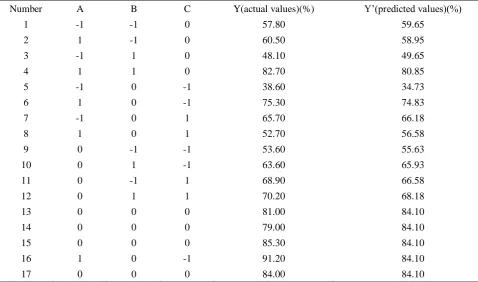
Design of RSM experiment and results. The solid state fermentation technology for producing antioxidant peptides was optimized by BBD of three factors and three levels, and the effects of these variables and their interactions, Time(A),Moisture ratio(B), Inoculum size(C) on the hydroxyl free radical scavenging rate of fermentation liquid were investigated. There are17 experimental points. Design and results see Table 2.
Table 2BBD and results
Number A B C Y(actual values)(%) Y’(predicted values)(%)
1 -1 -1 0 57.80 59.65
2 1 -1 0 60.50 58.95
3 -1 1 0 48.10 49.65
4 1 1 0 82.70 80.85
5 -1 0 -1 38.60 34.73
6 1 0 -1 75.30 74.83
7 -1 0 1 65.70 66.18
8 1 0 1 52.70 56.58
9 0 -1 -1 53.60 55.63
10 0 1 -1 63.60 65.93
11 0 -1 1 68.90 66.58
12 0 1 1 70.20 68.18
13 0 0 0 81.00 84.10
14 0 0 0 79.00 84.10
15 0 0 0 85.30 84.10
16 1 0 -1 91.20 84.10
17 0 0 0 84.00 84.10
According to the data from experiment (Table 2), the regression analysis was carried out by using Design-Expert software, taking Y as the dependent variable, and each factor and their interactions as the independent variable. The regression equation was established as formula
Y=84.1+7.63A+2.98B+3.30C+7.97AB-12.43AC-2.18 BC-13.91A2
-7.91B2-12.11C2
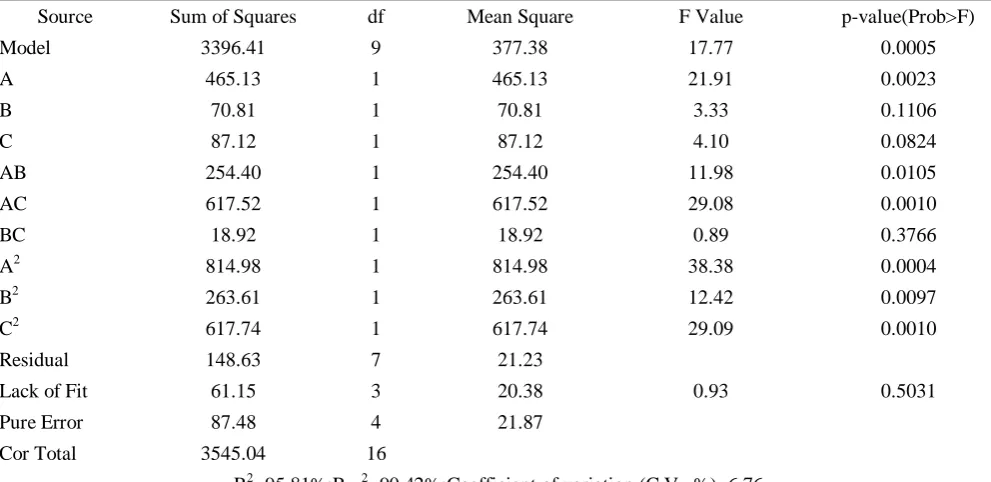
The variance analysis results of this regression equation see Table3. The regression equation agrees
http://www.ijSciences.com
Volume 6
– January
2017 (01
)
49
rateis at 0.01 significant levels and the effect of A2、 B2、C2 on the hydroxyl free radical scavenging rate were significant. The influencing sequence for
hydroxyl free radical scavenging rate is A>C>B, that
is, fermentation time>Inoculum size>solid-to-liquid
ratio. The prediction about each experimental value is performed by using the regression equation and the
results see Table 2.The model calculation and prediction show good agreement with the experimental results and it also accounts for the preferable fitness between the regression equation and actual experimental values. However, individual experiment error is great based on the influence of the instrumental error and the human factor in the course of the experiment. On the whole, the model performs well in experimental data.
Table 3 Variance analysis of RSM model for hydroxyl free radical scavenging rate
Source Sum of Squares df Mean Square F Value p-value(Prob>F)
Model 3396.41 9 377.38 17.77 0.0005
A 465.13 1 465.13 21.91 0.0023
B 70.81 1 70.81 3.33 0.1106
C 87.12 1 87.12 4.10 0.0824
AB 254.40 1 254.40 11.98 0.0105
AC 617.52 1 617.52 29.08 0.0010
BC 18.92 1 18.92 0.89 0.3766
A2 814.98 1 814.98 38.38 0.0004
B2 263.61 1 263.61 12.42 0.0097
C2 617.74 1 617.74 29.09 0.0010
Residual 148.63 7 21.23
Lack of Fit 61.15 3 20.38 0.93 0.5031
Pure Error 87.48 4 21.87
Cor Total 3545.04 16
R2=95.81%;Radj2=90.42%;Coefficient of variation (C.V., %)=6.76
The trend graphs of the three factors interaction on hydroxyl free radical scavenging rate are given in Fig. 2. The effect of fermentation time on hydroxyl free radical scavenging rate was significant. Moreover, this effect was not only one-dimensional but also quadratic. The hydroxyl free radical scavenging rate increased with the increasing of fermentation time, but the variable trend was relatively uniform. The fermented action might best strengthened and product might increase when fermentation time increased under the condition of fixed solid-to-liquid ratio and inoculum size. Therefore, the hydroxyl free radical scavenging rate of fermented liquid increased. As inoculum size increased, hydroxyl free radical scavenging rate
http://www.ijSciences.com
Volume 6
– January
2017 (01
)
50
0 2 4 6 8 100 2 4 6 8 10 h yd ro xy l f ree r ad ic al s ca ve n g in g r at e
0 2 4 6 8 10
0 2 4 6 8 10 h yd ro xy l f ree r ad ic al s ca ve n g in g r at e
0 2 4 6 8 10
0 2 4 6 8 10 h yd ro xy l f ree r ad ic al s ca ve n g in g r at e
Fig.2 Trend graphs of effect of various factors on fermentation results
The optimum fermented conditions were obtained by using Design-Expert software design and analysis of RSM model as follows: A=38.8, B=1:0.44, C=6.48%, that is38.8 h of fermentation time ,material liquid ratio1:0.44, 6.48% of inoculation amount. The theoretical maximum of hydroxyl free radical scavenging rate is 86.28%.Nevertheless, under the optimum conditions, verifying test result showed that the hydroxyl free radical scavenging rate could reach 87.3%. The relative error of the difference of the result obtained by predicted and actual soluble nitrogen mass concentration is less than 2%. Therefore, result of validate experiment proved that there are good fitness between the predicted and actual value.
Conclusions
The purpose of this research is to study the optimum
http://www.ijSciences.com
Volume 6
– January
2017 (01
)
51
References1. L.N. Yu, Q.L. Yang, S.L. Yu, J. Bi and C.S. Zhang: Science and Technology of Food Industry, (2010), 3,376-380 . 2. Y.H. Zhang and Q. Wang: Transactions of the Chinese Society
of Agricultural Engineering, (2007), 23, p. 258 .
3. Chung, Y. C., Chang, C. T., Chao, W. W., Lin, C. F., & Chou, S. T. Antioxidant activity and safety of the 50% ethanolic extract from red bean fermented by Bacillus subtilis IMR-NK1. Journal of Agricultural and Food Chemistry, (2002), 50, 2454–2458.
4. Steinkraus, K. H. Classification of fermented foods: worldwide review of household fermentation techniques. Food Control, (1997) ,8,311–317.
5. Y.P. Zhu, J.F. Fan, Y.Q. Cheng, L.T. Li .Improvement of the antioxidant activity of Chinese traditional fermented okara
(Meitauza) using Bacillus subtilis B2. Food Control, (2008), 19, 654–661.
6. Amarowicz, R.; Naczk, M.; Shahidi, F. Antioxidant activity of various fractions of non-taninphenolics of canola hulls. J. Agric. Food Chem. (2000), 48, 2755–2759.
7. Khantaphant, S.; Benjakul, S.; Ghomi, M.R. The effects of pretreatments on antioxidative activities of protein hydrolysate from the muscle of browns tripe red snapper
(Lutjanusvitta).LWT Food Sci. Technol.( 2011), 44,
1139–1148.
![加成性雜訊環境下運用特徵參數統計補償法於強健性語音辨識 (Feature Statistics Compensation for Robust Speech Recognition in Additive Noise Environments) [In Chinese]](data:image/gif;base64,R0lGODlhAQABAIAAAP///wAAACH5BAEAAAAALAAAAAABAAEAAAICRAEAOw==)