ISSN: 2231-5373
http://www.ijmttjournal.org
Page 195
Influence of Second Order Resistance and
Variable Fluid Properties on Double Diffusive
Mixed Convection
1
Kavitha S, 2Nalinakshi N, 3Dinesh P A and 4 Geethu Varghese 1,2,4
Department of Mathematics, Atria Institute of Technology, Bengaluru – 560 024, India 3
Department of Mathematics, M. S. Ramaiah Institute of Technology, Bengaluru – 560 054, India
Abstract
The Analysis of Influence of second order resistance and variation in fluid properties on double diffusive mixed convection is studied numerically. In the study of boundary layer flow with porous medium for the physical system here, the extended darcy model is considered. The mathematical formulation leads to equations which are highly coupled and non-linear in nature. Using similarity transformations, they are converted to first order ODE and solved approximately applying shooting technique. Fluid flows for double diffusive mixed convection are discussed by plotting the graphs for transport processes. It is observed that the effect of second order resistance are more prominent for heat and mass transfer when compared with its absence of the study made. A good agreement is found when interpretation of the effects of various significant parameters are analysed and compared.
Keywords— Double Diffusion, boundary layer, porous medium, second order resistance.
I. INTRODUCTION
Combined fluid flow and convection observed by vertical heated plate have numerous applications in many engineering process. Movement of temperature stratified mass of air and water areas of the earth in geophysics are few of the traditionally studied application in the systems of much smaller scales engineering devices. In mixed convection, when difference in thermal expansion between walls and pressure boundaries is not negligible and when perforation is needed for walls to be adapted to a pressure transient in a sudden charging or discharging process of an internal gas, a two component (heat and mass) called double diffusive convection is considered here.
Non-uniformities arising in the fluid saturated medium leads to Double diffusive or thermohaline convection. Nield [1] made an initial study concerning the onset of thermohaline convection. Subcritical steady flows of thermohaline convection for a horizontal layer in porous medium is analysed by Rudraiah et al [2] applying non-linear perturbation theory. The thermohaline convection in an inclined slot was investigated by Mamou et al [3] with uniform fluxes. Study of transport processes along the plate was analysed; by Hooper et al [4] with suction and injection; Lai and Kulacki [5] for effect of flow injection; Murthy and Singh [6] made an analysis with Forcheimeir effect and Chamkha and Khaled [7] with dispersion effects.
Rudraiah and Malashetty [8] studied assistance of diffusion terms on mixed convection in the medium of porous. The absence of pure air or water leads to foreign mass, the presence and effect of it is studied by Gebhart and Pera [9] on free convection flow. The problem of double diffusive convection over a vertical heated plate, horizontal plates, stretching sheet with the constant physical properties and variable viscosity have been considered in the literature. The inertia effects are more significant in high porosity media, hence solid material like sparsely packed effective insulation is achieved and inertia effects are not neglected.
ISSN: 2231-5373
http://www.ijmttjournal.org
Page 196
The main objective in this study is therefore, to understand effect of second order resistance analytically and numerically on convective transport process past a heated plate. The fluid properties such as porosity, permeability, conductivity and solutal diffusivity are varied here. Here the equations governing the physical system are highly coupled which are involved with non-linear partial derivatives are converted to ordinary equations analytically and solved numerically by shooting technique using Runge-Kutta Felberg algorithm and Newton-Raphson corrector method to find the graphical representations for transport processes for different physical parameters.
II. MATHEMATICAL FORMULATION
An incompressible Newtonian fluid in a two-dimensional, steady state for the heated plate with second order resistance effect and high porosity is considered. The plate with uniform temperature and concentration which is high compared to far from it, is with x-axis from the leading edge normal to it is the y-axis. The temperature and concentration are uniform at the plate which is greater when compared system with far away from the plate. The boundary layer theory arising with governing equations for the physical are:
,
0
y
v
x
u
(1)
2 2
2 2 2
)
(
)
(
)
(
)
(
u
U
y
k
y
C
u
U
y
k
y
y
u
C
C
g
T
T
g
y
v
v
x
u
u
o b o C T
(2) , ) ( 2 y u C y T y y y T v x T u p
(3) y C y y y C v x Cu ( ) (4)
For such a physical configuration, the boundary conditions are found to be as follows:
(5)
y
as
C
C
,
,
0
,
,
0
at
,
,
0
,
0
T
T
v
U
u
y
C
C
T
T
v
u
W W o
Equations (1) – (4) are solved using the following dimensionless variables
f
,
and
, similarity variable with stream function are introduced:
C
T
T
T
T
f
x
vU
v
x
U
x
y
W o o W 2 1C
C
-C
,
),
(
,
(6)The fluid properties to be varied with their edge terms are defined as
(
1
)
1
(
1
)
ISSN: 2231-5373
http://www.ijmttjournal.org
Page 197
Equations (2) - (4) using Equations. (6) and (7) are transformed to the local similarity equations as
0 ) 1 ( ) 1 ( ) 1 ( ) 1 ( ) 1 Re( ) 1 ( Re 2 1 2 2 1 2 * * * * 2 f de e d f de e d Gr f f f
(8))
1
(
)
1
(
)
1
(
Pr
2
1
* * * * *
e
d
e
d
f
o o o o (9))
1
(
)
1
(
)
1
(
2
1
* * * * *
e
d
e
d
f
Sc
o o o o (10)The transformed boundary condition takes in the form
0,
at
1
1,
,
0
,
0
f
f
1
,
0,
0
as
f
(11)The rate of heat and mass transfer expressions are very important to be computed due to many practical applications, hence skin friction
, Nusselt number Nu and Sherwood number Sh are in the form(0).
Re
and
)
0
(
Re
,
Re
/
)
0
(
f
Nu
Sh
(12)III. METHOD OF SOLUTION
The governing equations arising pertaining to the physical system considered are coupled and nonlinear equations which are solved by reducing into first order ordinary differential equations. A numerical technique called shooting technique which involves RK-Fehlberg scheme and Newton-Raphson method for the accuracy of 10-6 is applied to obtain the distributions and physical interpretations of various parameters. The reduced system of seven simultaneous equations is as follows:
,
1
f
f 1
f
2,
d
df
3,
2
f
d
df
(
1
)
(1
-
)
)
1
(
)
1
(
1
1
Re
)
(
Re
2
1
2 2 2 / 1 * * 2 * * 6 4 2 3 1 3f
de
e
d
f
de
e
d
Nf
f
Gr
f
f
d
df
5 4 4,
f
d
df
f
)
1
(
)
1
(
)
1
(
Pr
)
2
/
1
(
* * * 5 * * 5 1 5
e
d
f
e
d
f
f
d
df
o o o o 7 66
,
f
d
df
f
(
1
)
(
1
)
.
)
1
(
)
2
/
1
(
* * * 7 * * 7 1 7
e
d
f
e
d
f
Scf
d
df
o o o o (13)ISSN: 2231-5373
http://www.ijmttjournal.org
Page 198
,
)
0
(
,
1
)
0
(
,
)
0
(
,
1
)
0
(
,
)
0
(
,
0
)
0
(
,
0
)
0
(
2 3 4 5 6 71
f
f
P
f
f
Q
f
f
R
f
f
2(
)
1
,
f
3(
)
1
,
f
4(
)
0
,
f
6(
)
0
.
(14)The initiation of the Numerical technique in solving the system of I order ODEs with boundary conditions, led the understanding that seven initial conditions are needed, but only two initial conditions on velocity, one on temperature and one on concentration are available. The unknown conditions are not prescribed, which are determined by using the four-ending boundary condition given in equations (14). An appropriate finite value of need to be guessed, depending on the convergence using shooting technique. The accuracy of
initial conditions is checked at the terminal point, and the process can be stopped when the converged results are obtained. Since RK method of fifth order is used the results are more accurate.IV. RESULTS AND DISCUSSIONS
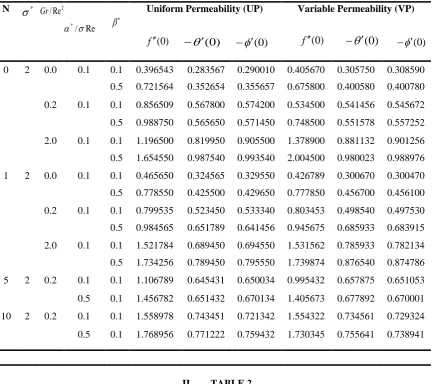
The paper emphasizes on the approximated results for the effects of second order resistance and variable fluid properties for the combined fluid flow study. Table 1 and 2, tabulates for velocity, temperatures and concentration for various non-dimensional parameters of physical problem considered. We observe that variable permeability dominates more when compared to uniform permeability due to second order resistance drag.
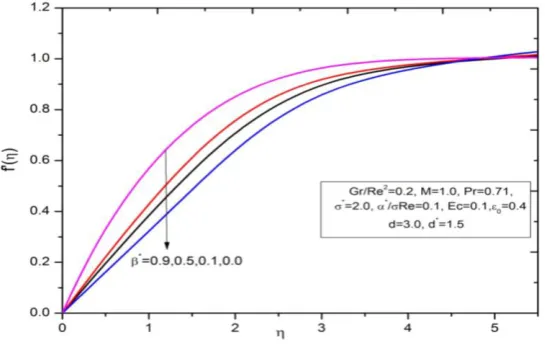
The graphical representations for different
*varying the permeability of transport process are shown in Figs 1 and 2. High resistance of the porous medium to the fluid flow leads to positive correlation in the velocity profile. The boundary layer thickness diminishes with increase *. The continuous decrease in temperature profile forhigher values of second order resistance is due to drag.
The profiles from Fig 3, reveals that upsurge in the value of N escalates the velocity profile, whereas negatively correlates with boundary layer. Energy and solutal profiles negatively correlates with rise in N within the boundary layer as shown in Figs 4 and 5 and gives the observation that cooling is faster for huge number of N.
Mixed convective flow behaviour is observed by the value of
Ri
in Figs 6,7 and 8. Significance in the boundarylayer is high with the rise of
Gr
Re
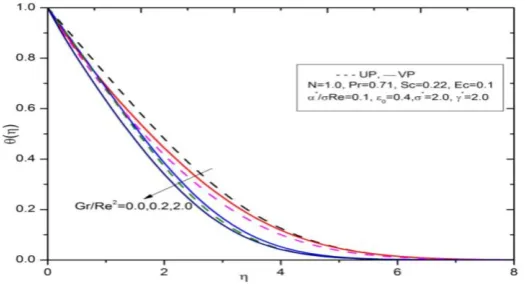
2. When the Richardson number takes the value 2.0 the effect of VP is more prominent as observed in velocity profiles and boundary layer decreases. Since free stream is directed upward, the temperature change currents induce the average speed to rise when heated plate is cooled. Illustrations of energy and solutal distributions, where the parameterGr
Re
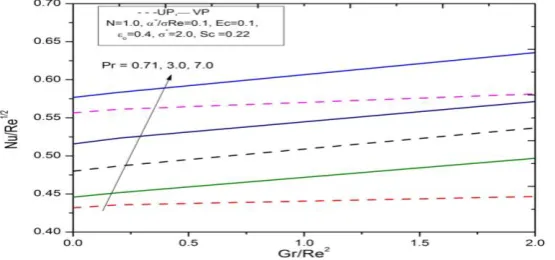
2enhances the surface heat and thickness of the boundary layer lowers leading to increase in wall temperature.Values of */Re is varied for velocity profiles and found varied fluid properties are less when compared to uniform as shown in Fig 9 this is due to high viscous forces arising because of low value of local permeability parameter and Reynolds number. Fig 10 depicts the variation of Nusselt number for different values of
2
Re /
Gr ,
*
and Pr. Higher the Prand
*
the number Nu increases, slowly uniforms as the parameterRi
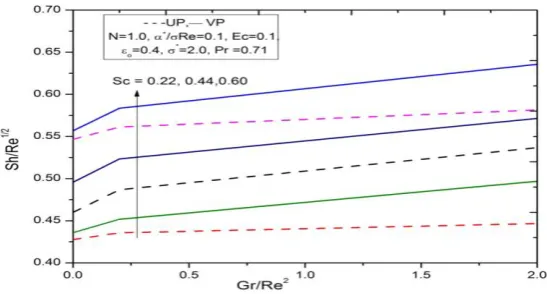
increases. Mass transfer behaviour is observed in Fig 11 for various values of Gr/Re2 and Schmidt number
.
Sc
With fixedSc
the mass transfer coefficient remains same after a slight increase initially for both UP and VP case. Increase in value ofSc
leads to higher mass transfer coefficient.V. CONCLUSIONS
In this article, a computational numerical analysis for Forcheimeir effect is discussed for transport processes and the following observations are made
The graph depicts that rate of cooling is faster with Forcheimeir drag by varying the fluid properties. Thermohaline convection for combined flow is more prominent due to drag and fluid properties. Prandtl number enhances the temperature. Schmidt number leads to higher mass transfer coefficient.
ISSN: 2231-5373
http://www.ijmttjournal.org
Page 199
2
Re /
Gr
) 0 (
(0) (0) (0)
(0)ACKNOWLEDGEMENT
The authors are grateful to research centres, Atria Institute of Technology and Ramaiah Institute of Technology Bengaluru, Karnataka, INDIA for their support and encouragement to carry out our research work.
I. TABLE I
Results for
f
(
0
),
-
(
0
)
and
-
(
0
)
for Uniform Permeability (UP) and Variable Permeability (VP) Cases for Various Fixed Parameters.II. TABLE 2
Values of Rate of Heat Transfer (Nu) and Mass Transfer (Sh)
(0)and-(0)
for UP and VPN
Uniform Permeability (UP) Variable Permeability (VP)
0 2 0.0 0.1 0.1 0.396543 0.283567 0.290010 0.405670 0.305750 0.308590
0.5 0.721564 0.352654 0.355657 0.675800 0.400580 0.400780
0.2 0.1 0.1 0.856509 0.567800 0.574200 0.534500 0.541456 0.545672
0.5 0.988750 0.565650 0.571450 0.748500 0.551578 0.557252
2.0 0.1 0.1 1.196500 0.819950 0.905500 1.378900 0.881132 0.901256
0.5 1.654550 0.987540 0.993540 2.004500 0.980023 0.988976
1 2 0.0 0.1 0.1 0.465650 0.324565 0.329550 0.426789 0.300670 0.300470
0.5 0.778550 0.425500 0.429650 0.777850 0.456700 0.456100
0.2 0.1 0.1 0.799535 0.523450 0.533340 0.803453 0.498540 0.497530
0.5 0.984565 0.651789 0.641456 0.945675 0.685933 0.683915
2.0 0.1 0.1 1.521784 0.689450 0.694550 1.531562 0.785933 0.782134
0.5 1.734256 0.789450 0.795550 1.739874 0.876540 0.874786
5 2 0.2 0.1 0.1 1.106789 0.645431 0.650034 0.995432 0.657875 0.651053
0.5 0.1 1.456782 0.651432 0.670134 1.405673 0.677892 0.670001
10 2 0.2 0.1 0.1 1.558978 0.743451 0.721342 1.554322 0.734561 0.729324
0.5 0.1 1.768956 0.771222 0.759432 1.730345 0.755641 0.738941
Pr = 0.71 Pr =3.0 Pr = 7.0 Sc = 0.22 Sc = 0.44 Sc = 0.60
UP VP UP VP UP VP UP VP UP VP UP VP
0.0 0.417
6
0.437 8
0.423 8
0.485 6
0.546 5
0.556 7
0.431 6
0.445 7
0.479 8
0.515 6
0.556
5 0.5767
0.2 0.436
5
0.461 6
0.506 7
0.543 4
0.561 2
0.583 4
0.435 6
0.451 6
0.486 7
0.523 4
0.561
2 0.5834
2.0 0.440
2
0.471 3
0.546 7
0.591 4
0.581 4
0.635 6
0.446 5
0.496 8
0.536 7
0.571 4
0.581
4 0.6356
2
Re /
Gr
Re /
*
*
) 0 (
ISSN: 2231-5373
http://www.ijmttjournal.org
Page 200
Cases for Different Values of Pr and Sc Respectively with Fixed Parameters.
Fig 1 Velocity profiles for different values of
*for VP caseFig 2 Temperature profiles for various values of
*for VP caseISSN: 2231-5373
http://www.ijmttjournal.org
Page 201
Fig 4 Temperature distributions for various values of buoyancy ratio N for VP caseFig 5 Concentration distribution for various values of buoyancy ratio N for VP case
Fig 6 Velocity distributions for various values of Gr/Re2 for both UP and VP cases
Fig 7 Temperature profiles for various values of 2
Re /
ISSN: 2231-5373
http://www.ijmttjournal.org
Page 202
Fig 8 Concentration profiles for various values of Gr/Re2for both UP and VP casesFig 9 Velocity profiles for different values of
*/
Refor both UP and VP cases
Fig 10 Velocity profiles for various values of Prandtl number for UP and VP cases
ISSN: 2231-5373
http://www.ijmttjournal.org
Page 203
Fig 12 Variations in local Sherwood number with Gr/Re2 for various values of Sc for UP and VP cases
REFERENCES
[1] Nield D A., “Onset of thermohaline convection in a porous medium”, Water Resources Res., Vol.4, 553-560 (1968).
[2] Rudraiah N., Srimani P.K., & Friedrich R., “Finite amplitude convection in a two component fluid saturated porous layer”, Int. J. Heat Mass Transfer, Vol.25, 715-722(1982).
[3] Mamou M., Vasseur P., Bilgen E., & Gobin D., “Double diffusive convection in an inclined slot filled with porous medium”, European Journal of Mechancis B/Fluids, Vol.14, 629-652(1995).
[4] Hooper W.B., Chen T.S., Armaly B.F., “Mixed convection from a vertical plate in porous media with surface injection or suction”, Numer. Heat Transfer, Part A, Vol.25, 317-329 (1994).
[5] Lai F.C., & Kulacki F A., “Coupled heat and mass transfer by natural convection from vertical surfaces in porous media”, Int. J. Heat Mass Transfer, Vol. 34, 1189-1194 (1991).
[6] Murthy P.V.S.N., & Singh P., “Heat and mass transfer by natural convection in a non-Darcy porous medium”, Acta Mechanica, Vol.138, 243-254(1999).
[7] Khaled A.R.A., & Chamkha A.J., “Variable porosity and thermal dispersion effects on coupled heat and mass transfer by natural convection from a surface embedded in a non-metallic porous medium”, Int. J. Numer. Meth. Heat Fluid Flow, Vol.11, 413-429 (2001).
[8] Rudraiah N., & Malashetty M.S., “The Influence of coupled molecular diffusion on double diffusive-convection in a porous medium”J. Heat Transfer, Vol.108, 872-876 (1986).
[9] Gebhart B., & Pera L., “The nature of vertical natural convection flows resulting from the combined buoyancy effects of thermal and mass diffusion”, International Journal of Heat Mass Transfer, Vol.14 (12), 2025-2050 (1971).
[10] Ranganathann P, & Viskanta, “Mixed convection boundary layer flow along a vertical surface in a porous medium”, Num. Heat Transfer, Vol.7, 305-317 (1984).
[11] Va fai K., & Kim S.J., “Analysis of natural convection about a vertical plate embedded in a porous Medium”, Int. J. Heat Mass Transfer, Vol. 32 (4), 665-677(1989).
[12] Hung C.I., & Chen C.B., “Non – Darcy free convection in a thermally stratified porous medium along a vertical plate with variable heat flux”, Heat and Mass Transfer, Vol.33, 101-107 (1997).
[13] Calmidi V.V., & Mahajan R.L., “Forced convection in high porosity metal foams”, ASME J. Heat Transfer Vol.122, 557-565 (2000). Vafai K., & Kim S.J., “Analysis of natural convection about a vertical plate embedded in a porous Medium”, Int. J. Heat Mass Transfer, Vol. 32 (4), 665-677(1989).
[14] Schwartz C.E., & Smith J.M., “Flow distribution in packed beds”, Ind. Eng. Chem., Vol.45, 1209-1218 (1953). [15] Benanati R.F., & Brosilow C.B., “Void fraction distribution in beds of spheres”, AIChe. J., Vol.8, 359- 361(1962). [16] Vafai K., “Convective flow and heat transfer in variable – porosity media”, J. Fluid Mech., Vol.147, 233-259 (1984).
[17] Chandrasekhara B.C., Namboodiri P.M.S., & Hanumanthappa A.R., “Similarity solutions of buoyancy induced flows in a saturated porous medium adjacent to impermeable horizontal surfaces”, Warme Stoffubertrag, Vol.18, 17-23 (1984).
[18] Chandrasekhara B.C., & Namboodiri P.M.S., “Influence of variable permeability on combined vertical surfaces in porous medium”, International Journal of Heat Mass Transfer, Vol.28, 199-206 (1985).
[19] Hong J.T., Yamada Y., & Tien C.L., “Effects on non–Darcian and non-uniform porosity on vertical plate natural convection in porous media”, International Journal of Heat Mass Transfer, Vol.109, 356-382 (1987).
[20] Mohammadein A.A., & El-Shaer N.A., “Influence of variable permeability on combined free and forced convection flow past a semi-infinite vertical plate in a saturated porous medium”, Heat Mass Transfer, Vol.40, 341-346 (2004).
[21] Pal D., & Shivakumara I S., “Mixed Convection heat transfer from a vertical heated plate embedded in a sparsely packed porous medium”, Int. J. Appl. Mech. Eng., Vol.11, 929-939 (2006).
[22] Dulal Pal., “Magnetohydrodynamic non-Darcy mixed convection heat transfer from a vertical heated plate embedded in a porous medium with variable porosity”, Commun. Nonlinear Sci. Numer. Simulat., Vol.15, 3974-3987 (2010).
[23] Nield D.A., & Bejan A., “Convection in porous medium”, 2nd ed., Springer-Verlag, New York (1999). [24] Nield D.A., & Bejan A., “Convection in porous media”, 3rd ed., Springer, New York, (2006). [25] Ingham D.B., & Pop I., “Transport phenomena in Porous medium”, Pergamon, Oxford (1998). [26] Ingham D.B., Pop I.(Eds), “Transport phenomena in Porous media”, Vol.III, Elsevier, Oxford (2005). [27] Vafai K., (Editor). Handbook of porous media. Marcel Dekker, New York. (2000).